What do you mean by Chromatography ?
Chromatography is essentially a group of techniques for the
separation of the compounds of mixtures by their continuous
distribution between two phases, one of which is mobile
phase and other is stationary phase.
Example: HPLC, GC
a) Mobile phase: They consist of water, organic solvent or
mixtures of organic solvents. They are continuously flown
‘like river water’ and carried samples.
b) Stationary phase: They consist of a large number of
particles like silica. They are constant in a place and the
separation occurs in this phase.
What is HPLC?
High-performance liquid chromatography is a
technique used to separate, identify,
detection and quantify each component in a
mixture.
Spectroscopy: It is the study of the interaction
between the matter and electromagnetic
radiation.
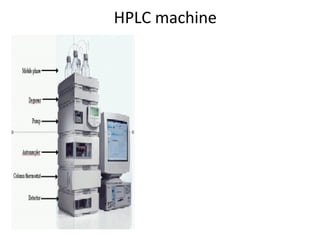
HPLC machine
What are the main function of
HPLC?
 Separation
Identification
Detection
Quantification
of the components dissolved in a liquid
solvent.
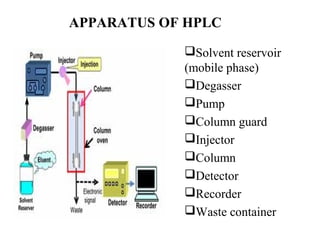
APPARATUS OF HPLC
Solvent reservoir
(mobile phase)
Degasser
Pump
Column guard
Injector
Column
Detector
Recorder
Waste container
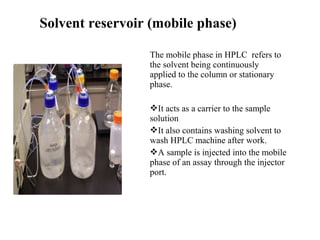
Solvent reservoir (mobile phase)
The mobile phase in HPLC refers to
the solvent being continuously
applied to the column or stationary
phase.
It acts as a carrier to the sample
solution
It also contains washing solvent to
wash HPLC machine after work.
A sample is injected into the mobile
phase of an assay through the injector
port.
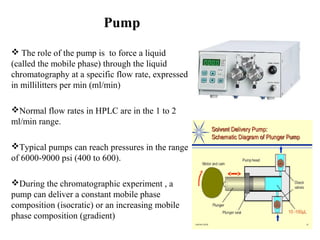
Pump
 The role of the pump is to force a liquid
(called the mobile phase) through the liquid
chromatography at a specific flow rate, expressed
in millilitters per min (ml/min)
Normal flow rates in HPLC are in the 1 to 2
ml/min range.
Typical pumps can reach pressures in the range
of 6000-9000 psi (400 to 600).
During the chromatographic experiment , a
pump can deliver a constant mobile phase
composition (isocratic) or an increasing mobile
phase composition (gradient)
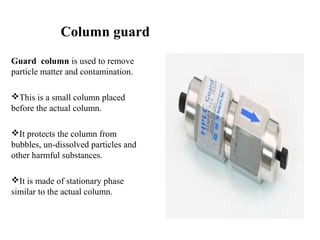
Column guard
Guard column is used to remove
particle matter and contamination.
This is a small column placed
before the actual column.
It protects the column from
bubbles, un-dissolved particles and
other harmful substances.
It is made of stationary phase
similar to the actual column.
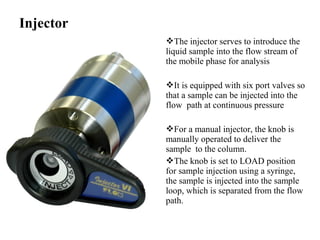
Injector
The injector serves to introduce the
liquid sample into the flow stream of
the mobile phase for analysis
It is equipped with six port valves so
that a sample can be injected into the
flow path at continuous pressure
For a manual injector, the knob is
manually operated to deliver the
sample to the column.
The knob is set to LOAD position
for sample injection using a syringe,
the sample is injected into the sample
loop, which is separated from the flow
path.
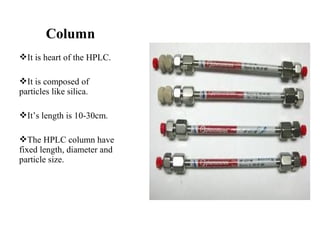
Column
It is heart of the HPLC.
It is composed of
particles like silica.
It’s length is 10-30cm.
The HPLC column have
fixed length, diameter and
particle size.
Column
Considered the ‘’Heart of the chromatography’’ the
column’s stationary phase separates the sample components of
interest using various physical and chemical parameters.
When samples are entered into the column, the components
of samples are adsorbed with adsorbent of stationary phase
according to the affinity between them.
The different sizes of column are available that we
can use as we need.
Column
The longer columns are used for the separation of
complex mixture with many components.
Similarly, shorter columns are used to separate less
complex mixture with less components.
It separates the components on the basis of polarity and
adsorbent.
Mechanism of column
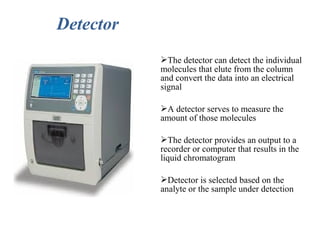
Detector
The detector can detect the individual
molecules that elute from the column
and convert the data into an electrical
signal
A detector serves to measure the
amount of those molecules
The detector provides an output to a
recorder or computer that results in the
liquid chromatogram
Detector is selected based on the
analyte or the sample under detection
Recorder
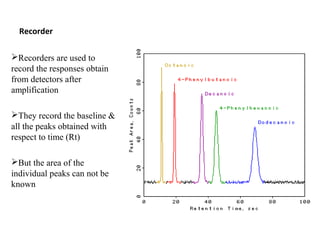
Recorders are used to
record the responses obtain
from detectors after
amplification
They record the baseline &
all the peaks obtained with
respect to time (Rt)
But the area of the
individual peaks can not be
known
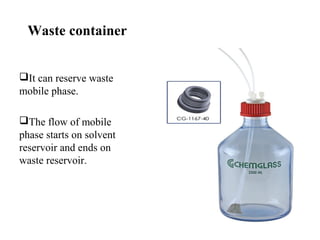
Waste container
It can reserve waste
mobile phase.
The flow of mobile
phase starts on solvent
reservoir and ends on
waste reservoir.
What is normal phase and reversed
phase chromatography?
In normal-phase chromatography the
stationary phase is polar and the mobile phase is
non-polar. Typical stationary phases for normal-
phase chromatography are silica.
In reversed-phase chromatography the
stationary phase is non-polar and the mobile
phase is polar.
Why is the reversed phase HPLC
more commonly used than normal
phase HPLC?
Reverse phase is easier to use than normal phase.
Reversed phase has a hydrophobic (non-polar) stationary phase
which can be applied to a wide range of molecules (samples).
It works well in retention time for most of the organic analytes. 70
to 80% of common analytes can be measured by reversed phase
HPLC.
What is HETP?
HETP: Height Equivalent to a Theoretical Plate.
HETP=L/n
Where
L= Length of column.
n= Number of particles that are
responsible for adsorption.
When the value of HETP is as much lower the
quality of the column is as much better.
Overall mechanism of HPLC
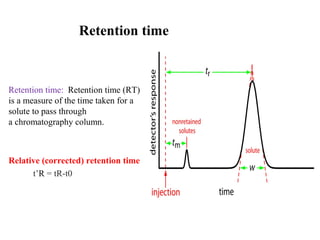
Retention time
Retention time: Retention time (RT)
is a measure of the time taken for a
solute to pass through
a chromatography column.
Relative (corrected) retention time
t’R = tR-t0
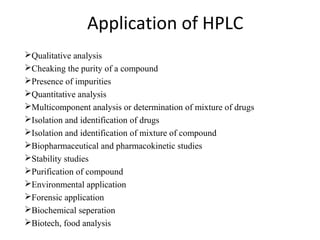
Application of HPLC
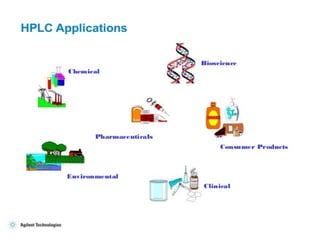
Qualitative analysis
Cheaking the purity of a compound
Presence of impurities
Quantitative analysis
Multicomponent analysis or determination of mixture of drugs
Isolation and identification of drugs
Isolation and identification of mixture of compound
Biopharmaceutical and pharmacokinetic studies
Stability studies
Purification of compound
Environmental application
Forensic application
Biochemical seperation
Biotech, food analysis
Advantages of HPLC
Separations fast and efficient (high resolution power)
Continuous monitoring of the column effluent
It can be applied to the separation and analysis of very complex
mixtures
Accurate quantitative measurements.
Repetitive and reproducible analysis using the same column.
Adsorption, partition, ion exchange and exclusion column separations
are excellently made.
 Both aqueous and non aqueous samples can be analyzed with little or no
sample pre treatment
 A variety of solvents and column packing are available, providing a
high degree of selectivity for specific analyses.
Disadvantages of HPLC
It is difficult to detect co elution (two compounds escaping from
the tubing at once) with HPLC, which may lead to inaccurate
compound categorization.
There is a high cost for equipment needed to conduct HPLC.
Its operation can be complex, requiring a trained technician to
operate. Because of the speed of the process, the equipment has low
sensitivity to some compounds.

HPLC Presentation by moun

  • 1.
    What do youmean by Chromatography ? Chromatography is essentially a group of techniques for the separation of the compounds of mixtures by their continuous distribution between two phases, one of which is mobile phase and other is stationary phase. Example: HPLC, GC a) Mobile phase: They consist of water, organic solvent or mixtures of organic solvents. They are continuously flown ‘like river water’ and carried samples. b) Stationary phase: They consist of a large number of particles like silica. They are constant in a place and the separation occurs in this phase.
  • 2.
    What is HPLC? High-performanceliquid chromatography is a technique used to separate, identify, detection and quantify each component in a mixture. Spectroscopy: It is the study of the interaction between the matter and electromagnetic radiation.
  • 3.
  • 4.
    What are themain function of HPLC?  Separation Identification Detection Quantification of the components dissolved in a liquid solvent.
  • 5.
    APPARATUS OF HPLC Solventreservoir (mobile phase) Degasser Pump Column guard Injector Column Detector Recorder Waste container
  • 6.
    Solvent reservoir (mobilephase) The mobile phase in HPLC refers to the solvent being continuously applied to the column or stationary phase. It acts as a carrier to the sample solution It also contains washing solvent to wash HPLC machine after work. A sample is injected into the mobile phase of an assay through the injector port.
  • 7.
    Pump  The roleof the pump is to force a liquid (called the mobile phase) through the liquid chromatography at a specific flow rate, expressed in millilitters per min (ml/min) Normal flow rates in HPLC are in the 1 to 2 ml/min range. Typical pumps can reach pressures in the range of 6000-9000 psi (400 to 600). During the chromatographic experiment , a pump can deliver a constant mobile phase composition (isocratic) or an increasing mobile phase composition (gradient)
  • 8.
    Column guard Guard columnis used to remove particle matter and contamination. This is a small column placed before the actual column. It protects the column from bubbles, un-dissolved particles and other harmful substances. It is made of stationary phase similar to the actual column.
  • 9.
    Injector The injector servesto introduce the liquid sample into the flow stream of the mobile phase for analysis It is equipped with six port valves so that a sample can be injected into the flow path at continuous pressure For a manual injector, the knob is manually operated to deliver the sample to the column. The knob is set to LOAD position for sample injection using a syringe, the sample is injected into the sample loop, which is separated from the flow path.
  • 10.
    Column It is heartof the HPLC. It is composed of particles like silica. It’s length is 10-30cm. The HPLC column have fixed length, diameter and particle size.
  • 11.
    Column Considered the ‘’Heartof the chromatography’’ the column’s stationary phase separates the sample components of interest using various physical and chemical parameters. When samples are entered into the column, the components of samples are adsorbed with adsorbent of stationary phase according to the affinity between them. The different sizes of column are available that we can use as we need.
  • 12.
    Column The longer columnsare used for the separation of complex mixture with many components. Similarly, shorter columns are used to separate less complex mixture with less components. It separates the components on the basis of polarity and adsorbent.
  • 13.
  • 14.
    Detector The detector candetect the individual molecules that elute from the column and convert the data into an electrical signal A detector serves to measure the amount of those molecules The detector provides an output to a recorder or computer that results in the liquid chromatogram Detector is selected based on the analyte or the sample under detection
  • 15.
    Recorder Recorders are usedto record the responses obtain from detectors after amplification They record the baseline & all the peaks obtained with respect to time (Rt) But the area of the individual peaks can not be known
  • 16.
    Waste container It canreserve waste mobile phase. The flow of mobile phase starts on solvent reservoir and ends on waste reservoir.
  • 17.
    What is normalphase and reversed phase chromatography? In normal-phase chromatography the stationary phase is polar and the mobile phase is non-polar. Typical stationary phases for normal- phase chromatography are silica. In reversed-phase chromatography the stationary phase is non-polar and the mobile phase is polar.
  • 18.
    Why is thereversed phase HPLC more commonly used than normal phase HPLC? Reverse phase is easier to use than normal phase. Reversed phase has a hydrophobic (non-polar) stationary phase which can be applied to a wide range of molecules (samples). It works well in retention time for most of the organic analytes. 70 to 80% of common analytes can be measured by reversed phase HPLC.
  • 20.
    What is HETP? HETP:Height Equivalent to a Theoretical Plate. HETP=L/n Where L= Length of column. n= Number of particles that are responsible for adsorption. When the value of HETP is as much lower the quality of the column is as much better.
  • 21.
  • 22.
    Retention time Retention time:Retention time (RT) is a measure of the time taken for a solute to pass through a chromatography column. Relative (corrected) retention time t’R = tR-t0
  • 23.
    Application of HPLC Qualitativeanalysis Cheaking the purity of a compound Presence of impurities Quantitative analysis Multicomponent analysis or determination of mixture of drugs Isolation and identification of drugs Isolation and identification of mixture of compound Biopharmaceutical and pharmacokinetic studies Stability studies Purification of compound Environmental application Forensic application Biochemical seperation Biotech, food analysis
  • 25.
    Advantages of HPLC Separationsfast and efficient (high resolution power) Continuous monitoring of the column effluent It can be applied to the separation and analysis of very complex mixtures Accurate quantitative measurements. Repetitive and reproducible analysis using the same column. Adsorption, partition, ion exchange and exclusion column separations are excellently made.  Both aqueous and non aqueous samples can be analyzed with little or no sample pre treatment  A variety of solvents and column packing are available, providing a high degree of selectivity for specific analyses.
  • 26.
    Disadvantages of HPLC Itis difficult to detect co elution (two compounds escaping from the tubing at once) with HPLC, which may lead to inaccurate compound categorization. There is a high cost for equipment needed to conduct HPLC. Its operation can be complex, requiring a trained technician to operate. Because of the speed of the process, the equipment has low sensitivity to some compounds.