Presentation on 
Presented to 
Sir M. AAMIR 
Presented by 
BS-BIOTECHNOLOGY-4th semester 
Group # 3
Group Members 
ʘ ZAHRA NAZ BS-BT-04 
ʘ FARAZ AHMAD BS-BT-11 
ʘ TOOBA MAQBOOL BS-BT-20 
ʘ EJAZ-ul-HASSAN BS-BT-27 
ʘ BUSHRA RAFIQUE BS-BT-18 
ʘ SHEEBA RAUF BS-BT-19 
ʘ FAIZA SHAUKAT BS-BT-23
INTRODUCTION TO CHROMATOGRAPHY 
by 
ZAHRA NAZ BS-BT-04
colour 
to write
CHROMATOGRAPHY 
The physical technique for separation of a mixture 
by distribution of its components between a 
mobile and stationary phase over time 
– mobile phase = solvent 
– stationary phase = column packing material
Invention of chromatography 
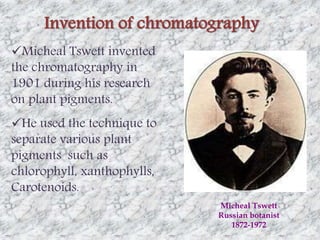
Micheal Tswett invented 
the chromatography in 
1901 during his research 
on plant pigments. 
He used the technique to 
separate various plant 
pigments such as 
chlorophyll, xanthophylls, 
Carotenoids. 
Micheal Tswett 
Russian botanist 
1872-1972
Milestones in Chromatography 
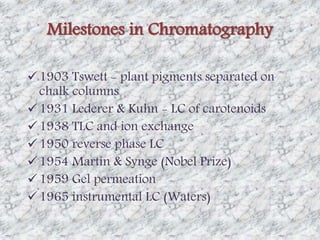
1903 Tswett - plant pigments separated on 
chalk columns 
1931 Lederer & Kuhn - LC of carotenoids 
1938 TLC and ion exchange 
1950 reverse phase LC 
1954 Martin & Synge (Nobel Prize) 
1959 Gel permeation 
1965 instrumental LC (Waters)
Purpose of Chromatography 
 Analytical - determine chemical composition of a 
sample 
 Preparative - purify and collect one or more 
components of a sample
Components of Chromatography 
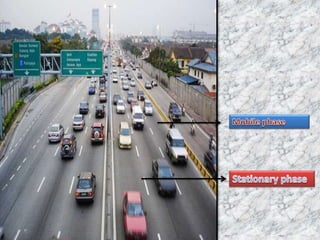
Mobile Phase – phase that carries the 
mixture of components through the 
stationary phase. 
E.g. gas, liquid 
Stationary Phase –phase that holds the 
components as they move through it & 
separates them. 
E.g. silica gel, aluminium oxide
ANALOGY…
Important definitions 
Analyte- the substance to be separated during 
chromatography 
Bonded phase-a stationary phase that is 
covalently bonded to the support particles 
Mobile phase -the phase that moves in a 
definite direction.(liquid/gas) 
Stationary phase-the substance fixed in place 
for the chromatography procedure
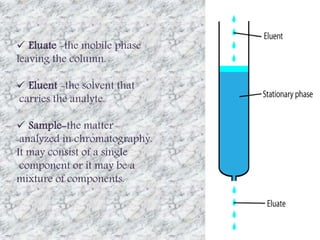
 Eluate -the mobile phase 
leaving the column. 
 Eluent -the solvent that 
carries the analyte. 
 Sample-the matter 
analyzed in chromatography. 
It may consist of a single 
component or it may be a 
mixture of components.
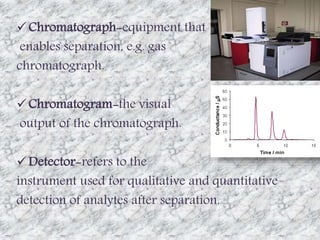
Chromatograph-equipment that 
enables separation, e.g. gas 
chromatograph. 
Chromatogram-the visual 
output of the chromatograph. 
Detector-refers to the 
instrument used for qualitative and quantitative 
detection of analytes after separation.
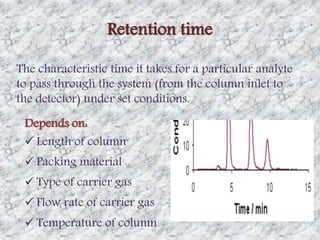
Retention time 
The characteristic time it takes for a particular analyte 
to pass through the system (from the column inlet to 
the detector) under set conditions. 
Depends on: 
 Length of column 
 Packing material 
 Type of carrier gas 
 Flow rate of carrier gas 
 Temperature of column
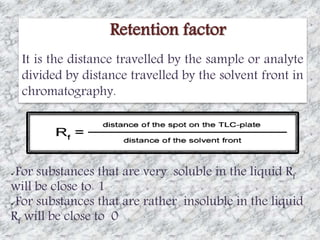
Retention RF VALUE 
factor 
It is the distance travelled by the sample or analyte 
divided by distance travelled by the solvent front in 
chromatography. 
For substances that are very soluble in the liquid Rf will be close to 1 
For substances that are rather insoluble in the liquid 
Rf will be close to 0
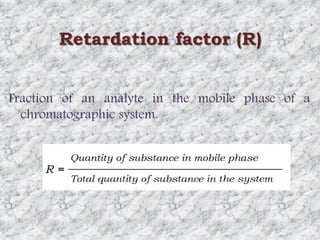
Retardation factor (R) 
Fraction of an analyte in the mobile phase of a 
chromatographic system.
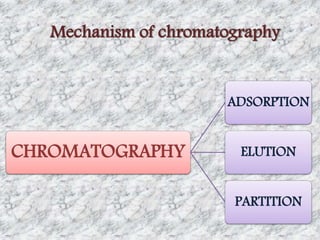
Mechanism of chromatography 
CHROMATOGRAPHY 
ADSORPTION 
ELUTION 
PARTITION
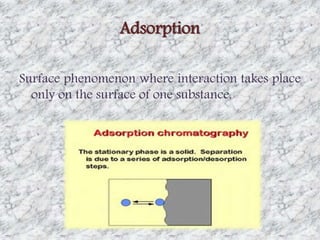
Adsorption 
Surface phenomenon where interaction takes place 
only on the surface of one substance.
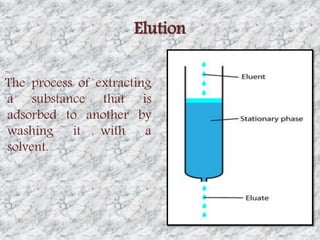
Elution 
The process of extracting 
a substance that is 
adsorbed to another by 
washing it with a 
solvent.
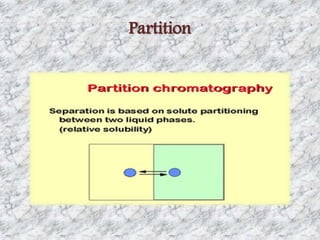
Partition
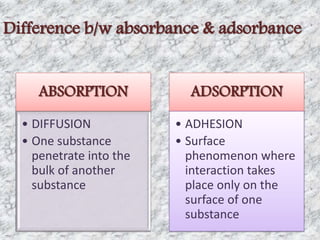
Difference b/w absorbance & adsorbance 
ABSORPTION 
• DIFFUSION 
• One substance 
penetrate into the 
bulk of another 
substance 
ADSORPTION 
• ADHESION 
• Surface 
phenomenon where 
interaction takes 
place only on the 
surface of one 
substance
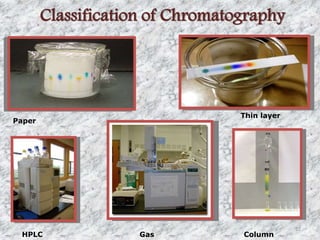
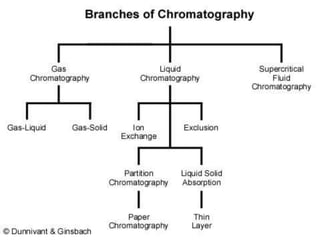
Classification of Chromatography 
22 
Paper 
HPLC Gas 
Thin layer 
Column
According to separation mode 
a) Adsorption chromatography 
b) Partition chromatography 
c) Ion-exchange chromatography 
d) Size exclusion chromatography 
e) Affinity chromatography
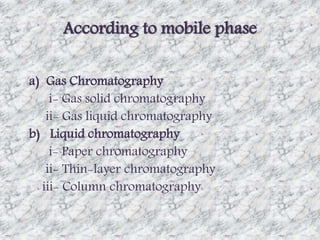
According to mobile phase 
a) Gas Chromatography 
i- Gas solid chromatography 
ii- Gas liquid chromatography 
b) Liquid chromatography 
i- Paper chromatography 
ii- Thin-layer chromatography 
iii- Column chromatography
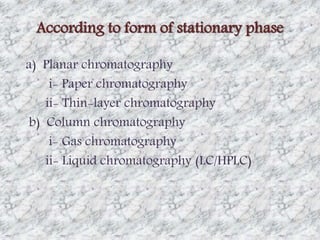
According to form of stationary phase 
a) Planar chromatography 
i- Paper chromatography 
ii- Thin-layer chromatography 
b) Column chromatography 
i- Gas chromatography 
ii- Liquid chromatography (LC/HPLC)
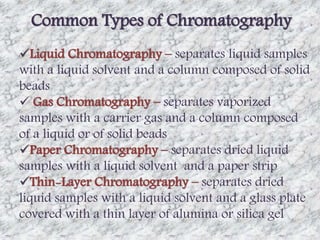
Common Types of Chromatography 
Liquid Chromatography – separates liquid samples 
with a liquid solvent and a column composed of solid 
beads 
 Gas Chromatography – separates vaporized 
samples with a carrier gas and a column composed 
of a liquid or of solid beads 
Paper Chromatography – separates dried liquid 
samples with a liquid solvent and a paper strip 
Thin-Layer Chromatography – separates dried 
liquid samples with a liquid solvent and a glass plate 
covered with a thin layer of alumina or silica gel
Uses for Chromatography 
Pharmaceutical Company 
Hospital 
Law Enforcement 
Environmental Agency 
Manufacturing Plant 
Separating mixtures of compounds 
Identifying unknown compounds 
Establishing the purity or concentration of 
compounds 
Monitoring product formation in the pharmaceutical 
and biotechnology industries
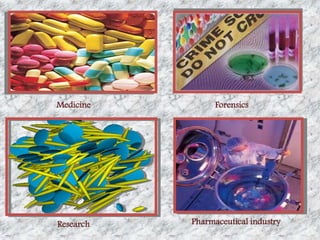
Forensics 
Medicine 
Research Pharmaceutical industry

Chromatography

  • 1.
    Presentation on Presentedto Sir M. AAMIR Presented by BS-BIOTECHNOLOGY-4th semester Group # 3
  • 2.
    Group Members ʘZAHRA NAZ BS-BT-04 ʘ FARAZ AHMAD BS-BT-11 ʘ TOOBA MAQBOOL BS-BT-20 ʘ EJAZ-ul-HASSAN BS-BT-27 ʘ BUSHRA RAFIQUE BS-BT-18 ʘ SHEEBA RAUF BS-BT-19 ʘ FAIZA SHAUKAT BS-BT-23
  • 3.
    INTRODUCTION TO CHROMATOGRAPHY by ZAHRA NAZ BS-BT-04
  • 4.
  • 5.
    CHROMATOGRAPHY The physicaltechnique for separation of a mixture by distribution of its components between a mobile and stationary phase over time – mobile phase = solvent – stationary phase = column packing material
  • 6.
    Invention of chromatography Micheal Tswett invented the chromatography in 1901 during his research on plant pigments. He used the technique to separate various plant pigments such as chlorophyll, xanthophylls, Carotenoids. Micheal Tswett Russian botanist 1872-1972
  • 7.
    Milestones in Chromatography 1903 Tswett - plant pigments separated on chalk columns 1931 Lederer & Kuhn - LC of carotenoids 1938 TLC and ion exchange 1950 reverse phase LC 1954 Martin & Synge (Nobel Prize) 1959 Gel permeation 1965 instrumental LC (Waters)
  • 8.
    Purpose of Chromatography  Analytical - determine chemical composition of a sample  Preparative - purify and collect one or more components of a sample
  • 9.
    Components of Chromatography Mobile Phase – phase that carries the mixture of components through the stationary phase. E.g. gas, liquid Stationary Phase –phase that holds the components as they move through it & separates them. E.g. silica gel, aluminium oxide
  • 10.
  • 11.
    Important definitions Analyte-the substance to be separated during chromatography Bonded phase-a stationary phase that is covalently bonded to the support particles Mobile phase -the phase that moves in a definite direction.(liquid/gas) Stationary phase-the substance fixed in place for the chromatography procedure
  • 12.
     Eluate -themobile phase leaving the column.  Eluent -the solvent that carries the analyte.  Sample-the matter analyzed in chromatography. It may consist of a single component or it may be a mixture of components.
  • 13.
    Chromatograph-equipment that enablesseparation, e.g. gas chromatograph. Chromatogram-the visual output of the chromatograph. Detector-refers to the instrument used for qualitative and quantitative detection of analytes after separation.
  • 14.
    Retention time Thecharacteristic time it takes for a particular analyte to pass through the system (from the column inlet to the detector) under set conditions. Depends on:  Length of column  Packing material  Type of carrier gas  Flow rate of carrier gas  Temperature of column
  • 15.
    Retention RF VALUE factor It is the distance travelled by the sample or analyte divided by distance travelled by the solvent front in chromatography. For substances that are very soluble in the liquid Rf will be close to 1 For substances that are rather insoluble in the liquid Rf will be close to 0
  • 16.
    Retardation factor (R) Fraction of an analyte in the mobile phase of a chromatographic system.
  • 17.
    Mechanism of chromatography CHROMATOGRAPHY ADSORPTION ELUTION PARTITION
  • 18.
    Adsorption Surface phenomenonwhere interaction takes place only on the surface of one substance.
  • 19.
    Elution The processof extracting a substance that is adsorbed to another by washing it with a solvent.
  • 20.
  • 21.
    Difference b/w absorbance& adsorbance ABSORPTION • DIFFUSION • One substance penetrate into the bulk of another substance ADSORPTION • ADHESION • Surface phenomenon where interaction takes place only on the surface of one substance
  • 22.
    Classification of Chromatography 22 Paper HPLC Gas Thin layer Column
  • 23.
    According to separationmode a) Adsorption chromatography b) Partition chromatography c) Ion-exchange chromatography d) Size exclusion chromatography e) Affinity chromatography
  • 24.
    According to mobilephase a) Gas Chromatography i- Gas solid chromatography ii- Gas liquid chromatography b) Liquid chromatography i- Paper chromatography ii- Thin-layer chromatography iii- Column chromatography
  • 25.
    According to formof stationary phase a) Planar chromatography i- Paper chromatography ii- Thin-layer chromatography b) Column chromatography i- Gas chromatography ii- Liquid chromatography (LC/HPLC)
  • 27.
    Common Types ofChromatography Liquid Chromatography – separates liquid samples with a liquid solvent and a column composed of solid beads  Gas Chromatography – separates vaporized samples with a carrier gas and a column composed of a liquid or of solid beads Paper Chromatography – separates dried liquid samples with a liquid solvent and a paper strip Thin-Layer Chromatography – separates dried liquid samples with a liquid solvent and a glass plate covered with a thin layer of alumina or silica gel
  • 28.
    Uses for Chromatography Pharmaceutical Company Hospital Law Enforcement Environmental Agency Manufacturing Plant Separating mixtures of compounds Identifying unknown compounds Establishing the purity or concentration of compounds Monitoring product formation in the pharmaceutical and biotechnology industries
  • 29.
    Forensics Medicine ResearchPharmaceutical industry