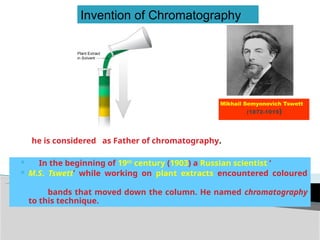
Mikhail Semyonovich Tswett
(1872-1919)
In the beginning of 19th
century (1903) a Russian scientist ‘
M.S. Tswett’ while working on plant extracts encountered coloured
bands that moved down the column. He named chromatography
to this technique.
Invention of Chromatography
he is considered as Father of chromatography.
4.
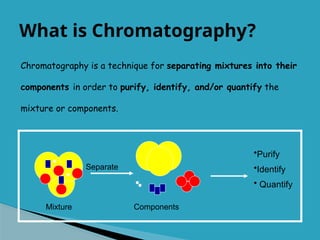
What is Chromatography?
Chromatographyis a technique for separating mixtures into their
components in order to purify, identify, and/or quantify the
mixture or components.
Separate
•Purify
•Identify
• Quantify
Components
Mixture
5.
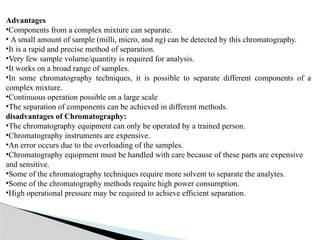
Advantages
•Components from acomplex mixture can separate.
• A small amount of sample (milli, micro, and ng) can be detected by this chromatography.
•It is a rapid and precise method of separation.
•Very few sample volume/quantity is required for analysis.
•It works on a broad range of samples.
•In some chromatography techniques, it is possible to separate different components of a
complex mixture.
•Continuous operation possible on a large scale
•The separation of components can be achieved in different methods.
disadvantages of Chromatography:
•The chromatography equipment can only be operated by a trained person.
•Chromatography instruments are expensive.
•An error occurs due to the overloading of the samples.
•Chromatography equipment must be handled with care because of these parts are expensive
and sensitive.
•Some of the chromatography techniques require more solvent to separate the analytes.
•Some of the chromatography methods require high power consumption.
•High operational pressure may be required to achieve efficient separation.
6.
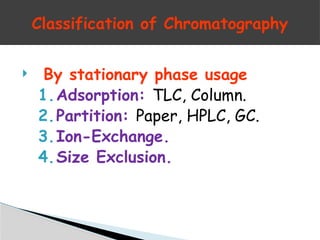
By stationaryphase usage
1.Adsorption: TLC, Column.
2.Partition: Paper, HPLC, GC.
3.Ion-Exchange.
4.Size Exclusion.
Classification of Chromatography
7.
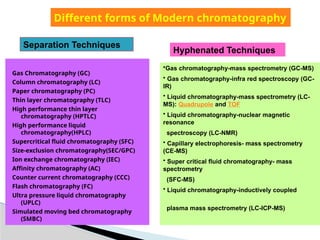
•Gas chromatography-mass spectrometry(GC-MS)
• Gas chromatography-infra red spectroscopy (GC-
IR)
• Liquid chromatography-mass spectrometry (LC-
MS): Quadrupole and TOF
• Liquid chromatography-nuclear magnetic
resonance
spectroscopy (LC-NMR)
• Capillary electrophoresis- mass spectrometry
(CE-MS)
• Super critical fluid chromatography- mass
spectrometry
(SFC-MS)
• Liquid chromatography-inductively coupled
plasma mass spectrometry (LC-ICP-MS)
Gas Chromatography (GC)
Column chromatography (LC)
Paper chromatography (PC)
Thin layer chromatography (TLC)
High performance thin layer
chromatography (HPTLC)
High performance liquid
chromatography(HPLC)
Supercritical fluid chromatography (SFC)
Size-exclusion chromatography(SEC/GPC)
Ion exchange chromatography (IEC)
Affinity chromatography (AC)
Counter current chromatography (CCC)
Flash chromatography (FC)
Ultra pressure liquid chromatography
(UPLC)
Simulated moving bed chromatography
(SMBC)
Different forms of Modern chromatography
Hyphenated Techniques
Separation Techniques
8.
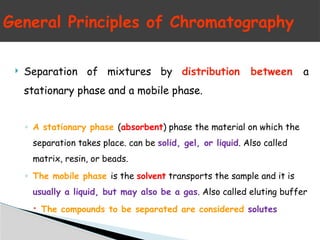
General Principles ofChromatography
Separation of mixtures by distribution between a
stationary phase and a mobile phase.
◦ A stationary phase (absorbent) phase the material on which the
separation takes place. can be solid, gel, or liquid. Also called
matrix, resin, or beads.
◦ The mobile phase is the solvent transports the sample and it is
usually a liquid, but may also be a gas. Also called eluting buffer
The compounds to be separated are considered solutes
9.
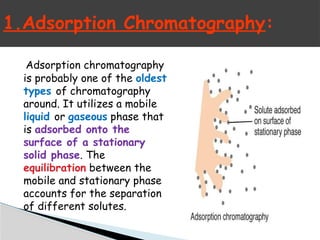
Adsorption chromatography
is probablyone of the oldest
types of chromatography
around. It utilizes a mobile
liquid or gaseous phase that
is adsorbed onto the
surface of a stationary
solid phase. The
equilibration between the
mobile and stationary phase
accounts for the separation
of different solutes.
1.Adsorption Chromatography:
10.
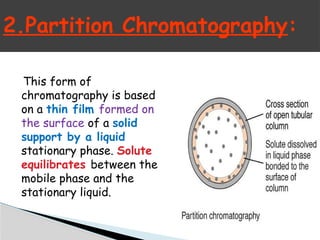
This form of
chromatographyis based
on a thin film formed on
the surface of a solid
support by a liquid
stationary phase. Solute
equilibrates between the
mobile phase and the
stationary liquid.
2.Partition Chromatography:
11.
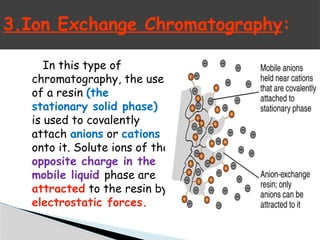
In this typeof
chromatography, the use
of a resin (the
stationary solid phase)
is used to covalently
attach anions or cations
onto it. Solute ions of the
opposite charge in the
mobile liquid phase are
attracted to the resin by
electrostatic forces.
3.Ion Exchange Chromatography:
12.
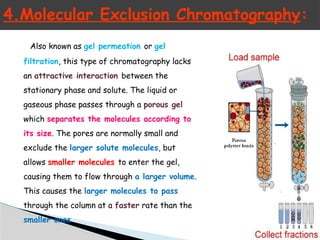
Also known asgel permeation or gel
filtration, this type of chromatography lacks
an attractive interaction between the
stationary phase and solute. The liquid or
gaseous phase passes through a porous gel
which separates the molecules according to
its size. The pores are normally small and
exclude the larger solute molecules, but
allows smaller molecules to enter the gel,
causing them to flow through a larger volume.
This causes the larger molecules to pass
through the column at a faster rate than the
smaller ones.
4.Molecular Exclusion Chromatography:
13.
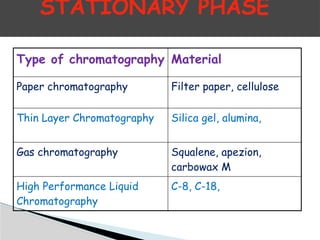
STATIONARY PHASE
Type ofchromatography Material
Paper chromatography Filter paper, cellulose
Thin Layer Chromatography Silica gel, alumina,
Gas chromatography Squalene, apezion,
carbowax M
High Performance Liquid
Chromatography
C-8, C-18,
14.
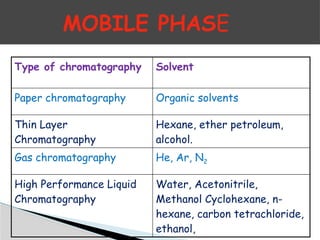
Type of chromatographySolvent
Paper chromatography Organic solvents
Thin Layer
Chromatography
Hexane, ether petroleum,
alcohol.
Gas chromatography He, Ar, N2
High Performance Liquid
Chromatography
Water, Acetonitrile,
Methanol Cyclohexane, n-
hexane, carbon tetrachloride,
ethanol,
MOBILE PHASE
15.
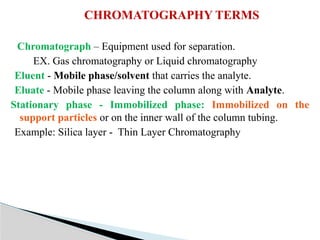
Chromatograph – Equipmentused for separation.
EX. Gas chromatography or Liquid chromatography
Eluent - Mobile phase/solvent that carries the analyte.
Eluate - Mobile phase leaving the column along with Analyte.
Stationary phase - Immobilized phase: Immobilized on the
support particles or on the inner wall of the column tubing.
Example: Silica layer - Thin Layer Chromatography
CHROMATOGRAPHY TERMS
16.
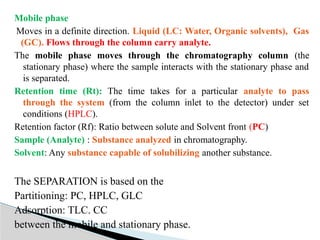
Mobile phase
Moves ina definite direction. Liquid (LC: Water, Organic solvents), Gas
(GC). Flows through the column carry analyte.
The mobile phase moves through the chromatography column (the
stationary phase) where the sample interacts with the stationary phase and
is separated.
Retention time (Rt): The time takes for a particular analyte to pass
through the system (from the column inlet to the detector) under set
conditions (HPLC).
Retention factor (Rf): Ratio between solute and Solvent front (PC)
Sample (Analyte) : Substance analyzed in chromatography.
Solvent: Any substance capable of solubilizing another substance.
The SEPARATION is based on the
Partitioning: PC, HPLC, GLC
Adsorption: TLC. CC
between the mobile and stationary phase.
17.
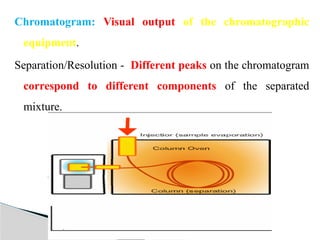
Chromatogram: Visual outputof the chromatographic
equipment.
Separation/Resolution - Different peaks on the chromatogram
correspond to different components of the separated
mixture.
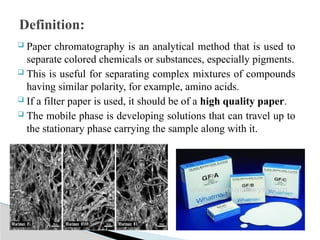
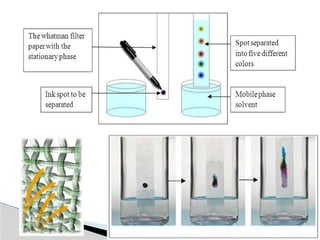
Paper chromatographyis an analytical method that is used to
separate colored chemicals or substances, especially pigments.
This is useful for separating complex mixtures of compounds
having similar polarity, for example, amino acids.
If a filter paper is used, it should be of a high quality paper.
The mobile phase is developing solutions that can travel up to
the stationary phase carrying the sample along with it.
Definition:
20.
The principleinvolved is partition chromatography where in
the substances are distributed or partitioned between two
liquid phases.
One phase is the water which is held in the pores of filter
paper (stationary phase) used and the other phase is that of
the mobile phase which moves over the paper.
The compounds in the mixture get separated due to
differences in their affinity towards water (in the stationary
phase) and mobile phase solvents during the movement of the
mobile phase under the capillary action of pores in the
paper.
Principle:
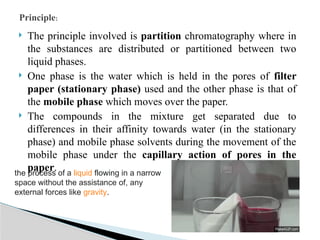
the process of a liquid flowing in a narrow
space without the assistance of, any
external forces like gravity.
22.
1. Descending paperchromatography.
2. Ascending paper chromatography.
3. Ascending and descending paper chromatography.
4. Radial paper chromatography or circular chromatography.
5. Two dimensional paper chromatography.
Types of paper chromatography
23.
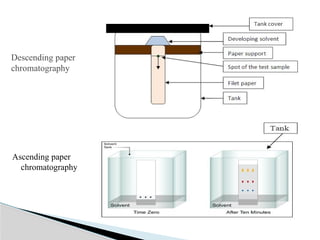
1.Descending Paper Chromatography-Inthis type,
development of the chromatogram is done by allowing the
solvent to travel down the paper is called Descending
Chromatography. Here, the mobile phase is present in the
upper portion.
2. Ascending Paper Chromatography-Here the solvent travel
upward direction of the Chromatographic paper. Both the
Descending and Ascending Paper Chromatography are used
for separation of Organic and Inorganic substances.
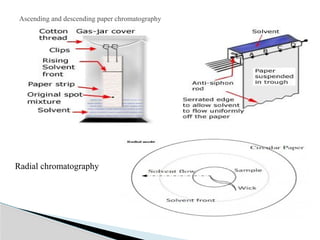
3. Ascending-Descending PaperChromatography-It is the
hybrid of both the above techniques. The upper part of the
Ascending chromatography can be folded over a rod and
allowing the paper to become descending after crossing the
rod.
4. Radial Paper Chromatography-It is also called as Circular
chromatography. Here a circular filter paper is taken and the
sample is spotted at the center of the paper. After drying the
spot the filter paper is tied horizontally on a Petri dish
containing solvent. So that Wick of the paper is dipped inside
the solvent. The solvent rises through the wick and the
component get separated in form of concentrate circular zone.
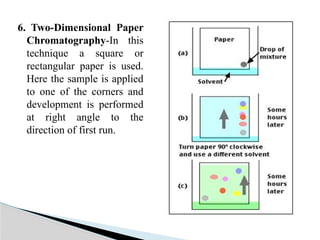
6. Two-Dimensional Paper
Chromatography-Inthis
technique a square or
rectangular paper is used.
Here the sample is applied
to one of the corners and
development is performed
at right angle to the
direction of first run.
28.
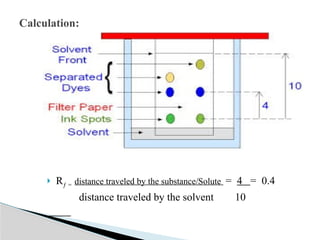
The retentionfactor (Rƒ) may be defined as the ratio of the
distance traveled by the substance to the distance traveled by the
solvent. Rƒ values are usually expressed as a fraction of two
decimal places.
If Rƒ value of a solution is zero, the solute remains in the
stationary phase and thus it is immobile.
If Rƒ value = 1 then the solute has no affinity for the stationary
phase and travels with the solvent front.
To calculate the Rƒ value, take the distance traveled by the
substance divided by the distance traveled by the solvent (as
mentioned earlier in terms of ratios).
Retention factor value (Rƒ):
29.
Rƒ =distance traveled by the substance/Solute = 4 = 0.4
distance traveled by the solvent 10
Calculation:
30.
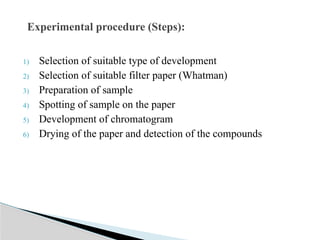
1) Selection ofsuitable type of development
2) Selection of suitable filter paper (Whatman)
3) Preparation of sample
4) Spotting of sample on the paper
5) Development of chromatogram
6) Drying of the paper and detection of the compounds
Experimental procedure (Steps):
31.
The experimental methodinvolves
1.Selection of suitable type of development: This depends on
complexity of the mixture, solvent, paper etc. But in general
ascending type or radial type of chromatography are used as
they are easy to perform, handle, less time consuming and
also give chromatogram faster.
2.Selection of suitable filter paper: Filter paper is selected
based on pore size, quality of the sample to be separated and
also mode of development.
Experimental procedure
32.
3.Preparation of sample:Preparation of sample involves
dissolution of sample in suitable solvent used in making
mobile phase. The solvent used should be inert with the
sample under analysis.
4.Spotting of sample on the paper. Samples are to be spotted at
proper position on the paper using preferably a capillary tube.
33.
5.Development of chromatogram:Sample spotted paper is
subjected to development by immersing it in the mobile phase.
The mobile phase moves over the sample on the paper under
the capillary action of paper.
6.Drying of the paper and detection of the compounds : Once
the development of chromatogram is over, The paper is held
carefully at the borders so as to avoid touching the sample
spots and dried using an air drier. Sometimes the detecting
solution is sprayed in the developed paper and dried to
identify the sample chromatogram spots.
34.
Visualizing Agent:-
After development of chromatogram the spot should be visualized. It can
done by two Method
A. Nonspecific methods
B. Specific methods
A. Nonspecific methods :- where the number of spot can be detected but
not the exact nature or type of compound
Example
1. Iodine chamber method :- where brown or Amber spots are observed
when the TLC plates are kept in a tank with few iodine crystal at the
bottom.
2. UV chamber for fluorescent compound :- when compound are viewed
under UV chamber at 254 nm or at 365 nm fluorescent compound can be
detected.
B. Specific methods :-
Specific spray reagents or detecting agent or visualising agent are used to
find out the nature of compound.
Example
1. Ferric chloride – for phenolic compound and tannins
DETECTING OR VISUALISING AGENTS
35.
Paper chromatographyis specially used for the separation of
mixtures having polar and nonpolar compounds in plant
mixtures.
For separation of Proteins, peptides, NA, amino acids.
It is used to determine organic compounds, and biochemicals
in biological samples (Plasma, urine).
In the pharma sector for separation of determination of drugs.
Applications:
36.
Prepare solutionof 0.1g/100ml each of valine, threonine, glycine, crystine
and isoleucine.
8×10 inch sheet of Whatmann filter paper No.1 and place six equally spaced
small circles with a pencil, 0.5 inch from the bottom.
Label the paper at the top with the name of each amino acid and label the
sixth unknown(for an unknown mixture of acids).
Place small drops of an amino acid on one circle and dry it carefully over the
plate between each drop application.
Now curl or roll the paper sheet into cylindrical form and put it into the jar
or beaker containing a mixture of 95% ethyl alcohol and 5% water to a depth
of about 0.25 inch and cover the beaker with a lid or watch glass.
That the paper does not touch the sides of the beaker.
The top and bottom of the paper are stapled.
Ex: Separation of amino acids by paper chromatography
37.
Now allowthe eluting agent to rise about 6 inch.
Its takes about 3 hours.
Then remove the paper from the beaker and immediately mark the solvent
front position with the help of pencil.
The chromatogram is dried and then sprayed with 0.25% ninhydrin
solution in water saturated with butyl alcohol.
Now allow chromatogram to dry in an oven for few minutes at about 100-
105 c until color spots develop.
The different amino acids appear as blue like spots.
Calculate the Rƒ values of the amino acids.
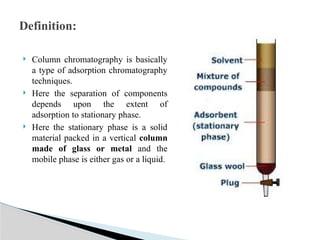
Column chromatographyis basically
a type of adsorption chromatography
techniques.
Here the separation of components
depends upon the extent of
adsorption to stationary phase.
Here the stationary phase is a solid
material packed in a vertical column
made of glass or metal and the
mobile phase is either gas or a liquid.
Definition:
40.
When amixture of mobile phase and sample to be separated
are introduced from top of the column, the individual
components of mixture move with different rates.
Those with lower adsorption/affinity to the stationary
phase move faster and eluted out first while those with
greater adsorption/affinity move or travel slower and get
eluted out last.
The solute molecules adsorb to the column in a reversible
manner. The rate of the movement of the components is given
as follows
Principle:
41.
Adsorbents:
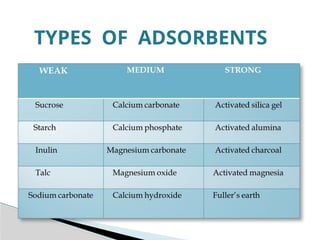
The usualadsorbents employed in column
chromatography are silica, alumina, calcium carbonate,
calcium phosphate, magnesia, starch, etc.,
Alumina is generally suitable for chromatography of less
polar compounds.
Silica gel gives good results with compounds containing
polar functional groups.
Experimental aspects:
42.
Particles shouldbe spherical in shape & uniform in size.
Mechanical stability must be high.
They shouldn’t react chemically.
It should be useful for separating for wide variety of
compounds.
It should be freely available & inexpensive (The particle size
of the commercially available grade is in the range 50 – 200
µm.)
Adsorbent in column chromatography should
meet following criteria:
43.
Success ofchromatography depends upon proper selection of
Stationary phase, it depends on the following:
Removal of impurities.
Number of components to be separated.
Length of the column used.
Affinity differences between components.
Quantity of adsorbent used.
Selection of stationary phase:
COLUMN CHROMATOGRAPHY
Experimentalaspects of column
chromatography:
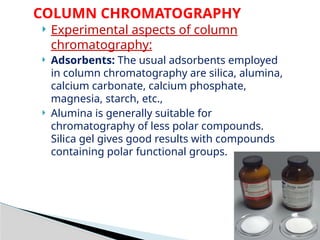
Adsorbents: The usual adsorbents employed
in column chromatography are silica, alumina,
calcium carbonate, calcium phosphate,
magnesia, starch, etc.,
Alumina is generally suitable for
chromatography of less polar compounds.
Silica gel gives good results with compounds
containing polar functional groups.
46.
Silica gel
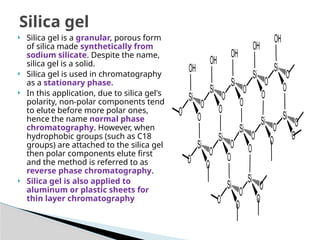
Silicagel is a granular, porous form
of silica made synthetically from
sodium silicate. Despite the name,
silica gel is a solid.
Silica gel is used in chromatography
as a stationary phase.
In this application, due to silica gel's
polarity, non-polar components tend
to elute before more polar ones,
hence the name normal phase
chromatography. However, when
hydrophobic groups (such as C18
groups) are attached to the silica gel
then polar components elute first
and the method is referred to as
reverse phase chromatography.
Silica gel is also applied to
aluminum or plastic sheets for
thin layer chromatography
OH
Si
O
OH
Si
O
O
O
OH
Si
O
O
OH
Si
O
O
OH
Si
O O
O
Si
O
O
Si
O
O
Si
O
O
Si
O O
O
Si
O
O
Si
O
O
Si
O O
O
47.
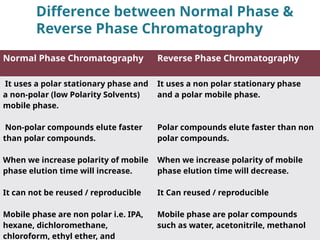
Difference between NormalPhase &
Reverse Phase Chromatography
Normal Phase Chromatography Reverse Phase Chromatography
It uses a polar stationary phase and
a non-polar (low Polarity Solvents)
mobile phase.
Non-polar compounds elute faster
than polar compounds.
When we increase polarity of mobile
phase elution time will increase.
It can not be reused / reproducible
Mobile phase are non polar i.e. IPA,
hexane, dichloromethane,
chloroform, ethyl ether, and
It uses a non polar stationary phase
and a polar mobile phase.
Polar compounds elute faster than non
polar compounds.
When we increase polarity of mobile
phase elution time will decrease.
It Can reused / reproducible
Mobile phase are polar compounds
such as water, acetonitrile, methanol
48.
They actas solvent, developer & eluent. The function of a
mobile phase are:
As developing agent.
To introduce the mixture into the column – as solvent.
To developing agent.
To remove pure components out of the column – as eluent.
Selection of mobile phase:
The choice of the solvent is depend on the solubility
characteristics of the mixture.
The solvents should also have sufficiently low boiling point to
permit the ready recovery of eluted material.
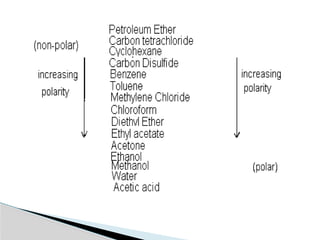
However, polarity as seen the most important factor in
adsorption chromatography.
It can be used in either pure form or as mixture of solvents
51.
The mainfunction of all the columns is to support the stationary
phase.
The material of the column is mostly good quality neutral glass
since it shouldn’t be affected by solvents. An ordinary burette can
also be used as column for separation.
Column dimensions - length & diameter ratio (10:1,30:1 or
100:1cm)
Various accessories are attached to the top and bottom of the
column for maintenance of the elution process.
A
Column characteristics:
52.
The lengthof the column depends upon:
Number of compounds to be separated.
Type of adsorbent used.
Quantity of the sample.
Affinity of compounds towards the adsorbent used.
Better separation will be obtained with a long narrow column
than short thick column because number of plates will be
more.
53.
It consistsof a glass tube with bottom portion of the
column – packed with glass wool/cotton wool or may
contain asbestos pad.
Above which adsorbent is packed.
After packing a paper disc kept on the top, so that the
adsorbent layer is not disturbed during the introduction of
sample or mobile phase.
Demerit: Air bubbles are entrapped between Mobile phase.
Preparation of the column:
There are two types of preparing/packing the column, they are:
1. Dry packing / dry filling.
2. Wet packing / wet filling.
54.
Column chromatographyDry Packing Technique:
The Stationary phase cracks appear in the adsorbent layer.
After filling tapping can be done to remove void spaces.
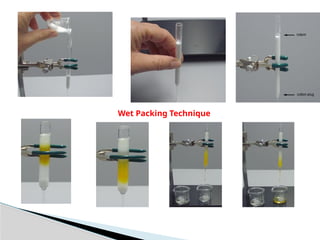
Column chromatography wet packing technique:
Ideal & common technique.
The material is slurred with solvent and generally added to the
column in portions.
Stationary phase settles uniformly and no crack in the column
of adsorbent.
Solid settle down while the solvent remain upward.
This solvent is removed then again cotton plug is placed.
55.
Dry Packing Technique
Adsorbent is packed in the column in dry form
Fill the solvent, till equilibrium is reached
DEMERIT: Air bubbles are entrapped b/w M.P & S.P→
cracks appear in the adsorbent layer.
After filling tapping can be done to remove void
spaces.
57.
Wet Packing Technique
»ideal & common technique
The material is slurried with solvent and generally
added to the column in portions.
◊ S.P settles uniformly & no crack in the column of
adsorbent.
» solid settle down while the solvent remain upward.
» this solvent is removed then again cotton plug is
placed.
58.
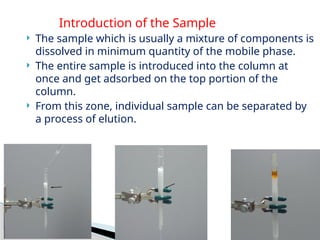
Introduction of theSample
The sample which is usually a mixture of components is
dissolved in minimum quantity of the mobile phase.
The entire sample is introduced into the column at
once and get adsorbed on the top portion of the
column.
From this zone, individual sample can be separated by
a process of elution.
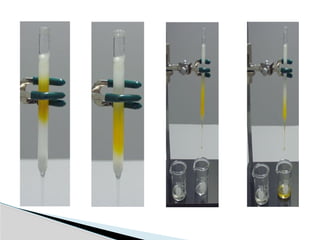
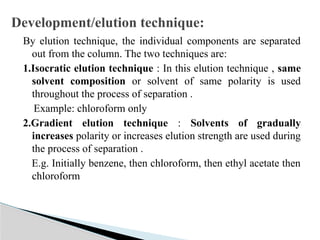
By elution technique,the individual components are separated
out from the column. The two techniques are:
1.Isocratic elution technique : In this elution technique , same
solvent composition or solvent of same polarity is used
throughout the process of separation .
Example: chloroform only
2.Gradient elution technique : Solvents of gradually
increases polarity or increases elution strength are used during
the process of separation .
E.g. Initially benzene, then chloroform, then ethyl acetate then
chloroform
Development/elution technique:
62.
If thecompounds separated in a column chromatography
procedure are colored, the progress of the separation can
simply be monitored visually.
If the compounds to be isolated from column chromatography
are colorless. In this case, small fractions of the eluent are
collected sequentially in labeled tubes and the composition of
each fraction is analyzed by TLC.
Detection of components:
63.
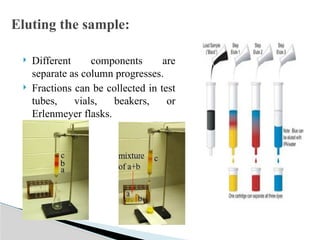
Different componentsare
separate as column progresses.
Fractions can be collected in test
tubes, vials, beakers, or
Erlenmeyer flasks.
Eluting the sample:
64.
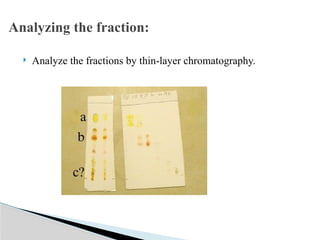
Analyze thefractions by thin-layer chromatography.
Analyzing the fraction:
65.
1. Dimension ofthe column: column efficiency has been
improved by increasing length/width ratio of the column.
2. Particle size of column packing: separation to be improved
by decreasing the particle size of the adsorbent.
3. Activity of the adsorbent.
4. Temperature of the column: The speed of the elution
increases at higher temperatures.
5. Packing of the column.
6. Quality of solvents: solvents having low viscosities is
giving better results.
Factors affecting column efficiency:
66.
Procedure:
The stationaryphase material is suitably moistened with
mobile phase and packed sufficiently in the column with a
cotton or asbestos pad at the bottom. The extract material or
sample to be separated is placed on the top of packed
stationary phase with a second cotton or asbestos pad in
between.
The mobile phase is poured into the column over the sample.
A collecting beaker is placed at the bottom of column near the
end to collect the elute.
67.
Separate activeprinciple from plant materials.
In separation of compounds after organic synthesis to obtain
desired molecule.
To separate or purify natural compound mixtures like
alkaloids, glycosides.
Separation of mixture of compounds.
Purification process.
Applications:
68.
Isolation ofactive constituents.
Estimation of drugs in formulation.
Isolation of active constituents.
Determination of primary and secondary glycosides
in digitalis leaf.
Separation of diastereomers.
69.
Stationary phase-slurry of 25g of alumina(neutral 100-200 mesh) in ethyl
alcohol.
Sample - 5mg each of methylene blue in 5ml of ethyl alcohol.
Allow the eluent to drain in the column to within 1mm of the top of the
alumina.
Mobile phase- ethyl alcohol.
Elute the methylene blue from the column, collect the eluent in 5ml
aliquots in vials.
After all the methylene blue has been collected, rate the relative
concentration of each vial from 1to 10 from the depth of blue.
Now plot the relative concentration of each vial against the tube number
and obtain the chromatogram.
Repeat the experiment using 50% water, 50% ethyl alcohol and 100%
water eluents.
Compare the data for the three eluting agents.
Separation of methylene blue by column
chromatography:
70.
Advantages:
Any typeof mixture can be separated.
Any quantity of mixture can be separated.
Wider choice of Mobile Phase.
Automation is possible.
Disadvantages:
Time consuming.
More amount of Mobile Phase are required.
Automation makes the techniques more complicated &
expensive.
Advantages and disadvantages: