PHARMACEUTICAL ANALYSIS
Chromatography
Dr. Kiptembur.K.P
Chromatography
Chromatography
• Chromatography, is an analytical technique for separating
the components, or solutes, of a mixture on the basis of the
relative amounts of each solute distributed between the
mobile phase, and a stationary phase.It is widely used in
pharmaceutical industry
֎To check traces of drugs in the blood or compound that
indicate a specific disease
֎To assess the purity of a compound e.g additional peaks
means impurity . we can also use it to
֎To identify if we have the correct amount of the compound in
the sample because the chromatograph peaks the area of it is
proportional to the amount of the compound in that sample if
the peak is bigger or smaller than the original reference peak
in the reference chromatograph that mean there is more or
less of the active drug in the sample.
DEFINATION
• Chromatography, is an analytical technique for separating
the components, or solutes, of a mixture on the basis of the
relative amounts of each solute distributed between a
moving fluid stream, called the mobile phase, and a
stationary phase. The mobile phase may be either a liquid or
a gas, while the stationary phase is either a solid or a liquid.
• Chromatogram – the visual output of the chromatograph. In
the case of an optimal separation, different peaks or
patterns on the chromatogram correspond to different
components of the separated mixture.
• Chromatograph – an instrument that enables a
sophisticated separation, e.g. gas chromatographic or liquid
chromatographic separation
• Eluent – the solvent or solvent fixture used in elution
chromatography and is synonymous with mobile phase
• Elute – a more precise term for solute or analyte. It is a
sample component leaving the chromatographic column
• Elution – a process where a mobile phase is passed through
or over the system and sample components moves
• Retention time – the characteristic time it takes for a
particular analyte to pass through the system (from the
column inlet to the detector) under set conditions
• Solute – the sample components in partition
chromatography.
• Solvent – any substance capable of solubilizing another
substance, and especially the liquid mobile phase in liquid
chromatography.
• Stationary phase – the substance fixed in place for the
chromatography procedure. Examples include the silica
gel or alumina layer in thin-layer chromatography
• Retardation factor value/ relative front value– is the ratio
of the solute’s distance travelled to the solvents distance
travelled. It is a physical constant that can be used to
verify a molecules identity.
• Detector – the instrument used for qualitative and
quantitative detection of analyte after separation
• Distribution ratio (D) – It is the ratio of solute
concentration in a stationary phase (Cs) to solute conc in
the mobile phase (CM). Used to determine the rate of
migration through the stationery phase.
• Sorption – the process whereby solutes are transferred
from mobile to stationary phase
• Desorption – the process by which solutes a are
transferred from stationery phase to mobile phase.
• Desorption and sorption occurs continuously throughout a
chromatographic separation process.
TYPES OF MECHANISM OF SORPTION
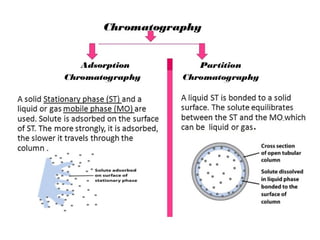
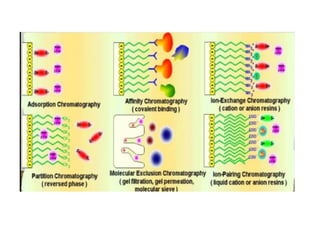
• Adsorption
 It is a surface effect. It occurs because of electrostatic
interactions between compound and surface of stationary
phase.
 E.g. silica is a common stationary phase which has Si-OH
(silanol)R groups on the surface which readily form hydrogen
bonds with solutes with polar compounds. common HPLC & TLC
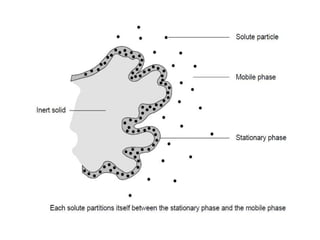
• Partition
 Applies to bonded phases-i.e. where the stationary phase is a
liquid coated onto a solid phase. Here, the sorption and
desorption occur between the liquid coated on the stationary
phase and mobile liquid. This analogous to solvent extraction
using two immiscible liquids.
 Silica coated with oil in a column flask, solute is added and then
the mobile phase.
• Ion exchange
 Solute ions in the mobile phase can exchange with similar
charged ions bound to the stationary phase.
 This can be used to separate and determine ions in water e.g.
sulphate, chloride, fluoride.
• Exclusion
 Differs from the above 3 because there are no specific
interaction between solute and the stationary phase.
 The stationary phase consists of porous silica or polymer
containing holes/pores.
 Larger molecules are unable to get into the holes and pass
down the column quicker. Smaller molecules spend time in the
holes and pass down the column slower. So separation is
based on the molecular size and this method can be used for
the determination of molecular weight of polymers or
proteins.
•Chromatography is an important biophysical technique
that enables the separation, identification, and
purification of the components of a mixture for
qualitative and quantitative analysis.
•Chromatography is a very useful technique as it allows
the separation of components of a mixture on the basis
of their nature, structure, size, and other properties.
•Chromatography, in general, is based on the principle
that components of a mixture are separated when the
mixture added to a mobile phase is moved through a
stationary phase, resulting in some components of the
mixture being attached to the stationary phase. At the
same time, the rest is passed along with the mobile
phase
What is a stationary phase?
• The stationary phase in chromatography is the phase that
is either a solid or liquid particle attached to a glass or a
metal surface on which the components of the mixture to
be separated is absorbed selectively.
• The term stationary refers to the fact that this phase
remains stationary while the other phase moves.
• Most substances used as stationary phases are porous,
thus allowing the attachment of components during
chromatography.
• The stationary phase to be selected for a chromatographic
process depends on the nature of the components to be
separated and the type of chromatography.
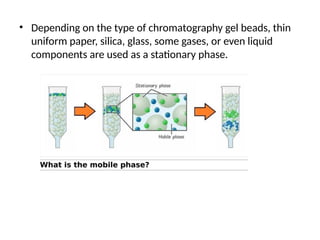
• Depending on the type of chromatography gel beads, thin
uniform paper, silica, glass, some gases, or even liquid
components are used as a stationary phase.
What is a mobile phase ?
֎The mobile phase is the phase that is either liquid or gas that
is passed through a chromatographic system where the
components of the mixture are separated at different rates by
adsorbing them to the stationary phase. It is the solvent that
carries the mixture as it moves down the stationary phase.
֎The term mobile indicates that the phase is moving down the
chromatographic system, whereas the other phase remains
stationary.
֎Substances used as mobile phases are selected for a
chromatographic process depending on the nature of the
components to be separated and the type of chromatography.
֎Alcohol, water, acetic acid, acetone, or some gases are the
commonly used mobile phase in different chromatographic
techniques.
Types of Chromatography
֎Affinity chromatography
֎Ion Exchange Chromatography
֎Column chromatography
֎Gas chromatography
֎Gel filtration chromatography/ Gel permeation
chromatography/ Size exclusion chromatography/
Molecular sieve chromatography
֎High-performance liquid chromatography
֎Liquid chromatography
֎Paper chromatography
• A wide range of chromatographic
procedures makes use of differences in:
• size,
• binding affinities,
• charge,
• and other properties to separate materials.
Thin Layer Chromatography
• Thin-layer chromatography is a separation
technique where the stationary phase is applied as
a thin layer on a solid support plate with a liquid
mobile phase.
• A sample is spotted onto the plate or a strip with a
micropipette and the plate or the strip is placed in
a suitable solvent to develop the chromatogram.
• The solvent is drawn up the plate by capillary
action, which moves the sample components up
the plate at different rates, depending upon their
solubility and their degree of retention by the
stationary phase.
• Following development, the individual spots are noted or made
visible by treatment with areagent that forms a coloured
derivative.
• For example, amino acids and amines are detectedby spraying
the plate with a solution of ninhydrin, resulting in a blue or
purple coloured spot.
• If the solute compound is fluorescent, they can be detected by
exposing to UV light. Thespots generally move at a certain
fraction of the rate at which the solvent moves and they are
characterized by the Rf value.
• Rf value is characteristic for a given stationary phase and solvent
combination.
• Retardation factor value/ relative front value is the ratio of the
solute’s distance travelled to the solvents distance travelled. It is
a physical constant that can be used to verify a molecules
identity.
• Since the separation and identification spots on TLC is
based upon visual observation, at certain times, if the
product analyzed contains large number of components,
the method may suffer from poor resolution due to the
closely lying or the overlapping spots and poor specificity.
• Therefore, the results may sometimes be uncertain,
misleading or inaccurate
Principle of Thin-layer chromatography (TLC)
• This chromatography technique is based on the principle that
components of a mixture are separated when the component
having an affinity towards the stationary phase binds to the
stationary phase. In contrast, other components are eluted with
the mobile phase.
• The substrate is bound to the stationary phase so that the
reactive sites for the binding of components are exposed.
• Now, the mixture is passed through the mobile phase where the
components with binding sites for the substrate bind to the
substrate on the stationary phase while the rest of the
components are eluted out with the mobile phase.
• After separation, the molecules are seen as spots at a different
location throughout the stationary phase.
• The detection of molecules is performed by various techniques.
Steps of Thin-layer chromatography (TLC)
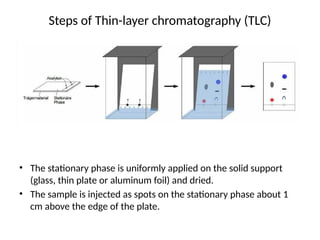
• The stationary phase is uniformly applied on the solid support
(glass, thin plate or aluminum foil) and dried.
• The sample is injected as spots on the stationary phase about 1
cm above the edge of the plate.
• The sample loaded plate is then carefully dipped into the
mobile phase not more than the height of 1 cm.
• After the mobile phase reaches near the edge of the plate,
the plate is taken out.
• The retention factor is calculated as in paper
chromatography, and the separated components are
detected by different techniques.
Uses of Thin-layer chromatography (TLC)
• Thin-layer chromatography is routinely
performed in laboratories to identify different
substances present in a mixture.
AFFINITY CHROMATOGRAPHY
• In 1930s, first developed by A. Wilhem Tiselius. A Swedish
Biochemist. He won the Nobel Prize in 1948.
• It is used to study enzymes and other proteins
• It relies on the affinity of various biochemical compounds
with specific properties.
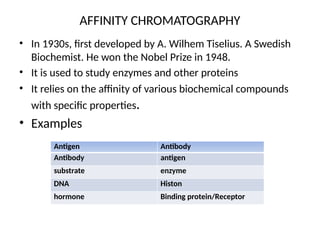
• Examples
Antigen Antibody
Antibody antigen
substrate enzyme
DNA Histon
hormone Binding protein/Receptor
Specificity of Affinty Chromatography
• Specificity is based on three aspect of affinty
– Matrix: for ligand attechment
– Space arm: used to bind ligand to matrix
– Ligand: molecule that’s reversibly to a specific target
molecules (site interaction)
PROCEDURE
• The sample is injected into the equilibrated affinity
chromatography column
• Only the substances with affinity for the ligand are retained
on the column.
• The substances with no affinity to the ligand will elute off
• The substances retained in the column can be eluted by
changing the of the salt of rgnganic solvent concentration
MATRIX
• The matrix simply provides a structure to increase the
surface area to which the molecules can bin
• The matrix must be activated for the ligand to bind to it but
stilll be able to retain its’ own activation towards the target
molecule.
• Amino, hydroxyl, carbonyl, and thio groups located within
the matrix serves as ligand binding sites.
• Matrix are made up of agarose and other polysaccharides.
LIGAND
• The ligand binds only to the desired molecule within the
solution.
• The ligand attaches to the matrix which is made up of an
inert substance.
• The ligand should only interact with the desired molecules
and form a temporary bond.
• The ligand/ molecule complex will remain in the column,
eluting everything else off.
• The ligand/ molecule complex dissociates by changing the
pH.
ANTIBODY AFFINITY (IMMUNOAFFINITY
CHROMATOGRAPHY)
• It is used to purify antibody against a specific antigen. For
example, immunoglobulins
• Purification of IgG, IgG fragments and subclasses have a
high affinity of protein A and protein G for Fc region of
polyconal and monoclonal IgG-type antibodies.
• Protein A and protein G are bacterial cell surface proteins
(from Staphylococcus aureus and Streptococcus
respectively)
• Recombinant protein A is available, and as been
engineered to include a C terminal with enhanced binding
capacity
USES AND APPLICATION OF AFFINITY
CHROMATOGRAPHY
• It can be used
•Purify and concentrate a substance from a mixture into a
buffering solution
•Reduce amount of a substance in a mixture
•Discern what biological compounds bind to a particular
substance, such as a drug.
•Purify and concentrate an enzyme solution
•Used in genetic engineering – nucleic acid purification
•Production of vaccines – antibody purification from blood
serum
•Used in basic metabolic research – protein or enzyme
purification from cell free extracts
ADVANTAGES OF AFFINITY CHROMATOGRAPHY
• Extremely high specificity.
• High degree of purity can be obtained.
• The process is very reproducible.
• The binding sites of biological molecules can
be simply investigated
DISADVANTAGES OF AFFINITY CHROMATOGRAPHY
• Expensive ligand
• leakage of ligand
• Degradation of solid support
• Limited lifetime
• Non- specific adsorption
• Relatively low productivity

PHARMACEUTICAL ANALYSIS (chromatography).pptx

  • 1.
  • 2.
  • 3.
    Chromatography • Chromatography, isan analytical technique for separating the components, or solutes, of a mixture on the basis of the relative amounts of each solute distributed between the mobile phase, and a stationary phase.It is widely used in pharmaceutical industry ֎To check traces of drugs in the blood or compound that indicate a specific disease ֎To assess the purity of a compound e.g additional peaks means impurity . we can also use it to ֎To identify if we have the correct amount of the compound in the sample because the chromatograph peaks the area of it is proportional to the amount of the compound in that sample if the peak is bigger or smaller than the original reference peak in the reference chromatograph that mean there is more or less of the active drug in the sample.
  • 4.
    DEFINATION • Chromatography, isan analytical technique for separating the components, or solutes, of a mixture on the basis of the relative amounts of each solute distributed between a moving fluid stream, called the mobile phase, and a stationary phase. The mobile phase may be either a liquid or a gas, while the stationary phase is either a solid or a liquid. • Chromatogram – the visual output of the chromatograph. In the case of an optimal separation, different peaks or patterns on the chromatogram correspond to different components of the separated mixture. • Chromatograph – an instrument that enables a sophisticated separation, e.g. gas chromatographic or liquid chromatographic separation
  • 5.
    • Eluent –the solvent or solvent fixture used in elution chromatography and is synonymous with mobile phase • Elute – a more precise term for solute or analyte. It is a sample component leaving the chromatographic column • Elution – a process where a mobile phase is passed through or over the system and sample components moves • Retention time – the characteristic time it takes for a particular analyte to pass through the system (from the column inlet to the detector) under set conditions • Solute – the sample components in partition chromatography. • Solvent – any substance capable of solubilizing another substance, and especially the liquid mobile phase in liquid chromatography.
  • 6.
    • Stationary phase– the substance fixed in place for the chromatography procedure. Examples include the silica gel or alumina layer in thin-layer chromatography
  • 7.
    • Retardation factorvalue/ relative front value– is the ratio of the solute’s distance travelled to the solvents distance travelled. It is a physical constant that can be used to verify a molecules identity. • Detector – the instrument used for qualitative and quantitative detection of analyte after separation • Distribution ratio (D) – It is the ratio of solute concentration in a stationary phase (Cs) to solute conc in the mobile phase (CM). Used to determine the rate of migration through the stationery phase. • Sorption – the process whereby solutes are transferred from mobile to stationary phase • Desorption – the process by which solutes a are transferred from stationery phase to mobile phase. • Desorption and sorption occurs continuously throughout a chromatographic separation process.
  • 8.
    TYPES OF MECHANISMOF SORPTION • Adsorption  It is a surface effect. It occurs because of electrostatic interactions between compound and surface of stationary phase.  E.g. silica is a common stationary phase which has Si-OH (silanol)R groups on the surface which readily form hydrogen bonds with solutes with polar compounds. common HPLC & TLC • Partition  Applies to bonded phases-i.e. where the stationary phase is a liquid coated onto a solid phase. Here, the sorption and desorption occur between the liquid coated on the stationary phase and mobile liquid. This analogous to solvent extraction using two immiscible liquids.  Silica coated with oil in a column flask, solute is added and then the mobile phase.
  • 11.
    • Ion exchange Solute ions in the mobile phase can exchange with similar charged ions bound to the stationary phase.  This can be used to separate and determine ions in water e.g. sulphate, chloride, fluoride. • Exclusion  Differs from the above 3 because there are no specific interaction between solute and the stationary phase.  The stationary phase consists of porous silica or polymer containing holes/pores.  Larger molecules are unable to get into the holes and pass down the column quicker. Smaller molecules spend time in the holes and pass down the column slower. So separation is based on the molecular size and this method can be used for the determination of molecular weight of polymers or proteins.
  • 12.
    •Chromatography is animportant biophysical technique that enables the separation, identification, and purification of the components of a mixture for qualitative and quantitative analysis. •Chromatography is a very useful technique as it allows the separation of components of a mixture on the basis of their nature, structure, size, and other properties. •Chromatography, in general, is based on the principle that components of a mixture are separated when the mixture added to a mobile phase is moved through a stationary phase, resulting in some components of the mixture being attached to the stationary phase. At the same time, the rest is passed along with the mobile phase
  • 13.
    What is astationary phase? • The stationary phase in chromatography is the phase that is either a solid or liquid particle attached to a glass or a metal surface on which the components of the mixture to be separated is absorbed selectively. • The term stationary refers to the fact that this phase remains stationary while the other phase moves. • Most substances used as stationary phases are porous, thus allowing the attachment of components during chromatography. • The stationary phase to be selected for a chromatographic process depends on the nature of the components to be separated and the type of chromatography.
  • 14.
    • Depending onthe type of chromatography gel beads, thin uniform paper, silica, glass, some gases, or even liquid components are used as a stationary phase.
  • 15.
    What is amobile phase ? ֎The mobile phase is the phase that is either liquid or gas that is passed through a chromatographic system where the components of the mixture are separated at different rates by adsorbing them to the stationary phase. It is the solvent that carries the mixture as it moves down the stationary phase. ֎The term mobile indicates that the phase is moving down the chromatographic system, whereas the other phase remains stationary. ֎Substances used as mobile phases are selected for a chromatographic process depending on the nature of the components to be separated and the type of chromatography. ֎Alcohol, water, acetic acid, acetone, or some gases are the commonly used mobile phase in different chromatographic techniques.
  • 16.
    Types of Chromatography ֎Affinitychromatography ֎Ion Exchange Chromatography ֎Column chromatography ֎Gas chromatography ֎Gel filtration chromatography/ Gel permeation chromatography/ Size exclusion chromatography/ Molecular sieve chromatography ֎High-performance liquid chromatography ֎Liquid chromatography ֎Paper chromatography
  • 17.
    • A widerange of chromatographic procedures makes use of differences in: • size, • binding affinities, • charge, • and other properties to separate materials.
  • 19.
    Thin Layer Chromatography •Thin-layer chromatography is a separation technique where the stationary phase is applied as a thin layer on a solid support plate with a liquid mobile phase. • A sample is spotted onto the plate or a strip with a micropipette and the plate or the strip is placed in a suitable solvent to develop the chromatogram. • The solvent is drawn up the plate by capillary action, which moves the sample components up the plate at different rates, depending upon their solubility and their degree of retention by the stationary phase.
  • 20.
    • Following development,the individual spots are noted or made visible by treatment with areagent that forms a coloured derivative. • For example, amino acids and amines are detectedby spraying the plate with a solution of ninhydrin, resulting in a blue or purple coloured spot. • If the solute compound is fluorescent, they can be detected by exposing to UV light. Thespots generally move at a certain fraction of the rate at which the solvent moves and they are characterized by the Rf value. • Rf value is characteristic for a given stationary phase and solvent combination. • Retardation factor value/ relative front value is the ratio of the solute’s distance travelled to the solvents distance travelled. It is a physical constant that can be used to verify a molecules identity.
  • 21.
    • Since theseparation and identification spots on TLC is based upon visual observation, at certain times, if the product analyzed contains large number of components, the method may suffer from poor resolution due to the closely lying or the overlapping spots and poor specificity. • Therefore, the results may sometimes be uncertain, misleading or inaccurate
  • 22.
    Principle of Thin-layerchromatography (TLC) • This chromatography technique is based on the principle that components of a mixture are separated when the component having an affinity towards the stationary phase binds to the stationary phase. In contrast, other components are eluted with the mobile phase. • The substrate is bound to the stationary phase so that the reactive sites for the binding of components are exposed. • Now, the mixture is passed through the mobile phase where the components with binding sites for the substrate bind to the substrate on the stationary phase while the rest of the components are eluted out with the mobile phase. • After separation, the molecules are seen as spots at a different location throughout the stationary phase. • The detection of molecules is performed by various techniques.
  • 23.
    Steps of Thin-layerchromatography (TLC) • The stationary phase is uniformly applied on the solid support (glass, thin plate or aluminum foil) and dried. • The sample is injected as spots on the stationary phase about 1 cm above the edge of the plate.
  • 24.
    • The sampleloaded plate is then carefully dipped into the mobile phase not more than the height of 1 cm. • After the mobile phase reaches near the edge of the plate, the plate is taken out. • The retention factor is calculated as in paper chromatography, and the separated components are detected by different techniques.
  • 25.
    Uses of Thin-layerchromatography (TLC) • Thin-layer chromatography is routinely performed in laboratories to identify different substances present in a mixture.
  • 28.
    AFFINITY CHROMATOGRAPHY • In1930s, first developed by A. Wilhem Tiselius. A Swedish Biochemist. He won the Nobel Prize in 1948. • It is used to study enzymes and other proteins • It relies on the affinity of various biochemical compounds with specific properties. • Examples Antigen Antibody Antibody antigen substrate enzyme DNA Histon hormone Binding protein/Receptor
  • 29.
    Specificity of AffintyChromatography • Specificity is based on three aspect of affinty – Matrix: for ligand attechment – Space arm: used to bind ligand to matrix – Ligand: molecule that’s reversibly to a specific target molecules (site interaction)
  • 30.
    PROCEDURE • The sampleis injected into the equilibrated affinity chromatography column • Only the substances with affinity for the ligand are retained on the column. • The substances with no affinity to the ligand will elute off • The substances retained in the column can be eluted by changing the of the salt of rgnganic solvent concentration
  • 31.
    MATRIX • The matrixsimply provides a structure to increase the surface area to which the molecules can bin • The matrix must be activated for the ligand to bind to it but stilll be able to retain its’ own activation towards the target molecule. • Amino, hydroxyl, carbonyl, and thio groups located within the matrix serves as ligand binding sites. • Matrix are made up of agarose and other polysaccharides.
  • 32.
    LIGAND • The ligandbinds only to the desired molecule within the solution. • The ligand attaches to the matrix which is made up of an inert substance. • The ligand should only interact with the desired molecules and form a temporary bond. • The ligand/ molecule complex will remain in the column, eluting everything else off. • The ligand/ molecule complex dissociates by changing the pH.
  • 33.
    ANTIBODY AFFINITY (IMMUNOAFFINITY CHROMATOGRAPHY) •It is used to purify antibody against a specific antigen. For example, immunoglobulins • Purification of IgG, IgG fragments and subclasses have a high affinity of protein A and protein G for Fc region of polyconal and monoclonal IgG-type antibodies. • Protein A and protein G are bacterial cell surface proteins (from Staphylococcus aureus and Streptococcus respectively) • Recombinant protein A is available, and as been engineered to include a C terminal with enhanced binding capacity
  • 34.
    USES AND APPLICATIONOF AFFINITY CHROMATOGRAPHY • It can be used •Purify and concentrate a substance from a mixture into a buffering solution •Reduce amount of a substance in a mixture •Discern what biological compounds bind to a particular substance, such as a drug. •Purify and concentrate an enzyme solution •Used in genetic engineering – nucleic acid purification •Production of vaccines – antibody purification from blood serum •Used in basic metabolic research – protein or enzyme purification from cell free extracts
  • 35.
    ADVANTAGES OF AFFINITYCHROMATOGRAPHY • Extremely high specificity. • High degree of purity can be obtained. • The process is very reproducible. • The binding sites of biological molecules can be simply investigated
  • 36.
    DISADVANTAGES OF AFFINITYCHROMATOGRAPHY • Expensive ligand • leakage of ligand • Degradation of solid support • Limited lifetime • Non- specific adsorption • Relatively low productivity