Intelligence Unit 3 > Individual Differences
Individual Differences Psychologists are also interested in why some people behave in ways, which you or I would not call ‘normal’.  Behaviour that is not considered ‘normal’ in our society is called ‘atypical behaviour’.  This simply means it is different from the accepted norm.
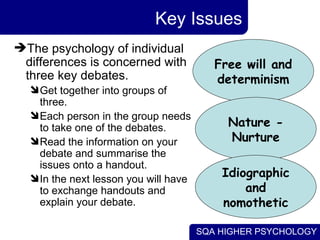
Key Issues The psychology of individual differences is concerned with three key debates. Get together into groups of three. Each person in the group needs to take one of the debates. Read the information on your debate and summarise the issues onto a handout. In the next lesson you will have to exchange handouts and explain your debate. Free will and determinism Nature - Nurture Idiographic and nomothetic
Learning Content Intelligence Nature of intelligence, and the intelligence/IQ distinction; measurement of IQ; theoretical views of intelligence, including factor theories and information-processing approach. Nature-nurture debate in intelligence: genetic relatedness and IQ, twins and adoption studies; effects of early deprivation and environmental enrichment; interactionist approaches. Uses of IQ testing: educational selection; recruitment in employment and military organisations; effect of cultural biases on validity/reliability of IQ tests.
Intelligence What is intelligence? Can your group write a definition of intelligence? “ The aggregate of the global capacity to act purposefully, to think rationally and to deal effectively with the environment.” (Wechsler, 1944) “ Innate, general cognitive ability.” (Burt, 1955) “ The effective all-round cognitive abilities to comprehend, to grasp relations and reason.” (Vernon 1969) “ Intelligent activity consists in grasping the essentials in a situation and responding appropriately to them.” (Heim, 1970)
Intelligence Intelligence is very difficult to define. What is meant by ability and capacity? What is the relationship between these?
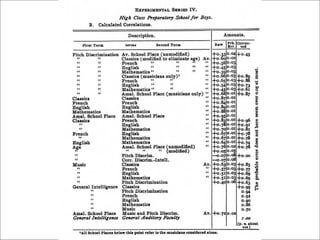
Theories of Intelligence Factor theory approach The psychometric approach by Spearman (1904) refers to the measurement of differences in individual behaviours and abilities.  His testing of school children led him to focus on the ability correlations which appeared between different subjects.  Some of the children had performed well in all the tests while others had not performed so well in any of the tests.  This led him to the conclusion that how a child performs on a test will be dependent upon their:  general ability level (‘g’ or general intelligence) specific abilities (‘s’) that the child possesses.
 
Factor Theory How did Thurstone (1938) challenge Spearman’s work? List Thurstone’s seven separate factors. How have Guilford & Vernon modified the factor theory? Although following a similar path to Spearman, Cattell (1987) proposed an important modification to the ‘g’ factor by stating that it could be sub-divided into two important components: fluid intelligence crystallised intelligence What is the difference between fluid & crystallised intelligence?
Factor Theory How can factor theories be evaluated? Variation Data collection Measuring not defining Inherited assumed
Theories of Intelligence Cognitive/Information Processing Theory In contrast to the previous approaches Gardner (1985) put forward the idea that people have a number or multiple intelligences which are  unrelated .  Gardner identified seven distinct intelligences. Outline these intelligences. In what ways do Garnder’s intelligences differ from factor analysis? Where do your strengths lie? Can you evaluate Gardner’s theory?
Cognitive/Information Processing  The theory put forward by Sternberg (1985) is known as a  triarchic  theory as he addresses three aspects of intelligence:  Contextual: How intelligence relates to the external world. Componential: The cognitive processes that take place within the individual. Experiential: Actual situations that require intelligence. Make notes on each of these aspects. How can Sternberg’s theories be evaluated?
Measuring Intelligence As psychologists investigated different areas of human behaviour, they began to look for ways in which the science could be used to help people.  The first modern intelligence test was devised by Alfred Binet in 1905 at the request of the French education authorities.  In 1881, the French Government introduced compulsory schooling for all children.  This meant that slow learners, who had originally been kept at home, now had to attend school.  Binet devised a test which measured ability and considered that age of the child being tested.  He devised the concept of mental age which is the individual's mental development in relation to others.
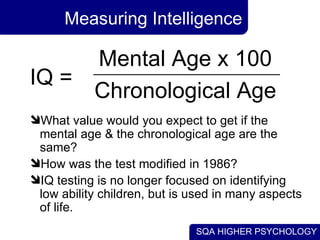
Measuring Intelligence Therefore, the six-year-old who can satisfactorily complete the work of a seven-year-old is said to have a mental age of seven.  Likewise, a child of eight who can only complete the work of a six-year-old is said to have the mental age of six. Future researchers developed this work with Stern producing the idea of an intelligence quotient (IQ) in 1912.  The IQ was calculated as follows:
Measuring Intelligence What value would you expect to get if the mental age & the chronological age are the same? How was the test modified in 1986? IQ testing is no longer focused on identifying low ability children, but is used in many aspects of life. IQ = Mental Age x 100 Chronological Age
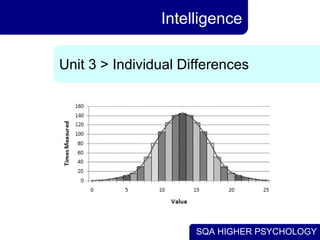
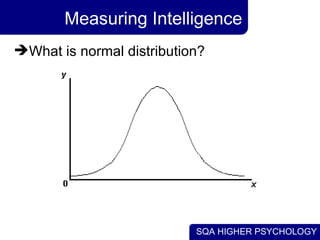
Measuring Intelligence What is normal distribution?
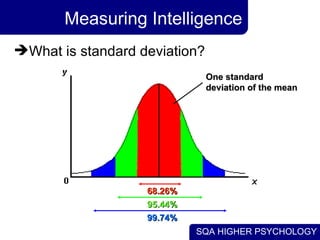
Measuring Intelligence What is standard deviation? 68.26% 95.44% 99.74% One standard deviation of the mean
Measuring Intelligence Complete the (b) & (e) sections of the activity on page 301. What must you do with an intelligence test before you can use it to measure IQ? What is the IQ score telling you therefore? What is meant be the following terms in relation to intelligence testing? Reliable Valid Standardised
Measuring Intelligence Outline the criticisms which have been made of intelligence testing.
Nature v Nurture How does the nature/nurture debate apply to intelligence? Explain what is meant by MZ and DZ. Outline the intelligence studies performed using twins. What do the results show? How can this work be evaluated? How have adoption studies been used to study genetic factors?
Nature v Nurture What environmental factors have been studied by Harrell  et al  and Benton & Cook? Outline the study conducted by Zajonc & Marcus. What did they discover? What are Sameroff & Seifer’s ten environmental factor effecting IQ scores? How do these factors effect IQ? What other studies support the views of Sameroff & Seifer?
Nature v Nurture Rosenthal and Jacobson carried out a classic study of the effect of teacher expectations of success on IQ. Outline their procedure. What were the results?
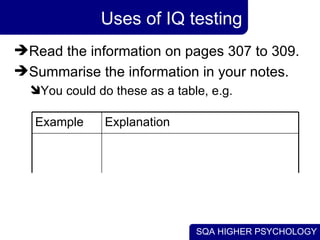
Uses of IQ testing Read the information on pages 307 to 309. Summarise the information in your notes. You could do these as a table, e.g. Explanation Example
Cultural, political  & environmental factors What is ethnocentrism? How does this impact IQ testing? What role has racism played in psychology? Outline the case of Yerkes (1971). What impact did Yerkes ‘findings’ have on: the military? minority ethnic groups in general? immigration into the US? What was lacking in Yerkes’ methodology?

4. Individual Differences

  • 1.
    Intelligence Unit 3> Individual Differences
  • 2.
    Individual Differences Psychologistsare also interested in why some people behave in ways, which you or I would not call ‘normal’. Behaviour that is not considered ‘normal’ in our society is called ‘atypical behaviour’. This simply means it is different from the accepted norm.
  • 3.
    Key Issues Thepsychology of individual differences is concerned with three key debates. Get together into groups of three. Each person in the group needs to take one of the debates. Read the information on your debate and summarise the issues onto a handout. In the next lesson you will have to exchange handouts and explain your debate. Free will and determinism Nature - Nurture Idiographic and nomothetic
  • 4.
    Learning Content IntelligenceNature of intelligence, and the intelligence/IQ distinction; measurement of IQ; theoretical views of intelligence, including factor theories and information-processing approach. Nature-nurture debate in intelligence: genetic relatedness and IQ, twins and adoption studies; effects of early deprivation and environmental enrichment; interactionist approaches. Uses of IQ testing: educational selection; recruitment in employment and military organisations; effect of cultural biases on validity/reliability of IQ tests.
  • 5.
    Intelligence What isintelligence? Can your group write a definition of intelligence? “ The aggregate of the global capacity to act purposefully, to think rationally and to deal effectively with the environment.” (Wechsler, 1944) “ Innate, general cognitive ability.” (Burt, 1955) “ The effective all-round cognitive abilities to comprehend, to grasp relations and reason.” (Vernon 1969) “ Intelligent activity consists in grasping the essentials in a situation and responding appropriately to them.” (Heim, 1970)
  • 6.
    Intelligence Intelligence isvery difficult to define. What is meant by ability and capacity? What is the relationship between these?
  • 7.
    Theories of IntelligenceFactor theory approach The psychometric approach by Spearman (1904) refers to the measurement of differences in individual behaviours and abilities. His testing of school children led him to focus on the ability correlations which appeared between different subjects. Some of the children had performed well in all the tests while others had not performed so well in any of the tests. This led him to the conclusion that how a child performs on a test will be dependent upon their: general ability level (‘g’ or general intelligence) specific abilities (‘s’) that the child possesses.
  • 8.
  • 9.
    Factor Theory Howdid Thurstone (1938) challenge Spearman’s work? List Thurstone’s seven separate factors. How have Guilford & Vernon modified the factor theory? Although following a similar path to Spearman, Cattell (1987) proposed an important modification to the ‘g’ factor by stating that it could be sub-divided into two important components: fluid intelligence crystallised intelligence What is the difference between fluid & crystallised intelligence?
  • 10.
    Factor Theory Howcan factor theories be evaluated? Variation Data collection Measuring not defining Inherited assumed
  • 11.
    Theories of IntelligenceCognitive/Information Processing Theory In contrast to the previous approaches Gardner (1985) put forward the idea that people have a number or multiple intelligences which are unrelated . Gardner identified seven distinct intelligences. Outline these intelligences. In what ways do Garnder’s intelligences differ from factor analysis? Where do your strengths lie? Can you evaluate Gardner’s theory?
  • 12.
    Cognitive/Information Processing The theory put forward by Sternberg (1985) is known as a triarchic theory as he addresses three aspects of intelligence: Contextual: How intelligence relates to the external world. Componential: The cognitive processes that take place within the individual. Experiential: Actual situations that require intelligence. Make notes on each of these aspects. How can Sternberg’s theories be evaluated?
  • 13.
    Measuring Intelligence Aspsychologists investigated different areas of human behaviour, they began to look for ways in which the science could be used to help people. The first modern intelligence test was devised by Alfred Binet in 1905 at the request of the French education authorities. In 1881, the French Government introduced compulsory schooling for all children. This meant that slow learners, who had originally been kept at home, now had to attend school. Binet devised a test which measured ability and considered that age of the child being tested. He devised the concept of mental age which is the individual's mental development in relation to others.
  • 14.
    Measuring Intelligence Therefore,the six-year-old who can satisfactorily complete the work of a seven-year-old is said to have a mental age of seven. Likewise, a child of eight who can only complete the work of a six-year-old is said to have the mental age of six. Future researchers developed this work with Stern producing the idea of an intelligence quotient (IQ) in 1912. The IQ was calculated as follows:
  • 15.
    Measuring Intelligence Whatvalue would you expect to get if the mental age & the chronological age are the same? How was the test modified in 1986? IQ testing is no longer focused on identifying low ability children, but is used in many aspects of life. IQ = Mental Age x 100 Chronological Age
  • 16.
    Measuring Intelligence Whatis normal distribution?
  • 17.
    Measuring Intelligence Whatis standard deviation? 68.26% 95.44% 99.74% One standard deviation of the mean
  • 18.
    Measuring Intelligence Completethe (b) & (e) sections of the activity on page 301. What must you do with an intelligence test before you can use it to measure IQ? What is the IQ score telling you therefore? What is meant be the following terms in relation to intelligence testing? Reliable Valid Standardised
  • 19.
    Measuring Intelligence Outlinethe criticisms which have been made of intelligence testing.
  • 20.
    Nature v NurtureHow does the nature/nurture debate apply to intelligence? Explain what is meant by MZ and DZ. Outline the intelligence studies performed using twins. What do the results show? How can this work be evaluated? How have adoption studies been used to study genetic factors?
  • 21.
    Nature v NurtureWhat environmental factors have been studied by Harrell et al and Benton & Cook? Outline the study conducted by Zajonc & Marcus. What did they discover? What are Sameroff & Seifer’s ten environmental factor effecting IQ scores? How do these factors effect IQ? What other studies support the views of Sameroff & Seifer?
  • 22.
    Nature v NurtureRosenthal and Jacobson carried out a classic study of the effect of teacher expectations of success on IQ. Outline their procedure. What were the results?
  • 23.
    Uses of IQtesting Read the information on pages 307 to 309. Summarise the information in your notes. You could do these as a table, e.g. Explanation Example
  • 24.
    Cultural, political & environmental factors What is ethnocentrism? How does this impact IQ testing? What role has racism played in psychology? Outline the case of Yerkes (1971). What impact did Yerkes ‘findings’ have on: the military? minority ethnic groups in general? immigration into the US? What was lacking in Yerkes’ methodology?