Chapter 9
Intelligence
Dr. Irene Karayianni
What is Intelligence?
Focal point for Psychologists
• Adapt to environment
• Differ from each other in terms of learning & understanding the world
• Use resources of our environment
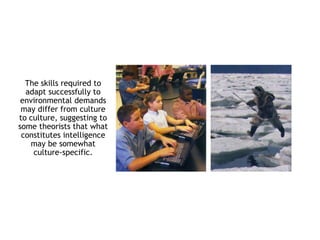
The skills required to
adapt successfully to
environmental demands
may differ from culture
to culture, suggesting to
some theorists that what
constitutes intelligence
may be somewhat
culture-specific.
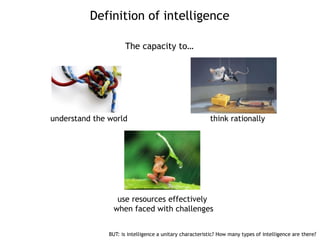
Definition of intelligence
The capacity to…
understand the world think rationally
use resources effectively
when faced with challenges
BUT: is intelligence a unitary characteristic? How many types of intelligence are there?
Theories of intelligence
Are you good at math? At literature? At painting? At playing soccer?
How many kinds of intelligence are there?
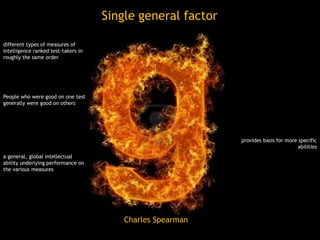
Single general factor
Charles Spearman
different types of measures of
intelligence ranked test-takers in
roughly the same order
People who were good on one test
generally were good on others
a general, global intellectual
ability underlying performance on
the various measures
provides basis for more specific
abilities
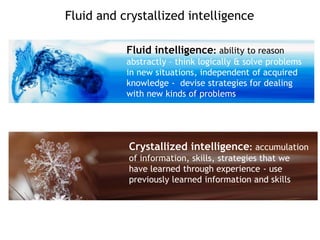
Fluid and crystallized intelligence
Fluid intelligence: ability to reason
abstractly – think logically & solve problems
in new situations, independent of acquired
knowledge - devise strategies for dealing
with new kinds of problems
Crystallized intelligence: accumulation
of information, skills, strategies that we
have learned through experience - use
previously learned information and skills
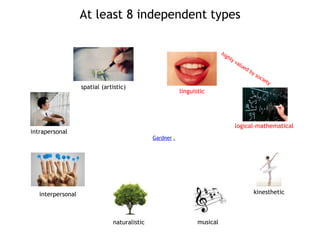
At least 8 independent types
Gardner .
linguistic
logical-mathematical
musical
kinestheticinterpersonal
naturalistic
intrapersonal
spatial (artistic)
At least 8 independent types
• Linguistic : the ability to use language well, as writers do.
• Logical-mathematical : the ability to reason mathematically and logically.
• Visuospatial : the ability to solve spatial problems or to succeed in a field such
as architecture.
• Musical : the ability to perceive pitch and rhythm and to understand and
produce music
• Bodily-kinesthetic : the ability to control body movements and skillfully
manipulate objects, as demonstrated by a highly skilled dancer, athlete, or
surgeon.
• Interpersonal : the ability to understand and relate well to others.
• Intrapersonal : the ability to understand oneself.
• Naturalistic : the ability to detect and understand phenomena in the natural
world, as a zoologist or meteorologist might
• Existential: identifying and thinking about the fundamental questions of
human existence
At least 8 independent types
• Each person has the same kinds of intelligence in different degrees.
• These separate intelligences do not operate in isolation. Normally, any
activity encompasses several kinds of intelligence working together.
•  development of intelligence tests with questions in which more than
one answer can be correct; these provide an opportunity for test takers
to demonstrate creative thinking.
• Gardner believes we should use intelligence tests to reinforce children’s
strengths rather than to focus on forcing them to develop in their
weakest areas. He argues that the current intelligence and aptitude
tests predict at best how a child will perform in today’s linguistic and
logical-mathematic schools.
• Implications: if we focus only on some forms of intelligence, we often
waste a portion of society by dumping all who are not skilled in those
areas onto a societal scrap heap.
Is information-processing intelligence?
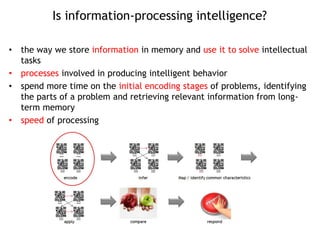
• the way we store information in memory and use it to solve intellectual
tasks
• processes involved in producing intelligent behavior
• spend more time on the initial encoding stages of problems, identifying
the parts of a problem and retrieving relevant information from long-
term memory
• speed of processing
Biological basis of intelligence
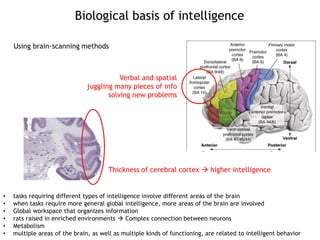
Verbal and spatial
juggling many pieces of info
solving new problems
Thickness of cerebral cortex  higher intelligence
• tasks requiring different types of intelligence involve different areas of the brain
• when tasks require more general global intelligence, more areas of the brain are involved
• Global workspace that organizes information
• rats raised in enriched environments  Complex connection between neurons
• Metabolism
• multiple areas of the brain, as well as multiple kinds of functioning, are related to intelligent behavior
Using brain-scanning methods
Practical intelligence
Sternberg
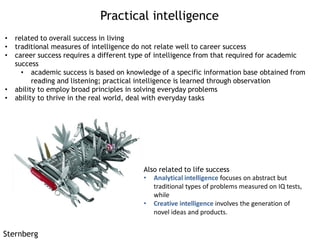
• related to overall success in living
• traditional measures of intelligence do not relate well to career success
• career success requires a different type of intelligence from that required for academic
success
• academic success is based on knowledge of a specific information base obtained from
reading and listening; practical intelligence is learned through observation
• ability to employ broad principles in solving everyday problems
• ability to thrive in the real world, deal with everyday tasks
Also related to life success
• Analytical intelligence focuses on abstract but
traditional types of problems measured on IQ tests,
while
• Creative intelligence involves the generation of
novel ideas and products.
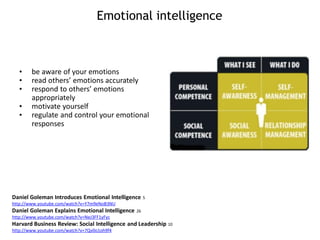
Emotional intelligence
• be aware of your emotions
• read others’ emotions accurately
• respond to others’ emotions
appropriately
• motivate yourself
• regulate and control your emotional
responses
Daniel Goleman Introduces Emotional Intelligence 5
http://www.youtube.com/watch?v=Y7m9eNoB3NU
Daniel Goleman Explains Emotional Intelligence 26
http://www.youtube.com/watch?v=NeJ3FF1yFyc
Harvard Business Review: Social Intelligence and Leadership 10
http://www.youtube.com/watch?v=7Qv0o1oh9f4
Assessing intelligence
• Quantify level of intelligence
• Variety of approaches  challenging to measure
• Benefit: identify students in need of special attention; diagnose cognitive
difficulties
• Controversial, raising important social and educational issues.
• First effort: size and shape of a person’s head
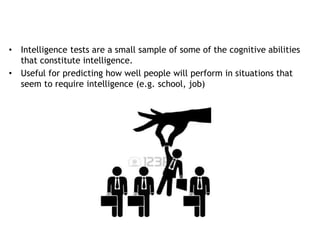
• Intelligence tests are a small sample of some of the cognitive abilities
that constitute intelligence.
• Useful for predicting how well people will perform in situations that
seem to require intelligence (e.g. school, job)
Binet and the development of IQ tests
• Designed to identify the “dullest” students in the Paris school system in order to
provide them with remedial aid.
• Premise: If performance on certain tasks improves with chronological age,
performance can be used to distinguish more intelligent people from less intelligent
ones within a particular age group.
• Binet presented tasks to same-age students who had been labeled “bright” or “dull”
by their teachers.
• If a task could be completed by the bright students but not by the dull ones, he
retained that task as a proper test item; otherwise it was discarded.
• In the end he came up with a test that distinguished between bright and dull groups,
and one that distinguished among children in different age groups.
• Children were assigned a score relating to their mental age  indication of general
level of performance.
• However, it did not allow for adequate comparisons among people of different
chronological ages.
• Solution: intelligence quotient (IQ)
• If mental age = chronological age  IQ = 100
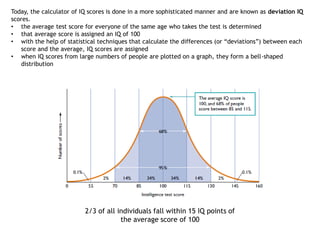
2/3 of all individuals fall within 15 IQ points of
the average score of 100
Today, the calculator of IQ scores is done in a more sophisticated manner and are known as deviation IQ
scores.
• the average test score for everyone of the same age who takes the test is determined
• that average score is assigned an IQ of 100
• with the help of statistical techniques that calculate the differences (or “deviations”) between each
score and the average, IQ scores are assigned
• when IQ scores from large numbers of people are plotted on a graph, they form a bell-shaped
distribution
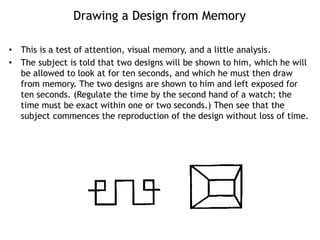
Drawing a Design from Memory
• This is a test of attention, visual memory, and a little analysis.
• The subject is told that two designs will be shown to him, which he will
be allowed to look at for ten seconds, and which he must then draw
from memory. The two designs are shown to him and left exposed for
ten seconds. (Regulate the time by the second hand of a watch; the
time must be exact within one or two seconds.) Then see that the
subject commences the reproduction of the design without loss of time.
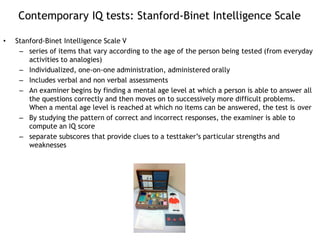
Contemporary IQ tests: Stanford-Binet Intelligence Scale
• Stanford-Binet Intelligence Scale V
– series of items that vary according to the age of the person being tested (from everyday
activities to analogies)
– Individualized, one-on-one administration, administered orally
– Includes verbal and non verbal assessments
– An examiner begins by finding a mental age level at which a person is able to answer all
the questions correctly and then moves on to successively more difficult problems.
When a mental age level is reached at which no items can be answered, the test is over
– By studying the pattern of correct and incorrect responses, the examiner is able to
compute an IQ score
– separate subscores that provide clues to a testtaker’s particular strengths and
weaknesses
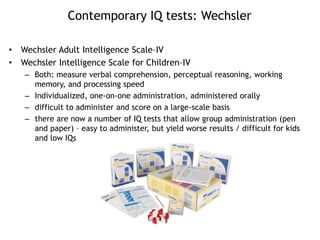
Contemporary IQ tests: Wechsler
• Wechsler Adult Intelligence Scale–IV
• Wechsler Intelligence Scale for Children–IV
– Both: measure verbal comprehension, perceptual reasoning, working
memory, and processing speed
– Individualized, one-on-one administration, administered orally
– difficult to administer and score on a large-scale basis
– there are now a number of IQ tests that allow group administration (pen
and paper) – easy to administer, but yield worse results / difficult for kids
and low IQs
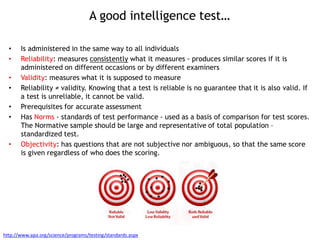
A good intelligence test…
• Is administered in the same way to all individuals
• Reliability: measures consistently what it measures - produces similar scores if it is
administered on different occasions or by different examiners
• Validity: measures what it is supposed to measure
• Reliability ≠ validity. Knowing that a test is reliable is no guarantee that it is also valid. If
a test is unreliable, it cannot be valid.
• Prerequisites for accurate assessment
• Has Norms - standards of test performance - used as a basis of comparison for test scores.
The Normative sample should be large and representative of total population –
standardized test.
• Objectivity: has questions that are not subjective nor ambiguous, so that the same score
is given regardless of who does the scoring.
http://www.apa.org/science/programs/testing/standards.aspx
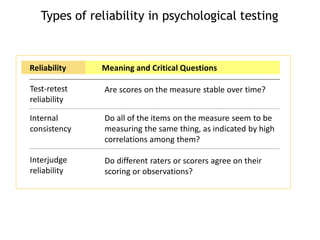
Types of reliability in psychological testing
Test-retest
reliability
Are scores on the measure stable over time?
Internal
consistency
Do all of the items on the measure seem to be
measuring the same thing, as indicated by high
correlations among them?
Interjudge
reliability
Do different raters or scorers agree on their
scoring or observations?
Reliability Meaning and Critical Questions
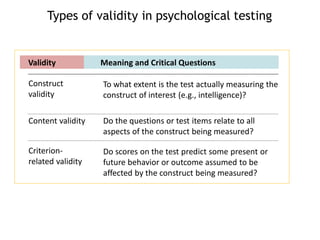
Types of validity in psychological testing
Construct
validity
To what extent is the test actually measuring the
construct of interest (e.g., intelligence)?
Content validity Do the questions or test items relate to all
aspects of the construct being measured?
Criterion-
related validity
Do scores on the test predict some present or
future behavior or outcome assumed to be
affected by the construct being measured?
Validity Meaning and Critical Questions
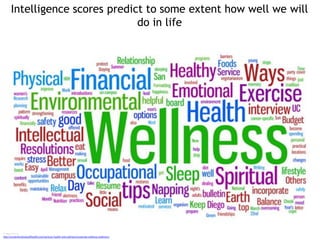
Intelligence scores predict to some extent how well we will
do in life
Image sources
http://centerforwholeselfhealth.com/services-health-and-wellness/corporate-wellness-webinars/
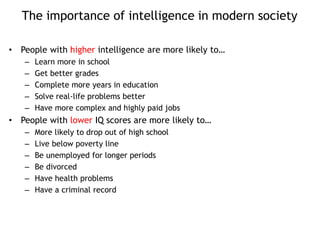
The importance of intelligence in modern society
• People with higher intelligence are more likely to…
– Learn more in school
– Get better grades
– Complete more years in education
– Solve real-life problems better
– Have more complex and highly paid jobs
• People with lower IQ scores are more likely to…
– More likely to drop out of high school
– Live below poverty line
– Be unemployed for longer periods
– Be divorced
– Have health problems
– Have a criminal record
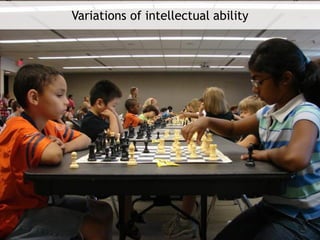
Variations of intellectual ability
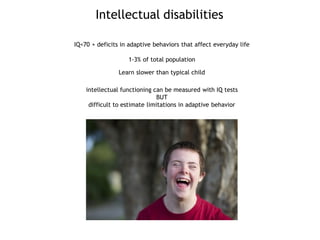
Intellectual disabilities
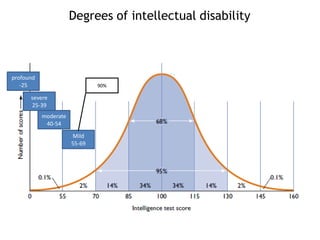
IQ<70 + deficits in adaptive behaviors that affect everyday life
intellectual functioning can be measured with IQ tests
BUT
difficult to estimate limitations in adaptive behavior
1-3% of total population
Learn slower than typical child
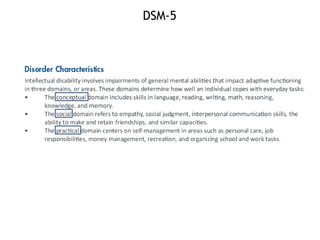
DSM-5
Degrees of intellectual disability
Mild
55-69
moderate
40-54
severe
25-39
profound
-25 90%
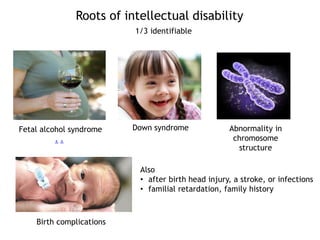
Roots of intellectual disability
Fetal alcohol syndrome
. .
Down syndrome Abnormality in
chromosome
structure
Birth complications
Also
• after birth head injury, a stroke, or infections
• familial retardation, family history
1/3 identifiable
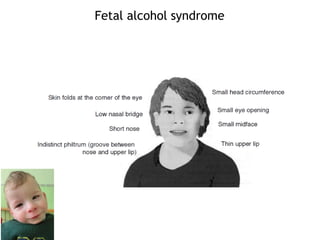
Fetal alcohol syndrome
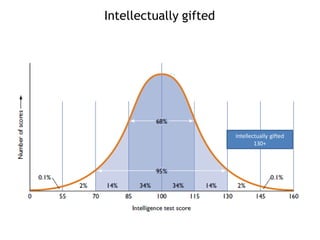
Intellectually gifted
130+
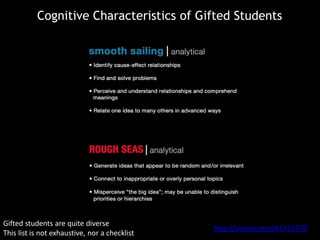
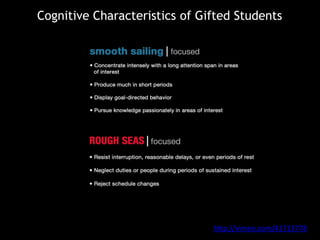
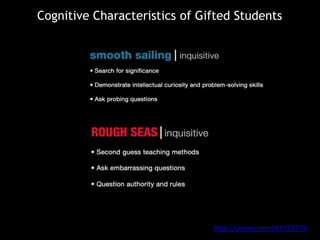
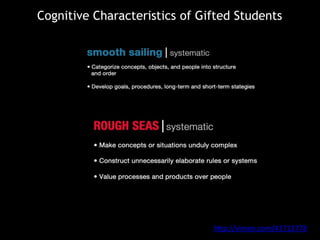
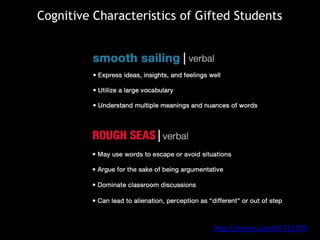
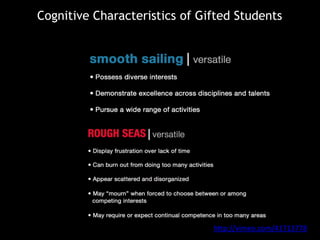
Cognitive Characteristics of Gifted Students
Gifted students are quite diverse
This list is not exhaustive, nor a checklist
http://vimeo.com/41713778
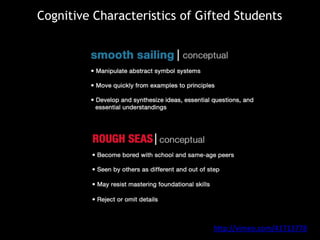
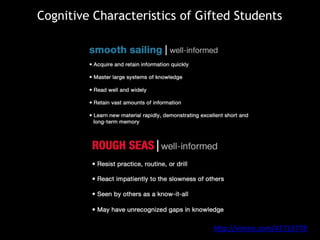
Cognitive Characteristics of Gifted Students
http://vimeo.com/41713778
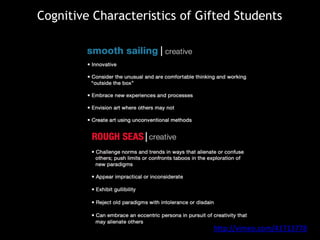
Cognitive Characteristics of Gifted Students
http://vimeo.com/41713778
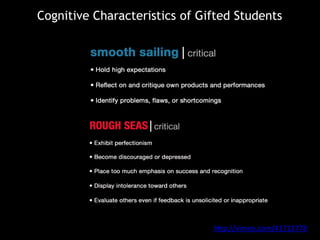
Cognitive Characteristics of Gifted Students
http://vimeo.com/41713778
Cognitive Characteristics of Gifted Students
http://vimeo.com/41713778
Cognitive Characteristics of Gifted Students
http://vimeo.com/41713778
Cognitive Characteristics of Gifted Students
http://vimeo.com/41713778
Cognitive Characteristics of Gifted Students
http://vimeo.com/41713778
Cognitive Characteristics of Gifted Students
http://vimeo.com/41713778
Cognitive Characteristics of Gifted Students
http://vimeo.com/41713778
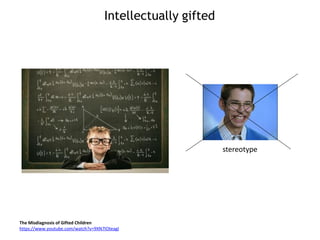
Intellectually gifted
The Misdiagnosis of Gifted Children
https://www.youtube.com/watch?v=9XN7IOteagI
stereotype
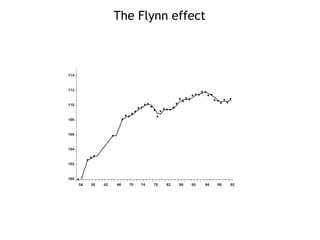
The Flynn effect
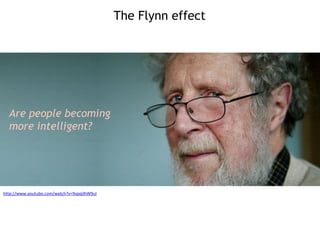
The Flynn effect
http://www.youtube.com/watch?v=9vpqilhW9uI
Are people becoming
more intelligent?

Intelligence

  • 1.
  • 2.
    What is Intelligence? Focalpoint for Psychologists • Adapt to environment • Differ from each other in terms of learning & understanding the world • Use resources of our environment
  • 3.
    The skills requiredto adapt successfully to environmental demands may differ from culture to culture, suggesting to some theorists that what constitutes intelligence may be somewhat culture-specific.
  • 4.
    Definition of intelligence Thecapacity to… understand the world think rationally use resources effectively when faced with challenges BUT: is intelligence a unitary characteristic? How many types of intelligence are there?
  • 5.
    Theories of intelligence Areyou good at math? At literature? At painting? At playing soccer? How many kinds of intelligence are there?
  • 6.
    Single general factor CharlesSpearman different types of measures of intelligence ranked test-takers in roughly the same order People who were good on one test generally were good on others a general, global intellectual ability underlying performance on the various measures provides basis for more specific abilities
  • 7.
    Fluid and crystallizedintelligence Fluid intelligence: ability to reason abstractly – think logically & solve problems in new situations, independent of acquired knowledge - devise strategies for dealing with new kinds of problems Crystallized intelligence: accumulation of information, skills, strategies that we have learned through experience - use previously learned information and skills
  • 8.
    At least 8independent types Gardner . linguistic logical-mathematical musical kinestheticinterpersonal naturalistic intrapersonal spatial (artistic)
  • 9.
    At least 8independent types • Linguistic : the ability to use language well, as writers do. • Logical-mathematical : the ability to reason mathematically and logically. • Visuospatial : the ability to solve spatial problems or to succeed in a field such as architecture. • Musical : the ability to perceive pitch and rhythm and to understand and produce music • Bodily-kinesthetic : the ability to control body movements and skillfully manipulate objects, as demonstrated by a highly skilled dancer, athlete, or surgeon. • Interpersonal : the ability to understand and relate well to others. • Intrapersonal : the ability to understand oneself. • Naturalistic : the ability to detect and understand phenomena in the natural world, as a zoologist or meteorologist might • Existential: identifying and thinking about the fundamental questions of human existence
  • 10.
    At least 8independent types • Each person has the same kinds of intelligence in different degrees. • These separate intelligences do not operate in isolation. Normally, any activity encompasses several kinds of intelligence working together. •  development of intelligence tests with questions in which more than one answer can be correct; these provide an opportunity for test takers to demonstrate creative thinking. • Gardner believes we should use intelligence tests to reinforce children’s strengths rather than to focus on forcing them to develop in their weakest areas. He argues that the current intelligence and aptitude tests predict at best how a child will perform in today’s linguistic and logical-mathematic schools. • Implications: if we focus only on some forms of intelligence, we often waste a portion of society by dumping all who are not skilled in those areas onto a societal scrap heap.
  • 11.
    Is information-processing intelligence? •the way we store information in memory and use it to solve intellectual tasks • processes involved in producing intelligent behavior • spend more time on the initial encoding stages of problems, identifying the parts of a problem and retrieving relevant information from long- term memory • speed of processing
  • 12.
    Biological basis ofintelligence Verbal and spatial juggling many pieces of info solving new problems Thickness of cerebral cortex  higher intelligence • tasks requiring different types of intelligence involve different areas of the brain • when tasks require more general global intelligence, more areas of the brain are involved • Global workspace that organizes information • rats raised in enriched environments  Complex connection between neurons • Metabolism • multiple areas of the brain, as well as multiple kinds of functioning, are related to intelligent behavior Using brain-scanning methods
  • 13.
    Practical intelligence Sternberg • relatedto overall success in living • traditional measures of intelligence do not relate well to career success • career success requires a different type of intelligence from that required for academic success • academic success is based on knowledge of a specific information base obtained from reading and listening; practical intelligence is learned through observation • ability to employ broad principles in solving everyday problems • ability to thrive in the real world, deal with everyday tasks Also related to life success • Analytical intelligence focuses on abstract but traditional types of problems measured on IQ tests, while • Creative intelligence involves the generation of novel ideas and products.
  • 14.
    Emotional intelligence • beaware of your emotions • read others’ emotions accurately • respond to others’ emotions appropriately • motivate yourself • regulate and control your emotional responses Daniel Goleman Introduces Emotional Intelligence 5 http://www.youtube.com/watch?v=Y7m9eNoB3NU Daniel Goleman Explains Emotional Intelligence 26 http://www.youtube.com/watch?v=NeJ3FF1yFyc Harvard Business Review: Social Intelligence and Leadership 10 http://www.youtube.com/watch?v=7Qv0o1oh9f4
  • 15.
    Assessing intelligence • Quantifylevel of intelligence • Variety of approaches  challenging to measure • Benefit: identify students in need of special attention; diagnose cognitive difficulties • Controversial, raising important social and educational issues. • First effort: size and shape of a person’s head
  • 16.
    • Intelligence testsare a small sample of some of the cognitive abilities that constitute intelligence. • Useful for predicting how well people will perform in situations that seem to require intelligence (e.g. school, job)
  • 17.
    Binet and thedevelopment of IQ tests • Designed to identify the “dullest” students in the Paris school system in order to provide them with remedial aid. • Premise: If performance on certain tasks improves with chronological age, performance can be used to distinguish more intelligent people from less intelligent ones within a particular age group. • Binet presented tasks to same-age students who had been labeled “bright” or “dull” by their teachers. • If a task could be completed by the bright students but not by the dull ones, he retained that task as a proper test item; otherwise it was discarded. • In the end he came up with a test that distinguished between bright and dull groups, and one that distinguished among children in different age groups. • Children were assigned a score relating to their mental age  indication of general level of performance. • However, it did not allow for adequate comparisons among people of different chronological ages. • Solution: intelligence quotient (IQ) • If mental age = chronological age  IQ = 100
  • 18.
    2/3 of allindividuals fall within 15 IQ points of the average score of 100 Today, the calculator of IQ scores is done in a more sophisticated manner and are known as deviation IQ scores. • the average test score for everyone of the same age who takes the test is determined • that average score is assigned an IQ of 100 • with the help of statistical techniques that calculate the differences (or “deviations”) between each score and the average, IQ scores are assigned • when IQ scores from large numbers of people are plotted on a graph, they form a bell-shaped distribution
  • 19.
    Drawing a Designfrom Memory • This is a test of attention, visual memory, and a little analysis. • The subject is told that two designs will be shown to him, which he will be allowed to look at for ten seconds, and which he must then draw from memory. The two designs are shown to him and left exposed for ten seconds. (Regulate the time by the second hand of a watch; the time must be exact within one or two seconds.) Then see that the subject commences the reproduction of the design without loss of time.
  • 20.
    Contemporary IQ tests:Stanford-Binet Intelligence Scale • Stanford-Binet Intelligence Scale V – series of items that vary according to the age of the person being tested (from everyday activities to analogies) – Individualized, one-on-one administration, administered orally – Includes verbal and non verbal assessments – An examiner begins by finding a mental age level at which a person is able to answer all the questions correctly and then moves on to successively more difficult problems. When a mental age level is reached at which no items can be answered, the test is over – By studying the pattern of correct and incorrect responses, the examiner is able to compute an IQ score – separate subscores that provide clues to a testtaker’s particular strengths and weaknesses
  • 21.
    Contemporary IQ tests:Wechsler • Wechsler Adult Intelligence Scale–IV • Wechsler Intelligence Scale for Children–IV – Both: measure verbal comprehension, perceptual reasoning, working memory, and processing speed – Individualized, one-on-one administration, administered orally – difficult to administer and score on a large-scale basis – there are now a number of IQ tests that allow group administration (pen and paper) – easy to administer, but yield worse results / difficult for kids and low IQs
  • 22.
    A good intelligencetest… • Is administered in the same way to all individuals • Reliability: measures consistently what it measures - produces similar scores if it is administered on different occasions or by different examiners • Validity: measures what it is supposed to measure • Reliability ≠ validity. Knowing that a test is reliable is no guarantee that it is also valid. If a test is unreliable, it cannot be valid. • Prerequisites for accurate assessment • Has Norms - standards of test performance - used as a basis of comparison for test scores. The Normative sample should be large and representative of total population – standardized test. • Objectivity: has questions that are not subjective nor ambiguous, so that the same score is given regardless of who does the scoring. http://www.apa.org/science/programs/testing/standards.aspx
  • 23.
    Types of reliabilityin psychological testing Test-retest reliability Are scores on the measure stable over time? Internal consistency Do all of the items on the measure seem to be measuring the same thing, as indicated by high correlations among them? Interjudge reliability Do different raters or scorers agree on their scoring or observations? Reliability Meaning and Critical Questions
  • 24.
    Types of validityin psychological testing Construct validity To what extent is the test actually measuring the construct of interest (e.g., intelligence)? Content validity Do the questions or test items relate to all aspects of the construct being measured? Criterion- related validity Do scores on the test predict some present or future behavior or outcome assumed to be affected by the construct being measured? Validity Meaning and Critical Questions
  • 25.
    Intelligence scores predictto some extent how well we will do in life Image sources http://centerforwholeselfhealth.com/services-health-and-wellness/corporate-wellness-webinars/
  • 26.
    The importance ofintelligence in modern society • People with higher intelligence are more likely to… – Learn more in school – Get better grades – Complete more years in education – Solve real-life problems better – Have more complex and highly paid jobs • People with lower IQ scores are more likely to… – More likely to drop out of high school – Live below poverty line – Be unemployed for longer periods – Be divorced – Have health problems – Have a criminal record
  • 27.
  • 28.
    Intellectual disabilities IQ<70 +deficits in adaptive behaviors that affect everyday life intellectual functioning can be measured with IQ tests BUT difficult to estimate limitations in adaptive behavior 1-3% of total population Learn slower than typical child
  • 29.
  • 30.
    Degrees of intellectualdisability Mild 55-69 moderate 40-54 severe 25-39 profound -25 90%
  • 31.
    Roots of intellectualdisability Fetal alcohol syndrome . . Down syndrome Abnormality in chromosome structure Birth complications Also • after birth head injury, a stroke, or infections • familial retardation, family history 1/3 identifiable
  • 32.
  • 33.
  • 34.
    Cognitive Characteristics ofGifted Students Gifted students are quite diverse This list is not exhaustive, nor a checklist http://vimeo.com/41713778
  • 35.
    Cognitive Characteristics ofGifted Students http://vimeo.com/41713778
  • 36.
    Cognitive Characteristics ofGifted Students http://vimeo.com/41713778
  • 37.
    Cognitive Characteristics ofGifted Students http://vimeo.com/41713778
  • 38.
    Cognitive Characteristics ofGifted Students http://vimeo.com/41713778
  • 39.
    Cognitive Characteristics ofGifted Students http://vimeo.com/41713778
  • 40.
    Cognitive Characteristics ofGifted Students http://vimeo.com/41713778
  • 41.
    Cognitive Characteristics ofGifted Students http://vimeo.com/41713778
  • 42.
    Cognitive Characteristics ofGifted Students http://vimeo.com/41713778
  • 43.
    Cognitive Characteristics ofGifted Students http://vimeo.com/41713778
  • 44.
  • 45.
    Intellectually gifted The Misdiagnosisof Gifted Children https://www.youtube.com/watch?v=9XN7IOteagI stereotype
  • 47.
  • 48.