Chapter 31
Intelligence The ability to acquire new ideas and new behavior and to adapt to new situations
Two-factor Theory of intelligence Proposes that a person’s intelligence is composed of a general ability level and specific mental abilities Proposed in 1904 by Charles Spearman Two factors contibute to a persons intelligence  G factor: a person’s general intelligence S factor: a person’s specific mental abilities
Thurstone’s Theory of Intelligence Gave large number of people more than 50 different ability test and conclude there was no evidence for the general intelligence that Spearman  had identified Believed a person’s intelligence needed to be a measurement of all 7 mental abilities and not just a measurement of one factor
7 factors of mental abilities Verbal ability Logical-mathematical reasoning skills Spatial ability Musical ability Body kinesthetic ability Interpersonal ability Intrapersonal ability
Gardner’s Theory of Multiple Intelligence Rejected traditional idea of intelligence as primarily the ability to think logically because it omits many important skills Added 8 th  type of intelligence: naturalistic ability
Sternberg’s Theory of Intelligence Triachic theory proposes that a person’s intelligence involves analytical, creative, and practical thinking skills Analytical: thinking  Creative: solving problems and dealing with new situations Practical: thinking skills to help adjust to and cope with one’s environment
Emotional Intelligence Interpersonal and intrapersonal abilities needed to understand and use knowledge of emotions effectively
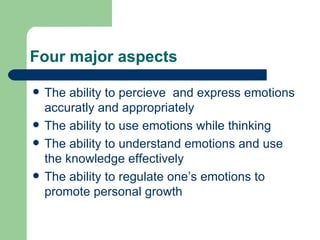
Four major aspects The ability to percieve  and express emotions accuratly and appropriately The ability to use emotions while thinking The ability to understand emotions and use the knowledge effectively The ability to regulate one’s emotions to promote personal growth
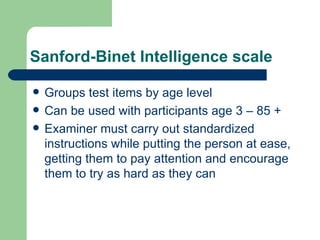
Sanford-Binet Intelligence scale Groups test items by age level Can be used with participants age 3 – 85 + Examiner must carry out standardized instructions while putting the person at ease, getting them to pay attention and encourage them to try as hard as they can
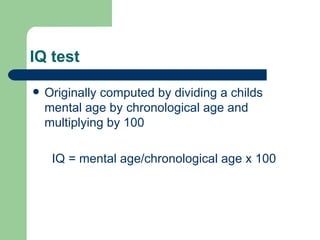
IQ test Originally computed by dividing a childs mental age by chronological age and multiplying by 100 IQ = mental age/chronological age x 100
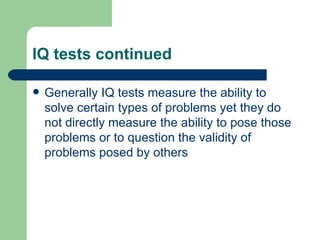
IQ tests continued Generally IQ tests measure the ability to solve certain types of problems yet they do not directly measure the ability to pose those problems or to question the validity of problems posed by others
The Wechsler Tests WAIS-III: adults age 16 to 89 WISC-IV: children age 6 to 16+ WPPSI-III:children age 2-6 Yields scores in several areas- vocabulary, information, arithmetic, picture arrangement Seprate scores for verbal and performance abilities Provides a more detailed picture of individuals strengths and weaknesses than a single score
The Uses and Meaning of IQ scores Most people score nean 100 95% score between 75 and 130 A little more than 2% score above 130 People who score below 70 have been classified as mentally handicapped Mildly handicapped(55-69) Moderately handicapped (40-54) Severely handicapped (25-39) Profoundly handicapped (below 25)
Nature vs. Nurture heritability: the degree to which a characteristics is related to inherited genetic factors Both heredity and environment have an impact on intelligence Advances in behavioral genetics research continue to refine results on the contributions that heredity and experience have on IQ

PSYIntelligence

  • 1.
  • 2.
    Intelligence The abilityto acquire new ideas and new behavior and to adapt to new situations
  • 3.
    Two-factor Theory ofintelligence Proposes that a person’s intelligence is composed of a general ability level and specific mental abilities Proposed in 1904 by Charles Spearman Two factors contibute to a persons intelligence G factor: a person’s general intelligence S factor: a person’s specific mental abilities
  • 4.
    Thurstone’s Theory ofIntelligence Gave large number of people more than 50 different ability test and conclude there was no evidence for the general intelligence that Spearman had identified Believed a person’s intelligence needed to be a measurement of all 7 mental abilities and not just a measurement of one factor
  • 5.
    7 factors ofmental abilities Verbal ability Logical-mathematical reasoning skills Spatial ability Musical ability Body kinesthetic ability Interpersonal ability Intrapersonal ability
  • 6.
    Gardner’s Theory ofMultiple Intelligence Rejected traditional idea of intelligence as primarily the ability to think logically because it omits many important skills Added 8 th type of intelligence: naturalistic ability
  • 7.
    Sternberg’s Theory ofIntelligence Triachic theory proposes that a person’s intelligence involves analytical, creative, and practical thinking skills Analytical: thinking Creative: solving problems and dealing with new situations Practical: thinking skills to help adjust to and cope with one’s environment
  • 8.
    Emotional Intelligence Interpersonaland intrapersonal abilities needed to understand and use knowledge of emotions effectively
  • 9.
    Four major aspectsThe ability to percieve and express emotions accuratly and appropriately The ability to use emotions while thinking The ability to understand emotions and use the knowledge effectively The ability to regulate one’s emotions to promote personal growth
  • 10.
    Sanford-Binet Intelligence scaleGroups test items by age level Can be used with participants age 3 – 85 + Examiner must carry out standardized instructions while putting the person at ease, getting them to pay attention and encourage them to try as hard as they can
  • 11.
    IQ test Originallycomputed by dividing a childs mental age by chronological age and multiplying by 100 IQ = mental age/chronological age x 100
  • 12.
    IQ tests continuedGenerally IQ tests measure the ability to solve certain types of problems yet they do not directly measure the ability to pose those problems or to question the validity of problems posed by others
  • 13.
    The Wechsler TestsWAIS-III: adults age 16 to 89 WISC-IV: children age 6 to 16+ WPPSI-III:children age 2-6 Yields scores in several areas- vocabulary, information, arithmetic, picture arrangement Seprate scores for verbal and performance abilities Provides a more detailed picture of individuals strengths and weaknesses than a single score
  • 14.
    The Uses andMeaning of IQ scores Most people score nean 100 95% score between 75 and 130 A little more than 2% score above 130 People who score below 70 have been classified as mentally handicapped Mildly handicapped(55-69) Moderately handicapped (40-54) Severely handicapped (25-39) Profoundly handicapped (below 25)
  • 15.
    Nature vs. Nurtureheritability: the degree to which a characteristics is related to inherited genetic factors Both heredity and environment have an impact on intelligence Advances in behavioral genetics research continue to refine results on the contributions that heredity and experience have on IQ