Presented by :
Pankaj soni
M.Pharm(1st sem)
Ph’Analysis
INTRODUCTION
Webster's dictionary defines impurity as something that is
impure or makes something else impure. An impure substance
may be defined as follows: a substance of interest mixed or
impregnated with an extraneous or usually inferior substance.
2
TERMINOLOOGY
COMMONLY USED TERMINOLOGY :
• Starting material(s)
• Intermediates
• Penultimate intermediate (Final intermediate)
• By-products
• Transformation products(similar to by-products)
• Interaction products
• Related products(similar to the drug substance)
• Degradation products
3
COMPENDIAL TERMINOLOGY :
▪ Foreign substances
▪ Toxic impurities
▪ Concomitant components
▪ Signal impurities
▪ Ordinary impurities
▪ Organic volatile impurities (OVIs)
4
A. Organic impurities
a. starting materials
b. Process-related impurities
c. Intermediates
d. Degradation products.
B. Inorganic impurities
a. Salts
b. Catalysts
c. Ligands
d. Heavy metals or other residual metals.
C. Other materials
a. Filter aids
b. Charcoal. 5
D. Residual solvents:
Organic and inorganic liquids used during
production and/or crystallization.
6
Identification and qualification
thresholds of impurities
The International Conference on Harmonisation addresses
questions relating to impurities as follows [6]:
Q1A (R) stability testing of new drug substances and
products
Q3A (R) impurities in drug substances
Q3B (R) impurities in drug products
Q3C impurities: residual solvents
Q6A specifications: test procedures and acceptance criteria
for new drug substances and new drug products; chemical
substances
7
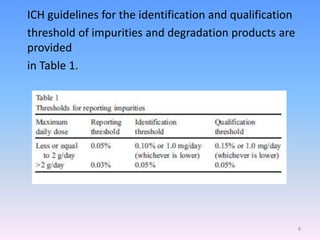
ICH guidelines for the identification and qualification
threshold of impurities and degradation products are
provided
in Table 1.
8
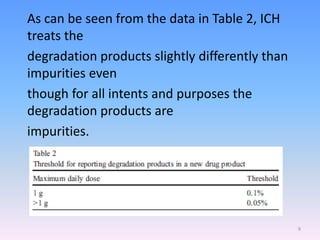
As can be seen from the data in Table 2, ICH
treats the
degradation products slightly differently than
impurities even
though for all intents and purposes the
degradation products are
impurities.
9
SOURCES OF IMPURITIES
Synthesis-related impurities :
Impurities in a drug substance or a new
chemical entity
(NCE) originate mainly during the synthetic
process from raw
materials, solvents, intermediates, and by-
products.
10
Formulation-related impurities:
A number of impurities in a drug product can
arise out of interactions with excipients used to
formulate a drug product.
Furthermore, in the process of formulation, a
drug substance is subjected to a variety of
conditions that can lead to its
degradation or other deleterious reactions. For
example,
if heat is used for drying or for other reasons, it
can facilitate degradation of thermally labile
drug substances.
Solutions and suspensions are potentially prone
to degradation
that is due to hydrolysis or solvolysis etc.
11
Degradation-related impurities
A number of impurities can be produced because of API
Degradation or other interactions on storage.
Therefore, it is very important to conduct stability studies
to predict, evaluate, and ensure drug product safety [7].
Stability studies include evaluation of stability of API,
preformulation studies to evaluate compatibility of API
with the excipients to determine its stability in the
formulation matrix, accelerated stability evaluations of
the test or final drug product, stability evaluation via
kinetic studies and
projection of expiration date, routine stability studies of
drug products in marketed, sample or dispensed package
under various conditions of temperature light, and
humidity
12
The stability studies under various exaggerated conditions of
temperature, humidity, and light can help us determine what
potential impurities can be produced by degradation reactions.
13
Selective analytical
methodologies
Development of a new drug mandates that meaningful and
reliable analytical data be generated at various steps of the
new drug development . Ensuring the safety of a new
pharmaceutical compound or drug requires that it meet the
established purity standards as a chemical entity or when
admixed with animal feeds for toxicity studies or
pharmaceutical excipients for human use.
Furthermore, it should exhibit excellent stability
throughout its shelf life. These requirements demand that the
analytical methodology that is used be sensitive enough to
measure low levels of impurities.
14
A variety of methods are available for
monitoring impurities.
The primary criterion is the ability to
differentiate between the compounds of
interest.
This requirement reduces the availability
of methods primarily to spectroscopic and
separation methods or a combination
thereof.
15
Spectroscopic methods
The following spectroscopic methods can be
used:
▪ Ultraviolet (UV)
▪ Infrared (IR)
▪ Nuclear magnetic resonance (NMR)
▪ Mass spectrometry (MS)
16
SEPARATION METHODS
The following separation methods can be
used:
▪ Thin-layer chromatography (TLC)
▪ Gas chromatography (GC)
▪ High-pressure liquid chromatography (HPLC)
▪ Capillary electrophoresis (CE)
▪ Supercritical fluid chromatography (SFC)
17
TLC: A broad range of compounds can be resolved using
TLC by utilizing a variety of different plates and mobile
phases. The primary difficulties related to this method are
limited resolution, detection, and ease of quantification. The
greatest advantages are the ease of use and low cost.
GC: Gas chromatography is a very useful technique for
quantification.
It can provide the desired resolution, selectivity, and
ease of quantification. However, the primary limitation is
that the sample must be volatile or has to be made volatile
by derivatization. This technique is very useful for organic
volatile impurities.
HPLC: This is a useful technique with applications that have
been significantly extended for the pharmaceutical chemist
by the use of a variety of detectors such as fluorescence,
electrometric, MS, etc
18
Capillary electrophoresis : a useful technique
when very low quantities of samples are available
and high resolution is required. The primary
difficulty is assuring reproducibility of
the injected samples.
Supercritical fluid chromatography: offers some of
the advantages of GC in terms of detection and
HPLC in terms of separations, in that volatility of
the sample is not of paramount importance. This
technique is still evolving, and its greatest
application has been found in the extraction of
samples.
19
Hyphenated methods
▪ GC–MS
▪ LC–MS
▪ LC–DAD–MS
▪ LC–NMR
▪ LC–DAD–NMR–MS
▪ LC–MS–MS
20
Impurity profiling
The name impurity profiling is commonly reflected to be a set of
analytical
activities targeting at the detection, identification or structure
characterisation and
quantitative estimation of organic, inorganic impurities, and
residual solvents, in drug
substances as well as in a drug products.
Reporting, identification and qualification of
impurities are required for determining the biological safety of
each impurity.
21
Samples to be profiled :
Impurity profiling should be done for the
following samples:
▪ Active ingredient
▪ Process check (synthesis or formulation)
▪ Final product.
22
Components seen in a profile :
Ideally, an impurity profile should show the
following:
▪ Synthesis-related impurities
▪ Formulation-related impurities
▪ Degradation products
▪ Interaction products
23
Isolating impurities
The following methods have been used for isolation of
impurities:
▪ Solid-phase extraction
▪ Liquid–liquid extraction
▪ Accelerated solvent extraction
▪ Supercritical fluid extraction
▪ Column chromatography
▪ Flash chromatography
▪ Thin-layer chromatography
▪ Gas chromatography
▪ High-pressure liquid chromatography
▪ Capillary electrophoresis
▪ Supercritical fluid chromatography.
24
Isolation should be initiated based on simple
extraction or partition methods. It may be possible to
extract impurities selectively on the basis of acidity,
basicity, or neutrality.
The extraction process usually involves liquid–liquid
extraction, where one phase is an aqueous solution
and the other is an organic phase that is nonpolar.
By appropriate adjustment of the pH of the aqueous
solution, one can extract acidic, basic, or neutral
impurities. Further separations can be made by
chromatographic methods. Frequently, the isolation
methods tend to be the same methods that are used
for analysis.
25
Characterization of impurities
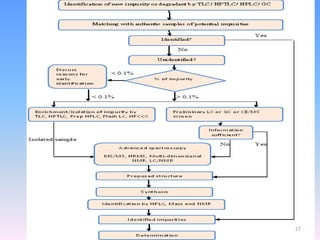
The characterization of impurities is generally achieved by
the following means:
▪ Matching retention data
▪ UV
▪ IR
▪ NMR
▪ MS
Once an impurity has been detected, it becomes necessary to
estimate its content. Detectability frequently means that a
given component provides a signal at least twice that of
background noise or the baseline.
26
27
Application of Impurity Profiling
Numerous applications have been sought in the areas
of drug designing and in monitoring quality, stability,
and safety of pharmaceutical compounds, whether
produced synthetically, extracted from natural
products or produced by recombinant methods.
The applications include alkaloids, amines, amino
acids, analgesics, antibacterials, anticonvulsants,
antidepressant, tranquilizers, antineoplastic agents,
local anesthetics, macromolecules, steroids etc.
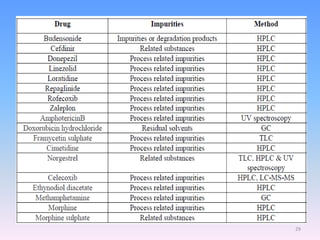
Some commonly found impurities in drug and their
identification method are:
28
29
30

Basics of Impurity Profiling

  • 1.
    Presented by : Pankajsoni M.Pharm(1st sem) Ph’Analysis
  • 2.
    INTRODUCTION Webster's dictionary definesimpurity as something that is impure or makes something else impure. An impure substance may be defined as follows: a substance of interest mixed or impregnated with an extraneous or usually inferior substance. 2
  • 3.
    TERMINOLOOGY COMMONLY USED TERMINOLOGY: • Starting material(s) • Intermediates • Penultimate intermediate (Final intermediate) • By-products • Transformation products(similar to by-products) • Interaction products • Related products(similar to the drug substance) • Degradation products 3
  • 4.
    COMPENDIAL TERMINOLOGY : ▪Foreign substances ▪ Toxic impurities ▪ Concomitant components ▪ Signal impurities ▪ Ordinary impurities ▪ Organic volatile impurities (OVIs) 4
  • 5.
    A. Organic impurities a.starting materials b. Process-related impurities c. Intermediates d. Degradation products. B. Inorganic impurities a. Salts b. Catalysts c. Ligands d. Heavy metals or other residual metals. C. Other materials a. Filter aids b. Charcoal. 5
  • 6.
    D. Residual solvents: Organicand inorganic liquids used during production and/or crystallization. 6
  • 7.
    Identification and qualification thresholdsof impurities The International Conference on Harmonisation addresses questions relating to impurities as follows [6]: Q1A (R) stability testing of new drug substances and products Q3A (R) impurities in drug substances Q3B (R) impurities in drug products Q3C impurities: residual solvents Q6A specifications: test procedures and acceptance criteria for new drug substances and new drug products; chemical substances 7
  • 8.
    ICH guidelines forthe identification and qualification threshold of impurities and degradation products are provided in Table 1. 8
  • 9.
    As can beseen from the data in Table 2, ICH treats the degradation products slightly differently than impurities even though for all intents and purposes the degradation products are impurities. 9
  • 10.
    SOURCES OF IMPURITIES Synthesis-relatedimpurities : Impurities in a drug substance or a new chemical entity (NCE) originate mainly during the synthetic process from raw materials, solvents, intermediates, and by- products. 10
  • 11.
    Formulation-related impurities: A numberof impurities in a drug product can arise out of interactions with excipients used to formulate a drug product. Furthermore, in the process of formulation, a drug substance is subjected to a variety of conditions that can lead to its degradation or other deleterious reactions. For example, if heat is used for drying or for other reasons, it can facilitate degradation of thermally labile drug substances. Solutions and suspensions are potentially prone to degradation that is due to hydrolysis or solvolysis etc. 11
  • 12.
    Degradation-related impurities A numberof impurities can be produced because of API Degradation or other interactions on storage. Therefore, it is very important to conduct stability studies to predict, evaluate, and ensure drug product safety [7]. Stability studies include evaluation of stability of API, preformulation studies to evaluate compatibility of API with the excipients to determine its stability in the formulation matrix, accelerated stability evaluations of the test or final drug product, stability evaluation via kinetic studies and projection of expiration date, routine stability studies of drug products in marketed, sample or dispensed package under various conditions of temperature light, and humidity 12
  • 13.
    The stability studiesunder various exaggerated conditions of temperature, humidity, and light can help us determine what potential impurities can be produced by degradation reactions. 13
  • 14.
    Selective analytical methodologies Development ofa new drug mandates that meaningful and reliable analytical data be generated at various steps of the new drug development . Ensuring the safety of a new pharmaceutical compound or drug requires that it meet the established purity standards as a chemical entity or when admixed with animal feeds for toxicity studies or pharmaceutical excipients for human use. Furthermore, it should exhibit excellent stability throughout its shelf life. These requirements demand that the analytical methodology that is used be sensitive enough to measure low levels of impurities. 14
  • 15.
    A variety ofmethods are available for monitoring impurities. The primary criterion is the ability to differentiate between the compounds of interest. This requirement reduces the availability of methods primarily to spectroscopic and separation methods or a combination thereof. 15
  • 16.
    Spectroscopic methods The followingspectroscopic methods can be used: ▪ Ultraviolet (UV) ▪ Infrared (IR) ▪ Nuclear magnetic resonance (NMR) ▪ Mass spectrometry (MS) 16
  • 17.
    SEPARATION METHODS The followingseparation methods can be used: ▪ Thin-layer chromatography (TLC) ▪ Gas chromatography (GC) ▪ High-pressure liquid chromatography (HPLC) ▪ Capillary electrophoresis (CE) ▪ Supercritical fluid chromatography (SFC) 17
  • 18.
    TLC: A broadrange of compounds can be resolved using TLC by utilizing a variety of different plates and mobile phases. The primary difficulties related to this method are limited resolution, detection, and ease of quantification. The greatest advantages are the ease of use and low cost. GC: Gas chromatography is a very useful technique for quantification. It can provide the desired resolution, selectivity, and ease of quantification. However, the primary limitation is that the sample must be volatile or has to be made volatile by derivatization. This technique is very useful for organic volatile impurities. HPLC: This is a useful technique with applications that have been significantly extended for the pharmaceutical chemist by the use of a variety of detectors such as fluorescence, electrometric, MS, etc 18
  • 19.
    Capillary electrophoresis :a useful technique when very low quantities of samples are available and high resolution is required. The primary difficulty is assuring reproducibility of the injected samples. Supercritical fluid chromatography: offers some of the advantages of GC in terms of detection and HPLC in terms of separations, in that volatility of the sample is not of paramount importance. This technique is still evolving, and its greatest application has been found in the extraction of samples. 19
  • 20.
    Hyphenated methods ▪ GC–MS ▪LC–MS ▪ LC–DAD–MS ▪ LC–NMR ▪ LC–DAD–NMR–MS ▪ LC–MS–MS 20
  • 21.
    Impurity profiling The nameimpurity profiling is commonly reflected to be a set of analytical activities targeting at the detection, identification or structure characterisation and quantitative estimation of organic, inorganic impurities, and residual solvents, in drug substances as well as in a drug products. Reporting, identification and qualification of impurities are required for determining the biological safety of each impurity. 21
  • 22.
    Samples to beprofiled : Impurity profiling should be done for the following samples: ▪ Active ingredient ▪ Process check (synthesis or formulation) ▪ Final product. 22
  • 23.
    Components seen ina profile : Ideally, an impurity profile should show the following: ▪ Synthesis-related impurities ▪ Formulation-related impurities ▪ Degradation products ▪ Interaction products 23
  • 24.
    Isolating impurities The followingmethods have been used for isolation of impurities: ▪ Solid-phase extraction ▪ Liquid–liquid extraction ▪ Accelerated solvent extraction ▪ Supercritical fluid extraction ▪ Column chromatography ▪ Flash chromatography ▪ Thin-layer chromatography ▪ Gas chromatography ▪ High-pressure liquid chromatography ▪ Capillary electrophoresis ▪ Supercritical fluid chromatography. 24
  • 25.
    Isolation should beinitiated based on simple extraction or partition methods. It may be possible to extract impurities selectively on the basis of acidity, basicity, or neutrality. The extraction process usually involves liquid–liquid extraction, where one phase is an aqueous solution and the other is an organic phase that is nonpolar. By appropriate adjustment of the pH of the aqueous solution, one can extract acidic, basic, or neutral impurities. Further separations can be made by chromatographic methods. Frequently, the isolation methods tend to be the same methods that are used for analysis. 25
  • 26.
    Characterization of impurities Thecharacterization of impurities is generally achieved by the following means: ▪ Matching retention data ▪ UV ▪ IR ▪ NMR ▪ MS Once an impurity has been detected, it becomes necessary to estimate its content. Detectability frequently means that a given component provides a signal at least twice that of background noise or the baseline. 26
  • 27.
  • 28.
    Application of ImpurityProfiling Numerous applications have been sought in the areas of drug designing and in monitoring quality, stability, and safety of pharmaceutical compounds, whether produced synthetically, extracted from natural products or produced by recombinant methods. The applications include alkaloids, amines, amino acids, analgesics, antibacterials, anticonvulsants, antidepressant, tranquilizers, antineoplastic agents, local anesthetics, macromolecules, steroids etc. Some commonly found impurities in drug and their identification method are: 28
  • 29.
  • 30.