MASS ANALYSER
BY-VASUNDHRA KAKKAR
M.PHARM(PARMACEUTICS)
SEMESTER-1
MASS ANALYSER
• Mass spectrometry is an analytic method that employs
ionization and mass analysis of compounds to determine the
mass, formula and structure of the compound being analyzed.
• A mass analyzer is the component of the mass spectrometer
that takes ionized masses and separates them based on mass
to charge ratios and outputs them to the detector where they
are detected and later converted to a digital output.
MAGNETIC SECTOR MASS ANALYSER
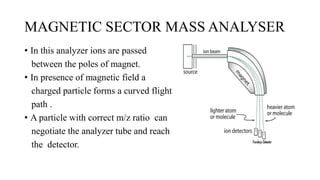
• In this analyzer ions are passed
between the poles of magnet.
• In presence of magnetic field a
charged particle forms a curved flight
path .
• A particle with correct m/z ratio can
negotiate the analyzer tube and reach
the detector.
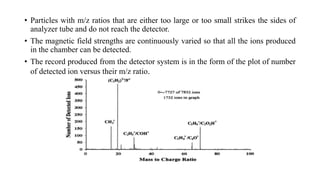
• Particles with m/z ratios that are either too large or too small strikes the sides of
analyzer tube and do not reach the detector.
• The magnetic field strengths are continuously varied so that all the ions produced
in the chamber can be detected.
• The record produced from the detector system is in the form of the plot of number
of detected ion versus their m/z ratio.
DOUBLE FOCUSSING MASS ANALYZER
• Particles leaving the ionizing chamber
do not all have precisely the same
velocity.
• In presence of electric field, the
particles travel at same velocity.
• Particles forms curved path in each
of these region.
• The resolution of the mass analyzer
improves-by a factor of 10 or more
over the magnetic sector alone.
QUADROUPOLE MASS ANALYSER
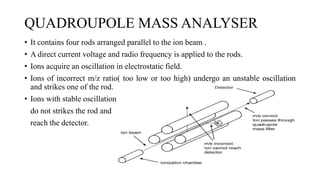
• It contains four rods arranged parallel to the ion beam .
• A direct current voltage and radio frequency is applied to the rods.
• Ions acquire an oscillation in electrostatic field.
• Ions of incorrect m/z ratio( too low or too high) undergo an unstable oscillation
and strikes one of the rod.
• Ions with stable oscillation
do not strikes the rod and
reach the detector.
TIME OF FLIGHT MASS ANALYSER
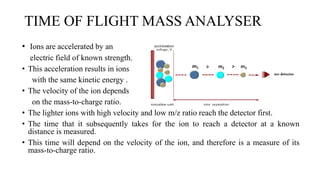
• Ions are accelerated by an
electric field of known strength.
• This acceleration results in ions
with the same kinetic energy .
• The velocity of the ion depends
on the mass-to-charge ratio.
• The lighter ions with high velocity and low m/z ratio reach the detector first.
• The time that it subsequently takes for the ion to reach a detector at a known
distance is measured.
• This time will depend on the velocity of the ion, and therefore is a measure of its
mass-to-charge ratio.
ION CYCLOTRON RESONANCE
• In this analyzer there is no separation that occurs rather all the ions of a
particular range are trapped inside, and an applied external electric field
helps to generate a signal.
• When a moving charge enters a magnetic field, it experiences a centripetal
force making the ion orbit. Again the force on the ion due to the magnetic
field is equal to the centripetal force on the ion.
• Frequency of the orbit depends on the charge and mass of the ions, not the
velocity.
• If the magnetic field is held constant, the charge to mass ratio of each ion
can be determined by measuring the angular velocity.
• To generate electric signal from trapped ions a varied electric field is
applied.
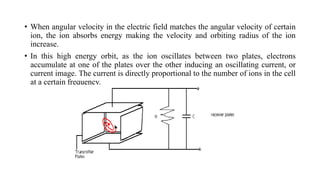
• When angular velocity in the electric field matches the angular velocity of certain
ion, the ion absorbs energy making the velocity and orbiting radius of the ion
increase.
• In this high energy orbit, as the ion oscillates between two plates, electrons
accumulate at one of the plates over the other inducing an oscillating current, or
current image. The current is directly proportional to the number of ions in the cell
at a certain frequency.
Mass analyser
Mass analyser

Mass analyser

  • 1.
  • 2.
    MASS ANALYSER • Massspectrometry is an analytic method that employs ionization and mass analysis of compounds to determine the mass, formula and structure of the compound being analyzed. • A mass analyzer is the component of the mass spectrometer that takes ionized masses and separates them based on mass to charge ratios and outputs them to the detector where they are detected and later converted to a digital output.
  • 3.
    MAGNETIC SECTOR MASSANALYSER • In this analyzer ions are passed between the poles of magnet. • In presence of magnetic field a charged particle forms a curved flight path . • A particle with correct m/z ratio can negotiate the analyzer tube and reach the detector.
  • 4.
    • Particles withm/z ratios that are either too large or too small strikes the sides of analyzer tube and do not reach the detector. • The magnetic field strengths are continuously varied so that all the ions produced in the chamber can be detected. • The record produced from the detector system is in the form of the plot of number of detected ion versus their m/z ratio.
  • 5.
    DOUBLE FOCUSSING MASSANALYZER • Particles leaving the ionizing chamber do not all have precisely the same velocity. • In presence of electric field, the particles travel at same velocity. • Particles forms curved path in each of these region. • The resolution of the mass analyzer improves-by a factor of 10 or more over the magnetic sector alone.
  • 6.
    QUADROUPOLE MASS ANALYSER •It contains four rods arranged parallel to the ion beam . • A direct current voltage and radio frequency is applied to the rods. • Ions acquire an oscillation in electrostatic field. • Ions of incorrect m/z ratio( too low or too high) undergo an unstable oscillation and strikes one of the rod. • Ions with stable oscillation do not strikes the rod and reach the detector.
  • 7.
    TIME OF FLIGHTMASS ANALYSER • Ions are accelerated by an electric field of known strength. • This acceleration results in ions with the same kinetic energy . • The velocity of the ion depends on the mass-to-charge ratio. • The lighter ions with high velocity and low m/z ratio reach the detector first. • The time that it subsequently takes for the ion to reach a detector at a known distance is measured. • This time will depend on the velocity of the ion, and therefore is a measure of its mass-to-charge ratio.
  • 8.
    ION CYCLOTRON RESONANCE •In this analyzer there is no separation that occurs rather all the ions of a particular range are trapped inside, and an applied external electric field helps to generate a signal. • When a moving charge enters a magnetic field, it experiences a centripetal force making the ion orbit. Again the force on the ion due to the magnetic field is equal to the centripetal force on the ion. • Frequency of the orbit depends on the charge and mass of the ions, not the velocity. • If the magnetic field is held constant, the charge to mass ratio of each ion can be determined by measuring the angular velocity. • To generate electric signal from trapped ions a varied electric field is applied.
  • 9.
    • When angularvelocity in the electric field matches the angular velocity of certain ion, the ion absorbs energy making the velocity and orbiting radius of the ion increase. • In this high energy orbit, as the ion oscillates between two plates, electrons accumulate at one of the plates over the other inducing an oscillating current, or current image. The current is directly proportional to the number of ions in the cell at a certain frequency.