CHECKLIST
Presentation By Group 1
Torcino, J
Elegio, C
Alao, S
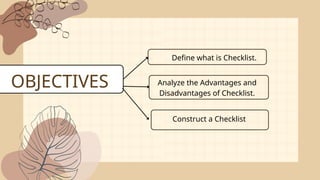
OBJECTIVES
Define what is Checklist.
Analyze the Advantages and
Disadvantages of Checklist.
Construct a Checklist
WHAT IS A CHECKLIST?
• is an assessment tool that lists the specific criteria
fortheskills,behaviors,orattitudes
• It is a list of all the things that you need to do,
information that you want to find out, or things that
you need totakesomewhere.
WHAT IS A CHECKLIST?
• It is also used to monitor jobs or projects and ensure that
nothingimportanthasbeenforgotten duringexecution.
• It usually features statements or questions about the
participant’s performance of each criteria. Answer
choicesaregenerally limitedto “Yes”or “No”
ADVANTAGES
• Easy to construct and use.
• Align closely with tasks.
• Effective for self and peer
assessment.
• Make learners aware of task
requirements, allowing them
to self-monitor progress.
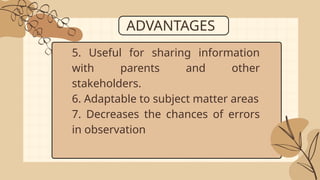
ADVANTAGES
5. Useful for sharing information
with parents and other
stakeholders.
6. Adaptable to subject matter areas
7. Decreases the chances of errors
in observation
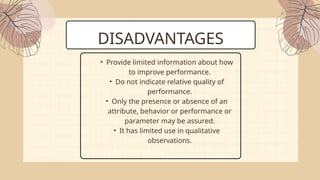
DISADVANTAGES
• Provide limited information about how
to improve performance.
• Do not indicate relative quality of
performance.
• Only the presence or absence of an
attribute, behavior or performance or
parameter may be assured.
• It has limited use in qualitative
observations.
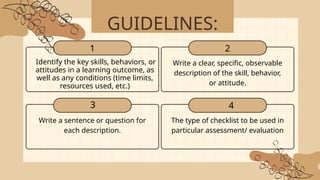
GUIDELINES:
Identify the key skills, behaviors, or
attitudes in a learning outcome, as
well as any conditions (time limits,
resources used, etc.)
1
Write a clear, specific, observable
description of the skill, behavior,
or attitude.
Write a sentence or question for
each description.
The type of checklist to be used in
particular assessment/ evaluation
2
3 4
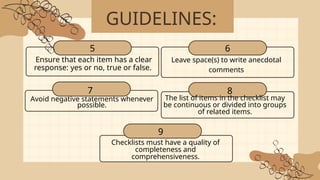
GUIDELINES:
Ensure that each item has a clear
response: yes or no, true or false.
5
Leave space(s) to write anecdotal
comments
Avoid negative statements whenever
possible.
The list of items in the checklist may
be continuous or divided into groups
of related items.
6
7 8
Checklists must have a quality of
completeness and
comprehensiveness.
9
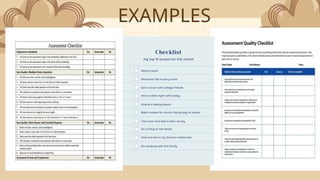
EXAMPLES
SUMMARY
• Checklist an effective tool for improving efficiency
and reducing errors in various areas of life.
• usually feature statements or questions about the
participant’s performance against each criteria.
• Instructors and peers can use checklists to record
their observations during participant
demonstrations or performances.
QUIZ
1–3. Explain what a checklist is.
4-6. Enumerate and explain at least three advantages
of a checklist.
7-8. Enumerate and explain at least two disadvantages
of a checklist.
9–10. Create a checklist about your career plan.
ESSAY
THANK YOU

Checklist technology for teaching .pptx

  • 1.
    CHECKLIST Presentation By Group1 Torcino, J Elegio, C Alao, S
  • 2.
    OBJECTIVES Define what isChecklist. Analyze the Advantages and Disadvantages of Checklist. Construct a Checklist
  • 3.
    WHAT IS ACHECKLIST? • is an assessment tool that lists the specific criteria fortheskills,behaviors,orattitudes • It is a list of all the things that you need to do, information that you want to find out, or things that you need totakesomewhere.
  • 4.
    WHAT IS ACHECKLIST? • It is also used to monitor jobs or projects and ensure that nothingimportanthasbeenforgotten duringexecution. • It usually features statements or questions about the participant’s performance of each criteria. Answer choicesaregenerally limitedto “Yes”or “No”
  • 5.
    ADVANTAGES • Easy toconstruct and use. • Align closely with tasks. • Effective for self and peer assessment. • Make learners aware of task requirements, allowing them to self-monitor progress.
  • 6.
    ADVANTAGES 5. Useful forsharing information with parents and other stakeholders. 6. Adaptable to subject matter areas 7. Decreases the chances of errors in observation
  • 7.
    DISADVANTAGES • Provide limitedinformation about how to improve performance. • Do not indicate relative quality of performance. • Only the presence or absence of an attribute, behavior or performance or parameter may be assured. • It has limited use in qualitative observations.
  • 8.
    GUIDELINES: Identify the keyskills, behaviors, or attitudes in a learning outcome, as well as any conditions (time limits, resources used, etc.) 1 Write a clear, specific, observable description of the skill, behavior, or attitude. Write a sentence or question for each description. The type of checklist to be used in particular assessment/ evaluation 2 3 4
  • 9.
    GUIDELINES: Ensure that eachitem has a clear response: yes or no, true or false. 5 Leave space(s) to write anecdotal comments Avoid negative statements whenever possible. The list of items in the checklist may be continuous or divided into groups of related items. 6 7 8 Checklists must have a quality of completeness and comprehensiveness. 9
  • 10.
  • 11.
    SUMMARY • Checklist aneffective tool for improving efficiency and reducing errors in various areas of life. • usually feature statements or questions about the participant’s performance against each criteria. • Instructors and peers can use checklists to record their observations during participant demonstrations or performances.
  • 12.
    QUIZ 1–3. Explain whata checklist is. 4-6. Enumerate and explain at least three advantages of a checklist. 7-8. Enumerate and explain at least two disadvantages of a checklist. 9–10. Create a checklist about your career plan. ESSAY
  • 13.