SHORT ANSWER
QUESTIONS
(SAQ)
Presented by
Rahul Gusain
Msc (N) Ist year
Objective
•Define the short answer questions
•Principles
•Formulate the structure of question
•Enlist the advantages of SAQ
•Enlist the disadvantages of SAQ
•Explain the Examples of SAQ.
Definition
• Short answer questions (SAQ) are open ended
question that require students to create an
answer, rather than choose from a selection of
responses.
• They are commonly used in examination to
assess the basic knowledge and understanding
of a topic before more in depth assessment
question.
Principles
• Use action oriented precise verbs.
• Each item should deal with important content
area.
• Use precise, simple and accurate language in
relation to the subject matter area.
• Provide the necessary space for answers below
each question asked.
Structure of short answer
• Design for recall of specific names, facts, and basic
knowledge.
• Focus the question so there a limited number of
possible correct responses (or only one) in order to
discriminate achievement.
• Word item so that the required answer is both brief and
specific.
• When completion items are used, do not include too
many blanks.
Contd…
• When a negative item is used, emphasize the negative
word or phrase, that is, underline, capitalize, or
italicize, for example, "DOES NOT.“
• SAQ tend to test the lower levels of the cognitive
domain and assess mainly knowledge, comprehension
and some application.
• They are most effective when there can be no
disagreement about acceptable answers.
Advantages
• Easy to score, reliability of the score is improved,
quick response.
• Reduces possibility of guessing.
• Better content coverage as compared to long essay
question.
• Improved objectivity as the marking scheme can be
structured and predetermined
• Higher chances for assessment of clinical reasoning.
Disadvantage
• Correct responses may appear incorrect due to
minor errors such as misspellings, order of
words, etc.
• It is not suitable for measuring complex
learning outcome.
• It is not suitable for judging the power of
analyzing and reasoning of the student.
• If a large amount of knowledge needs to be
tested, it is more efficient to use MCQs.
Examples
Good Example of a Short Answer Question
• What is the name of the man discovered
penicillin?
• Answer: The name of the person who
discovered penicillin is Alexander Fleming.
Bad Example of a ShortAnswer Question
• What does the acronym ENIAC mean?
• Answer: Electronic Numerical Integrator and
Calculator
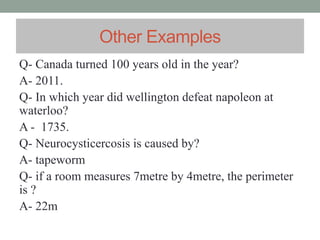
Other Examples
Q- Canada turned 100 years old in the year?
A- 2011.
Q- In which year did wellington defeat napoleon at
waterloo?
A - 1735.
Q- Neurocysticercosis is caused by?
A- tapeworm
Q- if a room measures 7metre by 4metre, the perimeter
is ?
A- 22m
Summary
conclusion
Short answer questions

Short answer questions

  • 1.
  • 2.
    Objective •Define the shortanswer questions •Principles •Formulate the structure of question •Enlist the advantages of SAQ •Enlist the disadvantages of SAQ •Explain the Examples of SAQ.
  • 3.
    Definition • Short answerquestions (SAQ) are open ended question that require students to create an answer, rather than choose from a selection of responses. • They are commonly used in examination to assess the basic knowledge and understanding of a topic before more in depth assessment question.
  • 4.
    Principles • Use actionoriented precise verbs. • Each item should deal with important content area. • Use precise, simple and accurate language in relation to the subject matter area. • Provide the necessary space for answers below each question asked.
  • 5.
    Structure of shortanswer • Design for recall of specific names, facts, and basic knowledge. • Focus the question so there a limited number of possible correct responses (or only one) in order to discriminate achievement. • Word item so that the required answer is both brief and specific. • When completion items are used, do not include too many blanks.
  • 6.
    Contd… • When anegative item is used, emphasize the negative word or phrase, that is, underline, capitalize, or italicize, for example, "DOES NOT.“ • SAQ tend to test the lower levels of the cognitive domain and assess mainly knowledge, comprehension and some application. • They are most effective when there can be no disagreement about acceptable answers.
  • 7.
    Advantages • Easy toscore, reliability of the score is improved, quick response. • Reduces possibility of guessing. • Better content coverage as compared to long essay question. • Improved objectivity as the marking scheme can be structured and predetermined • Higher chances for assessment of clinical reasoning.
  • 8.
    Disadvantage • Correct responsesmay appear incorrect due to minor errors such as misspellings, order of words, etc. • It is not suitable for measuring complex learning outcome. • It is not suitable for judging the power of analyzing and reasoning of the student. • If a large amount of knowledge needs to be tested, it is more efficient to use MCQs.
  • 9.
    Examples Good Example ofa Short Answer Question • What is the name of the man discovered penicillin? • Answer: The name of the person who discovered penicillin is Alexander Fleming.
  • 10.
    Bad Example ofa ShortAnswer Question • What does the acronym ENIAC mean? • Answer: Electronic Numerical Integrator and Calculator
  • 11.
    Other Examples Q- Canadaturned 100 years old in the year? A- 2011. Q- In which year did wellington defeat napoleon at waterloo? A - 1735. Q- Neurocysticercosis is caused by? A- tapeworm Q- if a room measures 7metre by 4metre, the perimeter is ? A- 22m
  • 12.
  • 13.