 Research tool can be defined as the instrument
in the hands of researchers to measure what
they intend to in their study.
 Research tools are materials that are necessary
to preform research. All inventions,
discoveries and knowledge can become
research tools.
 Research is a systematic study or investigation
of something for the purpose of answering
question post by a researcher.
 After this presentation you will be able to :
 State different types of tools and techniques
used for data collection
 Distinguish the basic difference between tools
and techniques.
 Describe concept, purpose and uses of various
tools and techniques in research.
 State the tools coming under inquiry form,
psychological test
 observation and Interview.
 Different tools are suitable for collecting
various kinds of information for various
purposes.
 The research worker may use one or more of
the tools in combination for his purpose.
 The systematic way and procedure by which a
complex or scientific task is accomplished is
known as the technique.
 The selection of any method for collecting data
must balance reliability and validity.
Reliability
 The researcher should address all the following
issues before starting data collection:
 Will the research process consistently measure
what it is supposed to measure?
 In the case of multiple interviews, settings, or
observers, will measurements be consistent?
 Will people interpret questions the same way each
time?
 The researcher should make sure that the
information collected is relevant to the
research questions. Specifically, the
researcher must consider whether the
data collection methods produce
information that actually addresses the
research question.
 The major tools of research in education can be
classified broadly into the following categories.
A. Inquiry forms
 Questionnaire
 Checklist
 Score-card
 Schedule
 Rating Scale
 Opinionnaire
 Attitude Scale
B. Observation
C. Interview
D. Sociometry
E. Psychological Tests
 Achievement Test
Aptitude Test
Intelligence Test
Interest inventory
Personality measures etc.
 A questionnaire is a form prepared and distributed to
secure responses to certain questions.
 It is a device for securing answers to questions by
using a form which the respondent fills by himself.
 It is a systematic compilation of questions that are
submitted to a sampling of population from which
information is desired.
 Questionnaire rely on written information supplied
directly by people in response to questions.
 The information from questionnaires tends to fall into
two broad categories – ‘facts’ and ‘opinions’.
Purpose :
 The purpose of the questionnaire is to gather
information from widely scattered sources.
 It is mostly used in uses in cases where one can not
readily see personally all of the people from whom he
desires responses.
 Types :
 Structured questionnaires (Closed Ended Questions)
 are based predominantly on closed questions which
produce data that can be analyzed quantitatively for
patterns and trends. The agenda is entirely
predetermined by the evaluator and provides little
flexibility for respondents to qualify their answers
 A closed question can be answered with either 'yes' or
'no'.
 Example:
Do you have a library membership card?
Yes ( )
No ( )
 Multiple Choice Questions
What purpose do you visit the library? (Multiple
choices)
( ) To read news papers
( ) To refer books
( ) To borrow and return books
( ) To brows Internet
 Scaled questions
 Responses are graded on a continuum (example: rate
the appearance of the product on a scale from 1 to 10,
with 10 being the most preferred appearance).
 Examples & Types
 The Likert scale
 Semantic differential scale,
 Rank-order scale
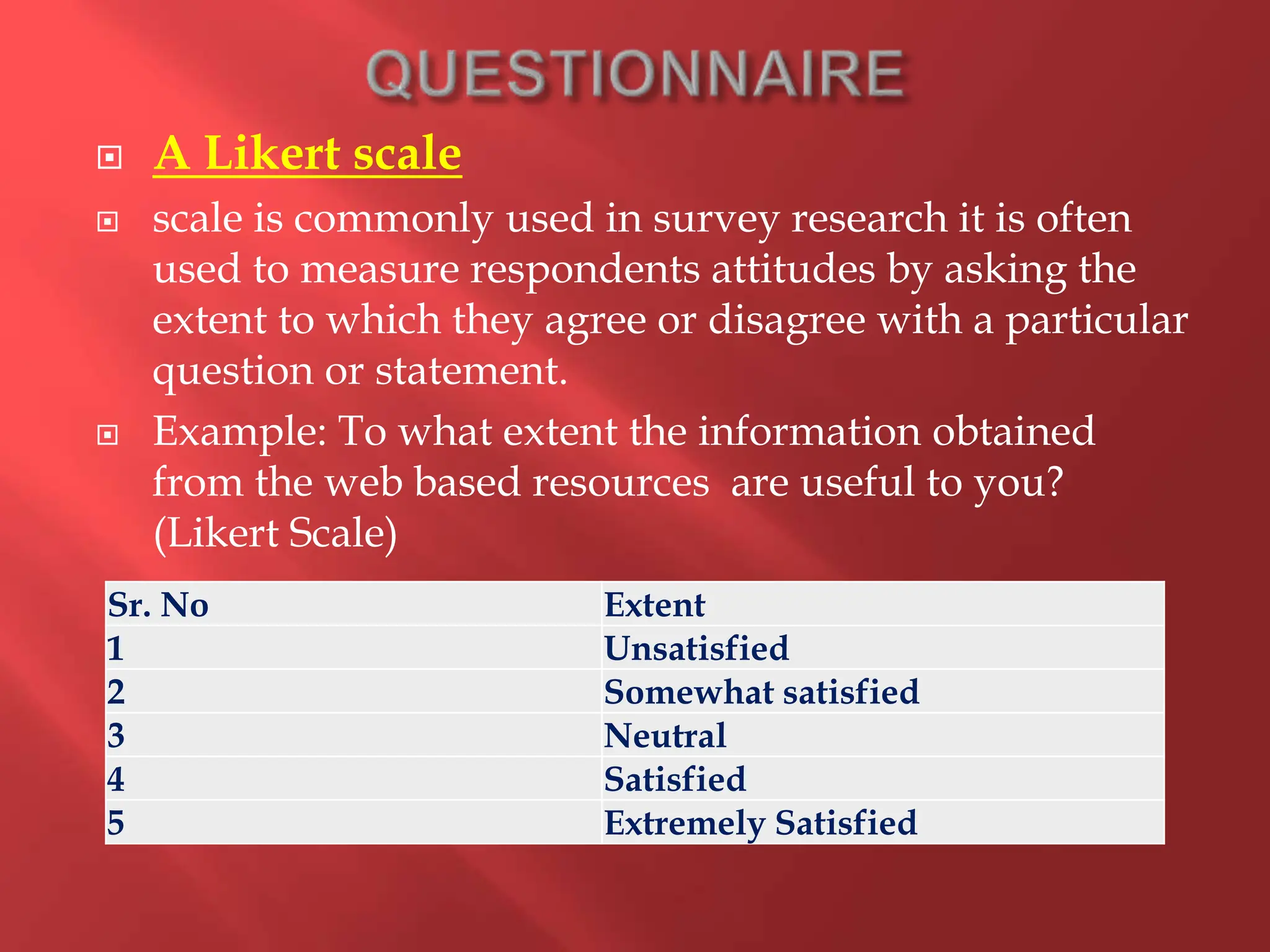
 A Likert scale
 scale is commonly used in survey research it is often
used to measure respondents attitudes by asking the
extent to which they agree or disagree with a particular
question or statement.
 Example: To what extent the information obtained
from the web based resources are useful to you?
(Likert Scale)
Sr. No Extent
1 Unsatisfied
2 Somewhat satisfied
3 Neutral
4 Satisfied
5 Extremely Satisfied
 Rankings:
Sr.No Web Based Resources Ranking (1….10)
1E-Books
2E-Journals
3Discussion Forum
4Database
 Ratings can be obtained through one of three
major approaches:
 Paired comparison
 Ranking and
 Rating scales
 Purpose of Rating Scale
 Rating scales have been successfully utilized for
measuring
the following:
 Teacher Performance/Effectiveness
 Personality, anxiety, stress, emotional intelligence
etc.
 School appraisal including appraisal of courses,
practices and programmes.
ATTITUDE SCALE
 Attitude scale is a form of appraisal procedure and it is
also one of the enquiry term.
Purpose of Attitude Scale
In educational research, these scales are used especially
for finding the attitudes of persons on different issues like:
• Co-education
• Religious education
• Corporal punishment
• Democracy in schools
• Linguistic prejudices
• International co-operation etc.
Unstructured questionnaires (Open-ended)
Non-structured questions, or open-ended questions, are
questions where there is no list of answer choices from
which to choose. Respondents are simply asked to write
their response to a question. Here is an example:
An open question is likely to receive a long answer.
Example of a Non-structured Question
What are the facilities and services do you expect from
your library?
________________________________
________________________________
 Semi-structured questionnaires (Partially
Structured Question)
 take a mixed approach. In some situations, you may
have a partial list of answer choices, but you may still
have some doubt or uncertainty about other possible
responses. You can create a partially structured
question such as the following:
Example of a Partially Structured Question
What purpose do you use web based resources?
 For research work
 To write assignments
 To improve subject knowledge
 For the purpose of seminar presentation
 Any other (Please specify): 1.________________
 2. ________________
 An Opinionnaire is defined as a special form of
inquiry. It is used by the researcher to collect the
opinions of a sample of population on certain facts or
factors the problem under investigation. These
opinions on different facts of the problem under study
are further quantified, analyzed and interpreted.
 Purpose :
 Opinionnaire are usually used in researches of the
descriptive type which demands survey of opinions of
the concerned individuals. Public opinion research is
an example of opinion survey.
 A checklist, is a type of informational job aid used to
reduce failure by compensating for potential limits of
human memory and attention.
 It helps to ensure consisting and completeness in
carrying out a task.
 A basic example is ‘to do list’. A more advanced
checklist which lays out tasks to be done according to
time of a day or other factors.
 The checklist consists of a list of items with a place to
check, or to mark yes or no.
 Analysis and Interpretation of Checklist
Data
 The tabulation and quantification of checklist
data is done from the responses. Frequencies
are counted, percentages and averages
Calculated, central tendencies, measures of
variability and co-efficient of correlation
completed as and when necessary.
is a type of a rating scale designed to measure the
connotative meaning of objects, events and
concepts. The connotations are used to drive the
attitude towards the given object, event of
concept.
SWEET --------------- BITTER
WARM --------------- COOL
BEAUTIFUL -------------- UGLY
BRAVE -------------- COWARD
BRIGHT ----------------- DARK
 Among the most useful and most frequently employed
tools of educational research psychological tests
occupy a very significant
position.
 Psychological tests are described to describe and
measure a sample of certain aspects of human
behaviors or inner qualities.
Aptitude Tests :
“Aptitude tests attempt to predict the capacities or the
degree of achievement that may be expected from
individuals in a particular activity”.
 Purpose :
 The purpose of aptitude test is to test a candidate’s profile.
Aptitude test helps to check one’s knowledge and filters the
good candidates.
 Importance of Aptitude Test :
Research data show that individually administered aptitude
tests have the following qualities:
 They are excellent predictors of future scholastic
achievement.
 They provide ways for comparison of a child’s performance
with other in a same situation.
 They provide a profile of strength and weaknesses.
 They asses difference among individuals.
 Observation offers the researcher a distinct way of
collecting data. It does not rely on what people say
they do, or what they say they think.
 Observation method is a technique in which the
behavior of research subjects is watched and recorded
without any direct contact.
Purpose :
 The purpose of observation techniques are:
 To collect data directly.
 To collect substantial amount of data in short time
span.
 To get eye witness first hand data in real like situation.
 To collect data in a natural setting.
There are two important forms of observation
Quantitative observation
Qualitative observation
 It involves standardization procedures, and it
produces quantitative data.
 It can be standardized
 Who is observed
 What is observed
 When the observation are to take place
 Where the observation are to take place.
 How the observation are to take place
 It is exploratory and open- ended and the researcher takes
extensive field notes.
 It may be take in four different form
 Complete participant ( becoming a full members of the
group and note informing the participants that you are
studying them)
 Participants as observer ( spending extensive time “inside”
and informing the participants that you are studying them.)
 Observer as Participant (spending a limited amount of time
“inside” and informing them that you are studying them).
 Complete Observer (observing from the “outside” and not
informing that participants that you are studying them ).
 According to Longman’s dictionary of
contemporary English
 “ It is face to face verbal exchange in which
interviewer attempts to elicit information in a
variety of topics from the interviewee”.
 An occasion when a person is asked question
by one or more people either to decide whether
he or she is a suitable person for his aim or
goal.
 Structured interview
 Behavioral interview
 Telephone interview
 Individual and group interview
 Structured and Un- structured interview
 Focused Interview
 Interview may be quantitative and Qualitative
 Quantitative interviews
 ( They are standardize same information is
provided to everyone)
 Use closed- ended questions.
 Interview should be necessary.
 They are based on open ended questions.
 There are three types of qualitative interviews.
 Informal Conversational Interview
 Interview guide approach
 Standardized Open ended interview
 An achievement test is a test developed skill or
knowledge. The most common type of
achievement test is a standardized test
developed to measure skills and knowledge
 It is usually through planned instructions, such
as training or classroom instruction.
 Achievement test are often contrasted with
tests that measure aptitude.
 Test score are often used in educational system
to determine what level of instruction for
which a student is prepared.
 A focus group is a type of group interview in
which a moderator (working for the researcher)
leads a discussion with a small group of
individuals (e.g., students, teachers, teenagers)
to examine, in detail, how the group members
think and feel about a topic. It is called a
‘focus” group because the moderator keeps the
individuals in the group focused on the topic
being discussed. The moderator generates
group discussion through the use of open
ended questions, and he or she acts as a
facilitator of group process.
DEVELOPMENT of Research Tool Power Point.pptx

DEVELOPMENT of Research Tool Power Point.pptx

  • 2.
     Research toolcan be defined as the instrument in the hands of researchers to measure what they intend to in their study.  Research tools are materials that are necessary to preform research. All inventions, discoveries and knowledge can become research tools.  Research is a systematic study or investigation of something for the purpose of answering question post by a researcher.
  • 3.
     After thispresentation you will be able to :  State different types of tools and techniques used for data collection  Distinguish the basic difference between tools and techniques.  Describe concept, purpose and uses of various tools and techniques in research.  State the tools coming under inquiry form, psychological test  observation and Interview.
  • 4.
     Different toolsare suitable for collecting various kinds of information for various purposes.  The research worker may use one or more of the tools in combination for his purpose.  The systematic way and procedure by which a complex or scientific task is accomplished is known as the technique.
  • 5.
     The selectionof any method for collecting data must balance reliability and validity. Reliability  The researcher should address all the following issues before starting data collection:  Will the research process consistently measure what it is supposed to measure?  In the case of multiple interviews, settings, or observers, will measurements be consistent?  Will people interpret questions the same way each time?
  • 6.
     The researchershould make sure that the information collected is relevant to the research questions. Specifically, the researcher must consider whether the data collection methods produce information that actually addresses the research question.
  • 7.
     The majortools of research in education can be classified broadly into the following categories. A. Inquiry forms  Questionnaire  Checklist  Score-card  Schedule  Rating Scale  Opinionnaire  Attitude Scale
  • 8.
    B. Observation C. Interview D.Sociometry E. Psychological Tests  Achievement Test Aptitude Test Intelligence Test Interest inventory Personality measures etc.
  • 9.
     A questionnaireis a form prepared and distributed to secure responses to certain questions.  It is a device for securing answers to questions by using a form which the respondent fills by himself.  It is a systematic compilation of questions that are submitted to a sampling of population from which information is desired.  Questionnaire rely on written information supplied directly by people in response to questions.  The information from questionnaires tends to fall into two broad categories – ‘facts’ and ‘opinions’.
  • 10.
    Purpose :  Thepurpose of the questionnaire is to gather information from widely scattered sources.  It is mostly used in uses in cases where one can not readily see personally all of the people from whom he desires responses.
  • 11.
     Types : Structured questionnaires (Closed Ended Questions)  are based predominantly on closed questions which produce data that can be analyzed quantitatively for patterns and trends. The agenda is entirely predetermined by the evaluator and provides little flexibility for respondents to qualify their answers  A closed question can be answered with either 'yes' or 'no'.  Example: Do you have a library membership card? Yes ( ) No ( )
  • 12.
     Multiple ChoiceQuestions What purpose do you visit the library? (Multiple choices) ( ) To read news papers ( ) To refer books ( ) To borrow and return books ( ) To brows Internet
  • 13.
     Scaled questions Responses are graded on a continuum (example: rate the appearance of the product on a scale from 1 to 10, with 10 being the most preferred appearance).  Examples & Types  The Likert scale  Semantic differential scale,  Rank-order scale
  • 14.
     A Likertscale  scale is commonly used in survey research it is often used to measure respondents attitudes by asking the extent to which they agree or disagree with a particular question or statement.  Example: To what extent the information obtained from the web based resources are useful to you? (Likert Scale) Sr. No Extent 1 Unsatisfied 2 Somewhat satisfied 3 Neutral 4 Satisfied 5 Extremely Satisfied
  • 15.
     Rankings: Sr.No WebBased Resources Ranking (1….10) 1E-Books 2E-Journals 3Discussion Forum 4Database
  • 16.
     Ratings canbe obtained through one of three major approaches:  Paired comparison  Ranking and  Rating scales  Purpose of Rating Scale  Rating scales have been successfully utilized for measuring the following:  Teacher Performance/Effectiveness  Personality, anxiety, stress, emotional intelligence etc.  School appraisal including appraisal of courses, practices and programmes.
  • 17.
    ATTITUDE SCALE  Attitudescale is a form of appraisal procedure and it is also one of the enquiry term. Purpose of Attitude Scale In educational research, these scales are used especially for finding the attitudes of persons on different issues like: • Co-education • Religious education • Corporal punishment • Democracy in schools • Linguistic prejudices • International co-operation etc.
  • 18.
    Unstructured questionnaires (Open-ended) Non-structuredquestions, or open-ended questions, are questions where there is no list of answer choices from which to choose. Respondents are simply asked to write their response to a question. Here is an example: An open question is likely to receive a long answer. Example of a Non-structured Question What are the facilities and services do you expect from your library? ________________________________ ________________________________
  • 19.
     Semi-structured questionnaires(Partially Structured Question)  take a mixed approach. In some situations, you may have a partial list of answer choices, but you may still have some doubt or uncertainty about other possible responses. You can create a partially structured question such as the following: Example of a Partially Structured Question What purpose do you use web based resources?  For research work  To write assignments  To improve subject knowledge  For the purpose of seminar presentation  Any other (Please specify): 1.________________  2. ________________
  • 20.
     An Opinionnaireis defined as a special form of inquiry. It is used by the researcher to collect the opinions of a sample of population on certain facts or factors the problem under investigation. These opinions on different facts of the problem under study are further quantified, analyzed and interpreted.  Purpose :  Opinionnaire are usually used in researches of the descriptive type which demands survey of opinions of the concerned individuals. Public opinion research is an example of opinion survey.
  • 21.
     A checklist,is a type of informational job aid used to reduce failure by compensating for potential limits of human memory and attention.  It helps to ensure consisting and completeness in carrying out a task.  A basic example is ‘to do list’. A more advanced checklist which lays out tasks to be done according to time of a day or other factors.  The checklist consists of a list of items with a place to check, or to mark yes or no.
  • 22.
     Analysis andInterpretation of Checklist Data  The tabulation and quantification of checklist data is done from the responses. Frequencies are counted, percentages and averages Calculated, central tendencies, measures of variability and co-efficient of correlation completed as and when necessary.
  • 23.
    is a typeof a rating scale designed to measure the connotative meaning of objects, events and concepts. The connotations are used to drive the attitude towards the given object, event of concept. SWEET --------------- BITTER WARM --------------- COOL BEAUTIFUL -------------- UGLY BRAVE -------------- COWARD BRIGHT ----------------- DARK
  • 24.
     Among themost useful and most frequently employed tools of educational research psychological tests occupy a very significant position.  Psychological tests are described to describe and measure a sample of certain aspects of human behaviors or inner qualities. Aptitude Tests : “Aptitude tests attempt to predict the capacities or the degree of achievement that may be expected from individuals in a particular activity”.
  • 25.
     Purpose : The purpose of aptitude test is to test a candidate’s profile. Aptitude test helps to check one’s knowledge and filters the good candidates.  Importance of Aptitude Test : Research data show that individually administered aptitude tests have the following qualities:  They are excellent predictors of future scholastic achievement.  They provide ways for comparison of a child’s performance with other in a same situation.  They provide a profile of strength and weaknesses.  They asses difference among individuals.
  • 26.
     Observation offersthe researcher a distinct way of collecting data. It does not rely on what people say they do, or what they say they think.  Observation method is a technique in which the behavior of research subjects is watched and recorded without any direct contact. Purpose :  The purpose of observation techniques are:  To collect data directly.  To collect substantial amount of data in short time span.  To get eye witness first hand data in real like situation.  To collect data in a natural setting.
  • 27.
    There are twoimportant forms of observation Quantitative observation Qualitative observation
  • 28.
     It involvesstandardization procedures, and it produces quantitative data.  It can be standardized  Who is observed  What is observed  When the observation are to take place  Where the observation are to take place.  How the observation are to take place
  • 29.
     It isexploratory and open- ended and the researcher takes extensive field notes.  It may be take in four different form  Complete participant ( becoming a full members of the group and note informing the participants that you are studying them)  Participants as observer ( spending extensive time “inside” and informing the participants that you are studying them.)  Observer as Participant (spending a limited amount of time “inside” and informing them that you are studying them).  Complete Observer (observing from the “outside” and not informing that participants that you are studying them ).
  • 30.
     According toLongman’s dictionary of contemporary English  “ It is face to face verbal exchange in which interviewer attempts to elicit information in a variety of topics from the interviewee”.  An occasion when a person is asked question by one or more people either to decide whether he or she is a suitable person for his aim or goal.
  • 31.
     Structured interview Behavioral interview  Telephone interview  Individual and group interview  Structured and Un- structured interview  Focused Interview
  • 32.
     Interview maybe quantitative and Qualitative  Quantitative interviews  ( They are standardize same information is provided to everyone)  Use closed- ended questions.  Interview should be necessary.
  • 33.
     They arebased on open ended questions.  There are three types of qualitative interviews.  Informal Conversational Interview  Interview guide approach  Standardized Open ended interview
  • 34.
     An achievementtest is a test developed skill or knowledge. The most common type of achievement test is a standardized test developed to measure skills and knowledge  It is usually through planned instructions, such as training or classroom instruction.  Achievement test are often contrasted with tests that measure aptitude.  Test score are often used in educational system to determine what level of instruction for which a student is prepared.
  • 35.
     A focusgroup is a type of group interview in which a moderator (working for the researcher) leads a discussion with a small group of individuals (e.g., students, teachers, teenagers) to examine, in detail, how the group members think and feel about a topic. It is called a ‘focus” group because the moderator keeps the individuals in the group focused on the topic being discussed. The moderator generates group discussion through the use of open ended questions, and he or she acts as a facilitator of group process.