ITEM
       ANALYSIS
ITEM ANALYSIS


    Item analysis is a statistical technique
 which is used for selecting and rejecting the
 items of the test on the basis of their difficulty
 value and discriminated power
OBJECTIVES OF ITEM ANALYSIS

   To select appropriate items for the final draft

   To obtain the information about the difficulty value(D.V) of all
    the items

   To provide discriminatory power (D.I) to differentiate between
    capable and less capable examinees for the items

   To provide modification to be made in some of the items

   To prepare the final draft properly ( easy to difficult items)
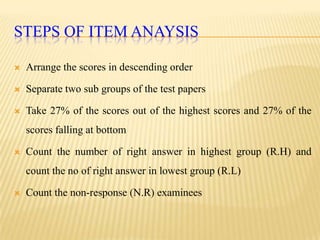
STEPS OF ITEM ANAYSIS

   Arrange the scores in descending order

   Separate two sub groups of the test papers

   Take 27% of the scores out of the highest scores and 27% of the
    scores falling at bottom

   Count the number of right answer in highest group (R.H) and
    count the no of right answer in lowest group (R.L)

   Count the non-response (N.R) examinees
Item analysis is done for obtaining:

      a) Difficulty value (D.V)

      b) Discriminative power (D.P)
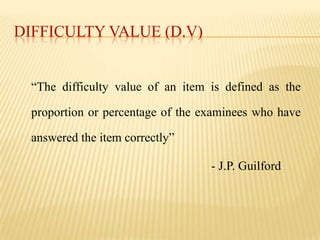
DIFFICULTY VALUE (D.V)


  “The difficulty value of an item is defined as the

  proportion or percentage of the examinees who have

  answered the item correctly”

                                   - J.P. Guilford
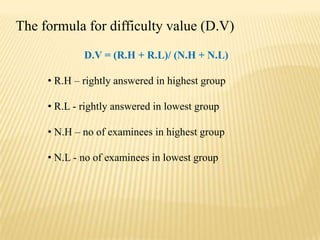
The formula for difficulty value (D.V)
             D.V = (R.H + R.L)/ (N.H + N.L)

     • R.H – rightly answered in highest group

     • R.L - rightly answered in lowest group

     • N.H – no of examinees in highest group

     • N.L - no of examinees in lowest group
In case non-response examinees available
means,

The formula for difficulty value (D.V)

       D.V = (R.H + R.L)/ [(N.H + N.L)- N.R]

      • R.H – rightly answered in highest group

      • R.L - rightly answered in lowest group

      • N.H – no of examinees in highest group

      • N.L - no of examinees in lowest group

      • N.R – no of non-response examinees
DISCRIMINATION INDEX (D.I)

“Index of discrimination is that ability of an item on the

 basis of which the discrimination is made between

 superiors and inferiors”

                            - Blood and Budd (1972)
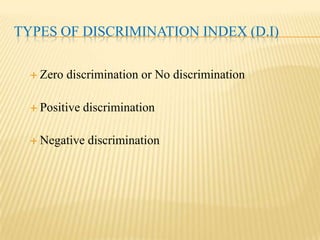
TYPES OF DISCRIMINATION INDEX (D.I)

   Zero   discrimination or No discrimination

   Positive   discrimination

   Negative   discrimination
ZERO DISCRIMINATION OR NO
DISCRIMINATION

   The item of the test is answered correctly or
    know the answer by all the examinee’s

   An item is not answered correctly any of the
    examinee
POSITIVE DISCRIMINATION INDEX

 An item is correctly answered by superiors and is
 not   answered   correctly   by   inferiors.   The
 discriminative power range from +1 to -1.
NEGATIVE DISCRIMINATION INDEX


 An item is correctly answered by inferiors and is
 not answered correctly by superiors.
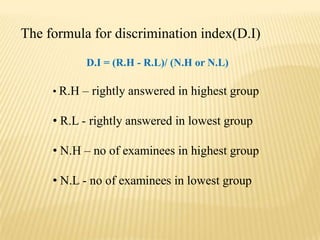
The formula for discrimination index(D.I)
           D.I = (R.H - R.L)/ (N.H or N.L)

     • R.H – rightly answered in highest group

     • R.L - rightly answered in lowest group

     • N.H – no of examinees in highest group

     • N.L - no of examinees in lowest group
Another method for discrimination index(D.I)
If you take Likert       scale for data collection
          The correlation between each item scores with total
scores.
General guidelines for discriminating index (D.I)
According to Ebel ,

               D.I             Item Evaluation
              ≥0.40              Very good items

            0.30 - 0.39   Reasonably good but subject to
                                 improvement

            0.20 – 0.29        Marginal items , need
                                   improvement
              <0.19       Poor items . Rejected or revised
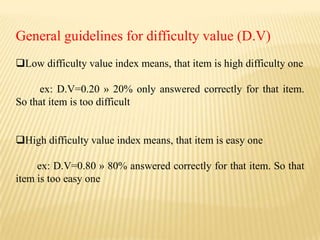
General guidelines for difficulty value (D.V)
Low difficulty value index means, that item is high difficulty one

     ex: D.V=0.20 » 20% only answered correctly for that item.
So that item is too difficult


High difficulty value index means, that item is easy one

     ex: D.V=0.80 » 80% answered correctly for that item. So that
item is too easy one
D.V        Item Evaluation

0.20 – 0.30     Most difficult

0.30 - 0.40       Difficult

0.40 – 0.60   Moderate difficult

0.60 – 0.70         Easy

0.70 – 0.80      Most easy
Relationship between difficulty value and
discrimination power

Both (D.V & D.I) are complementary not contradictory to each other

Both should considered in selecting good items

If an item has negatively discriminate or zero discrimination, is to be

rejected whatever the difficulty value
CRITERIA FOR SELECTION AND REJECTION
ITEMS

   Positive discrimination index only selected

   Negative and zero discrimination index items are

    rejected

   High and low difficulty value items are rejected
REFERENCE

   Sharma R.A (2007);Essential of Scientific Behavioural Research,

    Meerut, Lall book depot.

   Mehta D.D (2011);Educational Measurement and Evaluation,

    Meerut, Tandon publication.

   Kulbir Singh Sidhu (2005);New Approaches to Measurement and

    Evaluation, New Delhi, Sterling Publishers.

   Akbar Husain (2012);Psychological Testing, New Delhi, Pearson.
Thank you

Item analysis

  • 1.
    ITEM ANALYSIS
  • 2.
    ITEM ANALYSIS Item analysis is a statistical technique which is used for selecting and rejecting the items of the test on the basis of their difficulty value and discriminated power
  • 3.
    OBJECTIVES OF ITEMANALYSIS  To select appropriate items for the final draft  To obtain the information about the difficulty value(D.V) of all the items  To provide discriminatory power (D.I) to differentiate between capable and less capable examinees for the items  To provide modification to be made in some of the items  To prepare the final draft properly ( easy to difficult items)
  • 4.
    STEPS OF ITEMANAYSIS  Arrange the scores in descending order  Separate two sub groups of the test papers  Take 27% of the scores out of the highest scores and 27% of the scores falling at bottom  Count the number of right answer in highest group (R.H) and count the no of right answer in lowest group (R.L)  Count the non-response (N.R) examinees
  • 5.
    Item analysis isdone for obtaining: a) Difficulty value (D.V) b) Discriminative power (D.P)
  • 6.
    DIFFICULTY VALUE (D.V) “The difficulty value of an item is defined as the proportion or percentage of the examinees who have answered the item correctly” - J.P. Guilford
  • 7.
    The formula fordifficulty value (D.V) D.V = (R.H + R.L)/ (N.H + N.L) • R.H – rightly answered in highest group • R.L - rightly answered in lowest group • N.H – no of examinees in highest group • N.L - no of examinees in lowest group
  • 8.
    In case non-responseexaminees available means, The formula for difficulty value (D.V) D.V = (R.H + R.L)/ [(N.H + N.L)- N.R] • R.H – rightly answered in highest group • R.L - rightly answered in lowest group • N.H – no of examinees in highest group • N.L - no of examinees in lowest group • N.R – no of non-response examinees
  • 9.
    DISCRIMINATION INDEX (D.I) “Indexof discrimination is that ability of an item on the basis of which the discrimination is made between superiors and inferiors” - Blood and Budd (1972)
  • 10.
    TYPES OF DISCRIMINATIONINDEX (D.I)  Zero discrimination or No discrimination  Positive discrimination  Negative discrimination
  • 11.
    ZERO DISCRIMINATION ORNO DISCRIMINATION  The item of the test is answered correctly or know the answer by all the examinee’s  An item is not answered correctly any of the examinee
  • 12.
    POSITIVE DISCRIMINATION INDEX An item is correctly answered by superiors and is not answered correctly by inferiors. The discriminative power range from +1 to -1.
  • 13.
    NEGATIVE DISCRIMINATION INDEX An item is correctly answered by inferiors and is not answered correctly by superiors.
  • 14.
    The formula fordiscrimination index(D.I) D.I = (R.H - R.L)/ (N.H or N.L) • R.H – rightly answered in highest group • R.L - rightly answered in lowest group • N.H – no of examinees in highest group • N.L - no of examinees in lowest group
  • 15.
    Another method fordiscrimination index(D.I) If you take Likert scale for data collection The correlation between each item scores with total scores.
  • 16.
    General guidelines fordiscriminating index (D.I) According to Ebel , D.I Item Evaluation ≥0.40 Very good items 0.30 - 0.39 Reasonably good but subject to improvement 0.20 – 0.29 Marginal items , need improvement <0.19 Poor items . Rejected or revised
  • 17.
    General guidelines fordifficulty value (D.V) Low difficulty value index means, that item is high difficulty one ex: D.V=0.20 » 20% only answered correctly for that item. So that item is too difficult High difficulty value index means, that item is easy one ex: D.V=0.80 » 80% answered correctly for that item. So that item is too easy one
  • 18.
    D.V Item Evaluation 0.20 – 0.30 Most difficult 0.30 - 0.40 Difficult 0.40 – 0.60 Moderate difficult 0.60 – 0.70 Easy 0.70 – 0.80 Most easy
  • 19.
    Relationship between difficultyvalue and discrimination power Both (D.V & D.I) are complementary not contradictory to each other Both should considered in selecting good items If an item has negatively discriminate or zero discrimination, is to be rejected whatever the difficulty value
  • 20.
    CRITERIA FOR SELECTIONAND REJECTION ITEMS  Positive discrimination index only selected  Negative and zero discrimination index items are rejected  High and low difficulty value items are rejected
  • 21.
    REFERENCE  Sharma R.A (2007);Essential of Scientific Behavioural Research, Meerut, Lall book depot.  Mehta D.D (2011);Educational Measurement and Evaluation, Meerut, Tandon publication.  Kulbir Singh Sidhu (2005);New Approaches to Measurement and Evaluation, New Delhi, Sterling Publishers.  Akbar Husain (2012);Psychological Testing, New Delhi, Pearson.
  • 22.