Dr. Y. S. THAKARE
M.Sc. (CHE) Ph D, NET, SET
Assistant Professor in Chemistry,
Shri Shivaji Science College, Amravati
Email: yogitathakare_2007@rediffmail.com
B Sc- III Year
SEM-V
PAPER-III
PHYSICAL CHEMISTRY
UNIT- V
Quantum yield
Photosensitize Reactions
08-August -20 1
Quantum Yield
The efficiency of a photochemical reaction can be expressed in terms of quantum
yield. It can be defined as,
“the number of molecules reacting per quantum energy absorbed.”
OR
“The number of moles reacting per Einstein of energy absorbed”.
It is denoted by Φ so that
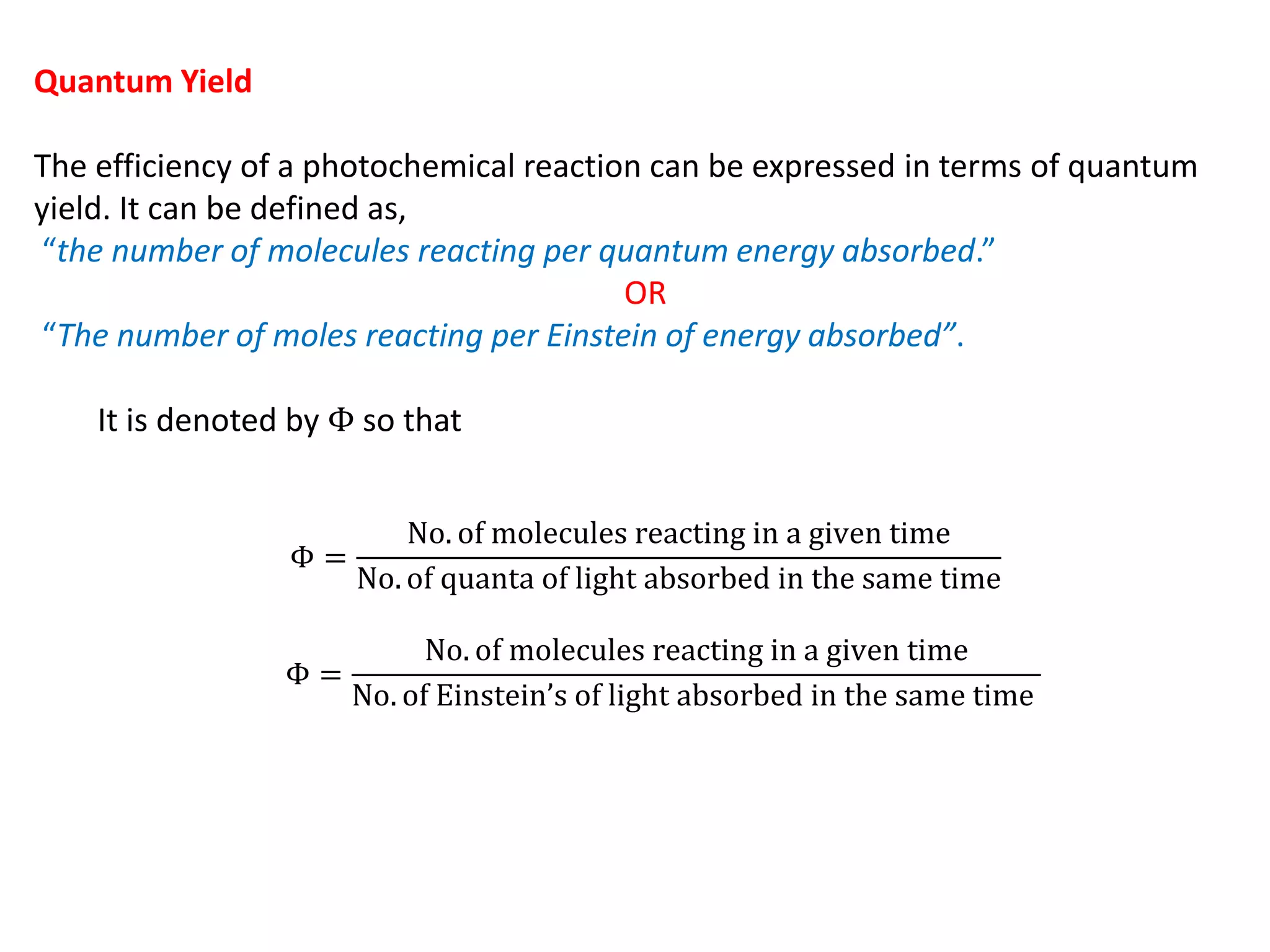
Φ =
No. of molecules reacting in a given time
No. of quanta of light absorbed in the same time
Φ =
No. of molecules reacting in a given time
No. of Einstein’s of light absorbed in the same time
Experimental Determination Of Quantum Yields
In order to find out quantum yields of photochemical reactions, two
types of determinations are needed. These are described as follows
1) Determination of number of moles reacted
It can be determined by analytical methods used in chemical kinetics. Knowing
concentration of reactants before and after the reaction, number of moles can be
calculated.
2) Determination of number of Einstein’s absorbed
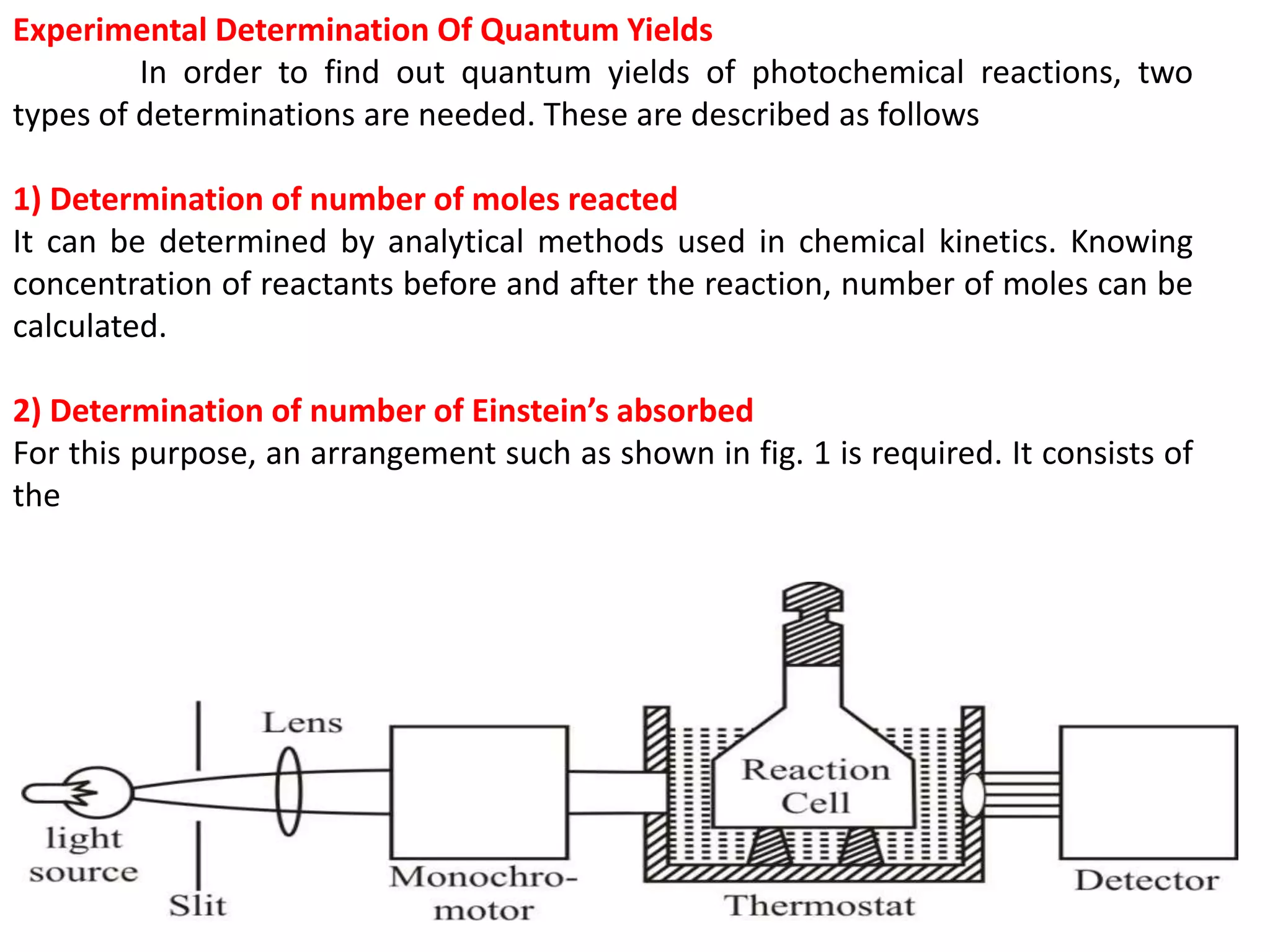
For this purpose, an arrangement such as shown in fig. 1 is required. It consists of
the
i) Source of light : The light source used may be sunlight, arc lamp, mercury vapour
lamp, discharge tube, tungsten lamp etc. which emits radiations of suitable intensity in
the desired spectral range.
ii) Monochromator: It consists of optical filters. They are made up of gelatin or
coloured glass or transparent plates with metal films. It absorbs unwanted wave
lengths of light and transmits the light of required wave length. Prisms and gratings
can also be used as monochromators.
iii) Reaction cell : The reaction cell is made up of glass or quarts with optically plane
windows for the entrance and exit of light. It is placed in thermostat to keep the
reactant at constant temperature.
iv) Detector : The light coming from the reaction cell falls on a suitable detector. It
measures the intensity of transmitted light.
First light is passed through empty cell and its intensity is measured (Ia). Then light is
passed through reaction mixture and intensity of transmitted light is measured (I). The
difference between the two readings will give the intensity of light absorbed in the
reaction.
The intensity of light is measured by using either a thermopile or chemical
actinometer.
v) Thermopile: It is multi-junction thermocouple consisting usually of metals unlike Ag and Bi
connected with a moving coil galvonometer. The metal strips are blackned with lamp black or
platinum black. The radiation falling on the blackened metal strip is absorbed completely and
converted into heat. It raises the temperature and the current generated due to this
temperature difference is measured. The current produced is proportional to the intensity of
radiations. Thermopiles are calibrated with standard light sources.
vi) Chemical Actinometer : It consists of a solution which is affected by light. When light falls on
the solution, chemical reaction starts.
The extent of reaction is directly proportional to the intensity of light absorbed. The most
common chemical actinometer used is uranyl oxalate actinometer. It consists of a solution of
0.05M oxalic acid and 0.01M uranyl sulphate in water. Oxalic acid decomposes photochemically
in presence of uranyl sulphate. The uranyl ions act as a photosensitizer. The reaction takes place
as follows –
UO2
+2 + h ν (UO2
+2)* Uranyl ion i.e. activated ion
H2C2O4 + (UO2
+2)* CO + CO2 + H2O + UO2
+2
The remaining amount of oxalic acid can be titrated against KMnO4 solution. The
extent of decomposition of oxalic acid is proportional to intensity of light absorbed.
Thus knowing the number of moles reacted and number of einsteins absorbed, quantum yield
can be determined.
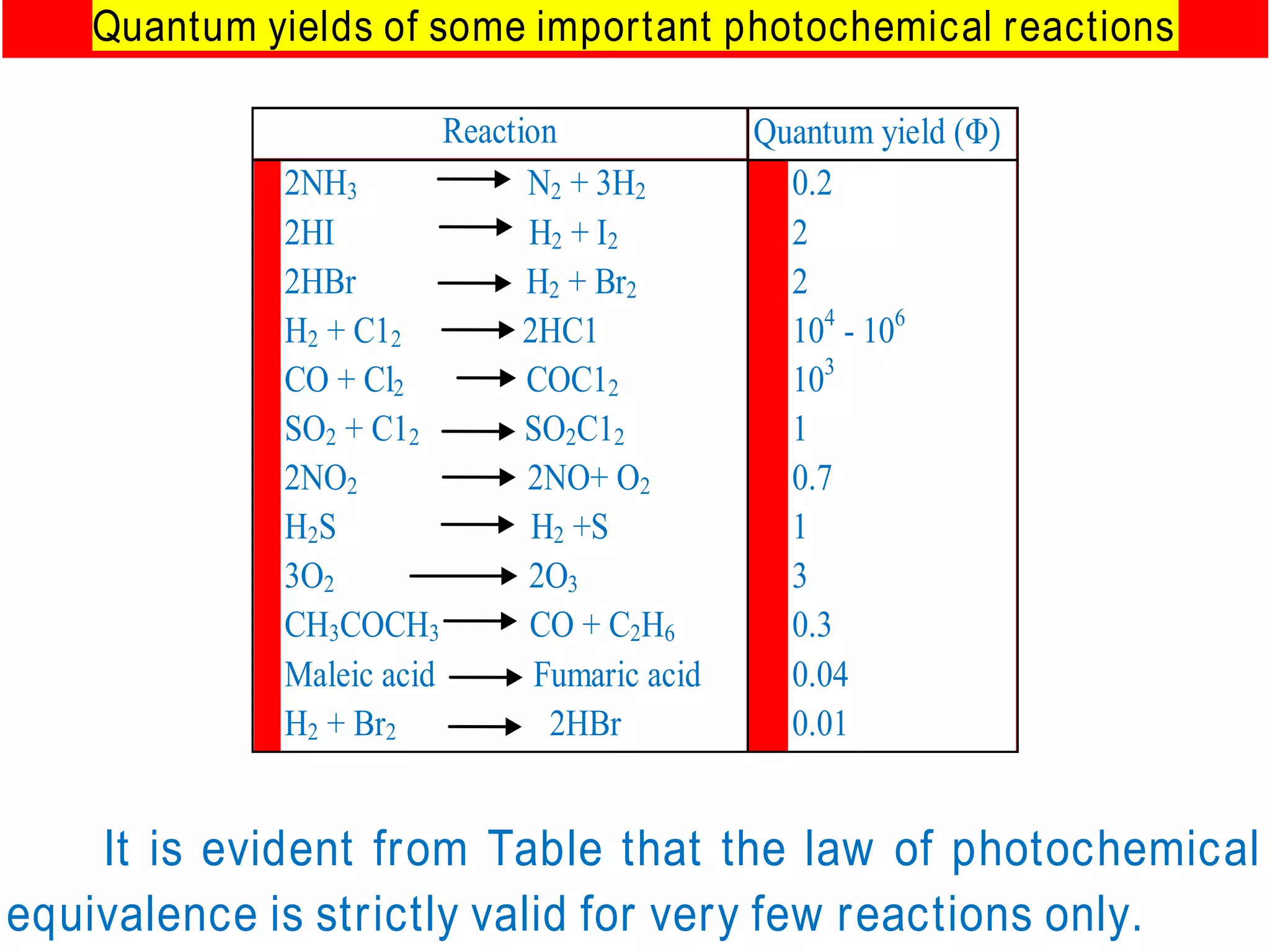
Quantum yields of some important photochemical reactions
Reaction Quantum yield (Φ)
2NH3 N2 + 3H2 0.2
2HI H2 + I2 2
2HBr H2 + Br2 2
H2 + C12 2HC1 104
- 106
CO + Cl2 COC12 103
SO2 + C12 SO2C12 1
2NO2 2NO+ O2 0.7
H2S H2 +S 1
3O2 2O3 3
CH3COCH3 CO + C2H6 0.3
Maleic acid Fumaric acid 0.04
H2 + Br2 2HBr 0.01
It is evident from Table that the law of photochemical
equivalence is strictly valid for very few reactions only.
Types of photochemical reaction
1) Those in which the quantum yield is a small integer such as
1, 2 or 3. (High quantum yield reactions)
Examples are: Combination of SO2 and C12, dissociation of HI
or HBr, ozonisation of oxygen etc.
2) Those in which the quantum yield is less than 1.
(low quantum yield reactions). Examples are: Dissociation of
NH3, NO2 or acetone vapour and transformation of maleic acid
into fumaric acid etc.
3) Those in which the quantum yield is extremely high.
Examples are: Combination of CO and C12 and H2 and C12
Reasons For High And Low Quantum Yield
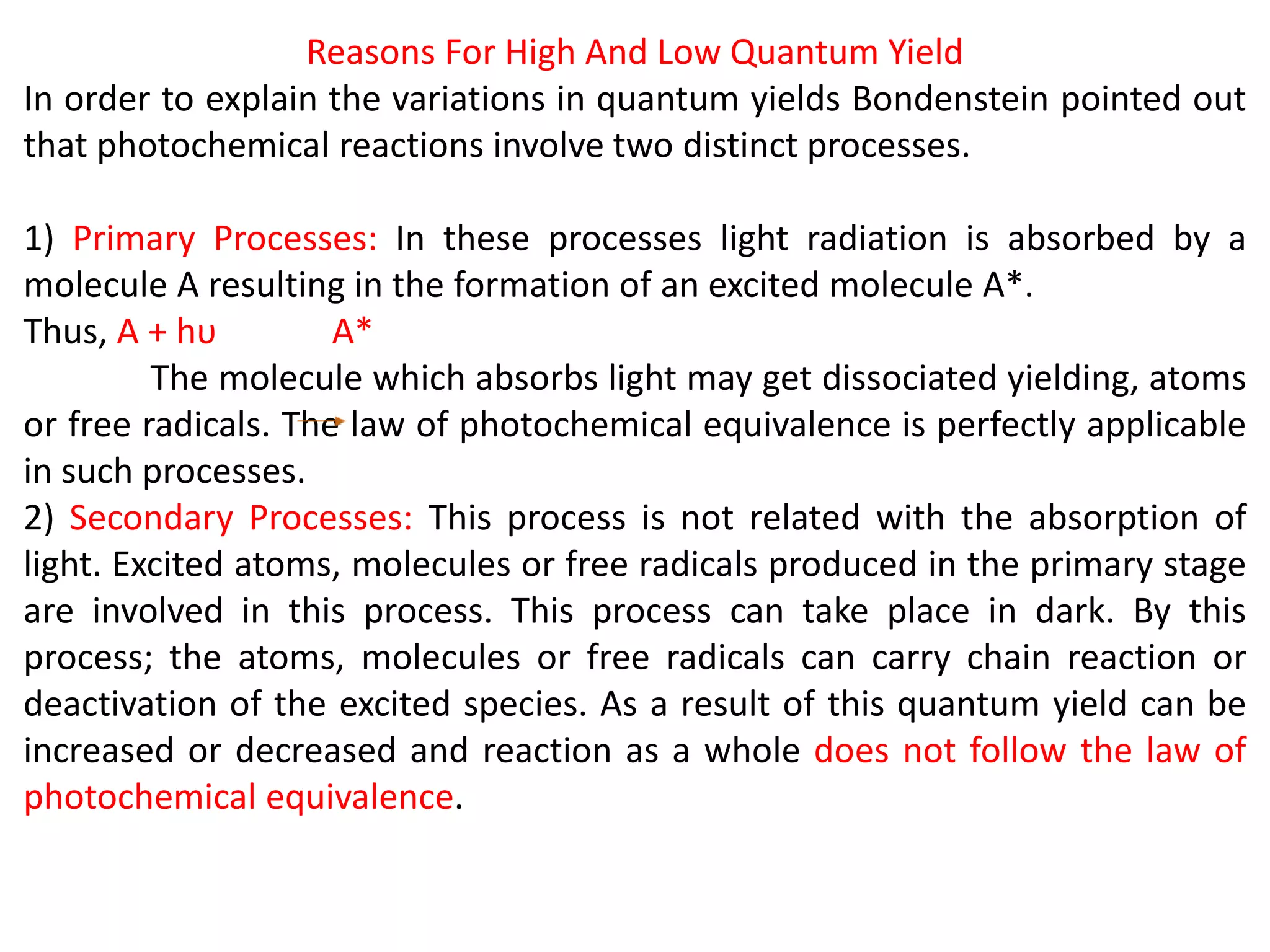
In order to explain the variations in quantum yields Bondenstein pointed out
that photochemical reactions involve two distinct processes.
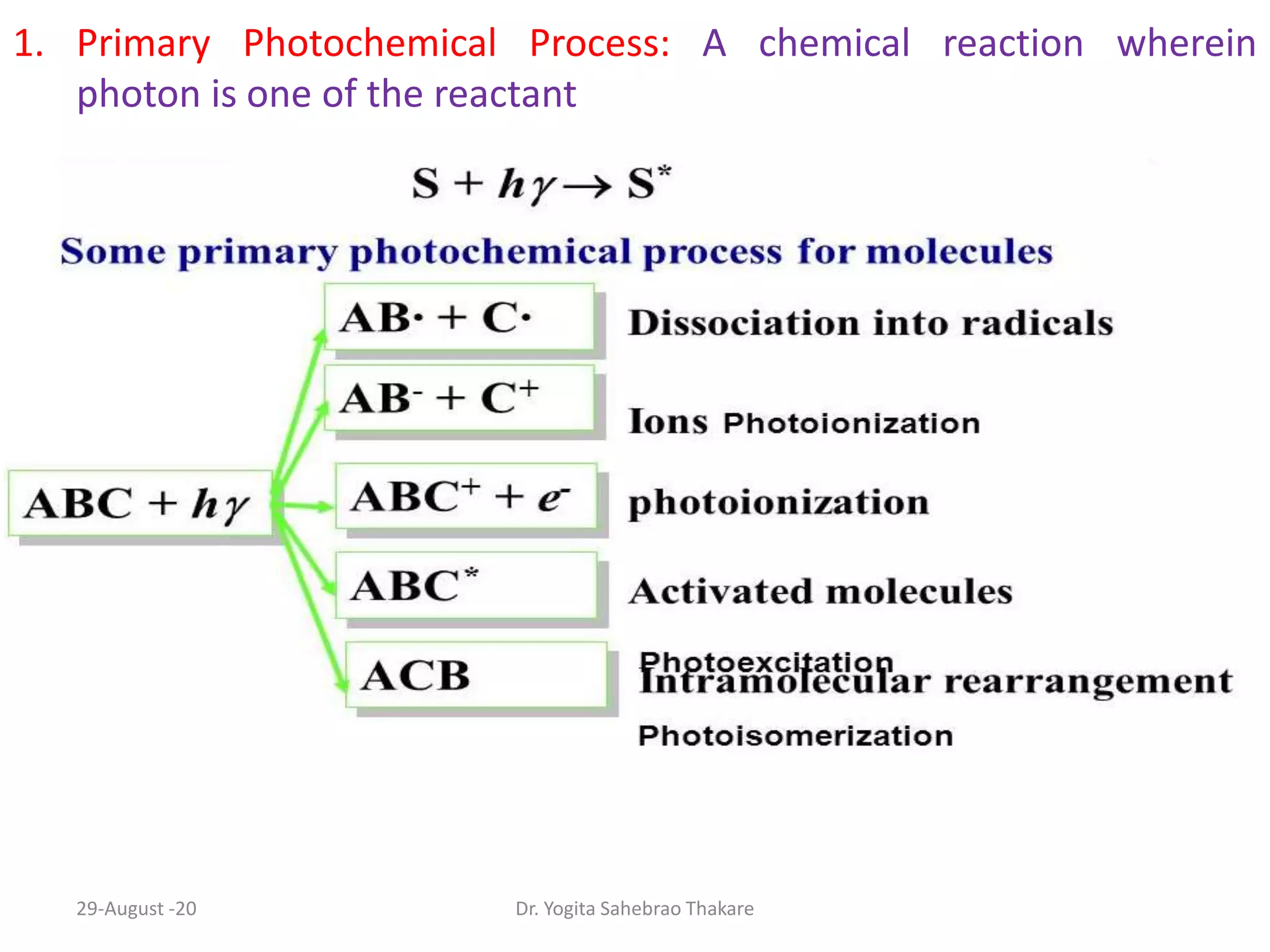
1) Primary Processes: In these processes light radiation is absorbed by a
molecule A resulting in the formation of an excited molecule A*.
Thus, A + hυ A*
The molecule which absorbs light may get dissociated yielding, atoms
or free radicals. The law of photochemical equivalence is perfectly applicable
in such processes.
2) Secondary Processes: This process is not related with the absorption of
light. Excited atoms, molecules or free radicals produced in the primary stage
are involved in this process. This process can take place in dark. By this
process; the atoms, molecules or free radicals can carry chain reaction or
deactivation of the excited species. As a result of this quantum yield can be
increased or decreased and reaction as a whole does not follow the law of
photochemical equivalence.
29-August -20 Dr. Yogita Sahebrao Thakare
1. Primary Photochemical Process: A chemical reaction wherein
photon is one of the reactant
29-August -20
2. Secondary process: This involves reaction of activated
molecules of primary process with other molecules
resulting into activation or deactivation
Dr. Yogita Sahebrao Thakare
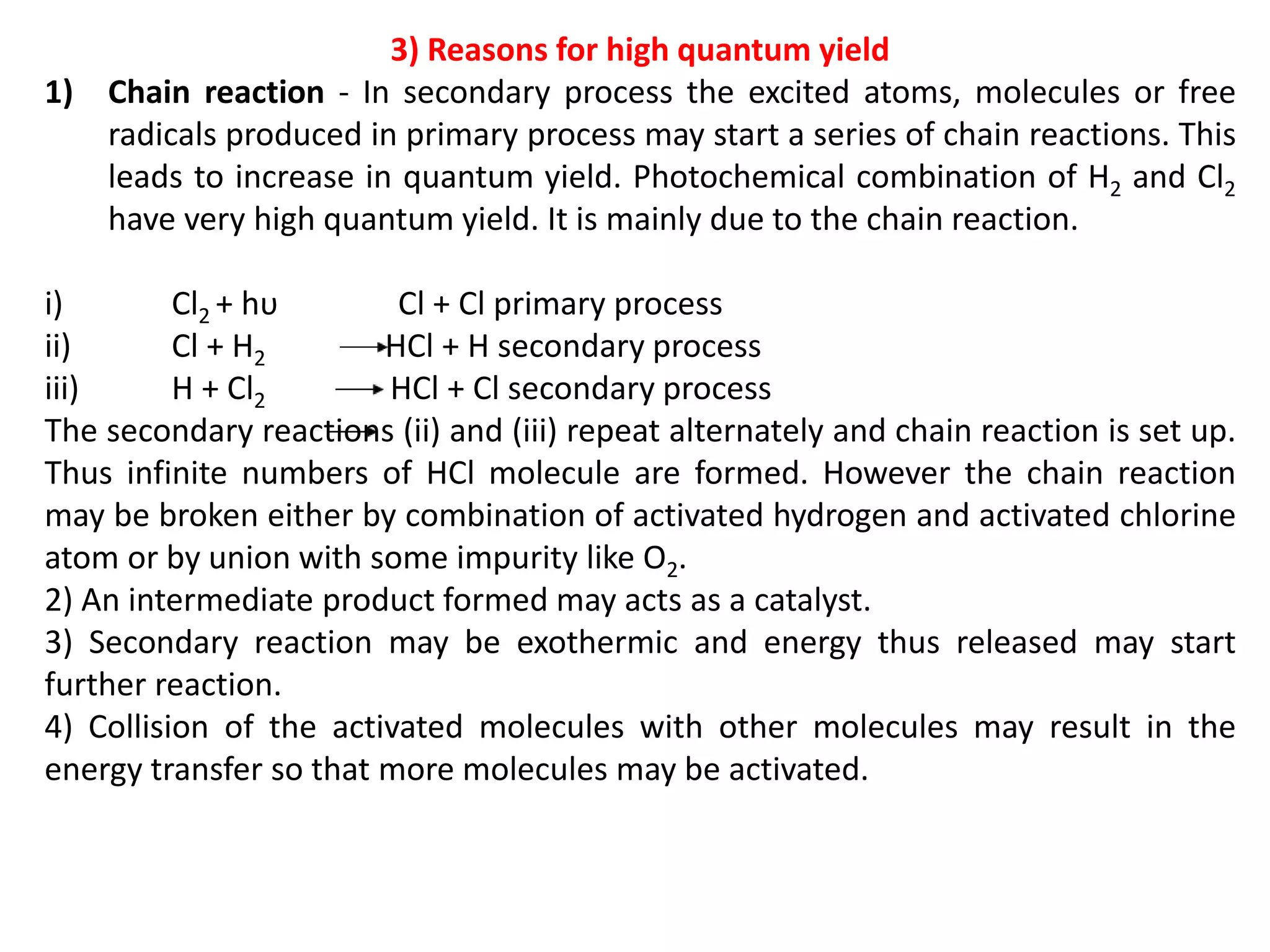
3) Reasons for high quantum yield
1) Chain reaction - In secondary process the excited atoms, molecules or free
radicals produced in primary process may start a series of chain reactions. This
leads to increase in quantum yield. Photochemical combination of H2 and Cl2
have very high quantum yield. It is mainly due to the chain reaction.
i) Cl2 + hυ Cl + Cl primary process
ii) Cl + H2 HCl + H secondary process
iii) H + Cl2 HCl + Cl secondary process
The secondary reactions (ii) and (iii) repeat alternately and chain reaction is set up.
Thus infinite numbers of HCl molecule are formed. However the chain reaction
may be broken either by combination of activated hydrogen and activated chlorine
atom or by union with some impurity like O2.
2) An intermediate product formed may acts as a catalyst.
3) Secondary reaction may be exothermic and energy thus released may start
further reaction.
4) Collision of the activated molecules with other molecules may result in the
energy transfer so that more molecules may be activated.
4) Reasons for low quantum yield
a) The energy absorbed by the molecules may not be sufficient to
excite the molecules and to start the reaction.
b) The primary photochemical process may get reversed.
c) The dissociated fragments may recombine to form original
molecule.
d) Excited molecule may lose energy by collision with non excited
molecules.
5) The excited molecules may get deactivated before they form
product.
Photosensitized Reactions
In many photochemical reactions the reactant molecule
does not absorb the radiation required for the reaction. Hence
reaction is not possible. In such cases the reaction may still occur if a
small amount of third substance is added. This third substance
absorbs the incident radiation, get excited and subsequently
transfers this energy to one of the reactants and their by activates for
the reaction. Thus the reaction occurs. A species which can absorb
and transfer radiant energy for activation or reactant molecule is
called a photosensitizer and the process is known as
photosensitization. The reaction so caused is called a photosensitized
reaction. Among photosensitizers in common use are atomic
sensitizer such as mercury, cadmium and zinc and molecular
photosensitizers such as benzophenone and SO2.
15-September -20
15-September -20
Energy Transfer Processes In Photosensitized Reactions
Consider a general donor acceptor system in which only the
donor 'D' i.e. photosensitizer, absorbs the incident photon and the
triplet state of the donor is higher than the triplet state of acceptor A
i.e. reactant in fig.2
Absorption of the photon produces the singlet excited state of
the donor 1D which via intersystem crossing (ISC) gives the triplet
excited state of the donor 3D. This triplet excited state then collides
with acceptor producing the triplet excited state of the acceptor 3A and
the ground state of the donor. If 3A gives the desired products, the
mechanism is called photosensitization. If however the products result
from 3D then A is called quencher and the process is known as
quenching.
15-September -20
DONAR ACCEPTOR
Fig. 2 : Mechanism of Photosensitization
15-September -20
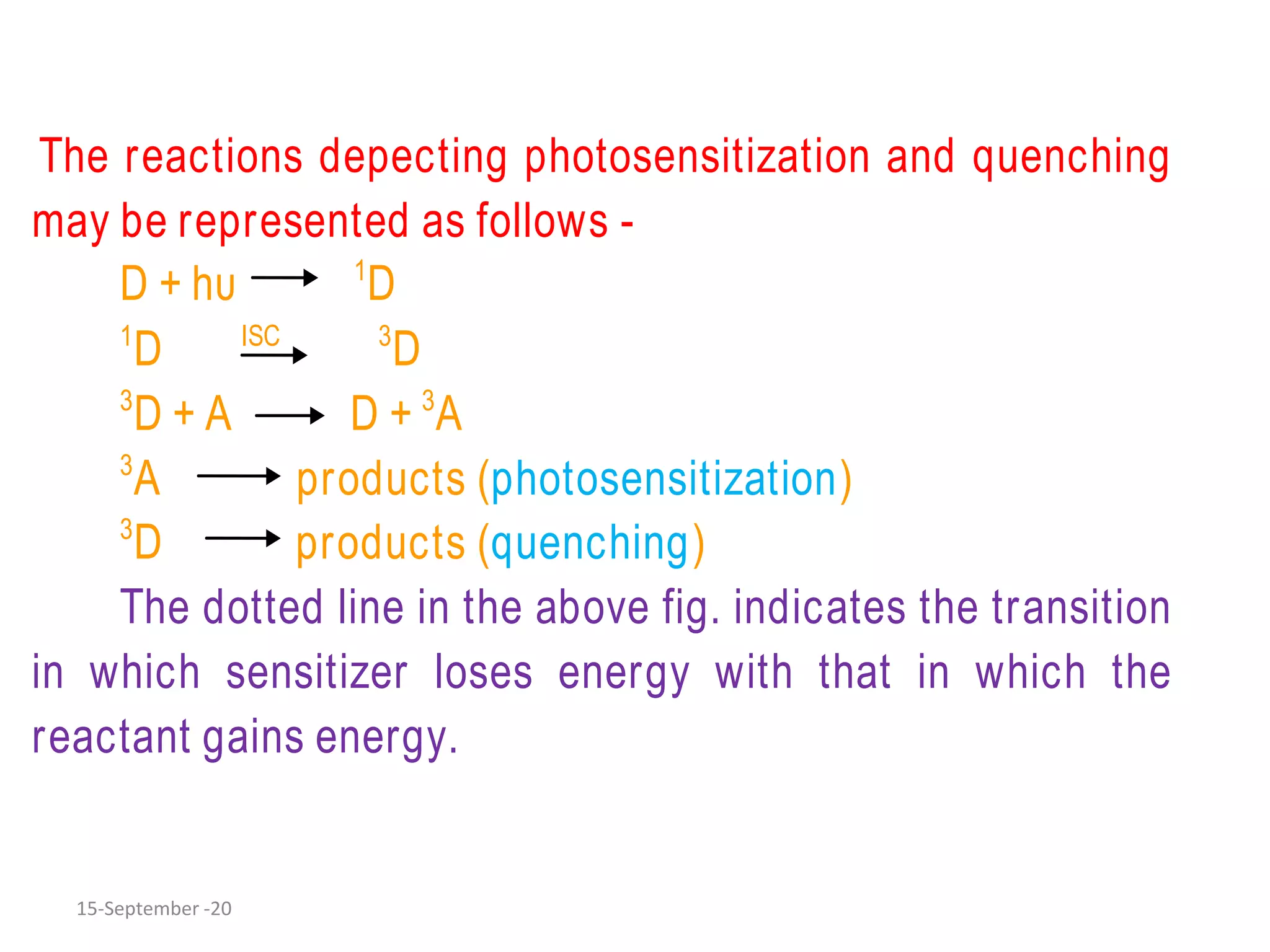
The reactions depecting photosensitization and quenching
may be represented as follows -
D + hυ 1
D
1
D ISC 3
D
3
D + A D + 3
A
3
A products (photosensitization)
3
D products (quenching)
The dotted line in the above fig. indicates the transition
in which sensitizer loses energy with that in which the
reactant gains energy.
15-September -20
15-September -20
15-September -20

Lect. 5 quantum yield and photosensitize reaction

  • 1.
    Dr. Y. S.THAKARE M.Sc. (CHE) Ph D, NET, SET Assistant Professor in Chemistry, Shri Shivaji Science College, Amravati Email: yogitathakare_2007@rediffmail.com B Sc- III Year SEM-V PAPER-III PHYSICAL CHEMISTRY UNIT- V Quantum yield Photosensitize Reactions 08-August -20 1
  • 2.
    Quantum Yield The efficiencyof a photochemical reaction can be expressed in terms of quantum yield. It can be defined as, “the number of molecules reacting per quantum energy absorbed.” OR “The number of moles reacting per Einstein of energy absorbed”. It is denoted by Φ so that Φ = No. of molecules reacting in a given time No. of quanta of light absorbed in the same time Φ = No. of molecules reacting in a given time No. of Einstein’s of light absorbed in the same time
  • 3.
    Experimental Determination OfQuantum Yields In order to find out quantum yields of photochemical reactions, two types of determinations are needed. These are described as follows 1) Determination of number of moles reacted It can be determined by analytical methods used in chemical kinetics. Knowing concentration of reactants before and after the reaction, number of moles can be calculated. 2) Determination of number of Einstein’s absorbed For this purpose, an arrangement such as shown in fig. 1 is required. It consists of the
  • 4.
    i) Source oflight : The light source used may be sunlight, arc lamp, mercury vapour lamp, discharge tube, tungsten lamp etc. which emits radiations of suitable intensity in the desired spectral range. ii) Monochromator: It consists of optical filters. They are made up of gelatin or coloured glass or transparent plates with metal films. It absorbs unwanted wave lengths of light and transmits the light of required wave length. Prisms and gratings can also be used as monochromators. iii) Reaction cell : The reaction cell is made up of glass or quarts with optically plane windows for the entrance and exit of light. It is placed in thermostat to keep the reactant at constant temperature. iv) Detector : The light coming from the reaction cell falls on a suitable detector. It measures the intensity of transmitted light. First light is passed through empty cell and its intensity is measured (Ia). Then light is passed through reaction mixture and intensity of transmitted light is measured (I). The difference between the two readings will give the intensity of light absorbed in the reaction. The intensity of light is measured by using either a thermopile or chemical actinometer.
  • 5.
    v) Thermopile: Itis multi-junction thermocouple consisting usually of metals unlike Ag and Bi connected with a moving coil galvonometer. The metal strips are blackned with lamp black or platinum black. The radiation falling on the blackened metal strip is absorbed completely and converted into heat. It raises the temperature and the current generated due to this temperature difference is measured. The current produced is proportional to the intensity of radiations. Thermopiles are calibrated with standard light sources. vi) Chemical Actinometer : It consists of a solution which is affected by light. When light falls on the solution, chemical reaction starts. The extent of reaction is directly proportional to the intensity of light absorbed. The most common chemical actinometer used is uranyl oxalate actinometer. It consists of a solution of 0.05M oxalic acid and 0.01M uranyl sulphate in water. Oxalic acid decomposes photochemically in presence of uranyl sulphate. The uranyl ions act as a photosensitizer. The reaction takes place as follows – UO2 +2 + h ν (UO2 +2)* Uranyl ion i.e. activated ion H2C2O4 + (UO2 +2)* CO + CO2 + H2O + UO2 +2 The remaining amount of oxalic acid can be titrated against KMnO4 solution. The extent of decomposition of oxalic acid is proportional to intensity of light absorbed. Thus knowing the number of moles reacted and number of einsteins absorbed, quantum yield can be determined.
  • 6.
    Quantum yields ofsome important photochemical reactions Reaction Quantum yield (Φ) 2NH3 N2 + 3H2 0.2 2HI H2 + I2 2 2HBr H2 + Br2 2 H2 + C12 2HC1 104 - 106 CO + Cl2 COC12 103 SO2 + C12 SO2C12 1 2NO2 2NO+ O2 0.7 H2S H2 +S 1 3O2 2O3 3 CH3COCH3 CO + C2H6 0.3 Maleic acid Fumaric acid 0.04 H2 + Br2 2HBr 0.01 It is evident from Table that the law of photochemical equivalence is strictly valid for very few reactions only.
  • 7.
    Types of photochemicalreaction 1) Those in which the quantum yield is a small integer such as 1, 2 or 3. (High quantum yield reactions) Examples are: Combination of SO2 and C12, dissociation of HI or HBr, ozonisation of oxygen etc. 2) Those in which the quantum yield is less than 1. (low quantum yield reactions). Examples are: Dissociation of NH3, NO2 or acetone vapour and transformation of maleic acid into fumaric acid etc. 3) Those in which the quantum yield is extremely high. Examples are: Combination of CO and C12 and H2 and C12
  • 8.
    Reasons For HighAnd Low Quantum Yield In order to explain the variations in quantum yields Bondenstein pointed out that photochemical reactions involve two distinct processes. 1) Primary Processes: In these processes light radiation is absorbed by a molecule A resulting in the formation of an excited molecule A*. Thus, A + hυ A* The molecule which absorbs light may get dissociated yielding, atoms or free radicals. The law of photochemical equivalence is perfectly applicable in such processes. 2) Secondary Processes: This process is not related with the absorption of light. Excited atoms, molecules or free radicals produced in the primary stage are involved in this process. This process can take place in dark. By this process; the atoms, molecules or free radicals can carry chain reaction or deactivation of the excited species. As a result of this quantum yield can be increased or decreased and reaction as a whole does not follow the law of photochemical equivalence.
  • 9.
    29-August -20 Dr.Yogita Sahebrao Thakare 1. Primary Photochemical Process: A chemical reaction wherein photon is one of the reactant
  • 10.
    29-August -20 2. Secondaryprocess: This involves reaction of activated molecules of primary process with other molecules resulting into activation or deactivation Dr. Yogita Sahebrao Thakare
  • 11.
    3) Reasons forhigh quantum yield 1) Chain reaction - In secondary process the excited atoms, molecules or free radicals produced in primary process may start a series of chain reactions. This leads to increase in quantum yield. Photochemical combination of H2 and Cl2 have very high quantum yield. It is mainly due to the chain reaction. i) Cl2 + hυ Cl + Cl primary process ii) Cl + H2 HCl + H secondary process iii) H + Cl2 HCl + Cl secondary process The secondary reactions (ii) and (iii) repeat alternately and chain reaction is set up. Thus infinite numbers of HCl molecule are formed. However the chain reaction may be broken either by combination of activated hydrogen and activated chlorine atom or by union with some impurity like O2. 2) An intermediate product formed may acts as a catalyst. 3) Secondary reaction may be exothermic and energy thus released may start further reaction. 4) Collision of the activated molecules with other molecules may result in the energy transfer so that more molecules may be activated.
  • 12.
    4) Reasons forlow quantum yield a) The energy absorbed by the molecules may not be sufficient to excite the molecules and to start the reaction. b) The primary photochemical process may get reversed. c) The dissociated fragments may recombine to form original molecule. d) Excited molecule may lose energy by collision with non excited molecules. 5) The excited molecules may get deactivated before they form product.
  • 13.
    Photosensitized Reactions In manyphotochemical reactions the reactant molecule does not absorb the radiation required for the reaction. Hence reaction is not possible. In such cases the reaction may still occur if a small amount of third substance is added. This third substance absorbs the incident radiation, get excited and subsequently transfers this energy to one of the reactants and their by activates for the reaction. Thus the reaction occurs. A species which can absorb and transfer radiant energy for activation or reactant molecule is called a photosensitizer and the process is known as photosensitization. The reaction so caused is called a photosensitized reaction. Among photosensitizers in common use are atomic sensitizer such as mercury, cadmium and zinc and molecular photosensitizers such as benzophenone and SO2. 15-September -20
  • 14.
  • 15.
    Energy Transfer ProcessesIn Photosensitized Reactions Consider a general donor acceptor system in which only the donor 'D' i.e. photosensitizer, absorbs the incident photon and the triplet state of the donor is higher than the triplet state of acceptor A i.e. reactant in fig.2 Absorption of the photon produces the singlet excited state of the donor 1D which via intersystem crossing (ISC) gives the triplet excited state of the donor 3D. This triplet excited state then collides with acceptor producing the triplet excited state of the acceptor 3A and the ground state of the donor. If 3A gives the desired products, the mechanism is called photosensitization. If however the products result from 3D then A is called quencher and the process is known as quenching. 15-September -20
  • 16.
    DONAR ACCEPTOR Fig. 2: Mechanism of Photosensitization 15-September -20
  • 17.
    The reactions depectingphotosensitization and quenching may be represented as follows - D + hυ 1 D 1 D ISC 3 D 3 D + A D + 3 A 3 A products (photosensitization) 3 D products (quenching) The dotted line in the above fig. indicates the transition in which sensitizer loses energy with that in which the reactant gains energy. 15-September -20
  • 18.
  • 19.