1
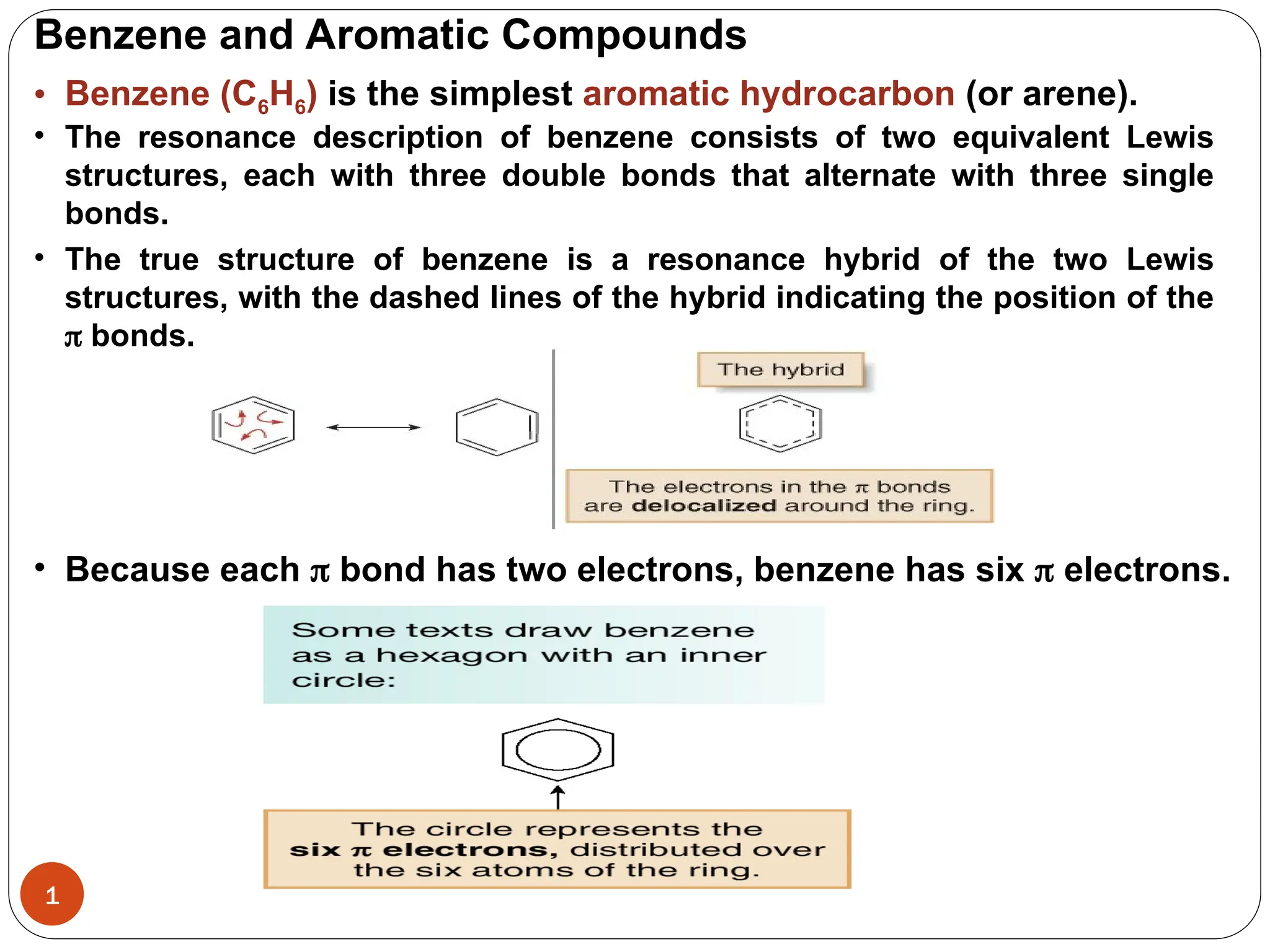
• The resonance description of benzene consists of two equivalent Lewis
structures, each with three double bonds that alternate with three single
bonds.
• The true structure of benzene is a resonance hybrid of the two Lewis
structures, with the dashed lines of the hybrid indicating the position of the
 bonds.
• Because each  bond has two electrons, benzene has six  electrons.
Benzene and Aromatic Compounds
• Benzene (C6H6) is the simplest aromatic hydrocarbon (or arene).
2
• In benzene, the actual bond length (1.39 Å) is
intermediate between the carbon—carbon single bond
(1.53 Å) and the carbon—carbon double bond (1.34 Å).
3
• To name a benzene ring with one substituent, name the substituent and add
the word benzene.
Nomenclature of Benzene Derivatives
• Many monosubstituted benzenes have common names which you must
also learn.
• There are three different ways that two groups can be attached to a benzene
ring, so a prefix—ortho, meta, or para—can be used to designate the relative
position of the two substituents.
ortho-dibromobenzene
or
o-dibromobenzene
or 1,2-dibromobenzene
meta-dibromobenzene
or
m-dibromobenzene
or 1,3-dibromobenzene
para-dibromobenzene
or
p-dibromobenzene
or 1,4-dibromobenzene
4
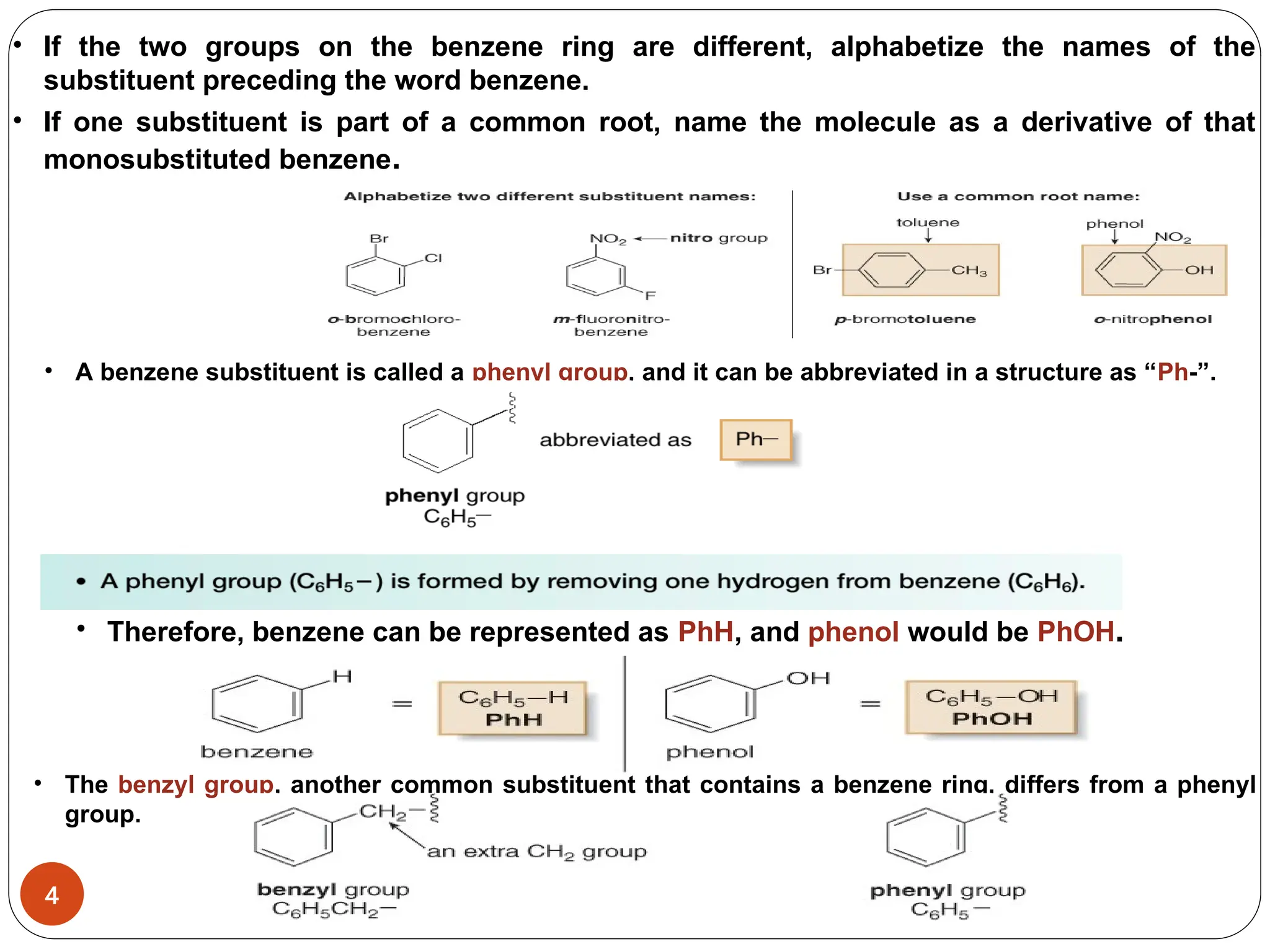
• A benzene substituent is called a phenyl group, and it can be abbreviated in a structure as “Ph-”.
• Therefore, benzene can be represented as PhH, and phenol would be PhOH.
• The benzyl group, another common substituent that contains a benzene ring, differs from a phenyl
group.
• If the two groups on the benzene ring are different, alphabetize the names of the
substituent preceding the word benzene.
• If one substituent is part of a common root, name the molecule as a derivative of that
monosubstituted benzene.
5
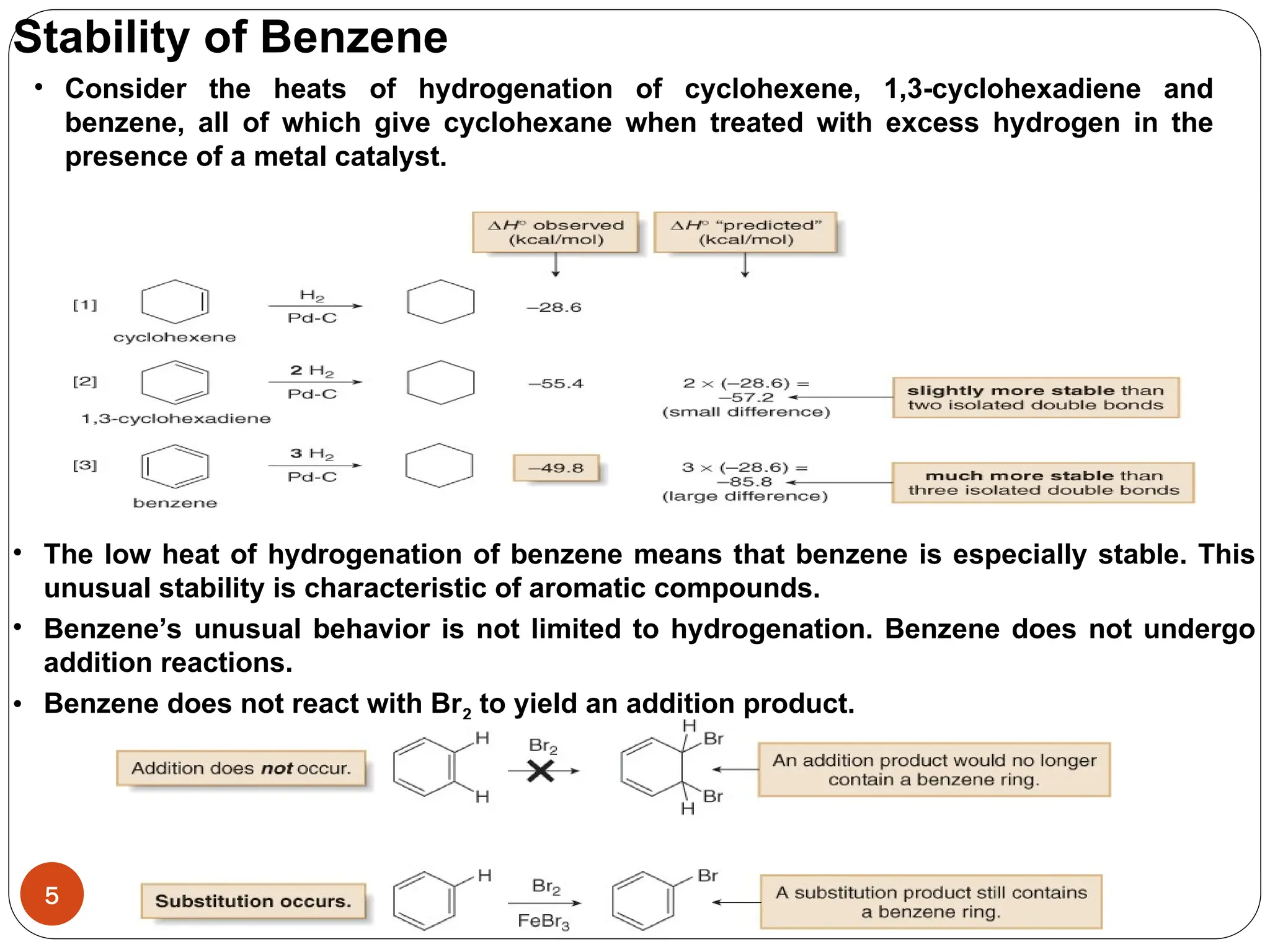
• Consider the heats of hydrogenation of cyclohexene, 1,3-cyclohexadiene and
benzene, all of which give cyclohexane when treated with excess hydrogen in the
presence of a metal catalyst.
Stability of Benzene
• The low heat of hydrogenation of benzene means that benzene is especially stable. This
unusual stability is characteristic of aromatic compounds.
• Benzene’s unusual behavior is not limited to hydrogenation. Benzene does not undergo
addition reactions.
• Benzene does not react with Br2 to yield an addition product.
6
Four structural criteria must be satisfied for a compound to be aromatic.
The Criteria for Aromaticity—Hückel’s Rule
[1] A molecule must be cyclic.
To be aromatic, each p orbital must overlap with p orbitals on adjacent atoms.
[2] A molecule must be planar.
7
[3] A molecule must be completely conjugated.
Aromatic compounds must have a p orbital on every atom.
[4] A molecule must satisfy Hückel’s rule, and contain a particular number of 
electrons.
Hückel's rule:
Benzene is aromatic and especially stable because it contains 6  electrons. Cyclobutadiene
is nonaromatic and especially unstable because it contains 4  electrons.
An aromatic compound must contain 4n+2π electrons [n (integer no.) =
0, 1, 2, and so…]
Benzene
An aromatic compound
4n+2= 6 e 4n+2=4 e
4n=6 - 2=4 4n= 4 - 2 =2
n=4/4=1 n=2/4 = 1.5
aromatic non-aromatic
Cyclobutadiene
non-aromatic compound
8
Note that Hückel’s rule refers to the number of 
electrons, not the number of atoms in a particular ring.
9
Examples of Aromatic Rings
• Completely conjugated rings larger than benzene are
also aromatic if they are planar and have 4n + 2 
electrons.
• Hydrocarbons containing a single ring with alternating
double and single bonds are called annulenes.
• To name an annulene, indicate the number of atoms in
the ring in brackets and add the word annulene.
10
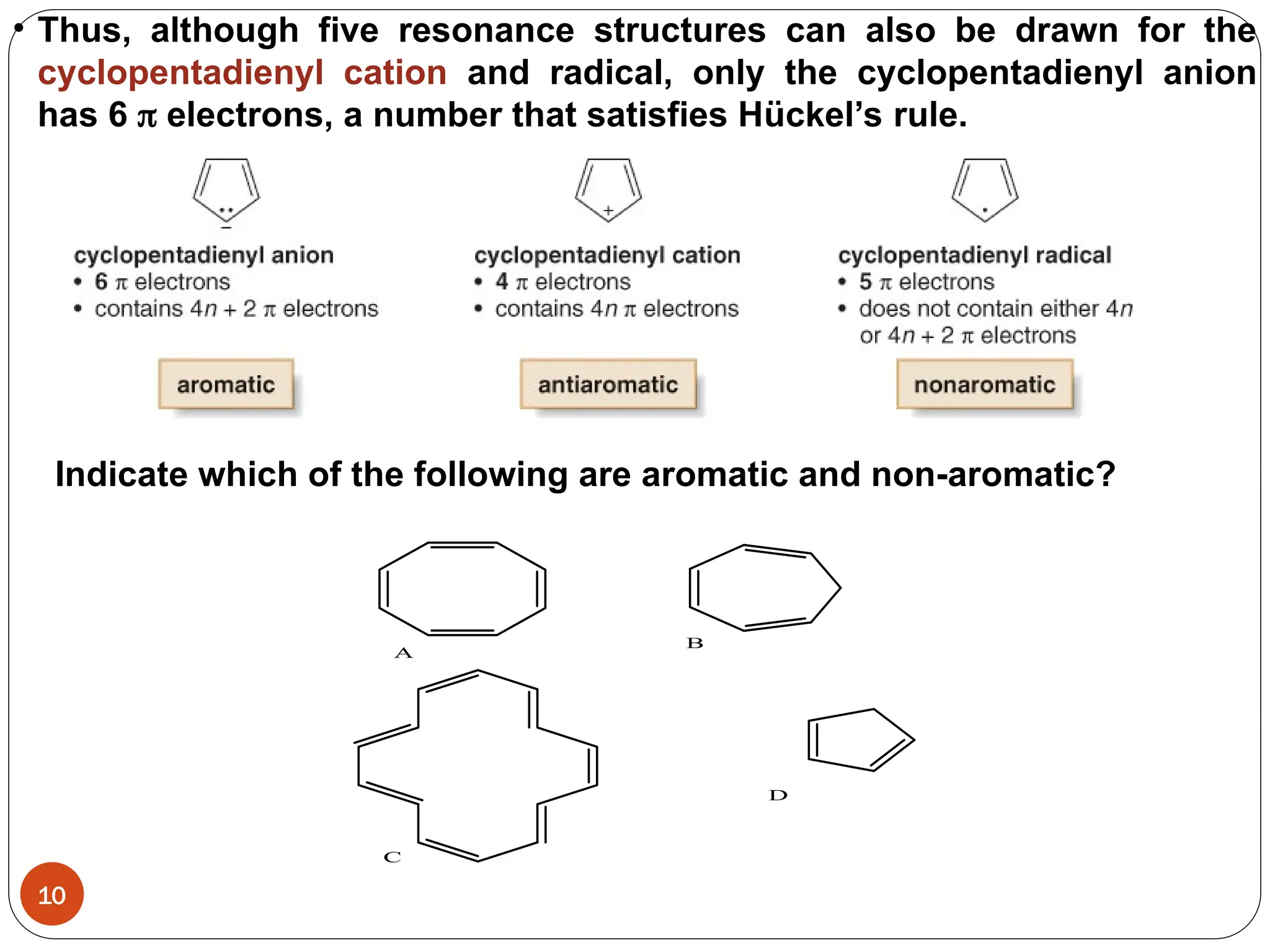
Indicate which of the following are aromatic and non-aromatic?
• Thus, although five resonance structures can also be drawn for the
cyclopentadienyl cation and radical, only the cyclopentadienyl anion
has 6  electrons, a number that satisfies Hückel’s rule.
A
B
C
D

Benzene and aromatic compounds..power point

  • 1.
    1 • The resonancedescription of benzene consists of two equivalent Lewis structures, each with three double bonds that alternate with three single bonds. • The true structure of benzene is a resonance hybrid of the two Lewis structures, with the dashed lines of the hybrid indicating the position of the  bonds. • Because each  bond has two electrons, benzene has six  electrons. Benzene and Aromatic Compounds • Benzene (C6H6) is the simplest aromatic hydrocarbon (or arene).
  • 2.
    2 • In benzene,the actual bond length (1.39 Å) is intermediate between the carbon—carbon single bond (1.53 Å) and the carbon—carbon double bond (1.34 Å).
  • 3.
    3 • To namea benzene ring with one substituent, name the substituent and add the word benzene. Nomenclature of Benzene Derivatives • Many monosubstituted benzenes have common names which you must also learn. • There are three different ways that two groups can be attached to a benzene ring, so a prefix—ortho, meta, or para—can be used to designate the relative position of the two substituents. ortho-dibromobenzene or o-dibromobenzene or 1,2-dibromobenzene meta-dibromobenzene or m-dibromobenzene or 1,3-dibromobenzene para-dibromobenzene or p-dibromobenzene or 1,4-dibromobenzene
  • 4.
    4 • A benzenesubstituent is called a phenyl group, and it can be abbreviated in a structure as “Ph-”. • Therefore, benzene can be represented as PhH, and phenol would be PhOH. • The benzyl group, another common substituent that contains a benzene ring, differs from a phenyl group. • If the two groups on the benzene ring are different, alphabetize the names of the substituent preceding the word benzene. • If one substituent is part of a common root, name the molecule as a derivative of that monosubstituted benzene.
  • 5.
    5 • Consider theheats of hydrogenation of cyclohexene, 1,3-cyclohexadiene and benzene, all of which give cyclohexane when treated with excess hydrogen in the presence of a metal catalyst. Stability of Benzene • The low heat of hydrogenation of benzene means that benzene is especially stable. This unusual stability is characteristic of aromatic compounds. • Benzene’s unusual behavior is not limited to hydrogenation. Benzene does not undergo addition reactions. • Benzene does not react with Br2 to yield an addition product.
  • 6.
    6 Four structural criteriamust be satisfied for a compound to be aromatic. The Criteria for Aromaticity—Hückel’s Rule [1] A molecule must be cyclic. To be aromatic, each p orbital must overlap with p orbitals on adjacent atoms. [2] A molecule must be planar.
  • 7.
    7 [3] A moleculemust be completely conjugated. Aromatic compounds must have a p orbital on every atom. [4] A molecule must satisfy Hückel’s rule, and contain a particular number of  electrons. Hückel's rule: Benzene is aromatic and especially stable because it contains 6  electrons. Cyclobutadiene is nonaromatic and especially unstable because it contains 4  electrons. An aromatic compound must contain 4n+2π electrons [n (integer no.) = 0, 1, 2, and so…] Benzene An aromatic compound 4n+2= 6 e 4n+2=4 e 4n=6 - 2=4 4n= 4 - 2 =2 n=4/4=1 n=2/4 = 1.5 aromatic non-aromatic Cyclobutadiene non-aromatic compound
  • 8.
    8 Note that Hückel’srule refers to the number of  electrons, not the number of atoms in a particular ring.
  • 9.
    9 Examples of AromaticRings • Completely conjugated rings larger than benzene are also aromatic if they are planar and have 4n + 2  electrons. • Hydrocarbons containing a single ring with alternating double and single bonds are called annulenes. • To name an annulene, indicate the number of atoms in the ring in brackets and add the word annulene.
  • 10.
    10 Indicate which ofthe following are aromatic and non-aromatic? • Thus, although five resonance structures can also be drawn for the cyclopentadienyl cation and radical, only the cyclopentadienyl anion has 6  electrons, a number that satisfies Hückel’s rule. A B C D