Human language


What are the characteristics of human languages?


                                                   1
Characteristics of human
            language
 Language is a social tool
 Language must be learned
 The relationship between the sounds of a
  language and their meaning is arbitrary and
  dual
 Language has rules
 Language allows humans to be creative

                                                2
Social tool
 Language is not essential for
  communication
 Communication is the purpose of language
 Language enables us to communicate ideas
  and desires to other people
     With people in our own culture
     With people from other cultures
     With ancient cultures

                                             3
Language is learned
 Animal communication is innate
 Human babies must hear and speak a
  language in order to learn it


                                       4
Sounds and meaning 1
   Human language is arbitrary
     There is no connection between the sound and
      the message
   Animal language is not arbitrary
     An animal’s message and the sound cannot be
      separated


                                                     5
Sounds and meaning 2
 Human language has duality
 Human sounds have basic sounds
     English: /k/, /m/, /p/, /a/, etc.
   English basic sounds can be combined to
    create many other different sounds
     Cat, mat, pat, etc.


                                              6
Language rules
 All languages have rules that guide how the
  parts of languages can be combined
 Animal sounds can be combined in almost
  any order and they will still have the same
  meaning


                                                7
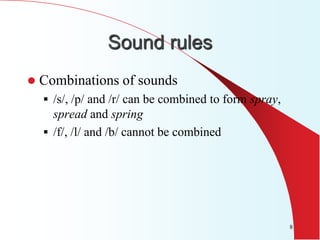
Sound rules
   Combinations of sounds
     /s/, /p/ and /r/ can be combined to form spray,
      spread and spring
     /f/, /l/ and /b/ cannot be combined


                                                        8
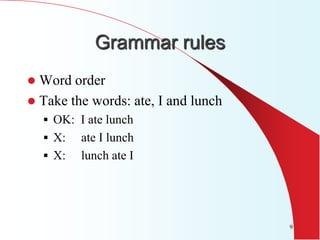
Grammar rules
 Word order
 Take the words: ate, I and lunch
     OK: I ate lunch
     X:   ate I lunch
     X:   lunch ate I


                                     9
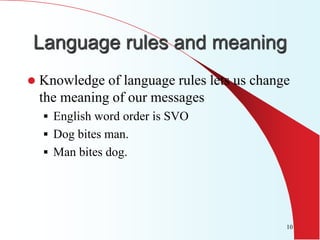
Language rules and meaning
   Knowledge of language rules lets us change
    the meaning of our messages
     English word order is SVO
     Dog bites man.
     Man bites dog.


                                             10
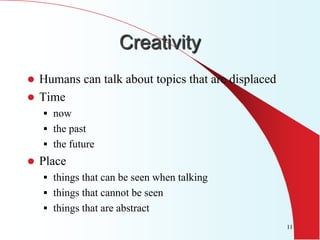
Creativity
 Humans can talk about topics that are displaced
 Time
     now
     the past
     the future
   Place
     things that can be seen when talking
     things that cannot be seen
     things that are abstract
                                                    11
‹#›
Reasons for variety
   Humans can create an infinite number of
    messages because
     Words can refer to more than one thing
     Things can be called by more than one name
     Words can be combined in a variety of ways


                                                   13
Characteristics of human
            language
 Language is a social tool
 Language must be learned
 The relationship between the sounds of a
  language and their meaning is arbitrary and
  dual
 Language has rules
 Language allows humans to be creative

                                                14

Characteristics of human language

  • 1.
    Human language What arethe characteristics of human languages? 1
  • 2.
    Characteristics of human language  Language is a social tool  Language must be learned  The relationship between the sounds of a language and their meaning is arbitrary and dual  Language has rules  Language allows humans to be creative 2
  • 3.
    Social tool  Languageis not essential for communication  Communication is the purpose of language  Language enables us to communicate ideas and desires to other people  With people in our own culture  With people from other cultures  With ancient cultures 3
  • 4.
    Language is learned Animal communication is innate  Human babies must hear and speak a language in order to learn it 4
  • 5.
    Sounds and meaning1  Human language is arbitrary  There is no connection between the sound and the message  Animal language is not arbitrary  An animal’s message and the sound cannot be separated 5
  • 6.
    Sounds and meaning2  Human language has duality  Human sounds have basic sounds  English: /k/, /m/, /p/, /a/, etc.  English basic sounds can be combined to create many other different sounds  Cat, mat, pat, etc. 6
  • 7.
    Language rules  Alllanguages have rules that guide how the parts of languages can be combined  Animal sounds can be combined in almost any order and they will still have the same meaning 7
  • 8.
    Sound rules  Combinations of sounds  /s/, /p/ and /r/ can be combined to form spray, spread and spring  /f/, /l/ and /b/ cannot be combined 8
  • 9.
    Grammar rules  Wordorder  Take the words: ate, I and lunch  OK: I ate lunch  X: ate I lunch  X: lunch ate I 9
  • 10.
    Language rules andmeaning  Knowledge of language rules lets us change the meaning of our messages  English word order is SVO  Dog bites man.  Man bites dog. 10
  • 11.
    Creativity  Humans cantalk about topics that are displaced  Time  now  the past  the future  Place  things that can be seen when talking  things that cannot be seen  things that are abstract 11
  • 12.
  • 13.
    Reasons for variety  Humans can create an infinite number of messages because  Words can refer to more than one thing  Things can be called by more than one name  Words can be combined in a variety of ways 13
  • 14.
    Characteristics of human language  Language is a social tool  Language must be learned  The relationship between the sounds of a language and their meaning is arbitrary and dual  Language has rules  Language allows humans to be creative 14

Editor's Notes

  • #4 Animals communicate, but without languageFacial expressions and gestures are used for communication