Some Characteristics of Middle English                                                          Page 1 of 3


                         Some Characteristics of Middle English
Vocabulary:
      Consider these pairs of Modern English words. The first of each pair is derived from Old
      English and the second is of Anglo-Norman origin: pig/pork, chicken/poultry, calf/veal,
      cow/beef, wood/forest, sheep/mutton, house/mansion, worthy/honourable, bold/courageous,
      freedom/liberty. The role of Anglo-Norman as the language of government and law can be
      seen in the abundance of Modern English words for the mechanisms of government which
      derive from Anglo-Norman: court, judge jury, appeal, parliament.
      Why is middle English called Anglo-Norman? (Because it is a mixture of Old English and
      French)

      This period of trilingual activity developed much of the flexible triplicate synonymy of
      modern English. For instance, English has three words meaning roughly "of or relating to a
      king":kingly from Old English, royal from French and regal from Latin. Likewise, Norman
      and — later — French influences led to some interesting word pairs in English, such as the
      following, which both mean "someone who defends": Warden from Norman, and
      Guardian from French.
      How do you account with example for the triplicate synonymy of English?
Grammar:
      With its simplified case-ending system, the grammar of Middle English is much closer to that
      of modern English than that of Old English. The changes in English grammar may be
      described as a general reduction of inflections. Endings of the noun and adjective marking
      distinctions of number and case and often of gender were so altered in pronunciation as to
      lose their distinctive form and hence their usefulness. To some extent the same thing is true
      of the verb.
      Middle English grammar was simpler than Old English grammar, Comment.
Nouns:
        How do you account for this feature of Middle English: "name" and "namen"?

         Middle English retains only two distinct noun-ending patterns from the more complex system
         of inflection in Old English. The early Modern English words engel (angel) and name (name)
         demonstrate the two patterns:
                                                  strong                weak
                                           singular    plural     singular plural
                                 nom/acc   engel      engles      name      namen
                                   gen     engles     engle(ne)   name      namen
                                   dat     engle      engle(s)    name      namen
         The strong -(e)s plural form has survived into Modern English. The weak -(e)n form is now
         rare in the standard language, used only in oxen, children, brethren; and it is slightly less rare
         in some dialects, used in eyen for eyes, shoon for shoes, hosen for hose(s), kine for cows,
         and been for bees.
Verbs:
How do you account for theses forms of Middle English: ich here, þou spekest, and he comeþ?

         As a general rule, the first person singular of verbs in the present tense ends in -e ("ich here" -
         "I hear"), the second person in -(e)st ("þou spekest" - "thou speakest"), and the third person in
         -eþ ("he comeþ" - "he cometh/he comes"). (þ is pronounced like the unvoiced th in "think").
         Plural forms vary strongly by dialect, with southern dialects preserving the Old English -eþ,
         midland dialects showing -en from about 1200 onward, and northern forms using -es in the
         third person singular as well as the plural.
Some Characteristics of Middle English                                                                       Page 2 of 3


What are the two form of past verbs in Middle English?

      In the past tense, weak verbs are formed by adding an -ed(e), -d(e) or -t(e) ending. These,
      without their personal endings, also form past participles, together with past-participle
      prefixes derived from Old English: i-, y- and sometimes bi-. Strong verbs, by contrast, form
      their past tense by changing their stem vowel (e.g. binden -> bound), as in Modern English.
Pronouns:
      Middle English inherits its pronouns from Old English, with the exception of the third person
      plural:
                                                 Singular                                       Plural
                                 Subject           Object      Possessive      Subject        Object     Possessive
            First               ik / ich / I         me          my(n)            we            us          oure
           Second               þou / thou        þee/thee    þy(n) / thy(n)     e / ye      ow / you    ower / your
      Third Impersonal              hit           hit / him        his             he          hem           her
             Masculine               he              him           his         þei / they   þem / them   þeir / their
             Feminine         ho / scho / sche       hire         hire
        The first and second person pronouns in Old English survived into Middle English largely
        unchanged, with only minor spelling variations. In the third person, the masculine vocative
        singular became 'him'. The neuter form was replaced by a form of the demonstrative that
        developed into 'sche', but unsteadily—'heyr' remained in some areas for a long time. The lack
        of a strong standard written form between the thirteenth and the fifteenth century makes these
        changes hard to map.

      The overall trend was the gradual reduction in the number of different case endings: the
      locative case disappeared, but the six other cases were partly retained in personal pronouns,
      as inhe, him, his.
Pronunciation:
      Generally, all letters in Middle English words were pronounced. (Silent letters in Modern
      English generally come from pronunciation shifts, which means that pronunciation is no
      longer closely reflected by the written form because of fixed spelling constraints imposed by
      the invention of dictionaries and printing.) Therefore 'knight' was pronounced [ kniçt] (with a
      pronounced <k> and the <gh> as the <ch> in German 'Knecht'), not [ na t] as in Modern
      English.

      In earlier Middle English all written vowels were pronounced. By Chaucer's time, however,
      the final <e> had become silent in normal speech, but could optionally be pronounced in
      verse as the meter required (but was normally silent when the next word began with a vowel).
Archaic characters:
      What was the source of such characters in Middle English: æ, ð, þ?
      The following characters can be found in Middle English text, direct holdovers from the Old
      English Latin alphabet.
                                  letter   name                 pronunciation
                                  Ææ       Ash       [æ]
                                   Ðð      Eth       [ð]
                                           Yogh      [ ], [ ], [j] or [d ]
                                   Þþ      Thorn     [θ]
                                           Wynn      [w] (the group ⟨h ⟩ represents [ ])
Middle English Literature:
      The term Middle English literature refers to the literature written in Middle
      English, from the 12th century until the 1470s, when the Chancery Standard,
Some Characteristics of Middle English                                                      Page 3 of 3


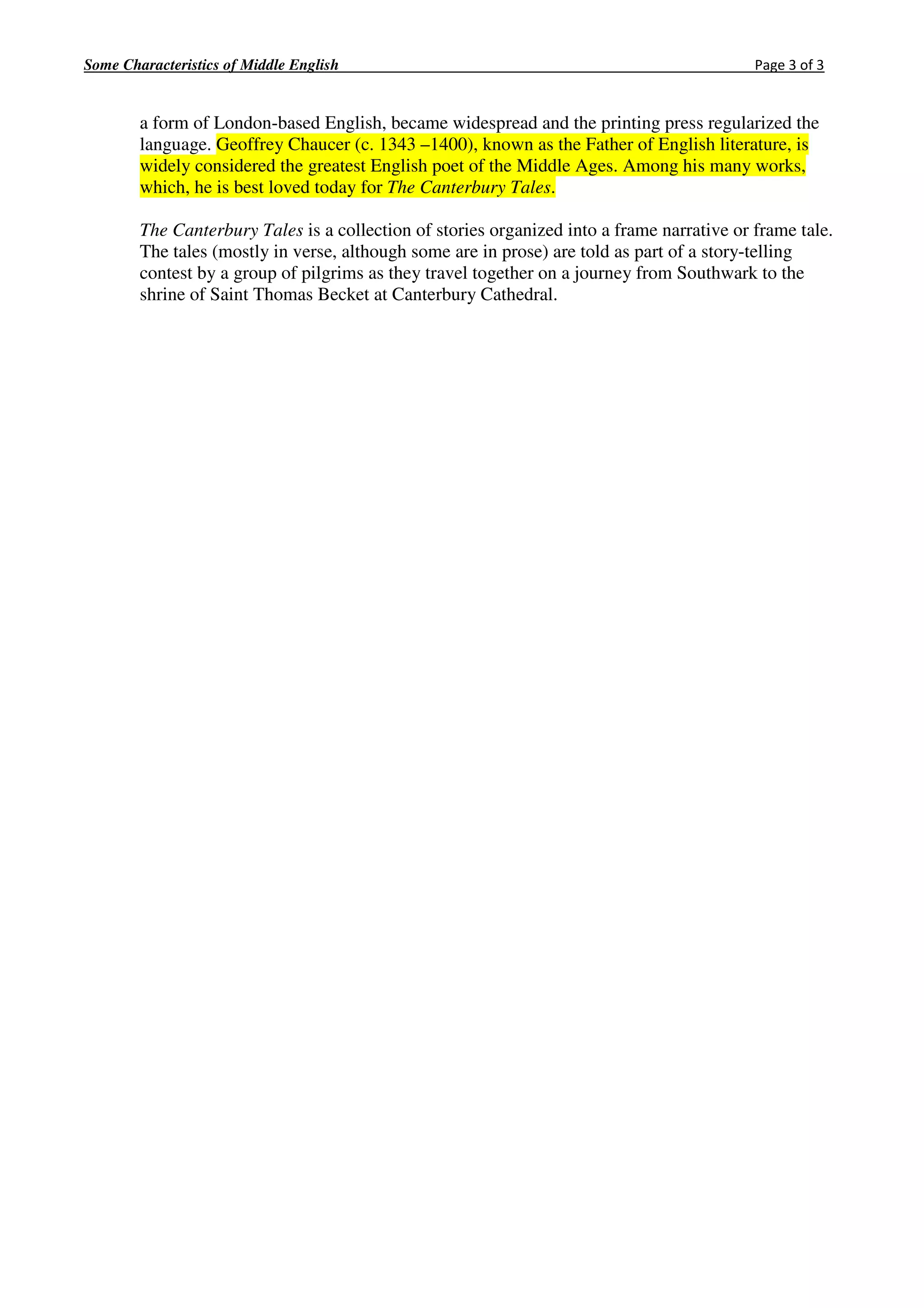
        a form of London-based English, became widespread and the printing press regularized the
        language. Geoffrey Chaucer (c. 1343 –1400), known as the Father of English literature, is
        widely considered the greatest English poet of the Middle Ages. Among his many works,
        which, he is best loved today for The Canterbury Tales.

        The Canterbury Tales is a collection of stories organized into a frame narrative or frame tale.
        The tales (mostly in verse, although some are in prose) are told as part of a story-telling
        contest by a group of pilgrims as they travel together on a journey from Southwark to the
        shrine of Saint Thomas Becket at Canterbury Cathedral.

Some characteristics of middle english

  • 1.
    Some Characteristics ofMiddle English Page 1 of 3 Some Characteristics of Middle English Vocabulary: Consider these pairs of Modern English words. The first of each pair is derived from Old English and the second is of Anglo-Norman origin: pig/pork, chicken/poultry, calf/veal, cow/beef, wood/forest, sheep/mutton, house/mansion, worthy/honourable, bold/courageous, freedom/liberty. The role of Anglo-Norman as the language of government and law can be seen in the abundance of Modern English words for the mechanisms of government which derive from Anglo-Norman: court, judge jury, appeal, parliament. Why is middle English called Anglo-Norman? (Because it is a mixture of Old English and French) This period of trilingual activity developed much of the flexible triplicate synonymy of modern English. For instance, English has three words meaning roughly "of or relating to a king":kingly from Old English, royal from French and regal from Latin. Likewise, Norman and — later — French influences led to some interesting word pairs in English, such as the following, which both mean "someone who defends": Warden from Norman, and Guardian from French. How do you account with example for the triplicate synonymy of English? Grammar: With its simplified case-ending system, the grammar of Middle English is much closer to that of modern English than that of Old English. The changes in English grammar may be described as a general reduction of inflections. Endings of the noun and adjective marking distinctions of number and case and often of gender were so altered in pronunciation as to lose their distinctive form and hence their usefulness. To some extent the same thing is true of the verb. Middle English grammar was simpler than Old English grammar, Comment. Nouns: How do you account for this feature of Middle English: "name" and "namen"? Middle English retains only two distinct noun-ending patterns from the more complex system of inflection in Old English. The early Modern English words engel (angel) and name (name) demonstrate the two patterns: strong weak singular plural singular plural nom/acc engel engles name namen gen engles engle(ne) name namen dat engle engle(s) name namen The strong -(e)s plural form has survived into Modern English. The weak -(e)n form is now rare in the standard language, used only in oxen, children, brethren; and it is slightly less rare in some dialects, used in eyen for eyes, shoon for shoes, hosen for hose(s), kine for cows, and been for bees. Verbs: How do you account for theses forms of Middle English: ich here, þou spekest, and he comeþ? As a general rule, the first person singular of verbs in the present tense ends in -e ("ich here" - "I hear"), the second person in -(e)st ("þou spekest" - "thou speakest"), and the third person in -eþ ("he comeþ" - "he cometh/he comes"). (þ is pronounced like the unvoiced th in "think"). Plural forms vary strongly by dialect, with southern dialects preserving the Old English -eþ, midland dialects showing -en from about 1200 onward, and northern forms using -es in the third person singular as well as the plural.
  • 2.
    Some Characteristics ofMiddle English Page 2 of 3 What are the two form of past verbs in Middle English? In the past tense, weak verbs are formed by adding an -ed(e), -d(e) or -t(e) ending. These, without their personal endings, also form past participles, together with past-participle prefixes derived from Old English: i-, y- and sometimes bi-. Strong verbs, by contrast, form their past tense by changing their stem vowel (e.g. binden -> bound), as in Modern English. Pronouns: Middle English inherits its pronouns from Old English, with the exception of the third person plural: Singular Plural Subject Object Possessive Subject Object Possessive First ik / ich / I me my(n) we us oure Second þou / thou þee/thee þy(n) / thy(n) e / ye ow / you ower / your Third Impersonal hit hit / him his he hem her Masculine he him his þei / they þem / them þeir / their Feminine ho / scho / sche hire hire The first and second person pronouns in Old English survived into Middle English largely unchanged, with only minor spelling variations. In the third person, the masculine vocative singular became 'him'. The neuter form was replaced by a form of the demonstrative that developed into 'sche', but unsteadily—'heyr' remained in some areas for a long time. The lack of a strong standard written form between the thirteenth and the fifteenth century makes these changes hard to map. The overall trend was the gradual reduction in the number of different case endings: the locative case disappeared, but the six other cases were partly retained in personal pronouns, as inhe, him, his. Pronunciation: Generally, all letters in Middle English words were pronounced. (Silent letters in Modern English generally come from pronunciation shifts, which means that pronunciation is no longer closely reflected by the written form because of fixed spelling constraints imposed by the invention of dictionaries and printing.) Therefore 'knight' was pronounced [ kniçt] (with a pronounced <k> and the <gh> as the <ch> in German 'Knecht'), not [ na t] as in Modern English. In earlier Middle English all written vowels were pronounced. By Chaucer's time, however, the final <e> had become silent in normal speech, but could optionally be pronounced in verse as the meter required (but was normally silent when the next word began with a vowel). Archaic characters: What was the source of such characters in Middle English: æ, ð, þ? The following characters can be found in Middle English text, direct holdovers from the Old English Latin alphabet. letter name pronunciation Ææ Ash [æ] Ðð Eth [ð] Yogh [ ], [ ], [j] or [d ] Þþ Thorn [θ] Wynn [w] (the group ⟨h ⟩ represents [ ]) Middle English Literature: The term Middle English literature refers to the literature written in Middle English, from the 12th century until the 1470s, when the Chancery Standard,
  • 3.
    Some Characteristics ofMiddle English Page 3 of 3 a form of London-based English, became widespread and the printing press regularized the language. Geoffrey Chaucer (c. 1343 –1400), known as the Father of English literature, is widely considered the greatest English poet of the Middle Ages. Among his many works, which, he is best loved today for The Canterbury Tales. The Canterbury Tales is a collection of stories organized into a frame narrative or frame tale. The tales (mostly in verse, although some are in prose) are told as part of a story-telling contest by a group of pilgrims as they travel together on a journey from Southwark to the shrine of Saint Thomas Becket at Canterbury Cathedral.