
1
Origins of Language
& Linguistics
An Introduction
S. Mohan Raj
Ph.D Research Scholar
VIT, Vellore.
9751660760
rajmohan251@gmail.com
Origins of Language and
Development of Writing
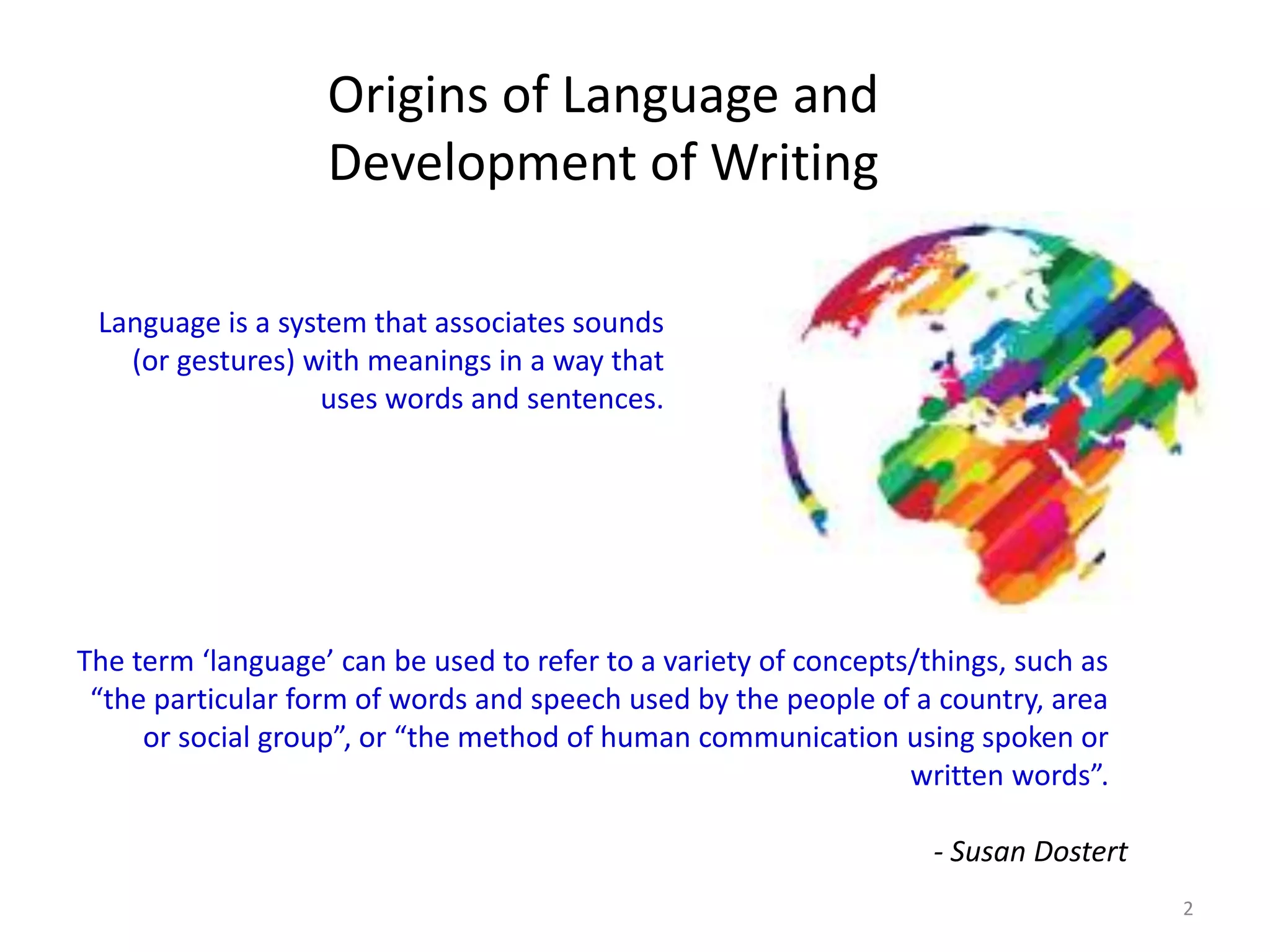
Language is a system that associates sounds
(or gestures) with meanings in a way that
uses words and sentences.
The term ‘language’ can be used to refer to a variety of concepts/things, such as
“the particular form of words and speech used by the people of a country, area
or social group”, or “the method of human communication using spoken or
written words”.
2
- Susan Dostert
A further meaning of ‘language’ is “the
style or types of words used by a person
or group”, which is a topic generally
studied within sociolinguistics.
- Susan Dostert
Language is a purely human and non-
instinctive method of communicating ideas,
emotions and desires by means of voluntarily
produced symbols - (Sapir 1921).
3
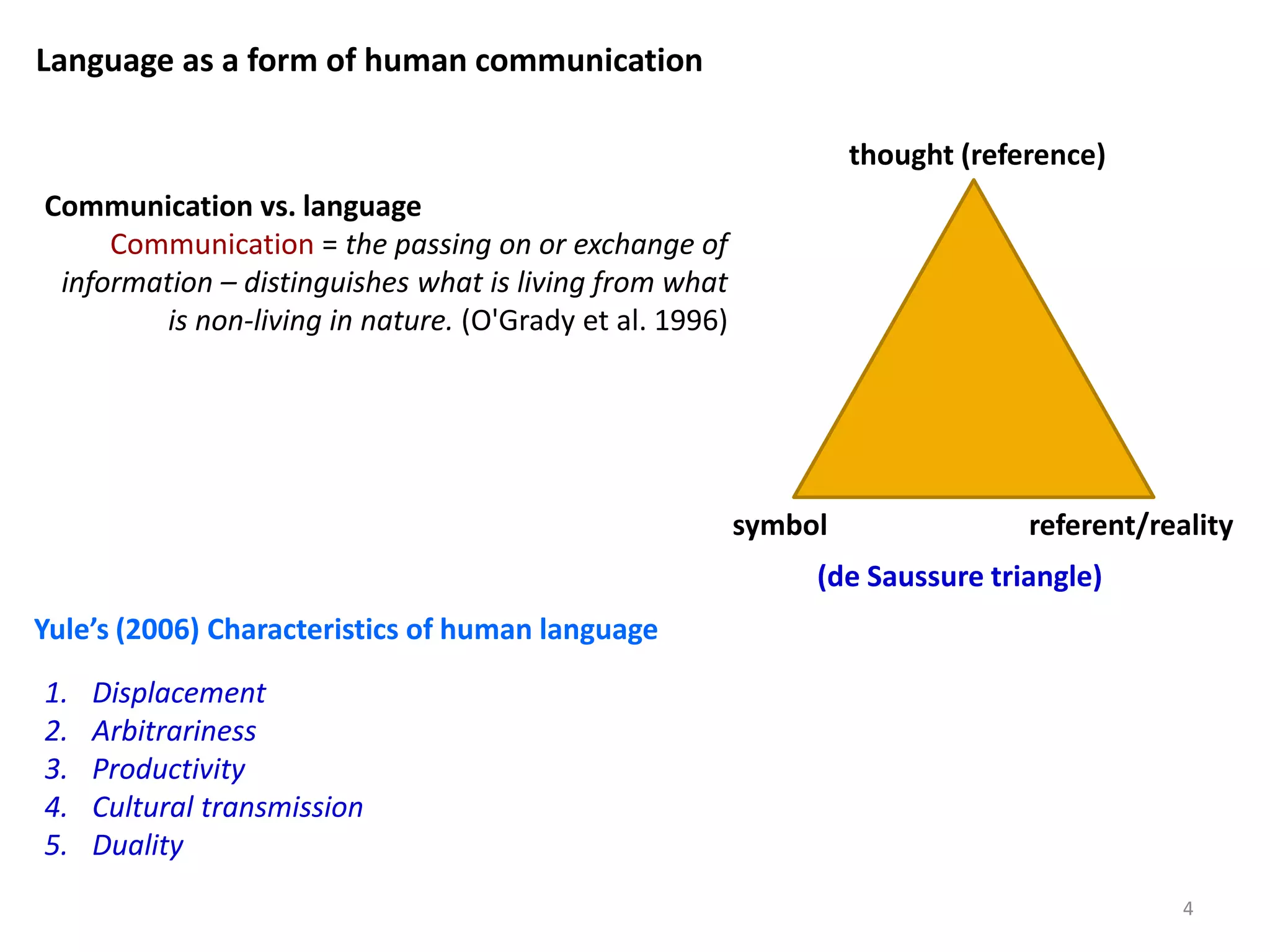
thought (reference)
symbol referent/reality
(de Saussure triangle)
Communication vs. language
Communication = the passing on or exchange of
information – distinguishes what is living from what
is non-living in nature. (O'Grady et al. 1996)
Language as a form of human communication
1. Displacement
2. Arbitrariness
3. Productivity
4. Cultural transmission
5. Duality
Yule’s (2006) Characteristics of human language
4
Language and the brain
Language is a cognitive skill
whose roots are situated in the
*evolution of the brain.
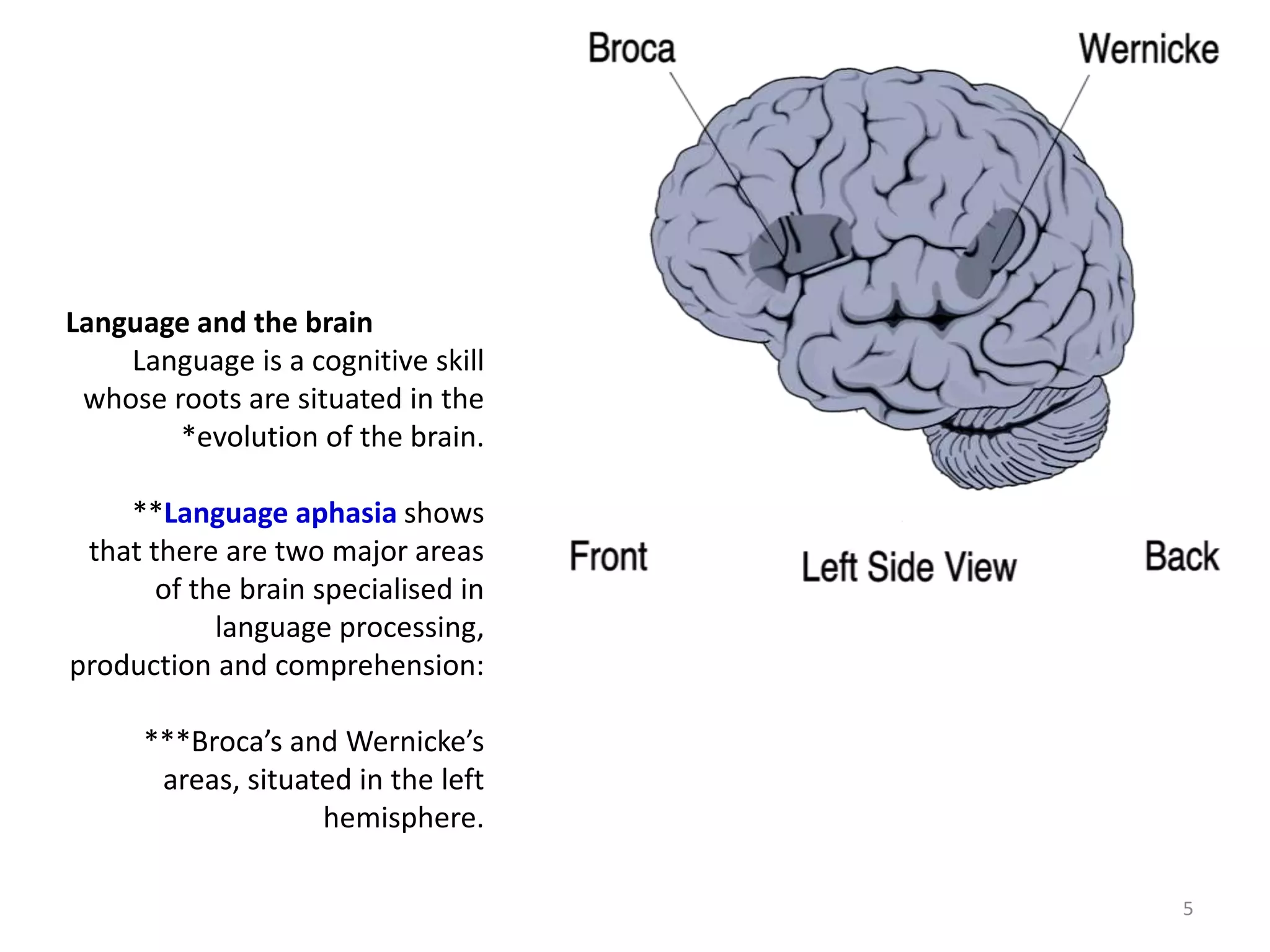
**Language aphasia shows
that there are two major areas
of the brain specialised in
language processing,
production and comprehension:
***Broca’s and Wernicke’s
areas, situated in the left
hemisphere.
5
6
Early Theories about the Origin of Language
1. The bow-wow theory - imitating sounds that things make.
2. The pooh-pooh theory - speech comes from the automatic vocal.
3. The ding-dong theory - speech reflects some mystical resonance in the world.
4. The yo-he-ho theory - speech started with the rhythmic chants.
5. The ta-ta theory - speech from tongue/mouth gestures to mimic manual gestures.
6. The la-la theory - speech emerged from the sounds Inspired.
7
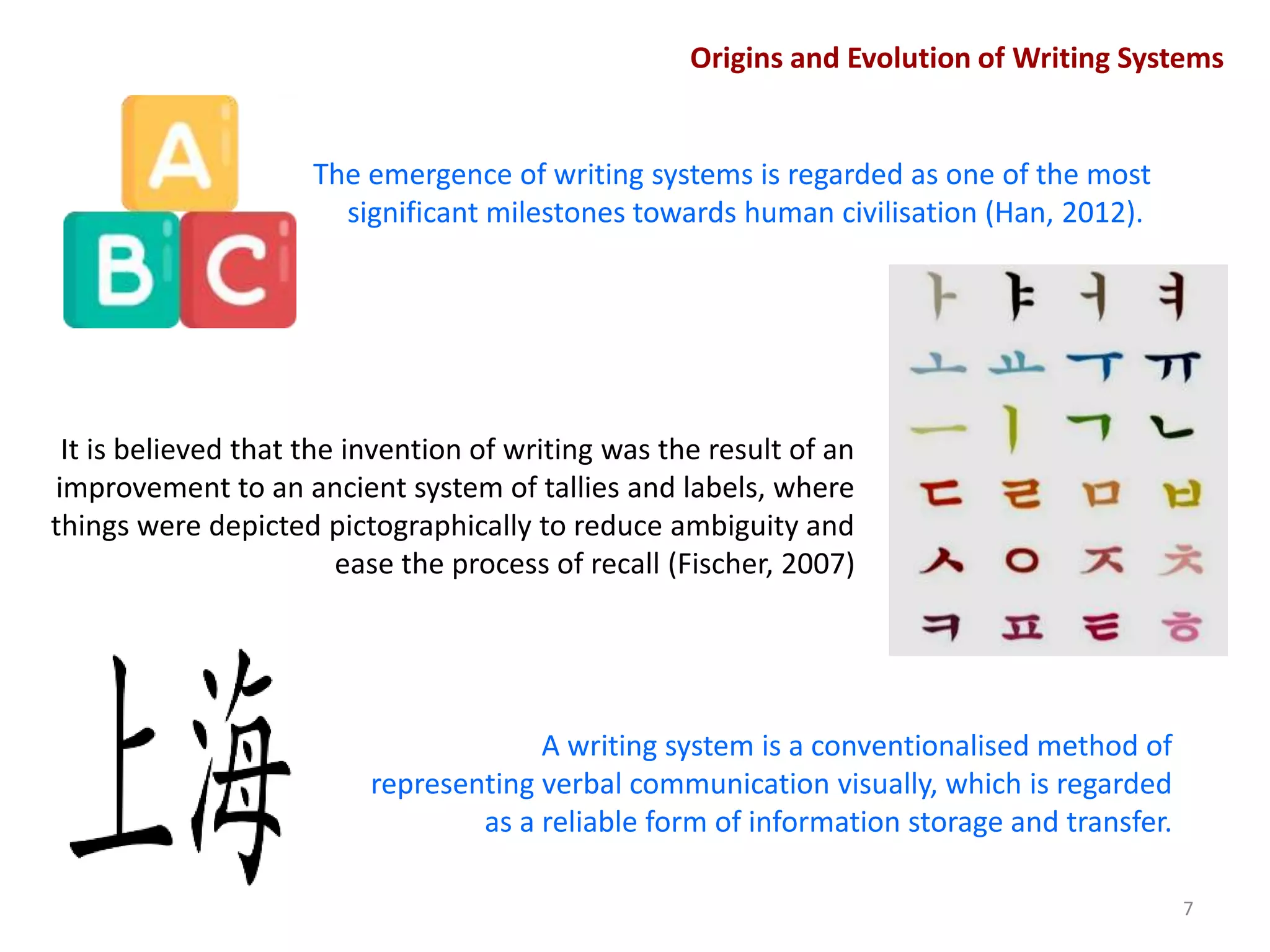
The emergence of writing systems is regarded as one of the most
significant milestones towards human civilisation (Han, 2012).
It is believed that the invention of writing was the result of an
improvement to an ancient system of tallies and labels, where
things were depicted pictographically to reduce ambiguity and
ease the process of recall (Fischer, 2007)
A writing system is a conventionalised method of
representing verbal communication visually, which is regarded
as a reliable form of information storage and transfer.
Origins and Evolution of Writing Systems
8
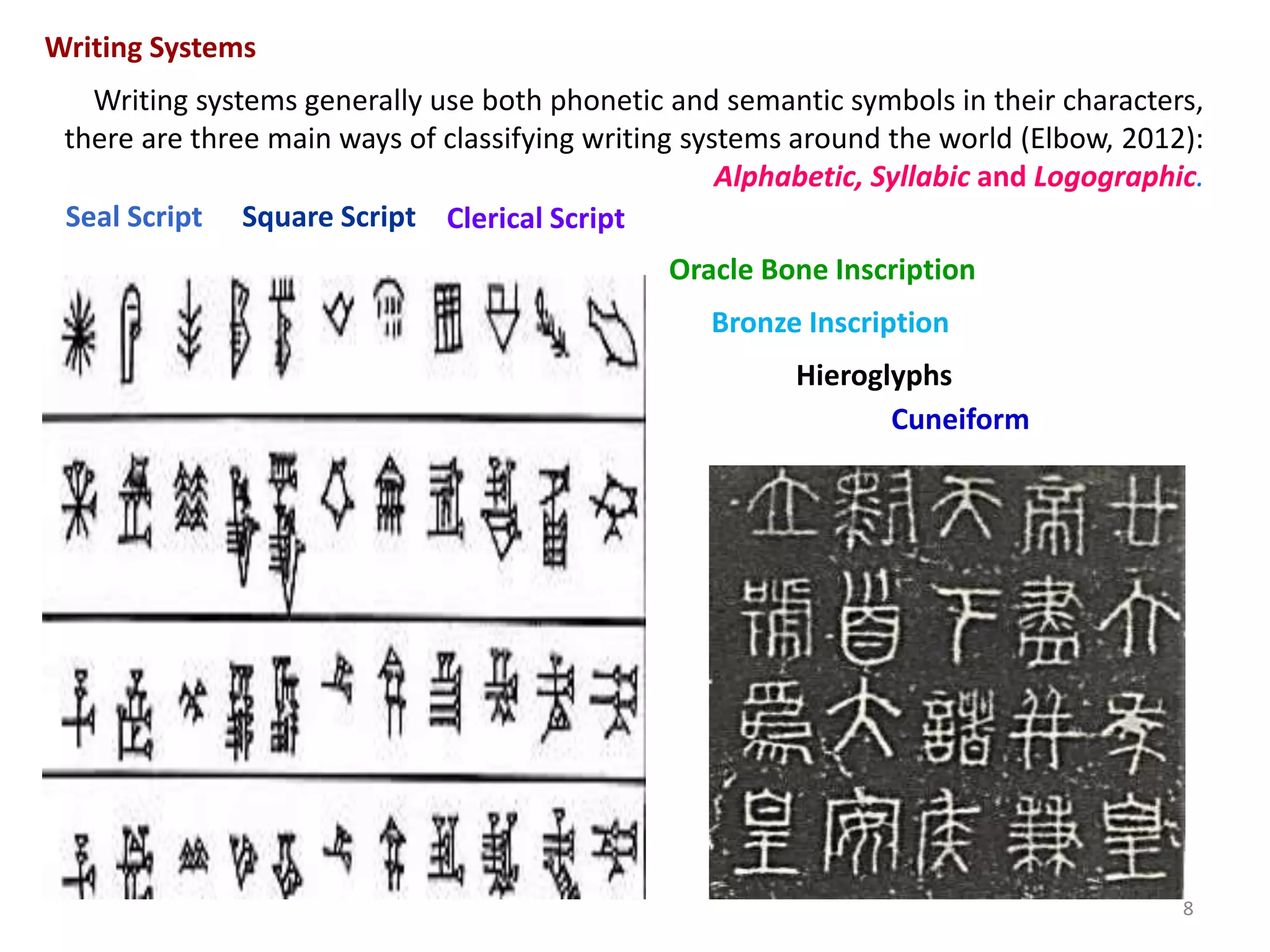
Writing systems generally use both phonetic and semantic symbols in their characters,
there are three main ways of classifying writing systems around the world (Elbow, 2012):
Alphabetic, Syllabic and Logographic.
Cuneiform
Oracle Bone Inscription
Bronze Inscription
Seal Script Clerical ScriptSquare Script
Hieroglyphs
Writing Systems
9
Writing Systems
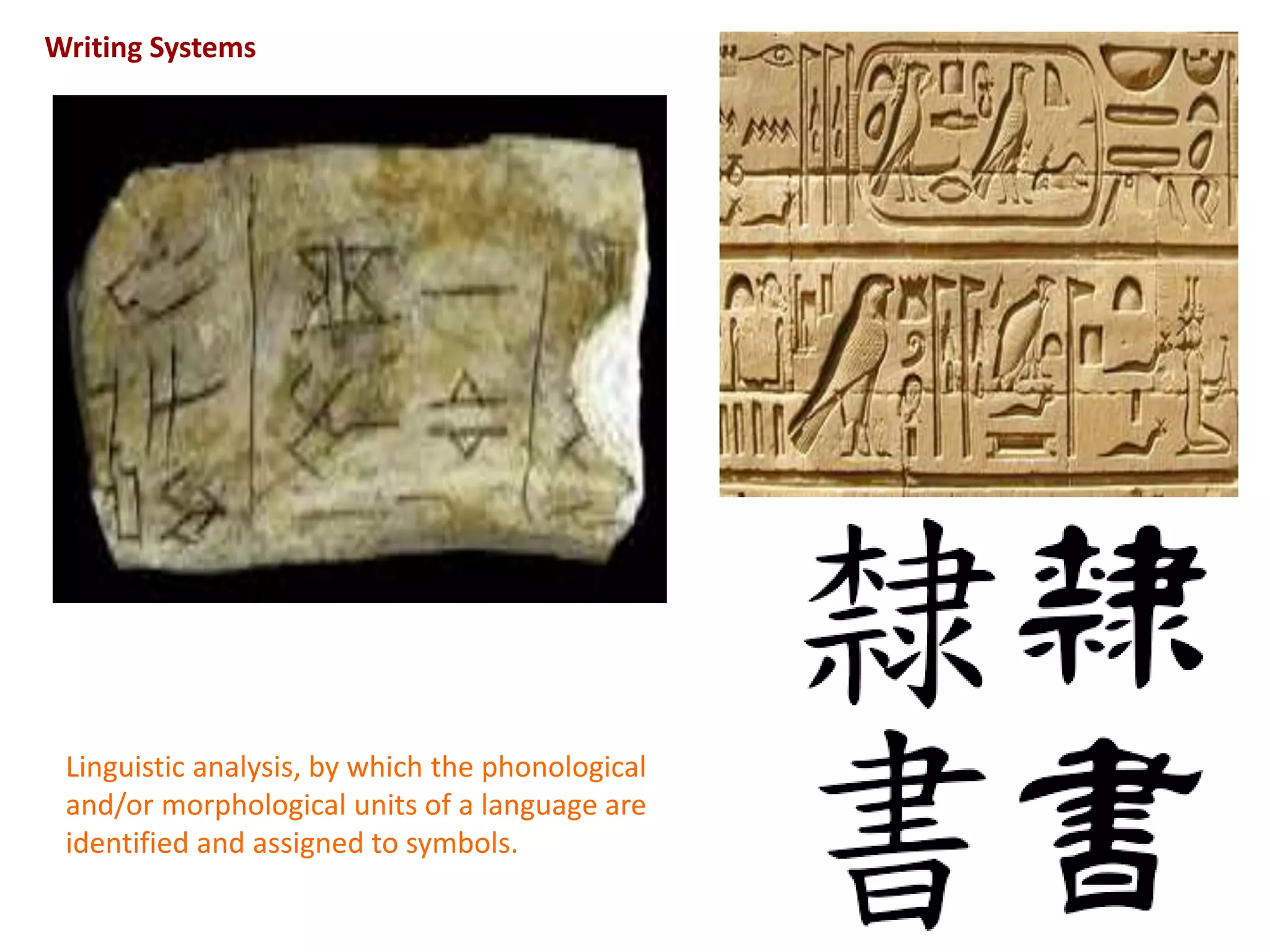
Linguistic analysis, by which the phonological
and/or morphological units of a language are
identified and assigned to symbols.
10
The study of writing systems, or grammatology, is concerned with the
means by which languages are represented by graphic symbols.
The scientific study of language and its structure, including the study of
grammar, syntax, and phonetics. Specific branches of linguistics include
sociolinguistics, dialectology, psycholinguistics, computational linguistics,
comparative linguistics, and structural linguistics. (Oxford dictionary)
ம ொழியியல்
11
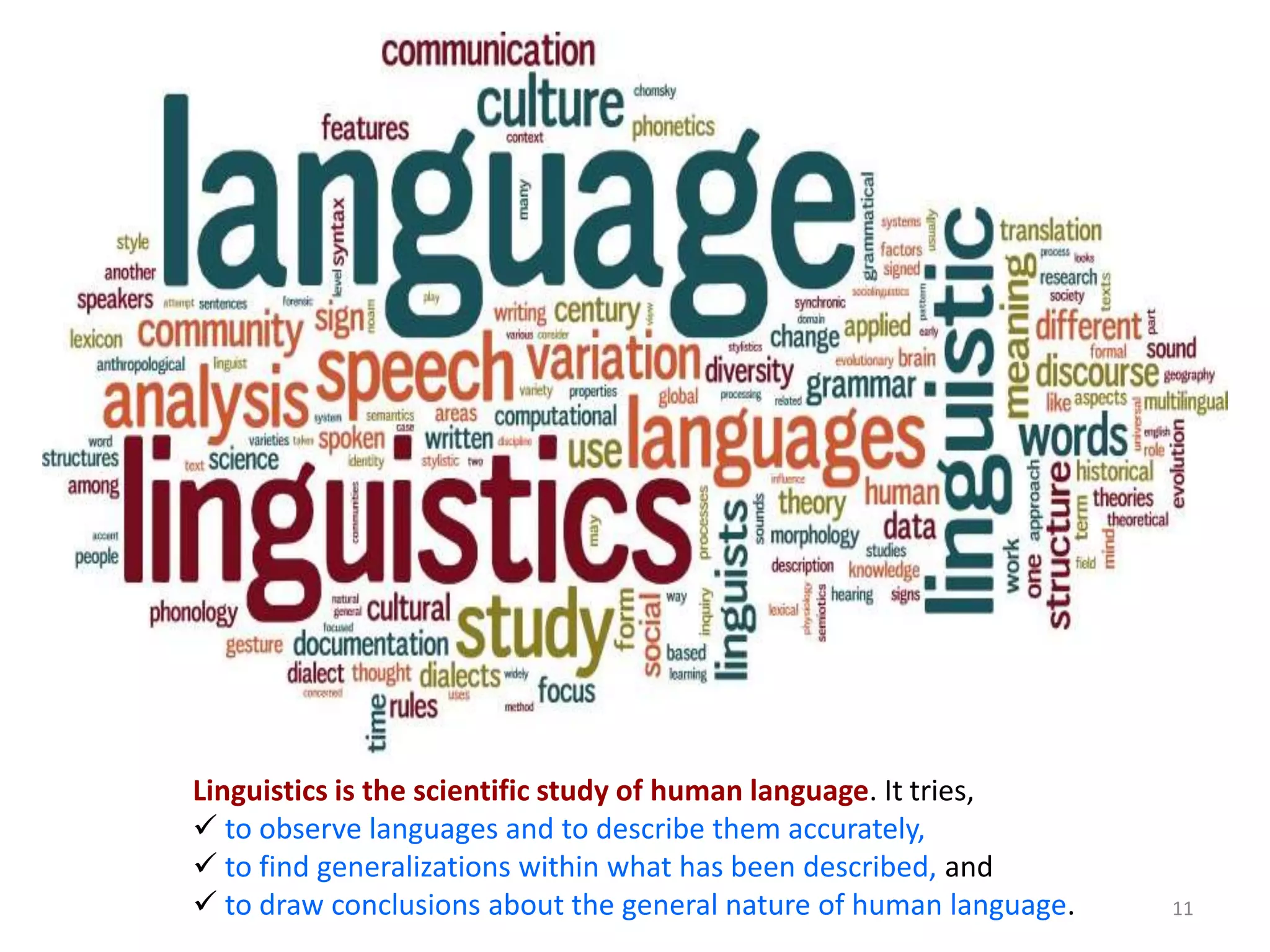
Linguistics is the scientific study of human language. It tries,
 to observe languages and to describe them accurately,
 to find generalizations within what has been described, and
 to draw conclusions about the general nature of human language.
12
13
Linguistics seeks explicit knowledge about language, by submitting it to
systematic and objective study. Linguistics is the scientific study of language.
A study that is systematic, objective, and
seeks explicit knowledge is scientific.
The product of linguistics is an objective, systematic, and explicit account
of (some aspect of) language, i.e. an explicit grammar.
A linguist is a person who is professionally
engaged in the scientific study of some
aspect of language.
The word "linguistics" is derived from the
Latin word for tongue. Linguistics is the
scientific study of human language.
14
15
Applied linguistics attempts to make practical
use of the knowledge derived from
general linguistic research { in order, for
example, to:
improve the ways in which a student's native
language is taught
help people learn foreign language more
eciently
write better dictionaries
improve therapy for people with language
problems
search the Internet more eciently and
successfully
Linguistics overlaps and (ideally) cooperates
with: psychology, sociology, anthropology,
philosophy, logic, mathematics, computer
science, speech pathology, acoustics, music,
cryptanalysis, etc.
16
The main branches of linguistics are:
 Historical linguistics.
 Geographical linguistics.
 Descriptive linguistics.
 Comparative and contrastive linguistics.
 Psycholinguistics.
 Sociolinguistics.
 Ethno linguistics.
 Syntactic/Grammar.
Noam Chomsky is known as the father of modern linguistics.
Back in 1957, Chomsky, with his revolutionary book “Syntactic
Structures,” laid the foundation of his theory of language.
Five major components of the
structure of language are
1. Phonemes,
2. Morphemes,
3. Lexemes,
4. Syntax, and
5. Context.
Around 6th century BC, linguistics began to be studied systematically by the Indian
scholar Pānini, who is generally regarded as the “father of linguistics.”
Formal linguistics later developed in Ancient Greece and around 4th century
BC, China also developed its own grammatical traditions.
17
Applied linguistics attempts to make practical use of the knowledge derived
from general linguistic research in order, for example, to
 Improve the ways in which a student’s native language is taught.
 Help people learn a foreign language more efficiently.
 Write better dictionaries.
 Improve therapy for people with language problems.
 Search the Internet more efficiently and successfully.
A glimpse into a few type of linguistics
Linguistics overlaps and (ideally) cooperates with:
psychology, sociology, anthropology,
philosophy, logic, mathematics, computer
science, speech pathology, acoustics, music,
cryptanalysis, etc.
18
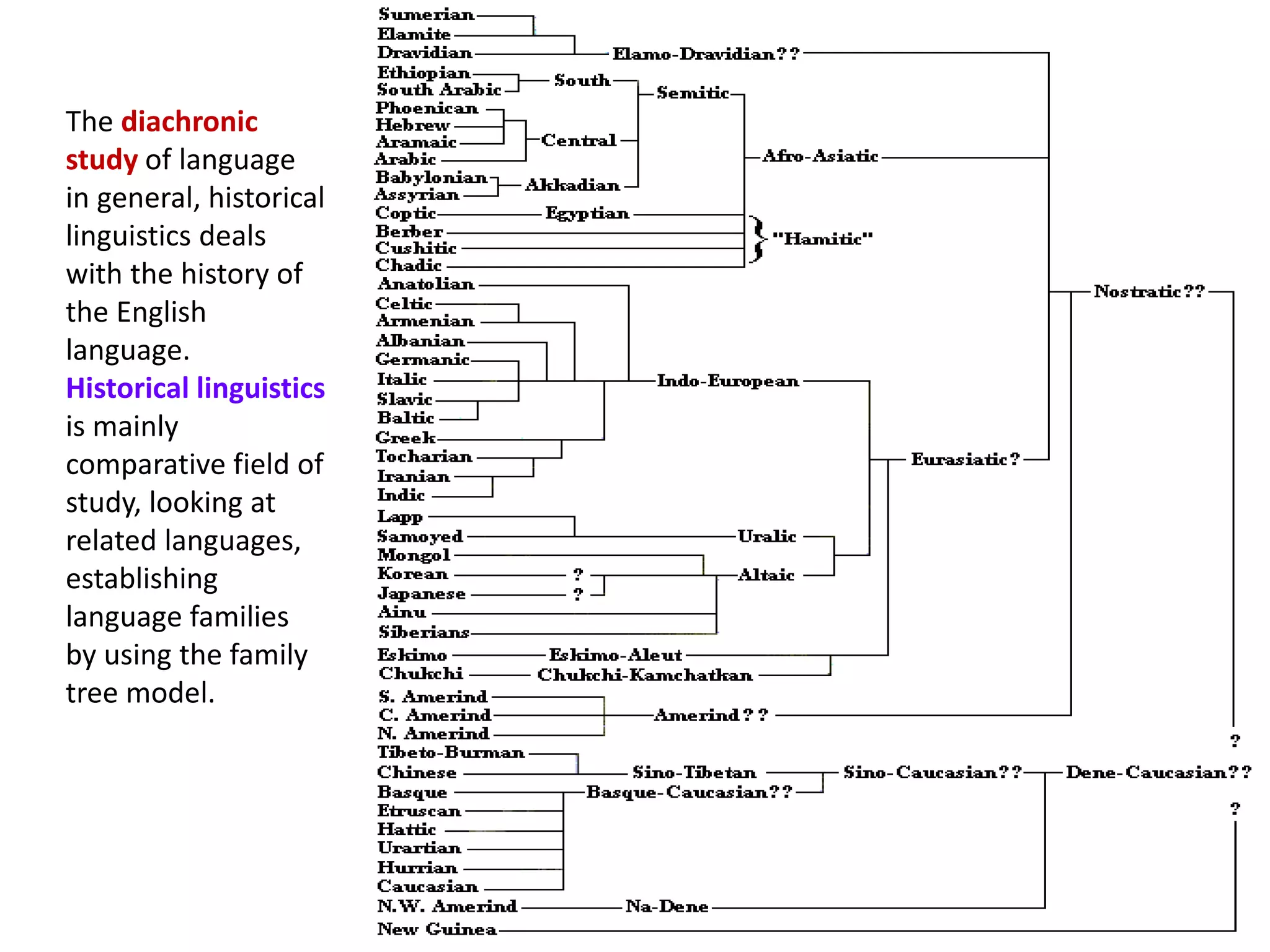
The diachronic
study of language
in general, historical
linguistics deals
with the history of
the English
language.
Historical linguistics
is mainly
comparative field of
study, looking at
related languages,
establishing
language families
by using the family
tree model.
19
20
Reference
https://en.wikipedia.org/wiki/History of linguistics
https://www.britannica.com/topic/Indo-European-languages
https://linguistics.ucsc.edu/about/what-is-linguistics.html
https://mentalfloss.com/article/48631/6-early-theories-about-origin-language
https://en.wikipedia.org/wiki/Origin of language
http://pandora.cii.wwu.edu/vajda/ling201/test1materials/origin of language.htm
https://www.thoughtco.com/where-does-language-come-from-1691015
http://www.historyworld.net/wrldhis/PlainTextHistories.asp?historyid=ab13
https://pdfs.semanticscholar.org/c0a1/c3cf559427e80f27ddae69984519029f1765.pdf
https://en.wikipedia.org/wiki/Triangle of reference
https://en.wikipedia.org/wiki/Writing system
https://www.lexico.com/en/definition/linguistics
21

Origins of language and linguistics

  • 1.
    1 Origins of Language &Linguistics An Introduction S. Mohan Raj Ph.D Research Scholar VIT, Vellore. 9751660760 rajmohan251@gmail.com
  • 2.
    Origins of Languageand Development of Writing Language is a system that associates sounds (or gestures) with meanings in a way that uses words and sentences. The term ‘language’ can be used to refer to a variety of concepts/things, such as “the particular form of words and speech used by the people of a country, area or social group”, or “the method of human communication using spoken or written words”. 2 - Susan Dostert
  • 3.
    A further meaningof ‘language’ is “the style or types of words used by a person or group”, which is a topic generally studied within sociolinguistics. - Susan Dostert Language is a purely human and non- instinctive method of communicating ideas, emotions and desires by means of voluntarily produced symbols - (Sapir 1921). 3
  • 4.
    thought (reference) symbol referent/reality (deSaussure triangle) Communication vs. language Communication = the passing on or exchange of information – distinguishes what is living from what is non-living in nature. (O'Grady et al. 1996) Language as a form of human communication 1. Displacement 2. Arbitrariness 3. Productivity 4. Cultural transmission 5. Duality Yule’s (2006) Characteristics of human language 4
  • 5.
    Language and thebrain Language is a cognitive skill whose roots are situated in the *evolution of the brain. **Language aphasia shows that there are two major areas of the brain specialised in language processing, production and comprehension: ***Broca’s and Wernicke’s areas, situated in the left hemisphere. 5
  • 6.
    6 Early Theories aboutthe Origin of Language 1. The bow-wow theory - imitating sounds that things make. 2. The pooh-pooh theory - speech comes from the automatic vocal. 3. The ding-dong theory - speech reflects some mystical resonance in the world. 4. The yo-he-ho theory - speech started with the rhythmic chants. 5. The ta-ta theory - speech from tongue/mouth gestures to mimic manual gestures. 6. The la-la theory - speech emerged from the sounds Inspired.
  • 7.
    7 The emergence ofwriting systems is regarded as one of the most significant milestones towards human civilisation (Han, 2012). It is believed that the invention of writing was the result of an improvement to an ancient system of tallies and labels, where things were depicted pictographically to reduce ambiguity and ease the process of recall (Fischer, 2007) A writing system is a conventionalised method of representing verbal communication visually, which is regarded as a reliable form of information storage and transfer. Origins and Evolution of Writing Systems
  • 8.
    8 Writing systems generallyuse both phonetic and semantic symbols in their characters, there are three main ways of classifying writing systems around the world (Elbow, 2012): Alphabetic, Syllabic and Logographic. Cuneiform Oracle Bone Inscription Bronze Inscription Seal Script Clerical ScriptSquare Script Hieroglyphs Writing Systems
  • 9.
    9 Writing Systems Linguistic analysis,by which the phonological and/or morphological units of a language are identified and assigned to symbols.
  • 10.
    10 The study ofwriting systems, or grammatology, is concerned with the means by which languages are represented by graphic symbols. The scientific study of language and its structure, including the study of grammar, syntax, and phonetics. Specific branches of linguistics include sociolinguistics, dialectology, psycholinguistics, computational linguistics, comparative linguistics, and structural linguistics. (Oxford dictionary) ம ொழியியல்
  • 11.
    11 Linguistics is thescientific study of human language. It tries,  to observe languages and to describe them accurately,  to find generalizations within what has been described, and  to draw conclusions about the general nature of human language.
  • 12.
  • 13.
    13 Linguistics seeks explicitknowledge about language, by submitting it to systematic and objective study. Linguistics is the scientific study of language. A study that is systematic, objective, and seeks explicit knowledge is scientific. The product of linguistics is an objective, systematic, and explicit account of (some aspect of) language, i.e. an explicit grammar. A linguist is a person who is professionally engaged in the scientific study of some aspect of language. The word "linguistics" is derived from the Latin word for tongue. Linguistics is the scientific study of human language.
  • 14.
  • 15.
    15 Applied linguistics attemptsto make practical use of the knowledge derived from general linguistic research { in order, for example, to: improve the ways in which a student's native language is taught help people learn foreign language more eciently write better dictionaries improve therapy for people with language problems search the Internet more eciently and successfully Linguistics overlaps and (ideally) cooperates with: psychology, sociology, anthropology, philosophy, logic, mathematics, computer science, speech pathology, acoustics, music, cryptanalysis, etc.
  • 16.
    16 The main branchesof linguistics are:  Historical linguistics.  Geographical linguistics.  Descriptive linguistics.  Comparative and contrastive linguistics.  Psycholinguistics.  Sociolinguistics.  Ethno linguistics.  Syntactic/Grammar. Noam Chomsky is known as the father of modern linguistics. Back in 1957, Chomsky, with his revolutionary book “Syntactic Structures,” laid the foundation of his theory of language. Five major components of the structure of language are 1. Phonemes, 2. Morphemes, 3. Lexemes, 4. Syntax, and 5. Context. Around 6th century BC, linguistics began to be studied systematically by the Indian scholar Pānini, who is generally regarded as the “father of linguistics.” Formal linguistics later developed in Ancient Greece and around 4th century BC, China also developed its own grammatical traditions.
  • 17.
    17 Applied linguistics attemptsto make practical use of the knowledge derived from general linguistic research in order, for example, to  Improve the ways in which a student’s native language is taught.  Help people learn a foreign language more efficiently.  Write better dictionaries.  Improve therapy for people with language problems.  Search the Internet more efficiently and successfully. A glimpse into a few type of linguistics Linguistics overlaps and (ideally) cooperates with: psychology, sociology, anthropology, philosophy, logic, mathematics, computer science, speech pathology, acoustics, music, cryptanalysis, etc.
  • 18.
    18 The diachronic study oflanguage in general, historical linguistics deals with the history of the English language. Historical linguistics is mainly comparative field of study, looking at related languages, establishing language families by using the family tree model.
  • 19.
  • 20.
    20 Reference https://en.wikipedia.org/wiki/History of linguistics https://www.britannica.com/topic/Indo-European-languages https://linguistics.ucsc.edu/about/what-is-linguistics.html https://mentalfloss.com/article/48631/6-early-theories-about-origin-language https://en.wikipedia.org/wiki/Originof language http://pandora.cii.wwu.edu/vajda/ling201/test1materials/origin of language.htm https://www.thoughtco.com/where-does-language-come-from-1691015 http://www.historyworld.net/wrldhis/PlainTextHistories.asp?historyid=ab13 https://pdfs.semanticscholar.org/c0a1/c3cf559427e80f27ddae69984519029f1765.pdf https://en.wikipedia.org/wiki/Triangle of reference https://en.wikipedia.org/wiki/Writing system https://www.lexico.com/en/definition/linguistics
  • 21.

Editor's Notes

  • #6 *Our ancestors began to speak (estimates vary from 30,000 – 100,000 years ago) around 5,000 – 6,000 languages assumed to exist today. **Inability to use spoken language. ***Named after the two physicians who first discovered them in the 19th century.
  • #9 Originated from Mesopotamia – modern day Iraq and Kuwait c. 3500-3000 BCE. Egyptian hieroglyphs were the formal writing systems used in Ancient Egypt
  • #10 Originated from Mesopotamia – modern day Iraq and Kuwait c. 3500-3000 BCE. Egyptian hieroglyphs were the formal writing systems used in Ancient Egypt
  • #19 A hypothesis put forward by Professor Joseph Greenberg and his colleagues (Stanford University) holds that the original mother language developed in Africa among early Homo sapiens.