Nonverbal CommunicationForms of Nonverbal Communication
How to use it effectively?
How to express dissatisfaction effectively to students using nonverbal means?
Effective communication skillsForms of Nonverbal CommunicationFacial ExpressionEye ContactGesturesPosture and Body OrientationProxemics or personal space ParalinguisticsTouch (NA)Appearance
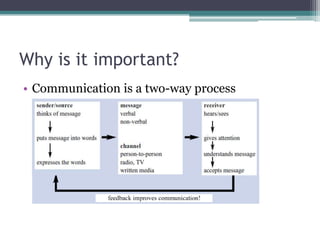
Why is it important?Communication is a two-way process
Why is it important?Nonverbal makes you a better communicatorImprove relationships with peopleImprove self esteemImprove ability to deceive people
Why is it important for teachers?become better receivers of students' messages. become a better sender of signals that reinforce learning. Nonverbal communication increases the degree of the perceived psychological closeness between teacher and student.
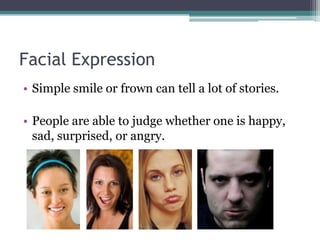
Facial ExpressionSimple smile or frown can tell a lot of stories.People are able to judge whether one is happy, sad, surprised, or angry.
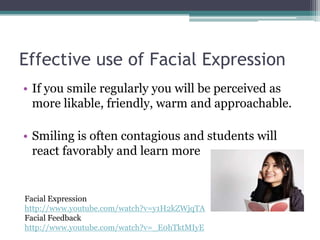
Effective use of Facial ExpressionIf you smile regularly you will be perceived as more likable, friendly, warm and approachable. Smiling is often contagious and students will react favorably and learn moreFacial Expressionhttp://www.youtube.com/watch?v=y1H2kZWjqTAFacial Feedbackhttp://www.youtube.com/watch?v=_E0hTktMIyE
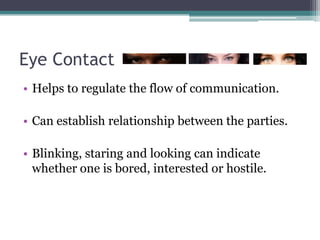
Eye ContactHelps to regulate the flow of communication.Can establish relationship between the parties.Blinking, staring and looking can indicate whether one is bored, interested or hostile.
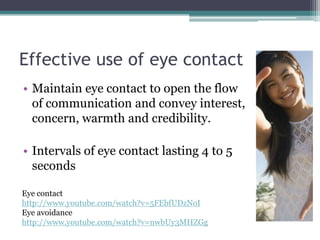
Effective use of eye contactMaintain eye contact to open the flow of communication and convey interest, concern, warmth and credibility. Intervals of eye contact lasting 4 to 5 secondsEye contacthttp://www.youtube.com/watch?v=5FEbfUDzNoIEye avoidancehttp://www.youtube.com/watch?v=nwbUy3MHZGg
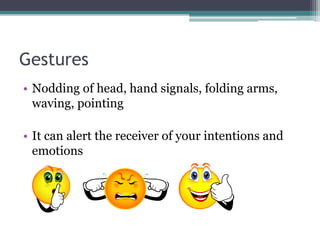
GesturesNodding of head, hand signals, folding arms, waving, pointingIt can alert the receiver of your intentions and emotions
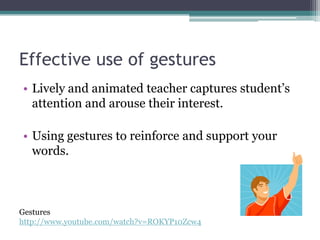
Effective use of gesturesLively and animated teacher captures student’s attention and arouse their interest.Using gestures to reinforce and support your words.Gestureshttp://www.youtube.com/watch?v=ROKYP10Zcw4
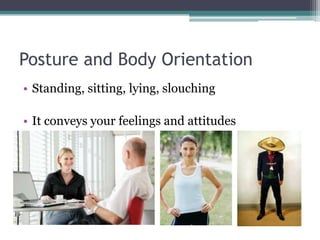
Posture and Body OrientationStanding, sitting, lying, slouchingIt conveys your feelings and attitudes
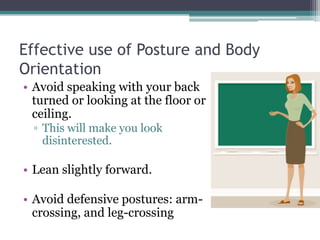
Effective use of Posture and Body OrientationAvoid speaking with your back turned or looking at the floor or ceiling.This will make you look disinterested.Lean slightly forward.Avoid defensive postures: arm-crossing, and leg-crossing
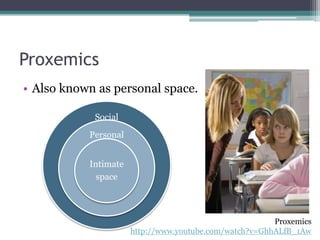
ProxemicsAlso known as personal space.Proxemics http://www.youtube.com/watch?v=GhhALfB_1Aw
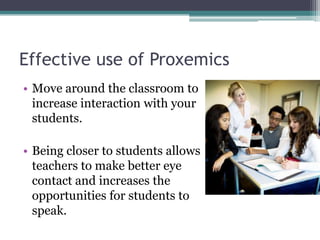
Effective use of ProxemicsMove around the classroom to increase interaction with your students. Being closer to students allows teachers to make better eye contact and increases the opportunities for students to speak.
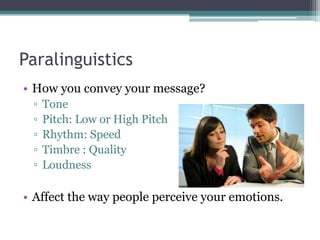
ParalinguisticsHow you convey your message?Tone Pitch: Low or High Pitch Rhythm: Speed Timbre : QualityLoudness Affect the way people perceive your emotions.
Effective use of ParalinguisticsTry to vary the tone and be aware of the underlying message that it conveys.Concentrate on how you phrase and use tones to emphasize ideas.Use soft/ low voice that only the student can hearParalanguagehttp://www.youtube.com/watch?v=P5j0DFkbnE
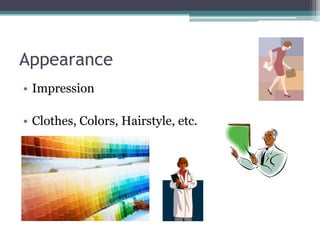
AppearanceImpressionClothes, Colors, Hairstyle, etc.
Effective use of AppearanceDifferent colors can invoke different moods.Warm colors: vary from warmth to anger & hostilityCool colors: vary from calm to feelings of sadnessAppearance can also change physiological reactions, judgment, and interpretations.
How to express dissatisfaction effectively to students using nonverbal means?We can practice and manage our:Eye contactMake sure the student is not avoiding eye contact with youProxemicsStand closer to the student to alert him/herGesturesPut up your hand to stop him/herParalinguisticsVary tone, timbre and loudness
Effective Communication SkillsActive ListeningVerbalNonverbalPractice or Self Review
Active ListeningRelax and listen using verbal and nonverbalAvoid interrupting the speakerIt is important as it can help you digest what is being said accurately. It allows you to think through clearly.
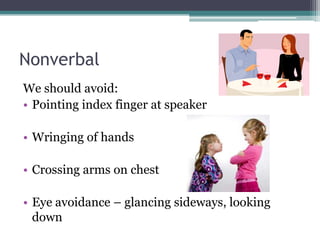
Steps for Active ListeningAffirmation – Acknowledge ideas, thoughts, feelingsVerbal: yes, go on, etcNonverbal: nodding your headParaphrasing – Using own words to repeat speaker’s ideasClarification – check whether you understoodVerbal: ask open-ended questions starting with “How”, “What”, “Please explain”Nonverbal: using gestures to enhance questionsSummarize and give opinionsVerbal: ask if speaker wants to hear your opinions, using “would you..”Nonverbal: using gestures to emphasize ideas
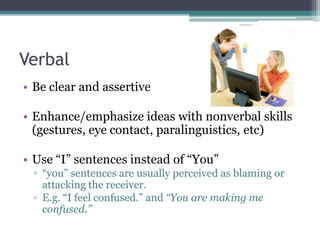
VerbalBe clear and assertiveEnhance/emphasize ideas with nonverbal skills (gestures, eye contact, paralinguistics, etc)Use “I” sentences instead of “You”“you” sentences are usually perceived as blaming or attacking the receiver.E.g. “I feel confused.” and “You are making me confused.”
Verbal + NonverbalWe have to manage our emotions (anger)Using “I” statements, do not use words like “better”, “worse”, “should”Acknowledge other’s emotions (through facial expression, eye contact), look interested to help speaker to relax.Rephrase speaker’s wordsTake note of paralanguage used: tone, timbre and loudnessAdd others into the conversation to address the issue
NonverbalWe should avoid: Pointing index finger at speakerWringing of handsCrossing arms on chestEye avoidance – glancing sideways, looking down
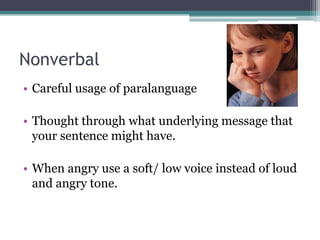
NonverbalCareful usage of paralanguageThought through what underlying message that your sentence might have.When angry use a soft/ low voice instead of loud and angry tone.
Practice or Self reviewPractice and record the speech at home.Take note of paralinguistics usedReflect on these questions:Are everyone being heard?Does everyone has a chance to clarify?Is everyone clear about what you say?Did everyone manage to use the tools of expressing and receiving anger?

Nonverbal Communication

  • 1.
    Nonverbal CommunicationForms ofNonverbal Communication
  • 2.
    How to useit effectively?
  • 3.
    How to expressdissatisfaction effectively to students using nonverbal means?
  • 4.
    Effective communication skillsFormsof Nonverbal CommunicationFacial ExpressionEye ContactGesturesPosture and Body OrientationProxemics or personal space ParalinguisticsTouch (NA)Appearance
  • 5.
    Why is itimportant?Communication is a two-way process
  • 6.
    Why is itimportant?Nonverbal makes you a better communicatorImprove relationships with peopleImprove self esteemImprove ability to deceive people
  • 7.
    Why is itimportant for teachers?become better receivers of students' messages. become a better sender of signals that reinforce learning. Nonverbal communication increases the degree of the perceived psychological closeness between teacher and student.
  • 8.
    Facial ExpressionSimple smileor frown can tell a lot of stories.People are able to judge whether one is happy, sad, surprised, or angry.
  • 9.
    Effective use ofFacial ExpressionIf you smile regularly you will be perceived as more likable, friendly, warm and approachable. Smiling is often contagious and students will react favorably and learn moreFacial Expressionhttp://www.youtube.com/watch?v=y1H2kZWjqTAFacial Feedbackhttp://www.youtube.com/watch?v=_E0hTktMIyE
  • 10.
    Eye ContactHelps toregulate the flow of communication.Can establish relationship between the parties.Blinking, staring and looking can indicate whether one is bored, interested or hostile.
  • 11.
    Effective use ofeye contactMaintain eye contact to open the flow of communication and convey interest, concern, warmth and credibility. Intervals of eye contact lasting 4 to 5 secondsEye contacthttp://www.youtube.com/watch?v=5FEbfUDzNoIEye avoidancehttp://www.youtube.com/watch?v=nwbUy3MHZGg
  • 12.
    GesturesNodding of head,hand signals, folding arms, waving, pointingIt can alert the receiver of your intentions and emotions
  • 13.
    Effective use ofgesturesLively and animated teacher captures student’s attention and arouse their interest.Using gestures to reinforce and support your words.Gestureshttp://www.youtube.com/watch?v=ROKYP10Zcw4
  • 14.
    Posture and BodyOrientationStanding, sitting, lying, slouchingIt conveys your feelings and attitudes
  • 15.
    Effective use ofPosture and Body OrientationAvoid speaking with your back turned or looking at the floor or ceiling.This will make you look disinterested.Lean slightly forward.Avoid defensive postures: arm-crossing, and leg-crossing
  • 16.
    ProxemicsAlso known aspersonal space.Proxemics http://www.youtube.com/watch?v=GhhALfB_1Aw
  • 17.
    Effective use ofProxemicsMove around the classroom to increase interaction with your students. Being closer to students allows teachers to make better eye contact and increases the opportunities for students to speak.
  • 18.
    ParalinguisticsHow you conveyyour message?Tone Pitch: Low or High Pitch Rhythm: Speed Timbre : QualityLoudness Affect the way people perceive your emotions.
  • 19.
    Effective use ofParalinguisticsTry to vary the tone and be aware of the underlying message that it conveys.Concentrate on how you phrase and use tones to emphasize ideas.Use soft/ low voice that only the student can hearParalanguagehttp://www.youtube.com/watch?v=P5j0DFkbnE
  • 20.
  • 21.
    Effective use ofAppearanceDifferent colors can invoke different moods.Warm colors: vary from warmth to anger & hostilityCool colors: vary from calm to feelings of sadnessAppearance can also change physiological reactions, judgment, and interpretations.
  • 22.
    How to expressdissatisfaction effectively to students using nonverbal means?We can practice and manage our:Eye contactMake sure the student is not avoiding eye contact with youProxemicsStand closer to the student to alert him/herGesturesPut up your hand to stop him/herParalinguisticsVary tone, timbre and loudness
  • 23.
    Effective Communication SkillsActiveListeningVerbalNonverbalPractice or Self Review
  • 24.
    Active ListeningRelax andlisten using verbal and nonverbalAvoid interrupting the speakerIt is important as it can help you digest what is being said accurately. It allows you to think through clearly.
  • 25.
    Steps for ActiveListeningAffirmation – Acknowledge ideas, thoughts, feelingsVerbal: yes, go on, etcNonverbal: nodding your headParaphrasing – Using own words to repeat speaker’s ideasClarification – check whether you understoodVerbal: ask open-ended questions starting with “How”, “What”, “Please explain”Nonverbal: using gestures to enhance questionsSummarize and give opinionsVerbal: ask if speaker wants to hear your opinions, using “would you..”Nonverbal: using gestures to emphasize ideas
  • 26.
    VerbalBe clear andassertiveEnhance/emphasize ideas with nonverbal skills (gestures, eye contact, paralinguistics, etc)Use “I” sentences instead of “You”“you” sentences are usually perceived as blaming or attacking the receiver.E.g. “I feel confused.” and “You are making me confused.”
  • 27.
    Verbal + NonverbalWehave to manage our emotions (anger)Using “I” statements, do not use words like “better”, “worse”, “should”Acknowledge other’s emotions (through facial expression, eye contact), look interested to help speaker to relax.Rephrase speaker’s wordsTake note of paralanguage used: tone, timbre and loudnessAdd others into the conversation to address the issue
  • 28.
    NonverbalWe should avoid:Pointing index finger at speakerWringing of handsCrossing arms on chestEye avoidance – glancing sideways, looking down
  • 29.
    NonverbalCareful usage ofparalanguageThought through what underlying message that your sentence might have.When angry use a soft/ low voice instead of loud and angry tone.
  • 30.
    Practice or SelfreviewPractice and record the speech at home.Take note of paralinguistics usedReflect on these questions:Are everyone being heard?Does everyone has a chance to clarify?Is everyone clear about what you say?Did everyone manage to use the tools of expressing and receiving anger?

Editor's Notes

  • #4 Nonverbal communication allows people to share their feelings, thoughts and in turn help others to understand their feelings and purpose.
  • #10 When people avoid eye contact, they may be evading or trying to hide something. However, too much eye contact may be confrontational or intimidating.
  • #11 When you nod your head, it shows that you agree.When you put up your hand, it means stop.When you fold your arms, it shows that you have some arguments or you are angry.
  • #15 Social space: people whom I don’t really knowPersonal space: FriendsIntimate: Family or people who are really close to me
  • #16 Avoid being too close to students, allow space for upset students to leave the classroom or take some time to gather their thoughts
  • #21 Use soft/ low voice that only the student can hear