NONVERBAL COMMUNICATION
IN BUSINESS COMMUNICATION
OUTLINE
• Introduction.
• Importance.
• Types of NVC.
• Negative Indicators.
• Steps to Improve NVC.
• Conclusion
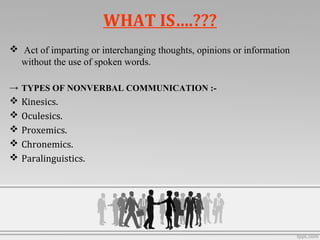
WHAT IS….???
 Act of imparting or interchanging thoughts, opinions or information
without the use of spoken words.
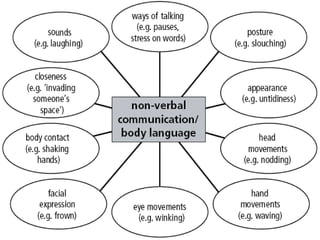
→ TYPES OF NONVERBAL COMMUNICATION :-
 Kinesics.
 Oculesics.
 Proxemics.
 Chronemics.
 Paralinguistics.
IMPORTANCE OF NVC IN BUSINESS
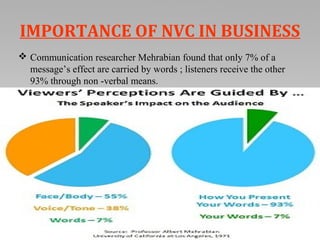
 Communication researcher Mehrabian found that only 7% of a
message’s effect are carried by words ; listeners receive the other
93% through non -verbal means.
IMPORTANCE OF NVC IN BUSINESS
To provide / gather new information.
It is unintentional.
It is more honest than verbal communication.
To make, or help to make a first impression.
To express power and control.
EYE CONTACT
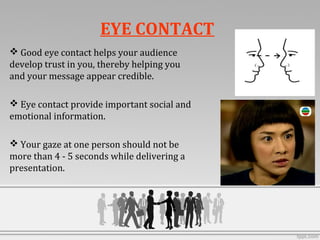
 Good eye contact helps your audience
develop trust in you, thereby helping you
and your message appear credible.
 Eye contact provide important social and
emotional information.
 Your gaze at one person should not be
more than 4 - 5 seconds while delivering a
presentation.
 Gestures include more than just your hands and arms.
 Gestures include all the body movement that takes place above the waist,
including the head, neck, shoulders, and torso movements.
 Gestures can effectively showcase your enthusiasm, confidence, and
authority.
 Don’t go overboard with your gesture.
GESTURES IN BUSINESS
COMMUNICATION
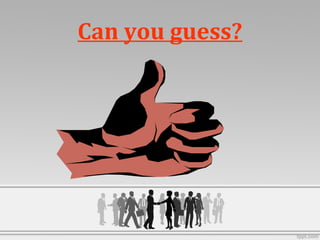
Can you guess?
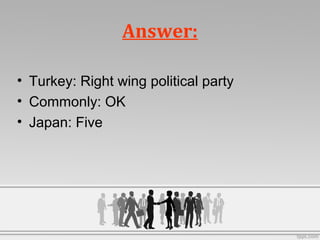
Answer:
• Turkey: Right wing political party
• Commonly: OK
• Japan: Five
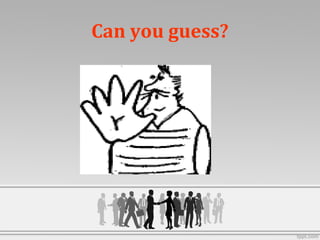
Can you guess?
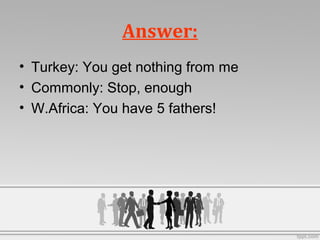
Answer:
• Turkey: You get nothing from me
• Commonly: Stop, enough
• W.Africa: You have 5 fathers!
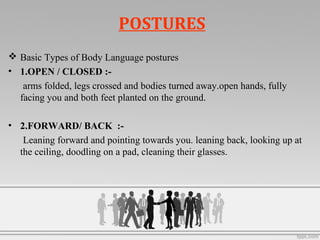
POSTURES
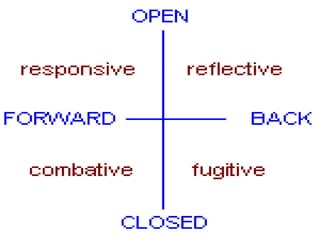
 Basic Types of Body Language postures
• 1.OPEN / CLOSED :-
arms folded, legs crossed and bodies turned away.open hands, fully
facing you and both feet planted on the ground.
• 2.FORWARD/ BACK :-
Leaning forward and pointing towards you. leaning back, looking up at
the ceiling, doodling on a pad, cleaning their glasses.
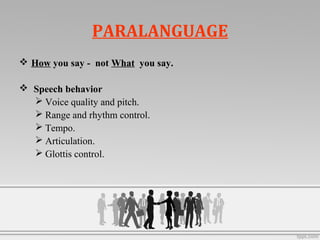
PARALANGUAGE
 How you say - not What you say.
 Speech behavior
 Voice quality and pitch.
 Range and rhythm control.
 Tempo.
 Articulation.
 Glottis control.
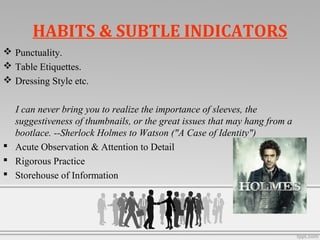
HABITS & SUBTLE INDICATORS
 Punctuality.
 Table Etiquettes.
 Dressing Style etc.
I can never bring you to realize the importance of sleeves, the
suggestiveness of thumbnails, or the great issues that may hang from a
bootlace. --Sherlock Holmes to Watson ("A Case of Identity")
 Acute Observation & Attention to Detail
 Rigorous Practice
 Storehouse of Information
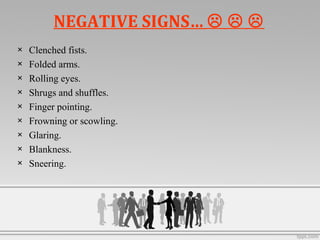
NEGATIVE SIGNS…   
× Clenched fists.
× Folded arms.
× Rolling eyes.
× Shrugs and shuffles.
× Finger pointing.
× Frowning or scowling.
× Glaring.
× Blankness.
× Sneering.
 When sending messages
 Be conscious of nonverbal behavior.
 Be purposeful in use of nonverbals.
 Make sure nonverbals are not distracting.
 Match verbal and nonverbal communication.
 Adapt to the situation.
HOW TO IMPROVE
COMMUNICATION IN BUSINESS
HOW TO IMPROVE
COMMUNICATION IN BUSINESS
 When receiving messages
 Don’t automatically assume.
 Consider gender, culture and individual differences.
 Pay attention to all aspects of nonverbal communication.
 Use perception checking.
CONCLUSIONS
 It is the most important form of communication.
 Employers are much more sensitive and conscious today.
 Our body language represents the best weapon.
 Doesn’t body language help you to realize your parents’ or
friend’s frame of mind?
REFERENCES
• www.smallbusiness.chron.com/benefit-nonverbal-
communication
• http://www.accuconference.com/resources/non-verbal-
communication.aspx
• http://www.inc.com/encyclopedia/nonverbal-
communication.html
• http://www.ehow.com/way_5765314_effective-non_verbal-
communication-business.html
• www.wikipedia.com/nonverbalcommunication
• www.slideshare.net/SahabzadaFahadAhmed/non-verbal-ppt
BEST
OF
LUCK!!!

Nvc in business comm. final

  • 1.
  • 2.
    OUTLINE • Introduction. • Importance. •Types of NVC. • Negative Indicators. • Steps to Improve NVC. • Conclusion
  • 3.
    WHAT IS….???  Actof imparting or interchanging thoughts, opinions or information without the use of spoken words. → TYPES OF NONVERBAL COMMUNICATION :-  Kinesics.  Oculesics.  Proxemics.  Chronemics.  Paralinguistics.
  • 5.
    IMPORTANCE OF NVCIN BUSINESS  Communication researcher Mehrabian found that only 7% of a message’s effect are carried by words ; listeners receive the other 93% through non -verbal means.
  • 6.
    IMPORTANCE OF NVCIN BUSINESS To provide / gather new information. It is unintentional. It is more honest than verbal communication. To make, or help to make a first impression. To express power and control.
  • 7.
    EYE CONTACT  Goodeye contact helps your audience develop trust in you, thereby helping you and your message appear credible.  Eye contact provide important social and emotional information.  Your gaze at one person should not be more than 4 - 5 seconds while delivering a presentation.
  • 8.
     Gestures includemore than just your hands and arms.  Gestures include all the body movement that takes place above the waist, including the head, neck, shoulders, and torso movements.  Gestures can effectively showcase your enthusiasm, confidence, and authority.  Don’t go overboard with your gesture. GESTURES IN BUSINESS COMMUNICATION
  • 9.
  • 10.
    Answer: • Turkey: Rightwing political party • Commonly: OK • Japan: Five
  • 11.
  • 12.
    Answer: • Turkey: Youget nothing from me • Commonly: Stop, enough • W.Africa: You have 5 fathers!
  • 13.
    POSTURES  Basic Typesof Body Language postures • 1.OPEN / CLOSED :- arms folded, legs crossed and bodies turned away.open hands, fully facing you and both feet planted on the ground. • 2.FORWARD/ BACK :- Leaning forward and pointing towards you. leaning back, looking up at the ceiling, doodling on a pad, cleaning their glasses.
  • 15.
    PARALANGUAGE  How yousay - not What you say.  Speech behavior  Voice quality and pitch.  Range and rhythm control.  Tempo.  Articulation.  Glottis control.
  • 16.
    HABITS & SUBTLEINDICATORS  Punctuality.  Table Etiquettes.  Dressing Style etc. I can never bring you to realize the importance of sleeves, the suggestiveness of thumbnails, or the great issues that may hang from a bootlace. --Sherlock Holmes to Watson ("A Case of Identity")  Acute Observation & Attention to Detail  Rigorous Practice  Storehouse of Information
  • 17.
    NEGATIVE SIGNS…   × Clenched fists. × Folded arms. × Rolling eyes. × Shrugs and shuffles. × Finger pointing. × Frowning or scowling. × Glaring. × Blankness. × Sneering.
  • 18.
     When sendingmessages  Be conscious of nonverbal behavior.  Be purposeful in use of nonverbals.  Make sure nonverbals are not distracting.  Match verbal and nonverbal communication.  Adapt to the situation. HOW TO IMPROVE COMMUNICATION IN BUSINESS
  • 19.
    HOW TO IMPROVE COMMUNICATIONIN BUSINESS  When receiving messages  Don’t automatically assume.  Consider gender, culture and individual differences.  Pay attention to all aspects of nonverbal communication.  Use perception checking.
  • 20.
    CONCLUSIONS  It isthe most important form of communication.  Employers are much more sensitive and conscious today.  Our body language represents the best weapon.  Doesn’t body language help you to realize your parents’ or friend’s frame of mind?
  • 22.
    REFERENCES • www.smallbusiness.chron.com/benefit-nonverbal- communication • http://www.accuconference.com/resources/non-verbal- communication.aspx •http://www.inc.com/encyclopedia/nonverbal- communication.html • http://www.ehow.com/way_5765314_effective-non_verbal- communication-business.html • www.wikipedia.com/nonverbalcommunication • www.slideshare.net/SahabzadaFahadAhmed/non-verbal-ppt
  • 23.