
2nd Material
1
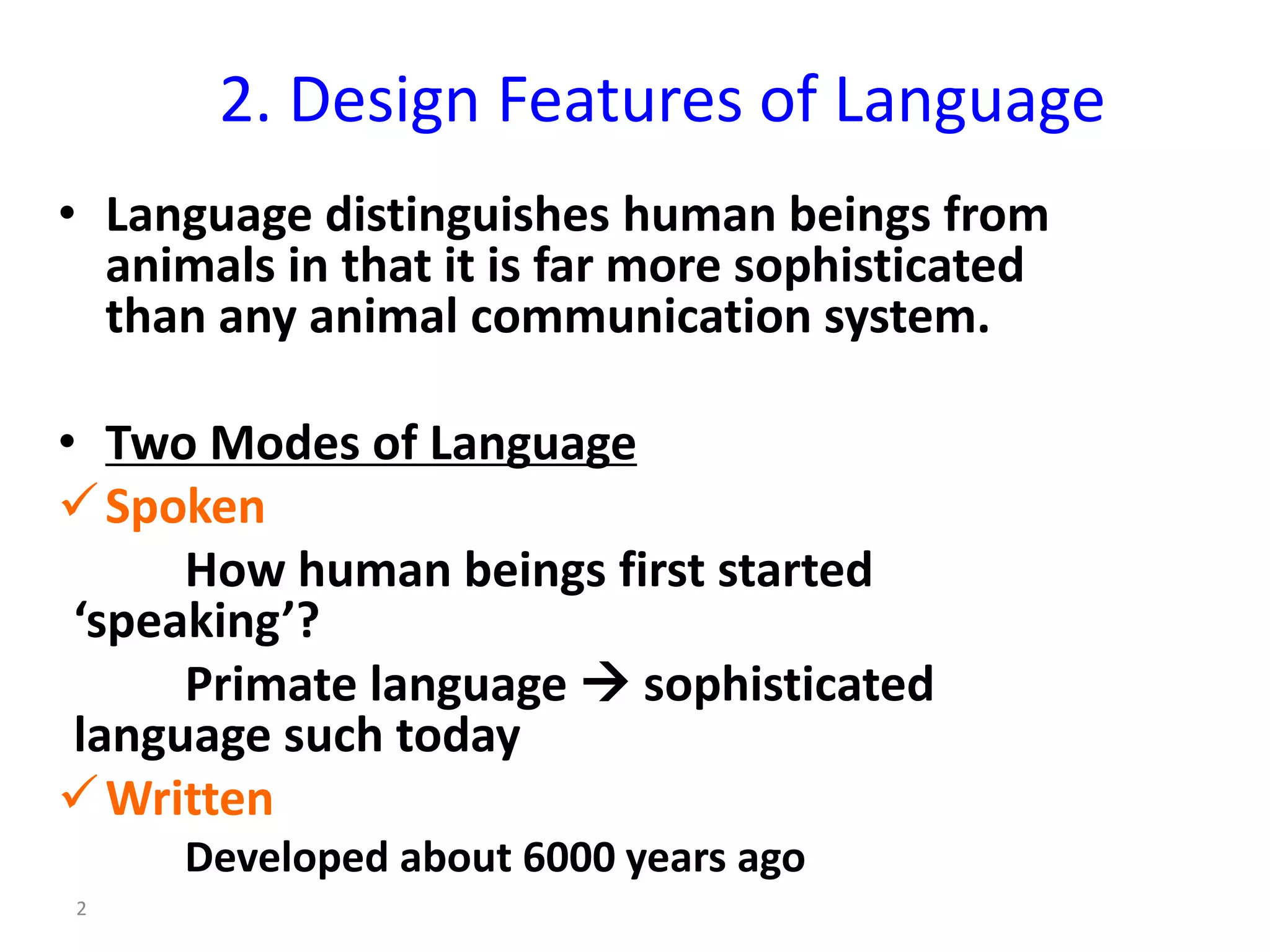
2. Design Features of Language
• Language distinguishes human beings from
animals in that it is far more sophisticated
than any animal communication system.
• Two Modes of Language
Spoken
How human beings first started
‘speaking’?
Primate language  sophisticated
language such today
Written
Developed about 6000 years ago
2
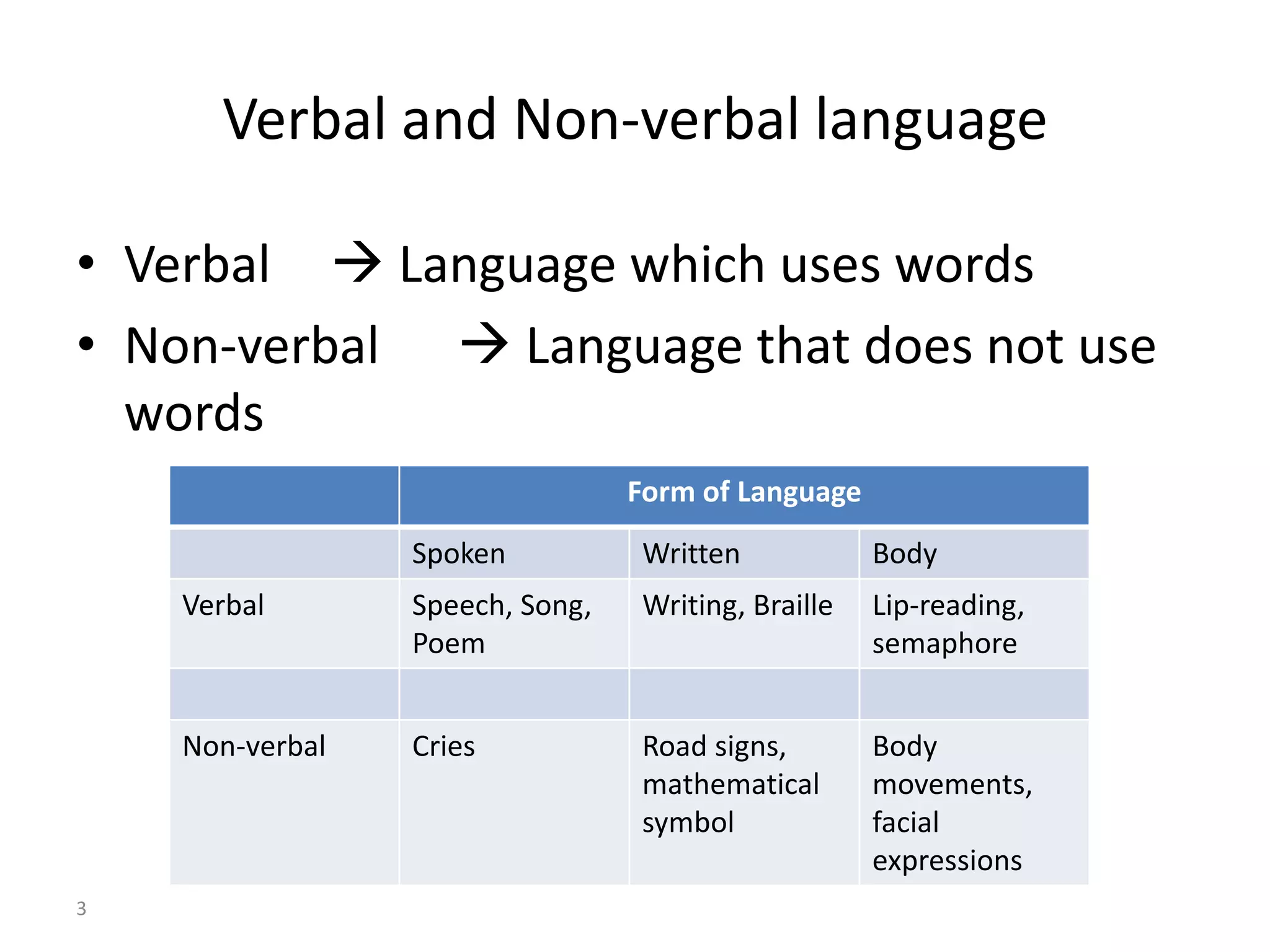
Verbal and Non-verbal language
• Verbal  Language which uses words
• Non-verbal  Language that does not use
words
3
Form of Language
Spoken Written Body
Verbal
Non-verbal
Form of Language
Spoken Written Body
Verbal Speech, Song,
Poem
Writing, Braille Lip-reading,
semaphore
Non-verbal Cries Road signs,
mathematical
symbol
Body
movements,
facial
expressions
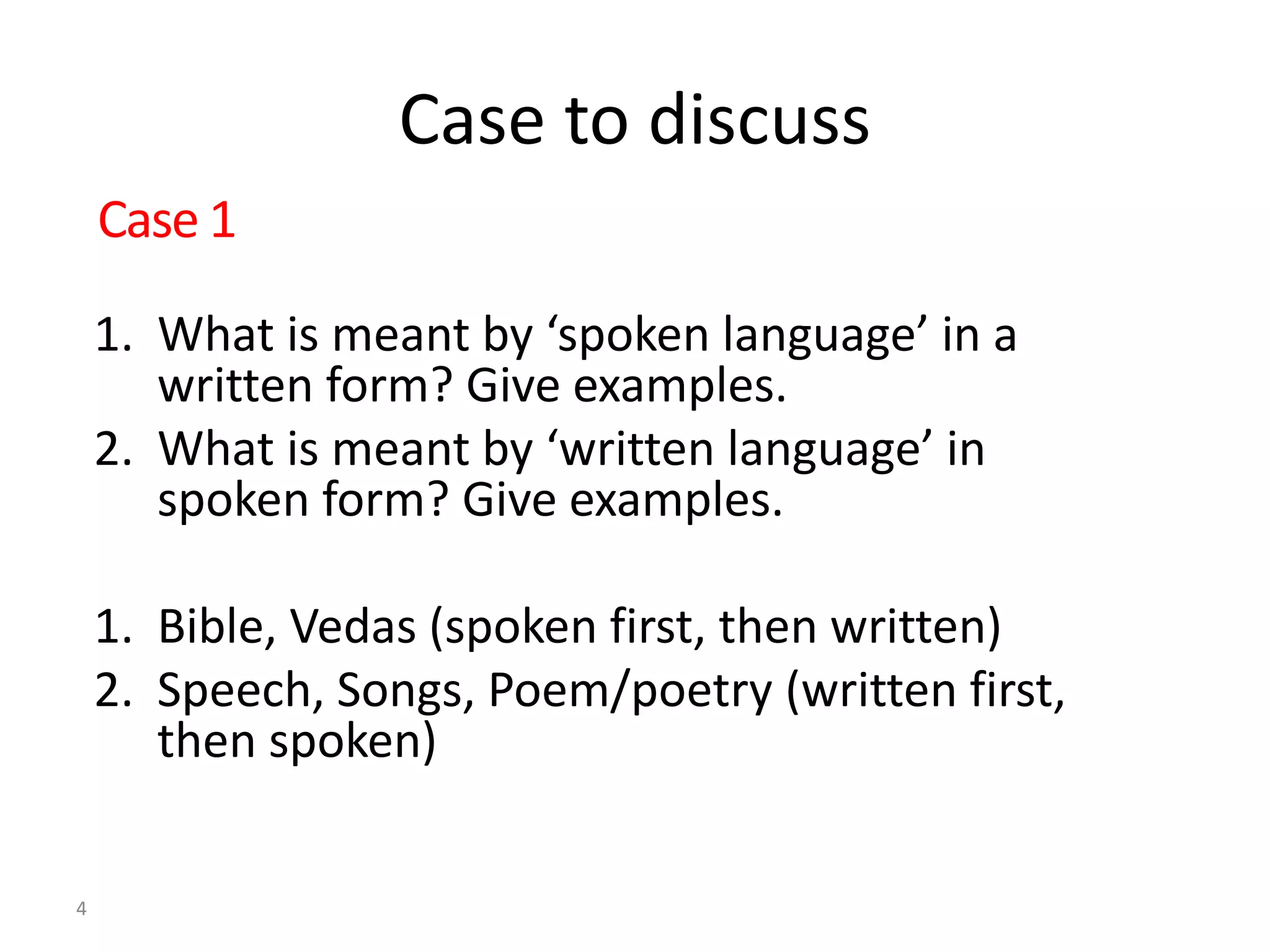
Case to discuss
1. What is meant by ‘spoken language’ in a
written form? Give examples.
2. What is meant by ‘written language’ in
spoken form? Give examples.
1. Bible, Vedas (spoken first, then written)
2. Speech, Songs, Poem/poetry (written first,
then spoken)
4
Case 1
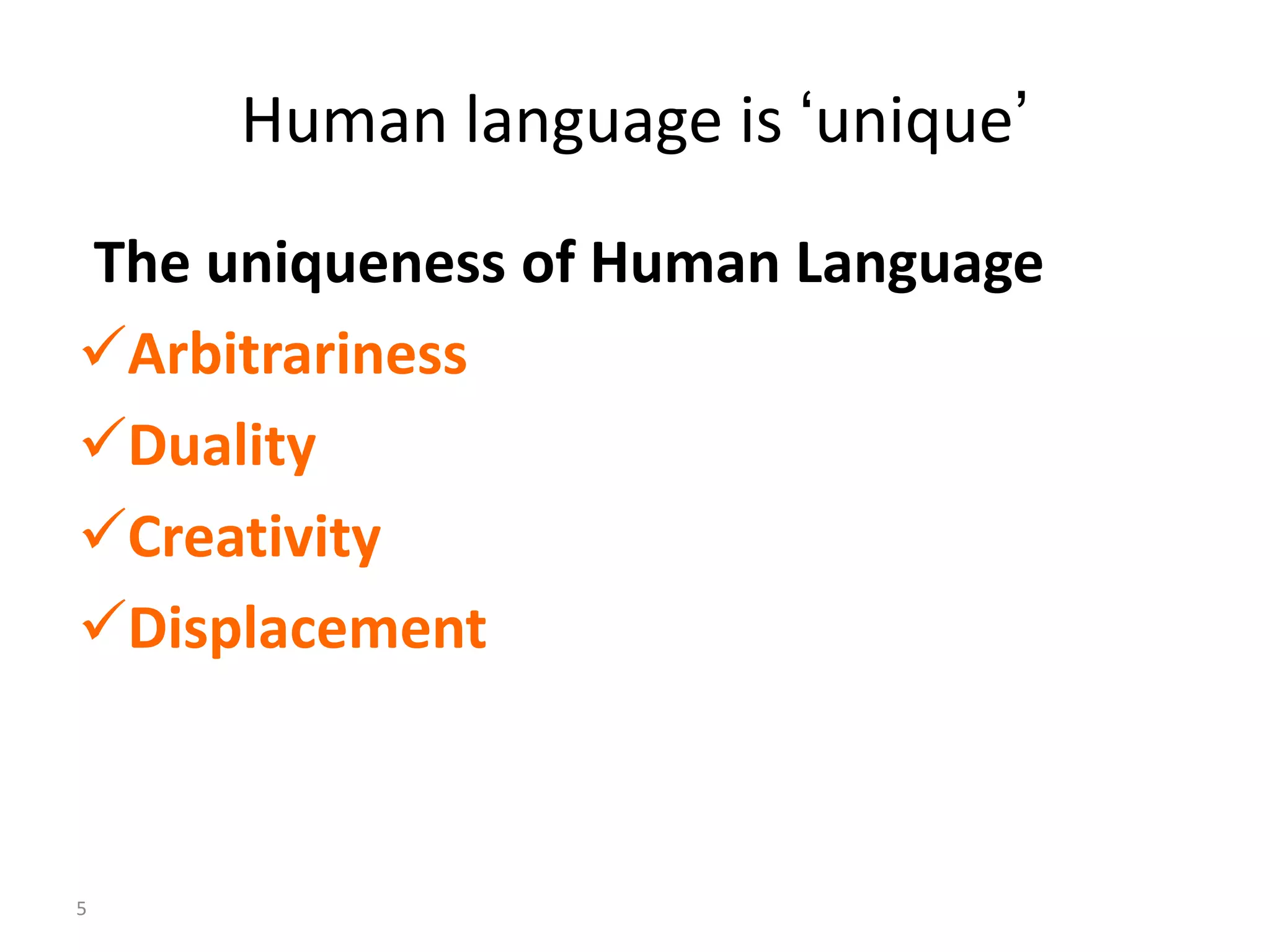
Human language is ‘unique’
The uniqueness of Human Language
Arbitrariness
Duality
Creativity
Displacement
5
2.1 Arbitrariness
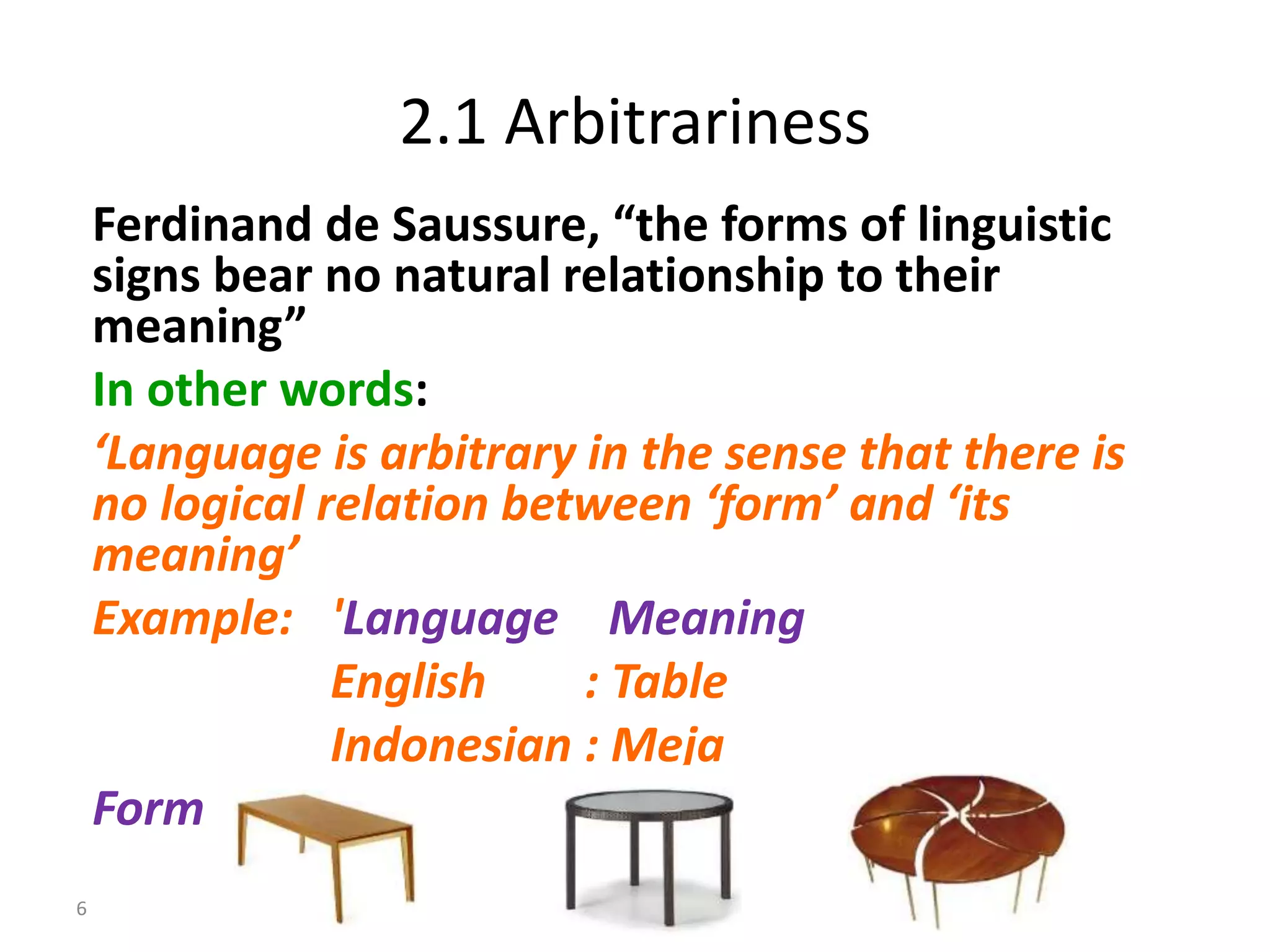
Ferdinand de Saussure, “the forms of linguistic
signs bear no natural relationship to their
meaning”
In other words:
‘Language is arbitrary in the sense that there is
no logical relation between ‘form’ and ‘its
meaning’
Example: 'Language Meaning
English : Table
Indonesian : Meja
Form
6
2.2 Duality
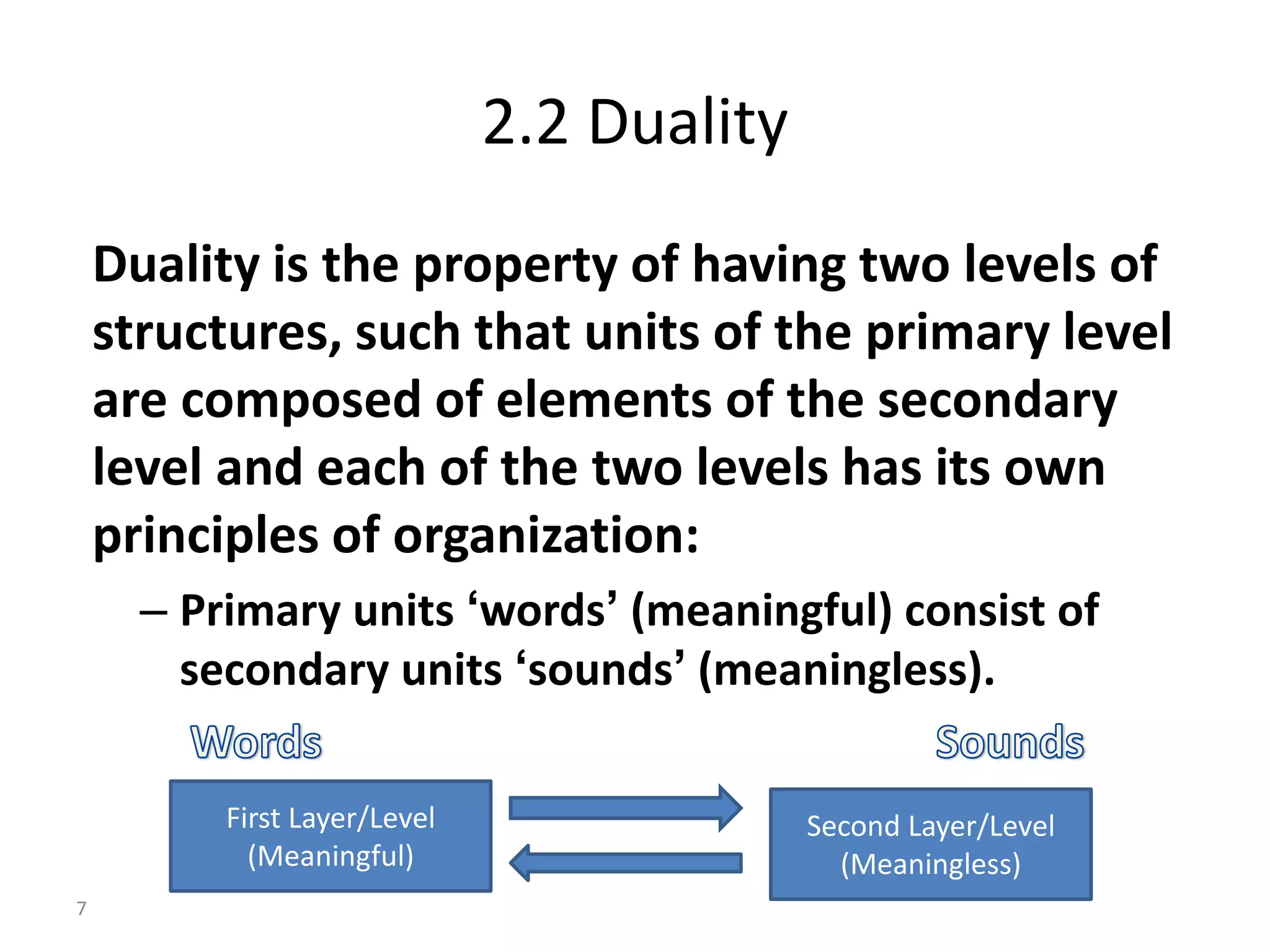
Duality is the property of having two levels of
structures, such that units of the primary level
are composed of elements of the secondary
level and each of the two levels has its own
principles of organization:
– Primary units ‘words’ (meaningful) consist of
secondary units ‘sounds’ (meaningless).
7
First Layer/Level
(Meaningful)
Second Layer/Level
(Meaningless)
2.2 Duality-explanation
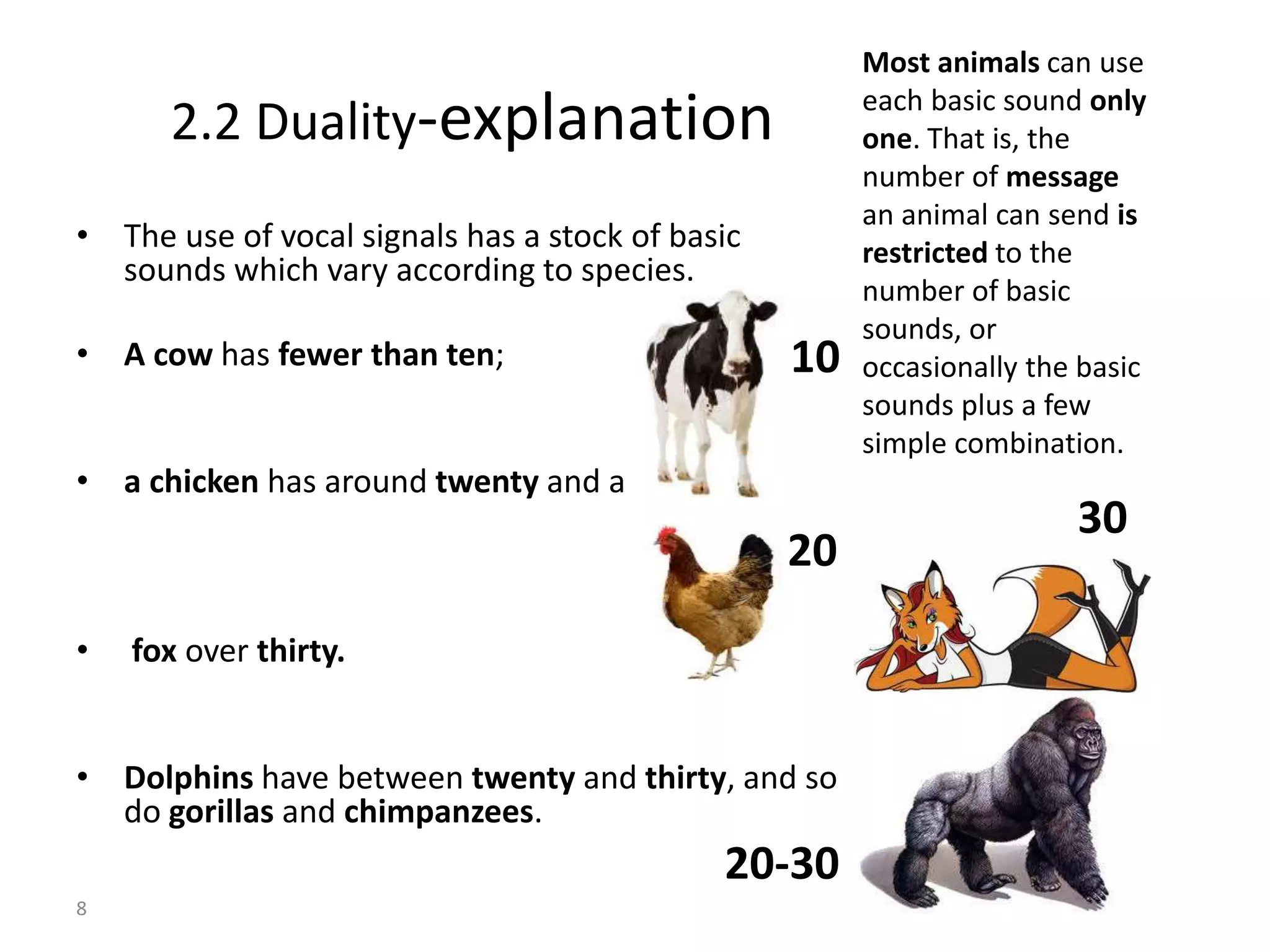
• The use of vocal signals has a stock of basic
sounds which vary according to species.
• A cow has fewer than ten;
• a chicken has around twenty and a
• fox over thirty.
• Dolphins have between twenty and thirty, and so
do gorillas and chimpanzees.
8
10
20
30
Most animals can use
each basic sound only
one. That is, the
number of message
an animal can send is
restricted to the
number of basic
sounds, or
occasionally the basic
sounds plus a few
simple combination.
20-30
2.2 Duality-explanation
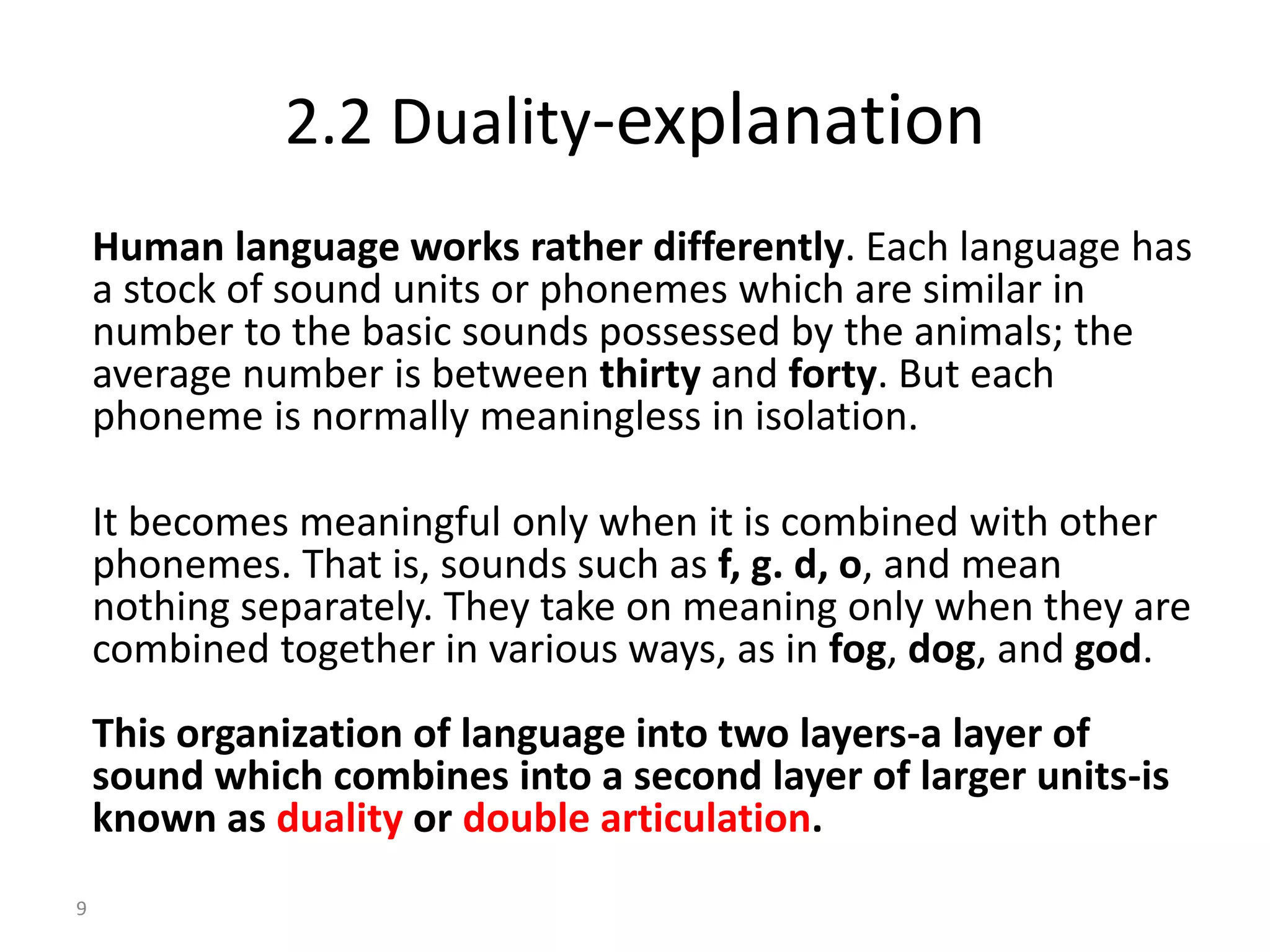
Human language works rather differently. Each language has
a stock of sound units or phonemes which are similar in
number to the basic sounds possessed by the animals; the
average number is between thirty and forty. But each
phoneme is normally meaningless in isolation.
It becomes meaningful only when it is combined with other
phonemes. That is, sounds such as f, g. d, o, and mean
nothing separately. They take on meaning only when they are
combined together in various ways, as in fog, dog, and god.
This organization of language into two layers-a layer of
sound which combines into a second layer of larger units-is
known as duality or double articulation.
9
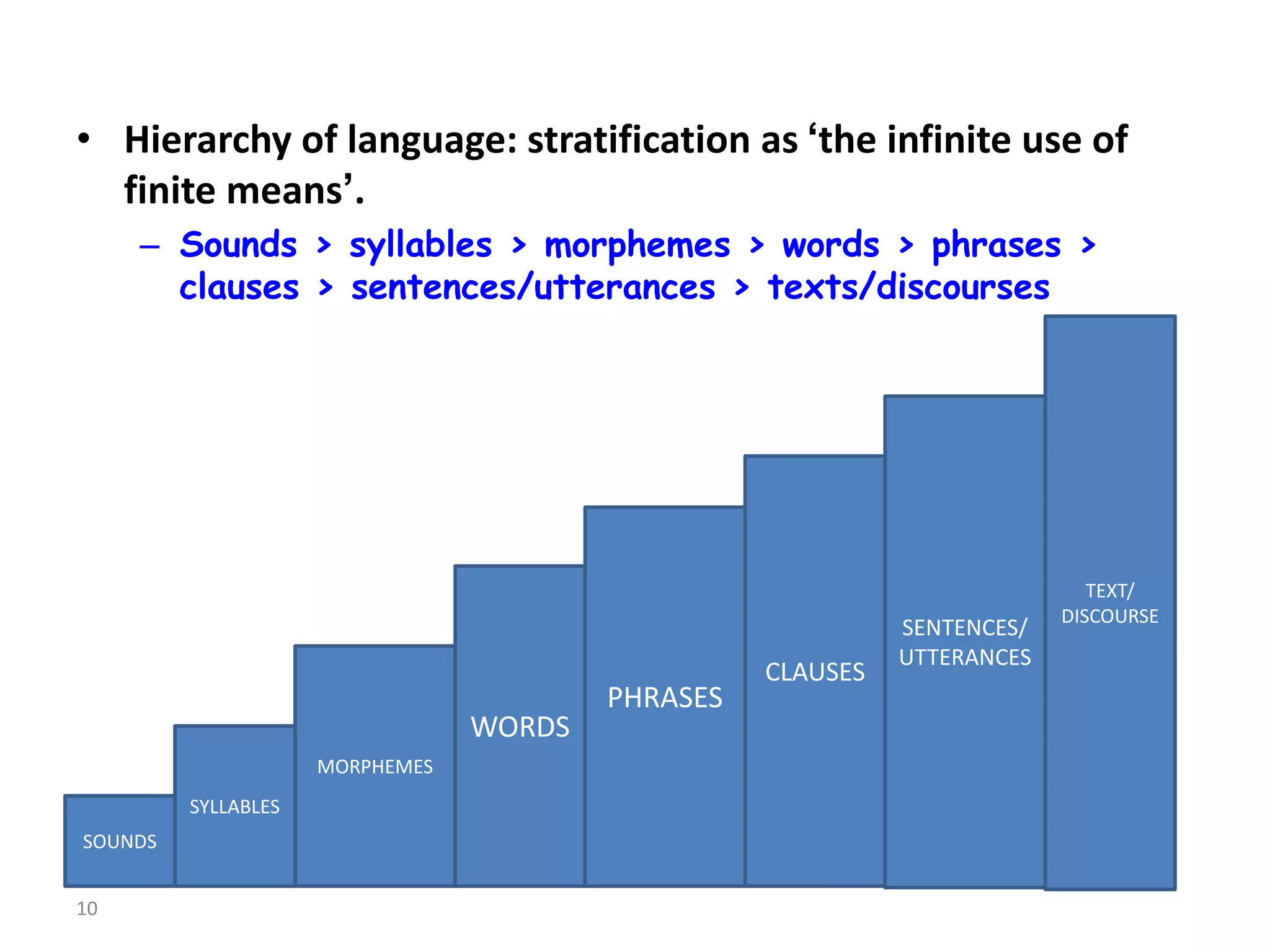
• Hierarchy of language: stratification as ‘the infinite use of
finite means’.
– Sounds > syllables > morphemes > words > phrases >
clauses > sentences/utterances > texts/discourses
10
SOUNDS
SYLLABLES
MORPHEMES
WORDS
PHRASES
CLAUSES
SENTENCES/
UTTERANCES
TEXT/
DISCOURSE
2.3 Creativity
• Language is resourceful because of its duality
and its recursivness (pengulangan). We can
use it to create new meanings.
• Words can be used in new ways to mean new
things, and can be instantly understood by
people who have never come across that
usage before.
11
• The recursive nature of language provides
a potential to create an infinite number
of sentences. For instance:
– He bought a book which was written by a
teacher who taught in a school which was
known for its graduates who ...
12
2.4 Displacement
• Human languages enable their users
to symbolize objects, events and
concepts which are not present (in
time and space) at the moment of
communication.
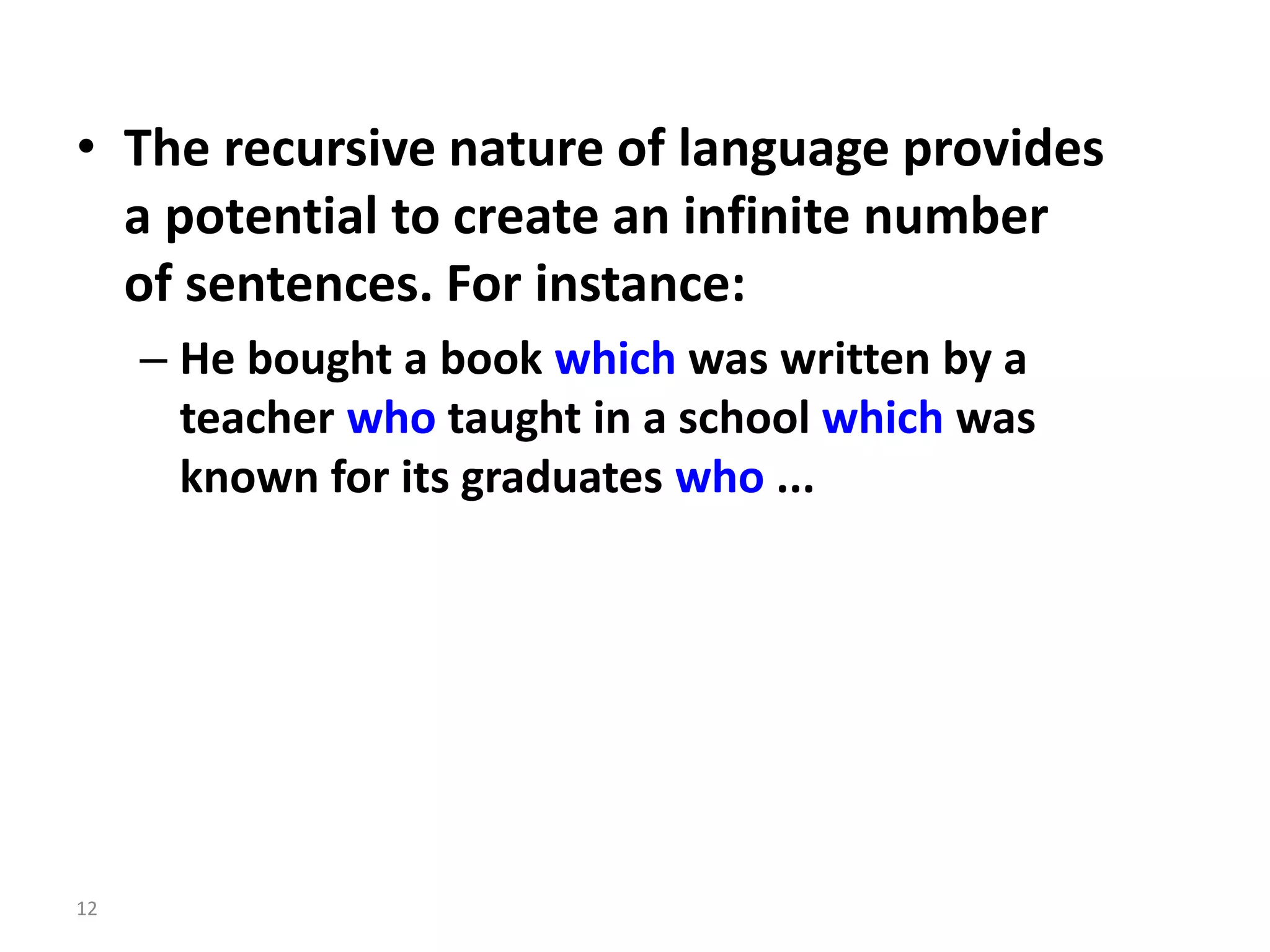
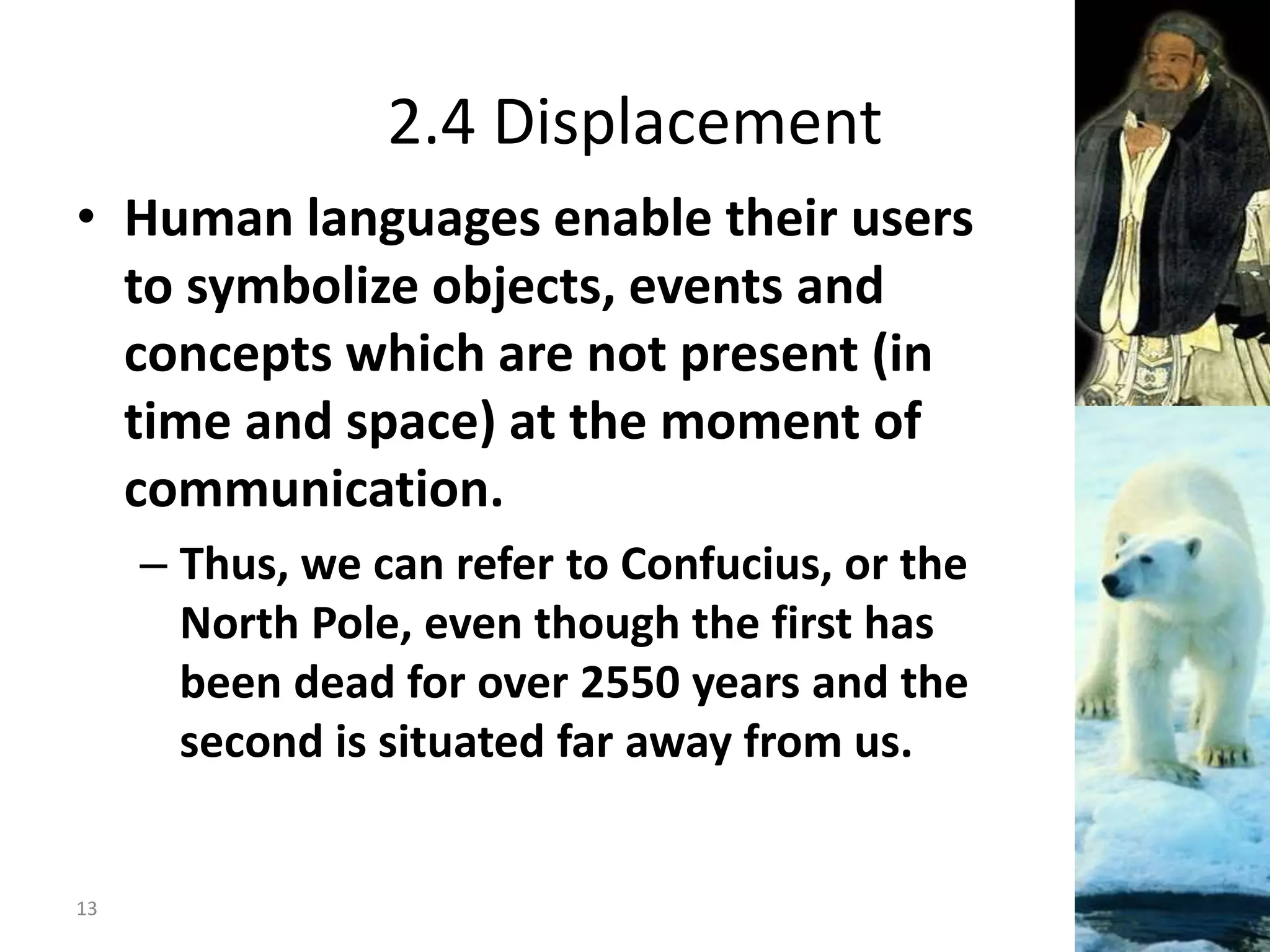
– Thus, we can refer to Confucius, or the
North Pole, even though the first has
been dead for over 2550 years and the
second is situated far away from us.
13
• The honeybee's dance exhibits
displacement a little bit: he can refer to a
source of food, which is remote in time
and space when he reports on it.
• A dog cannot tell people that its master
will be home in a few days.
• Our language enables us to communicate
about things that do not exist or do not
yet exist.
14
Case to discuss
1. Sukarno, the first President of RI, was said to be a
polyglot (someone with the ability of speaking
several languages). As a political who loved unity in
diversity, he wondered why people had to speak
different languages instead of one universal
language.
a. Why there are so many local languages, whether it
was possible to have one national language?
b. Why it should be English as the International
language?
15
Case 2
Assignment
1. What is?
a. Lingua Franca
b. Vernacular
c. Pidgin
d. Creoles
16
Case 3

2nd material linguistics design language features 2014

  • 1.
  • 2.
    2. Design Featuresof Language • Language distinguishes human beings from animals in that it is far more sophisticated than any animal communication system. • Two Modes of Language Spoken How human beings first started ‘speaking’? Primate language  sophisticated language such today Written Developed about 6000 years ago 2
  • 3.
    Verbal and Non-verballanguage • Verbal  Language which uses words • Non-verbal  Language that does not use words 3 Form of Language Spoken Written Body Verbal Non-verbal Form of Language Spoken Written Body Verbal Speech, Song, Poem Writing, Braille Lip-reading, semaphore Non-verbal Cries Road signs, mathematical symbol Body movements, facial expressions
  • 4.
    Case to discuss 1.What is meant by ‘spoken language’ in a written form? Give examples. 2. What is meant by ‘written language’ in spoken form? Give examples. 1. Bible, Vedas (spoken first, then written) 2. Speech, Songs, Poem/poetry (written first, then spoken) 4 Case 1
  • 5.
    Human language is‘unique’ The uniqueness of Human Language Arbitrariness Duality Creativity Displacement 5
  • 6.
    2.1 Arbitrariness Ferdinand deSaussure, “the forms of linguistic signs bear no natural relationship to their meaning” In other words: ‘Language is arbitrary in the sense that there is no logical relation between ‘form’ and ‘its meaning’ Example: 'Language Meaning English : Table Indonesian : Meja Form 6
  • 7.
    2.2 Duality Duality isthe property of having two levels of structures, such that units of the primary level are composed of elements of the secondary level and each of the two levels has its own principles of organization: – Primary units ‘words’ (meaningful) consist of secondary units ‘sounds’ (meaningless). 7 First Layer/Level (Meaningful) Second Layer/Level (Meaningless)
  • 8.
    2.2 Duality-explanation • Theuse of vocal signals has a stock of basic sounds which vary according to species. • A cow has fewer than ten; • a chicken has around twenty and a • fox over thirty. • Dolphins have between twenty and thirty, and so do gorillas and chimpanzees. 8 10 20 30 Most animals can use each basic sound only one. That is, the number of message an animal can send is restricted to the number of basic sounds, or occasionally the basic sounds plus a few simple combination. 20-30
  • 9.
    2.2 Duality-explanation Human languageworks rather differently. Each language has a stock of sound units or phonemes which are similar in number to the basic sounds possessed by the animals; the average number is between thirty and forty. But each phoneme is normally meaningless in isolation. It becomes meaningful only when it is combined with other phonemes. That is, sounds such as f, g. d, o, and mean nothing separately. They take on meaning only when they are combined together in various ways, as in fog, dog, and god. This organization of language into two layers-a layer of sound which combines into a second layer of larger units-is known as duality or double articulation. 9
  • 10.
    • Hierarchy oflanguage: stratification as ‘the infinite use of finite means’. – Sounds > syllables > morphemes > words > phrases > clauses > sentences/utterances > texts/discourses 10 SOUNDS SYLLABLES MORPHEMES WORDS PHRASES CLAUSES SENTENCES/ UTTERANCES TEXT/ DISCOURSE
  • 11.
    2.3 Creativity • Languageis resourceful because of its duality and its recursivness (pengulangan). We can use it to create new meanings. • Words can be used in new ways to mean new things, and can be instantly understood by people who have never come across that usage before. 11
  • 12.
    • The recursivenature of language provides a potential to create an infinite number of sentences. For instance: – He bought a book which was written by a teacher who taught in a school which was known for its graduates who ... 12
  • 13.
    2.4 Displacement • Humanlanguages enable their users to symbolize objects, events and concepts which are not present (in time and space) at the moment of communication. – Thus, we can refer to Confucius, or the North Pole, even though the first has been dead for over 2550 years and the second is situated far away from us. 13
  • 14.
    • The honeybee'sdance exhibits displacement a little bit: he can refer to a source of food, which is remote in time and space when he reports on it. • A dog cannot tell people that its master will be home in a few days. • Our language enables us to communicate about things that do not exist or do not yet exist. 14
  • 15.
    Case to discuss 1.Sukarno, the first President of RI, was said to be a polyglot (someone with the ability of speaking several languages). As a political who loved unity in diversity, he wondered why people had to speak different languages instead of one universal language. a. Why there are so many local languages, whether it was possible to have one national language? b. Why it should be English as the International language? 15 Case 2
  • 16.
    Assignment 1. What is? a.Lingua Franca b. Vernacular c. Pidgin d. Creoles 16 Case 3