Grimm's Law Marvyn A. Mahle TSL 660 March 9, 2010
What is Grimm's Law? Grimm's Law refers to the systematic study and categorization of the consonant shifts that occurred between Proto-Indo-European and Proto-Germanic...an eventually English Named for Jakob Grimm, one of the Brothers Grimm, most well-known in Western culture for their versions of children's stories and morality tales, e.g.,  Hansel & Gretel, Sleeping Beauty , etc.
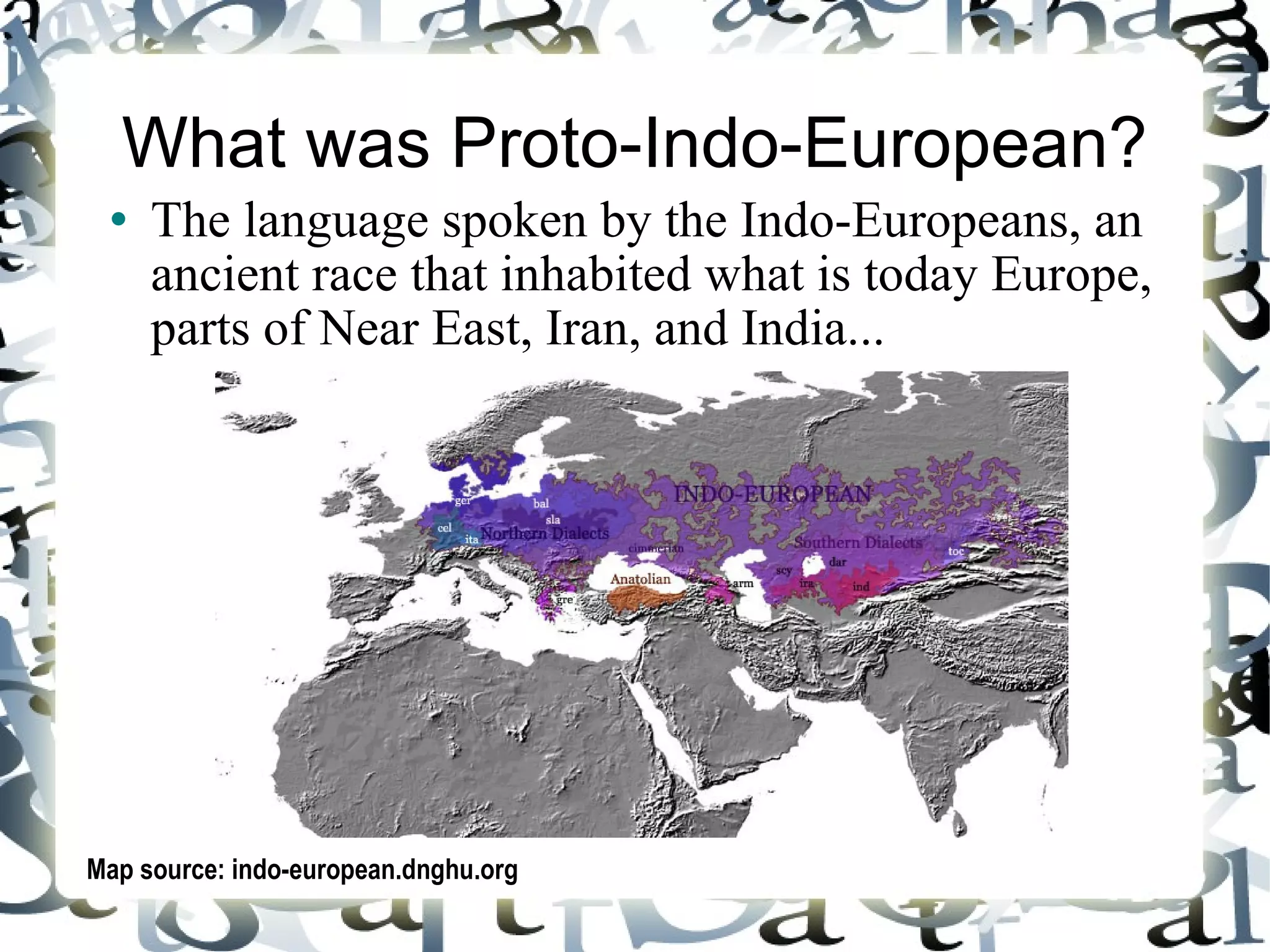
What was Proto-Indo-European? The language spoken by the Indo-Europeans, an ancient race that inhabited what is today Europe, parts of Near East, Iran, and India... Map source: indo-european.dnghu.org
Progression of Grimm's Law Proto-Indo-European voiceless stops change into voiceless fricatives. Proto-Indo-European voiced stops become voiceless stops. Proto-Indo-European voiced aspirated stops become voiced fricatives; ultimately, in most Germanic languages these voiced fricatives become voiced stops. Source: http://en.wikipedia.org/wiki/Grimm's_Law   Source: http://www.uoregon.edu/~l150web/weblec4.2.html
Examples of Consonant Shifts Source: Contemporary Linguistics, O'Grady, et al, p286.
Situations Where Grimm's Law Does  Not  Apply Direct borrowing of words  after  the consonant shift occurred: Pedestrian, from Latin pedes, pronounced pedestrian, not fedestrian Tenuous, Pedestrian, from Latin tenuis, pronounced tenuous, not thenuous Canal, Pedestrian, from Latin canalis, pronounced canal, not hanal
Further Information Full list of shifted consonants: http://german.about.com/library/blcognates_shiftC.htm Thumbnail history of the Indo-Europeans: http://www.uoregon.edu/~l150web/weblec4.2.html And after you've finished studying Grimm's Law, relax with a Brothers Grimm tale... http://en.wikipedia.org/wiki/Little_Red_Riding_Hood http://www.youtube.com/watch?v=iKbWdgW6sD8&feature=fvw

Grimm's law 1

  • 1.
    Grimm's Law MarvynA. Mahle TSL 660 March 9, 2010
  • 2.
    What is Grimm'sLaw? Grimm's Law refers to the systematic study and categorization of the consonant shifts that occurred between Proto-Indo-European and Proto-Germanic...an eventually English Named for Jakob Grimm, one of the Brothers Grimm, most well-known in Western culture for their versions of children's stories and morality tales, e.g., Hansel & Gretel, Sleeping Beauty , etc.
  • 3.
    What was Proto-Indo-European?The language spoken by the Indo-Europeans, an ancient race that inhabited what is today Europe, parts of Near East, Iran, and India... Map source: indo-european.dnghu.org
  • 4.
    Progression of Grimm'sLaw Proto-Indo-European voiceless stops change into voiceless fricatives. Proto-Indo-European voiced stops become voiceless stops. Proto-Indo-European voiced aspirated stops become voiced fricatives; ultimately, in most Germanic languages these voiced fricatives become voiced stops. Source: http://en.wikipedia.org/wiki/Grimm's_Law Source: http://www.uoregon.edu/~l150web/weblec4.2.html
  • 5.
    Examples of ConsonantShifts Source: Contemporary Linguistics, O'Grady, et al, p286.
  • 6.
    Situations Where Grimm'sLaw Does Not Apply Direct borrowing of words after the consonant shift occurred: Pedestrian, from Latin pedes, pronounced pedestrian, not fedestrian Tenuous, Pedestrian, from Latin tenuis, pronounced tenuous, not thenuous Canal, Pedestrian, from Latin canalis, pronounced canal, not hanal
  • 7.
    Further Information Fulllist of shifted consonants: http://german.about.com/library/blcognates_shiftC.htm Thumbnail history of the Indo-Europeans: http://www.uoregon.edu/~l150web/weblec4.2.html And after you've finished studying Grimm's Law, relax with a Brothers Grimm tale... http://en.wikipedia.org/wiki/Little_Red_Riding_Hood http://www.youtube.com/watch?v=iKbWdgW6sD8&feature=fvw