Chapter 10
Vertebrates
• Everything up till now has been Invertebrates
– What does this mean?
• From now on all Fishes, reptiles, birds and
mammals are all Vertebrates
– What does this mean?
• Can you think of some functions of Vertebrae
that are advantageous?
– Support
– Attachment of muscles= increased movement
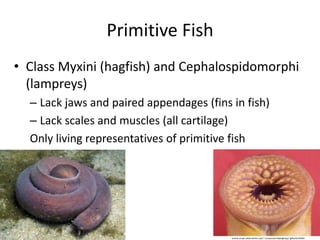
Primitive Fish
• Class Myxini (hagfish) and Cephalospidomorphi
(lampreys)
– Lack jaws and paired appendages (fins in fish)
– Lack scales and muscles (all cartilage)
Only living representatives of primitive fish
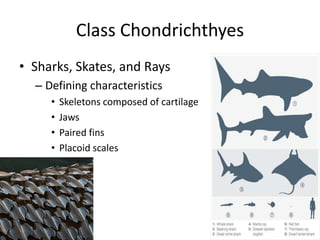
Class Chondrichthyes
• Sharks, Skates, and Rays
– Defining characteristics
• Skeletons composed of cartilage
• Jaws
• Paired fins
• Placoid scales
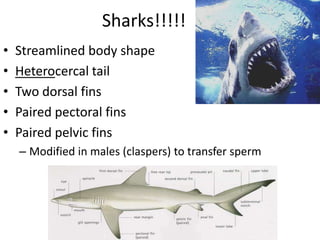
Sharks!!!!!
• Streamlined body shape
• Heterocercal tail
• Two dorsal fins
• Paired pectoral fins
• Paired pelvic fins
– Modified in males (claspers) to transfer sperm
Why do sharks have to “just keep
swimming”?
• Has to do with Density!!!!
– The are denser than the water so what will
happen if they stop swimming?
Osmoregulation
• Maintain homeostasis
– By holding large amounts of urea in body
– If they did not have this adaptation they would
lose body water.
• Then what would happen to the shark
– Dehydrate and cells would………
» Shrink -> remember osmosis chapter?????
– http://dsc.discovery.com/videos/the-ultimate-
guide-to-sharks-how-sharks-swim.html
Sensory in Sharks
• Sight
– Lack eyelids
– Scientists predict that they can see color, but what
sense is most dominant in shark?
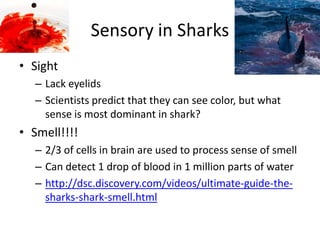
• Smell!!!!
– 2/3 of cells in brain are used to process sense of smell
– Can detect 1 drop of blood in 1 million parts of water
– http://dsc.discovery.com/videos/ultimate-guide-the-
sharks-shark-smell.html
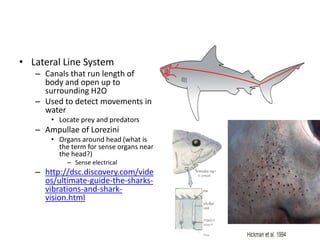
• Lateral Line System
– Canals that run length of
body and open up to
surrounding H2O
– Used to detect movements in
water
• Locate prey and predators
– Ampullae of Lorezini
• Organs around head (what is
the term for sense organs near
the head?)
– Sense electrical
– http://dsc.discovery.com/vide
os/ultimate-guide-the-sharks-
vibrations-and-shark-
vision.html
Digestion
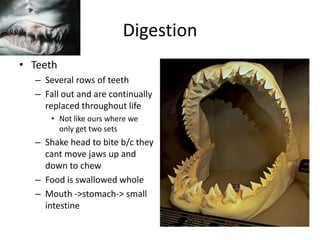
• Teeth
– Several rows of teeth
– Fall out and are continually
replaced throughout life
• Not like ours where we
only get two sets
– Shake head to bite b/c they
cant move jaws up and
down to chew
– Food is swallowed whole
– Mouth ->stomach-> small
intestine
Great White Jumping!!!
• http://dsc.discovery.com/videos/planet-earth-
pole-to-pole-great-white-hunt.html
Reproduction
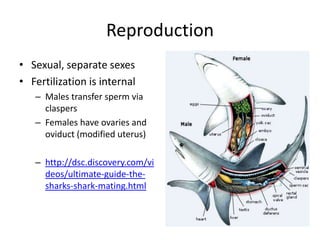
• Sexual, separate sexes
• Fertilization is internal
– Males transfer sperm via
claspers
– Females have ovaries and
oviduct (modified uterus)
– http://dsc.discovery.com/vi
deos/ultimate-guide-the-
sharks-shark-mating.html
3 types of Reproductive types
– Oviparity (most primitive)
• Eggs are laid outside body
• Develop in protective case that attaches to seafloor
• smaller b/c limited nutrients
• Whale sharks, bullhead sharks
– Ovoviviparity (most common)
• Eggs hatch in mothers uterus
• No placenta, nourishment is yolk stored in egg
• Single pup
– Viviparity (most recent, advanced)
• Babies get milk directly from mother
• Hammerhead shark
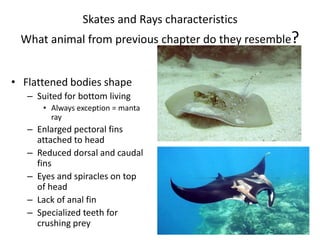
Skates and Rays characteristics
What animal from previous chapter do they resemble?
• Flattened bodies shape
– Suited for bottom living
• Always exception = manta
ray
– Enlarged pectoral fins
attached to head
– Reduced dorsal and caudal
fins
– Eyes and spiracles on top
of head
– Lack of anal fin
– Specialized teeth for
crushing prey
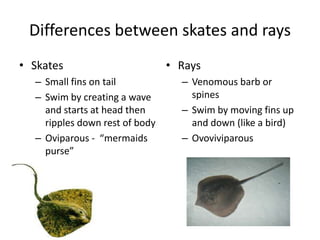
Differences between skates and rays
• Skates
– Small fins on tail
– Swim by creating a wave
and starts at head then
ripples down rest of body
– Oviparous - “mermaids
purse”
• Rays
– Venomous barb or
spines
– Swim by moving fins up
and down (like a bird)
– Ovoviviparous
• http://dsc.discovery.com/videos/ultimate-
guide-the-sharks-shark-mating.html

Chapter 10 sharks skates and rays

  • 1.
  • 2.
    Vertebrates • Everything uptill now has been Invertebrates – What does this mean? • From now on all Fishes, reptiles, birds and mammals are all Vertebrates – What does this mean? • Can you think of some functions of Vertebrae that are advantageous? – Support – Attachment of muscles= increased movement
  • 3.
    Primitive Fish • ClassMyxini (hagfish) and Cephalospidomorphi (lampreys) – Lack jaws and paired appendages (fins in fish) – Lack scales and muscles (all cartilage) Only living representatives of primitive fish
  • 4.
    Class Chondrichthyes • Sharks,Skates, and Rays – Defining characteristics • Skeletons composed of cartilage • Jaws • Paired fins • Placoid scales
  • 5.
    Sharks!!!!! • Streamlined bodyshape • Heterocercal tail • Two dorsal fins • Paired pectoral fins • Paired pelvic fins – Modified in males (claspers) to transfer sperm
  • 6.
    Why do sharkshave to “just keep swimming”? • Has to do with Density!!!! – The are denser than the water so what will happen if they stop swimming?
  • 7.
    Osmoregulation • Maintain homeostasis –By holding large amounts of urea in body – If they did not have this adaptation they would lose body water. • Then what would happen to the shark – Dehydrate and cells would……… » Shrink -> remember osmosis chapter????? – http://dsc.discovery.com/videos/the-ultimate- guide-to-sharks-how-sharks-swim.html
  • 8.
    Sensory in Sharks •Sight – Lack eyelids – Scientists predict that they can see color, but what sense is most dominant in shark? • Smell!!!! – 2/3 of cells in brain are used to process sense of smell – Can detect 1 drop of blood in 1 million parts of water – http://dsc.discovery.com/videos/ultimate-guide-the- sharks-shark-smell.html
  • 9.
    • Lateral LineSystem – Canals that run length of body and open up to surrounding H2O – Used to detect movements in water • Locate prey and predators – Ampullae of Lorezini • Organs around head (what is the term for sense organs near the head?) – Sense electrical – http://dsc.discovery.com/vide os/ultimate-guide-the-sharks- vibrations-and-shark- vision.html
  • 10.
    Digestion • Teeth – Severalrows of teeth – Fall out and are continually replaced throughout life • Not like ours where we only get two sets – Shake head to bite b/c they cant move jaws up and down to chew – Food is swallowed whole – Mouth ->stomach-> small intestine
  • 11.
    Great White Jumping!!! •http://dsc.discovery.com/videos/planet-earth- pole-to-pole-great-white-hunt.html
  • 12.
    Reproduction • Sexual, separatesexes • Fertilization is internal – Males transfer sperm via claspers – Females have ovaries and oviduct (modified uterus) – http://dsc.discovery.com/vi deos/ultimate-guide-the- sharks-shark-mating.html
  • 13.
    3 types ofReproductive types – Oviparity (most primitive) • Eggs are laid outside body • Develop in protective case that attaches to seafloor • smaller b/c limited nutrients • Whale sharks, bullhead sharks – Ovoviviparity (most common) • Eggs hatch in mothers uterus • No placenta, nourishment is yolk stored in egg • Single pup – Viviparity (most recent, advanced) • Babies get milk directly from mother • Hammerhead shark
  • 14.
    Skates and Rayscharacteristics What animal from previous chapter do they resemble? • Flattened bodies shape – Suited for bottom living • Always exception = manta ray – Enlarged pectoral fins attached to head – Reduced dorsal and caudal fins – Eyes and spiracles on top of head – Lack of anal fin – Specialized teeth for crushing prey
  • 15.
    Differences between skatesand rays • Skates – Small fins on tail – Swim by creating a wave and starts at head then ripples down rest of body – Oviparous - “mermaids purse” • Rays – Venomous barb or spines – Swim by moving fins up and down (like a bird) – Ovoviviparous
  • 16.