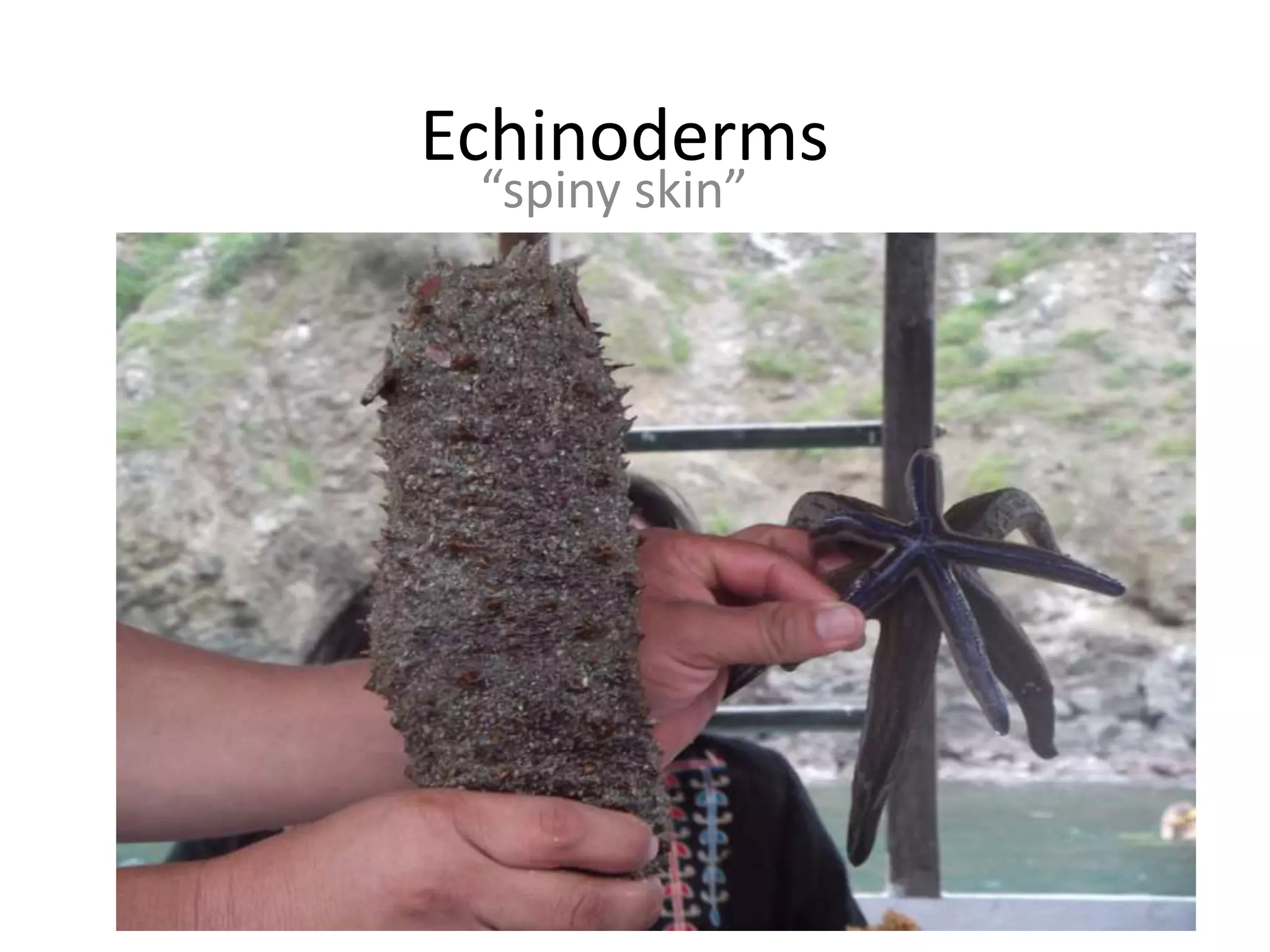
Echinoderms
 “spiny skin”
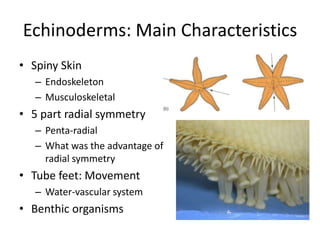
Echinoderms: Main Characteristics
• Spiny Skin
   – Endoskeleton
   – Musculoskeletal
• 5 part radial symmetry
   – Penta-radial
   – What was the advantage of
     radial symmetry
• Tube feet: Movement
   – Water-vascular system
• Benthic organisms
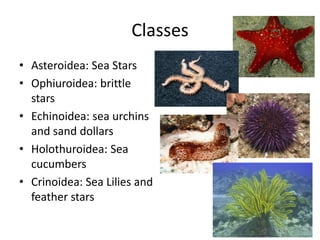
Classes
• Asteroidea: Sea Stars
• Ophiuroidea: brittle
  stars
• Echinoidea: sea urchins
  and sand dollars
• Holothuroidea: Sea
  cucumbers
• Crinoidea: Sea Lilies and
  feather stars
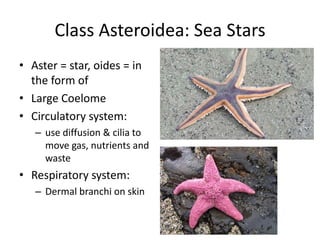
Class Asteroidea: Sea Stars
• Aster = star, oides = in
  the form of
• Large Coelome
• Circulatory system:
   – use diffusion & cilia to
     move gas, nutrients and
     waste
• Respiratory system:
   – Dermal branchi on skin
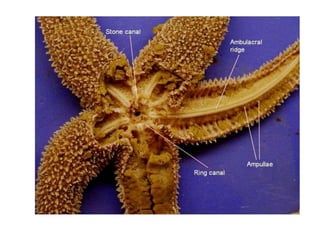
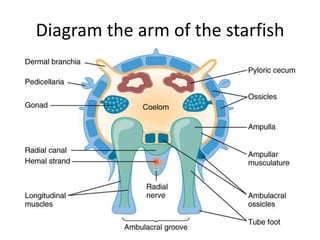
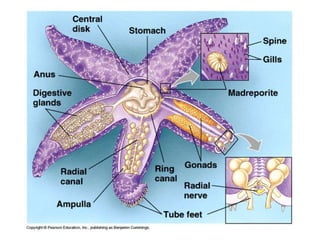
Diagram the arm of the starfish
Asteroidea
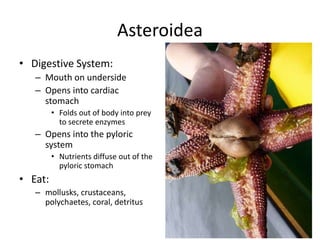
• Digestive System:
   – Mouth on underside
   – Opens into cardiac
     stomach
         • Folds out of body into prey
           to secrete enzymes
   – Opens into the pyloric
     system
         • Nutrients diffuse out of the
           pyloric stomach
• Eat:
   – mollusks, crustaceans,
     polychaetes, coral, detritus
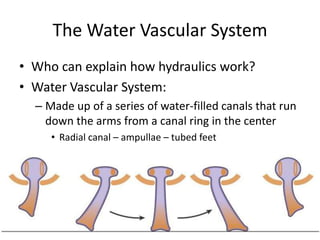
The Water Vascular System
• Who can explain how hydraulics work?
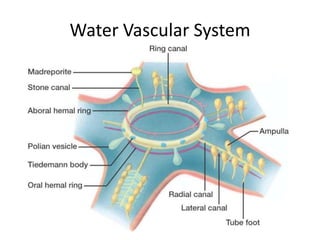
• Water Vascular System:
  – Made up of a series of water-filled canals that run
    down the arms from a canal ring in the center
     • Radial canal – ampullae – tubed feet
Water Vascular System
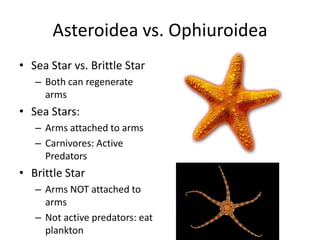
Asteroidea vs. Ophiuroidea
• Sea Star vs. Brittle Star
   – Both can regenerate
     arms
• Sea Stars:
   – Arms attached to arms
   – Carnivores: Active
     Predators
• Brittle Star
   – Arms NOT attached to
     arms
   – Not active predators: eat
     plankton
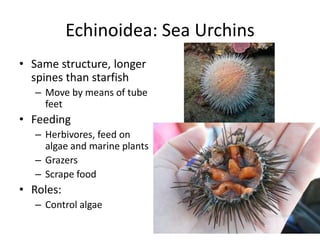
Echinoidea: Sea Urchins
• Same structure, longer
  spines than starfish
   – Move by means of tube
     feet
• Feeding
   – Herbivores, feed on
     algae and marine plants
   – Grazers
   – Scrape food
• Roles:
   – Control algae
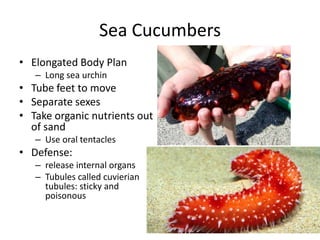
Sea Cucumbers
• Elongated Body Plan
   – Long sea urchin
• Tube feet to move
• Separate sexes
• Take organic nutrients out
  of sand
   – Use oral tentacles
• Defense:
   – release internal organs
   – Tubules called cuvierian
     tubules: sticky and
     poisonous
Work on Study Packet

Echinoderms

  • 1.
  • 2.
    Echinoderms: Main Characteristics •Spiny Skin – Endoskeleton – Musculoskeletal • 5 part radial symmetry – Penta-radial – What was the advantage of radial symmetry • Tube feet: Movement – Water-vascular system • Benthic organisms
  • 4.
    Classes • Asteroidea: SeaStars • Ophiuroidea: brittle stars • Echinoidea: sea urchins and sand dollars • Holothuroidea: Sea cucumbers • Crinoidea: Sea Lilies and feather stars
  • 5.
    Class Asteroidea: SeaStars • Aster = star, oides = in the form of • Large Coelome • Circulatory system: – use diffusion & cilia to move gas, nutrients and waste • Respiratory system: – Dermal branchi on skin
  • 6.
    Diagram the armof the starfish
  • 7.
    Asteroidea • Digestive System: – Mouth on underside – Opens into cardiac stomach • Folds out of body into prey to secrete enzymes – Opens into the pyloric system • Nutrients diffuse out of the pyloric stomach • Eat: – mollusks, crustaceans, polychaetes, coral, detritus
  • 9.
    The Water VascularSystem • Who can explain how hydraulics work? • Water Vascular System: – Made up of a series of water-filled canals that run down the arms from a canal ring in the center • Radial canal – ampullae – tubed feet
  • 10.
  • 11.
    Asteroidea vs. Ophiuroidea •Sea Star vs. Brittle Star – Both can regenerate arms • Sea Stars: – Arms attached to arms – Carnivores: Active Predators • Brittle Star – Arms NOT attached to arms – Not active predators: eat plankton
  • 12.
    Echinoidea: Sea Urchins •Same structure, longer spines than starfish – Move by means of tube feet • Feeding – Herbivores, feed on algae and marine plants – Grazers – Scrape food • Roles: – Control algae
  • 13.
    Sea Cucumbers • ElongatedBody Plan – Long sea urchin • Tube feet to move • Separate sexes • Take organic nutrients out of sand – Use oral tentacles • Defense: – release internal organs – Tubules called cuvierian tubules: sticky and poisonous
  • 14.