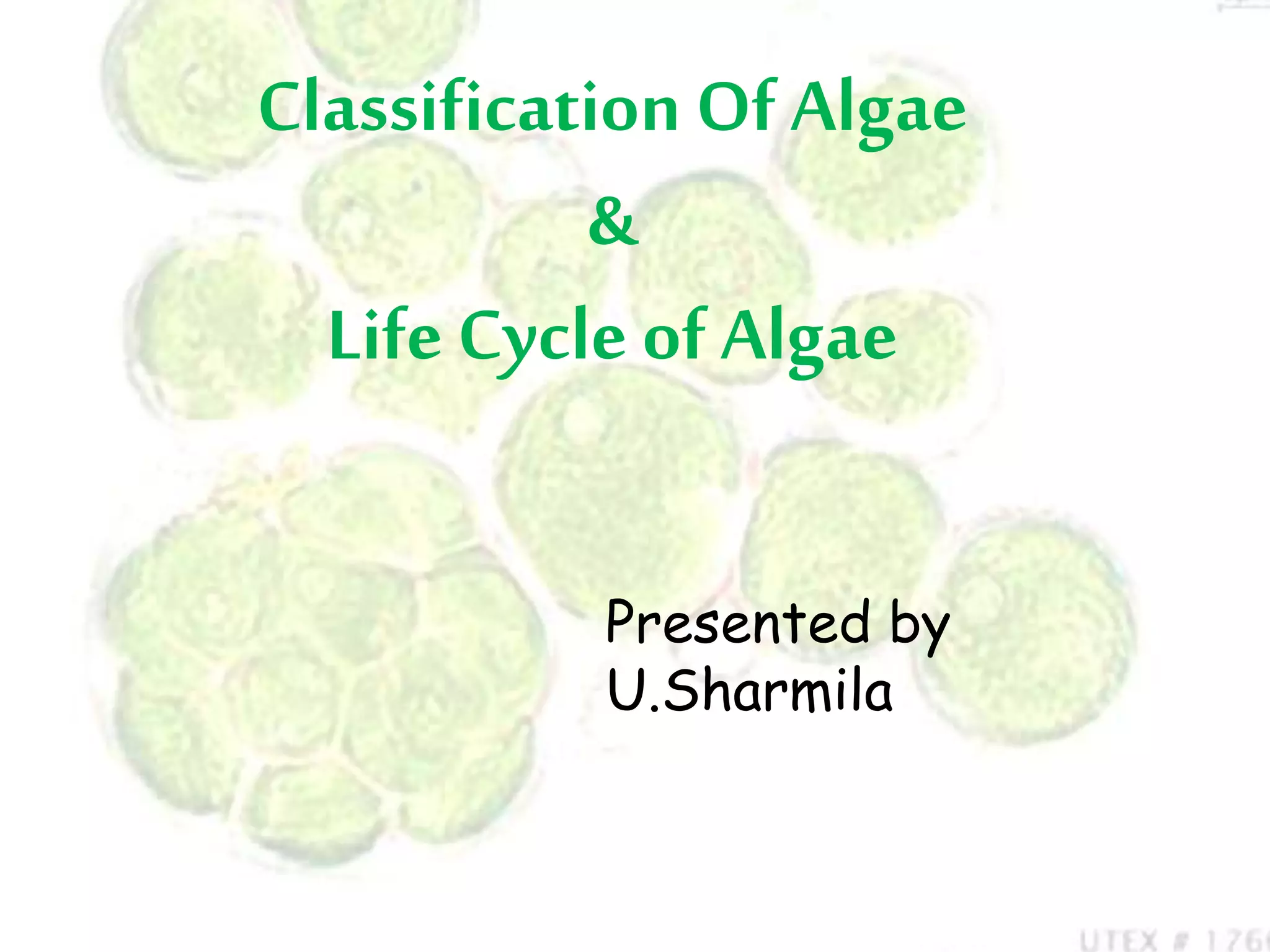
Classification Of Algae
&
Life Cycle of Algae
Presented by
U.Sharmila
Algae
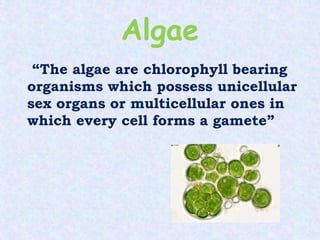
“The algae are chlorophyll bearing
organisms which possess unicellular
sex organs or multicellular ones in
which every cell forms a gamete”
Introduction
• They are aquatic both marine and freshwater
and occur on and within soil and on moist
stones and wood as well as in association
with fungi and certain animals.
• It is thought that 90 percent of the
photosynthesis on earth is carried on by
aquatic plants.
• Certain blue-green algae, like some bacteria
can use gaseous nitrogen from the
atmosphere in building their protoplasm and
in this way they increase the nitrogenous
compunds in water and soils of their habitat.
• This activity is called nitrogen fixation
Introduction cont.
• These are approximately 1800
genera with 21,000 species which
are highly diverse with respect to
habitat , size, organization ,
Physiology ,biochemistry and
reproduction.
• Phycology is the study of algae
History of Algae
• The algae as such have a history that is as old
as that of other plants .The first references to
algae are to be found in early Chinese literature
but there are also references in Roman and
Greek literature
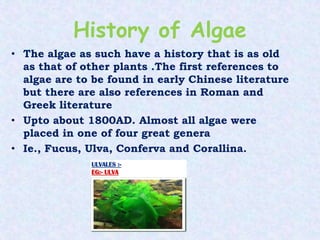
• Upto about 1800AD. Almost all algae were
placed in one of four great genera
• Ie., Fucus, Ulva, Conferva and Corallina.
History of Algae Cont.
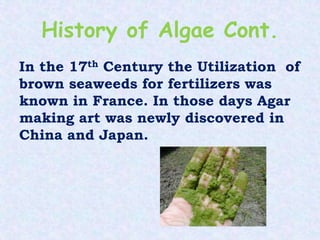
In the 17th Century the Utilization of
brown seaweeds for fertilizers was
known in France. In those days Agar
making art was newly discovered in
China and Japan.
Classification of Algae
• For the first time Aristole (382-322 B.C) and his pupil
Theophrastus (372-287 B.C).
• The Father Of Botany Classified the plants into three groups
ie. Trees, Shrubs and Herbs.
• Linnaeus divided his order Cryptogamia into four suborders.
Filices(Pteridophytes)
Musci (mosses and leafy liverworts)
Algae(algae,lichens and thallose liverworts)
Fungi
• The First natural System of Classification of the
Plants into 3 groups ie.Acotyledons
Monocotyledones
Dicotyledones
Classification of Algae conc.
• In 1880,the Cryptogamic plants were divided into
three major groups.
Thallophyta(algae,fungi and Bacteria)
Bryophyta
Pteridophyta
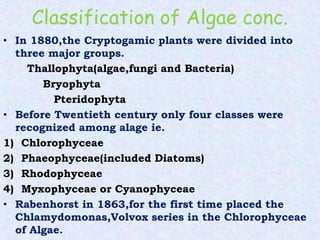
• Before Twentieth century only four classes were
recognized among alage ie.
1) Chlorophyceae
2) Phaeophyceae(included Diatoms)
3) Rhodophyceae
4) Myxophyceae or Cyanophyceae
• Rabenhorst in 1863,for the first time placed the
Chlamydomonas,Volvox series in the Chlorophyceae
of Algae.
Classification of Algae conc.
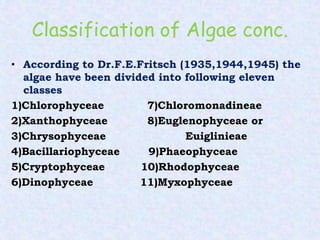
• According to Dr.F.E.Fritsch (1935,1944,1945) the
algae have been divided into following eleven
classes
1)Chlorophyceae 7)Chloromonadineae
2)Xanthophyceae 8)Euglenophyceae or
3)Chrysophyceae Euiglinieae
4)Bacillariophyceae 9)Phaeophyceae
5)Cryptophyceae 10)Rhodophyceae
6)Dinophyceae 11)Myxophyceae
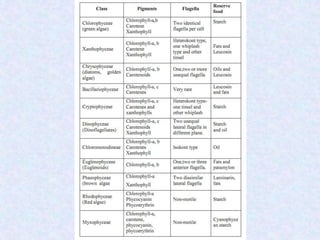
According to Dr.Fritsh’s Classification is mainly
based on the following facts:-
• Pigmentation
• The assimilatory food products
• Type of Flagella
We will consider the characters of few important
classes
 Chlorophyceae
 Xanthophyceae
 Bacillariophyceae
 Phaeophyceae
 Rhodophyceae
 Myxophyceae
Life Cycle Patterns In
Algae
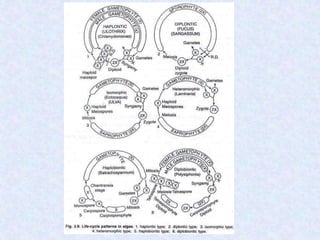
Many Life Cycle patterns are found in algae. However,
there is no regular and fixed alternation of generation,
as found in higher plants. In blue-green alage and
certain Chlorophyceae which reproduce
asexually,there is no alternation of generation.
The representative life –cycle Patterns in algae are as
follows.
• Haplontic type
• Diplontic type
• Isomorphic type
• Heteromorphic type
• Haplobiontic type
• Diplobiontic type
Haplontic Type
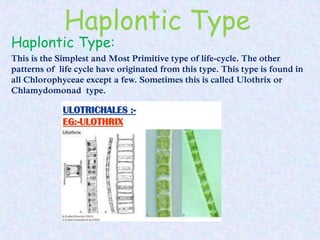
Haplontic Type:
This is the Simplest and Most Primitive type of life-cycle. The other
patterns of life cycle have originated from this type. This type is found in
all Chlorophyceae except a few. Sometimes this is called Ulothrix or
Chlamydomonad type.
Diplontic type
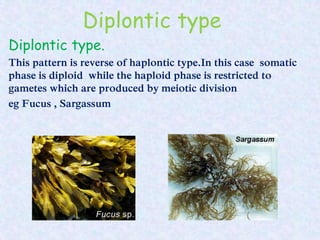
Diplontic type.
This pattern is reverse of haplontic type.In this case somatic
phase is diploid while the haploid phase is restricted to
gametes which are produced by meiotic division
eg Fucus , Sargassum
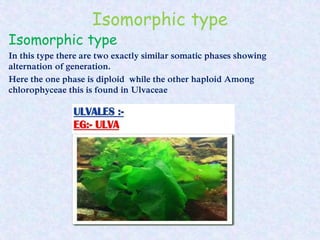
Isomorphic type
Isomorphic type
In this type there are two exactly similar somatic phases showing
alternation of generation.
Here the one phase is diploid while the other haploid Among
chlorophyceae this is found in Ulvaceae
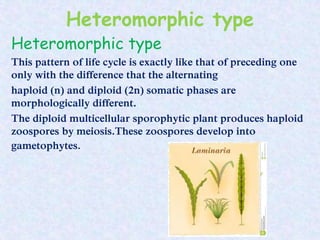
Heteromorphic type
Heteromorphic type
This pattern of life cycle is exactly like that of preceding one
only with the difference that the alternating
haploid (n) and diploid (2n) somatic phases are
morphologically different.
The diploid multicellular sporophytic plant produces haploid
zoospores by meiosis.These zoospores develop into
gametophytes.
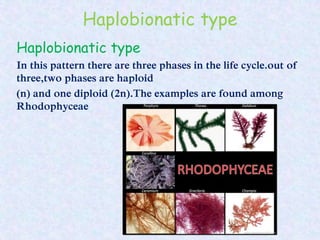
Haplobionatic type
Haplobionatic type
In this pattern there are three phases in the life cycle.out of
three,two phases are haploid
(n) and one diploid (2n).The examples are found among
Rhodophyceae
Diplobiontic type
Diplobiontic type
This type of life cycle is found in almost all Rhodophyceae except
Nemalionales.The most common example is Polysiphonia.
There are several patterns of life cycle in alage and there is no regular and
fixed alternation of generations as found in higher plants
Reference
College Botany Vol
I;B.P.Pandey;published by S.Chand &
Company Pvt.Ltd.;5th edition.
Net Sources.
Classification of Algae

Classification of Algae

  • 1.
    Classification Of Algae & LifeCycle of Algae Presented by U.Sharmila
  • 2.
    Algae “The algae arechlorophyll bearing organisms which possess unicellular sex organs or multicellular ones in which every cell forms a gamete”
  • 3.
    Introduction • They areaquatic both marine and freshwater and occur on and within soil and on moist stones and wood as well as in association with fungi and certain animals. • It is thought that 90 percent of the photosynthesis on earth is carried on by aquatic plants. • Certain blue-green algae, like some bacteria can use gaseous nitrogen from the atmosphere in building their protoplasm and in this way they increase the nitrogenous compunds in water and soils of their habitat. • This activity is called nitrogen fixation
  • 4.
    Introduction cont. • Theseare approximately 1800 genera with 21,000 species which are highly diverse with respect to habitat , size, organization , Physiology ,biochemistry and reproduction. • Phycology is the study of algae
  • 5.
    History of Algae •The algae as such have a history that is as old as that of other plants .The first references to algae are to be found in early Chinese literature but there are also references in Roman and Greek literature • Upto about 1800AD. Almost all algae were placed in one of four great genera • Ie., Fucus, Ulva, Conferva and Corallina.
  • 6.
    History of AlgaeCont. In the 17th Century the Utilization of brown seaweeds for fertilizers was known in France. In those days Agar making art was newly discovered in China and Japan.
  • 7.
    Classification of Algae •For the first time Aristole (382-322 B.C) and his pupil Theophrastus (372-287 B.C). • The Father Of Botany Classified the plants into three groups ie. Trees, Shrubs and Herbs. • Linnaeus divided his order Cryptogamia into four suborders. Filices(Pteridophytes) Musci (mosses and leafy liverworts) Algae(algae,lichens and thallose liverworts) Fungi • The First natural System of Classification of the Plants into 3 groups ie.Acotyledons Monocotyledones Dicotyledones
  • 8.
    Classification of Algaeconc. • In 1880,the Cryptogamic plants were divided into three major groups. Thallophyta(algae,fungi and Bacteria) Bryophyta Pteridophyta • Before Twentieth century only four classes were recognized among alage ie. 1) Chlorophyceae 2) Phaeophyceae(included Diatoms) 3) Rhodophyceae 4) Myxophyceae or Cyanophyceae • Rabenhorst in 1863,for the first time placed the Chlamydomonas,Volvox series in the Chlorophyceae of Algae.
  • 9.
    Classification of Algaeconc. • According to Dr.F.E.Fritsch (1935,1944,1945) the algae have been divided into following eleven classes 1)Chlorophyceae 7)Chloromonadineae 2)Xanthophyceae 8)Euglenophyceae or 3)Chrysophyceae Euiglinieae 4)Bacillariophyceae 9)Phaeophyceae 5)Cryptophyceae 10)Rhodophyceae 6)Dinophyceae 11)Myxophyceae
  • 11.
    According to Dr.Fritsh’sClassification is mainly based on the following facts:- • Pigmentation • The assimilatory food products • Type of Flagella We will consider the characters of few important classes  Chlorophyceae  Xanthophyceae  Bacillariophyceae  Phaeophyceae  Rhodophyceae  Myxophyceae
  • 13.
    Life Cycle PatternsIn Algae Many Life Cycle patterns are found in algae. However, there is no regular and fixed alternation of generation, as found in higher plants. In blue-green alage and certain Chlorophyceae which reproduce asexually,there is no alternation of generation. The representative life –cycle Patterns in algae are as follows. • Haplontic type • Diplontic type • Isomorphic type • Heteromorphic type • Haplobiontic type • Diplobiontic type
  • 15.
    Haplontic Type Haplontic Type: Thisis the Simplest and Most Primitive type of life-cycle. The other patterns of life cycle have originated from this type. This type is found in all Chlorophyceae except a few. Sometimes this is called Ulothrix or Chlamydomonad type.
  • 16.
    Diplontic type Diplontic type. Thispattern is reverse of haplontic type.In this case somatic phase is diploid while the haploid phase is restricted to gametes which are produced by meiotic division eg Fucus , Sargassum
  • 17.
    Isomorphic type Isomorphic type Inthis type there are two exactly similar somatic phases showing alternation of generation. Here the one phase is diploid while the other haploid Among chlorophyceae this is found in Ulvaceae
  • 18.
    Heteromorphic type Heteromorphic type Thispattern of life cycle is exactly like that of preceding one only with the difference that the alternating haploid (n) and diploid (2n) somatic phases are morphologically different. The diploid multicellular sporophytic plant produces haploid zoospores by meiosis.These zoospores develop into gametophytes.
  • 19.
    Haplobionatic type Haplobionatic type Inthis pattern there are three phases in the life cycle.out of three,two phases are haploid (n) and one diploid (2n).The examples are found among Rhodophyceae
  • 20.
    Diplobiontic type Diplobiontic type Thistype of life cycle is found in almost all Rhodophyceae except Nemalionales.The most common example is Polysiphonia. There are several patterns of life cycle in alage and there is no regular and fixed alternation of generations as found in higher plants
  • 21.
    Reference College Botany Vol I;B.P.Pandey;publishedby S.Chand & Company Pvt.Ltd.;5th edition. Net Sources.