‫‪MICROBIOLOGY‬‬
‫‪for the Health Sciences‬‬
‫اعداد‬
‫أ. فريد ابو العمرين‬
‫ماجستير العلوم الطبية المخبرية‬

‫5 :‪CH‬‬
‫1‬
Chapter 5. Microbial Diversity
Part 2: Eucaryotic Microbes

• Introduction

• Fungi

• Algae

–

Characteristics

–

Characteristics and

–

Classification

Classification

–

Medical Significance

–

Medical Significance

• Protozoa
–

Characteristics

–

Classification and Medical
Significance

2

• Lichens
• Slime Moulds
Algae

Characteristics and Classification

• Algae are photosynthetic, eucaryotic organisms.
• The study of algae is called phycology
• All algal cells consist of cytoplasm, a cell wall
(usually), a cell membrane, a nucleus, plastids,
ribosomes, mitochondria, and Golgi bodies.

• Algae range in size from unicellular microorganisms
to large, multi-cellular organisms.

• Algae produce energy by photosynthesis.
3
Algae
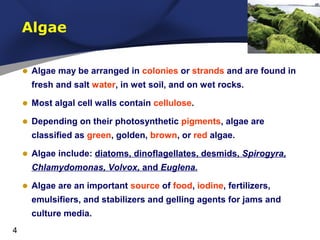
• Algae may be arranged in colonies or strands and are found in
fresh and salt water, in wet soil, and on wet rocks.

• Most algal cell walls contain cellulose.
• Depending on their photosynthetic pigments, algae are
classified as green, golden, brown, or red algae.

• Algae include: diatoms, dinoflagellates, desmids, Spirogyra,
Chlamydomonas, Volvox, and Euglena.

• Algae are an important source of food, iodine, fertilizers,
emulsifiers, and stabilizers and gelling agents for jams and
culture media.
4
Algae: Medical Significance
• Prototheca, is a very rare cause of human infections
• Causes protothecosis
• Prototheca lives in soil and can enter wounds, especially
those located on the feet.

•

It produces a small subcutaneous lesion that can
progress to a crusty, wartylooking lesion.

• Some Algae secrete toxic substances called phycotoxins
– Poisonous to humans, fish, and other animals
5
Protozoa

Characteristics

• Protozoa are, eucaryotic organisms.
• Most protozoa are unicellular and free-living; found in soil
and water.
• Most protozoa are more animal-like than plant-like.
• All protozoal cells possess a variety of eucaryotic
structures/organelles.

6

• Protozoa cannot make their own food; they ingest
whole algae, yeasts, bacteria, and smaller protozoa
for nutrients.
Protozoa

• Protozoa do-not have cell walls, but some possess a
thickened cell membrane called a “pellicle,” which
serves the same purpose – protection.
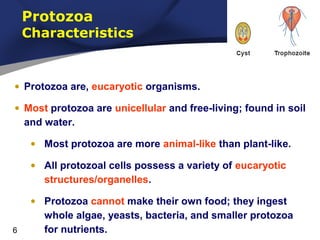
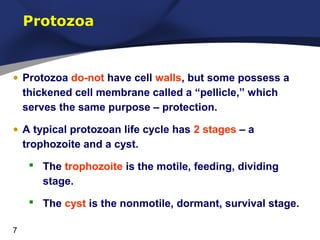
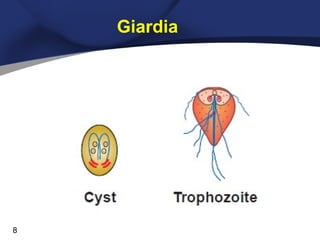
• A typical protozoan life cycle has 2 stages – a
trophozoite and a cyst.
 The trophozoite is the motile, feeding, dividing
stage.
 The cyst is the nonmotile, dormant, survival stage.
7
Giardia

8
Protozoa


Some protozoa are parasites.



Parasitic protozoa break down and absorb nutrients
from the body of the host in which they live.



Many parasitic protozoa are pathogens, such as
those that cause:
• Malaria,
• Giardiasis,
• African sleeping sickness,
• Amebic dysentery

9
Classification and Medical Significance
of Protozoa
• Protozoa are divided into groups, based on their method of
locomotion:




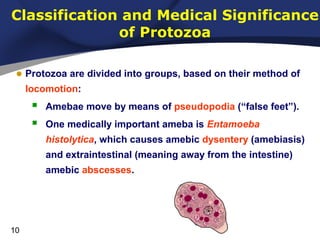
Amebae move by means of pseudopodia (“false feet”).
One medically important ameba is Entamoeba
histolytica, which causes amebic dysentery (amebiasis)
and extraintestinal (meaning away from the intestine)
amebic abscesses.

10
Medical Significance of Protozoa
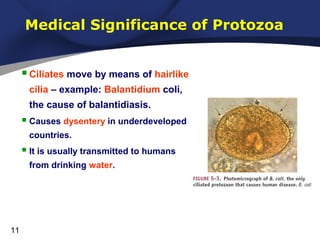
 Ciliates move by means of hairlike
cilia – example: Balantidium coli,
the cause of balantidiasis.

 Causes dysentery in underdeveloped
countries.

 It is usually transmitted to humans
from drinking water.

11
Medical Significance of Protozoa

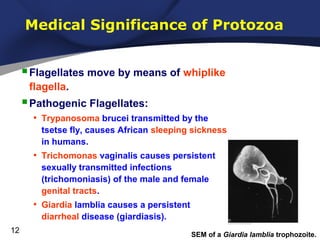
 Flagellates move by means of whiplike
flagella.

 Pathogenic Flagellates:
• Trypanosoma brucei transmitted by the
tsetse fly, causes African sleeping sickness
in humans.

• Trichomonas vaginalis causes persistent
sexually transmitted infections
(trichomoniasis) of the male and female
genital tracts.

• Giardia lamblia causes a persistent
diarrheal disease (giardiasis).
12

SEM of a Giardia lamblia trophozoite.
Medical Significance of Protozoa

• Sporozoa have no visible means of locomotion.
• Nonmotile protozoa
• The most important sporozoan pathogens:
• Plasmodium spp. that cause malaria.
• Malarial parasites are transmitted by female
Anopheles mosquitoes, which become infected
when they take a blood meal from a person with
malaria.

• Cryptosporidium parvum, causes severe diarrheal
13

disease in immunosuppressed patients,
especially those with AIDS
Fungi

Characteristics

• The study of fungi is called mycology.
• Some fungi are harmful, some are beneficial.
 Beneficial fungi are important in the production of
cheeses, and other foods, as well as certain drugs
(e.g., the cyclosporine) and antibiotics (e.g.,
penicillin).

• Fungi represent a diverse group of eucaryotic
organisms that include yeasts, moulds, and
mushrooms.
14
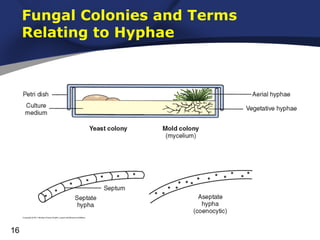
Fungi

• Fungal cell walls contain a polysaccharide called chitin.
 Many fungi are unicellular (e.g., yeasts), others grow as
filaments called hyphae which intertwine to form a mass
called a mycelium

• Some fungi have septate hyphae (the hyphae are divided
into cells by cross walls or septa).

• Some fungi have aseptate hyphae (the hyphae do not
have septa).

• Aseptate hyphae contain multinucleated cytoplasm.

15
Fungal Colonies and Terms
Relating to Hyphae

16
Fungi

Reproduction

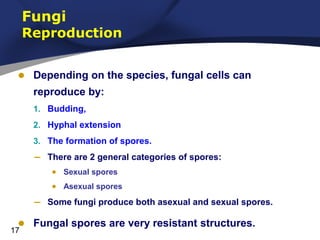
•

Depending on the species, fungal cells can
reproduce by:
1. Budding,
2. Hyphal extension
3. The formation of spores.

–

There are 2 general categories of spores:

• Sexual spores
• Asexual spores

–

•
17

Some fungi produce both asexual and sexual spores.

Fungal spores are very resistant structures.
Fungi

Classification

*

• Classification of fungi is based primarily on their
mode of sexual reproduction and the type of sexual
spore they produce.

• The 5 phyla of fungi are: Zygomycotina,
Chytridiomycotina, Ascomycotina, Basidiomycotina,
and Deuteromycotina.

• Deuteromycotina include the medically important
moulds such as Aspergillus and Penicillium.
18
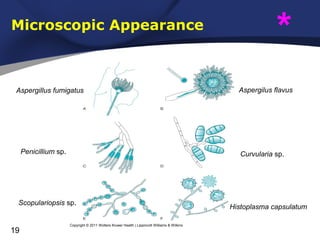
Microscopic Appearance

Aspergillus fumigatus

Penicillium sp.

Aspergilus flavus

Curvularia sp.

Scopulariopsis sp.

19

*

Copyright © 2011 Wolters Kluwer Health | Lippincott Williams & Wilkins

Histoplasma capsulatum
Yeasts

• Yeasts are eucaryotic, unicellular organisms that lack
mycelia.

• Yeasts usually reproduce by budding, but occasionally
by a type of spore formation.

• A string of elongated buds is known as a pseudohypha
(not really a hypha).

 Some yeasts (e.g., Candida albicans and Cryptococcus
neoformans) are human pathogens.

• Saccharomyces cerevisiae is a yeast used in baking.
20
Fungi: Yeasts

• Yeast colonies may be difficult to distinguish
from bacterial colonies.

–

A simple wet mount can be used to differentiate
yeast colonies from bacterial colonies.
• Yeasts are larger than bacteria and are usually ovalshaped.

• Yeasts are often observed in the process of budding.
• Bacteria do not bud.
21
Gram-Stained Clinical Specimen Containing
Yeasts, Bacteria, and White Blood Cells

Yeasts

Bacteria
22
Fungi: Moulds
• Moulds are often seen in water and soil and growing on food.
• Moulds produce cytoplasmic filaments called hyphae.
– Aerial hyphae extend above the surface of whatever the
mould is growing on.

–

Vegetative hyphae grow beneath the surface.

• Reproduction is by spore formation, either sexually or
asexually, on the aerial hyphae (also known as reproductive
hyphae).
23
Fungi: Moulds
• Moulds have great commercial importance.
– Some produce antibiotics.
• Examples: Penicillium and Cephalosporium

–

Some moulds are used to produce large quantities of
enzymes that are used commercially.

–

The flavor of cheeses like bleu cheese, Roquefort,
camembert, and limburger are due to moulds that
grow in them.

24
Fungi: Fleshy Fungi

• Include mushrooms, toadstools, puffballs and
bracket fungi

• Consist of a network of filaments or strands (the
mycelium) that grows in soil or on rotting logs

• The fruiting body that grows above the ground forms
and releases spores

• Some mushrooms are edible; some are extremely
toxic.
25
Fungi

Medical Significance
•

A variety of fungi including yeasts, moulds, and some fleshy
fungi, are of medical, veterinary and agricultural importance
because of the diseases they cause in humans, animals, and
plants.

•

The infectious diseases of humans and animals that are
caused by moulds are called mycoses.

•

26

Fungal infections of humans are categorized as:

1.
2.
3.
4.

Superficial
Cutaneous
Subcutaneous
Systemic mycoses.
Superficial and Cutaneous Mycoses
• Superficial mycoses are fungal infections of the outermost
areas of the human body – hair, nails and epidermis.

• Cutaneous mycoses are fungal infections of the living layer
of the skin, the dermis.

–

A group of moulds collectively referred to as
dermatophytes cause tinea (“ringworm”) infections.

–

The yeast, Candida albicans, can also cause cutaneous,
oral, and vaginal infections.

27
Subcutaneous and Systemic Mycoses

• Subcutaneous and systemic mycoses are more
severe types of fungal infections.

• Subcutaneous mycoses are fungal infections of the
dermis and underlying tissues.

• Systemic mycoses are fungal infections of the
internal organs of the body.

–

Spores of some pathogenic fungi may be inhaled with dust
from contaminated soil or dried bird or bat feces. They
may also enter through wounds of the hands and feet.

28
Subcutaneous and Systemic Mycoses
• Examples of deep-seated pulmonary infections include:
•
•
•
•

Blastomycosis
Coccidioidomycosis
Cryptococcosis
Histoplasmosis.

• Inhalation of common bread moulds like Rhizopus and Mucor
spp. can cause disease and even death in immunosuppressed
patients.

• Diagnosis of mycoses is accomplished by culture techniques
and immunodiagnostic procedures.
29
Dimorphic Fungi

• A few fungi, including some pathogens, can live as
either yeasts or moulds, depending on growth
conditions.

• This phenomenon is known as dimorphism and the
fungi are called dimorphic fungi.

–
–

When grown in vitro at room temperature (25oC), dimorphic
fungi exist as moulds, producing mould colonies.

–
30

When grown in vitro at body temperature (37oC), dimorphic
fungi grow as yeasts and produce yeast colonies.

In vivo, dimorphic fungi exist as yeasts.
Dimorphic Fungi
• Dimorphic fungi that cause
human diseases include:

–

Histoplasma capsulatum
(histoplasmosis)

–

Sporothrix schenckii
(sporotrichosis)

–

Coccidioides immitis
(coccidioidomycosis)

–

Blastomyces dermatitidis
(blastomycosis)

31
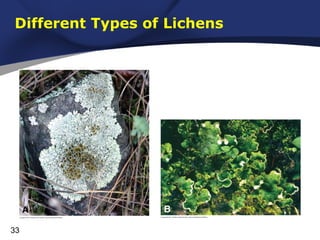
Lichens and Slime Moulds

• Lichens are observed as colored, often circular
patches on tree trunks and rocks.

• Slime moulds are found in soil and on rotting logs.

32
Different Types of Lichens

33

Chapter5 microbiology farid

  • 1.
    ‫‪MICROBIOLOGY‬‬ ‫‪for the HealthSciences‬‬ ‫اعداد‬ ‫أ. فريد ابو العمرين‬ ‫ماجستير العلوم الطبية المخبرية‬ ‫5 :‪CH‬‬ ‫1‬
  • 2.
    Chapter 5. MicrobialDiversity Part 2: Eucaryotic Microbes • Introduction • Fungi • Algae – Characteristics – Characteristics and – Classification Classification – Medical Significance – Medical Significance • Protozoa – Characteristics – Classification and Medical Significance 2 • Lichens • Slime Moulds
  • 3.
    Algae Characteristics and Classification •Algae are photosynthetic, eucaryotic organisms. • The study of algae is called phycology • All algal cells consist of cytoplasm, a cell wall (usually), a cell membrane, a nucleus, plastids, ribosomes, mitochondria, and Golgi bodies. • Algae range in size from unicellular microorganisms to large, multi-cellular organisms. • Algae produce energy by photosynthesis. 3
  • 4.
    Algae • Algae maybe arranged in colonies or strands and are found in fresh and salt water, in wet soil, and on wet rocks. • Most algal cell walls contain cellulose. • Depending on their photosynthetic pigments, algae are classified as green, golden, brown, or red algae. • Algae include: diatoms, dinoflagellates, desmids, Spirogyra, Chlamydomonas, Volvox, and Euglena. • Algae are an important source of food, iodine, fertilizers, emulsifiers, and stabilizers and gelling agents for jams and culture media. 4
  • 5.
    Algae: Medical Significance •Prototheca, is a very rare cause of human infections • Causes protothecosis • Prototheca lives in soil and can enter wounds, especially those located on the feet. • It produces a small subcutaneous lesion that can progress to a crusty, wartylooking lesion. • Some Algae secrete toxic substances called phycotoxins – Poisonous to humans, fish, and other animals 5
  • 6.
    Protozoa Characteristics • Protozoa are,eucaryotic organisms. • Most protozoa are unicellular and free-living; found in soil and water. • Most protozoa are more animal-like than plant-like. • All protozoal cells possess a variety of eucaryotic structures/organelles. 6 • Protozoa cannot make their own food; they ingest whole algae, yeasts, bacteria, and smaller protozoa for nutrients.
  • 7.
    Protozoa • Protozoa do-nothave cell walls, but some possess a thickened cell membrane called a “pellicle,” which serves the same purpose – protection. • A typical protozoan life cycle has 2 stages – a trophozoite and a cyst.  The trophozoite is the motile, feeding, dividing stage.  The cyst is the nonmotile, dormant, survival stage. 7
  • 8.
  • 9.
    Protozoa  Some protozoa areparasites.  Parasitic protozoa break down and absorb nutrients from the body of the host in which they live.  Many parasitic protozoa are pathogens, such as those that cause: • Malaria, • Giardiasis, • African sleeping sickness, • Amebic dysentery 9
  • 10.
    Classification and MedicalSignificance of Protozoa • Protozoa are divided into groups, based on their method of locomotion:   Amebae move by means of pseudopodia (“false feet”). One medically important ameba is Entamoeba histolytica, which causes amebic dysentery (amebiasis) and extraintestinal (meaning away from the intestine) amebic abscesses. 10
  • 11.
    Medical Significance ofProtozoa  Ciliates move by means of hairlike cilia – example: Balantidium coli, the cause of balantidiasis.  Causes dysentery in underdeveloped countries.  It is usually transmitted to humans from drinking water. 11
  • 12.
    Medical Significance ofProtozoa  Flagellates move by means of whiplike flagella.  Pathogenic Flagellates: • Trypanosoma brucei transmitted by the tsetse fly, causes African sleeping sickness in humans. • Trichomonas vaginalis causes persistent sexually transmitted infections (trichomoniasis) of the male and female genital tracts. • Giardia lamblia causes a persistent diarrheal disease (giardiasis). 12 SEM of a Giardia lamblia trophozoite.
  • 13.
    Medical Significance ofProtozoa • Sporozoa have no visible means of locomotion. • Nonmotile protozoa • The most important sporozoan pathogens: • Plasmodium spp. that cause malaria. • Malarial parasites are transmitted by female Anopheles mosquitoes, which become infected when they take a blood meal from a person with malaria. • Cryptosporidium parvum, causes severe diarrheal 13 disease in immunosuppressed patients, especially those with AIDS
  • 14.
    Fungi Characteristics • The studyof fungi is called mycology. • Some fungi are harmful, some are beneficial.  Beneficial fungi are important in the production of cheeses, and other foods, as well as certain drugs (e.g., the cyclosporine) and antibiotics (e.g., penicillin). • Fungi represent a diverse group of eucaryotic organisms that include yeasts, moulds, and mushrooms. 14
  • 15.
    Fungi • Fungal cellwalls contain a polysaccharide called chitin.  Many fungi are unicellular (e.g., yeasts), others grow as filaments called hyphae which intertwine to form a mass called a mycelium • Some fungi have septate hyphae (the hyphae are divided into cells by cross walls or septa). • Some fungi have aseptate hyphae (the hyphae do not have septa). • Aseptate hyphae contain multinucleated cytoplasm. 15
  • 16.
    Fungal Colonies andTerms Relating to Hyphae 16
  • 17.
    Fungi Reproduction • Depending on thespecies, fungal cells can reproduce by: 1. Budding, 2. Hyphal extension 3. The formation of spores. – There are 2 general categories of spores: • Sexual spores • Asexual spores – • 17 Some fungi produce both asexual and sexual spores. Fungal spores are very resistant structures.
  • 18.
    Fungi Classification * • Classification offungi is based primarily on their mode of sexual reproduction and the type of sexual spore they produce. • The 5 phyla of fungi are: Zygomycotina, Chytridiomycotina, Ascomycotina, Basidiomycotina, and Deuteromycotina. • Deuteromycotina include the medically important moulds such as Aspergillus and Penicillium. 18
  • 19.
    Microscopic Appearance Aspergillus fumigatus Penicilliumsp. Aspergilus flavus Curvularia sp. Scopulariopsis sp. 19 * Copyright © 2011 Wolters Kluwer Health | Lippincott Williams & Wilkins Histoplasma capsulatum
  • 20.
    Yeasts • Yeasts areeucaryotic, unicellular organisms that lack mycelia. • Yeasts usually reproduce by budding, but occasionally by a type of spore formation. • A string of elongated buds is known as a pseudohypha (not really a hypha).  Some yeasts (e.g., Candida albicans and Cryptococcus neoformans) are human pathogens. • Saccharomyces cerevisiae is a yeast used in baking. 20
  • 21.
    Fungi: Yeasts • Yeastcolonies may be difficult to distinguish from bacterial colonies. – A simple wet mount can be used to differentiate yeast colonies from bacterial colonies. • Yeasts are larger than bacteria and are usually ovalshaped. • Yeasts are often observed in the process of budding. • Bacteria do not bud. 21
  • 22.
    Gram-Stained Clinical SpecimenContaining Yeasts, Bacteria, and White Blood Cells Yeasts Bacteria 22
  • 23.
    Fungi: Moulds • Mouldsare often seen in water and soil and growing on food. • Moulds produce cytoplasmic filaments called hyphae. – Aerial hyphae extend above the surface of whatever the mould is growing on. – Vegetative hyphae grow beneath the surface. • Reproduction is by spore formation, either sexually or asexually, on the aerial hyphae (also known as reproductive hyphae). 23
  • 24.
    Fungi: Moulds • Mouldshave great commercial importance. – Some produce antibiotics. • Examples: Penicillium and Cephalosporium – Some moulds are used to produce large quantities of enzymes that are used commercially. – The flavor of cheeses like bleu cheese, Roquefort, camembert, and limburger are due to moulds that grow in them. 24
  • 25.
    Fungi: Fleshy Fungi •Include mushrooms, toadstools, puffballs and bracket fungi • Consist of a network of filaments or strands (the mycelium) that grows in soil or on rotting logs • The fruiting body that grows above the ground forms and releases spores • Some mushrooms are edible; some are extremely toxic. 25
  • 26.
    Fungi Medical Significance • A varietyof fungi including yeasts, moulds, and some fleshy fungi, are of medical, veterinary and agricultural importance because of the diseases they cause in humans, animals, and plants. • The infectious diseases of humans and animals that are caused by moulds are called mycoses. • 26 Fungal infections of humans are categorized as: 1. 2. 3. 4. Superficial Cutaneous Subcutaneous Systemic mycoses.
  • 27.
    Superficial and CutaneousMycoses • Superficial mycoses are fungal infections of the outermost areas of the human body – hair, nails and epidermis. • Cutaneous mycoses are fungal infections of the living layer of the skin, the dermis. – A group of moulds collectively referred to as dermatophytes cause tinea (“ringworm”) infections. – The yeast, Candida albicans, can also cause cutaneous, oral, and vaginal infections. 27
  • 28.
    Subcutaneous and SystemicMycoses • Subcutaneous and systemic mycoses are more severe types of fungal infections. • Subcutaneous mycoses are fungal infections of the dermis and underlying tissues. • Systemic mycoses are fungal infections of the internal organs of the body. – Spores of some pathogenic fungi may be inhaled with dust from contaminated soil or dried bird or bat feces. They may also enter through wounds of the hands and feet. 28
  • 29.
    Subcutaneous and SystemicMycoses • Examples of deep-seated pulmonary infections include: • • • • Blastomycosis Coccidioidomycosis Cryptococcosis Histoplasmosis. • Inhalation of common bread moulds like Rhizopus and Mucor spp. can cause disease and even death in immunosuppressed patients. • Diagnosis of mycoses is accomplished by culture techniques and immunodiagnostic procedures. 29
  • 30.
    Dimorphic Fungi • Afew fungi, including some pathogens, can live as either yeasts or moulds, depending on growth conditions. • This phenomenon is known as dimorphism and the fungi are called dimorphic fungi. – – When grown in vitro at room temperature (25oC), dimorphic fungi exist as moulds, producing mould colonies. – 30 When grown in vitro at body temperature (37oC), dimorphic fungi grow as yeasts and produce yeast colonies. In vivo, dimorphic fungi exist as yeasts.
  • 31.
    Dimorphic Fungi • Dimorphicfungi that cause human diseases include: – Histoplasma capsulatum (histoplasmosis) – Sporothrix schenckii (sporotrichosis) – Coccidioides immitis (coccidioidomycosis) – Blastomyces dermatitidis (blastomycosis) 31
  • 32.
    Lichens and SlimeMoulds • Lichens are observed as colored, often circular patches on tree trunks and rocks. • Slime moulds are found in soil and on rotting logs. 32
  • 33.