Introduction to Retailing
• Rajah of Retail
• Rewrite rules and Retain values
• Group’s network exists in 73 cities, 69 rural locations
with 1000 stores spread across 19 million square feet
of retail space
• Pantaloons (fashion destinations), Big Bazaar (Indian
Hyper market chain), Food Bazaar (combine look,
touch and feel along with choice, convenience and
quality), Central ( a chain of seamless destination
malls).
• Future Bazaar, Furniture Bazaar, Electronic Bazaar,
Brand Factory, Planet Sports et.al
1-3
Understanding Retailing
A retailer is a business that sells products and/or
services to consumers for personal, family or
household use.
Retailing encompasses the business activities
involved in selling goods and services to
consumers for their personal, family, or household
use. It includes every sale to the final consumer.
The word retail has its origin in French word retailer
and means “to cut a piece’’ or “to break bulk’.
According to Kotler: “Retailing includes all
the activities involved in selling goods or
services to the final consumers for
personal, non business use”
 Retailing may be understood as the final step in the distribution
of merchandise for consumption by the end consumers.
 Retailing is responsible for matching final consumer demand
with supplies of different marketers.
 Retailing is high intensity competition industry, The reasons for
its popularity lie in its ability to provide easier access to variety
of products, freedom of choice and many services to
consumers.
 The Indian retail is dotted by traditionally market place called
bazaars or haats comprises of numerous small and large shops,
selling different or similar merchandise
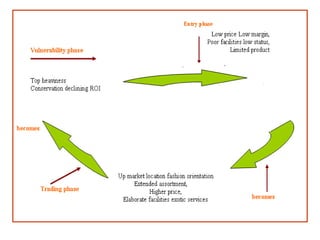
“’Wheel of Retailing”
A better known theory of retailing “wheel of retailing” proposed by
Maclcomb McNair says,
1. New retailers often enter the market place with low prices,
margins, and status. The low prices are usually the result of
some innovative cost-cutting procedures and soon attract
competitors.
2. With the passage of time, these businesses strive to broaden
their customer base and increase sales. Their operations and
facilities increase and become more expensive.
3. They may move to better up market locations, start carrying
higher quality products or add services and ultimately emerge
as a high cost price service retailer.
4. By this time newer competitors as low price, low margin, low
status emerge and these competitors too follow the same
evolutionary process.
5. The wheel keeps on turning and department stories,
supermarkets, and mass merchandise went through this
cycles.
Functions of a retaillier
 From the customer point of view, the retailer serves him by
providing the goods that he needs in the required assortment, at
the required place and time.
 From an economic standpoint, the role of a retailer is to provide
real added value or utility to the customer. This comes four
different perspectives
1. Form: First is utility regarding the form of a product that is
acceptable to the customer.
 The retailer does not supply raw material, but rather offers
finished goods and services in a form that the customers
want.
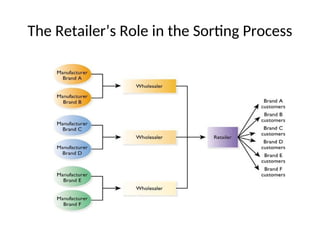
 The retailer performs the function of sorting the goods and
providing us with an assortment of product in various
categories.
2. Time: He cerates Time utility by keeping the store open
when the consumers prefer to shop.
 preferable shopping hours.
5. Place: By being available at a convenient location, he creates
place utility.
6. Ownership: Finally, when the product is sold, ownership
utility is created, get credit, layaway
Apart from these functions retailer also performs like:
5. Arranging Assortment: manufacturers usually make one
or a variety of products and would like to sell their entire
inventory to few buyers to reduce costs. Final consumers, in
contrast prefer a large variety of goods and services to choose
from and usually buy them in small units.
• Retailers are able to balance the demands of both sides, by
collecting an assortment of goods from different sources,
buying them in sufficiently large quantities and selling them to
consumers in small units
5. Breaking Bulk: to reduce transportation costs, manufacturer
and wholesalers typically ship large cartons of the products,
which are then tailored by the retailers into smaller quantities to
meet individual consumption needs
6. Holding stock: Retailers maintain an inventory that allows
for instant availability of the product to the consumers. It helps
to keep prices stable and enables the manufacture to regulate
production.
7. Promotional support: small manufacturers can use retailers
to provide assistance with transport, storage, advertising, and
pre- payment of merchandise.
The Retailer’s Role in the Sorting Process
1-14
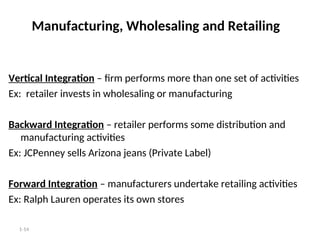
Manufacturing, Wholesaling and Retailing
Vertical Integration – firm performs more than one set of activities
Ex: retailer invests in wholesaling or manufacturing
Backward Integration – retailer performs some distribution and
manufacturing activities
Ex: JCPenney sells Arizona jeans (Private Label)
Forward Integration – manufacturers undertake retailing activities
Ex: Ralph Lauren operates its own stores
1-15
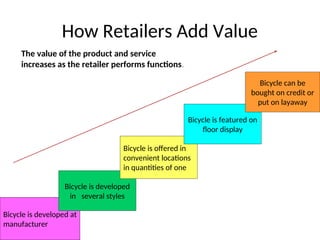
How Retailers Add Value
The value of the product and service
increases as the retailer performs functions.
Bicycle is developed at
manufacturer
Bicycle is developed
in several styles
Bicycle is offered in
convenient locations
in quantities of one
Bicycle is featured on
floor display
Bicycle can be
bought on credit or
put on layaway
1-16
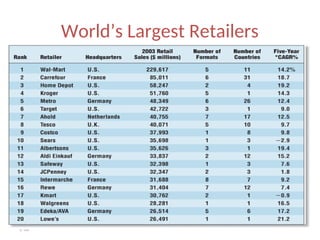
World’s Largest Retailers
Major type of retail stores
There is no universally accepted method of classifying retailer.
Various schemes have been proposed to categories retailers
based on
 Number of outlets
 Margin vs. turnover
 Location
 Size.
Because of overlap of classification criteria, some stores may
qualify as under two different categories.
1. General merchandise retailer: general merchandise
retailer carry a variety of product lines, with considerable
depth. Some major types of these stores include
supermarkets and hypermarkets , discount stores and
department stores.
o Super market: A supermarket is a large self service retail
store that carries a wide variety of consumer products under
one roof , such as complete line of food products , laundry
requirement, household maintenance items. In India
cooperative have managed some supermarkets for quite
sometime like super bazaar in Delhi, apna bazaar,etc.
o Discount store: these stores are self service, standard
general merchandise retailers regularly offering brand name
and private brand items at low price, earn lower margins and
push for high sales turnover. The characteristics of true
discount stores include
 Selling products at discounted price
 Carry standard international , national, or store brand to
build image
 Self service stores to minimize operational costs
 Preferred store location are low rent areas.
Like best known discount store is Wal-Mart. In India almost all
retail stores offer discounts, subhiksha
o Department store: a department store is larger retail store
organized into several departments, offering a broad verity and
depth of product lines. The product mix may include food
products, appliances, clothing, furnishing and other household
goods.
 Like Pantaloons, shoppers’ stop,
 department store only for kids is Kids Kemp.
 Fashion related department stores in India are Ebony, Globus,
pantaloons, lifestyles.
2. Specialty Stores: specialty stores carry a narrow product
mix with depth of assortment within the line.
 The emphasis is on a limited number of complimentary
products and high level of customer service
 Specialty store often sell shopping goods such as Jewelry,
apparel, computers, music systems, sporting goods.
 Like; Tanishq, Titan watches, Van Heusen, Raymond's.
3. Shopping Malls: shopping malls typically deal with several
bases and product categories and provide a large variety of
merchandise abs service. There are 96 operational malls in
India and expected to grow 158 by this current year.
 Ansal plaza (Delhi), Garuda mall (Bangalore) Sahara plaza
Gurgaon , Spenser Plaza Chennai
4. Retail chains: a retail chain operates multiple retail outlets
under common ownership in different cities and towns.
 To some extent the purchasing function and decision making
are coordinated or centralized.
 Like Westside, Globus, Food world, McDonald's, Shell Retail
petrol outlets. Etc.
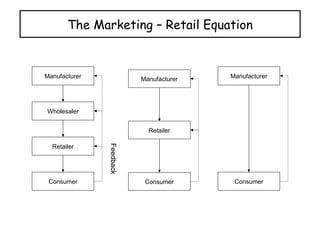
The Marketing – Retail Equation
Manufacturer
Retailer
Consumer
Manufacturer
Consumer
Manufacturer
Wholesaler
Retailer
Consumer
Feedback
Retailing in India.
 Retail is the new buzzword in India.
 The global Retail development Index has ranked India first,
among the top 30 emerging markets in the world.
 It is believed that India has the potential to deliver the fastest
growth over the next 50 years.
 While barter would be considered to be oldest form of retail
trade, since independence , retail in India has evolved to
support the unique needs of country, given its size and
complexity
 Second largest sector after Agriculture. Contributes about 10 –
11 % of the GDP
 The estimated size of the organized retail industry in India is
Rs. 16,000 crores. This is 2 % of the total estimated retail
trade.
 Indian Retail trade increased from Rs. 2200 billion in 2000 to
Rs 3300 billion by the year 2005
 India's first true shopping mall – complete with food courts,
recreation facilities and large car parking space – was
inaugurated as lately as in 1999 in Mumbai. (this mall is called
"Crossroads").
The Evolution of Retail in India
 Retail in India has evolved to support the unique needs of our
country, given its size and complexity Haats, Mandis and Melas have
always been a part of the Indian landscape. They still continue to be
present in most parts of the country and form an essential part of
life and trade in Various areas.
 The PDS (Public Distribution System) would easily as the
single largest retail chain existing in the country. the evolution of
the PDS of Grains in India has its origin in the “rationing
system” introduced by the British during world war II
 The system was started in 1939 in Bombay and subsequently
extended to other cities and towns. the system was abolished
post war but however attaining independence India was forced
to reintroduce it in 1950.
 There was rapid increase in the ration shops ( being
increasingly called the Fair Price Shop or FPSs)
 The Canteen Stores Department and the Post Offices
in India are also among the largest network of outlets in the
country reaching population across the country.
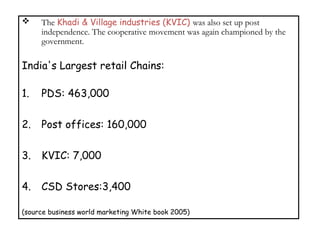
 The Khadi & Village industries (KVIC) was also set up post
independence. The cooperative movement was again championed by the
government.
India's Largest retail Chains:
1. PDS: 463,000
2. Post offices: 160,000
3. KVIC: 7,000
4. CSD Stores:3,400
(source business world marketing White book 2005)
 In the past decade, the Indian marketplace has transformed
dramatically. However from the 1950,s to the 80,s, investment
in various industries was limited due to low purchasing power
in the hands of the consumer and the government’s policies
favoring the small scale sector.
 The first attempts at organized retailing were noticed in the
textiles sector. One of the pioneers in this field was Raymond’s
which set up stores to retail fabric.
 Raymond’s distribution network today comprises 20,000
retailers and over 256 exclusive showrooms in over 120 cities
of the country
 Other textile manufacturing who set up their own retail chains
wee Reliance- which set up Vimal showrooms and Garden Silk
Mills, which set up Garden Vareli showrooms.
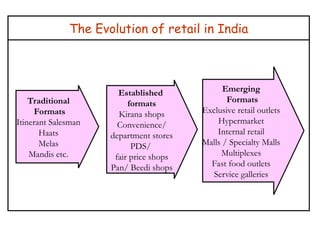
Traditional
Formats
Itinerant Salesman
Haats
Melas
Mandis etc.
Established
formats
Kirana shops
Convenience/
department stores
PDS/
fair price shops
Pan/ Beedi shops
Emerging
Formats
Exclusive retail outlets
Hypermarket
Internal retail
Malls / Specialty Malls
Multiplexes
Fast food outlets
Service galleries
The Evolution of retail in India
Drivers of Retail change in India
major drivers :
1. Changing Income Profiles: Steady economic growth fuelled
the increase in disposable income in India. The average
middle class family's disposable income rose by more than
20% between 1999-2003.
2. Diminishing difference between Rural and urban India: Rural
India accounts for over 75% of India population and this in
itself offers a tremendous opportunity for generating volume
driven growth. Tax benefit. In year 2002-03 LIC sold 50% of
its policies in rural India. Same BSNL also sold its 50%
connection in small towns .
3. Changes in Consumption patterns: Occupational changes and
expansion of media have caused a significant change in the way
the consumer lives and spends his money.
o The changes in income brought about changes in the
aspirations and the spending patterns of the consumers. the
buying basket of the consumer changed
4. The emergence of a young Earning India : Nearly 70% of the
Indian population is below the age of 34. taking advantages of
employment opportunity in the booming service sector these
young Indians are redefining service and consumption patterns
Prominent sector in Indian retail
1. Clothing, textiles and fashion Accessories:
2. Food & food Services:
3. Consumer Durables:
4. Books & Music:
Other emerging sectors
5. Jewellery retail
6. Footwear retail
7. Eye Wear Retail
8. Fuel Retail/ petro retail
Challenges to retail Development in India
• Retail not being recognized as an industry in India.
• The high costs of real estate.
• Lack of Adequate infrastructure.
• Multiple and complex taxation system.
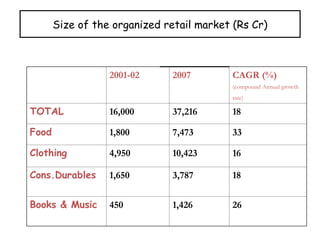
Size of the organized retail market (Rs Cr)
2001-02 2007 CAGR (%)
(compound Annual growth
rate)
TOTAL 16,000 37,216 18
Food 1,800 7,473 33
Clothing 4,950 10,423 16
Cons.Durables 1,650 3,787 18
Books & Music 450 1,426 26
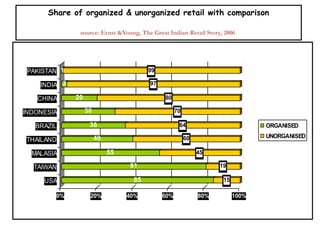
Share of organized & unorganized retail with comparison
source: Ernst &Young, The Great Indian Retail Story, 2006
85 15
81 19
55 45
40 60
36 64
30 70
20 80
3 97
1 99
0% 20% 40% 60% 80% 100%
USA
TAIWAN
MALASIA
THAILAND
BRAZIL
INDONESIA
CHINA
INDIA
PAKISTAN
ORGANISED
UNORGANISED
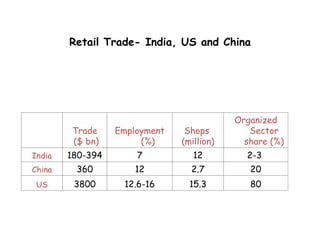
Retail Trade- India, US and China
Trade
($ bn)
Employment
(%)
Shops
(million)
Organized
Sector
share (%)
India 180-394 7 12 2-3
China 360 12 2.7 20
US 3800 12.6-16 15.3 80
1-39
Social and Economic
Significance of Retailing
• Community Support
• Over $3.4 trillion in annual U.S. sales
greater than medical care, housing, recreation combined
• Employs 27 million people
21% of non-agricultural US workforce
• Management training opportunities
• Entrepreneurial opportunities
1-40
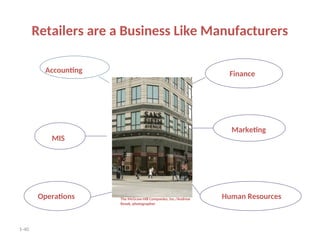
Retailers are a Business Like Manufacturers
Accounting
Marketing
Finance
Human Resources
Operations
MIS
The McGraw-Hill Companies, Inc./Andrew
Resek, photographer
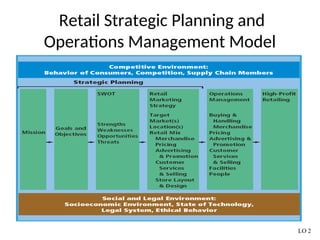
Retail Strategic Planning and
Operations Management Model
LO 2
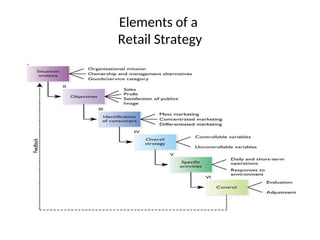
Elements of a
Retail Strategy
5-43
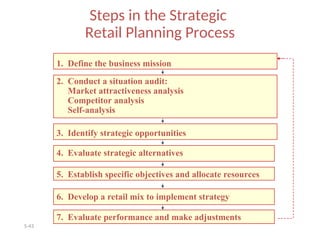
Steps in the Strategic
Retail Planning Process
1. Define the business mission
2. Conduct a situation audit:
Market attractiveness analysis
Competitor analysis
Self-analysis
3. Identify strategic opportunities
5. Establish specific objectives and allocate resources
7. Evaluate performance and make adjustments
6. Develop a retail mix to implement strategy
4. Evaluate strategic alternatives
1-44
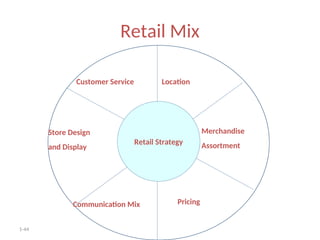
Retail Mix
Retail Strategy
Customer Service Location
Merchandise
Assortment
Pricing
Communication Mix
Store Design
and Display
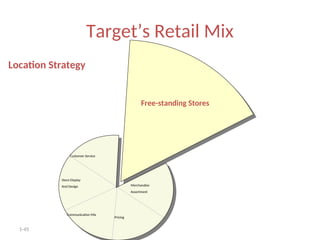
1-45
Target’s Retail Mix
Free-standing Stores
Customer Service
Merchandise
Assortment
Pricing
Communication Mix
Store Display
And Design
Location Strategy
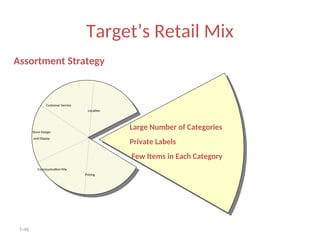
1-46
Target’s Retail Mix
Location
Pricing
Communication Mix
Store Design
and Display
Customer Service
Large Number of Categories
Private Labels
Few Items in Each Category
Assortment Strategy
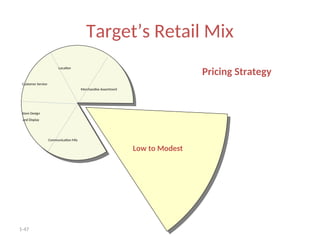
1-47
Target’s Retail Mix
Location
Communication Mix
Store Design
and Display
Customer Service
Merchandise Assortment
Low to Modest
Pricing Strategy
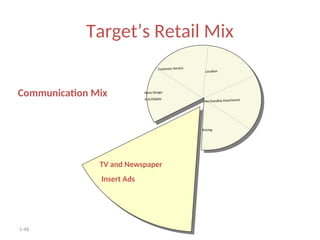
1-48
Target’s Retail Mix
Communication Mix
TV and Newspaper
Insert Ads
Store Design
And Display
Customer Service
Location
Merchandise Assortment
Pricing
1-49
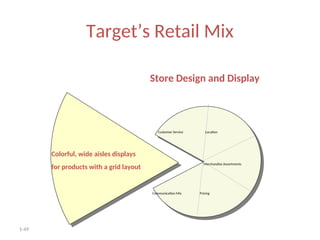
Target’s Retail Mix
Store Design and Display
Colorful, wide aisles displays
for products with a grid layout
Customer Service Location
Merchandise Assortments
Pricing
Communication Mix
1-50
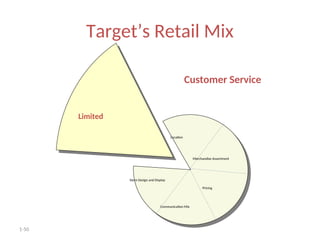
Target’s Retail Mix
Customer Service
Limited
Location
Merchandise Assortment
Pricing
Communication Mix
Store Design and Display
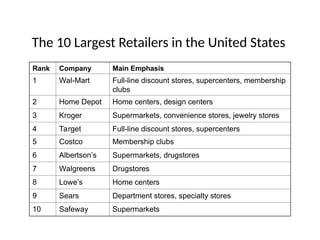
The 10 Largest Retailers in the United States
Rank Company Main Emphasis
1 Wal-Mart Full-line discount stores, supercenters, membership
clubs
2 Home Depot Home centers, design centers
3 Kroger Supermarkets, convenience stores, jewelry stores
4 Target Full-line discount stores, supercenters
5 Costco Membership clubs
6 Albertson’s Supermarkets, drugstores
7 Walgreens Drugstores
8 Lowe’s Home centers
9 Sears Department stores, specialty stores
10 Safeway Supermarkets
Multi-Channel Retailing
A retailer sells to consumers through
multiple retail formats
Web sites
Physical stores
Relationship Management Among Retailers and
Suppliers
• Disagreements may occur:
control over channel
profit allocation
number of competing retailers
product displays
promotional support
payment terms
operating flexibility
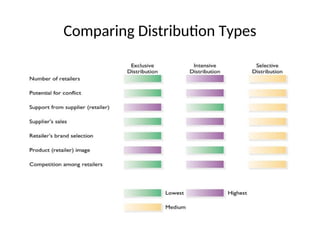
Distribution Types
• Exclusive: suppliers make agreements with one or few
retailers that designate the latter as the only ones in a
specified geographic area to carry certain brands or
products
• Intensive: suppliers sell through as many retailers as
possible
• Selective: suppliers sell through a moderate number of
retailers
Comparing Distribution Types
Competition in Retail
• Intratype competition - A retailer’s primary
competition is with other retailer’s using the same
format.
• Scrambled Merchandising – The offering of
merchandise not typically associated with the store
type
• Intertype Merchandising – Competition between
retailers that sell similar merchandise using different
formats, such as discount and departmental store
Customer Service
• Activities undertaken by a retailer in
conjunction with the basic goods and services
it sells
Store hours
Parking
Shopper-friendliness
Credit acceptance
Salespeople
Relationship Retailing
• Seek to establish and maintain long-term
bonds with customers, rather than act as if
each sales transaction is a completely new
encounter
– Concentrate on the total retail experience
– Monitor satisfaction
– Stay in touch with customers
1-59
Why You Should Consider Retailing
• Entry level management positions
-Department manager or assistant buyer/planner
-Manage and have P&L responsibility on your first job
• Starting pay average with great benefits
- Some retailers pay graduate school
• No two days are alike
• Buying and planning for financially analytically oriented
• Management for people-people
1-60
Types of Jobs in Retailing
Most entry level jobs are in store management or buying, but
there’s…
-accounting and finance
-real estate
-human resource management
-supply chain management
-advertising
-public affairs
-information systems
-visual merchandising

Introduction to Retail Management - An overview

  • 1.
  • 2.
    • Rajah ofRetail • Rewrite rules and Retain values • Group’s network exists in 73 cities, 69 rural locations with 1000 stores spread across 19 million square feet of retail space • Pantaloons (fashion destinations), Big Bazaar (Indian Hyper market chain), Food Bazaar (combine look, touch and feel along with choice, convenience and quality), Central ( a chain of seamless destination malls). • Future Bazaar, Furniture Bazaar, Electronic Bazaar, Brand Factory, Planet Sports et.al
  • 3.
    1-3 Understanding Retailing A retaileris a business that sells products and/or services to consumers for personal, family or household use. Retailing encompasses the business activities involved in selling goods and services to consumers for their personal, family, or household use. It includes every sale to the final consumer.
  • 4.
    The word retailhas its origin in French word retailer and means “to cut a piece’’ or “to break bulk’. According to Kotler: “Retailing includes all the activities involved in selling goods or services to the final consumers for personal, non business use”
  • 5.
     Retailing maybe understood as the final step in the distribution of merchandise for consumption by the end consumers.  Retailing is responsible for matching final consumer demand with supplies of different marketers.  Retailing is high intensity competition industry, The reasons for its popularity lie in its ability to provide easier access to variety of products, freedom of choice and many services to consumers.  The Indian retail is dotted by traditionally market place called bazaars or haats comprises of numerous small and large shops, selling different or similar merchandise
  • 6.
    “’Wheel of Retailing” Abetter known theory of retailing “wheel of retailing” proposed by Maclcomb McNair says, 1. New retailers often enter the market place with low prices, margins, and status. The low prices are usually the result of some innovative cost-cutting procedures and soon attract competitors. 2. With the passage of time, these businesses strive to broaden their customer base and increase sales. Their operations and facilities increase and become more expensive.
  • 7.
    3. They maymove to better up market locations, start carrying higher quality products or add services and ultimately emerge as a high cost price service retailer. 4. By this time newer competitors as low price, low margin, low status emerge and these competitors too follow the same evolutionary process. 5. The wheel keeps on turning and department stories, supermarkets, and mass merchandise went through this cycles.
  • 9.
    Functions of aretaillier  From the customer point of view, the retailer serves him by providing the goods that he needs in the required assortment, at the required place and time.  From an economic standpoint, the role of a retailer is to provide real added value or utility to the customer. This comes four different perspectives
  • 10.
    1. Form: Firstis utility regarding the form of a product that is acceptable to the customer.  The retailer does not supply raw material, but rather offers finished goods and services in a form that the customers want.  The retailer performs the function of sorting the goods and providing us with an assortment of product in various categories. 2. Time: He cerates Time utility by keeping the store open when the consumers prefer to shop.  preferable shopping hours.
  • 11.
    5. Place: Bybeing available at a convenient location, he creates place utility. 6. Ownership: Finally, when the product is sold, ownership utility is created, get credit, layaway Apart from these functions retailer also performs like: 5. Arranging Assortment: manufacturers usually make one or a variety of products and would like to sell their entire inventory to few buyers to reduce costs. Final consumers, in contrast prefer a large variety of goods and services to choose from and usually buy them in small units. • Retailers are able to balance the demands of both sides, by collecting an assortment of goods from different sources, buying them in sufficiently large quantities and selling them to consumers in small units
  • 12.
    5. Breaking Bulk:to reduce transportation costs, manufacturer and wholesalers typically ship large cartons of the products, which are then tailored by the retailers into smaller quantities to meet individual consumption needs 6. Holding stock: Retailers maintain an inventory that allows for instant availability of the product to the consumers. It helps to keep prices stable and enables the manufacture to regulate production. 7. Promotional support: small manufacturers can use retailers to provide assistance with transport, storage, advertising, and pre- payment of merchandise.
  • 13.
    The Retailer’s Rolein the Sorting Process
  • 14.
    1-14 Manufacturing, Wholesaling andRetailing Vertical Integration – firm performs more than one set of activities Ex: retailer invests in wholesaling or manufacturing Backward Integration – retailer performs some distribution and manufacturing activities Ex: JCPenney sells Arizona jeans (Private Label) Forward Integration – manufacturers undertake retailing activities Ex: Ralph Lauren operates its own stores
  • 15.
    1-15 How Retailers AddValue The value of the product and service increases as the retailer performs functions. Bicycle is developed at manufacturer Bicycle is developed in several styles Bicycle is offered in convenient locations in quantities of one Bicycle is featured on floor display Bicycle can be bought on credit or put on layaway
  • 16.
  • 17.
    Major type ofretail stores There is no universally accepted method of classifying retailer. Various schemes have been proposed to categories retailers based on  Number of outlets  Margin vs. turnover  Location  Size. Because of overlap of classification criteria, some stores may qualify as under two different categories.
  • 18.
    1. General merchandiseretailer: general merchandise retailer carry a variety of product lines, with considerable depth. Some major types of these stores include supermarkets and hypermarkets , discount stores and department stores. o Super market: A supermarket is a large self service retail store that carries a wide variety of consumer products under one roof , such as complete line of food products , laundry requirement, household maintenance items. In India cooperative have managed some supermarkets for quite sometime like super bazaar in Delhi, apna bazaar,etc.
  • 19.
    o Discount store:these stores are self service, standard general merchandise retailers regularly offering brand name and private brand items at low price, earn lower margins and push for high sales turnover. The characteristics of true discount stores include  Selling products at discounted price  Carry standard international , national, or store brand to build image  Self service stores to minimize operational costs  Preferred store location are low rent areas. Like best known discount store is Wal-Mart. In India almost all retail stores offer discounts, subhiksha
  • 20.
    o Department store:a department store is larger retail store organized into several departments, offering a broad verity and depth of product lines. The product mix may include food products, appliances, clothing, furnishing and other household goods.  Like Pantaloons, shoppers’ stop,  department store only for kids is Kids Kemp.  Fashion related department stores in India are Ebony, Globus, pantaloons, lifestyles.
  • 21.
    2. Specialty Stores:specialty stores carry a narrow product mix with depth of assortment within the line.  The emphasis is on a limited number of complimentary products and high level of customer service  Specialty store often sell shopping goods such as Jewelry, apparel, computers, music systems, sporting goods.  Like; Tanishq, Titan watches, Van Heusen, Raymond's. 3. Shopping Malls: shopping malls typically deal with several bases and product categories and provide a large variety of merchandise abs service. There are 96 operational malls in India and expected to grow 158 by this current year.  Ansal plaza (Delhi), Garuda mall (Bangalore) Sahara plaza Gurgaon , Spenser Plaza Chennai
  • 22.
    4. Retail chains:a retail chain operates multiple retail outlets under common ownership in different cities and towns.  To some extent the purchasing function and decision making are coordinated or centralized.  Like Westside, Globus, Food world, McDonald's, Shell Retail petrol outlets. Etc.
  • 23.
    The Marketing –Retail Equation Manufacturer Retailer Consumer Manufacturer Consumer Manufacturer Wholesaler Retailer Consumer Feedback
  • 24.
    Retailing in India. Retail is the new buzzword in India.  The global Retail development Index has ranked India first, among the top 30 emerging markets in the world.  It is believed that India has the potential to deliver the fastest growth over the next 50 years.  While barter would be considered to be oldest form of retail trade, since independence , retail in India has evolved to support the unique needs of country, given its size and complexity
  • 25.
     Second largestsector after Agriculture. Contributes about 10 – 11 % of the GDP  The estimated size of the organized retail industry in India is Rs. 16,000 crores. This is 2 % of the total estimated retail trade.  Indian Retail trade increased from Rs. 2200 billion in 2000 to Rs 3300 billion by the year 2005  India's first true shopping mall – complete with food courts, recreation facilities and large car parking space – was inaugurated as lately as in 1999 in Mumbai. (this mall is called "Crossroads").
  • 26.
    The Evolution ofRetail in India  Retail in India has evolved to support the unique needs of our country, given its size and complexity Haats, Mandis and Melas have always been a part of the Indian landscape. They still continue to be present in most parts of the country and form an essential part of life and trade in Various areas.  The PDS (Public Distribution System) would easily as the single largest retail chain existing in the country. the evolution of the PDS of Grains in India has its origin in the “rationing system” introduced by the British during world war II
  • 27.
     The systemwas started in 1939 in Bombay and subsequently extended to other cities and towns. the system was abolished post war but however attaining independence India was forced to reintroduce it in 1950.  There was rapid increase in the ration shops ( being increasingly called the Fair Price Shop or FPSs)  The Canteen Stores Department and the Post Offices in India are also among the largest network of outlets in the country reaching population across the country.
  • 28.
     The Khadi& Village industries (KVIC) was also set up post independence. The cooperative movement was again championed by the government. India's Largest retail Chains: 1. PDS: 463,000 2. Post offices: 160,000 3. KVIC: 7,000 4. CSD Stores:3,400 (source business world marketing White book 2005)
  • 29.
     In thepast decade, the Indian marketplace has transformed dramatically. However from the 1950,s to the 80,s, investment in various industries was limited due to low purchasing power in the hands of the consumer and the government’s policies favoring the small scale sector.  The first attempts at organized retailing were noticed in the textiles sector. One of the pioneers in this field was Raymond’s which set up stores to retail fabric.
  • 30.
     Raymond’s distributionnetwork today comprises 20,000 retailers and over 256 exclusive showrooms in over 120 cities of the country  Other textile manufacturing who set up their own retail chains wee Reliance- which set up Vimal showrooms and Garden Silk Mills, which set up Garden Vareli showrooms.
  • 31.
    Traditional Formats Itinerant Salesman Haats Melas Mandis etc. Established formats Kiranashops Convenience/ department stores PDS/ fair price shops Pan/ Beedi shops Emerging Formats Exclusive retail outlets Hypermarket Internal retail Malls / Specialty Malls Multiplexes Fast food outlets Service galleries The Evolution of retail in India
  • 32.
    Drivers of Retailchange in India major drivers : 1. Changing Income Profiles: Steady economic growth fuelled the increase in disposable income in India. The average middle class family's disposable income rose by more than 20% between 1999-2003. 2. Diminishing difference between Rural and urban India: Rural India accounts for over 75% of India population and this in itself offers a tremendous opportunity for generating volume driven growth. Tax benefit. In year 2002-03 LIC sold 50% of its policies in rural India. Same BSNL also sold its 50% connection in small towns .
  • 33.
    3. Changes inConsumption patterns: Occupational changes and expansion of media have caused a significant change in the way the consumer lives and spends his money. o The changes in income brought about changes in the aspirations and the spending patterns of the consumers. the buying basket of the consumer changed 4. The emergence of a young Earning India : Nearly 70% of the Indian population is below the age of 34. taking advantages of employment opportunity in the booming service sector these young Indians are redefining service and consumption patterns
  • 34.
    Prominent sector inIndian retail 1. Clothing, textiles and fashion Accessories: 2. Food & food Services: 3. Consumer Durables: 4. Books & Music: Other emerging sectors 5. Jewellery retail 6. Footwear retail 7. Eye Wear Retail 8. Fuel Retail/ petro retail
  • 35.
    Challenges to retailDevelopment in India • Retail not being recognized as an industry in India. • The high costs of real estate. • Lack of Adequate infrastructure. • Multiple and complex taxation system.
  • 36.
    Size of theorganized retail market (Rs Cr) 2001-02 2007 CAGR (%) (compound Annual growth rate) TOTAL 16,000 37,216 18 Food 1,800 7,473 33 Clothing 4,950 10,423 16 Cons.Durables 1,650 3,787 18 Books & Music 450 1,426 26
  • 37.
    Share of organized& unorganized retail with comparison source: Ernst &Young, The Great Indian Retail Story, 2006 85 15 81 19 55 45 40 60 36 64 30 70 20 80 3 97 1 99 0% 20% 40% 60% 80% 100% USA TAIWAN MALASIA THAILAND BRAZIL INDONESIA CHINA INDIA PAKISTAN ORGANISED UNORGANISED
  • 38.
    Retail Trade- India,US and China Trade ($ bn) Employment (%) Shops (million) Organized Sector share (%) India 180-394 7 12 2-3 China 360 12 2.7 20 US 3800 12.6-16 15.3 80
  • 39.
    1-39 Social and Economic Significanceof Retailing • Community Support • Over $3.4 trillion in annual U.S. sales greater than medical care, housing, recreation combined • Employs 27 million people 21% of non-agricultural US workforce • Management training opportunities • Entrepreneurial opportunities
  • 40.
    1-40 Retailers are aBusiness Like Manufacturers Accounting Marketing Finance Human Resources Operations MIS The McGraw-Hill Companies, Inc./Andrew Resek, photographer
  • 41.
    Retail Strategic Planningand Operations Management Model LO 2
  • 42.
  • 43.
    5-43 Steps in theStrategic Retail Planning Process 1. Define the business mission 2. Conduct a situation audit: Market attractiveness analysis Competitor analysis Self-analysis 3. Identify strategic opportunities 5. Establish specific objectives and allocate resources 7. Evaluate performance and make adjustments 6. Develop a retail mix to implement strategy 4. Evaluate strategic alternatives
  • 44.
    1-44 Retail Mix Retail Strategy CustomerService Location Merchandise Assortment Pricing Communication Mix Store Design and Display
  • 45.
    1-45 Target’s Retail Mix Free-standingStores Customer Service Merchandise Assortment Pricing Communication Mix Store Display And Design Location Strategy
  • 46.
    1-46 Target’s Retail Mix Location Pricing CommunicationMix Store Design and Display Customer Service Large Number of Categories Private Labels Few Items in Each Category Assortment Strategy
  • 47.
    1-47 Target’s Retail Mix Location CommunicationMix Store Design and Display Customer Service Merchandise Assortment Low to Modest Pricing Strategy
  • 48.
    1-48 Target’s Retail Mix CommunicationMix TV and Newspaper Insert Ads Store Design And Display Customer Service Location Merchandise Assortment Pricing
  • 49.
    1-49 Target’s Retail Mix StoreDesign and Display Colorful, wide aisles displays for products with a grid layout Customer Service Location Merchandise Assortments Pricing Communication Mix
  • 50.
    1-50 Target’s Retail Mix CustomerService Limited Location Merchandise Assortment Pricing Communication Mix Store Design and Display
  • 51.
    The 10 LargestRetailers in the United States Rank Company Main Emphasis 1 Wal-Mart Full-line discount stores, supercenters, membership clubs 2 Home Depot Home centers, design centers 3 Kroger Supermarkets, convenience stores, jewelry stores 4 Target Full-line discount stores, supercenters 5 Costco Membership clubs 6 Albertson’s Supermarkets, drugstores 7 Walgreens Drugstores 8 Lowe’s Home centers 9 Sears Department stores, specialty stores 10 Safeway Supermarkets
  • 52.
    Multi-Channel Retailing A retailersells to consumers through multiple retail formats Web sites Physical stores
  • 53.
    Relationship Management AmongRetailers and Suppliers • Disagreements may occur: control over channel profit allocation number of competing retailers product displays promotional support payment terms operating flexibility
  • 54.
    Distribution Types • Exclusive:suppliers make agreements with one or few retailers that designate the latter as the only ones in a specified geographic area to carry certain brands or products • Intensive: suppliers sell through as many retailers as possible • Selective: suppliers sell through a moderate number of retailers
  • 55.
  • 56.
    Competition in Retail •Intratype competition - A retailer’s primary competition is with other retailer’s using the same format. • Scrambled Merchandising – The offering of merchandise not typically associated with the store type • Intertype Merchandising – Competition between retailers that sell similar merchandise using different formats, such as discount and departmental store
  • 57.
    Customer Service • Activitiesundertaken by a retailer in conjunction with the basic goods and services it sells Store hours Parking Shopper-friendliness Credit acceptance Salespeople
  • 58.
    Relationship Retailing • Seekto establish and maintain long-term bonds with customers, rather than act as if each sales transaction is a completely new encounter – Concentrate on the total retail experience – Monitor satisfaction – Stay in touch with customers
  • 59.
    1-59 Why You ShouldConsider Retailing • Entry level management positions -Department manager or assistant buyer/planner -Manage and have P&L responsibility on your first job • Starting pay average with great benefits - Some retailers pay graduate school • No two days are alike • Buying and planning for financially analytically oriented • Management for people-people
  • 60.
    1-60 Types of Jobsin Retailing Most entry level jobs are in store management or buying, but there’s… -accounting and finance -real estate -human resource management -supply chain management -advertising -public affairs -information systems -visual merchandising