Trading Area Analysis
Dr. Gopal Thapa
Tribhuvan University
Email:thapazee@gmail.com
Benefits of Trading Area
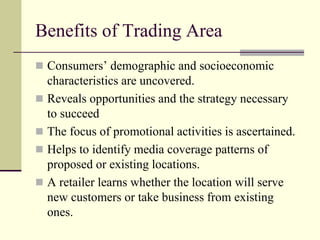
 Consumers’ demographic and socioeconomic
characteristics are uncovered.
 Reveals opportunities and the strategy necessary
to succeed
 The focus of promotional activities is ascertained.
 Helps to identify media coverage patterns of
proposed or existing locations.
 A retailer learns whether the location will serve
new customers or take business from existing
ones.
Benefits of Trading Area
 Whether competitors want to open nearby stores if
the firm does not do so itself.
 The best number of stores for a chain to operate in
a given area is calculated.
 Geographic weaknesses are highlighted.
 The impact of the Internet is taken into account.
 Other factors like competition, financial
institutions, transportation, labor availability,
supplier location, lega.l restrictions are reviewed
Trading Area Analysis
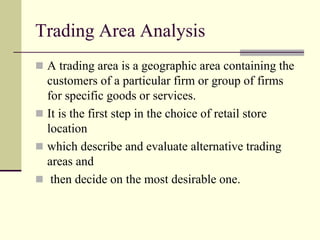
 A trading area is a geographic area containing the
customers of a particular firm or group of firms
for specific goods or services.
 It is the first step in the choice of retail store
location
 which describe and evaluate alternative trading
areas and
 then decide on the most desirable one.
Characteristics of Trading Area
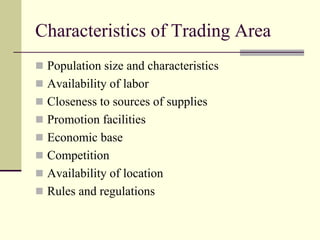
 Population size and characteristics
 Availability of labor
 Closeness to sources of supplies
 Promotion facilities
 Economic base
 Competition
 Availability of location
 Rules and regulations
Characteristics of Trading Area
▪ Population size and characteristics
▪ Total size and density
▪ Age distribution
▪ Average education level
▪ Percentage of residents owning homes
▪ Availability of Labor
▪ Management
▪ Management trainee
▪ Clerical
Characteristics of Trading Area
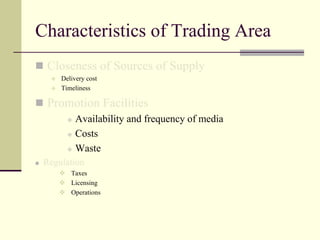
 Closeness of Sources of Supply
❖ Delivery cost
❖ Timeliness
 Promotion Facilities
❖ Availability and frequency of media
❖ Costs
❖ Waste
 Regulation
❖ Taxes
❖ Licensing
❖ Operations
Characteristics of Trading Area
 Economic Base
❖ Dominant industry
❖ Extent of diversification
❖ Growth projections
 Competitive Situation
❖ Number and size of existing competitors
❖ Evaluation of competitors
❖ Strengths and weaknesses
 Availability of Store Location
❖ Number and type of location
❖ Access to transportation
❖ Owning versus leasing opportunities
Trading area analysis

Trading area analysis

  • 1.
    Trading Area Analysis Dr.Gopal Thapa Tribhuvan University Email:thapazee@gmail.com
  • 2.
    Benefits of TradingArea  Consumers’ demographic and socioeconomic characteristics are uncovered.  Reveals opportunities and the strategy necessary to succeed  The focus of promotional activities is ascertained.  Helps to identify media coverage patterns of proposed or existing locations.  A retailer learns whether the location will serve new customers or take business from existing ones.
  • 3.
    Benefits of TradingArea  Whether competitors want to open nearby stores if the firm does not do so itself.  The best number of stores for a chain to operate in a given area is calculated.  Geographic weaknesses are highlighted.  The impact of the Internet is taken into account.  Other factors like competition, financial institutions, transportation, labor availability, supplier location, lega.l restrictions are reviewed
  • 4.
    Trading Area Analysis A trading area is a geographic area containing the customers of a particular firm or group of firms for specific goods or services.  It is the first step in the choice of retail store location  which describe and evaluate alternative trading areas and  then decide on the most desirable one.
  • 5.
    Characteristics of TradingArea  Population size and characteristics  Availability of labor  Closeness to sources of supplies  Promotion facilities  Economic base  Competition  Availability of location  Rules and regulations
  • 6.
    Characteristics of TradingArea ▪ Population size and characteristics ▪ Total size and density ▪ Age distribution ▪ Average education level ▪ Percentage of residents owning homes ▪ Availability of Labor ▪ Management ▪ Management trainee ▪ Clerical
  • 7.
    Characteristics of TradingArea  Closeness of Sources of Supply ❖ Delivery cost ❖ Timeliness  Promotion Facilities ❖ Availability and frequency of media ❖ Costs ❖ Waste  Regulation ❖ Taxes ❖ Licensing ❖ Operations
  • 8.
    Characteristics of TradingArea  Economic Base ❖ Dominant industry ❖ Extent of diversification ❖ Growth projections  Competitive Situation ❖ Number and size of existing competitors ❖ Evaluation of competitors ❖ Strengths and weaknesses  Availability of Store Location ❖ Number and type of location ❖ Access to transportation ❖ Owning versus leasing opportunities