BY AKHILANAND KUMAR
MEANING AND IMPORTANCE OF RETAIL STRATEGY
• It is more important to do what is strategically right
than what is immediately profitable.
• formulation of strategy is imperative taking into consideration
the commitment to creating and retaining satisfied customers.
MEANING AND IMPORTANCE OF RETAIL STRATEGY
• The importance of formulating a retail strategy is understood by all
small and big retailers.
• To build a competitive advantage that can be sustained, retailers
need to pay special attention to aspects like price, location,
merchandise, service and communications.
• Operations, purchasing/ logistics, market research, financing and
technology, which determine the strategic positioning of the firm
are also equally important.
RETAIL STRATEGY
• Retail strategy is a marketing plan that details how a
business intends to offer its products or services to
consumers and influence their purchases.
• For example, a typical retail strategy might illustrate how
best to place and display a company’s products in retail
outlets
• how to attract optimal consumer interest at those
locations with such things as price discounts, placement,
retailer incentives and signs.
FUNCTION OF A STRATEGY
• First, a strategy must help to achieve coordination among various
functional areas to the organisation.
• Second, strategy must clearly define how resources are to be
allocated. At any level of the organisation, resources are limited.
Strategy entails allocating resources to achieve the goals set with in
the time frame.
• Third strategy must show how it can lead to a superior market
position. A good strategy takes cognizance of existing and potential
competitors and their strengths and weaknesses.
RETAILERS CLASSIFIED BY MARKETING STRATEGIES
• What ever may be the form of ownership, a retailer must develop
marketing mix strategies to succeed in its chosen target markets.
• In retailing, the marketing mix, emphasizes product assortment, price,
location, promotion and customer services designed to aid in the sale
of a product.
• They include credit, delivery, gift wrapping, product installation,
merchandise returns, store hours, parking and- very important
personal service.
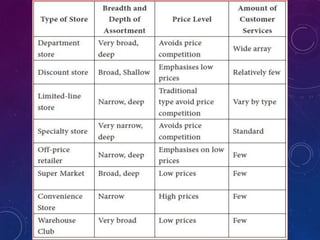
CLASSIFICATION OF RETAIL STORES
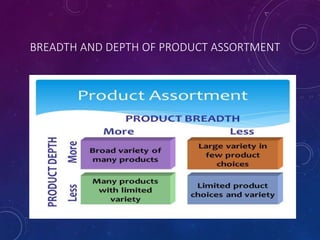
• Breadth and Depth of Product assortment
• Price Level
• Amount of customer services.
BREADTH AND DEPTH OF PRODUCT ASSORTMENT
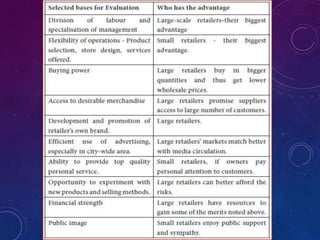
COMPETITIVE POSITIONS OF LARGE AND SMALL RETAILERS
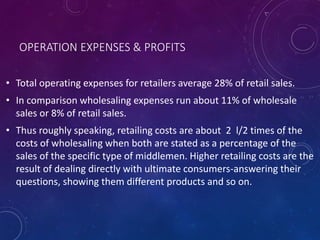
OPERATION EXPENSES & PROFITS
• Total operating expenses for retailers average 28% of retail sales.
• In comparison wholesaling expenses run about 11% of wholesale
sales or 8% of retail sales.
• Thus roughly speaking, retailing costs are about 2 l/2 times of the
costs of wholesaling when both are stated as a percentage of the
sales of the specific type of middlemen. Higher retailing costs are the
result of dealing directly with ultimate consumers-answering their
questions, showing them different products and so on.
COMPETITIVE ADVANTAGE WITH SPECIAL REFERENCE
PHYSICAL FACILITIES
• Another competitive advantage of retailers will be how they create
physical facilities which represent the distribution element of a
retailer’s marketing mix.
• Some firms engage in non-store retailing by selling on hire or through
catalogues or door to door.
• For example-but many more firms rely on retail stores. Firms that
operate retail stores must consider four aspects of physical facilities.
PHYSICAL FACILITIES
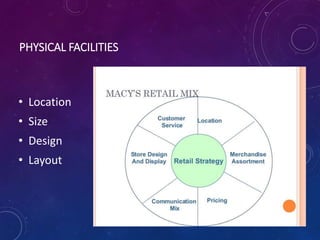
• Location
• Size
• Design
• Layout
• RETAIL STRATEGY
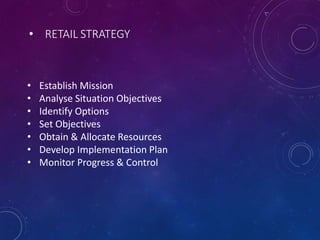
• Establish Mission
• Analyse Situation Objectives
• Identify Options
• Set Objectives
• Obtain & Allocate Resources
• Develop Implementation Plan
• Monitor Progress & Control
DEFINE MSSION OR PURPOSE
• Mission statement is a long term purpose of the
organization
• It describes what the retailer wishes to accomplish in
the markets in which he chooses to operate
• Retailers mission statement would normally highlight the
following
• The products and services that will be offered
• The customers who will be served
• The geographic areas that the organization chooses to
operate in
RETAIL STRATEGY
• A clear and definite plan outlined by the retailer to tap the market.
• A plan to build a long-term relationship with the consumers
• Process of strategy formulation in retail is the same as that for any
other industry.
• It starts with the retailer defining or stating the mission for the
organization
• The mission is at the core of the existence of the retailer
• Other aspects of the strategy may change over a period of time or
vary.
RETAIL STRATEGY
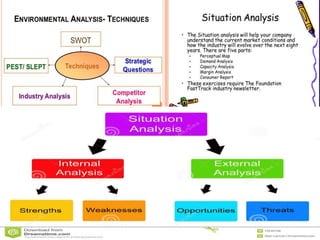
• Once the retail mission is defined, the retail ordination needs to look
inwards
• Understand what its strengths and weaknesses are
• Look outwards to analyse its opportunities and threats
• Situation analysis helps the retailer determine his position and his
strengths and weaknesses
• Helps formulate a clear picture of the advantages and opportunities
which can be
CONDUCT A SITUATION ANALYSIS
IDENTIFY OPTIONS / STRATEGIC ALTERNATIVES
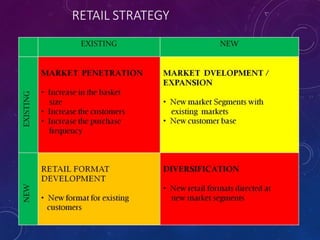
THE ALTERNATIVES AVAILABLE TO A RETAILER
A R E :
• M a r k e t Penetration
• M a r k e t D e v e l o p m e n t
• Retail F o r m a t D e v e l o p m e n t
• Diversification
IDENTIFY OPTIONS / STRATEGIC ALTERNATIVES
• After determining the strengths and weaknesses &
he environment retailer needs to consider various
alternatives available to tap a particular market
• Ansoff presented a matrix which looked at growth
opportunities
• He focused on firm’s present and potential
products in the existing and new markets
• Ansoff’s matrix also helps to understand the
options available to a retailer
RETAIL STRATEGY
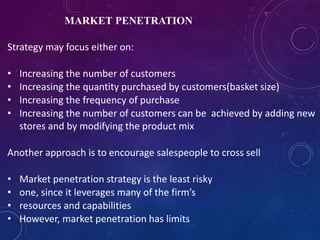
MARKET PENETRATION
Strategy may focus either on:
• Increasing the number of customers
• Increasing the quantity purchased by customers(basket size)
• Increasing the frequency of purchase
• Increasing the number of customers can be achieved by adding new
stores and by modifying the product mix
Another approach is to encourage salespeople to cross sell
• Market penetration strategy is the least risky
• one, since it leverages many of the firm’s
• resources and capabilities
• However, market penetration has limits
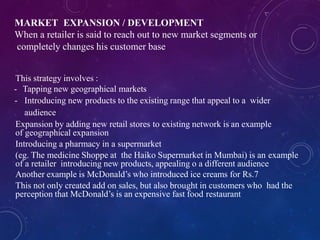
MARKET EXPANSION / DEVELOPMENT
When a retailer is said to reach out to new market segments or
completely changes his customer base
This strategy involves :
- Tapping new geographical markets
- Introducing new products to the existing range that appeal to a wider
audience
Expansion by adding new retail stores to existing network is an example
of geographical expansion
Introducing a pharmacy in a supermarket
(eg. The medicine Shoppe at the Haiko Supermarket in Mumbai) is an example
of a retailer introducing new products, appealing o a different audience
Another example is McDonald’s who introduced ice creams for Rs.7
This not only created add on sales, but also brought in customers who had the
perception that McDonald’s is an expensive fast food restaurant
• Example fast food retailers like McDonald’s and Subway offer limited
menus inside large department stores
• Another example is bookstore chain Crosswords, opening smaller format
stores by the name Crossword Corner at Shopper’s Stop
•Strategy may be appropriate if the retailer’s strengths are related to
specific customers, rather than to specific products
• In this situation retailer can leverage its strengths by developing a new
product targeted to his existing customers
RETAIL FORMAT DEVELOPMENT
When a retailer is said to introduce new retail format to customers
SET OBJECTIVES
• Translation of mission statement into operational terms
Indicate
• Results to be achieved
• Give direction to and set standards for the measurement of
performance Management sets both long term and short term
objectives
• One or two year time frames for achieving specific targets are short term objectives
Long term objectives are less specific and reflect the strategic dimension of the
firm
• Two important focus areas of retailers - Market Performance
Financial Performance
• Sales volume targets
• Market hare targets
• Profitability targets
• Liquidity targets
• Returns on investment targets
Objectives are set keeping these focus areas in mind
METHODS OF ENTERING A NEW MARKET
Joint Venture
Strategic partnership between a local retailer and a international /
foreign players.
Benefits / Advantages
International player learns from expertise of domestic partner
Domestic retailer learns from foreign player the international
practices
Key issues
Ownership, control, length of agreement, pricing, technology transfer,
government regulations.
Many joint ventures involve one local partner and one foreign player
At times for convenience two retailers can also form a JV company to enter new
market
METHODS OF ENTERING A NEW MARKET
Acquisitions
One organization acquiring another organization
Easy way of entering non domestic market without any complications
Considerations : management structure
new operating culture financial
burden
Example : Shopper’s stop acquiring bookstore chain Crossword, Wal-
mart acquiring ASDA
Mergers
Imply : Coming together of two organizations to form a combined entity
Example : Retail giants Carrefour and Promodes in Europe
RETAIL STRATEGY
RETAIL VALUE CHAIN
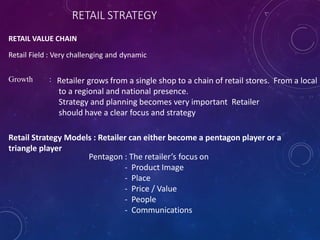
Retail Field : Very challenging and dynamic
Growth : Retailer grows from a single shop to a chain of retail stores. From a local
to a regional and national presence.
Strategy and planning becomes very important Retailer
should have a clear focus and strategy
Retail Strategy Models : Retailer can either become a pentagon player or a
triangle player
Pentagon : The retailer’s focus on
- Product Image
- Place
- Price / Value
- People
- Communications
RETAIL STRATEGY
RETAIL VALUE CHAIN
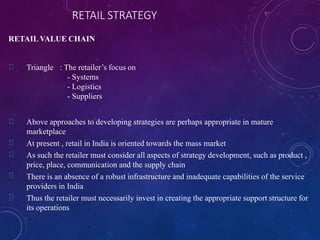
Triangle : The retailer’s focus on
- Systems
- Logistics
- Suppliers
Above approaches to developing strategies are perhaps appropriate in mature
marketplace
At present , retail in India is oriented towards the mass market
As such the retailer must consider all aspects of strategy development, such as product ,
price, place, communication and the supply chain
There is an absence of a robust infrastructure and inadequate capabilities of the service
providers in India
Thus the retailer must necessarily invest in creating the appropriate support structure for
its operations
RETAIL STRATEGY
RETAIL VALUE CHAIN
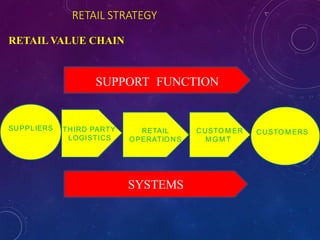
SUPPORT FUNCTION
SUPPLIERS THIRD PARTY
LOGISTICS
RETAIL
OPERATIONS
CUSTO M ER
M G M T
CUSTO M ERS
SYSTEMS
Retail strategy

Retail strategy

  • 1.
  • 2.
    MEANING AND IMPORTANCEOF RETAIL STRATEGY • It is more important to do what is strategically right than what is immediately profitable. • formulation of strategy is imperative taking into consideration the commitment to creating and retaining satisfied customers.
  • 3.
    MEANING AND IMPORTANCEOF RETAIL STRATEGY • The importance of formulating a retail strategy is understood by all small and big retailers. • To build a competitive advantage that can be sustained, retailers need to pay special attention to aspects like price, location, merchandise, service and communications. • Operations, purchasing/ logistics, market research, financing and technology, which determine the strategic positioning of the firm are also equally important.
  • 4.
    RETAIL STRATEGY • Retailstrategy is a marketing plan that details how a business intends to offer its products or services to consumers and influence their purchases. • For example, a typical retail strategy might illustrate how best to place and display a company’s products in retail outlets • how to attract optimal consumer interest at those locations with such things as price discounts, placement, retailer incentives and signs.
  • 5.
    FUNCTION OF ASTRATEGY • First, a strategy must help to achieve coordination among various functional areas to the organisation. • Second, strategy must clearly define how resources are to be allocated. At any level of the organisation, resources are limited. Strategy entails allocating resources to achieve the goals set with in the time frame. • Third strategy must show how it can lead to a superior market position. A good strategy takes cognizance of existing and potential competitors and their strengths and weaknesses.
  • 6.
    RETAILERS CLASSIFIED BYMARKETING STRATEGIES • What ever may be the form of ownership, a retailer must develop marketing mix strategies to succeed in its chosen target markets. • In retailing, the marketing mix, emphasizes product assortment, price, location, promotion and customer services designed to aid in the sale of a product. • They include credit, delivery, gift wrapping, product installation, merchandise returns, store hours, parking and- very important personal service.
  • 7.
    CLASSIFICATION OF RETAILSTORES • Breadth and Depth of Product assortment • Price Level • Amount of customer services.
  • 9.
    BREADTH AND DEPTHOF PRODUCT ASSORTMENT
  • 10.
    COMPETITIVE POSITIONS OFLARGE AND SMALL RETAILERS
  • 12.
    OPERATION EXPENSES &PROFITS • Total operating expenses for retailers average 28% of retail sales. • In comparison wholesaling expenses run about 11% of wholesale sales or 8% of retail sales. • Thus roughly speaking, retailing costs are about 2 l/2 times of the costs of wholesaling when both are stated as a percentage of the sales of the specific type of middlemen. Higher retailing costs are the result of dealing directly with ultimate consumers-answering their questions, showing them different products and so on.
  • 13.
    COMPETITIVE ADVANTAGE WITHSPECIAL REFERENCE
  • 14.
    PHYSICAL FACILITIES • Anothercompetitive advantage of retailers will be how they create physical facilities which represent the distribution element of a retailer’s marketing mix. • Some firms engage in non-store retailing by selling on hire or through catalogues or door to door. • For example-but many more firms rely on retail stores. Firms that operate retail stores must consider four aspects of physical facilities.
  • 15.
    PHYSICAL FACILITIES • Location •Size • Design • Layout
  • 16.
    • RETAIL STRATEGY •Establish Mission • Analyse Situation Objectives • Identify Options • Set Objectives • Obtain & Allocate Resources • Develop Implementation Plan • Monitor Progress & Control
  • 17.
    DEFINE MSSION ORPURPOSE • Mission statement is a long term purpose of the organization • It describes what the retailer wishes to accomplish in the markets in which he chooses to operate • Retailers mission statement would normally highlight the following • The products and services that will be offered • The customers who will be served • The geographic areas that the organization chooses to operate in
  • 18.
    RETAIL STRATEGY • Aclear and definite plan outlined by the retailer to tap the market. • A plan to build a long-term relationship with the consumers • Process of strategy formulation in retail is the same as that for any other industry. • It starts with the retailer defining or stating the mission for the organization • The mission is at the core of the existence of the retailer • Other aspects of the strategy may change over a period of time or vary.
  • 19.
    RETAIL STRATEGY • Oncethe retail mission is defined, the retail ordination needs to look inwards • Understand what its strengths and weaknesses are • Look outwards to analyse its opportunities and threats • Situation analysis helps the retailer determine his position and his strengths and weaknesses • Helps formulate a clear picture of the advantages and opportunities which can be CONDUCT A SITUATION ANALYSIS
  • 21.
    IDENTIFY OPTIONS /STRATEGIC ALTERNATIVES THE ALTERNATIVES AVAILABLE TO A RETAILER A R E : • M a r k e t Penetration • M a r k e t D e v e l o p m e n t • Retail F o r m a t D e v e l o p m e n t • Diversification
  • 22.
    IDENTIFY OPTIONS /STRATEGIC ALTERNATIVES • After determining the strengths and weaknesses & he environment retailer needs to consider various alternatives available to tap a particular market • Ansoff presented a matrix which looked at growth opportunities • He focused on firm’s present and potential products in the existing and new markets • Ansoff’s matrix also helps to understand the options available to a retailer
  • 23.
  • 24.
    MARKET PENETRATION Strategy mayfocus either on: • Increasing the number of customers • Increasing the quantity purchased by customers(basket size) • Increasing the frequency of purchase • Increasing the number of customers can be achieved by adding new stores and by modifying the product mix Another approach is to encourage salespeople to cross sell • Market penetration strategy is the least risky • one, since it leverages many of the firm’s • resources and capabilities • However, market penetration has limits
  • 25.
    MARKET EXPANSION /DEVELOPMENT When a retailer is said to reach out to new market segments or completely changes his customer base This strategy involves : - Tapping new geographical markets - Introducing new products to the existing range that appeal to a wider audience Expansion by adding new retail stores to existing network is an example of geographical expansion Introducing a pharmacy in a supermarket (eg. The medicine Shoppe at the Haiko Supermarket in Mumbai) is an example of a retailer introducing new products, appealing o a different audience Another example is McDonald’s who introduced ice creams for Rs.7 This not only created add on sales, but also brought in customers who had the perception that McDonald’s is an expensive fast food restaurant
  • 26.
    • Example fastfood retailers like McDonald’s and Subway offer limited menus inside large department stores • Another example is bookstore chain Crosswords, opening smaller format stores by the name Crossword Corner at Shopper’s Stop •Strategy may be appropriate if the retailer’s strengths are related to specific customers, rather than to specific products • In this situation retailer can leverage its strengths by developing a new product targeted to his existing customers RETAIL FORMAT DEVELOPMENT When a retailer is said to introduce new retail format to customers
  • 27.
    SET OBJECTIVES • Translationof mission statement into operational terms Indicate • Results to be achieved • Give direction to and set standards for the measurement of performance Management sets both long term and short term objectives • One or two year time frames for achieving specific targets are short term objectives Long term objectives are less specific and reflect the strategic dimension of the firm • Two important focus areas of retailers - Market Performance Financial Performance • Sales volume targets • Market hare targets • Profitability targets • Liquidity targets • Returns on investment targets Objectives are set keeping these focus areas in mind
  • 28.
    METHODS OF ENTERINGA NEW MARKET Joint Venture Strategic partnership between a local retailer and a international / foreign players. Benefits / Advantages International player learns from expertise of domestic partner Domestic retailer learns from foreign player the international practices Key issues Ownership, control, length of agreement, pricing, technology transfer, government regulations. Many joint ventures involve one local partner and one foreign player At times for convenience two retailers can also form a JV company to enter new market
  • 29.
    METHODS OF ENTERINGA NEW MARKET Acquisitions One organization acquiring another organization Easy way of entering non domestic market without any complications Considerations : management structure new operating culture financial burden Example : Shopper’s stop acquiring bookstore chain Crossword, Wal- mart acquiring ASDA Mergers Imply : Coming together of two organizations to form a combined entity Example : Retail giants Carrefour and Promodes in Europe
  • 30.
    RETAIL STRATEGY RETAIL VALUECHAIN Retail Field : Very challenging and dynamic Growth : Retailer grows from a single shop to a chain of retail stores. From a local to a regional and national presence. Strategy and planning becomes very important Retailer should have a clear focus and strategy Retail Strategy Models : Retailer can either become a pentagon player or a triangle player Pentagon : The retailer’s focus on - Product Image - Place - Price / Value - People - Communications
  • 31.
    RETAIL STRATEGY RETAIL VALUECHAIN Triangle : The retailer’s focus on - Systems - Logistics - Suppliers Above approaches to developing strategies are perhaps appropriate in mature marketplace At present , retail in India is oriented towards the mass market As such the retailer must consider all aspects of strategy development, such as product , price, place, communication and the supply chain There is an absence of a robust infrastructure and inadequate capabilities of the service providers in India Thus the retailer must necessarily invest in creating the appropriate support structure for its operations
  • 32.
    RETAIL STRATEGY RETAIL VALUECHAIN SUPPORT FUNCTION SUPPLIERS THIRD PARTY LOGISTICS RETAIL OPERATIONS CUSTO M ER M G M T CUSTO M ERS SYSTEMS