Amity Business School MBA (M&S), Class of 2010, Semester II DISTRIBUTION AND LOGISTICS MANAGEMENT SANJEEV TANDON
Aim To develop the understanding of various components of the integrated supply chain from the perspective of distribution management In the emerging globalised and technology-oriented business environment, it is essential to learn and optimise the total distribution system by integration of distribution channel management and logistics mgmt.
Objectives At the end of this course the students will understand: Learn the strategic position of distribution in marketing mix strategies To develop the various models of logistics and supply chain to suit domestic as well as global markets
Module:iii, Channel institutions Marketing Intermediaries: -- The people and Organisations that assist in the flow of goods and services from producer to customer The following are the common types of intermediaries: Middlemen Agents or Broker
Wholesaler Retailer Distributor, dealer, Value-added resellers (VARs), Merchants and Facilitating (C&F Agents) Agents RETAILING: - Final connection in the marketing channel that brings goods from manufacturers to consumers
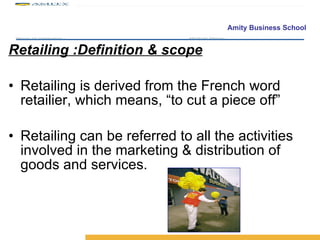
Retailing :Definition & scope Retailing is derived from the French word retailier, which means, “to cut a piece off” Retailing can be referred to all the activities involved in the marketing & distribution of goods and services.
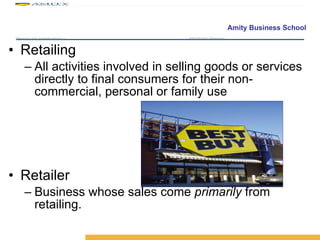
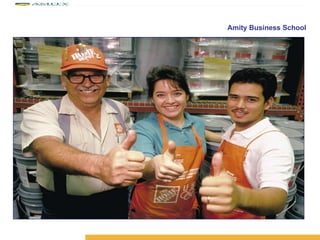
Retailing All activities involved in selling goods or services directly to final consumers for their non- commercial, personal or family use  Retailer Business whose sales come  primarily  from retailing.
 
Can be brick and mortar, 100% virtual, or click and mortar In addition to selling, retailing includes different diverse activities like, -- buying -- advertising -- data processing -- maintaining inventory
Retailing involves: Understanding the needs of consumers Developing good assortment of merchandise Displaying the merchandise Creates economic utility (time, place, possession and form)
BENEFITS OF RETAILING:--- ---  Benefits to Customers : -- Breaking Bulk -- Providing assortment -- Holding inventory -- Providing after sales services -- Providing information
Benefits to Manufacturers & wholesalers:  --- Revenue generators --some of the risks of the manufacturer by paying for the goods before they are actually sold to the final customer ( types of obsolescence risks– physical obsol. ,technological obs., Fashion obs. etc.)  -- Sensory organs of manufacturer -- Benefits the economy of the country
Retailers deal with two broad categories of suppliers: Those who are selling goods or services for use by the retailers. For eg: Store fixtures, data-processing equipment, management consulting and insurance Those selling goods or services that have to be resold by the retailers. For eg: assortments of goods and services
EVOLUTION OF RETAILING: Traditionally retailing in India can be traced to -  Initial period--- weekly Haats (still prevalent in villages, towns & cities)   The emergence of the neighborhood ‘Kirana’ stores catering to the convenience of the consumers Era of government support for rural retail: Indigenous franchise model of store chains run by Khadi & Village Industries Commission 1980s experienced slow change as India began to open up economy. Textiles sector with companies like Bombay Dyeing, Raymond's, S Kumar's and Grasim  first saw the emergence of retail chains
Later Titan successfully created an organized retailing concept and established a series of showrooms for its premium watches The latter half of the 1990s saw a fresh wave of entrants with a shift  from Manufacturers to Pure Retailers for e.g. Food World, Subhiksha and Nilgiris in food and FMCG; Planet M and Music World in music; Crossword and Fountainhead in books.
Post 1995 onwards saw an emergence of shopping centers,  mainly in urban areas, with facilities like car parking  targeted to provide a complete destination experience for all segments of  society Emergence of hyper and super markets trying to provide customer with 3 V’s - Value, Variety and Volume
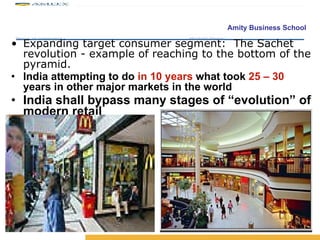
Expanding target consumer segment:  The Sachet revolution - example of reaching to the bottom of the pyramid. India attempting to do  in 10 years  what took  25 – 30  years in other major markets in the world   India shall bypass many stages of “evolution” of modern retail
 
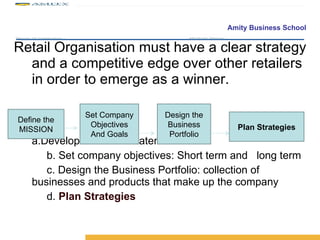
Retail Organisation must have a clear strategy and a competitive edge over other retailers in order to emerge as a winner. a.Develop a mission statement b. Set company objectives: Short term and  long term c. Design the Business Portfolio: collection of businesses and products that make up the company d.  Plan Strategies Define the MISSION Set Company Objectives And Goals Design the Business Portfolio Plan Strategies
In retailing, there are  3 generic strategies  to acquire competitive advantage: Operational Excellence: -- well defined operating process -- satisfying customers in a progressive and cost effective manner For eg: McDonalds in Mumbai claims to deliver the order in 1 hour
Product Differentiation: -- when there is product innovation or merchandise has unique characteristics exclusive to the retail organisation For eg:  the ready-to-wear garment retailer Westside has merchandised its store with its private label brands, unique to its stores - Sheetal Design studio sells designer merchandise
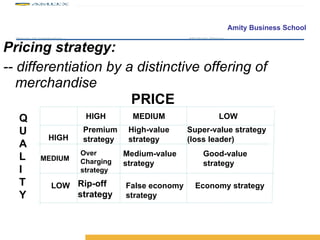
Pricing strategy: -- differentiation by a distinctive offering of merchandise PRICE Q U A L I T Y HIGH HIGH  MEDIUM  LOW MEDIUM LOW Premium strategy Over Charging strategy Rip-off strategy High-value strategy Super-value strategy (loss leader) Medium-value strategy Good-value strategy False economy strategy Economy strategy
Leader pricing strategy (loss leader pricing): selling merchandise or some of the merchandise at lost or near cost for promotional purposes to attract customers or establish a ‘low price’ reputation. Customer Intimacy: --  A progressive customer service strategy (CRM programmes or customer loyalty prog.) -- differentiatiation in service extended should exceed the expected levels of customer service
Development of a strategy defines for the store its business relative to its competitors There are five major dimensions of a retail strategy: Location Merchandise Price Service Communications
These dimensions are supported by: Store operations Logistics Purchasing Marketing research Finance Technology Each retailer should determine which dimensions will best serve to its advantage by examining its position relative to its competition
Quality logistics operations Market research Finance purchasing Technology Merchandise mix Location Communication mix Pricing Strategy Service mix
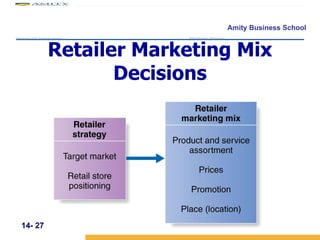
14-  Retailer Marketing Mix Decisions
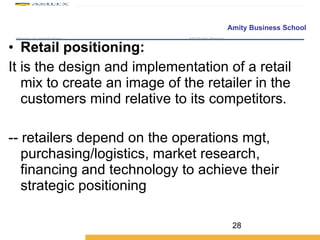
Retail positioning: It is the design and implementation of a retail mix to create an image of the retailer in the customers mind relative to its competitors. -- retailers depend on the operations mgt, purchasing/logistics, market research, financing and technology to achieve their strategic positioning
14-  The product assortment, the services mix, and the store atmosphere are  used by retailers to differentiate their business from the competition. Select two retailers from your local area and discuss how each store differs with respect to the three variables above. Discussion Question
Retail marketing mix can be viewed in terms of 4 major aspects of a retail enterprise 4 major aspects are: Merchandise characteristics Customer service characteristics Trading format Customer communications
For eg:  A plush and luxurious ambience----impression of an upscale, high-end retail outlet  Developing and implementing merchandise strategies: -- primary purpose--- to procure, store and offer for sale, products or services (demanded by target customers)
Merchandising:  “ A set of activities involved in acquiring particular goods and/or services and making them available at the places, times and prices and in the quantity that enable a retailer to reach its goals” Main considerations for a merchandising strategy are: -- the assortment characteristics -- the quality of merchandise
-- width and depth of assortment  Factors which determine the level of depth and width of a retailer’s merchandise strategy: -- company’s strategic objectives (profitability) -- space availability -- the preferences of target customers
-- relationships with manufacturers -- availability of trained  sales people Category management: The merchandising function:  The purchase, storage, display and sales of the goods in a retail set-up -- what to buy -- when to buy -- in what quantities
Financial aspects of merchandising
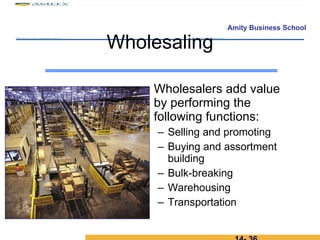
Wholesalers add value by performing the following functions: Selling and promoting Buying and assortment building Bulk-breaking Warehousing Transportation Wholesaling 14-
Wholesalers add  value by performing  the following  functions: Financing Risk bearing Marketing information Management services  and advice Wholesaling 14-
Wholesaling Full-service wholesalers Wholesale merchants Industrial distributors Limited service wholesalers Cash-and-carry wholesalers Truck wholesalers (jobbers) Drop shippers Rack jobbers Producer’s cooperatives Mail-order wholesalers 14-  Merchant Wholesalers Brokers and Agents  Manufacturers’ and retailers’ branches and offices Types of Wholesalers
Wholesaling Brokers Bring buyers and sellers together and assist in negotiation Agents Manufacturers’ agents Selling agents Purchasing agents Commission merchants 14-  Merchant Wholesalers Brokers and Agents  Manufacturers’ and retailers’ branches and offices Types of Wholesalers
Wholesaling Sales branches and offices Branches carry inventory: lumber, auto equipment, parts Offices do not carry inventory: dry goods Purchasing officers Perform roles similar to brokers and agents, however these individuals are employees of the organization 14-  Merchant Wholesalers Brokers and Agents  Manufacturers’ and retailers’ branches and offices Types of Wholesalers
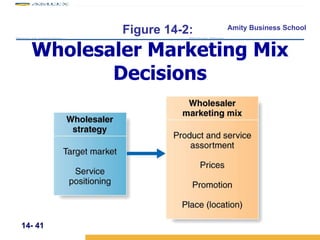
14-  Figure 14-2:   Wholesaler Marketing Mix Decisions
Wholesaler Marketing Decisions Targeting may be made on the basis of: Size of customer Type of retailer Need for service Positioning Wholesaling 14-
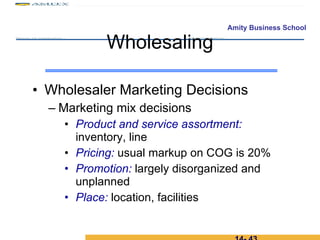
Wholesaler Marketing Decisions Marketing mix decisions Product and service assortment:    inventory, line Pricing:  usual markup on COG is 20% Promotion:  largely disorganized and   unplanned Place:  location, facilities Wholesaling 14-
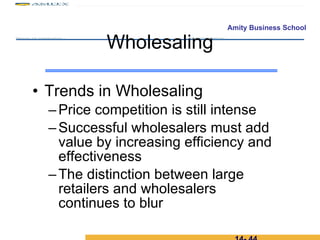
Trends in Wholesaling Price competition is still intense Successful wholesalers must add value by increasing efficiency and effectiveness The distinction between large retailers and wholesalers continues to blur Wholesaling 14-
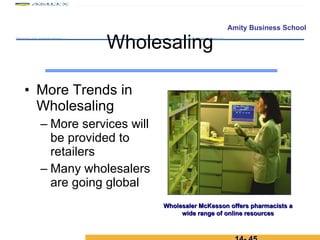
More Trends in Wholesaling More services will be provided to retailers Many wholesalers are going global Wholesaling 14-  Wholesaler McKesson offers pharmacists a wide range of online resources
Franchising The Basics
Franchising A form of licensing by which the owner (franchiser) of a product, service, or business method obtains distribution through affiliated dealers (franchisees) Franchisee pays initial fee  plus  a percentage of gross revenues for continued support of brands, trademarks, format. Average rate = 7% of sales
Franchising accounts for 1/3 of total retail sales in North America For eg: Fast Food:  McDonald’s, Dominos etc. Education:  Aptech, NIIT, CMC etc. Courier:  Overnite Express, DHL, Fedex etc. Hotels:  Holiday Inn, Radisson etc. Beauty Parlours:  Shehnaz
Franchise Systems Product/ Trade name Franchising: Dealer acquires some of the identity of supplier (franchiser) as a franchisee concentrating on one company’s product line and identifying their business with that company.  For eg: Bottling companies, beer distributorships, petroleum and automotive distributorships.
2. Business Format Franchising:  The right to license a business or trade style as opposed to selling a particular product. Utilizes franchiser’s business concept which could include a marketing plan, operating standards and manuals.  For eg: Howard Johnson, McDonald’s, Kentucky Fried Rodent, car rentals, market research, security services (Group 4 securities) etc.
Multi-Level Franchising Master Franchising:  fund individual franchisees. Sub-Franchising:  parent has no involvement with individual franchisees. Area Development Franchising:  allows area developers to seek independent franchisees or set up individual franchise units of their own.
Advantages to Franchisees The business has an accepted product, name, or service that can lead to rapid attainment of sales potential. Managerial assistance and training for starting and operating the business often are available from the franchiser. Starting a franchise operation may require less capital than starting a new business.
The franchisee gains access to the franchiser’s accumulated knowledge and experience with the market. The franchisee operation has an established structure of controls that the franchisee can use to manage the operation. Franchisee gets cost savings of bulk pricing and buying advantage.
Advantages to the Franchiser The franchiser can expand the operation quickly, with less capital, lower risk, and minimal commitment to developing a central organization. Access to large size organization allows the franchisee to quickly attain scale economies in marketing, production, management, and distribution.
The franchisee structure can align incentives of franchise operators and substitute for more intensive monitoring and control. Franchiser gets fees from franchisee up front. Franchiser gets an ongoing royalty.
Disadvantages of Franchising The residual claimant status of franchise operators can give rise to disputes between the parties. Franchisees often have political and legal clout at the state level, and this may impair the franchiser’s ability to manage the operation. In a franchise organization, the upside potential is shared with the franchisees. Franchisees are often subject to the imposition of controls.
Franchisees’ contracts are often biased towards the franchiser. Royalties come out of of gross revenues, NOT net profits.
Standard Franchising Arrangements Franchiser agrees to provide some form of managerial assistance to franchisee; start-up assistance, training, ongoing support. Franchisee agrees to run business in manner stipulated by franchiser. Specification of the amount of fee and royalties franchisee will pay. Termination clause. Supplies, advertising related issues.
Contracting “Terms” “ Inefficient risk bearing”: franchisee has substantial proportion of net worth tied up in one outlet. “ Free rider problems”: Failure to take responsibility and best efforts; can be accused of both parties.Example: A franchisee uses low quality materials, while reputation is shared with fellow franchisees. Franchisers may not protect trademark.
Electronic Channels: -- A number of technological advances have taken place due to immense use of EDI(electronic data exchange) These advances have led to: increased use of self service operations (services on Net) providing data bank services
electronic banking (ATMs and cards) E-mail and many more Distribution of services through electronic channel is without direct human interaction (service distribution system eg. Mobile banking)
-- requires a pre-designed service -- a system to deliver it (alternative channels like, ATMs, call centres, internet kiosks) Advantages: -- convenience (for eg. E-banking services, 24 hrs/7 days/ 365 days )
-- Low cost -- Wide distribution -- Customer choice -- Quality Control Some examples of electronic channels include: Plastic money Selling / buying through on-line services Video conferences Electronic marketing/ e-banking
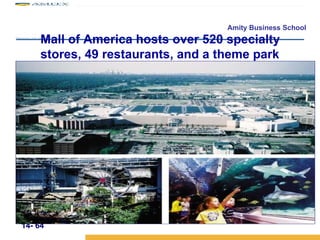
14-  Mall of America hosts over 520 specialty stores, 49 restaurants, and a theme park

Channel Institutions (Module 3)

  • 1.
    Amity Business SchoolMBA (M&S), Class of 2010, Semester II DISTRIBUTION AND LOGISTICS MANAGEMENT SANJEEV TANDON
  • 2.
    Aim To developthe understanding of various components of the integrated supply chain from the perspective of distribution management In the emerging globalised and technology-oriented business environment, it is essential to learn and optimise the total distribution system by integration of distribution channel management and logistics mgmt.
  • 3.
    Objectives At theend of this course the students will understand: Learn the strategic position of distribution in marketing mix strategies To develop the various models of logistics and supply chain to suit domestic as well as global markets
  • 4.
    Module:iii, Channel institutionsMarketing Intermediaries: -- The people and Organisations that assist in the flow of goods and services from producer to customer The following are the common types of intermediaries: Middlemen Agents or Broker
  • 5.
    Wholesaler Retailer Distributor,dealer, Value-added resellers (VARs), Merchants and Facilitating (C&F Agents) Agents RETAILING: - Final connection in the marketing channel that brings goods from manufacturers to consumers
  • 6.
    Retailing :Definition &scope Retailing is derived from the French word retailier, which means, “to cut a piece off” Retailing can be referred to all the activities involved in the marketing & distribution of goods and services.
  • 7.
    Retailing All activitiesinvolved in selling goods or services directly to final consumers for their non- commercial, personal or family use Retailer Business whose sales come primarily from retailing.
  • 8.
  • 9.
    Can be brickand mortar, 100% virtual, or click and mortar In addition to selling, retailing includes different diverse activities like, -- buying -- advertising -- data processing -- maintaining inventory
  • 10.
    Retailing involves: Understandingthe needs of consumers Developing good assortment of merchandise Displaying the merchandise Creates economic utility (time, place, possession and form)
  • 11.
    BENEFITS OF RETAILING:------ Benefits to Customers : -- Breaking Bulk -- Providing assortment -- Holding inventory -- Providing after sales services -- Providing information
  • 12.
    Benefits to Manufacturers& wholesalers: --- Revenue generators --some of the risks of the manufacturer by paying for the goods before they are actually sold to the final customer ( types of obsolescence risks– physical obsol. ,technological obs., Fashion obs. etc.) -- Sensory organs of manufacturer -- Benefits the economy of the country
  • 13.
    Retailers deal withtwo broad categories of suppliers: Those who are selling goods or services for use by the retailers. For eg: Store fixtures, data-processing equipment, management consulting and insurance Those selling goods or services that have to be resold by the retailers. For eg: assortments of goods and services
  • 14.
    EVOLUTION OF RETAILING:Traditionally retailing in India can be traced to - Initial period--- weekly Haats (still prevalent in villages, towns & cities) The emergence of the neighborhood ‘Kirana’ stores catering to the convenience of the consumers Era of government support for rural retail: Indigenous franchise model of store chains run by Khadi & Village Industries Commission 1980s experienced slow change as India began to open up economy. Textiles sector with companies like Bombay Dyeing, Raymond's, S Kumar's and Grasim first saw the emergence of retail chains
  • 15.
    Later Titan successfullycreated an organized retailing concept and established a series of showrooms for its premium watches The latter half of the 1990s saw a fresh wave of entrants with a shift from Manufacturers to Pure Retailers for e.g. Food World, Subhiksha and Nilgiris in food and FMCG; Planet M and Music World in music; Crossword and Fountainhead in books.
  • 16.
    Post 1995 onwardssaw an emergence of shopping centers, mainly in urban areas, with facilities like car parking targeted to provide a complete destination experience for all segments of society Emergence of hyper and super markets trying to provide customer with 3 V’s - Value, Variety and Volume
  • 17.
    Expanding target consumersegment: The Sachet revolution - example of reaching to the bottom of the pyramid. India attempting to do in 10 years what took 25 – 30 years in other major markets in the world India shall bypass many stages of “evolution” of modern retail
  • 18.
  • 19.
    Retail Organisation musthave a clear strategy and a competitive edge over other retailers in order to emerge as a winner. a.Develop a mission statement b. Set company objectives: Short term and long term c. Design the Business Portfolio: collection of businesses and products that make up the company d. Plan Strategies Define the MISSION Set Company Objectives And Goals Design the Business Portfolio Plan Strategies
  • 20.
    In retailing, thereare 3 generic strategies to acquire competitive advantage: Operational Excellence: -- well defined operating process -- satisfying customers in a progressive and cost effective manner For eg: McDonalds in Mumbai claims to deliver the order in 1 hour
  • 21.
    Product Differentiation: --when there is product innovation or merchandise has unique characteristics exclusive to the retail organisation For eg: the ready-to-wear garment retailer Westside has merchandised its store with its private label brands, unique to its stores - Sheetal Design studio sells designer merchandise
  • 22.
    Pricing strategy: --differentiation by a distinctive offering of merchandise PRICE Q U A L I T Y HIGH HIGH MEDIUM LOW MEDIUM LOW Premium strategy Over Charging strategy Rip-off strategy High-value strategy Super-value strategy (loss leader) Medium-value strategy Good-value strategy False economy strategy Economy strategy
  • 23.
    Leader pricing strategy(loss leader pricing): selling merchandise or some of the merchandise at lost or near cost for promotional purposes to attract customers or establish a ‘low price’ reputation. Customer Intimacy: -- A progressive customer service strategy (CRM programmes or customer loyalty prog.) -- differentiatiation in service extended should exceed the expected levels of customer service
  • 24.
    Development of astrategy defines for the store its business relative to its competitors There are five major dimensions of a retail strategy: Location Merchandise Price Service Communications
  • 25.
    These dimensions aresupported by: Store operations Logistics Purchasing Marketing research Finance Technology Each retailer should determine which dimensions will best serve to its advantage by examining its position relative to its competition
  • 26.
    Quality logistics operationsMarket research Finance purchasing Technology Merchandise mix Location Communication mix Pricing Strategy Service mix
  • 27.
    14- RetailerMarketing Mix Decisions
  • 28.
    Retail positioning: Itis the design and implementation of a retail mix to create an image of the retailer in the customers mind relative to its competitors. -- retailers depend on the operations mgt, purchasing/logistics, market research, financing and technology to achieve their strategic positioning
  • 29.
    14- Theproduct assortment, the services mix, and the store atmosphere are used by retailers to differentiate their business from the competition. Select two retailers from your local area and discuss how each store differs with respect to the three variables above. Discussion Question
  • 30.
    Retail marketing mixcan be viewed in terms of 4 major aspects of a retail enterprise 4 major aspects are: Merchandise characteristics Customer service characteristics Trading format Customer communications
  • 31.
    For eg: A plush and luxurious ambience----impression of an upscale, high-end retail outlet Developing and implementing merchandise strategies: -- primary purpose--- to procure, store and offer for sale, products or services (demanded by target customers)
  • 32.
    Merchandising: “A set of activities involved in acquiring particular goods and/or services and making them available at the places, times and prices and in the quantity that enable a retailer to reach its goals” Main considerations for a merchandising strategy are: -- the assortment characteristics -- the quality of merchandise
  • 33.
    -- width anddepth of assortment Factors which determine the level of depth and width of a retailer’s merchandise strategy: -- company’s strategic objectives (profitability) -- space availability -- the preferences of target customers
  • 34.
    -- relationships withmanufacturers -- availability of trained sales people Category management: The merchandising function: The purchase, storage, display and sales of the goods in a retail set-up -- what to buy -- when to buy -- in what quantities
  • 35.
    Financial aspects ofmerchandising
  • 36.
    Wholesalers add valueby performing the following functions: Selling and promoting Buying and assortment building Bulk-breaking Warehousing Transportation Wholesaling 14-
  • 37.
    Wholesalers add value by performing the following functions: Financing Risk bearing Marketing information Management services and advice Wholesaling 14-
  • 38.
    Wholesaling Full-service wholesalersWholesale merchants Industrial distributors Limited service wholesalers Cash-and-carry wholesalers Truck wholesalers (jobbers) Drop shippers Rack jobbers Producer’s cooperatives Mail-order wholesalers 14- Merchant Wholesalers Brokers and Agents Manufacturers’ and retailers’ branches and offices Types of Wholesalers
  • 39.
    Wholesaling Brokers Bringbuyers and sellers together and assist in negotiation Agents Manufacturers’ agents Selling agents Purchasing agents Commission merchants 14- Merchant Wholesalers Brokers and Agents Manufacturers’ and retailers’ branches and offices Types of Wholesalers
  • 40.
    Wholesaling Sales branchesand offices Branches carry inventory: lumber, auto equipment, parts Offices do not carry inventory: dry goods Purchasing officers Perform roles similar to brokers and agents, however these individuals are employees of the organization 14- Merchant Wholesalers Brokers and Agents Manufacturers’ and retailers’ branches and offices Types of Wholesalers
  • 41.
    14- Figure14-2: Wholesaler Marketing Mix Decisions
  • 42.
    Wholesaler Marketing DecisionsTargeting may be made on the basis of: Size of customer Type of retailer Need for service Positioning Wholesaling 14-
  • 43.
    Wholesaler Marketing DecisionsMarketing mix decisions Product and service assortment: inventory, line Pricing: usual markup on COG is 20% Promotion: largely disorganized and unplanned Place: location, facilities Wholesaling 14-
  • 44.
    Trends in WholesalingPrice competition is still intense Successful wholesalers must add value by increasing efficiency and effectiveness The distinction between large retailers and wholesalers continues to blur Wholesaling 14-
  • 45.
    More Trends inWholesaling More services will be provided to retailers Many wholesalers are going global Wholesaling 14- Wholesaler McKesson offers pharmacists a wide range of online resources
  • 46.
  • 47.
    Franchising A formof licensing by which the owner (franchiser) of a product, service, or business method obtains distribution through affiliated dealers (franchisees) Franchisee pays initial fee plus a percentage of gross revenues for continued support of brands, trademarks, format. Average rate = 7% of sales
  • 48.
    Franchising accounts for1/3 of total retail sales in North America For eg: Fast Food: McDonald’s, Dominos etc. Education: Aptech, NIIT, CMC etc. Courier: Overnite Express, DHL, Fedex etc. Hotels: Holiday Inn, Radisson etc. Beauty Parlours: Shehnaz
  • 49.
    Franchise Systems Product/Trade name Franchising: Dealer acquires some of the identity of supplier (franchiser) as a franchisee concentrating on one company’s product line and identifying their business with that company. For eg: Bottling companies, beer distributorships, petroleum and automotive distributorships.
  • 50.
    2. Business FormatFranchising: The right to license a business or trade style as opposed to selling a particular product. Utilizes franchiser’s business concept which could include a marketing plan, operating standards and manuals. For eg: Howard Johnson, McDonald’s, Kentucky Fried Rodent, car rentals, market research, security services (Group 4 securities) etc.
  • 51.
    Multi-Level Franchising MasterFranchising: fund individual franchisees. Sub-Franchising: parent has no involvement with individual franchisees. Area Development Franchising: allows area developers to seek independent franchisees or set up individual franchise units of their own.
  • 52.
    Advantages to FranchiseesThe business has an accepted product, name, or service that can lead to rapid attainment of sales potential. Managerial assistance and training for starting and operating the business often are available from the franchiser. Starting a franchise operation may require less capital than starting a new business.
  • 53.
    The franchisee gainsaccess to the franchiser’s accumulated knowledge and experience with the market. The franchisee operation has an established structure of controls that the franchisee can use to manage the operation. Franchisee gets cost savings of bulk pricing and buying advantage.
  • 54.
    Advantages to theFranchiser The franchiser can expand the operation quickly, with less capital, lower risk, and minimal commitment to developing a central organization. Access to large size organization allows the franchisee to quickly attain scale economies in marketing, production, management, and distribution.
  • 55.
    The franchisee structurecan align incentives of franchise operators and substitute for more intensive monitoring and control. Franchiser gets fees from franchisee up front. Franchiser gets an ongoing royalty.
  • 56.
    Disadvantages of FranchisingThe residual claimant status of franchise operators can give rise to disputes between the parties. Franchisees often have political and legal clout at the state level, and this may impair the franchiser’s ability to manage the operation. In a franchise organization, the upside potential is shared with the franchisees. Franchisees are often subject to the imposition of controls.
  • 57.
    Franchisees’ contracts areoften biased towards the franchiser. Royalties come out of of gross revenues, NOT net profits.
  • 58.
    Standard Franchising ArrangementsFranchiser agrees to provide some form of managerial assistance to franchisee; start-up assistance, training, ongoing support. Franchisee agrees to run business in manner stipulated by franchiser. Specification of the amount of fee and royalties franchisee will pay. Termination clause. Supplies, advertising related issues.
  • 59.
    Contracting “Terms” “Inefficient risk bearing”: franchisee has substantial proportion of net worth tied up in one outlet. “ Free rider problems”: Failure to take responsibility and best efforts; can be accused of both parties.Example: A franchisee uses low quality materials, while reputation is shared with fellow franchisees. Franchisers may not protect trademark.
  • 60.
    Electronic Channels: --A number of technological advances have taken place due to immense use of EDI(electronic data exchange) These advances have led to: increased use of self service operations (services on Net) providing data bank services
  • 61.
    electronic banking (ATMsand cards) E-mail and many more Distribution of services through electronic channel is without direct human interaction (service distribution system eg. Mobile banking)
  • 62.
    -- requires apre-designed service -- a system to deliver it (alternative channels like, ATMs, call centres, internet kiosks) Advantages: -- convenience (for eg. E-banking services, 24 hrs/7 days/ 365 days )
  • 63.
    -- Low cost-- Wide distribution -- Customer choice -- Quality Control Some examples of electronic channels include: Plastic money Selling / buying through on-line services Video conferences Electronic marketing/ e-banking
  • 64.
    14- Mallof America hosts over 520 specialty stores, 49 restaurants, and a theme park

Editor's Notes

  • #2 Amity Business School