FUNDAMENTALS OF
ORGANIZING, ITS
NATURE, IMPORTANCE AND
PROCESS
PRESENTED BY,
NEELAM BARA
AMAN KUMAR SINHA
ARJEEUN TIGGA
AMBARISH NAFDE
VINAY PRATEEK
WHAT IS ORGANIZING?
"Organization is the process of
identifying and grouping of the
works to be performed, defining
and delegating responsibility
and authority and establishing
relationships for the purpose of
enabling people to work most
efficiently".
- Louis A. Allen
FUNDAMENTAL CONCEPT OF
ORGANIZING:
 DIFFERENTIATION: It means that an organization is
composed of units that work on specialized tasks using
different work methods and requiring employees with
unique competencies.
 INTEGRATION: It means that the various units must
be put back together so that work is coordinated.
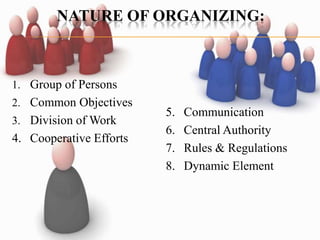
NATURE OF ORGANIZING:
5. Communication
6. Central Authority
7. Rules & Regulations
8. Dynamic Element
1. Group of Persons
2. Common Objectives
3. Division of Work
4. Cooperative Efforts
NATURE OF ORGANIZATION:
 Group of Persons: An organization is a group of people
working together for the achievement of common
objectives. The group may be large or small. An
organization is a system of cooperative relationships of
two or more persons.
 Common Objectives: Every organization has a common
objectives distinct from personal objectives of the
members. The common goal is the basis of cooperation
among the members. The objectives of the organization are
usually are made explicit
CONTD:
 Division of Work: An organization comes into existence
when the total task is divided into the members of the
group. Division of work is necessary not only because one
individual cannot do all the work but specialization results
in efficiency and effectiveness.
 Cooperative Efforts: The members of an organization are
willing to help each other for the achievement of desired
goals. Cooperative relationships are stabilized both
vertically and horizontally among different units of the
organization:
CONTD:
 Communication: People who form an organization
communicates with each other in order to integrate or
coordinate there efforts. The structure must be such that
people can perform together efficiently.
 Central Authority: In an organization, there is a central
directing authority which controls the concerted efforts
of the group. The chain of authority- responsibility
relationships is known as the chain of command.
 Rules and Regulations: For the orderly and systematic
working of the members, rules and regulations are laid
down and enforced by the central authority.
 The Dynamic Element: An organization is not a mere
mechanical structure but a living organism arising out of
the sentiments, attitudes, and behavior of people. The
people are the material of construction that holds the
structure together and gives it vitality.
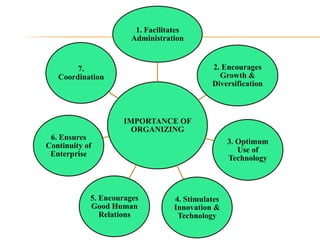
IMPORTANCE OF
ORGANIZING
1. Facilitates
Administration
2. Encourages
Growth &
Diversification
3. Optimum
Use of
Technology
4. Stimulates
Innovation &
Technology
5. Encourages
Good Human
Relations
6. Ensures
Continuity of
Enterprise
7.
Coordination
IMPORTANCE OF ORGANIZING:
 Facilitates Administration: Achievement of the objectives
of an enterprise by providing a framework of coordination
and control. It provides a system of authority and network
for effective communication. Individual goals can be
coordinated towards group goals. A properly balanced
organization facilitated both management and operation of
the enterprise.
 Encourages Growth & Diversification: It has enabled
organizations to grow and expand to giant sizes. Systematic
division of work and consistent delegation of authority
facilitate taking up of new activities and meeting new
demands. It provides flexibility for growth without losing
control over various activities.
CONTD…
 Optimum Use of New Technology: It is made through a
sound structure manned with competent employees. In
addition, Optimum use of technology permits optimum
utilisation of human resources. Sound organization ensures
that every individual is placed on the job for which one is
best suited.
 Stimulates Innovation & Creativity: It stimulates
creative thinking and initiative on the part of employees. It
provides for effective management of change and responds
favourably to changes in environment. It provides
recognition for the professional and the specialist in terms
of their achievement.
 Encourages Good Human Relations: The assignment of
right jobs to right person improves job satisfaction and
inter-personal relations. Well-defined jobs and clear lines
of authority and responsibility ensure good human
relations.
 Ensures Continuity of Enterprise: It provides scope for
the training and development of future management. It
provides avenues for development and promotions through
delegation and decentralisation.
 Coordination: It facilitates order and cohesiveness in the
enterprise. Division of labor, better utility of technology
and human talent helps to improve the efficiency and
quality of work. Clear channels of communication among
the members of the organization leads to coordination.
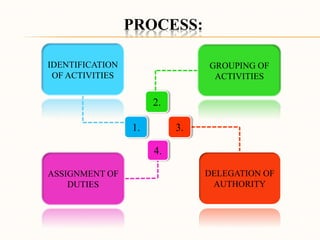
PROCESS:
1.
2.
3.
4.
IDENTIFICATION
OF ACTIVITIES
GROUPING OF
ACTIVITIES
ASSIGNMENT OF
DUTIES
DELEGATION OF
AUTHORITY
PROCESS OF ORGANIZING:
1. Identification of Activities: First step is to determine the
tasks that must be performed to achieve the established
objectives. Activities and jobs are building blocks of any
organization. The activities to be performed depends
upon the objectives, nature and size of the enterprise.
2. Grouping of Activities: The various activities are the
grouped into departments or divisions according to
similarity and common purpose. Such grouping is
necessary for the purpose of specialization, coordination
and control. It may be grouped on various basis i.e.
functions products, territories, customers etc depending
on requirements.
3. Assignment of Duties: Groups of activities or
departments are then allotted to different positions. Every
position is occupied by an individual best suited for it.
The assignments of activities creates responsibility and
ensures certainty of work performance. The process
should be carried down to the lowest levels. It is basically
done to avoid duplication of work and over-lapping
efforts.
4. Delegation of Authority: Every individual is given the
authority required to carry out the responsibility assigned
to him. A chain of command is created through successive
delegation of authority. Different positions are linked
vertically and horizontally by establishing formal
authority. Every individual must know to whom he is
accountable and who are his subordinates.
Ppt on organising

Ppt on organising

  • 1.
    FUNDAMENTALS OF ORGANIZING, ITS NATURE,IMPORTANCE AND PROCESS PRESENTED BY, NEELAM BARA AMAN KUMAR SINHA ARJEEUN TIGGA AMBARISH NAFDE VINAY PRATEEK
  • 2.
    WHAT IS ORGANIZING? "Organizationis the process of identifying and grouping of the works to be performed, defining and delegating responsibility and authority and establishing relationships for the purpose of enabling people to work most efficiently". - Louis A. Allen
  • 3.
    FUNDAMENTAL CONCEPT OF ORGANIZING: DIFFERENTIATION: It means that an organization is composed of units that work on specialized tasks using different work methods and requiring employees with unique competencies.  INTEGRATION: It means that the various units must be put back together so that work is coordinated.
  • 4.
    NATURE OF ORGANIZING: 5.Communication 6. Central Authority 7. Rules & Regulations 8. Dynamic Element 1. Group of Persons 2. Common Objectives 3. Division of Work 4. Cooperative Efforts
  • 5.
    NATURE OF ORGANIZATION: Group of Persons: An organization is a group of people working together for the achievement of common objectives. The group may be large or small. An organization is a system of cooperative relationships of two or more persons.  Common Objectives: Every organization has a common objectives distinct from personal objectives of the members. The common goal is the basis of cooperation among the members. The objectives of the organization are usually are made explicit
  • 6.
    CONTD:  Division ofWork: An organization comes into existence when the total task is divided into the members of the group. Division of work is necessary not only because one individual cannot do all the work but specialization results in efficiency and effectiveness.  Cooperative Efforts: The members of an organization are willing to help each other for the achievement of desired goals. Cooperative relationships are stabilized both vertically and horizontally among different units of the organization:
  • 7.
    CONTD:  Communication: Peoplewho form an organization communicates with each other in order to integrate or coordinate there efforts. The structure must be such that people can perform together efficiently.  Central Authority: In an organization, there is a central directing authority which controls the concerted efforts of the group. The chain of authority- responsibility relationships is known as the chain of command.
  • 8.
     Rules andRegulations: For the orderly and systematic working of the members, rules and regulations are laid down and enforced by the central authority.  The Dynamic Element: An organization is not a mere mechanical structure but a living organism arising out of the sentiments, attitudes, and behavior of people. The people are the material of construction that holds the structure together and gives it vitality.
  • 9.
    IMPORTANCE OF ORGANIZING 1. Facilitates Administration 2.Encourages Growth & Diversification 3. Optimum Use of Technology 4. Stimulates Innovation & Technology 5. Encourages Good Human Relations 6. Ensures Continuity of Enterprise 7. Coordination
  • 10.
    IMPORTANCE OF ORGANIZING: Facilitates Administration: Achievement of the objectives of an enterprise by providing a framework of coordination and control. It provides a system of authority and network for effective communication. Individual goals can be coordinated towards group goals. A properly balanced organization facilitated both management and operation of the enterprise.  Encourages Growth & Diversification: It has enabled organizations to grow and expand to giant sizes. Systematic division of work and consistent delegation of authority facilitate taking up of new activities and meeting new demands. It provides flexibility for growth without losing control over various activities.
  • 11.
    CONTD…  Optimum Useof New Technology: It is made through a sound structure manned with competent employees. In addition, Optimum use of technology permits optimum utilisation of human resources. Sound organization ensures that every individual is placed on the job for which one is best suited.  Stimulates Innovation & Creativity: It stimulates creative thinking and initiative on the part of employees. It provides for effective management of change and responds favourably to changes in environment. It provides recognition for the professional and the specialist in terms of their achievement.
  • 12.
     Encourages GoodHuman Relations: The assignment of right jobs to right person improves job satisfaction and inter-personal relations. Well-defined jobs and clear lines of authority and responsibility ensure good human relations.  Ensures Continuity of Enterprise: It provides scope for the training and development of future management. It provides avenues for development and promotions through delegation and decentralisation.  Coordination: It facilitates order and cohesiveness in the enterprise. Division of labor, better utility of technology and human talent helps to improve the efficiency and quality of work. Clear channels of communication among the members of the organization leads to coordination.
  • 13.
  • 14.
    PROCESS OF ORGANIZING: 1.Identification of Activities: First step is to determine the tasks that must be performed to achieve the established objectives. Activities and jobs are building blocks of any organization. The activities to be performed depends upon the objectives, nature and size of the enterprise. 2. Grouping of Activities: The various activities are the grouped into departments or divisions according to similarity and common purpose. Such grouping is necessary for the purpose of specialization, coordination and control. It may be grouped on various basis i.e. functions products, territories, customers etc depending on requirements.
  • 15.
    3. Assignment ofDuties: Groups of activities or departments are then allotted to different positions. Every position is occupied by an individual best suited for it. The assignments of activities creates responsibility and ensures certainty of work performance. The process should be carried down to the lowest levels. It is basically done to avoid duplication of work and over-lapping efforts. 4. Delegation of Authority: Every individual is given the authority required to carry out the responsibility assigned to him. A chain of command is created through successive delegation of authority. Different positions are linked vertically and horizontally by establishing formal authority. Every individual must know to whom he is accountable and who are his subordinates.