INTRODUCTION TO
RETAILING
What is Retailing?
Retailing is the business where an organization
directly sells its products and services to an end
consumer and this is for his personal use.
By definition whenever an organization be it a
manufacturing or a whole seller sells directly to the
end consumer it is actually operating in the Retail
space.
Industry Driver
It is an Industry which is heavily dependent on
consumer spending . In this ecosystem consumers play
the most important role.
Retail sales is generally driven by people’s ability
(disposable income) and willingness (consumer
confidence) to buy goods and services.
Current Scenario
   Money spent on household consumption worldwide has almost
    doubled since the 1980s. The leader has unquestionably been the
    USA , two-thirds of whose GDP is consumer spending.
    Retail turnover in the European Union is over Euros 2000 billion and
    the average growth in this sector seems to be following an upward
    trend.
   Retail in the Asian economies have been growing at 6% to 10% and
    despite the current recession the Indian retail sector is projected to
    grow by 7%.
    Retail consumer markets today include high rates of personal
    expenditures, low interest rates, low unemployment and very low
    inflation. Negative factors that impact retail sales involve weakening
    consumer confidence.
Types of Retailers
Specialty Stores
   These stores are characterized by narrow product
    lines but with deep assortments such as Apparel
    Stores , Sporting goods store, Furniture store ,Florist
    and Book store. Under this also there could be
    specializations like limited line store ( eg. Men’s
    clothing store) and Super specialty store (eg. Men’s
    custom shirt store ).
Department Stores
   Several Product Lines –typically clothing ,home
    furnishing and household goods with each line
    operated as a separate department managed by
    specialist buyers and merchandisers
Supermarket/Hypermarket
   Relatively large ,low cost ,low margin high volume
    ,self service operation which is designed to cater
    total needs for food, laundry, household
    maintenance products .
Convenience Stores
   These are the stores which are relatively small in
    size and they are located near residential area ,
    normally remains open seven days a week and
    carrying a limited line of high turnover convenience
    products at slightly high prices. Many have added
    take away sandwiches , coffee and pastries.
Discount Stores
   Standard merchandise sold at lower prices with
    lower margin but higher volumes. Actual discount
    stores regularly sell merchandise at lower prices
    and offer mostly national brands. In Discount
    retailing , Discount specialty retailing is also
    present eg. discount electronic store or discount
    book store
Off Price Retailers
   Merchandise bought at less than regular wholesale
    prices and sold at less than retail prices. Often left
    over goods , irregulars obtained at reduced prices
    from manufacturers and other retailers.
   Factory outlets are owned and operated by
    manufacturers and they normally carry
    manufacturer’s surplus ,discontinued and irregular
    goods
Mom & Pop Stores
   Local neighborhood stores managed by an
    independent, which provides limited range of daily
    use articles.
   Many such outlets are still thriving by knowing their
    customers better and providing them with more
    personalized service.
Current Characteristics of Retail
Industry
   Decline in Mom & Pop Stores
   Internet & E Commerce
   Repositioning of Departmental Stores
   Rise in Discount stores
   Category Killers
   Direct/Non Store Retailing
Operational Issues
Supply Chain Management
   Ideally Supply Chain Management encompasses the
    material flow from supplier’s suppliers to the final
    destination. Retailers need to have a grip on that
    whole chain in order to control the procurement and
    delivery cost. This will help them to choose the right
    supplier for the merchandise.
Pricing
   Pricing is a key positioning factor and must be decided in relation to
    the target market , Assortment mix and competition. Strategic
    pricing has become an important strategic tool to the retailers.
    Airlines
   Retail stores markdown the price for some items to attract people,
    this is called traffic building. They also run storewide reduction sell.
   It is observed that a shoe Retail outlet sells 50% of the product at
    normal mark up , 25% of the product at 40% mark up and
    remaining 25% at cost. Some Retailers have done away with sales
    pricing and they are resorting to everyday low price (EDLP). It leads
    to lower advertising cost , greater pricing stability and higher Retail
    profits. Wal- Mart uses this kind of pricing strategy.
Sales Channels
   Amongst Non store Retail channels Internet and E commerce
    is gradually gaining popularity. Consumers do not need to
    come to store for buying goods or service they can do that
    over a click of a button from their drawing room.
   Marketing through call centre or catalogue marketing is
    also an emerging trend .
   Retailers need to choose sales channels carefully and need
    to use all those channels effectively to acquire more
    customer centricity. Ultimate objective here is to offer a
    consumer a tailor made shopping experience and to provide
    more easy access to his product and service offering.
Retail Strategies
   High Margin and High Turnover eg. a convenience
    food store
   Low Margin and High Turnover eg. a discount store
   Low Margin Low Turnover i.e .a dying business
   High Margin Low Turnover eg. an up market
    specialty store.
Indian Scenario
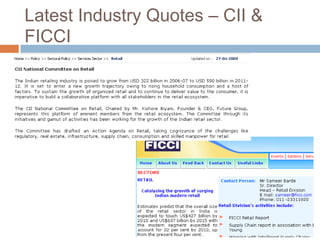
Latest Industry Quotes – CII &
FICCI
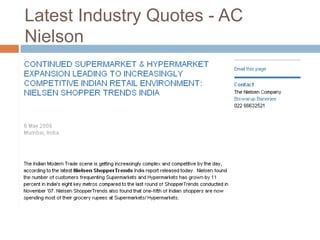
Latest Industry Quotes - AC
Nielson

Lecture 1 - Introduction to Retailing

  • 1.
  • 2.
    What is Retailing? Retailingis the business where an organization directly sells its products and services to an end consumer and this is for his personal use. By definition whenever an organization be it a manufacturing or a whole seller sells directly to the end consumer it is actually operating in the Retail space.
  • 3.
    Industry Driver It isan Industry which is heavily dependent on consumer spending . In this ecosystem consumers play the most important role. Retail sales is generally driven by people’s ability (disposable income) and willingness (consumer confidence) to buy goods and services.
  • 4.
    Current Scenario  Money spent on household consumption worldwide has almost doubled since the 1980s. The leader has unquestionably been the USA , two-thirds of whose GDP is consumer spending.  Retail turnover in the European Union is over Euros 2000 billion and the average growth in this sector seems to be following an upward trend.  Retail in the Asian economies have been growing at 6% to 10% and despite the current recession the Indian retail sector is projected to grow by 7%.  Retail consumer markets today include high rates of personal expenditures, low interest rates, low unemployment and very low inflation. Negative factors that impact retail sales involve weakening consumer confidence.
  • 5.
  • 6.
    Specialty Stores  These stores are characterized by narrow product lines but with deep assortments such as Apparel Stores , Sporting goods store, Furniture store ,Florist and Book store. Under this also there could be specializations like limited line store ( eg. Men’s clothing store) and Super specialty store (eg. Men’s custom shirt store ).
  • 7.
    Department Stores  Several Product Lines –typically clothing ,home furnishing and household goods with each line operated as a separate department managed by specialist buyers and merchandisers
  • 8.
    Supermarket/Hypermarket  Relatively large ,low cost ,low margin high volume ,self service operation which is designed to cater total needs for food, laundry, household maintenance products .
  • 9.
    Convenience Stores  These are the stores which are relatively small in size and they are located near residential area , normally remains open seven days a week and carrying a limited line of high turnover convenience products at slightly high prices. Many have added take away sandwiches , coffee and pastries.
  • 10.
    Discount Stores  Standard merchandise sold at lower prices with lower margin but higher volumes. Actual discount stores regularly sell merchandise at lower prices and offer mostly national brands. In Discount retailing , Discount specialty retailing is also present eg. discount electronic store or discount book store
  • 11.
    Off Price Retailers  Merchandise bought at less than regular wholesale prices and sold at less than retail prices. Often left over goods , irregulars obtained at reduced prices from manufacturers and other retailers.  Factory outlets are owned and operated by manufacturers and they normally carry manufacturer’s surplus ,discontinued and irregular goods
  • 12.
    Mom & PopStores  Local neighborhood stores managed by an independent, which provides limited range of daily use articles.  Many such outlets are still thriving by knowing their customers better and providing them with more personalized service.
  • 13.
    Current Characteristics ofRetail Industry  Decline in Mom & Pop Stores  Internet & E Commerce  Repositioning of Departmental Stores  Rise in Discount stores  Category Killers  Direct/Non Store Retailing
  • 14.
  • 15.
    Supply Chain Management  Ideally Supply Chain Management encompasses the material flow from supplier’s suppliers to the final destination. Retailers need to have a grip on that whole chain in order to control the procurement and delivery cost. This will help them to choose the right supplier for the merchandise.
  • 16.
    Pricing  Pricing is a key positioning factor and must be decided in relation to the target market , Assortment mix and competition. Strategic pricing has become an important strategic tool to the retailers. Airlines  Retail stores markdown the price for some items to attract people, this is called traffic building. They also run storewide reduction sell.  It is observed that a shoe Retail outlet sells 50% of the product at normal mark up , 25% of the product at 40% mark up and remaining 25% at cost. Some Retailers have done away with sales pricing and they are resorting to everyday low price (EDLP). It leads to lower advertising cost , greater pricing stability and higher Retail profits. Wal- Mart uses this kind of pricing strategy.
  • 17.
    Sales Channels  Amongst Non store Retail channels Internet and E commerce is gradually gaining popularity. Consumers do not need to come to store for buying goods or service they can do that over a click of a button from their drawing room.  Marketing through call centre or catalogue marketing is also an emerging trend .  Retailers need to choose sales channels carefully and need to use all those channels effectively to acquire more customer centricity. Ultimate objective here is to offer a consumer a tailor made shopping experience and to provide more easy access to his product and service offering.
  • 18.
    Retail Strategies  High Margin and High Turnover eg. a convenience food store  Low Margin and High Turnover eg. a discount store  Low Margin Low Turnover i.e .a dying business  High Margin Low Turnover eg. an up market specialty store.
  • 19.
  • 20.
    Latest Industry Quotes– CII & FICCI
  • 21.