IMPLEMENTING AND EVALUATING
THE TRAINING PROCESS
By: Jennifer J. Claveria
IMPLEMENTING THE TRAINING PROCESS
 The implementation phase includes selection of contents
and methods to be used and the actual training and / or
development method.
 It also covers the logistical aspects like venue, food, budget,
equipment, resource persons, transportation, and
participants. These should be properly attended to during
the actual conduct of training.
 Training programs are done within the company or outside
depending on the nature of program and the financial
capability of the organization.
 These programs may be classified as technical which
focuses on facilitating learning of competencies of
employees’ knowledge and skills or behavioral which
pertains to ensuring learning of competencies to workforce
attitudes and habits.
IMPLEMENTING THE TRAINING PROCESS
1. Orientation/ Induction of New Employees or Techniques
- Planned and guided program of adjustment in introducing new
employees to the job and refresher training for new methods,
procedures, and work conditions.
2. On-the-job Training
- Employee is placed into the real work situation and shown the
job and the tricks of the trade by an experienced employee or
the supervisor. A systematic approach of this is Job Instruction
Training (JIT) Method developed during World War II where the
trainers first train the supervisors, who in turn train the
employees.
A. Coaching and Counseling- One of the best and frequently
used method of training new managers is for effective managers
to teach them. The coach- supervisor sets a good example of
what a manager does and answers questions and explains why
things are done the way they are.
Types of Training and Instructional Methods:
B. Transitory Anticipatory Experiences- Once it has been
determined that a person will be promoted, provision is made for
a short period of time before the promotion in which he/ she
learns the new job, performing some new duties while still
performing most of the old ones.
C. Job Transfers and Rotation- Trainees are rotated through a
series of jobs to broaden their managerial experience, accelerate
promotion of highly competent individuals, and introduce more
new ideas and increases effectiveness in the organization.
3. Off-the-job Training
A. Lecture- Discussion Approach- Trainer is to give a lecture
and involve the trainees in a discussion of the material to be
learned and usually supplemented with audio- visual aids.
B. Computers- The use of computer- assisted instruction (CAI)
to train employees. These include the Internet, Intranets, Virtual
Reality (VR), Distance Learning/ Training.
Types of Training and Instructional Methods:
4. Apprenticeship Training
- Is practical training on the job supplemented by related
theoretical instruction.
- Article 57- 72 of the Labor Code of the Philippines states the
objectives for apprenticeship training in private industry, its
definition, qualifications, agreement, venue, sponsorship,
violations, aptitude testing, responsibility for theoretical
instruction, deductibility of training costs and compensation.
5. Dual- Tech Training
- Technical Education & Skills Development Authority (TESDA)
was established through the enactment of Republic Act No. 7796
or "Technical Education and Skills Development Act of 1994",
which aims to encourage the full participation of and mobilize the
industry, labor, local government units and technical-vocational
institutions in the skills development of the country's human
resources.
6. Understudy and Special Projects or Assignments
- Used for developing junior & senior officers, gives the employee
a chance to participate in creative thinking and decision- making.
Types of Training and Instructional Methods:
4. Apprenticeship Training
- Is practical training on the job supplemented by related
theoretical instruction.
- Article 57- 72 of the Labor Code of the Philippines states the
objectives for apprenticeship training in private industry, its
definition, qualifications, agreement, venue, sponsorship,
violations, aptitude testing, responsibility for theoretical
instruction, deductibility of training costs and compensation.
5. Dual- Tech Training
- Technical Education & Skills Development Authority (TESDA)
was established through the enactment of Republic Act No. 7796
or "Technical Education and Skills Development Act of 1994",
which aims to encourage the full participation of and mobilize the
industry, labor, local government units and technical-vocational
institutions in the skills development of the country's human
resources.
6. Understudy and Special Projects or Assignments
- Used for developing junior & senior officers, gives the employee
a chance to participate in creative thinking and decision- making.
Types of Training and Instructional Methods:
7. Supervisory Training to equip a supervisor with the needed
skills to better perform his duties and to help improve the
performance of his workers.
8. Travel or Observation Tours sponsored by the company or
through the employee’s own initiative.
9. Conferences, lectures, special seminars, or workshops in
different subject areas, either within or outside the company.
10. Management/ Leadership Development for potential
managers
11. Study Grants sponsored by either the company or some other
organizations.
12. Study Abroad on the employee’s own initiative
13. Training within the industry
14. Learners in the Industry
- These are usually graduating students in college who are
required to gain experience as a requirement for graduation.
Types of Training and Instructional Methods:
15. Case Method
- Uses written description of a real decision-making situation in
the organization or a situation that occurred in another
organization. Managers are asked to study the case to identify
and analyze the problem for their significance, propose solutions,
choose the best solution, and implement it.
16. Role- Playing
- Each person is assigned a role in a situation and asked to play
the role and to react to other player’s role- playing. The player is
asked to pretend to be a focal person in the situation and to react
to the stimuli as that person would.
17. In- Basket Technique
- The participant is given materials (typically memos or
descriptions of things to do) that include typical items from a
specific manager’s mail, e-mail, and a telephone list. The trainee
is analyzed and critiqued on the number of decisions made in the
time allotted, the quality of decisions, and the priorities chosen for
making them.
Types of Training and Instructional Methods:
18. Management Games
- Describe the operating characteristics of a company, industry, or
enterprise. Descriptions take the form of equation that is
manipulated after decisions have been made and emphasize on
development of problem- solving skills.
19. Behavior Modeling (Interaction Management/ Imitating
Models)
- The key to behavior- modeling is learning through observation
or imagination. It begins by identifying interpersonal problems that
employees, especially managers, face.
20. Outdoor- Oriented Programs
- The top priorities here are leadership, teamwork, and risk-
taking. The programs, conducted in remote areas, combine
outdoor skills with classroom seminars.
Types of Training and Instructional Methods:
 The theory behind is that experiences and techniques of past and
present managers form a body of knowledge that can be
systematically evaluated and learned. Since present and future
managers stir and guide their companies to profitability,
large sums of money are invested here to improve their
capabilities.
 Management development is designed to equip a person to better
perform his duties in planning, organizing, directing, controlling,
and coordinating the work of others, and to improve the
performance of his assigned workers.
 Reasons for Management Training:
- Vital link between management and workers
- Most supervisors arose from the ranks with little or no training
for management work.
- Changes within supervisory and executor staff
- Technological changes
Management Training and Development Programs
 Advantages of Management Development:
- Improves the quality of leadership and the ability to meet
problems involved in managing personnel.
- Helps develop effective supervisors
- Promotes and maintains good employee relations
- Helps promote and maintain good labor relations by
spreading greater understanding of company policies and
rules, including the proper interpretation and application of
the collective bargaining agreement.
- Makes supervisors more effective in training their workers,
both new and old, in order to make them efficient in their
present jobs and to enable them to perform new operations
demanded by changing conditions.
Management Training and Development Programs
Management Development Techniques:
1. Goal Setting
- Is a mental (cognitive) process of some practical utility. Locke’s
view is that an individual’s conscious goals and intentions are
the primary determinants of behavior. That is “one of the
commonly observed characteristics of intentional behavior is that
it tends to keep going until it reaches completion.”
- Attributes of goals are specificity, difficulty, and intensity.
2. Behavior Modification
- The basic assumption of operant conditioning is that behavior
is influenced by its consequences. B.F. Skinner’s work of the
term operant conditioning principles applied to individual is
behavior modification (B-mod and behavior mod).
- Behavior modification is individual learning through
reinforcement which designates “the systematic reinforcement of
desirable organizational behavior and the nonreinforcement or
punishment of unwanted organizational behavior.”
Management Training and Development Programs
Principles of Operant Conditioning:
- Positive Reinforcement
- Negative Reinforcements
- Punishment
- Extinction
Basis: Thorndike’s classic law of effect- Of several responses to the
same situation, those that are accompanied or closely followed by
satisfaction(reinforcement) … will be more likely to recur; those
which are accompanied or closely followed by discomfort
(punishment) … will be less likely to occur.
Management Trainee Programs
 Aim to develop and maintain an adequate source of potential
supervisory, administrative, and technical personnel. It includes
conference leadership, training workers, company policies,
morale and motivation, human relations, simplification and
methods improvement, labor laws and labor relations.
Management Training and Development Programs
Management Assessment Centers
 A system evaluating the management potential and development
needs of an employee for promotion to higher position in
management.
 It is also known as a professional development program or a
“leadership development” technique because its main purpose is
to clarify the participant’s developmental needs in preparation for
management responsibilities. Its aim is to enable management to
select employees with management potential to fill up vacancies
in management positions.
Team Building
 Is a development process that helps or prepares organization
members to work more efficiently or effectively in groups. It is
designed to enhance individual team members’ problem-solving
skills, communication, and sensitivity to others.
 The evaluation is concerned with the measurement of the training
success or effectiveness to establish whether an investment in a
particular training has paid off.
 The training effectiveness is usually determined based on the
achievement of the previously set objectives and results,
considering the needs, methods, and other areas of training
administration.
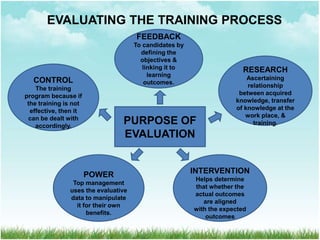
EVALUATING THE TRAINING PROCESS
FEEDBACK
To candidates by
defining the
objectives &
linking it to
learning
outcomes.
PURPOSE OF
EVALUATION
RESEARCH
Ascertaining
relationship
between acquired
knowledge, transfer
of knowledge at the
work place, &
training.
POWER
Top management
uses the evaluative
data to manipulate
it for their own
benefits.
CONTROL
The training
program because if
the training is not
effective, then it
can be dealt with
accordingly.
INTERVENTION
Helps determine
that whether the
actual outcomes
are aligned
with the expected
outcomes
 Evaluating training effectiveness is important because:
- Helps employees to monitor their own improvement.
- Builds morale, by demonstrating an interest in staff
development.
- To maximize the training ROI (return on investment).
- Helps to determine the form of future training programs.
- Assists with identifying the effectiveness of different forms of
teaching.
EVALUATING THE TRAINING PROCESS
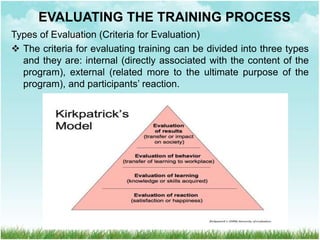
Types of Evaluation (Criteria for Evaluation)
 The criteria for evaluating training can be divided into three types
and they are: internal (directly associated with the content of the
program), external (related more to the ultimate purpose of the
program), and participants’ reaction.
EVALUATING THE TRAINING PROCESS
1. Participants’ Reaction
- Frequently encountered measure of consumer satisfaction.
- Favorable reaction to a program is important for the on-going
success of the program.
- Reacts positively= more likely to have been engaged, more
likely to make positive comments, and are more likely to return for
future programs.
EVALUATING THE TRAINING PROCESS
2. Learning
- All programs are intended to produce a change in
attitudes, knowledge and/or skills, and learning outcomes
are a reflection of change in these areas attributable to
program participation.
- Evaluation focuses on achieving specific learning
objectives, as defined by the program objectives.
EVALUATING THE TRAINING PROCESS
3. Behavior
- Focuses on the extent to which changes achieved during the
training program are extended beyond the program to the
workplace.
- A program can achieve learning outcomes without achieving
behavioral outcomes if there are insufficient rewards or work
climate to maintain or enhance the changes achieved during the
program.
EVALUATING THE TRAINING PROCESS
4. Results
- This represents the real world changes expected as a
consequence of the program, such as:
improved quality,
more efficient procedures, better trained personnel;
fewer audit exceptions, more consistent implementation of
operating standards and procedures.
EVALUATING THE TRAINING PROCESS
 The various Methods of Training Evaluation are:
- Observation
- Questionnaire
- Interview
- Self diaries
- Self recording of specific incidents
EVALUATING THE TRAINING PROCESS
 References:
Byars, Lloyd L. and Leslie W. Rue. Human Resources Management. Third
Edition. USA: Von Hoffman Press, Inc., 1991
Ivancevich, John M. Human Resource Management, 2010
Sison, Perfecto S. Personnel Management in the 21st Century (7th Edition).
Revised by Ranulfo P. Rayos and Orlando S. Zorilla. Quezon City,
Philippines: Rex Printing Company, Inc. 2003
http://www.dole.gov.ph/labor_codes.php?id=35
http://www.tesda.gov.ph/page.aspx?page_id=10
http://omerad.org/rcr/resources/a_closer_look.html
http://andrew-knowles.suite101.com/the-importance-of-training-evaluation-
a146471
http://www.dlsu.edu.ph/research/centers/cberd/pdf/business/vol7/no4.pdf, 2004
http://traininganddevelopment.naukrihub.com/training-evaluation.html, 2007
http://blog.commlabindia.com/elearning/training-evaluation, 2011
EVALUATING THE TRAINING PROCESS

Implementing and evaluating the training process (hrm)

  • 1.
    IMPLEMENTING AND EVALUATING THETRAINING PROCESS By: Jennifer J. Claveria
  • 2.
  • 3.
     The implementationphase includes selection of contents and methods to be used and the actual training and / or development method.  It also covers the logistical aspects like venue, food, budget, equipment, resource persons, transportation, and participants. These should be properly attended to during the actual conduct of training.  Training programs are done within the company or outside depending on the nature of program and the financial capability of the organization.  These programs may be classified as technical which focuses on facilitating learning of competencies of employees’ knowledge and skills or behavioral which pertains to ensuring learning of competencies to workforce attitudes and habits. IMPLEMENTING THE TRAINING PROCESS
  • 4.
    1. Orientation/ Inductionof New Employees or Techniques - Planned and guided program of adjustment in introducing new employees to the job and refresher training for new methods, procedures, and work conditions. 2. On-the-job Training - Employee is placed into the real work situation and shown the job and the tricks of the trade by an experienced employee or the supervisor. A systematic approach of this is Job Instruction Training (JIT) Method developed during World War II where the trainers first train the supervisors, who in turn train the employees. A. Coaching and Counseling- One of the best and frequently used method of training new managers is for effective managers to teach them. The coach- supervisor sets a good example of what a manager does and answers questions and explains why things are done the way they are. Types of Training and Instructional Methods:
  • 5.
    B. Transitory AnticipatoryExperiences- Once it has been determined that a person will be promoted, provision is made for a short period of time before the promotion in which he/ she learns the new job, performing some new duties while still performing most of the old ones. C. Job Transfers and Rotation- Trainees are rotated through a series of jobs to broaden their managerial experience, accelerate promotion of highly competent individuals, and introduce more new ideas and increases effectiveness in the organization. 3. Off-the-job Training A. Lecture- Discussion Approach- Trainer is to give a lecture and involve the trainees in a discussion of the material to be learned and usually supplemented with audio- visual aids. B. Computers- The use of computer- assisted instruction (CAI) to train employees. These include the Internet, Intranets, Virtual Reality (VR), Distance Learning/ Training. Types of Training and Instructional Methods:
  • 6.
    4. Apprenticeship Training -Is practical training on the job supplemented by related theoretical instruction. - Article 57- 72 of the Labor Code of the Philippines states the objectives for apprenticeship training in private industry, its definition, qualifications, agreement, venue, sponsorship, violations, aptitude testing, responsibility for theoretical instruction, deductibility of training costs and compensation. 5. Dual- Tech Training - Technical Education & Skills Development Authority (TESDA) was established through the enactment of Republic Act No. 7796 or "Technical Education and Skills Development Act of 1994", which aims to encourage the full participation of and mobilize the industry, labor, local government units and technical-vocational institutions in the skills development of the country's human resources. 6. Understudy and Special Projects or Assignments - Used for developing junior & senior officers, gives the employee a chance to participate in creative thinking and decision- making. Types of Training and Instructional Methods:
  • 7.
    4. Apprenticeship Training -Is practical training on the job supplemented by related theoretical instruction. - Article 57- 72 of the Labor Code of the Philippines states the objectives for apprenticeship training in private industry, its definition, qualifications, agreement, venue, sponsorship, violations, aptitude testing, responsibility for theoretical instruction, deductibility of training costs and compensation. 5. Dual- Tech Training - Technical Education & Skills Development Authority (TESDA) was established through the enactment of Republic Act No. 7796 or "Technical Education and Skills Development Act of 1994", which aims to encourage the full participation of and mobilize the industry, labor, local government units and technical-vocational institutions in the skills development of the country's human resources. 6. Understudy and Special Projects or Assignments - Used for developing junior & senior officers, gives the employee a chance to participate in creative thinking and decision- making. Types of Training and Instructional Methods:
  • 8.
    7. Supervisory Trainingto equip a supervisor with the needed skills to better perform his duties and to help improve the performance of his workers. 8. Travel or Observation Tours sponsored by the company or through the employee’s own initiative. 9. Conferences, lectures, special seminars, or workshops in different subject areas, either within or outside the company. 10. Management/ Leadership Development for potential managers 11. Study Grants sponsored by either the company or some other organizations. 12. Study Abroad on the employee’s own initiative 13. Training within the industry 14. Learners in the Industry - These are usually graduating students in college who are required to gain experience as a requirement for graduation. Types of Training and Instructional Methods:
  • 9.
    15. Case Method -Uses written description of a real decision-making situation in the organization or a situation that occurred in another organization. Managers are asked to study the case to identify and analyze the problem for their significance, propose solutions, choose the best solution, and implement it. 16. Role- Playing - Each person is assigned a role in a situation and asked to play the role and to react to other player’s role- playing. The player is asked to pretend to be a focal person in the situation and to react to the stimuli as that person would. 17. In- Basket Technique - The participant is given materials (typically memos or descriptions of things to do) that include typical items from a specific manager’s mail, e-mail, and a telephone list. The trainee is analyzed and critiqued on the number of decisions made in the time allotted, the quality of decisions, and the priorities chosen for making them. Types of Training and Instructional Methods:
  • 10.
    18. Management Games -Describe the operating characteristics of a company, industry, or enterprise. Descriptions take the form of equation that is manipulated after decisions have been made and emphasize on development of problem- solving skills. 19. Behavior Modeling (Interaction Management/ Imitating Models) - The key to behavior- modeling is learning through observation or imagination. It begins by identifying interpersonal problems that employees, especially managers, face. 20. Outdoor- Oriented Programs - The top priorities here are leadership, teamwork, and risk- taking. The programs, conducted in remote areas, combine outdoor skills with classroom seminars. Types of Training and Instructional Methods:
  • 11.
     The theorybehind is that experiences and techniques of past and present managers form a body of knowledge that can be systematically evaluated and learned. Since present and future managers stir and guide their companies to profitability, large sums of money are invested here to improve their capabilities.  Management development is designed to equip a person to better perform his duties in planning, organizing, directing, controlling, and coordinating the work of others, and to improve the performance of his assigned workers.  Reasons for Management Training: - Vital link between management and workers - Most supervisors arose from the ranks with little or no training for management work. - Changes within supervisory and executor staff - Technological changes Management Training and Development Programs
  • 12.
     Advantages ofManagement Development: - Improves the quality of leadership and the ability to meet problems involved in managing personnel. - Helps develop effective supervisors - Promotes and maintains good employee relations - Helps promote and maintain good labor relations by spreading greater understanding of company policies and rules, including the proper interpretation and application of the collective bargaining agreement. - Makes supervisors more effective in training their workers, both new and old, in order to make them efficient in their present jobs and to enable them to perform new operations demanded by changing conditions. Management Training and Development Programs
  • 13.
    Management Development Techniques: 1.Goal Setting - Is a mental (cognitive) process of some practical utility. Locke’s view is that an individual’s conscious goals and intentions are the primary determinants of behavior. That is “one of the commonly observed characteristics of intentional behavior is that it tends to keep going until it reaches completion.” - Attributes of goals are specificity, difficulty, and intensity. 2. Behavior Modification - The basic assumption of operant conditioning is that behavior is influenced by its consequences. B.F. Skinner’s work of the term operant conditioning principles applied to individual is behavior modification (B-mod and behavior mod). - Behavior modification is individual learning through reinforcement which designates “the systematic reinforcement of desirable organizational behavior and the nonreinforcement or punishment of unwanted organizational behavior.” Management Training and Development Programs
  • 14.
    Principles of OperantConditioning: - Positive Reinforcement - Negative Reinforcements - Punishment - Extinction Basis: Thorndike’s classic law of effect- Of several responses to the same situation, those that are accompanied or closely followed by satisfaction(reinforcement) … will be more likely to recur; those which are accompanied or closely followed by discomfort (punishment) … will be less likely to occur. Management Trainee Programs  Aim to develop and maintain an adequate source of potential supervisory, administrative, and technical personnel. It includes conference leadership, training workers, company policies, morale and motivation, human relations, simplification and methods improvement, labor laws and labor relations. Management Training and Development Programs
  • 15.
    Management Assessment Centers A system evaluating the management potential and development needs of an employee for promotion to higher position in management.  It is also known as a professional development program or a “leadership development” technique because its main purpose is to clarify the participant’s developmental needs in preparation for management responsibilities. Its aim is to enable management to select employees with management potential to fill up vacancies in management positions. Team Building  Is a development process that helps or prepares organization members to work more efficiently or effectively in groups. It is designed to enhance individual team members’ problem-solving skills, communication, and sensitivity to others.
  • 16.
     The evaluationis concerned with the measurement of the training success or effectiveness to establish whether an investment in a particular training has paid off.  The training effectiveness is usually determined based on the achievement of the previously set objectives and results, considering the needs, methods, and other areas of training administration. EVALUATING THE TRAINING PROCESS
  • 17.
    EVALUATING THE TRAININGPROCESS FEEDBACK To candidates by defining the objectives & linking it to learning outcomes. PURPOSE OF EVALUATION RESEARCH Ascertaining relationship between acquired knowledge, transfer of knowledge at the work place, & training. POWER Top management uses the evaluative data to manipulate it for their own benefits. CONTROL The training program because if the training is not effective, then it can be dealt with accordingly. INTERVENTION Helps determine that whether the actual outcomes are aligned with the expected outcomes
  • 18.
     Evaluating trainingeffectiveness is important because: - Helps employees to monitor their own improvement. - Builds morale, by demonstrating an interest in staff development. - To maximize the training ROI (return on investment). - Helps to determine the form of future training programs. - Assists with identifying the effectiveness of different forms of teaching. EVALUATING THE TRAINING PROCESS
  • 19.
    Types of Evaluation(Criteria for Evaluation)  The criteria for evaluating training can be divided into three types and they are: internal (directly associated with the content of the program), external (related more to the ultimate purpose of the program), and participants’ reaction. EVALUATING THE TRAINING PROCESS
  • 20.
    1. Participants’ Reaction -Frequently encountered measure of consumer satisfaction. - Favorable reaction to a program is important for the on-going success of the program. - Reacts positively= more likely to have been engaged, more likely to make positive comments, and are more likely to return for future programs. EVALUATING THE TRAINING PROCESS
  • 21.
    2. Learning - Allprograms are intended to produce a change in attitudes, knowledge and/or skills, and learning outcomes are a reflection of change in these areas attributable to program participation. - Evaluation focuses on achieving specific learning objectives, as defined by the program objectives. EVALUATING THE TRAINING PROCESS
  • 22.
    3. Behavior - Focuseson the extent to which changes achieved during the training program are extended beyond the program to the workplace. - A program can achieve learning outcomes without achieving behavioral outcomes if there are insufficient rewards or work climate to maintain or enhance the changes achieved during the program. EVALUATING THE TRAINING PROCESS
  • 23.
    4. Results - Thisrepresents the real world changes expected as a consequence of the program, such as: improved quality, more efficient procedures, better trained personnel; fewer audit exceptions, more consistent implementation of operating standards and procedures. EVALUATING THE TRAINING PROCESS
  • 24.
     The variousMethods of Training Evaluation are: - Observation - Questionnaire - Interview - Self diaries - Self recording of specific incidents EVALUATING THE TRAINING PROCESS
  • 25.
     References: Byars, LloydL. and Leslie W. Rue. Human Resources Management. Third Edition. USA: Von Hoffman Press, Inc., 1991 Ivancevich, John M. Human Resource Management, 2010 Sison, Perfecto S. Personnel Management in the 21st Century (7th Edition). Revised by Ranulfo P. Rayos and Orlando S. Zorilla. Quezon City, Philippines: Rex Printing Company, Inc. 2003 http://www.dole.gov.ph/labor_codes.php?id=35 http://www.tesda.gov.ph/page.aspx?page_id=10 http://omerad.org/rcr/resources/a_closer_look.html http://andrew-knowles.suite101.com/the-importance-of-training-evaluation- a146471 http://www.dlsu.edu.ph/research/centers/cberd/pdf/business/vol7/no4.pdf, 2004 http://traininganddevelopment.naukrihub.com/training-evaluation.html, 2007 http://blog.commlabindia.com/elearning/training-evaluation, 2011 EVALUATING THE TRAINING PROCESS