Launch: 9/24
  Grab your binder and immediately take a seat
  Place Textbook HW on desk
5. Which of the following atoms has the largest
  atomic radius?
  a. oxygen (O)
  b. phosphorus (P)
  c. sulfur (S)
  d. chlorine (Cl)
What is the trend for
 ionization energy?
       Mr. Heffner
        9/24/09
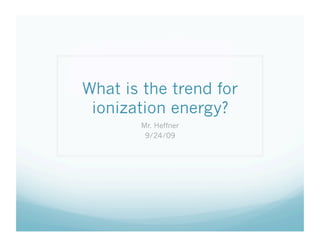
Review: Atomic Radius
                    Decreases
Increases
IV. Ionization Energy
A.  What is ionization energy?
  1.  The energy it takes to remove an electron from an atom
  2.  Atoms can have multiple ionization energies
    i.  First ionization energy – the energy it takes to remove the
       first electron
    ii.  Second ionization energy – the energy it takes to remove the
          second electron
    iii.  Third ionization energy – the energy it takes to remove the
          third electron
IV. Ionization Energy
B.  What is the trend for first ionization energy?
  1.  Ionization energy increases across a period (LR)
    i.  As the number of protons increases, atomic radius
       decreases
    ii.  It is harder to take an electron off a small atom, so
       ionization energy increases
Chihuahua Story
  I am a dog walker and everyday I walk 8

  The stronger I am, the closer I can pull them
   towards me

  The closer they are to me, the harder they are to
   steal!
IV. Ionization Energy
B.  What is the trend for first ionization energy?
  2.  Ionization energy decreases down a group
       (TopBottom)
    i.  As the number of electrons increases, atomic radius
       increases
    ii.  It is easier to take an electrons off a large atom, so
       ionization energy decreases
Chihuahua Story
  I am a dog walker and now I have 9

  I can’t fit any more around me, need a longer leash

  It is easier to steal one when it is farther away!
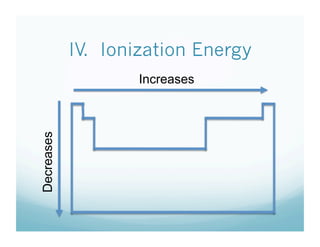
IV. Ionization Energy
                    Increases
Decreases
IV. Ionization Energy
A.  What is the trend for second & third ionization
   energy?
  1.  The trend is the same as first ionization energy
  2.  However, the amount of energy is always larger than
       first
    i.  After one electron is removed, the protons pull the
         remaining electrons closer to the nucleus making the atom
         smaller
    ii.  It is harder to take an electron off a small atom, so second
         ionization energy is larger than first
Practice Questions
1.  What is ionization energy?
2.  Describe the trend for ionization energy. How does it
   compare to atomic radius?
3.  Which has a larger ionization energy, P or S; F or Cl; Li
   or Cs; Pt or Ni; Fr or F; Se or O?

4.  Which element in group 2 has the largest ionization
   energy? The smallest?

5.  Magnesium has a first ionization energy of 737.7 kJ/
   mol and second ionization energy of 1450.7 kJ/mol.
   Use what you know to explain this phenomenon in at
   least two complete sentences.
Homework
  Textbook Problems:
    Pg. 141 Section Review: #1, 5, 11, 12, 13
  Finish Practice Problems
  Start reviewing for Monday’s Unit #2 Exam!
  lpschem.wordpress.com
Exit Slip
1. Ionization energy is the
  a. number of stable ions formed by an atom.
  b. number of protons and neutrons in an atom.
  c. energy it takes to remove an electron from an atom.
  d. distance from the nucleus to the valence ring.
Exit Slip
2. In general, how does ionization energy vary
  throughout the periodic table?
  a. it decreases across a period from left to right, and
     decreases down a group from top to bottom
  b. it increases across a period from left to right, and
     increases down a group from top to bottom
  c. it increases across a period from left to right, and
     decreases down a group from top to bottom
  d. It decreases across a period from left to right, and
     increases down a group from top to bottom
Exit Slip
3. Which of the following correctly describes the
   relationship between first and second ionization
   energy?
  a. First ionization energy is always larger than second
  b. Second ionization energy is always larger than first
  c. First ionization energy describes positively-charged
     ions, while second ionization energy describes
     negatively-charge ions
  d. First ionization energy describes negatively-charged
     ions, while second ionization energy describes
     positively-charge ions
Exit Slip
4. Which of the following atoms has the smallest first
  ionization energy?
  a. lithium (Li)
  b. beryllium (Be)
  c. sodium (Na)
  d. magnesium (Mg)
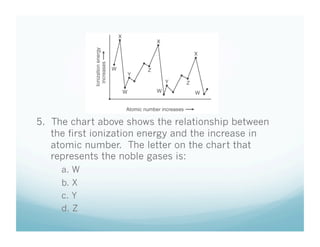
5. The chart above shows the relationship between
   the first ionization energy and the increase in
   atomic number. The letter on the chart that
   represents the noble gases is:
     a. W
     b. X
     c. Y
     d. Z

What is the trend for ionization energy?

  • 1.
    Launch: 9/24   Grabyour binder and immediately take a seat   Place Textbook HW on desk 5. Which of the following atoms has the largest atomic radius? a. oxygen (O) b. phosphorus (P) c. sulfur (S) d. chlorine (Cl)
  • 2.
    What is thetrend for ionization energy? Mr. Heffner 9/24/09
  • 3.
    Review: Atomic Radius Decreases Increases
  • 4.
    IV. Ionization Energy A. What is ionization energy? 1.  The energy it takes to remove an electron from an atom 2.  Atoms can have multiple ionization energies i.  First ionization energy – the energy it takes to remove the first electron ii.  Second ionization energy – the energy it takes to remove the second electron iii.  Third ionization energy – the energy it takes to remove the third electron
  • 5.
    IV. Ionization Energy B. What is the trend for first ionization energy? 1.  Ionization energy increases across a period (LR) i.  As the number of protons increases, atomic radius decreases ii.  It is harder to take an electron off a small atom, so ionization energy increases
  • 6.
    Chihuahua Story   Iam a dog walker and everyday I walk 8   The stronger I am, the closer I can pull them towards me   The closer they are to me, the harder they are to steal!
  • 7.
    IV. Ionization Energy B. What is the trend for first ionization energy? 2.  Ionization energy decreases down a group (TopBottom) i.  As the number of electrons increases, atomic radius increases ii.  It is easier to take an electrons off a large atom, so ionization energy decreases
  • 8.
    Chihuahua Story   Iam a dog walker and now I have 9   I can’t fit any more around me, need a longer leash   It is easier to steal one when it is farther away!
  • 9.
    IV. Ionization Energy Increases Decreases
  • 10.
    IV. Ionization Energy A. What is the trend for second & third ionization energy? 1.  The trend is the same as first ionization energy 2.  However, the amount of energy is always larger than first i.  After one electron is removed, the protons pull the remaining electrons closer to the nucleus making the atom smaller ii.  It is harder to take an electron off a small atom, so second ionization energy is larger than first
  • 11.
    Practice Questions 1.  Whatis ionization energy? 2.  Describe the trend for ionization energy. How does it compare to atomic radius? 3.  Which has a larger ionization energy, P or S; F or Cl; Li or Cs; Pt or Ni; Fr or F; Se or O? 4.  Which element in group 2 has the largest ionization energy? The smallest? 5.  Magnesium has a first ionization energy of 737.7 kJ/ mol and second ionization energy of 1450.7 kJ/mol. Use what you know to explain this phenomenon in at least two complete sentences.
  • 12.
    Homework   Textbook Problems:   Pg. 141 Section Review: #1, 5, 11, 12, 13   Finish Practice Problems   Start reviewing for Monday’s Unit #2 Exam!   lpschem.wordpress.com
  • 13.
    Exit Slip 1. Ionizationenergy is the a. number of stable ions formed by an atom. b. number of protons and neutrons in an atom. c. energy it takes to remove an electron from an atom. d. distance from the nucleus to the valence ring.
  • 14.
    Exit Slip 2. Ingeneral, how does ionization energy vary throughout the periodic table? a. it decreases across a period from left to right, and decreases down a group from top to bottom b. it increases across a period from left to right, and increases down a group from top to bottom c. it increases across a period from left to right, and decreases down a group from top to bottom d. It decreases across a period from left to right, and increases down a group from top to bottom
  • 15.
    Exit Slip 3. Whichof the following correctly describes the relationship between first and second ionization energy? a. First ionization energy is always larger than second b. Second ionization energy is always larger than first c. First ionization energy describes positively-charged ions, while second ionization energy describes negatively-charge ions d. First ionization energy describes negatively-charged ions, while second ionization energy describes positively-charge ions
  • 16.
    Exit Slip 4. Whichof the following atoms has the smallest first ionization energy? a. lithium (Li) b. beryllium (Be) c. sodium (Na) d. magnesium (Mg)
  • 17.
    5. The chartabove shows the relationship between the first ionization energy and the increase in atomic number. The letter on the chart that represents the noble gases is: a. W b. X c. Y d. Z