Chapter 1
Introduction to Chemistry
1.1 Chemistry and Its Importance
• Chemistry is the study of the composition,
structure, properties and interactions of matter
• In chemistry, we study:
 What chemicals are made of and what are
their properties.
 How elements interact with each other
 How to use this knowledge to produce useful
new chemicals
• A few examples of chemicals:
 medicine
 fertilizers
 glass and optical fibres
 preservatives
 cement, concrete & glass
 cosmetic product
 detergent & fabric softeners
• Chemistry related to careers:
 doctor
 chemical engineer
 food technologist
 geologist
 pharmacist
 nutritionist
 forensic scientist
 biochemist
1.2 Scientific Method
• Scientific method: A systematic method used
to solve problems in science
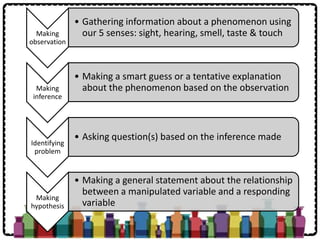
Making
observation
• Gathering information about a phenomenon using
our 5 senses: sight, hearing, smell, taste & touch
Making
inference
• Making a smart guess or a tentative explanation
about the phenomenon based on the observation
Identifying
problem
• Asking question(s) based on the inference made
Making
hypothesis
• Making a general statement about the relationship
between a manipulated variable and a responding
variable
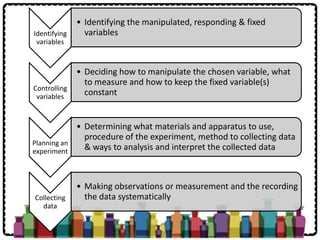
Identifying
variables
• Identifying the manipulated, responding & fixed
variables
Controlling
variables
• Deciding how to manipulate the chosen variable, what
to measure and how to keep the fixed variable(s)
constant
Planning an
experiment
• Determining what materials and apparatus to use,
procedure of the experiment, method to collecting data
& ways to analysis and interpret the collected data
Collecting
data
• Making observations or measurement and the recording
the data systematically
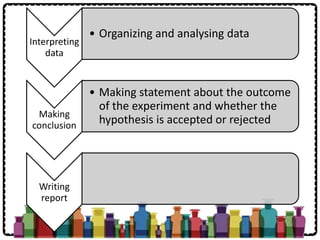
Interpreting
data
• Organizing and analysing data
Making
conclusion
• Making statement about the outcome
of the experiment and whether the
hypothesis is accepted or rejected
Writing
report
• Scientific attitudes and noble values must be
practiced by a chemist who wants to carry out
an investigation
Summary
• Copy the summary map (Textbook, page 7).
Then, complete it using the guides given.

Chapter 1 Introduction to Chemistry

  • 1.
  • 2.
    1.1 Chemistry andIts Importance • Chemistry is the study of the composition, structure, properties and interactions of matter • In chemistry, we study:  What chemicals are made of and what are their properties.  How elements interact with each other  How to use this knowledge to produce useful new chemicals
  • 3.
    • A fewexamples of chemicals:  medicine  fertilizers  glass and optical fibres  preservatives  cement, concrete & glass  cosmetic product  detergent & fabric softeners
  • 4.
    • Chemistry relatedto careers:  doctor  chemical engineer  food technologist  geologist  pharmacist  nutritionist  forensic scientist  biochemist
  • 5.
    1.2 Scientific Method •Scientific method: A systematic method used to solve problems in science
  • 6.
    Making observation • Gathering informationabout a phenomenon using our 5 senses: sight, hearing, smell, taste & touch Making inference • Making a smart guess or a tentative explanation about the phenomenon based on the observation Identifying problem • Asking question(s) based on the inference made Making hypothesis • Making a general statement about the relationship between a manipulated variable and a responding variable
  • 7.
    Identifying variables • Identifying themanipulated, responding & fixed variables Controlling variables • Deciding how to manipulate the chosen variable, what to measure and how to keep the fixed variable(s) constant Planning an experiment • Determining what materials and apparatus to use, procedure of the experiment, method to collecting data & ways to analysis and interpret the collected data Collecting data • Making observations or measurement and the recording the data systematically
  • 8.
    Interpreting data • Organizing andanalysing data Making conclusion • Making statement about the outcome of the experiment and whether the hypothesis is accepted or rejected Writing report
  • 9.
    • Scientific attitudesand noble values must be practiced by a chemist who wants to carry out an investigation
  • 10.
    Summary • Copy thesummary map (Textbook, page 7). Then, complete it using the guides given.