Introduction To Chemistry
Chapter 1
Downloaded from http://www.pahaikan.synthasite.com
The Meaning of Chemistry
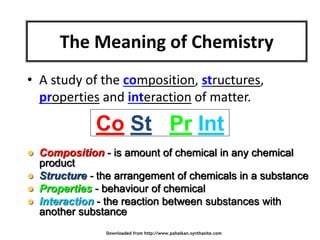
• A study of the composition, structures,
properties and interaction of matter.
Co St Pr Int
 Composition - is amount of chemical in any chemical
product
 Structure - the arrangement of chemicals in a substance
 Properties - behaviour of chemical
 Interaction - the reaction between substances with
another substance
Downloaded from http://www.pahaikan.synthasite.com
• Chemistry word originates from
the Arabic word `al-kamiya’
• Antoine Lavoisier (French
Chemist) founder of modern
chemistry
MODERN CHEMISTRY
 Modern chemistry was found in 17th
century.
 A branch of science that deals with
matter.
 All matter is chemical.
Downloaded from http://www.pahaikan.synthasite.com
Matter
• is any thing that have mass and can
occupy space
• All the thing in the environment
whether living or non-living thing
are matters.
Common chemicals used in daily life
• Table salt, NaCl
• Vinegar, CH3COOH
• Calcium carbonate, CaCO3
Downloaded from http://www.pahaikan.synthasite.com
The uses of common
chemicals in daily life
Name of
substance
Chemical
Formula
Uses
Table salt NaCl As preservatives and
cooking.
Vinegar CH3COOH Preservative for fruits and
food flavourings.
Sulphuric acid H2SO4 Electrolyte in car battery.
Ethanol C2H5OH To make alcoholic drinks
Calcium carbonate CaCO3 Marble tiles, calcium
supplement.
Sodium
bicarbonate
NaHCO3 Baking powder to raise
dough.
Downloaded from http://www.pahaikan.synthasite.com
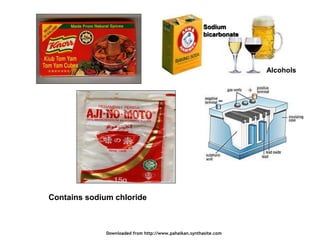
Contains sodium chloride
Alcohols
Sodium
bicarbonate
Downloaded from http://www.pahaikan.synthasite.com
Occupation & Chemistry
• What do you want to do
– after SPM ? or
– after you leave Polytechnic? or
– after you leave University?
• Chemistry opens the door to many
careers.
• In fact, knowledge of chemistry is useful to
almost everyone in every field.
Downloaded from http://www.pahaikan.synthasite.com
Occupation & Chemistry
 Transportation  Petroleum
 Medical  Pharmacy
 Sports  Formula 1
 Social Service  Fire Brigade,
Chemistry Teacher
 Fertilizer  Farmer
Downloaded from http://www.pahaikan.synthasite.com
Occupation that require the knowledge of
chemistry
• Forensic scientist
• Food technologist
• Doctor
• Geologist
• Environmental scientist
• Pharmacist
• Pathologist
• Bacteriologist
 Horticulturalist
 Chemical engineer
 Cosmetic scientist
 Biochemist
 Laboratory technician
 Nutritionist
 Aqua culturist
 Etc.
Downloaded from http://www.pahaikan.synthasite.com
Chemical based Industries in Malaysia
• Petronas
• Asean Bintulu Fertiliser
Downloaded from http://www.pahaikan.synthasite.com
The Contribution of Chemical based Industries
towards the development of our country
• Create job opportunities
• Increase export earning (economy) / support
other small industries
• Improve health and standard of living
Downloaded from http://www.pahaikan.synthasite.com
Scientific Method
• Scientific method is a systematic method used to
solve problems in science.
• It usually done to understand the phenomena of
nature.
Downloaded from http://www.pahaikan.synthasite.com
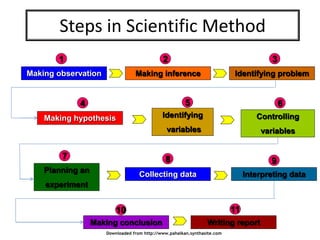
Steps in Scientific Method
Making observation Making inference Identifying problem
Making hypothesis Identifying
variables
Controlling
variables
Planning an
experiment
Collecting data Interpreting data
Making conclusion Writing report
1 2 3
654
7 8 9
1110
Downloaded from http://www.pahaikan.synthasite.com
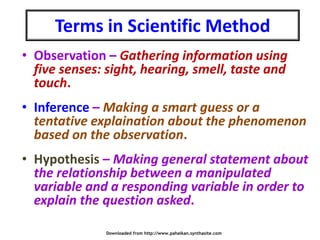
Terms in Scientific Method
• Observation – Gathering information using
five senses: sight, hearing, smell, taste and
touch.
• Inference – Making a smart guess or a
tentative explaination about the phenomenon
based on the observation.
• Hypothesis – Making general statement about
the relationship between a manipulated
variable and a responding variable in order to
explain the question asked.
Downloaded from http://www.pahaikan.synthasite.com
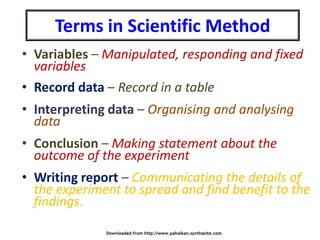
Terms in Scientific Method
• Variables – Manipulated, responding and fixed
variables
• Record data – Record in a table
• Interpreting data – Organising and analysing
data
• Conclusion – Making statement about the
outcome of the experiment
• Writing report – Communicating the details of
the experiment to spread and find benefit to the
findings.
Downloaded from http://www.pahaikan.synthasite.com
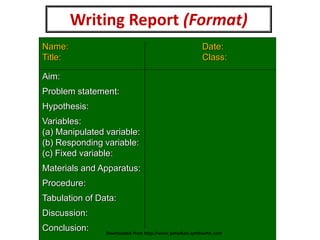
Writing Report (Format)
Name: Date:
Title: Class:
Aim:
Problem statement:
Hypothesis:
Variables:
(a) Manipulated variable:
(b) Responding variable:
(c) Fixed variable:
Materials and Apparatus:
Procedure:
Tabulation of Data:
Discussion:
Conclusion: Downloaded from http://www.pahaikan.synthasite.com
NOBLE VALUE AND SCIENTIFIC
ATTITUDES
• Objectively
• Carefully
• Patiently
• Rational
• Critical
• Analytical
• Diligent
• Persevering

Chapter 1 form 4

  • 1.
    Introduction To Chemistry Chapter1 Downloaded from http://www.pahaikan.synthasite.com
  • 2.
    The Meaning ofChemistry • A study of the composition, structures, properties and interaction of matter. Co St Pr Int  Composition - is amount of chemical in any chemical product  Structure - the arrangement of chemicals in a substance  Properties - behaviour of chemical  Interaction - the reaction between substances with another substance Downloaded from http://www.pahaikan.synthasite.com
  • 3.
    • Chemistry wordoriginates from the Arabic word `al-kamiya’ • Antoine Lavoisier (French Chemist) founder of modern chemistry
  • 4.
    MODERN CHEMISTRY  Modernchemistry was found in 17th century.  A branch of science that deals with matter.  All matter is chemical. Downloaded from http://www.pahaikan.synthasite.com
  • 5.
    Matter • is anything that have mass and can occupy space • All the thing in the environment whether living or non-living thing are matters.
  • 6.
    Common chemicals usedin daily life • Table salt, NaCl • Vinegar, CH3COOH • Calcium carbonate, CaCO3 Downloaded from http://www.pahaikan.synthasite.com
  • 7.
    The uses ofcommon chemicals in daily life Name of substance Chemical Formula Uses Table salt NaCl As preservatives and cooking. Vinegar CH3COOH Preservative for fruits and food flavourings. Sulphuric acid H2SO4 Electrolyte in car battery. Ethanol C2H5OH To make alcoholic drinks Calcium carbonate CaCO3 Marble tiles, calcium supplement. Sodium bicarbonate NaHCO3 Baking powder to raise dough. Downloaded from http://www.pahaikan.synthasite.com
  • 8.
  • 9.
    Occupation & Chemistry •What do you want to do – after SPM ? or – after you leave Polytechnic? or – after you leave University? • Chemistry opens the door to many careers. • In fact, knowledge of chemistry is useful to almost everyone in every field. Downloaded from http://www.pahaikan.synthasite.com
  • 10.
    Occupation & Chemistry Transportation  Petroleum  Medical  Pharmacy  Sports  Formula 1  Social Service  Fire Brigade, Chemistry Teacher  Fertilizer  Farmer Downloaded from http://www.pahaikan.synthasite.com
  • 11.
    Occupation that requirethe knowledge of chemistry • Forensic scientist • Food technologist • Doctor • Geologist • Environmental scientist • Pharmacist • Pathologist • Bacteriologist  Horticulturalist  Chemical engineer  Cosmetic scientist  Biochemist  Laboratory technician  Nutritionist  Aqua culturist  Etc. Downloaded from http://www.pahaikan.synthasite.com
  • 12.
    Chemical based Industriesin Malaysia • Petronas • Asean Bintulu Fertiliser Downloaded from http://www.pahaikan.synthasite.com
  • 13.
    The Contribution ofChemical based Industries towards the development of our country • Create job opportunities • Increase export earning (economy) / support other small industries • Improve health and standard of living Downloaded from http://www.pahaikan.synthasite.com
  • 14.
    Scientific Method • Scientificmethod is a systematic method used to solve problems in science. • It usually done to understand the phenomena of nature. Downloaded from http://www.pahaikan.synthasite.com
  • 15.
    Steps in ScientificMethod Making observation Making inference Identifying problem Making hypothesis Identifying variables Controlling variables Planning an experiment Collecting data Interpreting data Making conclusion Writing report 1 2 3 654 7 8 9 1110 Downloaded from http://www.pahaikan.synthasite.com
  • 16.
    Terms in ScientificMethod • Observation – Gathering information using five senses: sight, hearing, smell, taste and touch. • Inference – Making a smart guess or a tentative explaination about the phenomenon based on the observation. • Hypothesis – Making general statement about the relationship between a manipulated variable and a responding variable in order to explain the question asked. Downloaded from http://www.pahaikan.synthasite.com
  • 17.
    Terms in ScientificMethod • Variables – Manipulated, responding and fixed variables • Record data – Record in a table • Interpreting data – Organising and analysing data • Conclusion – Making statement about the outcome of the experiment • Writing report – Communicating the details of the experiment to spread and find benefit to the findings. Downloaded from http://www.pahaikan.synthasite.com
  • 18.
    Writing Report (Format) Name:Date: Title: Class: Aim: Problem statement: Hypothesis: Variables: (a) Manipulated variable: (b) Responding variable: (c) Fixed variable: Materials and Apparatus: Procedure: Tabulation of Data: Discussion: Conclusion: Downloaded from http://www.pahaikan.synthasite.com
  • 19.
    NOBLE VALUE ANDSCIENTIFIC ATTITUDES • Objectively • Carefully • Patiently • Rational • Critical • Analytical • Diligent • Persevering