Chapter 8

Target Marketing & Positioning
Target Marketing
• Target Market
  – Consists of a set of buyers who share common
    needs or characteristics that the company
    decides to serve.
  – The process of evaluating segments and focusing
    marketing efforts on a country, region, or group
    of people that has significant potential to
    respond
Criteria for Targeting: 9 W’s
•   Who buys our product?
•   Who does not buy it?
•   What need or function does it serve?
•   What are customers buying to satisfy the need
    for which our product is targeted?
•   What price are they paying?
•   When is the product purchased?
•   Where is it purchased?
•   Why is it purchased?
FACTORS CONSIDERED IMPORTANT IN
 THE SELECTION OF TARGET MARKET
             STRATEGY
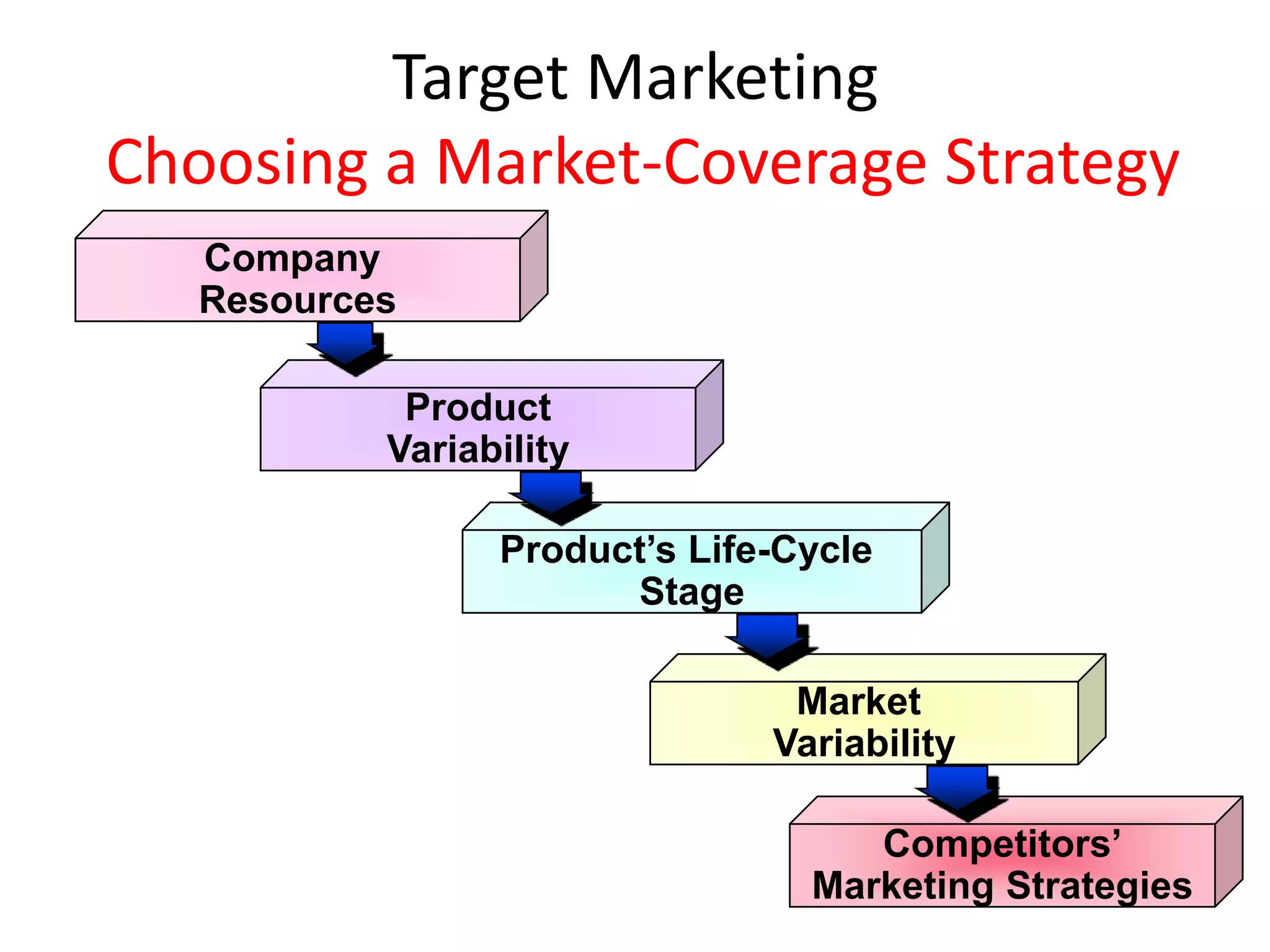
•   1.   Company’s Resources
•   2.   Product Homogeneity
•   3.   Product Stage in the Life Cycle
•   4.   Market Homogeneity
•   5.   Competitive Marketing Strategy
Target Marketing Strategies
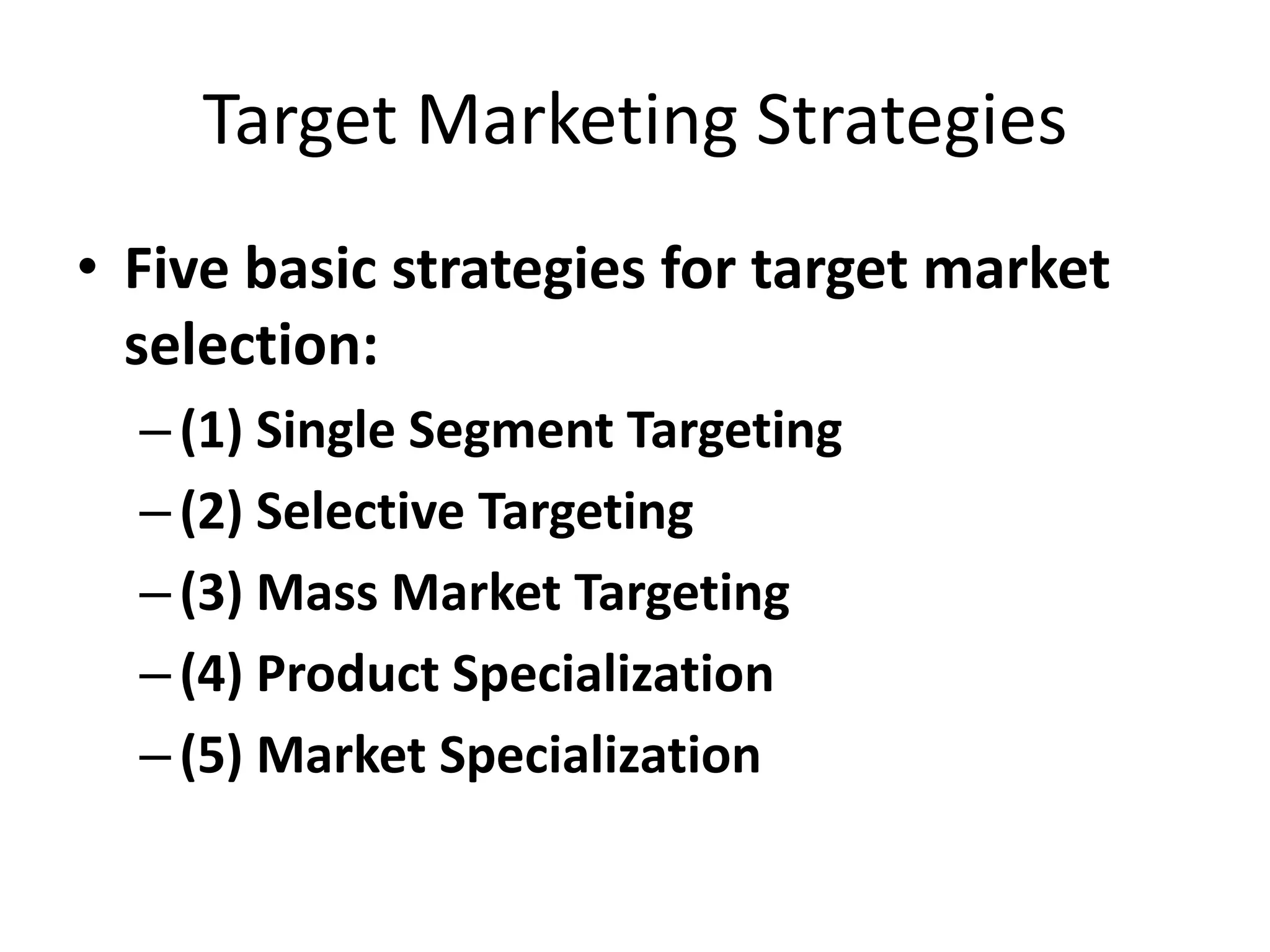
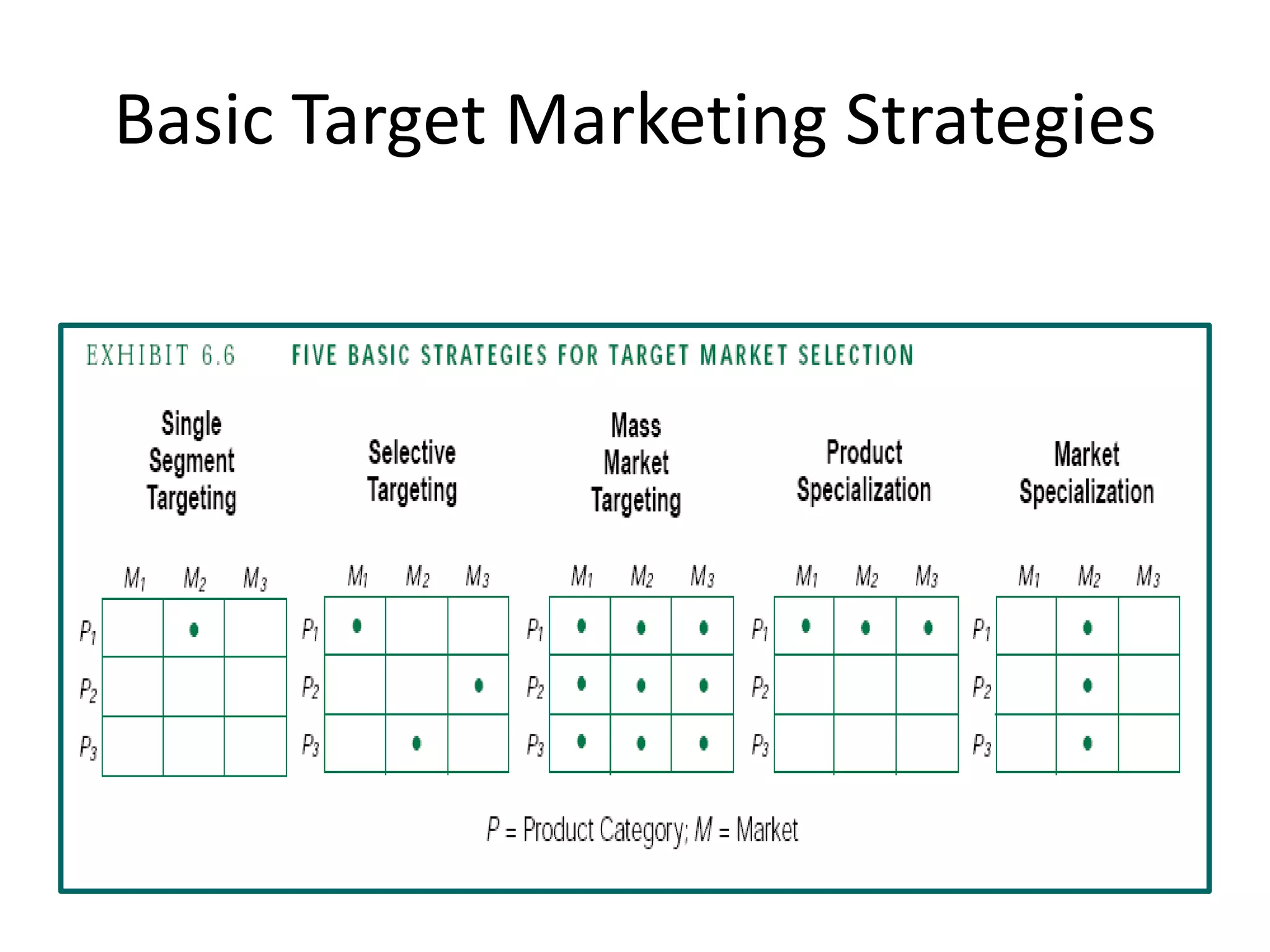
• Five basic strategies for target market
  selection:
  – (1) Single Segment Targeting
  – (2) Selective Targeting
  – (3) Mass Market Targeting
  – (4) Product Specialization
  – (5) Market Specialization
Basic Target Marketing Strategies
Target Marketing
Choosing a Market-Coverage Strategy
   Company
   Resources

            Product
           Variability

                 Product’s Life-Cycle
                       Stage

                                Market
                               Variability

                                    Competitors’
                                 Marketing Strategies
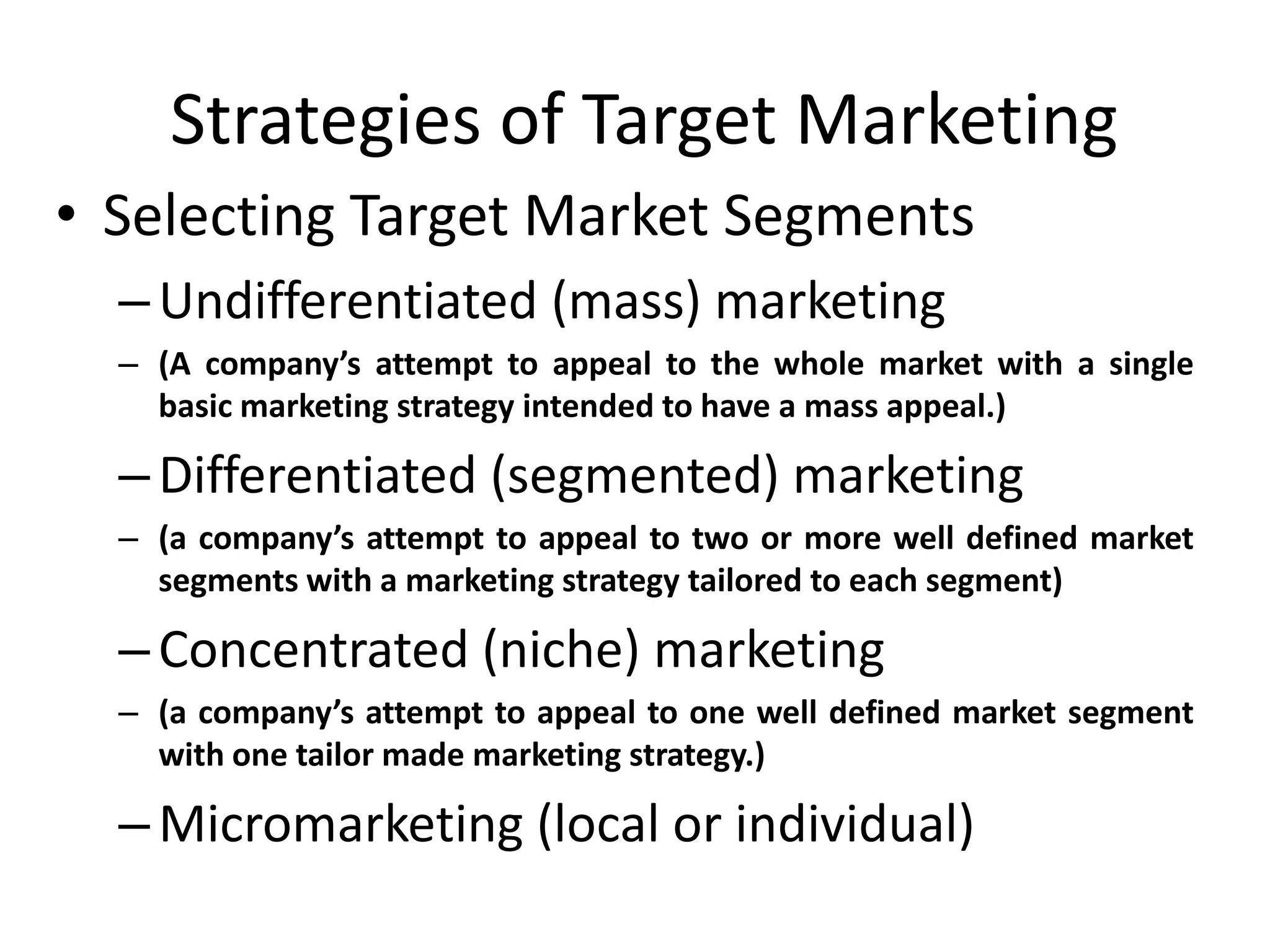
Strategies of Target Marketing
• Selecting Target Market Segments
  – Undifferentiated (mass) marketing
  – (A company’s attempt to appeal to the whole market with a single
    basic marketing strategy intended to have a mass appeal.)

  – Differentiated (segmented) marketing
  – (a company’s attempt to appeal to two or more well defined market
    segments with a marketing strategy tailored to each segment)

  – Concentrated (niche) marketing
  – (a company’s attempt to appeal to one well defined market segment
    with one tailor made marketing strategy.)

  – Micromarketing (local or individual)
Positioning is the act
of    designing      the
company’s       offering
and image to occupy a
distinctive place in the
target market’s mind.
Positioning
• Positioning:
   – The place the product occupies in consumers’ minds
     relative to competing products.
   – Typically defined by consumers on the basis of important
     attributes.
   – Involves implanting the brand’s unique benefits and
     differentiation in the customer’s mind.
   – Positioning maps that plot perceptions of brands are
     commonly used.
• Product’s Position - the place the product occupies in
  consumers’ minds relative to competing products; i.e.
  Volvo positions on “safety”.

• Marketers must:
   – Plan positions to give products the greatest advantage
   – Develop marketing mixes to create planned positions
Bases for Positioning
• Features: physical traits and performance
• Benefits : feviquick, nerolac paint, fairglow soap
• Usage:- chawanprash for body resistance, pulsur for specific area
• Parentage:- sony vaio, tata indica, Fiat Palio
• Manufacturing process: Fab India Hand Crafted
• Ingredients:- 100% cotton, 100% wool made
• Endorsement:- Lalita ji surf add, sachin boost secret of energy
• Comparison:-
• Pro-environment: canon made from recycled material
• Product class:- dove as moisturizer not as toilet soap, pears as glycerin
  soap
• Price/ quality:- Zenith computers “ multinational quality, Indian price”
• Country or geographic area:- German engineering, banarsi sari
Positioning must cover
•   Who am I? ( the identity, family)
•   What am I ? ( the functional capabilities
•   For whom am I? ( whom do I serve best)
•   Why me? ( why consumer should choose me
    and not the other alternatives)
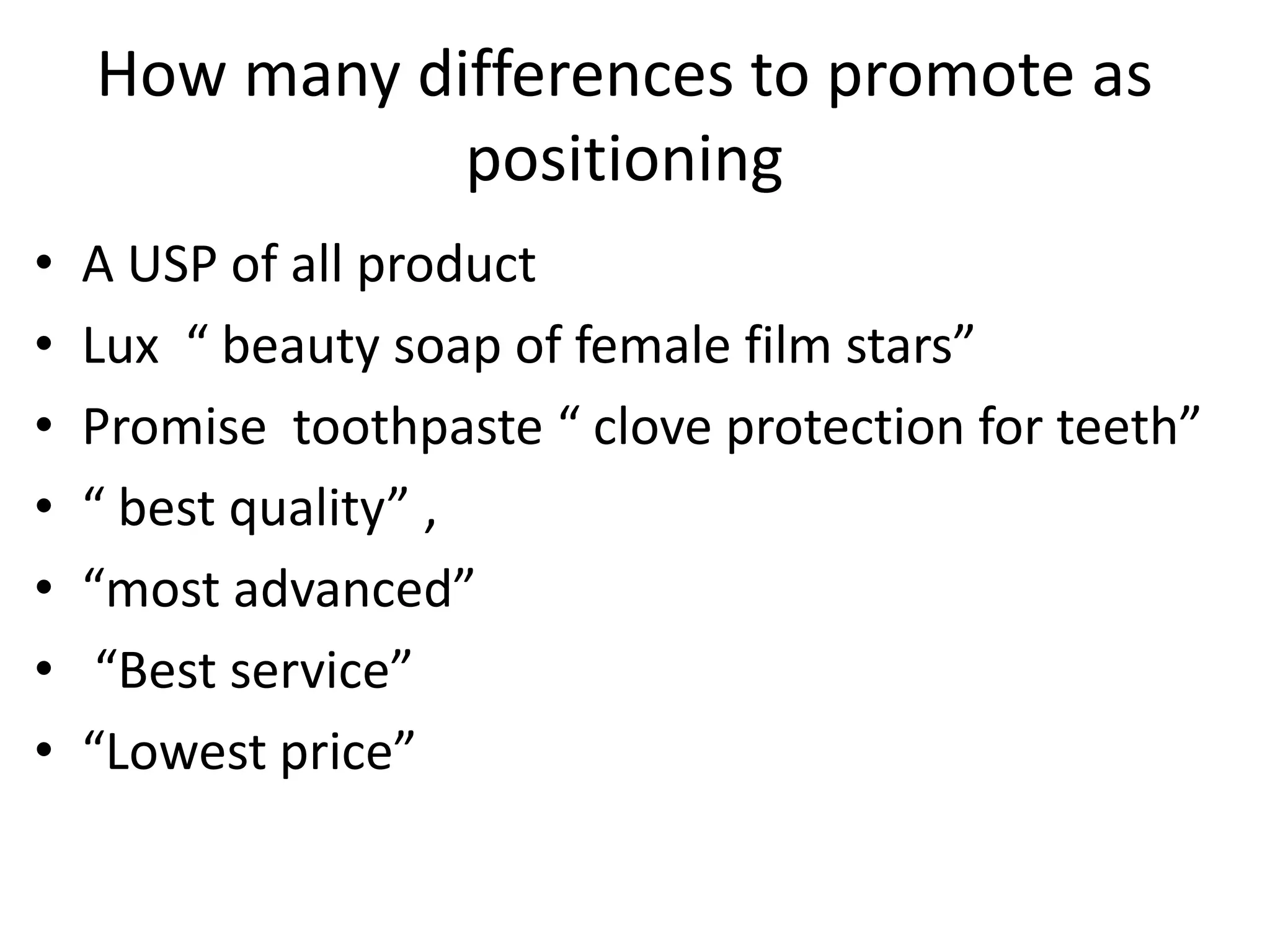
How many differences to promote as
               positioning
•   A USP of all product
•   Lux “ beauty soap of female film stars”
•   Promise toothpaste “ clove protection for teeth”
•   “ best quality” ,
•   “most advanced”
•    “Best service”
•   “Lowest price”
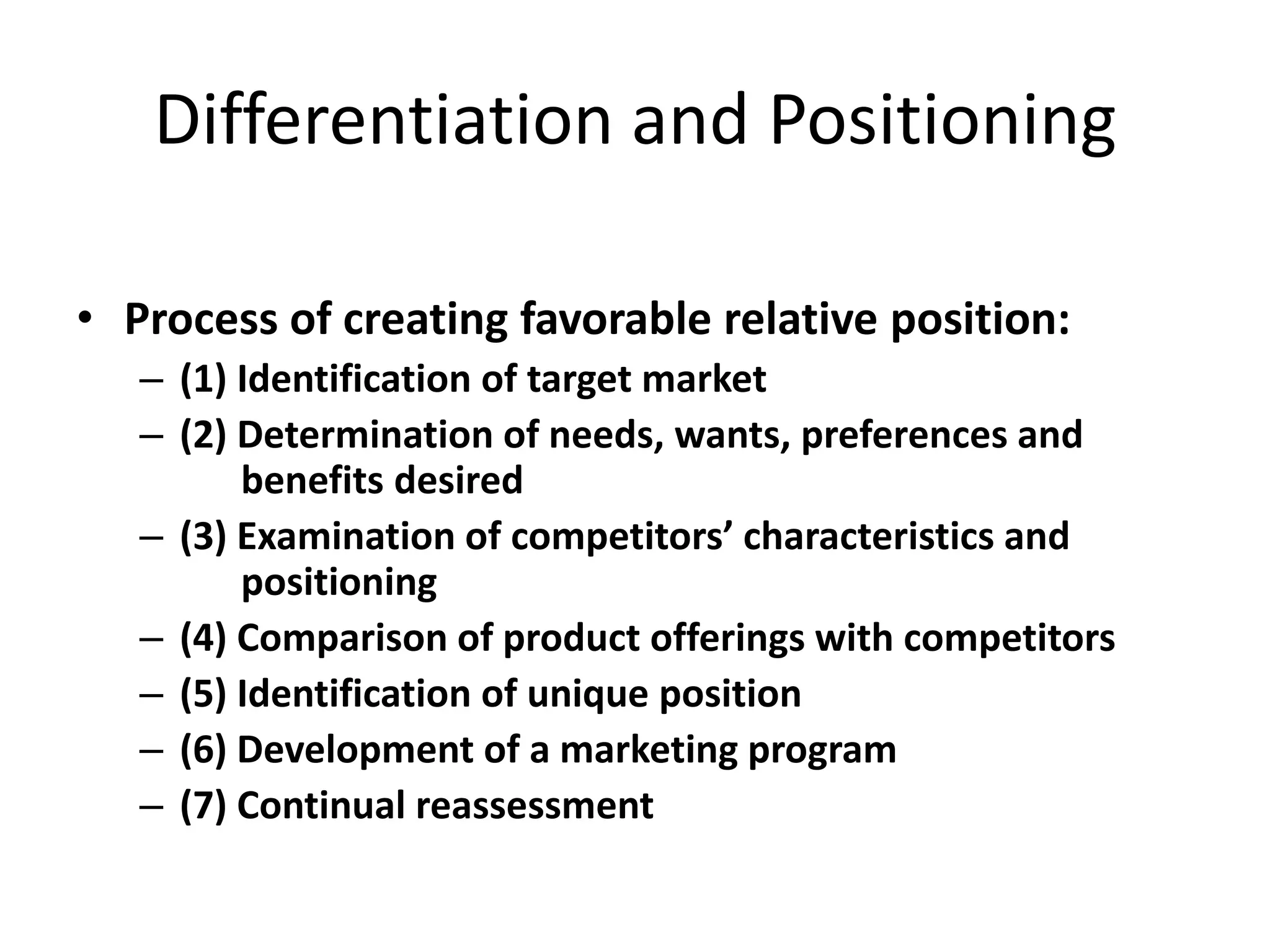
Differentiation and Positioning

• Process of creating favorable relative position:
   – (1) Identification of target market
   – (2) Determination of needs, wants, preferences and
         benefits desired
   – (3) Examination of competitors’ characteristics and
         positioning
   – (4) Comparison of product offerings with competitors
   – (5) Identification of unique position
   – (6) Development of a marketing program
   – (7) Continual reassessment
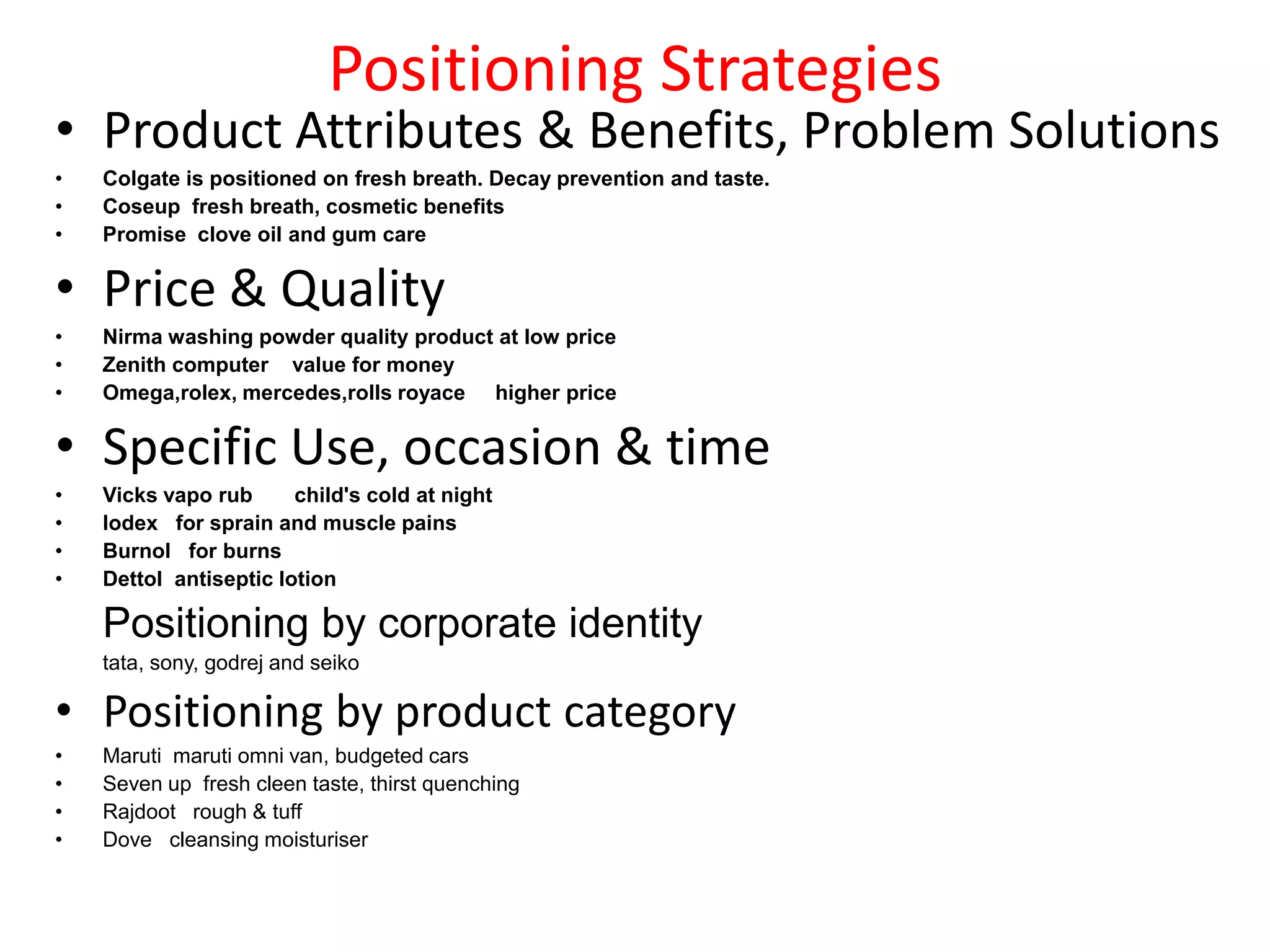
Positioning Strategies
• Product Attributes & Benefits, Problem Solutions
•   Colgate is positioned on fresh breath. Decay prevention and taste.
•   Coseup fresh breath, cosmetic benefits
•   Promise clove oil and gum care


• Price & Quality
•   Nirma washing powder quality product at low price
•   Zenith computer value for money
•   Omega,rolex, mercedes,rolls royace higher price


• Specific Use, occasion & time
•   Vicks vapo rub      child's cold at night
•   Iodex for sprain and muscle pains
•   Burnol for burns
•   Dettol antiseptic lotion

    Positioning by corporate identity
    tata, sony, godrej and seiko

• Positioning by product category
•   Maruti maruti omni van, budgeted cars
•   Seven up fresh cleen taste, thirst quenching
•   Rajdoot rough & tuff
•   Dove cleansing moisturiser
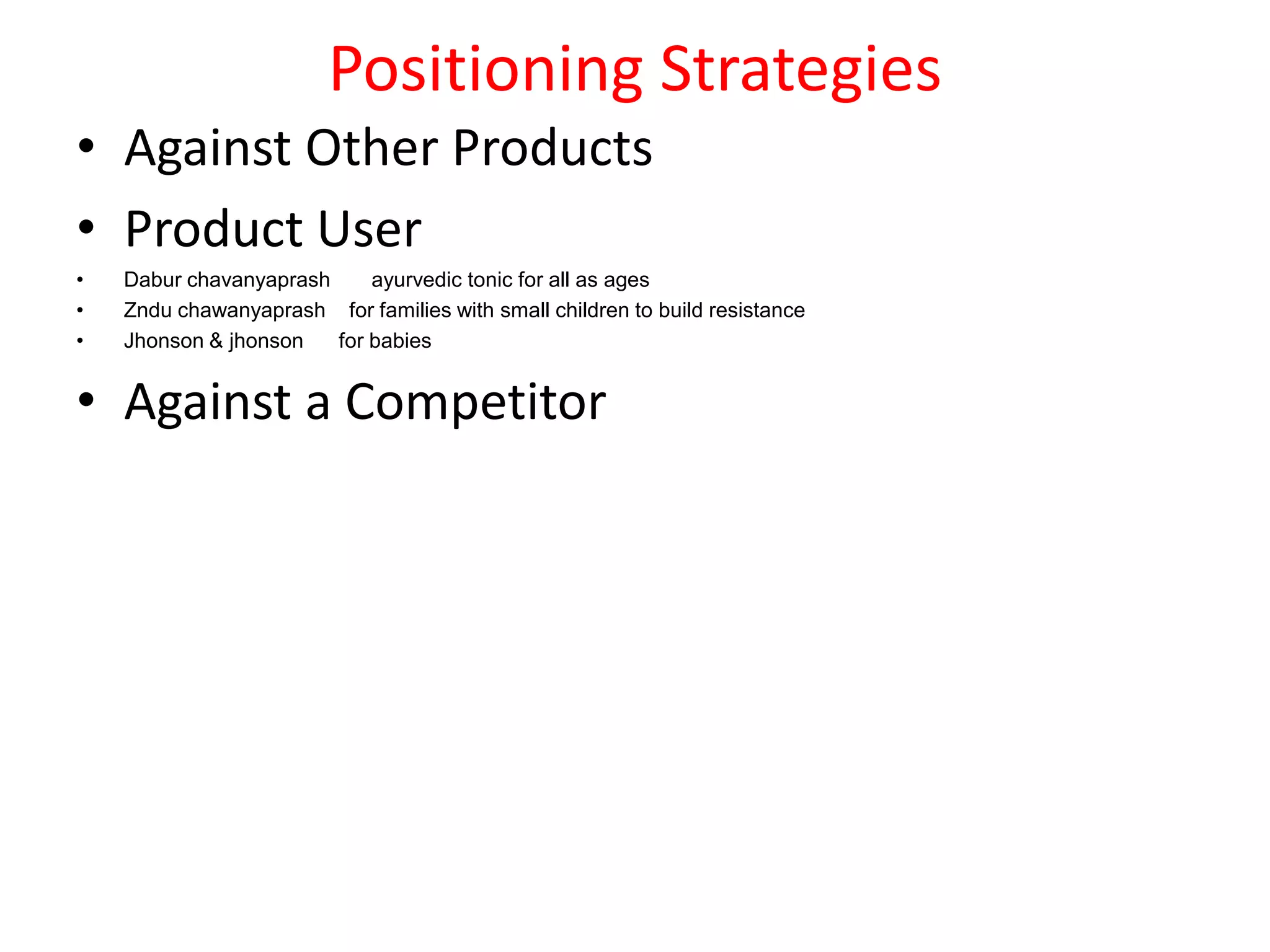
Positioning Strategies
• Against Other Products
• Product User
•   Dabur chavanyaprash     ayurvedic tonic for all as ages
•   Zndu chawanyaprash for families with small children to build resistance
•   Jhonson & jhonson   for babies


• Against a Competitor
POSITIONING STRATEGIES
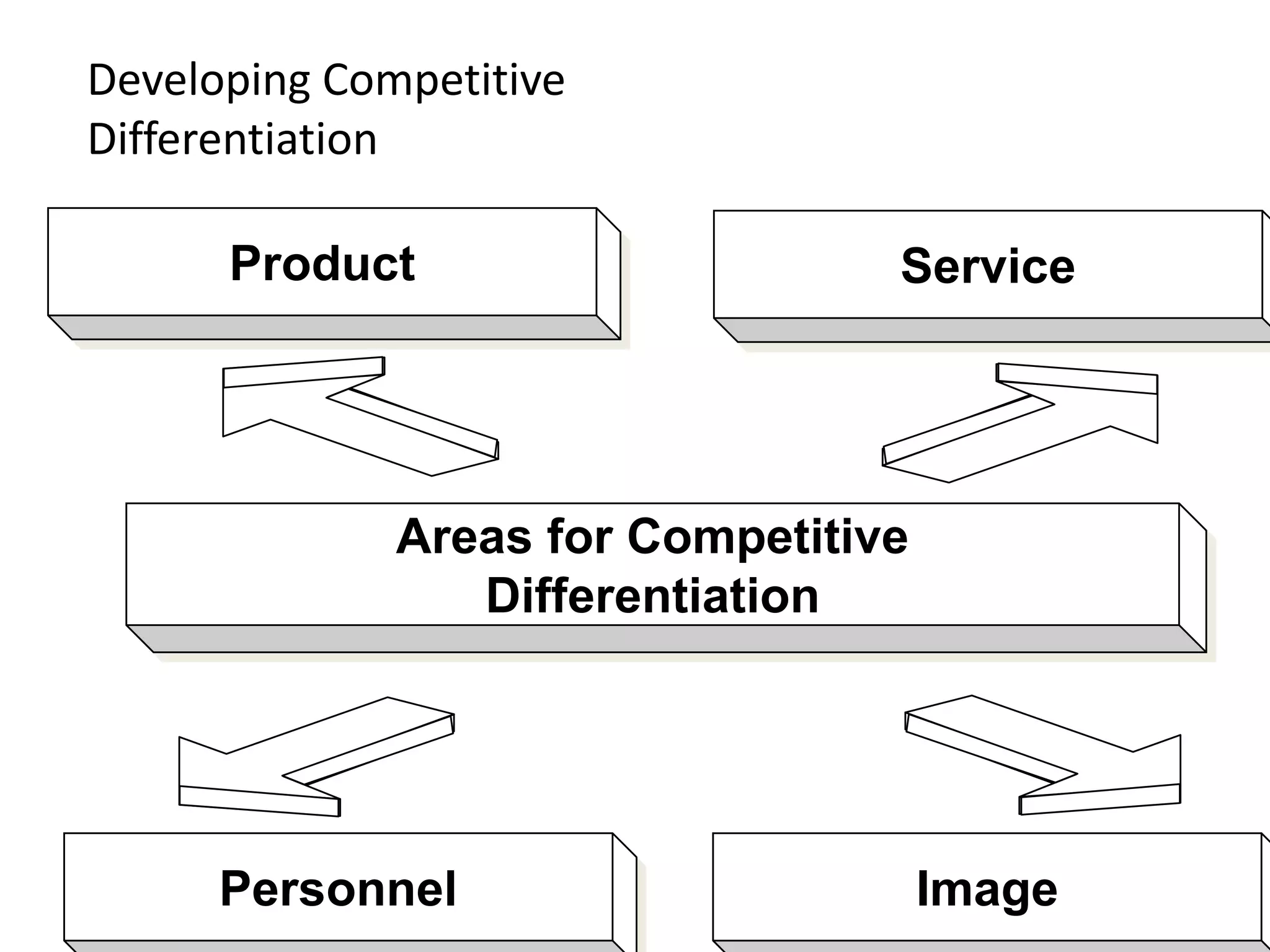
• Identifying possible competitive advantages
• Differentiation can be based on
   – Products
   – Services
   – Channels
   – People
   – Image
   – benefits
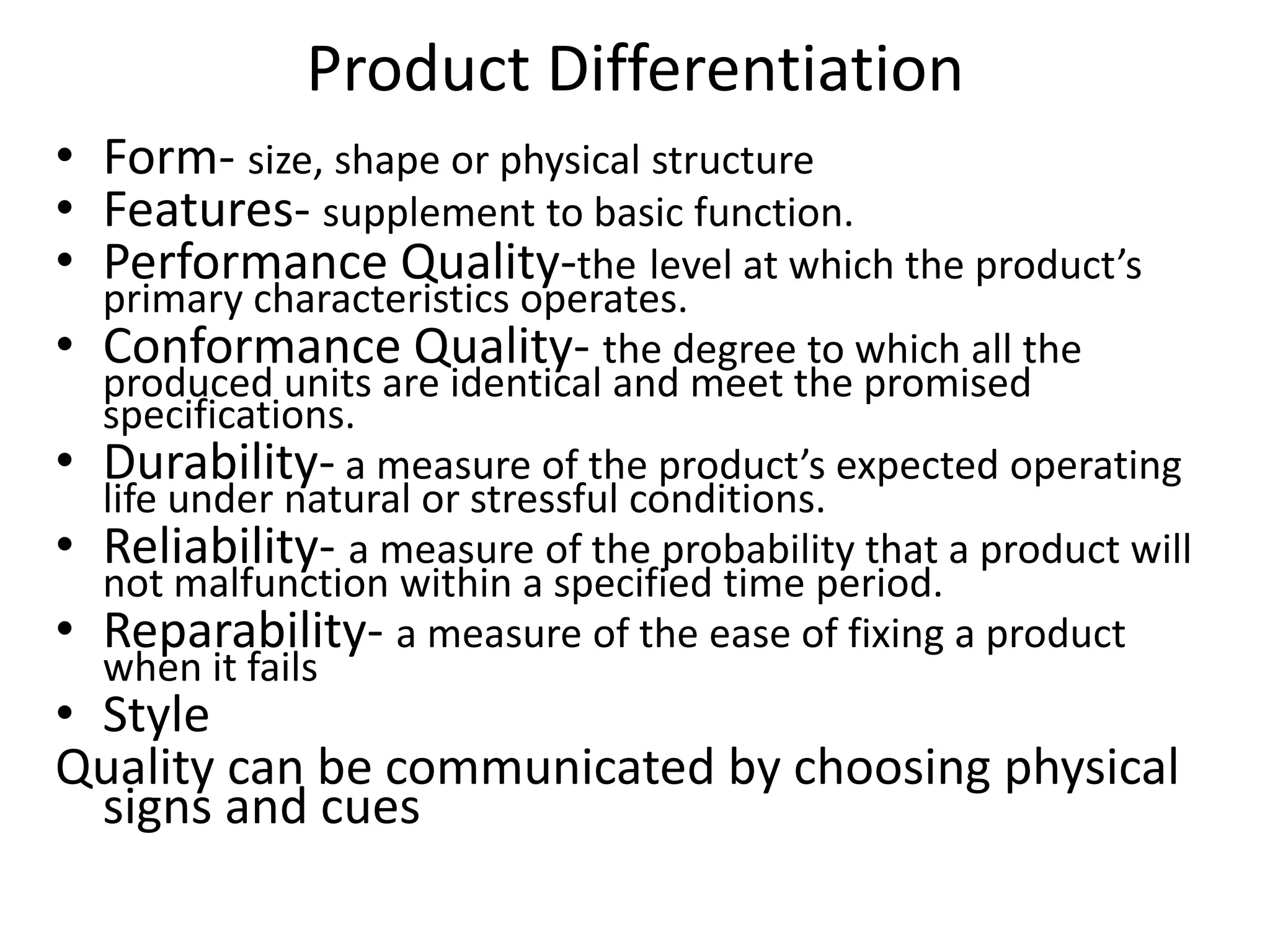
Product Differentiation
• Form- size, shape or physical structure
• Features- supplement to basic function.
• Performance Quality-the level at which the product’s
    primary characteristics operates.
•   Conformance Quality- the degree to which all the
    produced units are identical and meet the promised
    specifications.
•   Durability- a measure of the product’s expected operating
    life under natural or stressful conditions.
•   Reliability- a measure of the probability that a product will
    not malfunction within a specified time period.
•   Reparability- a measure of the ease of fixing a product
    when it fails
• Style
Quality can be communicated by choosing physical
  signs and cues
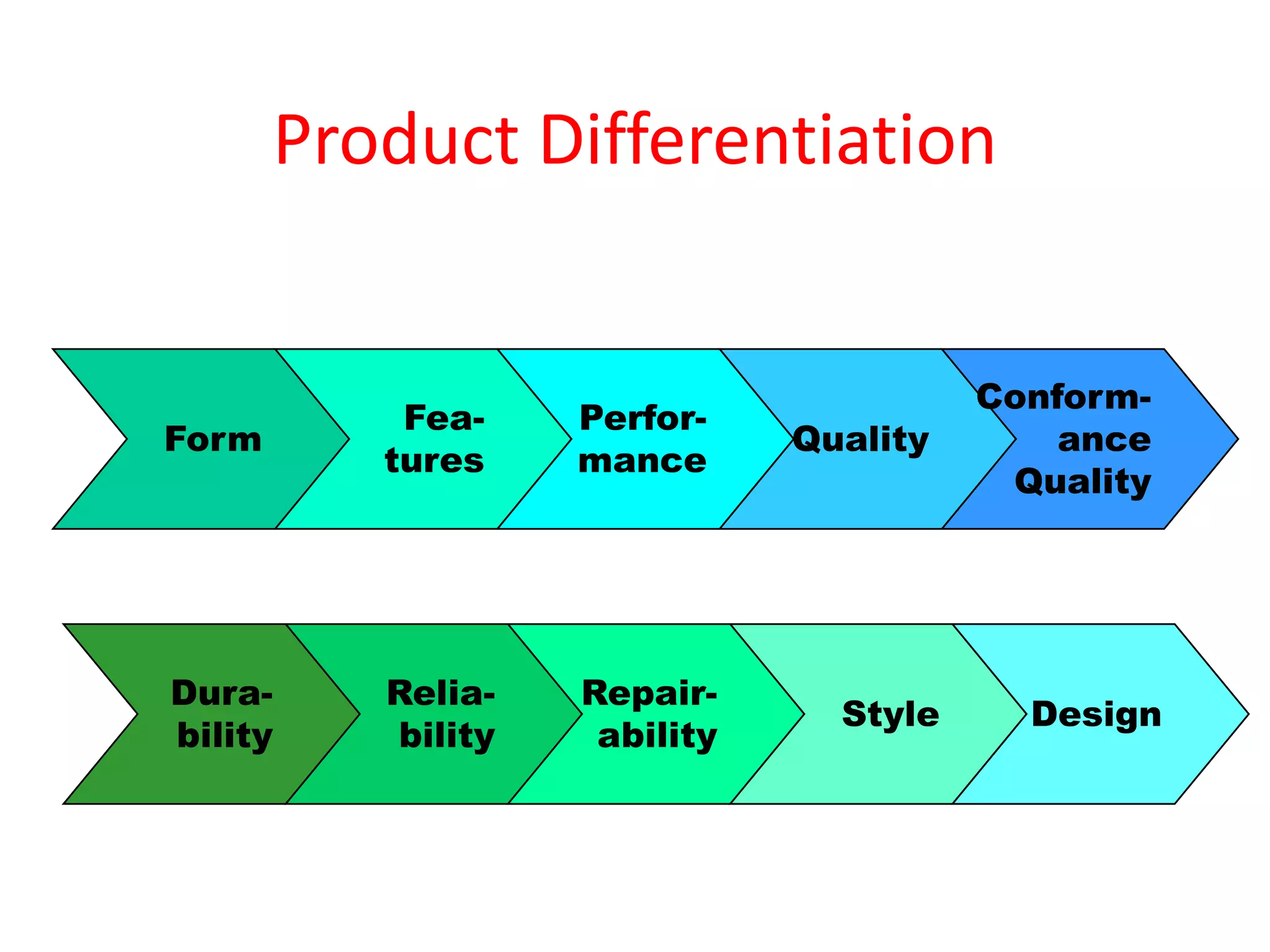
Product Differentiation


                                        Conform-
           Fea-    Perfor-
Form                          Quality       ance
          tures    mance
                                         Quality


Dura-     Relia-   Repair-
                                Style     Design
bility    bility    ability
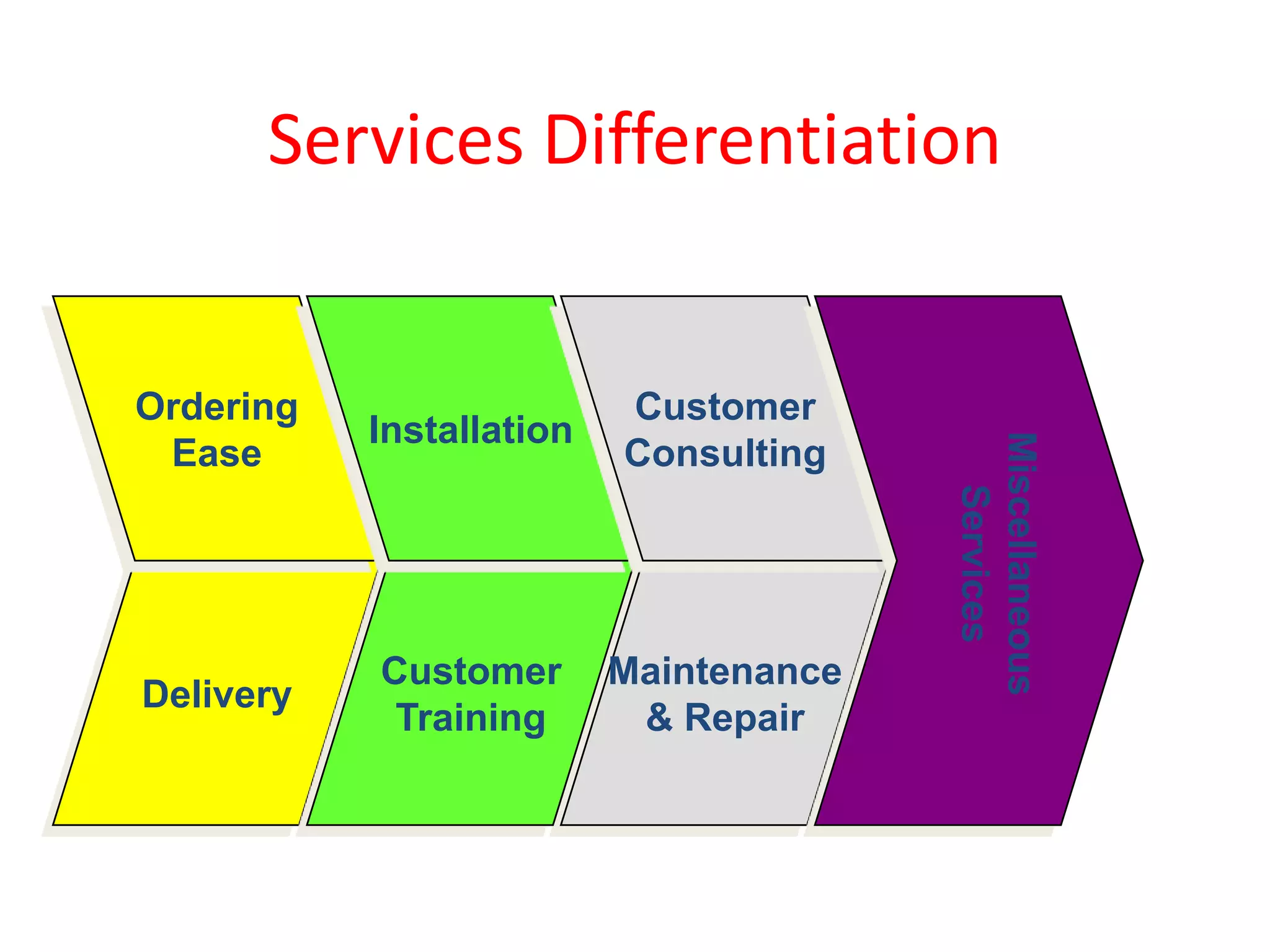
Services Differentiation


Ordering                  Customer
           Installation


                                        Miscellaneous
 Ease                     Consulting


                                          Services
           Customer       Maintenance
Delivery
            Training       & Repair
Services Differentiation
•   Ordering ease
•   Delivery
•   Installation
•   Customer training
•   Customer consulting
•   Maintenance and repair
Personnel Differentiation
•   Competence
•   Courtesy
•   Credibility
•   Reliability
•   Responsiveness
•   Communication
Channel Differentiation
• Coverage
• Expertise
• Performance
Image Differentiation
• Image is the way the public perceives the
  company or its products.
• Identity is the way a company aims to
  identify or position itself or its products.
• Symbols, colors, slogans, atmosphere,
• Events and employee behavior
Choosing the right competitive
                advantage
• How many differences to promote?
   • Unique selling proposition
   • Several benefits
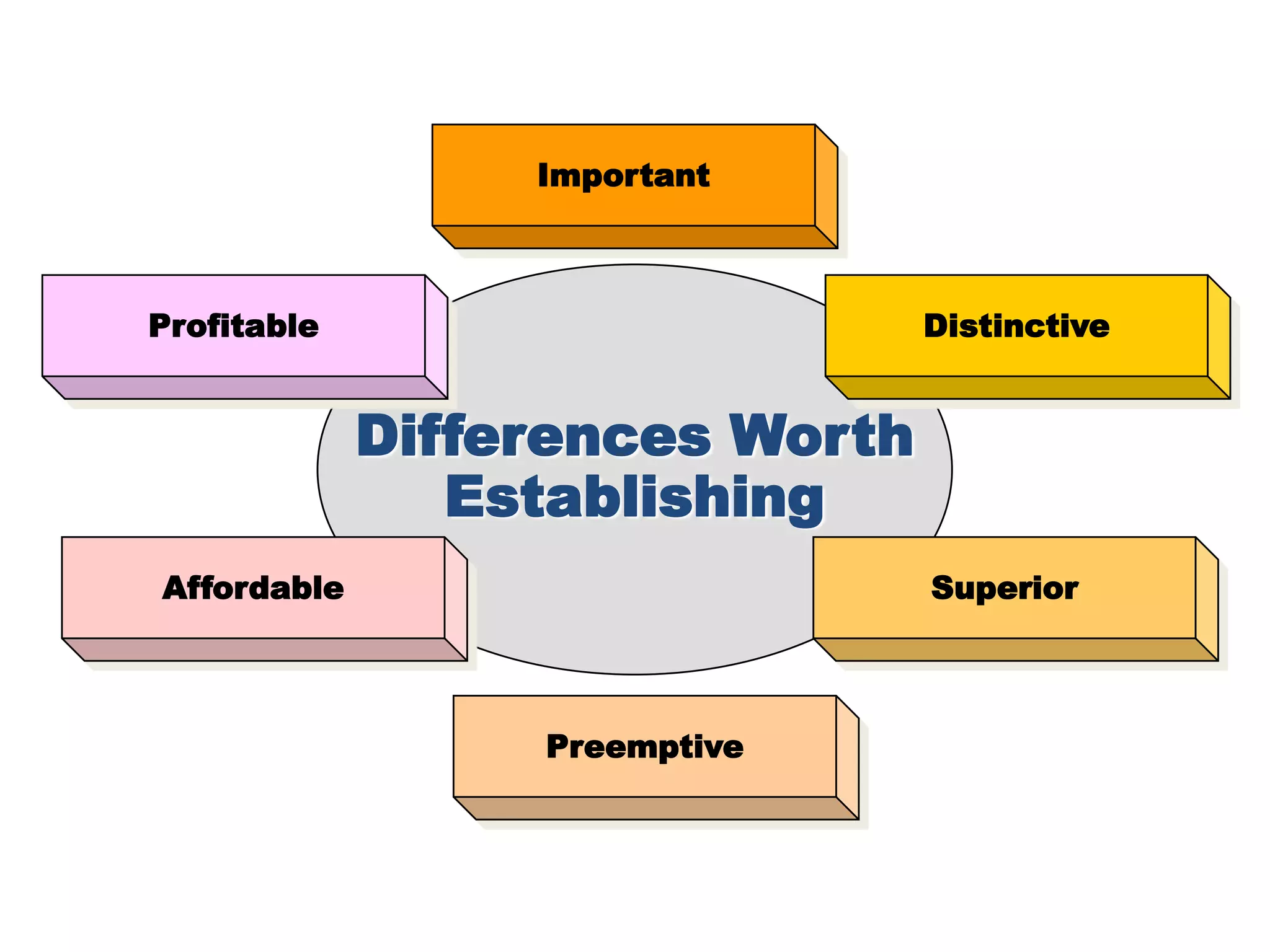
• Which differences to promote? Criteria include:
   • Important
   • Distinctive
   • Superior
   • Communicable
   • Preemptive
   • Affordable
   • Profitable
Developing and communicating a
         positioning strategy
All products can be differentiated to some
  extent. But not all differences are meaningful
  or worthwhile. A difference is worth
  establishing to the extent that it satisfies the
  following criteria :
• Important : The difference delivers a highly
  valued benefit to a sufficient numbers of
  buyers.
• Distinctive : The difference is delivered in a
  distinctive way.
Developing and communicating a
         positioning strategy
• Superior : The difference is superior to other
  ways of obtaining the benefit.
• Preemptive : The difference cannot be easily
  copied by competitors.
• Affordable : The buyer can afford to pay for
  the difference.
• Profitable : The company will find it
  profitable to introduce the difference.
Choosing a positioning strategy
• Value propositions ( the whole cluster of benefits the
  company promises to deliver )represent the full
  positioning of the brand
• Possible value propositions:
   – More for More
   – More for the Same
   – More for Less
   – The Same for Less
   – Less for Much Less
Important


Profitable                       Distinctive


             Differences Worth
                Establishing
Affordable                       Superior


                  Preemptive
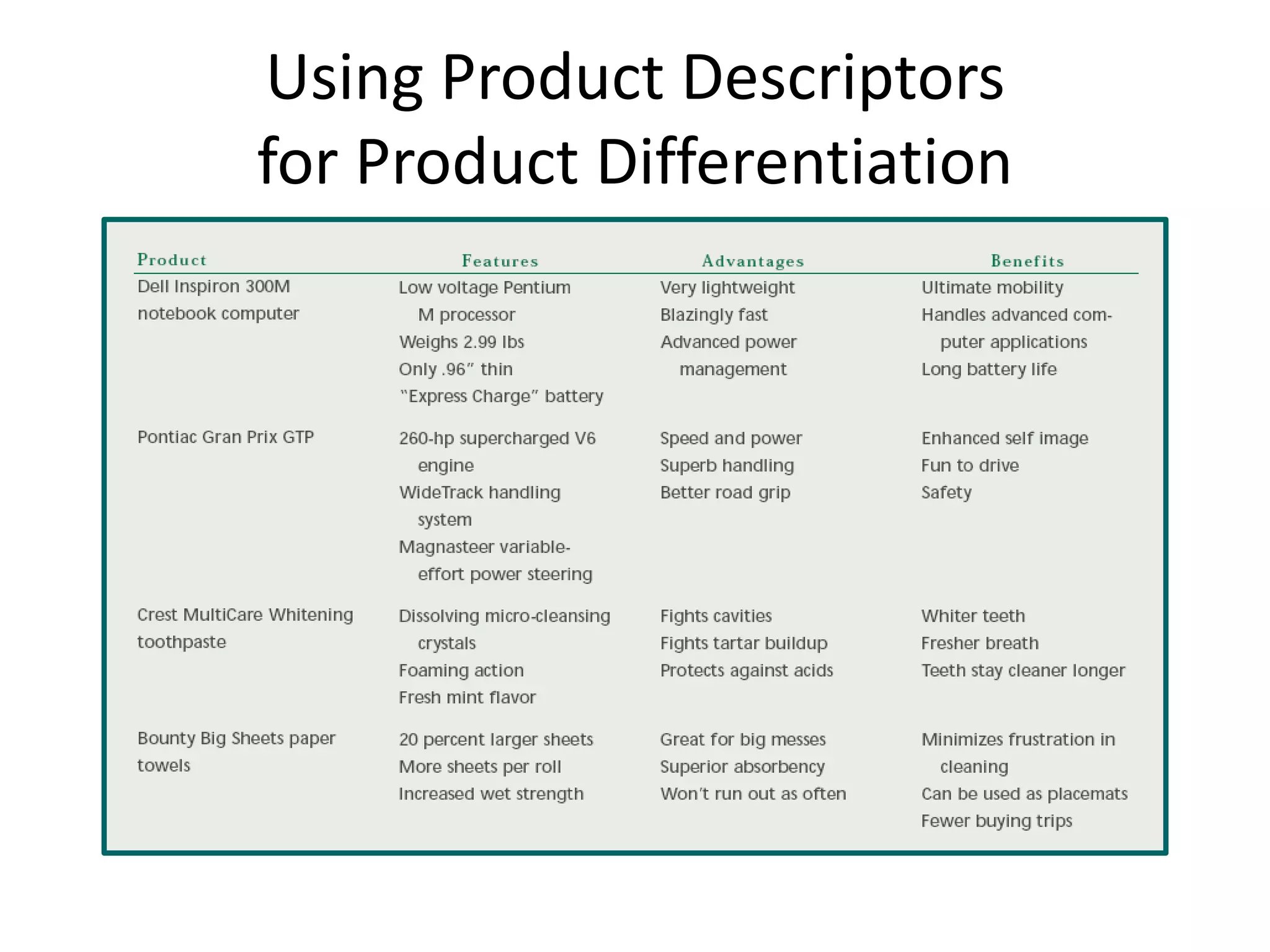
Using Product Descriptors
for Product Differentiation
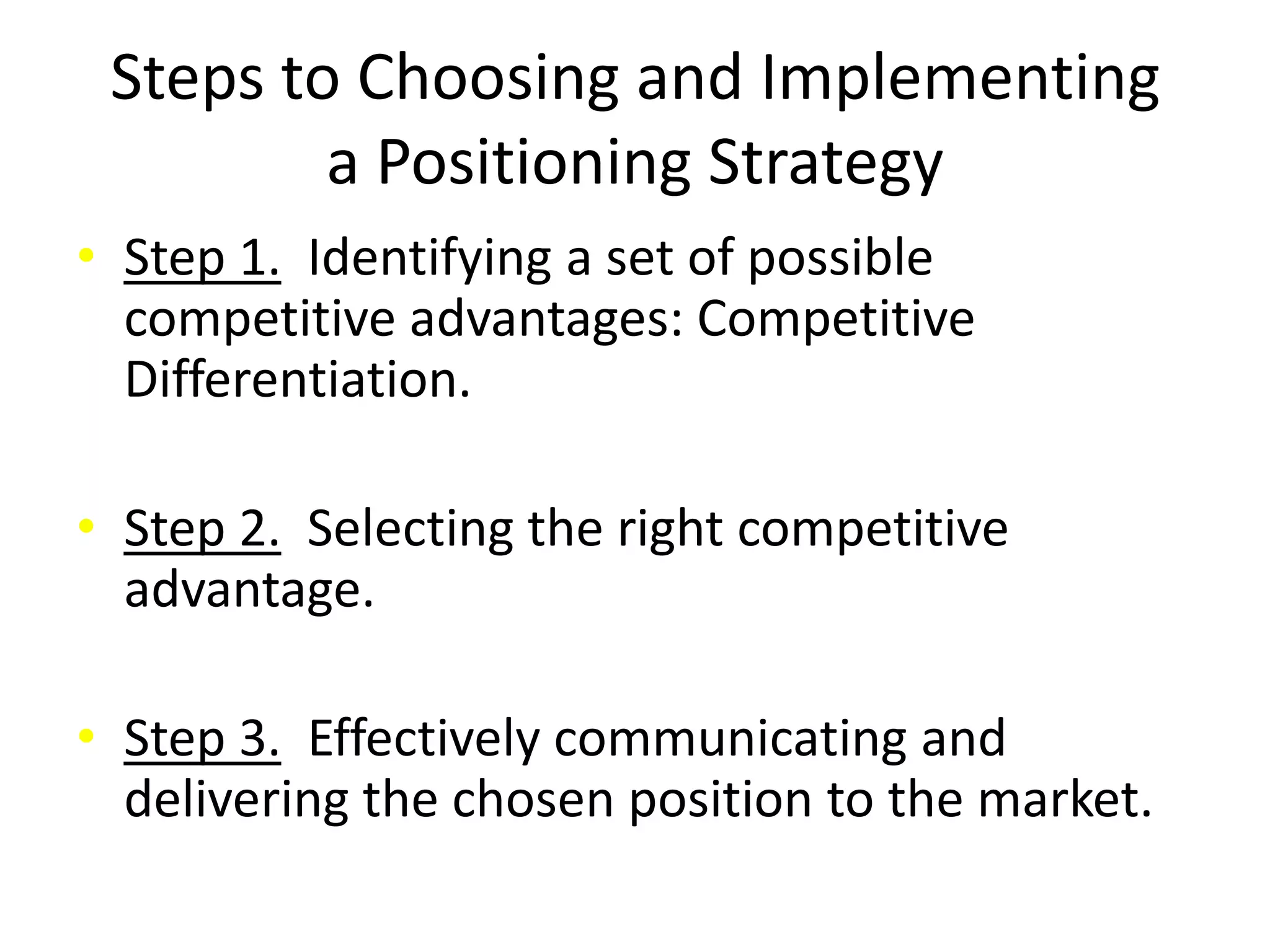
Steps to Choosing and Implementing
         a Positioning Strategy
• Step 1. Identifying a set of possible
  competitive advantages: Competitive
  Differentiation.

• Step 2. Selecting the right competitive
  advantage.

• Step 3. Effectively communicating and
  delivering the chosen position to the market.
Developing Competitive
Differentiation

      Product                     Service


              Areas for Competitive
                 Differentiation


      Personnel                       Image
Some examples
Lays
Dove
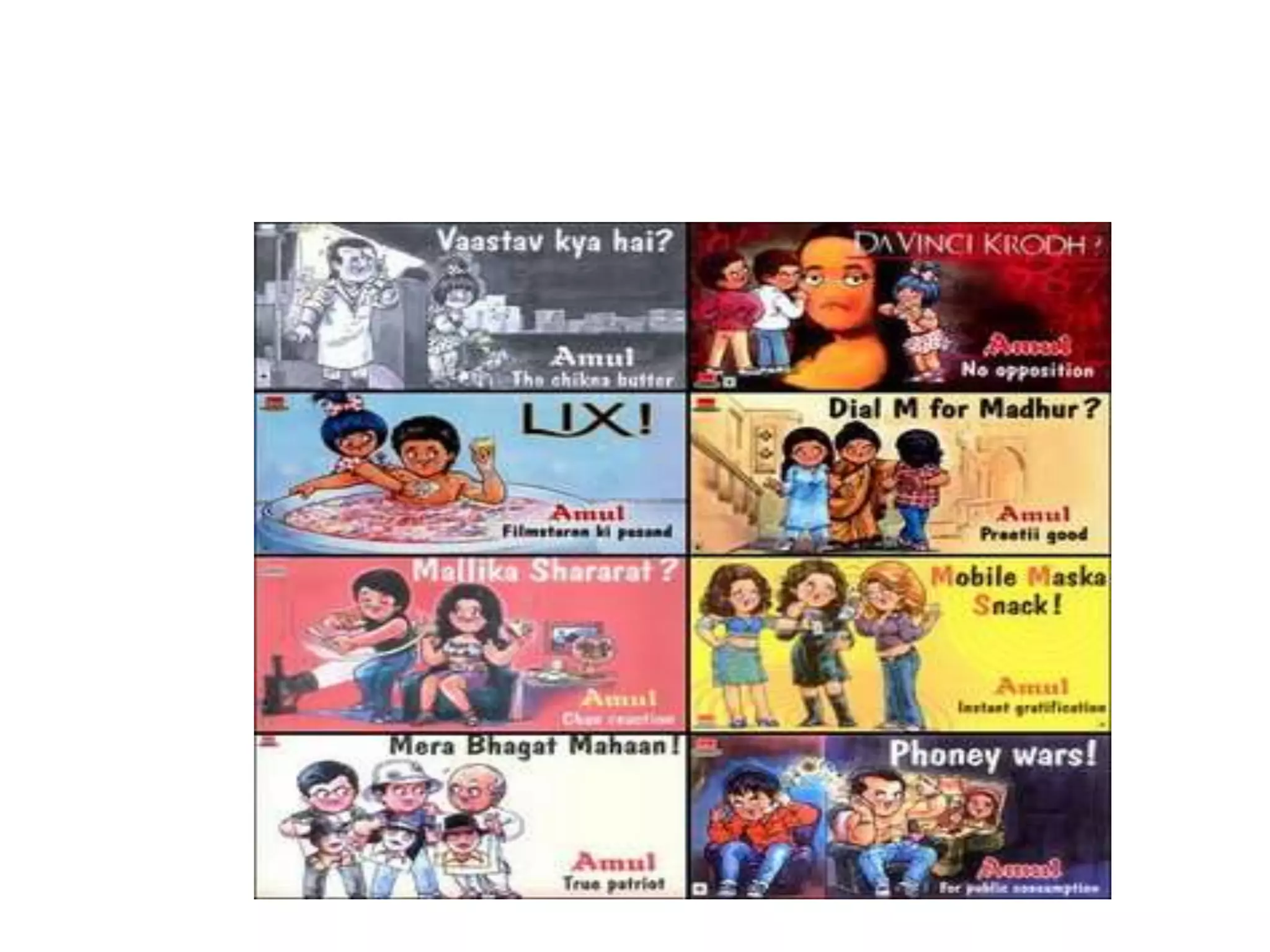
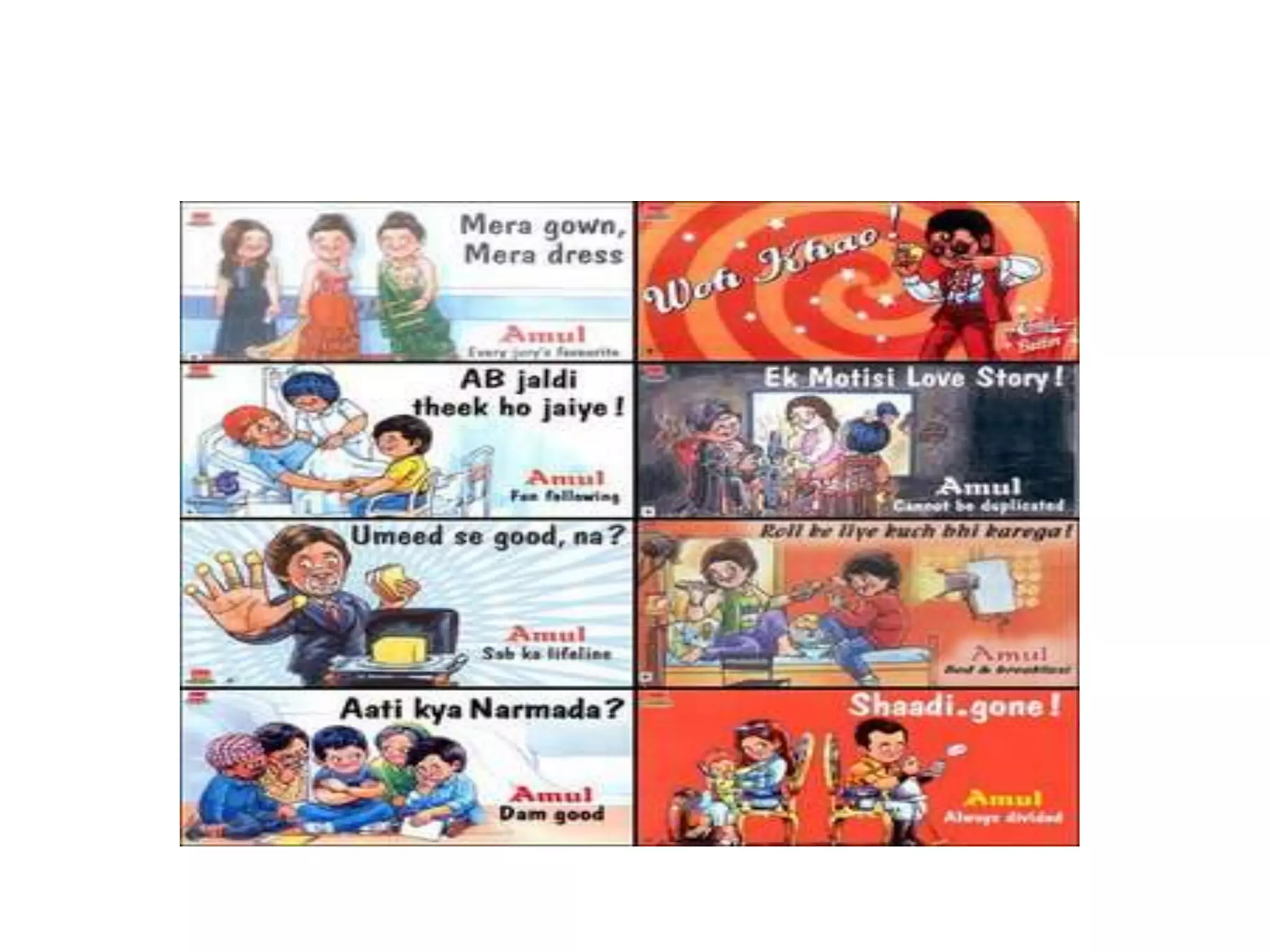
Amul : The taste of India
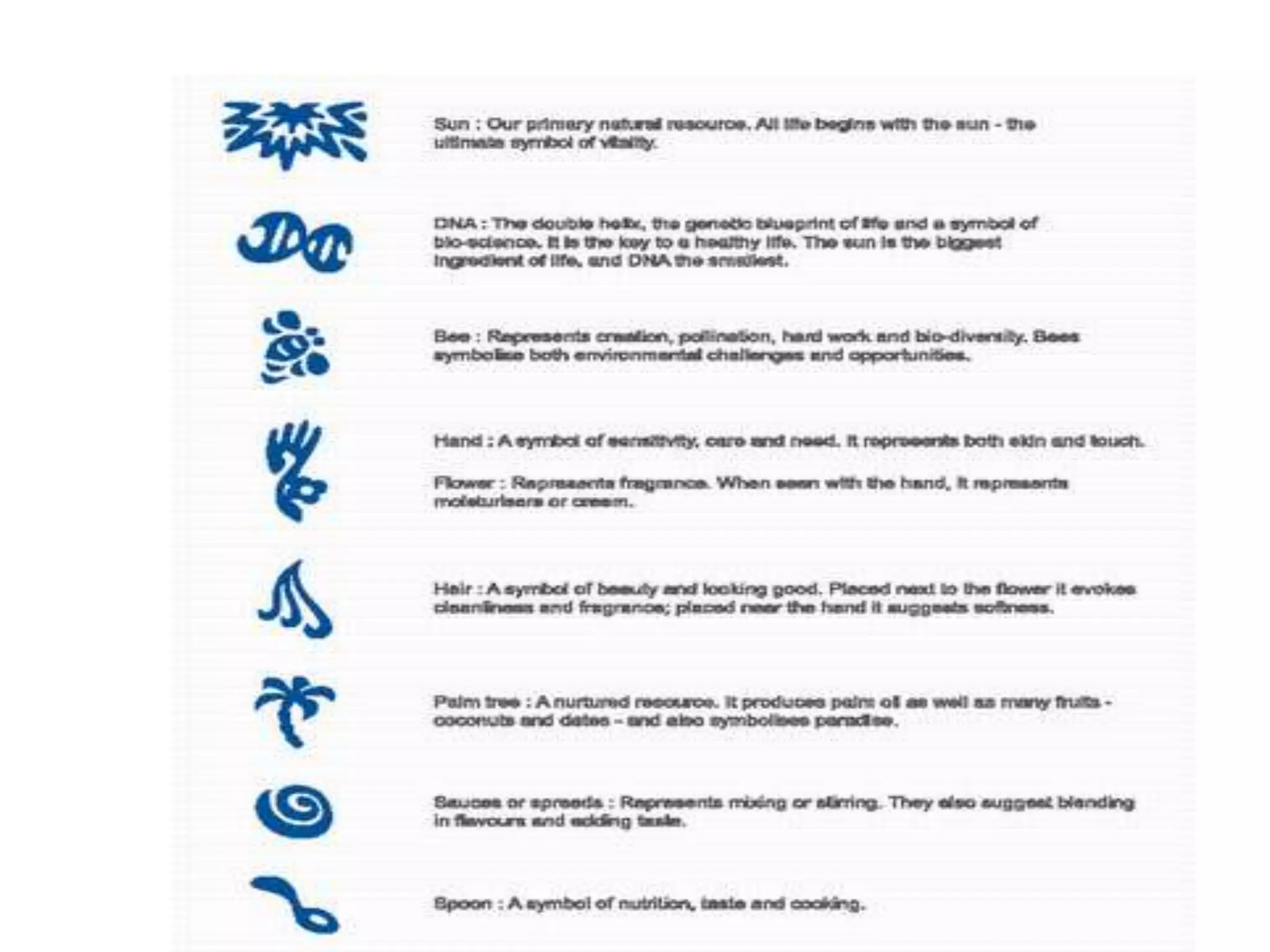
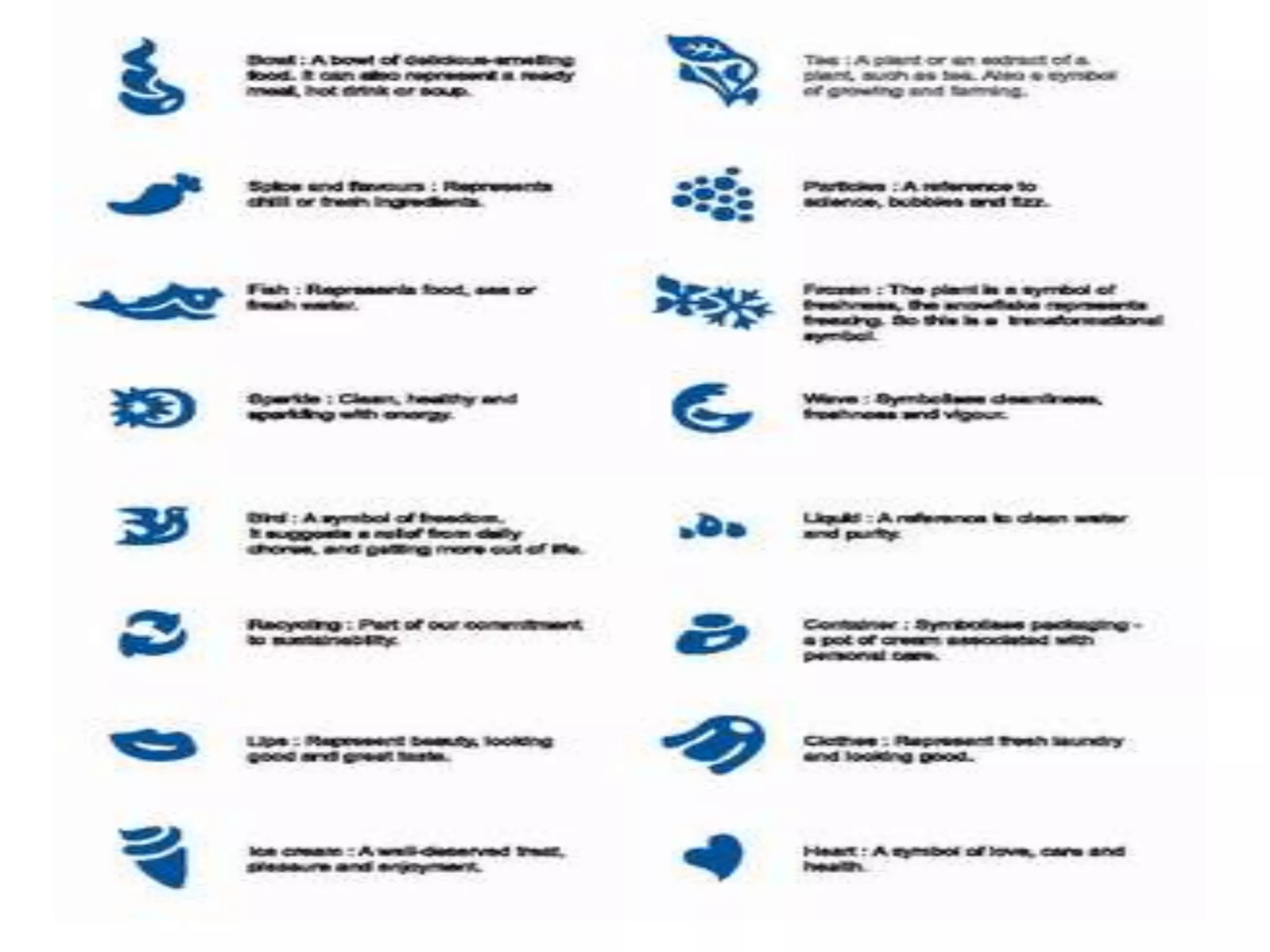
Hindustan Unilever Limited
HDFC Standard Life Insurance

Targeting & positioning

  • 1.
  • 2.
    Target Marketing • TargetMarket – Consists of a set of buyers who share common needs or characteristics that the company decides to serve. – The process of evaluating segments and focusing marketing efforts on a country, region, or group of people that has significant potential to respond
  • 3.
    Criteria for Targeting:9 W’s • Who buys our product? • Who does not buy it? • What need or function does it serve? • What are customers buying to satisfy the need for which our product is targeted? • What price are they paying? • When is the product purchased? • Where is it purchased? • Why is it purchased?
  • 4.
    FACTORS CONSIDERED IMPORTANTIN THE SELECTION OF TARGET MARKET STRATEGY • 1. Company’s Resources • 2. Product Homogeneity • 3. Product Stage in the Life Cycle • 4. Market Homogeneity • 5. Competitive Marketing Strategy
  • 5.
    Target Marketing Strategies •Five basic strategies for target market selection: – (1) Single Segment Targeting – (2) Selective Targeting – (3) Mass Market Targeting – (4) Product Specialization – (5) Market Specialization
  • 6.
  • 7.
    Target Marketing Choosing aMarket-Coverage Strategy Company Resources Product Variability Product’s Life-Cycle Stage Market Variability Competitors’ Marketing Strategies
  • 8.
    Strategies of TargetMarketing • Selecting Target Market Segments – Undifferentiated (mass) marketing – (A company’s attempt to appeal to the whole market with a single basic marketing strategy intended to have a mass appeal.) – Differentiated (segmented) marketing – (a company’s attempt to appeal to two or more well defined market segments with a marketing strategy tailored to each segment) – Concentrated (niche) marketing – (a company’s attempt to appeal to one well defined market segment with one tailor made marketing strategy.) – Micromarketing (local or individual)
  • 9.
    Positioning is theact of designing the company’s offering and image to occupy a distinctive place in the target market’s mind.
  • 10.
    Positioning • Positioning: – The place the product occupies in consumers’ minds relative to competing products. – Typically defined by consumers on the basis of important attributes. – Involves implanting the brand’s unique benefits and differentiation in the customer’s mind. – Positioning maps that plot perceptions of brands are commonly used. • Product’s Position - the place the product occupies in consumers’ minds relative to competing products; i.e. Volvo positions on “safety”. • Marketers must: – Plan positions to give products the greatest advantage – Develop marketing mixes to create planned positions
  • 11.
    Bases for Positioning •Features: physical traits and performance • Benefits : feviquick, nerolac paint, fairglow soap • Usage:- chawanprash for body resistance, pulsur for specific area • Parentage:- sony vaio, tata indica, Fiat Palio • Manufacturing process: Fab India Hand Crafted • Ingredients:- 100% cotton, 100% wool made • Endorsement:- Lalita ji surf add, sachin boost secret of energy • Comparison:- • Pro-environment: canon made from recycled material • Product class:- dove as moisturizer not as toilet soap, pears as glycerin soap • Price/ quality:- Zenith computers “ multinational quality, Indian price” • Country or geographic area:- German engineering, banarsi sari
  • 12.
    Positioning must cover • Who am I? ( the identity, family) • What am I ? ( the functional capabilities • For whom am I? ( whom do I serve best) • Why me? ( why consumer should choose me and not the other alternatives)
  • 13.
    How many differencesto promote as positioning • A USP of all product • Lux “ beauty soap of female film stars” • Promise toothpaste “ clove protection for teeth” • “ best quality” , • “most advanced” • “Best service” • “Lowest price”
  • 14.
    Differentiation and Positioning •Process of creating favorable relative position: – (1) Identification of target market – (2) Determination of needs, wants, preferences and benefits desired – (3) Examination of competitors’ characteristics and positioning – (4) Comparison of product offerings with competitors – (5) Identification of unique position – (6) Development of a marketing program – (7) Continual reassessment
  • 15.
    Positioning Strategies • ProductAttributes & Benefits, Problem Solutions • Colgate is positioned on fresh breath. Decay prevention and taste. • Coseup fresh breath, cosmetic benefits • Promise clove oil and gum care • Price & Quality • Nirma washing powder quality product at low price • Zenith computer value for money • Omega,rolex, mercedes,rolls royace higher price • Specific Use, occasion & time • Vicks vapo rub child's cold at night • Iodex for sprain and muscle pains • Burnol for burns • Dettol antiseptic lotion Positioning by corporate identity tata, sony, godrej and seiko • Positioning by product category • Maruti maruti omni van, budgeted cars • Seven up fresh cleen taste, thirst quenching • Rajdoot rough & tuff • Dove cleansing moisturiser
  • 16.
    Positioning Strategies • AgainstOther Products • Product User • Dabur chavanyaprash ayurvedic tonic for all as ages • Zndu chawanyaprash for families with small children to build resistance • Jhonson & jhonson for babies • Against a Competitor
  • 17.
    POSITIONING STRATEGIES • Identifyingpossible competitive advantages • Differentiation can be based on – Products – Services – Channels – People – Image – benefits
  • 18.
    Product Differentiation • Form-size, shape or physical structure • Features- supplement to basic function. • Performance Quality-the level at which the product’s primary characteristics operates. • Conformance Quality- the degree to which all the produced units are identical and meet the promised specifications. • Durability- a measure of the product’s expected operating life under natural or stressful conditions. • Reliability- a measure of the probability that a product will not malfunction within a specified time period. • Reparability- a measure of the ease of fixing a product when it fails • Style Quality can be communicated by choosing physical signs and cues
  • 19.
    Product Differentiation Conform- Fea- Perfor- Form Quality ance tures mance Quality Dura- Relia- Repair- Style Design bility bility ability
  • 20.
    Services Differentiation Ordering Customer Installation Miscellaneous Ease Consulting Services Customer Maintenance Delivery Training & Repair
  • 21.
    Services Differentiation • Ordering ease • Delivery • Installation • Customer training • Customer consulting • Maintenance and repair
  • 22.
    Personnel Differentiation • Competence • Courtesy • Credibility • Reliability • Responsiveness • Communication
  • 23.
  • 24.
    Image Differentiation • Imageis the way the public perceives the company or its products. • Identity is the way a company aims to identify or position itself or its products. • Symbols, colors, slogans, atmosphere, • Events and employee behavior
  • 25.
    Choosing the rightcompetitive advantage • How many differences to promote? • Unique selling proposition • Several benefits • Which differences to promote? Criteria include: • Important • Distinctive • Superior • Communicable • Preemptive • Affordable • Profitable
  • 26.
    Developing and communicatinga positioning strategy All products can be differentiated to some extent. But not all differences are meaningful or worthwhile. A difference is worth establishing to the extent that it satisfies the following criteria : • Important : The difference delivers a highly valued benefit to a sufficient numbers of buyers. • Distinctive : The difference is delivered in a distinctive way.
  • 27.
    Developing and communicatinga positioning strategy • Superior : The difference is superior to other ways of obtaining the benefit. • Preemptive : The difference cannot be easily copied by competitors. • Affordable : The buyer can afford to pay for the difference. • Profitable : The company will find it profitable to introduce the difference.
  • 28.
    Choosing a positioningstrategy • Value propositions ( the whole cluster of benefits the company promises to deliver )represent the full positioning of the brand • Possible value propositions: – More for More – More for the Same – More for Less – The Same for Less – Less for Much Less
  • 29.
    Important Profitable Distinctive Differences Worth Establishing Affordable Superior Preemptive
  • 30.
    Using Product Descriptors forProduct Differentiation
  • 31.
    Steps to Choosingand Implementing a Positioning Strategy • Step 1. Identifying a set of possible competitive advantages: Competitive Differentiation. • Step 2. Selecting the right competitive advantage. • Step 3. Effectively communicating and delivering the chosen position to the market.
  • 32.
    Developing Competitive Differentiation Product Service Areas for Competitive Differentiation Personnel Image
  • 33.
  • 35.
  • 36.
  • 37.
    Amul : Thetaste of India
  • 40.
  • 43.