CONSUMER 
BEHAVIOUR 
Aravind TS
Grasping consumer behaviour 
,Basic to Value delivery 
 Marketing is all about value delivery 
 Marketers role is to deliver relevant value to 
the consumer .
The Value a buyer seeks in a 
Car 
 Situation 1 
(Economic value, the main concern) 
I want to graduate from my two wheeler to 
four wheeler.Price and EMI must be below 
Rs.5000/-
 Situation-2 
 (Functional Value, The main concern) 
I want good pickup,little more space and modern 
technology.
 Situation 3 
 (Social/Status value ,the main concern) 
 My zen is 3years old .I must upgrade now .All 
my colleagues are switching on to better cars.
Consumers 
 Individuals 
 Households 
 Business
Consumer Behaviour 
Study of how individual make decision to 
spend their available resources(money, time & 
effort) on consumption related items.
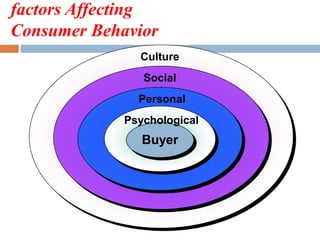
factors Affecting 
Consumer Behavior 
Culture 
Social 
Personal 
Psychological 
Buyer
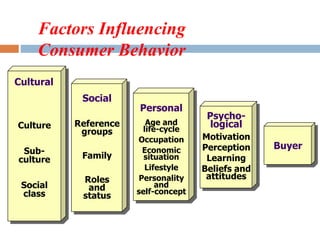
Factors Influencing 
Consumer Behavior 
Social 
Reference 
groups 
Family 
Roles 
and 
status 
Personal 
Age and 
life-cycle 
Occupation 
Economic 
situation 
Lifestyle 
Personality 
and 
self-concept 
Psycho-logical 
Motivation 
Perception 
Learning 
Beliefs and 
attitudes 
Buyer 
Cultural 
Culture 
Sub-culture 
Social 
class
Consumer does not 
go by set rules in his 
buying decision
Different Models of Buying 
behviour 
 Economic model 
 Learning model 
 Psychoanalytical model 
 Sociological model 
 Systems model 
1.Nicosia model 
2.Howard and sheth model
Economic model 
 The buyer is a rational man and his buying are 
governed by the concepts of utility 
 Intent to maximise the utility/benefit/need 
satisfaction.
Learning Model 
 Buyer behaviour can be influenced by 
manipulating the drives,Stimuli and responses 
of the buyer . 
 The model rests on the human ability of 
learning , forgetting , and discriminating
Sociological Model 
 The individual buying behavior by society – 
intimate groups as well as social class 
 The buying decisions are not totally governed 
b Utility, but he has a desire to emulate ,follow, 
and fit in with his environment.
Psychological model 
 A consumer has complex set of deep-seated 
motives that drive him towards certain 
behviour. 
 He has a private world with all his hidden 
fears, suppressed desires and totally 
subjective longings.
The System Model 
 Human being is analysed as a system,with 
stimuli as the input to the system and behviour 
as the output of the system. 
1.Nicosia Model 
2.Howard-Sheth Model
Nicosia Model-1966 
By: Francesco Nicosia 
 The model tries to establish the link between a 
firm and its consumer. 
 How the activities of the firm influence the 
consumer and result in his decision to buy
Howard – Sheth Model-1969 
John Howard and Jagadish sheth 
 Input – Stimuli 
 Output - Beginning with attention to the given 
stimuli and ending with purchase
Factors influencing Buying 
Behaviour
 Personal Factors 
a) Personal demographics 
b) Personal psychographics 
 Socio Cultural Factors 
a) Culture 
b) Social Factors/Influence of reference group
1.Personal Factors 
A. Demographics of the customer 
 Age 
 Stage in family cycle 
 Education 
 Occupation 
 Economic position
B. Psychographics of the customer 
 Lifestyle 
 Attitudes 
 Self-concept 
 Concern about status 
 Value system 
 Beliefs
2.Socio-cultural group 
A. Culture 
 Religion 
 Caste 
 Tradition 
 Language
B. Social Factors/Reference group 
1.Intimate group 
 Family, frinds ,peer groups, close collegagues & 
close kint organizations 
2. Secondary group 
 Occupation ,profession, place of residence 
3.Opinion Leaders 
 The others seeks guidance from these people 
4.Larger social class 
 Eduction,wealth,value-orientation, 
occupation/profession and designation
3.Information reaching from 
customer from various sources. 
 Advertising 
 Promotional campagains 
 Samples/ trials 
 Display in shops 
 Salesmen suggestions
 How does a consumer decision come up ? 
Stimulus 
A large variety of stimulus is involved
Buying Motives 
 All the impulses, desires and consideration 
,which induce buyer to purchase a given 
product. 
1. Product Motives 
2. Patronage Motives
 Product motives :- The impulses, desires and 
considerations that makes people buy a given 
product 
 Patronage Motive :- The impulse desire and 
consideration that makes people buy from 
particular firm/shop .
 Product Motives 
 Acc.to the nature of satisfaction sought by the 
buyer ,puts them in following two category 
1. Emotional product motives 
2. Rational product motives
 Another classification that takes into account 
the utility and prestige dimensions of a product 
1. Operational product motives 
2. Socio psychological Product motives
 Emotional Product motives 
 Those impulses that appeal to the buyers 
pride or ego,his urge to imitate others,or his 
desire to be distinctive.(Buying pattern : 
without evaluating products plus or minus)
Rational product motives 
 Careful reasoning or logical analysis need not 
be found behind such purchases
Operational product motives 
 A buyer can gain satisfaction from the function 
or physical utility of a product 
Socio-Psychological product 
 Social psychological factor attached to the 
product
Patronage motive 
 Emotional patronage motives: Those that 
persuade buyer to buy from specific shops, 
without much logical reason behind it. 
 Rational motives: If a buyer knows that shop 
will offer a wide selection , latest model,good 
after service
Buying Habits/Shoping 
behaviour 
1. Convenience goods 
2. Shopping goods 
3. Specialty goods
 Convenience goods 
Products for daily consumption ,like tooth 
paste,soap,cigarettes,etc 
The consumer is not prepared to make a special 
shopping trip for buying such product .Switch 
to substitute product or brand that is available 
in the immediate vicinity.
 Shopping goods 
Clothes, shoes, electrical appliance etc..not 
purchased frequently. 
1. Planning 
2. Ready to make more than one shopping trip 
3. Considerable expenditure 
4. Compare price, quality, models etc
Speciality goods 
 Special goods are high priced goods include 
products like cars, luxury watches, high priced 
dresses, ornaments,etc 
1. Substantial investment 
2. Periodicity of purchase is less 
3. No instant decision 
4. Cost angle, utility angle, prestige angle 
5. Entire family takes part in the decision 
making.
Consumer Decision Making
Problem Recognition (Need Recognition) 
 He recognises a problem and develops a 
perception of the problem 
 Seeks information from the environment for 
solving his problem
 Awareness (Information search) 
 Information search will helps him to aware the 
existence of the product that would solve his 
problem .
 Comprehension ( Evaluation of 
Alternatives) 
Awareness and comprehension stages 
represents the information processing stages. 
These two stages constitute the cognitive field of 
purchase process.(acquisition of knowledge)
 Adoption (purchase) 
This is an conative and action field
Post purchase Behaviour 
 Reaction and evaluation 
 Satisfaction/Dissonance 
 Seek additional information
Consumer behaviour in adopting 
new product
Innovators (2.5%) 
 Innovators are the first consumers to buy a 
new product. 
 They are venturesome, willing to accept risk, 
socially aggressive, communicative, and 
cosmopolitan. 
 This group represents 2.5 per cent of the 
target market.
Early adopters (13.5) 
 Early adopters are the next consumers to buy 
a new product. 
 They enjoy the leadership, prestige, and 
respect that early purchases bring. 
 These consumers tend to be opinion leaders. 
 They adopt new ideas but use discretion. 
 This group represents 13.5 per cent of the 
market.
The early majority(34%) 
 The early majority is the first part of the mass 
market to buy a product. 
 They have status in their social class and are 
outgoing, communicative, and attentive to 
information cues. 
 This group represents 34 per cent of the target 
market.
The late majority(34%) 
 The late majority is the second part of the 
mass market to buy a product. 
 They are less cosmopolitan and responsive to 
change. 
 The late majority includes people with lower 
economic and social status, those past middle 
age, and skeptics. 
 This group represents 34 per cent of the 
market.
Laggards (16%) 
 . Laggards are last to purchase. 
 They are price conscious, suspicious of 
change, low in income and status, tradition 
bound, and conservative. 
 Do not adopt a product until it reaches 
maturity. Some firms ignore them because it 
can be difficult to market a product to this 
small group. 
 However, a market segmenter may do well by 
concentrating on products for laggards. This 
group represents 16 per cent of the market.

Consumer behaviour

  • 1.
  • 2.
    Grasping consumer behaviour ,Basic to Value delivery  Marketing is all about value delivery  Marketers role is to deliver relevant value to the consumer .
  • 3.
    The Value abuyer seeks in a Car  Situation 1 (Economic value, the main concern) I want to graduate from my two wheeler to four wheeler.Price and EMI must be below Rs.5000/-
  • 4.
     Situation-2 (Functional Value, The main concern) I want good pickup,little more space and modern technology.
  • 5.
     Situation 3  (Social/Status value ,the main concern)  My zen is 3years old .I must upgrade now .All my colleagues are switching on to better cars.
  • 6.
    Consumers  Individuals  Households  Business
  • 7.
    Consumer Behaviour Studyof how individual make decision to spend their available resources(money, time & effort) on consumption related items.
  • 8.
    factors Affecting ConsumerBehavior Culture Social Personal Psychological Buyer
  • 9.
    Factors Influencing ConsumerBehavior Social Reference groups Family Roles and status Personal Age and life-cycle Occupation Economic situation Lifestyle Personality and self-concept Psycho-logical Motivation Perception Learning Beliefs and attitudes Buyer Cultural Culture Sub-culture Social class
  • 11.
    Consumer does not go by set rules in his buying decision
  • 12.
    Different Models ofBuying behviour  Economic model  Learning model  Psychoanalytical model  Sociological model  Systems model 1.Nicosia model 2.Howard and sheth model
  • 13.
    Economic model The buyer is a rational man and his buying are governed by the concepts of utility  Intent to maximise the utility/benefit/need satisfaction.
  • 14.
    Learning Model Buyer behaviour can be influenced by manipulating the drives,Stimuli and responses of the buyer .  The model rests on the human ability of learning , forgetting , and discriminating
  • 15.
    Sociological Model The individual buying behavior by society – intimate groups as well as social class  The buying decisions are not totally governed b Utility, but he has a desire to emulate ,follow, and fit in with his environment.
  • 16.
    Psychological model A consumer has complex set of deep-seated motives that drive him towards certain behviour.  He has a private world with all his hidden fears, suppressed desires and totally subjective longings.
  • 17.
    The System Model  Human being is analysed as a system,with stimuli as the input to the system and behviour as the output of the system. 1.Nicosia Model 2.Howard-Sheth Model
  • 18.
    Nicosia Model-1966 By:Francesco Nicosia  The model tries to establish the link between a firm and its consumer.  How the activities of the firm influence the consumer and result in his decision to buy
  • 19.
    Howard – ShethModel-1969 John Howard and Jagadish sheth  Input – Stimuli  Output - Beginning with attention to the given stimuli and ending with purchase
  • 20.
  • 21.
     Personal Factors a) Personal demographics b) Personal psychographics  Socio Cultural Factors a) Culture b) Social Factors/Influence of reference group
  • 22.
    1.Personal Factors A.Demographics of the customer  Age  Stage in family cycle  Education  Occupation  Economic position
  • 23.
    B. Psychographics ofthe customer  Lifestyle  Attitudes  Self-concept  Concern about status  Value system  Beliefs
  • 24.
    2.Socio-cultural group A.Culture  Religion  Caste  Tradition  Language
  • 25.
    B. Social Factors/Referencegroup 1.Intimate group  Family, frinds ,peer groups, close collegagues & close kint organizations 2. Secondary group  Occupation ,profession, place of residence 3.Opinion Leaders  The others seeks guidance from these people 4.Larger social class  Eduction,wealth,value-orientation, occupation/profession and designation
  • 26.
    3.Information reaching from customer from various sources.  Advertising  Promotional campagains  Samples/ trials  Display in shops  Salesmen suggestions
  • 27.
     How doesa consumer decision come up ? Stimulus A large variety of stimulus is involved
  • 29.
    Buying Motives All the impulses, desires and consideration ,which induce buyer to purchase a given product. 1. Product Motives 2. Patronage Motives
  • 30.
     Product motives:- The impulses, desires and considerations that makes people buy a given product  Patronage Motive :- The impulse desire and consideration that makes people buy from particular firm/shop .
  • 31.
     Product Motives  Acc.to the nature of satisfaction sought by the buyer ,puts them in following two category 1. Emotional product motives 2. Rational product motives
  • 32.
     Another classificationthat takes into account the utility and prestige dimensions of a product 1. Operational product motives 2. Socio psychological Product motives
  • 33.
     Emotional Productmotives  Those impulses that appeal to the buyers pride or ego,his urge to imitate others,or his desire to be distinctive.(Buying pattern : without evaluating products plus or minus)
  • 34.
    Rational product motives  Careful reasoning or logical analysis need not be found behind such purchases
  • 35.
    Operational product motives  A buyer can gain satisfaction from the function or physical utility of a product Socio-Psychological product  Social psychological factor attached to the product
  • 36.
    Patronage motive Emotional patronage motives: Those that persuade buyer to buy from specific shops, without much logical reason behind it.  Rational motives: If a buyer knows that shop will offer a wide selection , latest model,good after service
  • 37.
    Buying Habits/Shoping behaviour 1. Convenience goods 2. Shopping goods 3. Specialty goods
  • 38.
     Convenience goods Products for daily consumption ,like tooth paste,soap,cigarettes,etc The consumer is not prepared to make a special shopping trip for buying such product .Switch to substitute product or brand that is available in the immediate vicinity.
  • 39.
     Shopping goods Clothes, shoes, electrical appliance etc..not purchased frequently. 1. Planning 2. Ready to make more than one shopping trip 3. Considerable expenditure 4. Compare price, quality, models etc
  • 40.
    Speciality goods Special goods are high priced goods include products like cars, luxury watches, high priced dresses, ornaments,etc 1. Substantial investment 2. Periodicity of purchase is less 3. No instant decision 4. Cost angle, utility angle, prestige angle 5. Entire family takes part in the decision making.
  • 41.
  • 43.
    Problem Recognition (NeedRecognition)  He recognises a problem and develops a perception of the problem  Seeks information from the environment for solving his problem
  • 44.
     Awareness (Informationsearch)  Information search will helps him to aware the existence of the product that would solve his problem .
  • 45.
     Comprehension (Evaluation of Alternatives) Awareness and comprehension stages represents the information processing stages. These two stages constitute the cognitive field of purchase process.(acquisition of knowledge)
  • 46.
     Adoption (purchase) This is an conative and action field
  • 47.
    Post purchase Behaviour  Reaction and evaluation  Satisfaction/Dissonance  Seek additional information
  • 48.
    Consumer behaviour inadopting new product
  • 50.
    Innovators (2.5%) Innovators are the first consumers to buy a new product.  They are venturesome, willing to accept risk, socially aggressive, communicative, and cosmopolitan.  This group represents 2.5 per cent of the target market.
  • 51.
    Early adopters (13.5)  Early adopters are the next consumers to buy a new product.  They enjoy the leadership, prestige, and respect that early purchases bring.  These consumers tend to be opinion leaders.  They adopt new ideas but use discretion.  This group represents 13.5 per cent of the market.
  • 52.
    The early majority(34%)  The early majority is the first part of the mass market to buy a product.  They have status in their social class and are outgoing, communicative, and attentive to information cues.  This group represents 34 per cent of the target market.
  • 53.
    The late majority(34%)  The late majority is the second part of the mass market to buy a product.  They are less cosmopolitan and responsive to change.  The late majority includes people with lower economic and social status, those past middle age, and skeptics.  This group represents 34 per cent of the market.
  • 54.
    Laggards (16%) . Laggards are last to purchase.  They are price conscious, suspicious of change, low in income and status, tradition bound, and conservative.  Do not adopt a product until it reaches maturity. Some firms ignore them because it can be difficult to market a product to this small group.  However, a market segmenter may do well by concentrating on products for laggards. This group represents 16 per cent of the market.

Editor's Notes

  • #9 Characteristics Affecting Consumer Behavior This CTR relates to Figure 5-2 on p.135 and previews the material on pp. 135-150.