

MARKET
SEGMENTATION
&
TARGETING
V I J YATA
A S S I S TA N T P R O F E S S O R ( D E P T. O F M B A )
R A N C H I W O M E N ’ S C O L L E G E , R A N C H I U N I V E R S I Y
SEGMENTATION
Markets consist of buyers, and buyers differ in one or more
ways. They may differ in their wants, resources, locations,
buying attitudes and buying practices. Through market
segmentation, companies divide large, heterogeneous
markets into smaller segments that can be reached more
efficiently with products and services that match their
unique needs.
Dividing a market into distinct groups of buyers with
different needs, characteristics or behavior, who might
require separate produces or marketing mixes is called
SEGMENTATION
LEVEL OF SEGEMENTATION
MASS MARKETING
Using almost the same product, promotion and distribution for all
consumers. The traditional argument for mass marketing is that it
the largest potential market, which leads to the lowest costs, which in
can translate into either lower prices or higher margins. But it is very
to create a single product or programme that appeals to all of these
diverse groups.
SEGMENT MARKETING
Segment marketing recognizes that buyers differ in their needs,
perceptions and buying behaviours. The company tries to isolate broad
segments that make up a market and adapts its offers to match more
closely the needs of one or more segments
NICHE MARKETING
A niche is a more narrowly defined group, usually identified by
dividing a segment into subsegments or by defining a group with a
distinctive set of traits who may seek a special combination of benefits.
Niche marketing is adapting a company's offerings to more closely
the needs of one or more subsegments where there is often little
competition.
MICROMARKETING
Micromarketing is the practice of tailoring products and
programmes to suit the tastes of specific individuals and locations.
Micromarketing includes
• local marketing (tailored according to preference of city ,
etc)
• individual marketing (tailored according to preference of
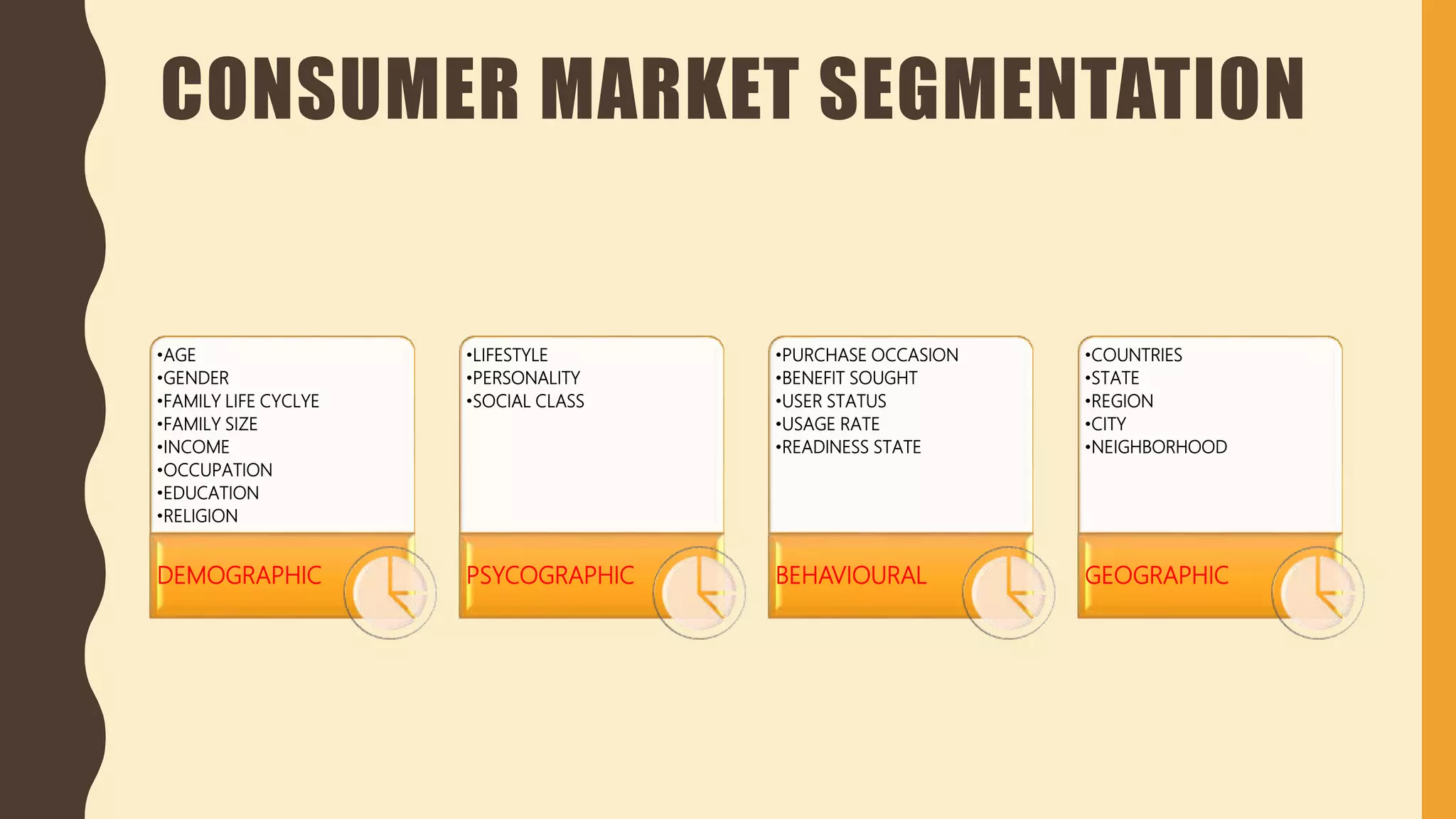
CONSUMER MARKET SEGMENTATION
•AGE
•GENDER
•FAMILY LIFE CYCLYE
•FAMILY SIZE
•INCOME
•OCCUPATION
•EDUCATION
•RELIGION
DEMOGRAPHIC
•LIFESTYLE
•PERSONALITY
•SOCIAL CLASS
PSYCOGRAPHIC
•PURCHASE OCCASION
•BENEFIT SOUGHT
•USER STATUS
•USAGE RATE
•READINESS STATE
BEHAVIOURAL
•COUNTRIES
•STATE
•REGION
•CITY
•NEIGHBORHOOD
GEOGRAPHIC
DEMOGRAPHIC SEGMENTATION
Demographic segmentation consists of dividing the market into
groups based on variables such as age, gender, family size,
family life cycle, income, occupation, education, religion, race
and nationality.
Age :( Infant, young, adult, old)
Gender: (Male , Female)
Family Life Cycle: (Young, single; young, married, no children;
young, married, youngest child under 6; young, married,
youngest child 6 or over; older, married with children; older,
married, no dependent children ; older, single; others)
• Income : (below poverty line, APL, Middle income group, high
income group)
• Family Size : 1-2, 2-4, 2-6,joint family
• Occupation : Professionals, employed, self-employed,
unemployed, homemakers , retired
• Education: illiterate, school, high school, college graduates,
scholars
• Religion: Hindu, Muslim, Cristian,
• Race : White, Black, Asian
• Nationality : Indian, American, Spanish , British
PSYCHOGRAPHIC SEGMENTATION
Dividing a market into different groups based on social class,
lifestyle or personality characteristics.
• Social Class : (Lower lowers, upper lowers, working class,
middle class, upper middles, lower uppers, upper uppers.)
• Lifestyle : (Achievers, believers, Strivers )
• Personality : (Compulsive, gregarious, authoritarian, ambitious
)
BEHAVIOURAL SEGMENTATION
Behavioral segmentation divides buyers into groups based
on their knowledge, attitudes, uses or responses to a product
. The various bases for segmenting market on the basis of
behavior are:
• Purchase occasion : Regular occasion or special occasion
• Benefit sought : Quality, Service, Economy
• User status : Non-user, ex-user, potential user, first-time
user, regular user.
• Usage rate : Light user, medium user, heavy user.
• Readiness state : Unaware, aware, informed, interested,
desirous, intending to buy.
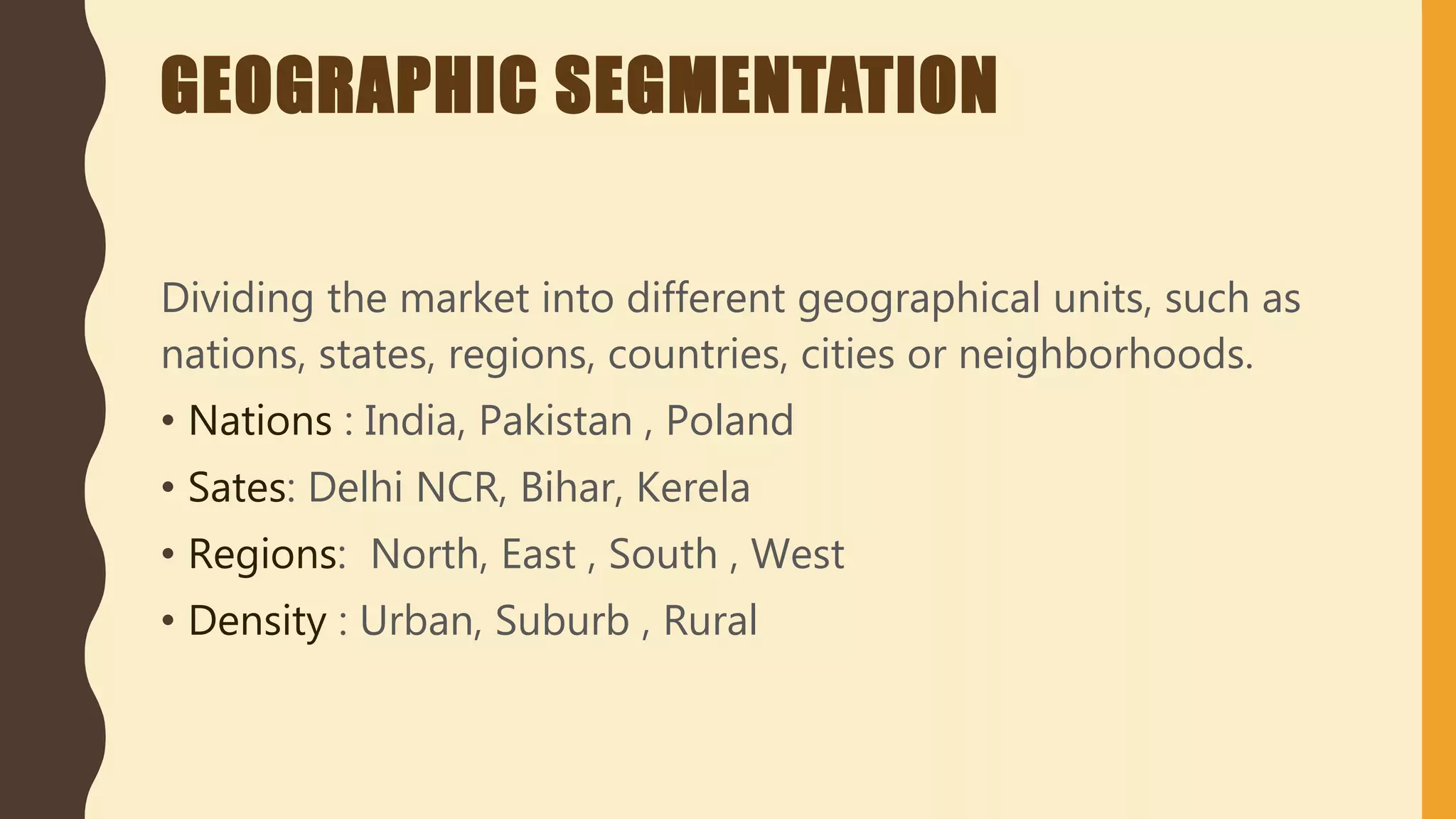
GEOGRAPHIC SEGMENTATION
Dividing the market into different geographical units, such as
nations, states, regions, countries, cities or neighborhoods.
• Nations : India, Pakistan , Poland
• Sates: Delhi NCR, Bihar, Kerela
• Regions: North, East , South , West
• Density : Urban, Suburb , Rural
REQUIREMENTS FOR EFFECTIVE
SEGMENTATION
• Measurability
The degree to which the size, purchasing power and profits of a
market segment can be measured.
• Accessibility
The degree to which a market segment can he reached and served
• Substantiality
The degree to which a market segment in sufficiently large or
profitable.
• Actionability
The degree to - which effective programmes can be designed for
attracting and serving a given market segment.
STEPS IN DEVELOPING MARKET
SEGMENT
• Qualitative research - Exploratory research techniques find the
motivations, attitude and behaviour of customers. Typical methods
are focus-group interviewing, elicitation interviews or repertory
grid techniques.
• Quantitative research - Quantitative research identifies the
important dimensions describing the market. Data are gathered by
mail or personal interviews from enough customers to allow
analysis
…
• Analysis - The data collected depend on the sort of analysis to be
used. The most common process is the use of factor analysis ,
cluster analysis , Automatic Interaction Detection (AID), and
conjoint analysis
• Validation - It is important to check if the segments are real or
have occurred by chance. Validation can be done by analyzing the
statistics from the analysis, replicating the results using new data,
or experimenting with the segments.
• Profiling - Each cluster is profiled to show its distinguishing
attitudes, behaviour, demographics and so forth. Usually the
clusters thus found get a descriptive name. e.g. initiators in
doctors
TARGETING
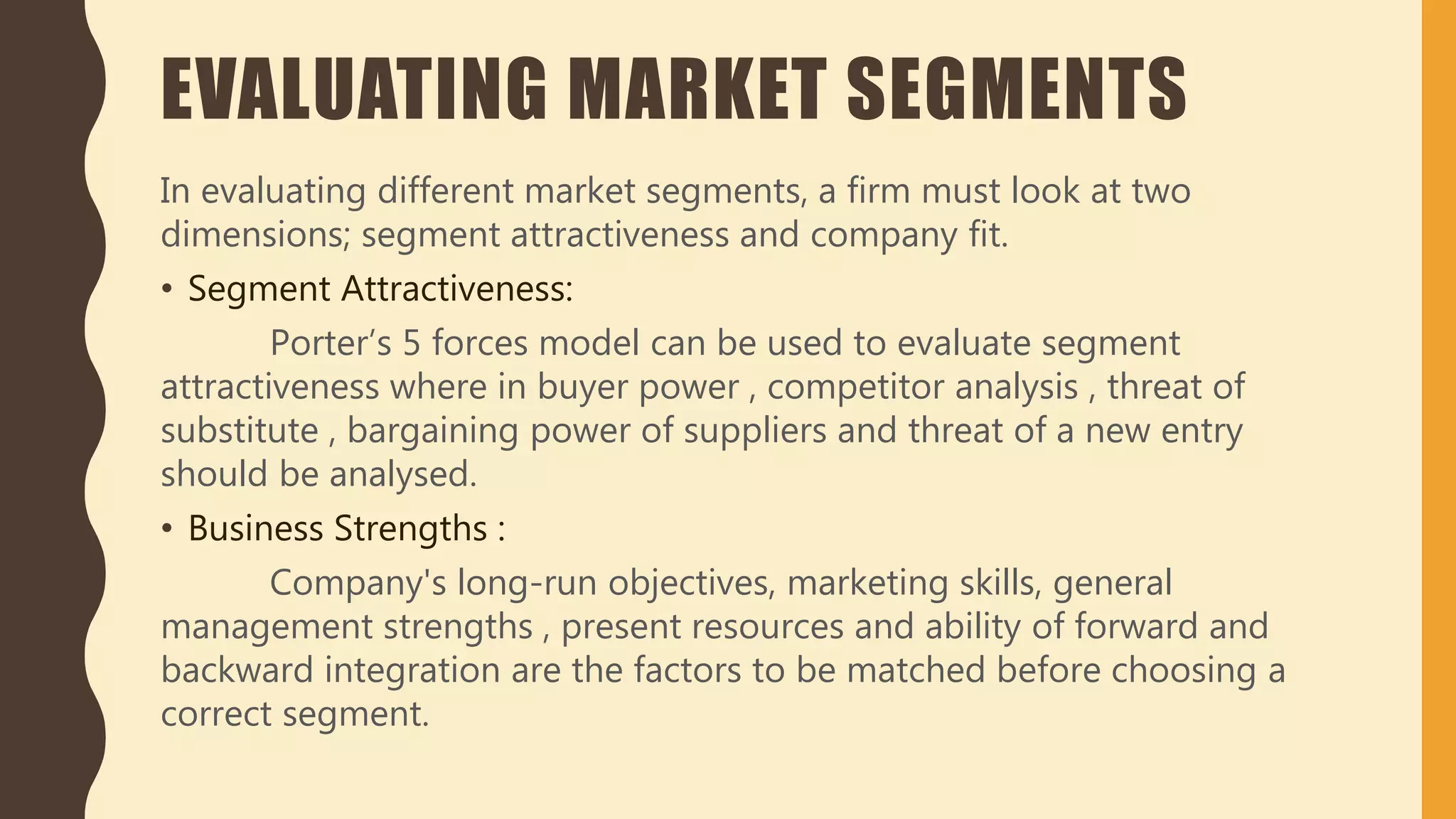
TARGET GROUP in marketing is defined as the
group of people or organization for which an
organisation designs, implements and
maintains its marketing mix. Target market is a
set of buyers sharing common needs or
characteristics the company decides to serve.
Targeting is a step of evaluating market
segments and selecting the segment to be in.
EVALUATING MARKET SEGMENTS
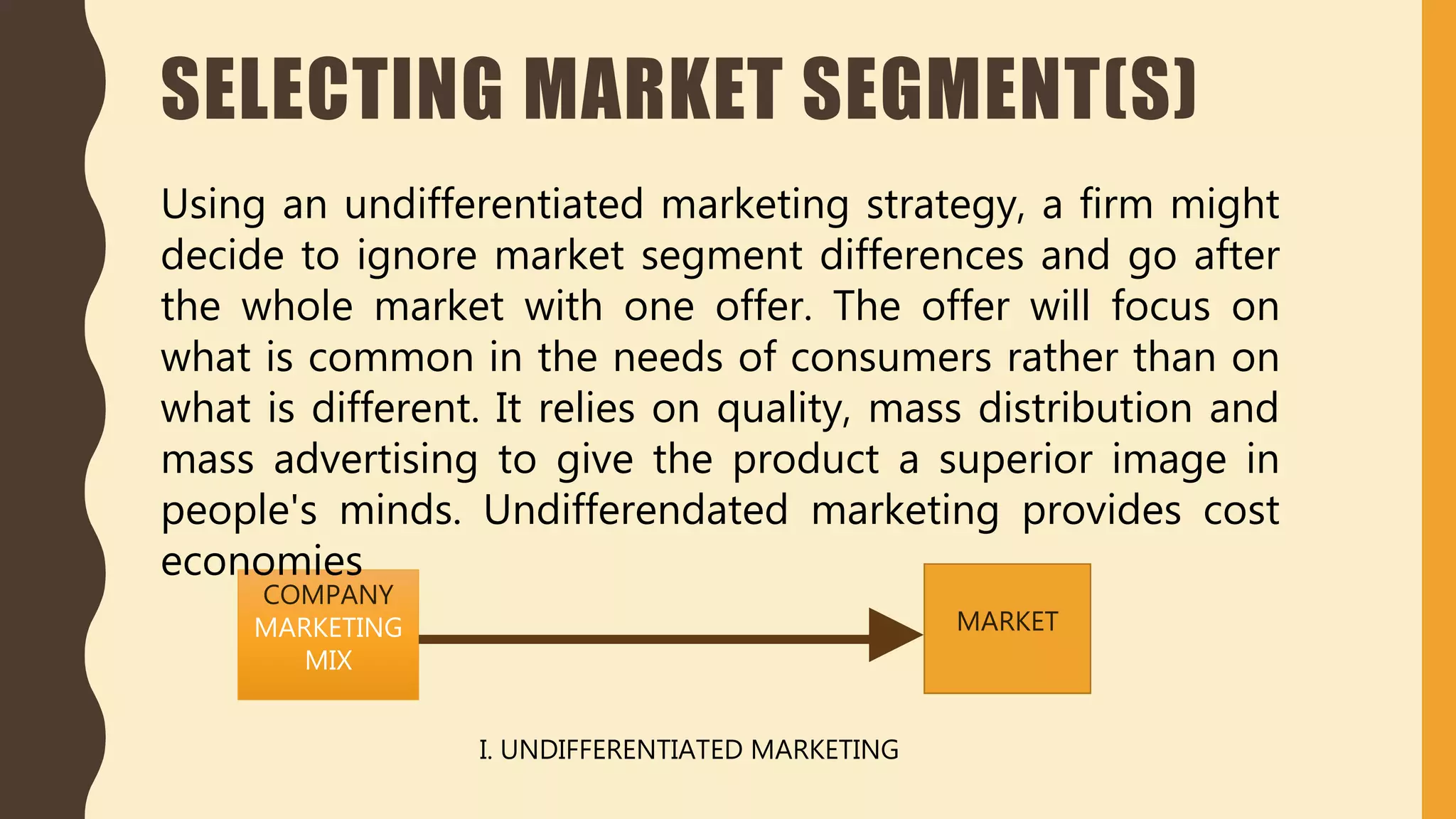
In evaluating different market segments, a firm must look at two
dimensions; segment attractiveness and company fit.
• Segment Attractiveness:
Porter’s 5 forces model can be used to evaluate segment
attractiveness where in buyer power , competitor analysis , threat of
substitute , bargaining power of suppliers and threat of a new entry
should be analysed.
• Business Strengths :
Company's long-run objectives, marketing skills, general
management strengths , present resources and ability of forward and
backward integration are the factors to be matched before choosing a
correct segment.
SELECTING MARKET SEGMENT(S)
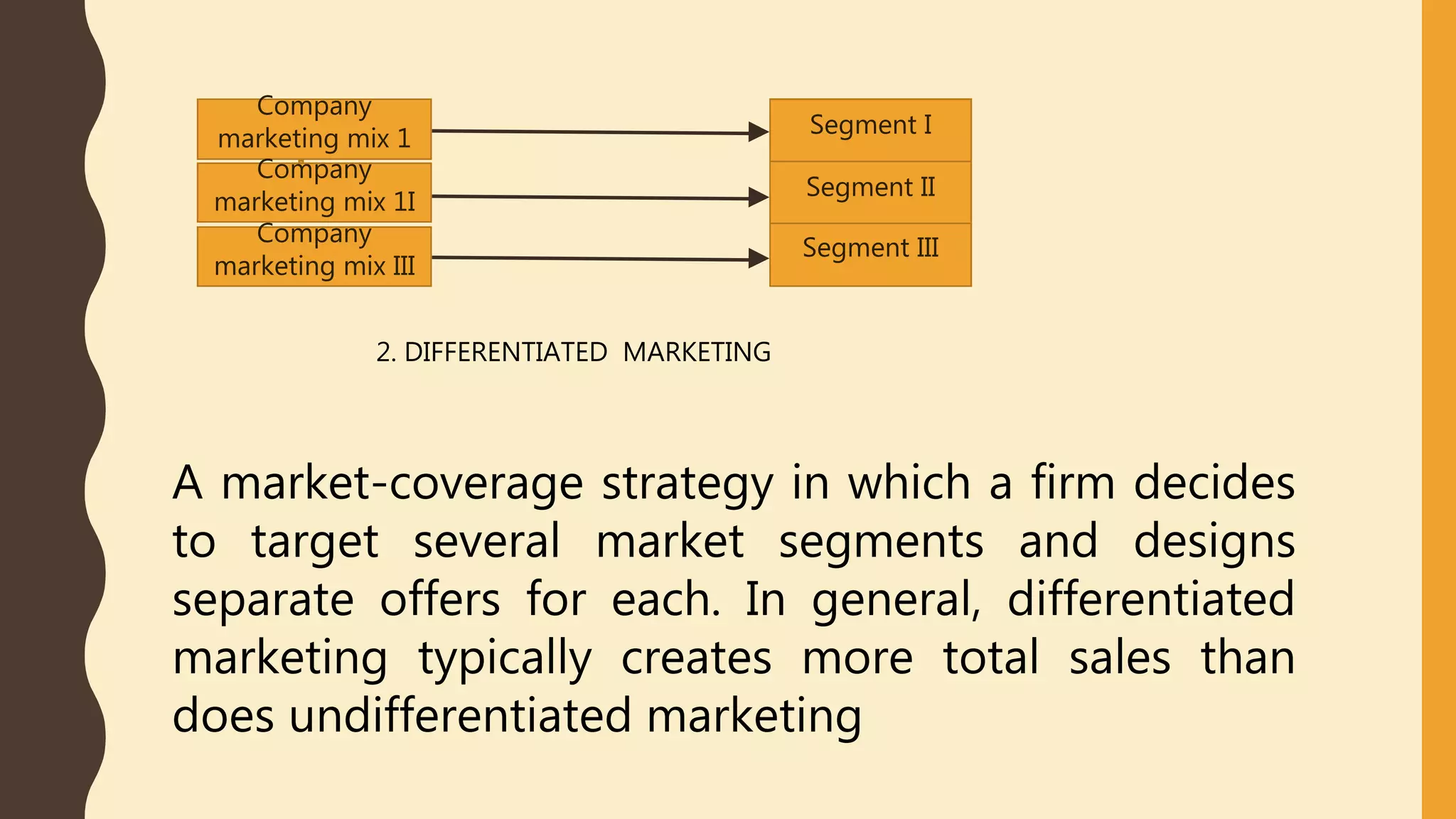
COMPANY
MARKETING
MIX
MARKET
I. UNDIFFERENTIATED MARKETING
Using an undifferentiated marketing strategy, a firm might
decide to ignore market segment differences and go after
the whole market with one offer. The offer will focus on
what is common in the needs of consumers rather than on
what is different. It relies on quality, mass distribution and
mass advertising to give the product a superior image in
people's minds. Undifferendated marketing provides cost
economies
Company
marketing mix 1
Company
marketing mix 1I
Company
marketing mix III
Segment I
Segment II
Segment III
2. DIFFERENTIATED MARKETING
A market-coverage strategy in which a firm decides
to target several market segments and designs
separate offers for each. In general, differentiated
marketing typically creates more total sales than
does undifferentiated marketing
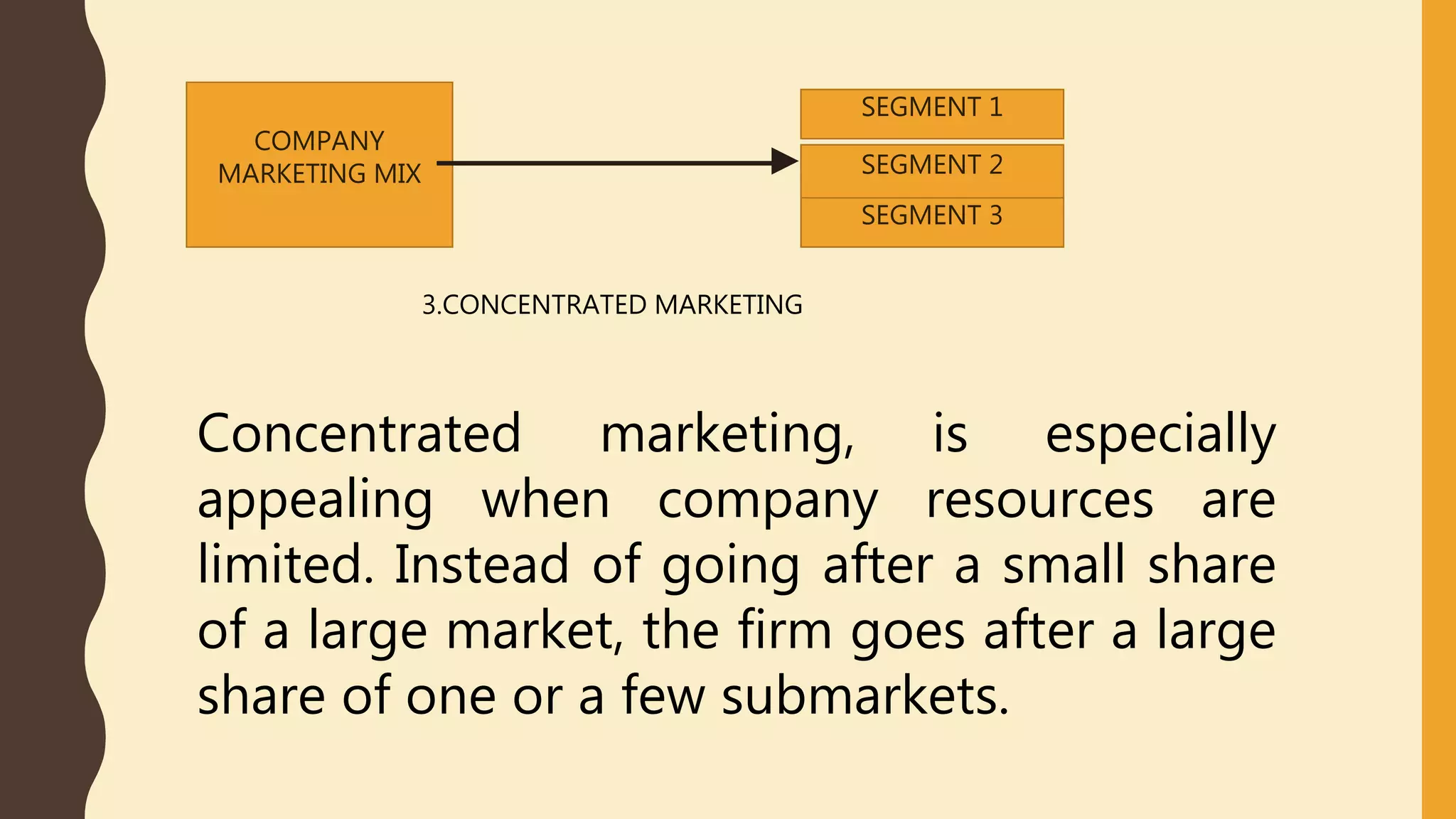
COMPANY
MARKETING MIX
SEGMENT 1
SEGMENT 2
SEGMENT 3
3.CONCENTRATED MARKETING
Concentrated marketing, is especially
appealing when company resources are
limited. Instead of going after a small share
of a large market, the firm goes after a large
share of one or a few submarkets.
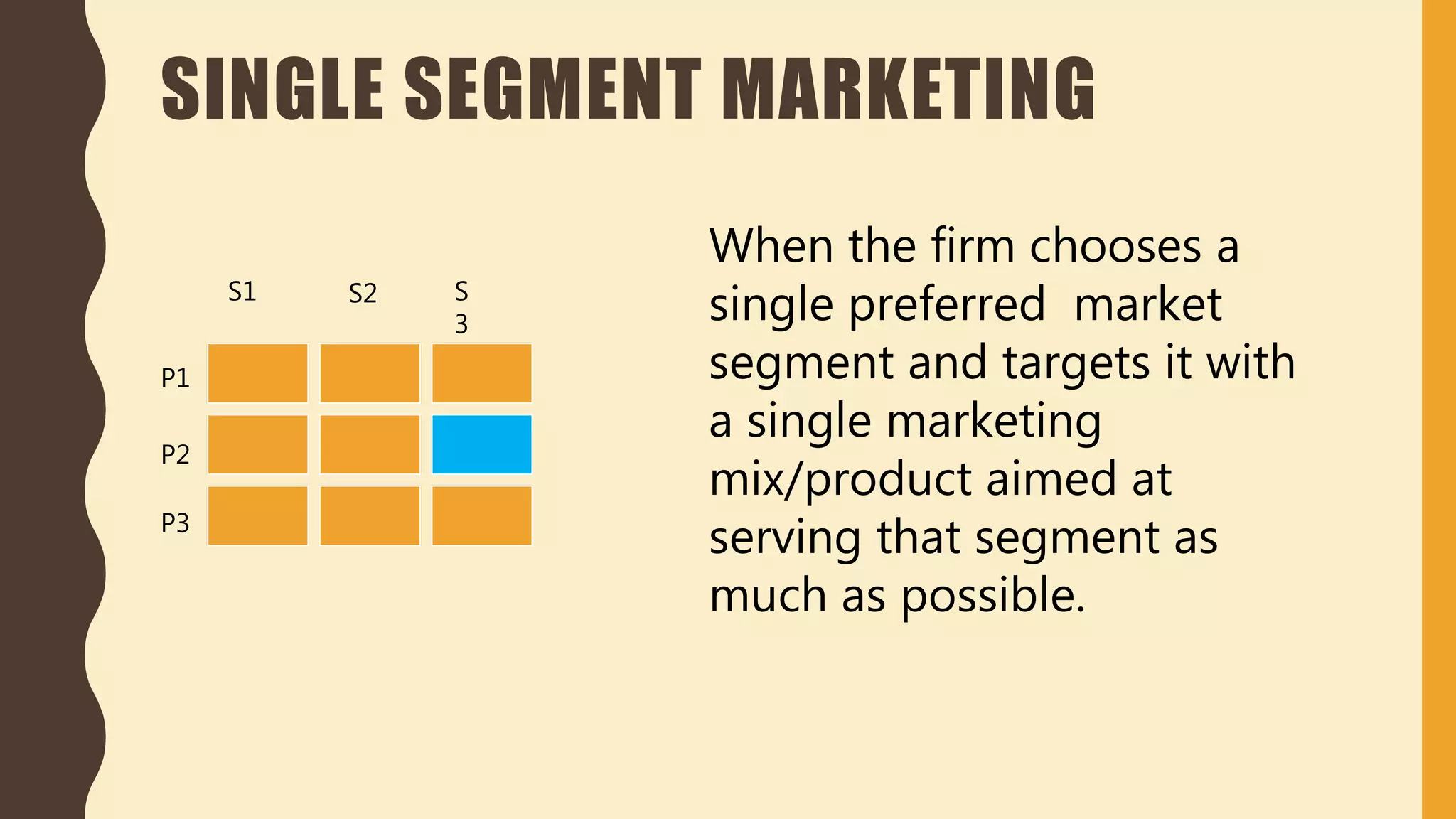
SINGLE SEGMENT MARKETING
S1 S2 S
3
P1
P2
P3
When the firm chooses a
single preferred market
segment and targets it with
a single marketing
mix/product aimed at
serving that segment as
much as possible.
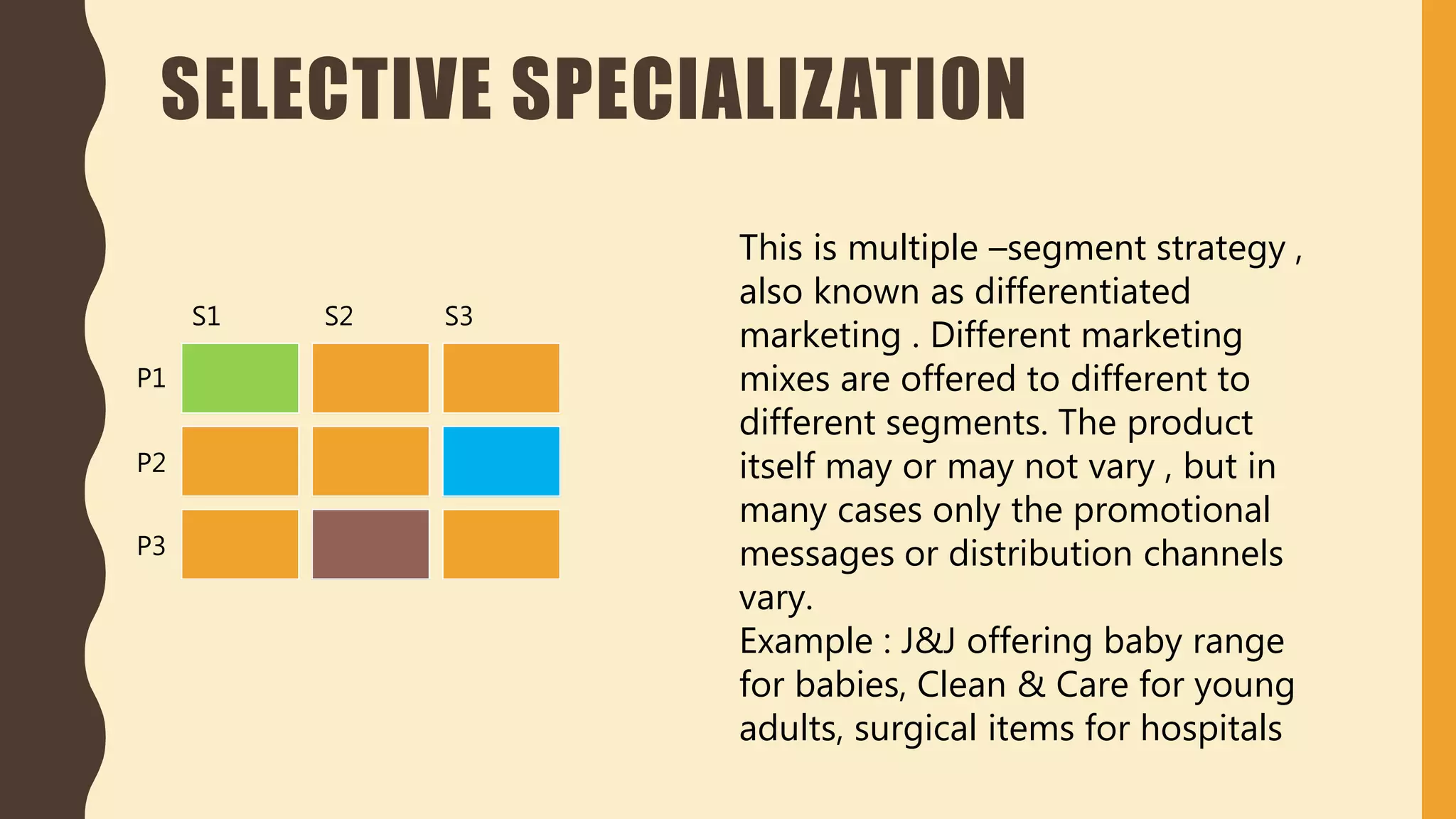
SELECTIVE SPECIALIZATION
S1 S2 S3
P1
P2
P3
This is multiple –segment strategy ,
also known as differentiated
marketing . Different marketing
mixes are offered to different to
different segments. The product
itself may or may not vary , but in
many cases only the promotional
messages or distribution channels
vary.
Example : J&J offering baby range
for babies, Clean & Care for young
adults, surgical items for hospitals
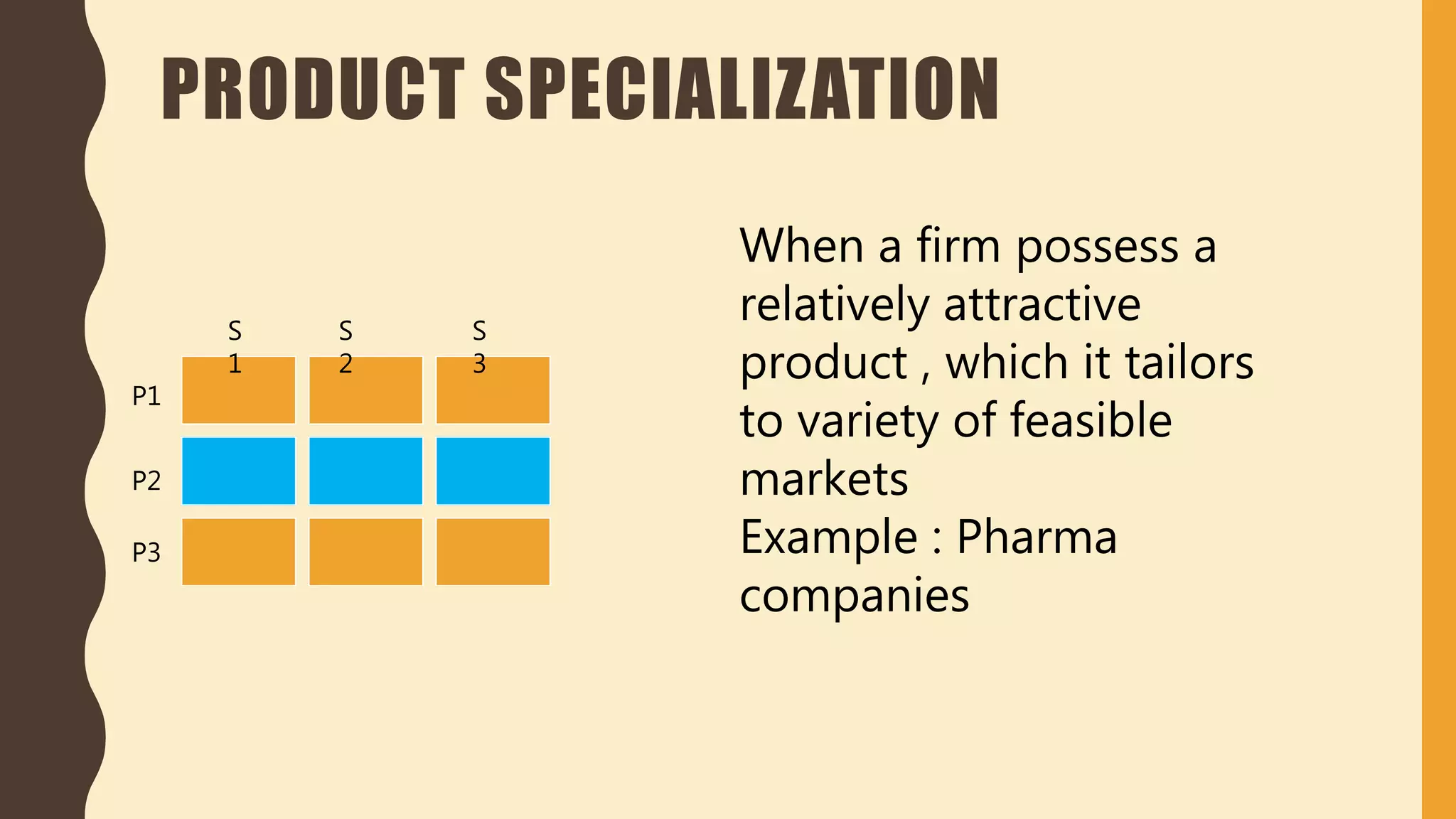
PRODUCT SPECIALIZATION
S
1
S
2
S
3
P1
P2
P3
When a firm possess a
relatively attractive
product , which it tailors
to variety of feasible
markets
Example : Pharma
companies
MARKET SPECIALIZATION STRATEGY
S1 S2 S3
P1
P2
P3
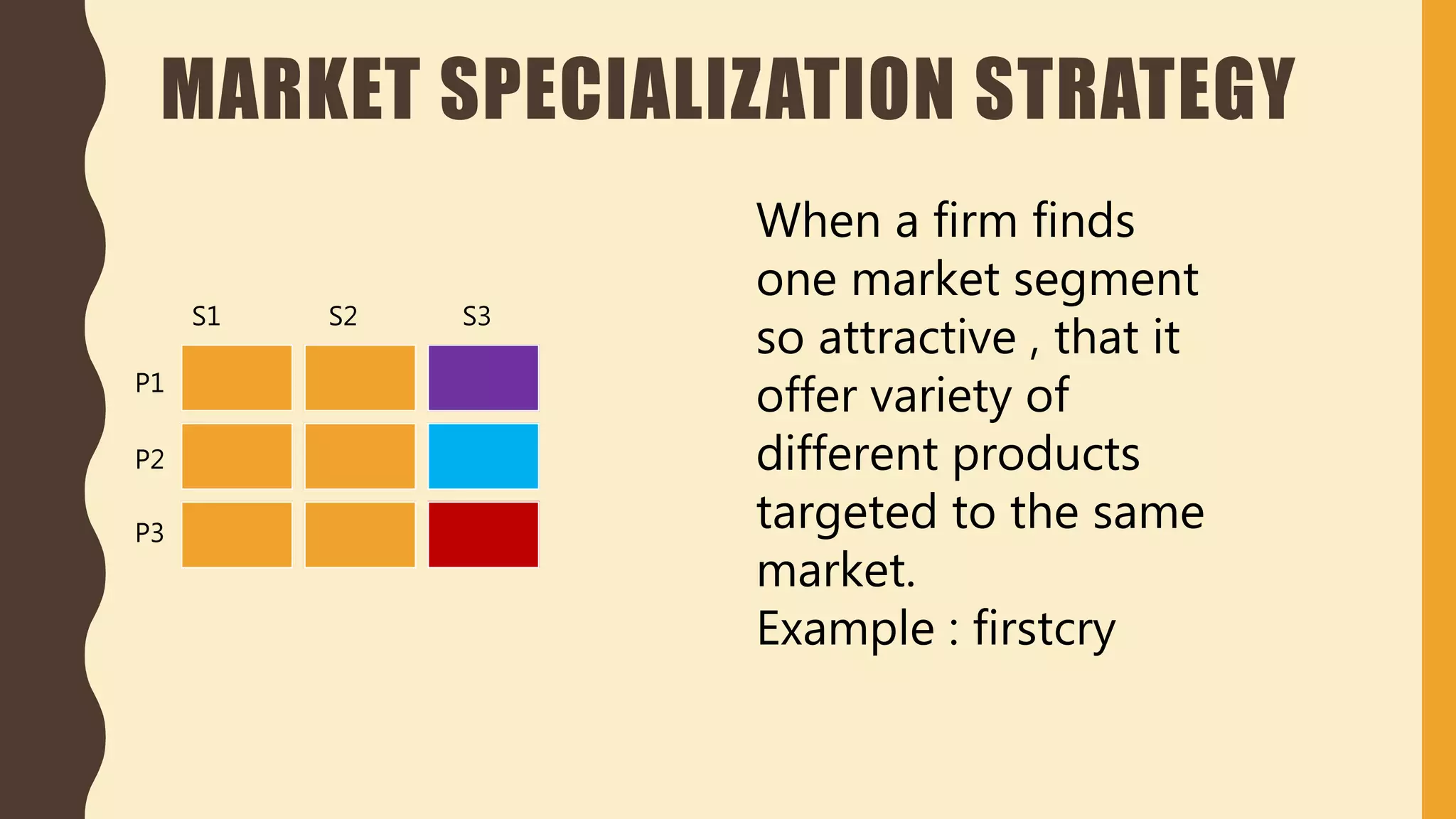
When a firm finds
one market segment
so attractive , that it
offer variety of
different products
targeted to the same
market.
Example : firstcry
FULL MARKET COVERAGE
S1 S2 S3
P
1
P
2
P
3
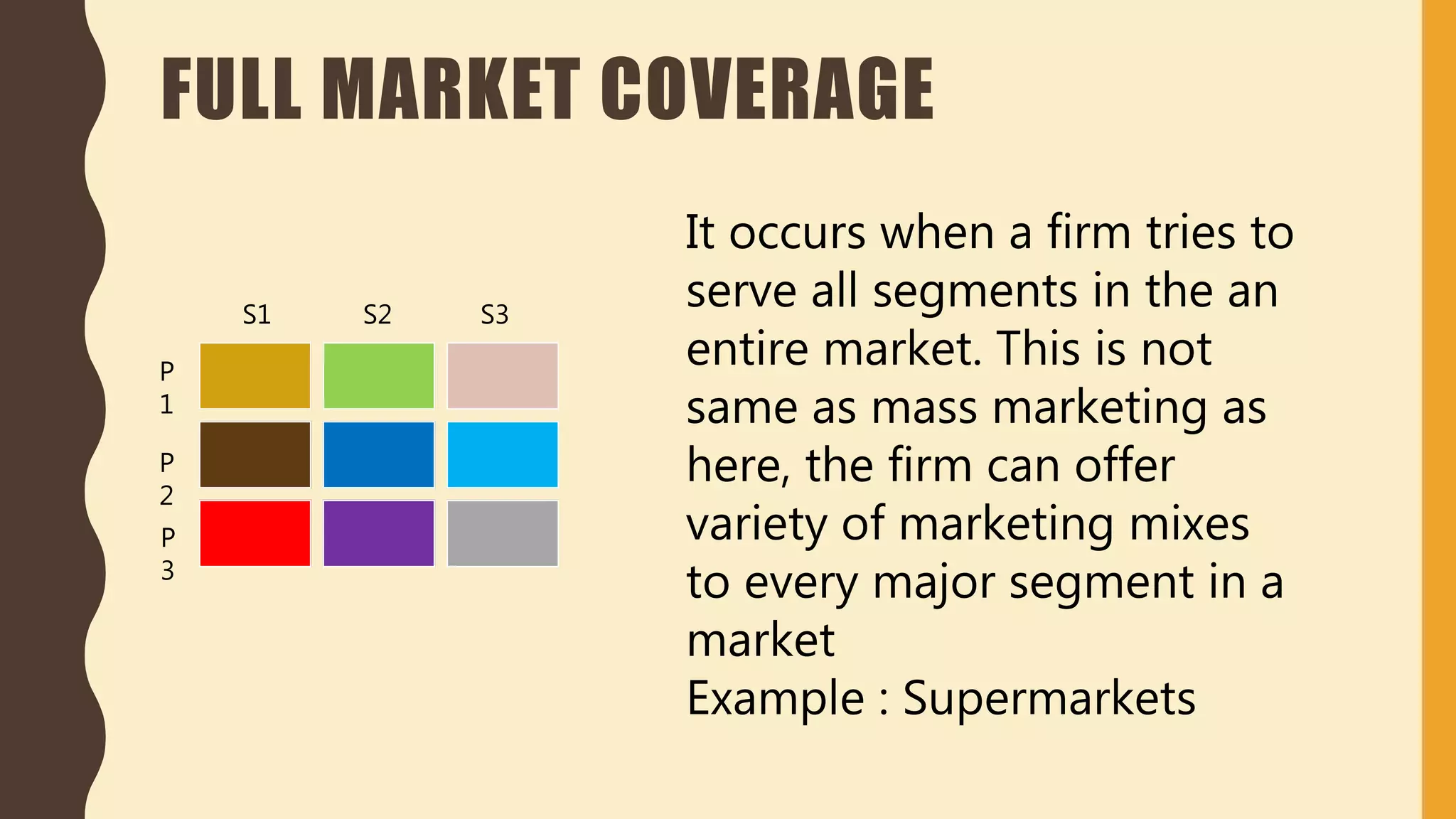
It occurs when a firm tries to
serve all segments in the an
entire market. This is not
same as mass marketing as
here, the firm can offer
variety of marketing mixes
to every major segment in a
market
Example : Supermarkets
THANK YOU
F O R F E E D B A C K / S U G G E S T I O N S
M A I L M E AT
V I J YATA . R W C @ G M A I L . C O M

Segmentation and targeting

  • 1.
    MARKET SEGMENTATION & TARGETING V I JYATA A S S I S TA N T P R O F E S S O R ( D E P T. O F M B A ) R A N C H I W O M E N ’ S C O L L E G E , R A N C H I U N I V E R S I Y
  • 2.
    SEGMENTATION Markets consist ofbuyers, and buyers differ in one or more ways. They may differ in their wants, resources, locations, buying attitudes and buying practices. Through market segmentation, companies divide large, heterogeneous markets into smaller segments that can be reached more efficiently with products and services that match their unique needs. Dividing a market into distinct groups of buyers with different needs, characteristics or behavior, who might require separate produces or marketing mixes is called SEGMENTATION
  • 3.
    LEVEL OF SEGEMENTATION MASSMARKETING Using almost the same product, promotion and distribution for all consumers. The traditional argument for mass marketing is that it the largest potential market, which leads to the lowest costs, which in can translate into either lower prices or higher margins. But it is very to create a single product or programme that appeals to all of these diverse groups. SEGMENT MARKETING Segment marketing recognizes that buyers differ in their needs, perceptions and buying behaviours. The company tries to isolate broad segments that make up a market and adapts its offers to match more closely the needs of one or more segments
  • 4.
    NICHE MARKETING A nicheis a more narrowly defined group, usually identified by dividing a segment into subsegments or by defining a group with a distinctive set of traits who may seek a special combination of benefits. Niche marketing is adapting a company's offerings to more closely the needs of one or more subsegments where there is often little competition. MICROMARKETING Micromarketing is the practice of tailoring products and programmes to suit the tastes of specific individuals and locations. Micromarketing includes • local marketing (tailored according to preference of city , etc) • individual marketing (tailored according to preference of
  • 5.
    CONSUMER MARKET SEGMENTATION •AGE •GENDER •FAMILYLIFE CYCLYE •FAMILY SIZE •INCOME •OCCUPATION •EDUCATION •RELIGION DEMOGRAPHIC •LIFESTYLE •PERSONALITY •SOCIAL CLASS PSYCOGRAPHIC •PURCHASE OCCASION •BENEFIT SOUGHT •USER STATUS •USAGE RATE •READINESS STATE BEHAVIOURAL •COUNTRIES •STATE •REGION •CITY •NEIGHBORHOOD GEOGRAPHIC
  • 6.
    DEMOGRAPHIC SEGMENTATION Demographic segmentationconsists of dividing the market into groups based on variables such as age, gender, family size, family life cycle, income, occupation, education, religion, race and nationality. Age :( Infant, young, adult, old) Gender: (Male , Female) Family Life Cycle: (Young, single; young, married, no children; young, married, youngest child under 6; young, married, youngest child 6 or over; older, married with children; older, married, no dependent children ; older, single; others)
  • 7.
    • Income :(below poverty line, APL, Middle income group, high income group) • Family Size : 1-2, 2-4, 2-6,joint family • Occupation : Professionals, employed, self-employed, unemployed, homemakers , retired • Education: illiterate, school, high school, college graduates, scholars • Religion: Hindu, Muslim, Cristian, • Race : White, Black, Asian • Nationality : Indian, American, Spanish , British
  • 8.
    PSYCHOGRAPHIC SEGMENTATION Dividing amarket into different groups based on social class, lifestyle or personality characteristics. • Social Class : (Lower lowers, upper lowers, working class, middle class, upper middles, lower uppers, upper uppers.) • Lifestyle : (Achievers, believers, Strivers ) • Personality : (Compulsive, gregarious, authoritarian, ambitious )
  • 9.
    BEHAVIOURAL SEGMENTATION Behavioral segmentationdivides buyers into groups based on their knowledge, attitudes, uses or responses to a product . The various bases for segmenting market on the basis of behavior are: • Purchase occasion : Regular occasion or special occasion • Benefit sought : Quality, Service, Economy • User status : Non-user, ex-user, potential user, first-time user, regular user. • Usage rate : Light user, medium user, heavy user. • Readiness state : Unaware, aware, informed, interested, desirous, intending to buy.
  • 10.
    GEOGRAPHIC SEGMENTATION Dividing themarket into different geographical units, such as nations, states, regions, countries, cities or neighborhoods. • Nations : India, Pakistan , Poland • Sates: Delhi NCR, Bihar, Kerela • Regions: North, East , South , West • Density : Urban, Suburb , Rural
  • 11.
    REQUIREMENTS FOR EFFECTIVE SEGMENTATION •Measurability The degree to which the size, purchasing power and profits of a market segment can be measured. • Accessibility The degree to which a market segment can he reached and served • Substantiality The degree to which a market segment in sufficiently large or profitable. • Actionability The degree to - which effective programmes can be designed for attracting and serving a given market segment.
  • 12.
    STEPS IN DEVELOPINGMARKET SEGMENT • Qualitative research - Exploratory research techniques find the motivations, attitude and behaviour of customers. Typical methods are focus-group interviewing, elicitation interviews or repertory grid techniques. • Quantitative research - Quantitative research identifies the important dimensions describing the market. Data are gathered by mail or personal interviews from enough customers to allow analysis
  • 13.
    … • Analysis -The data collected depend on the sort of analysis to be used. The most common process is the use of factor analysis , cluster analysis , Automatic Interaction Detection (AID), and conjoint analysis • Validation - It is important to check if the segments are real or have occurred by chance. Validation can be done by analyzing the statistics from the analysis, replicating the results using new data, or experimenting with the segments. • Profiling - Each cluster is profiled to show its distinguishing attitudes, behaviour, demographics and so forth. Usually the clusters thus found get a descriptive name. e.g. initiators in doctors
  • 14.
    TARGETING TARGET GROUP inmarketing is defined as the group of people or organization for which an organisation designs, implements and maintains its marketing mix. Target market is a set of buyers sharing common needs or characteristics the company decides to serve. Targeting is a step of evaluating market segments and selecting the segment to be in.
  • 15.
    EVALUATING MARKET SEGMENTS Inevaluating different market segments, a firm must look at two dimensions; segment attractiveness and company fit. • Segment Attractiveness: Porter’s 5 forces model can be used to evaluate segment attractiveness where in buyer power , competitor analysis , threat of substitute , bargaining power of suppliers and threat of a new entry should be analysed. • Business Strengths : Company's long-run objectives, marketing skills, general management strengths , present resources and ability of forward and backward integration are the factors to be matched before choosing a correct segment.
  • 16.
    SELECTING MARKET SEGMENT(S) COMPANY MARKETING MIX MARKET I.UNDIFFERENTIATED MARKETING Using an undifferentiated marketing strategy, a firm might decide to ignore market segment differences and go after the whole market with one offer. The offer will focus on what is common in the needs of consumers rather than on what is different. It relies on quality, mass distribution and mass advertising to give the product a superior image in people's minds. Undifferendated marketing provides cost economies
  • 17.
    Company marketing mix 1 Company marketingmix 1I Company marketing mix III Segment I Segment II Segment III 2. DIFFERENTIATED MARKETING A market-coverage strategy in which a firm decides to target several market segments and designs separate offers for each. In general, differentiated marketing typically creates more total sales than does undifferentiated marketing
  • 18.
    COMPANY MARKETING MIX SEGMENT 1 SEGMENT2 SEGMENT 3 3.CONCENTRATED MARKETING Concentrated marketing, is especially appealing when company resources are limited. Instead of going after a small share of a large market, the firm goes after a large share of one or a few submarkets.
  • 19.
    SINGLE SEGMENT MARKETING S1S2 S 3 P1 P2 P3 When the firm chooses a single preferred market segment and targets it with a single marketing mix/product aimed at serving that segment as much as possible.
  • 20.
    SELECTIVE SPECIALIZATION S1 S2S3 P1 P2 P3 This is multiple –segment strategy , also known as differentiated marketing . Different marketing mixes are offered to different to different segments. The product itself may or may not vary , but in many cases only the promotional messages or distribution channels vary. Example : J&J offering baby range for babies, Clean & Care for young adults, surgical items for hospitals
  • 21.
    PRODUCT SPECIALIZATION S 1 S 2 S 3 P1 P2 P3 When afirm possess a relatively attractive product , which it tailors to variety of feasible markets Example : Pharma companies
  • 22.
    MARKET SPECIALIZATION STRATEGY S1S2 S3 P1 P2 P3 When a firm finds one market segment so attractive , that it offer variety of different products targeted to the same market. Example : firstcry
  • 23.
    FULL MARKET COVERAGE S1S2 S3 P 1 P 2 P 3 It occurs when a firm tries to serve all segments in the an entire market. This is not same as mass marketing as here, the firm can offer variety of marketing mixes to every major segment in a market Example : Supermarkets
  • 24.
    THANK YOU F OR F E E D B A C K / S U G G E S T I O N S M A I L M E AT V I J YATA . R W C @ G M A I L . C O M