IMC PLANNING
AMITABH MISHRA, ASTT. PROFF. AIMT GR.
NOIDA
1
• “IMC plan details which marketing communication
function and which media are to be used at which
time and to what extent”
• The Marketing communication plan tells top mgt-
– How and why MC dollars will be spend and
– What the co. Can expect in return.
AMITABH MISHRA, ASTT. PROFF. AIMT GR.
NOIDA
2
Process if IMC Planning
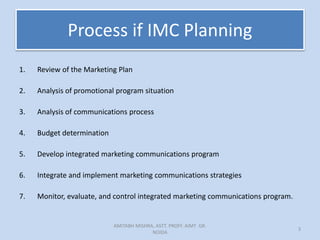
1. Review of the Marketing Plan
2. Analysis of promotional program situation
3. Analysis of communications process
4. Budget determination
5. Develop integrated marketing communications program
6. Integrate and implement marketing communications strategies
7. Monitor, evaluate, and control integrated marketing communications program.
AMITABH MISHRA, ASTT. PROFF. AIMT GR.
NOIDA
3
AMITABH MISHRA, ASTT. PROFF. AIMT GR.
NOIDA
4
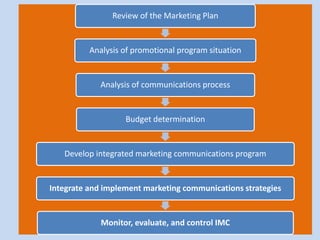
Review of the Marketing Plan
Analysis of promotional program situation
Analysis of communications process
Budget determination
Develop integrated marketing communications program
Integrate and implement marketing communications strategies
Monitor, evaluate, and control IMC
1. Review of the Marketing Plan
• The first step in the IMC planning process is to review
the marketing plan and objectives.
AMITABH MISHRA, ASTT. PROFF. AIMT GR.
NOIDA
5
• Before developing a promotional plan, marketers
must understand-
– Where the company (or the brand) has been,
– Its current position in the market,
– Where it intends to go, and
– How it plans to get there.
AMITABH MISHRA, ASTT. PROFF. AIMT GR.
NOIDA
6
2. Promotional program situation analysis
• After the overall marketing plan is reviewed, the next
step in developing a promotional plan is to conduct the
situation analysis.
• In the IMC program, the situation analysis focuses on the
factors that influence the development of a promotional
strategy.
AMITABH MISHRA, ASTT. PROFF. AIMT GR.
NOIDA
7
• Like the overall marketing situation analysis, the
promotional program situation analysis includes-
– Internal analysis. and
– External analysis.
• The internal analysis assesses relevant areas
involving the firm itself.
AMITABH MISHRA, ASTT. PROFF. AIMT GR.
NOIDA
8
• Internal analysis involves-
– Assessment of Firm’s Promotional Organization and
Capabilities
– Review of Firm’s Previous Promotional Programs and
Results
– Assessment of Firm or Brand Image and Implications
for Promotion
– Assessment of Relative Strengths and Weaknesses of
Product or Service
AMITABH MISHRA, ASTT. PROFF. AIMT GR.
NOIDA
9
• The external analysis involves-
– Customer Analysis
– Competitive Analysis
– Environmental Analysis
AMITABH MISHRA, ASTT. PROFF. AIMT GR.
NOIDA
10
• Customer Analysis includes the study of-
– Who buys our product or service?
– Who makes the decision to buy the product?
– Who influences the decision to buy the product?
– How is the purchase decision made? Who assumes what role?
– What does the customer buy? What needs must be satisfied?
– Why do customers buy a particular brand?
– Where do they go or look to buy the product or service?
AMITABH MISHRA, ASTT. PROFF. AIMT GR.
NOIDA
11
– When do they buy? Any seasonality factors?
– What are customers’ attitudes toward our product or service?
– What social factors might influence the purchase decision?
– Do the customers’ lifestyles influence their decisions?
– How is our product or service perceived by customers?
– How do demographic factors influence the purchase decision?
AMITABH MISHRA, ASTT. PROFF. AIMT GR.
NOIDA
12
• Competitive Analysis includes the study of-
– Who are our direct and indirect competitors?
– What key benefits and positioning are used by our
competitors?
– What is our position relative to the competition?
– How big are competitors’ ad budgets?
– What message and media strategies are competitors
using?
AMITABH MISHRA, ASTT. PROFF. AIMT GR.
NOIDA
13
• Environmental Analysis involves the study of-
– Are there any current trends or developments
that might affect the promotional program
AMITABH MISHRA, ASTT. PROFF. AIMT GR.
NOIDA
14
3. Analysis of the Communications Process
• The promotional planner must think about the
process consumers will go through in responding to
marketing communications.
AMITABH MISHRA, ASTT. PROFF. AIMT GR.
NOIDA
15
• The response process for products or services
for which consumer decision making is
characterized by a high level of interest is
often different from that for low-involvement
or routine purchase decisions.
• These differences will influence the
promotional strategy.
AMITABH MISHRA, ASTT. PROFF. AIMT GR.
NOIDA
16
4. Budget Determination
• Two basic questions are asked while determining the
budget:
– What will the promotional program cost?
– How will the money be allocated?
AMITABH MISHRA, ASTT. PROFF. AIMT GR.
NOIDA
17
5. Developing the Integrated Marketing
Communications Program
AMITABH MISHRA, ASTT. PROFF. AIMT GR.
NOIDA
18
6. Integrate and implement marketing
communications strategies
AMITABH MISHRA, ASTT. PROFF. AIMT GR.
NOIDA
19
7. Monitoring, Evaluation, and Control
• The final stage of the promotional planning process
is monitoring, evaluating, and controlling the
promotional program.
• It is important to determine how well the
promotional program is meeting communications
objectives and helping the firm accomplish its overall
marketing goals and objectives.
AMITABH MISHRA, ASTT. PROFF. AIMT GR.
NOIDA
20
• The promotional planner wants to know not only
how well the promotional program is doing but also
why.
• The manager must know the reasons for the results
in order to take the right steps to correct the
program.
AMITABH MISHRA, ASTT. PROFF. AIMT GR.
NOIDA
21

IMC PLANNING by Amitabh Mishra

  • 1.
    IMC PLANNING AMITABH MISHRA,ASTT. PROFF. AIMT GR. NOIDA 1
  • 2.
    • “IMC plandetails which marketing communication function and which media are to be used at which time and to what extent” • The Marketing communication plan tells top mgt- – How and why MC dollars will be spend and – What the co. Can expect in return. AMITABH MISHRA, ASTT. PROFF. AIMT GR. NOIDA 2
  • 3.
    Process if IMCPlanning 1. Review of the Marketing Plan 2. Analysis of promotional program situation 3. Analysis of communications process 4. Budget determination 5. Develop integrated marketing communications program 6. Integrate and implement marketing communications strategies 7. Monitor, evaluate, and control integrated marketing communications program. AMITABH MISHRA, ASTT. PROFF. AIMT GR. NOIDA 3
  • 4.
    AMITABH MISHRA, ASTT.PROFF. AIMT GR. NOIDA 4 Review of the Marketing Plan Analysis of promotional program situation Analysis of communications process Budget determination Develop integrated marketing communications program Integrate and implement marketing communications strategies Monitor, evaluate, and control IMC
  • 5.
    1. Review ofthe Marketing Plan • The first step in the IMC planning process is to review the marketing plan and objectives. AMITABH MISHRA, ASTT. PROFF. AIMT GR. NOIDA 5
  • 6.
    • Before developinga promotional plan, marketers must understand- – Where the company (or the brand) has been, – Its current position in the market, – Where it intends to go, and – How it plans to get there. AMITABH MISHRA, ASTT. PROFF. AIMT GR. NOIDA 6
  • 7.
    2. Promotional programsituation analysis • After the overall marketing plan is reviewed, the next step in developing a promotional plan is to conduct the situation analysis. • In the IMC program, the situation analysis focuses on the factors that influence the development of a promotional strategy. AMITABH MISHRA, ASTT. PROFF. AIMT GR. NOIDA 7
  • 8.
    • Like theoverall marketing situation analysis, the promotional program situation analysis includes- – Internal analysis. and – External analysis. • The internal analysis assesses relevant areas involving the firm itself. AMITABH MISHRA, ASTT. PROFF. AIMT GR. NOIDA 8
  • 9.
    • Internal analysisinvolves- – Assessment of Firm’s Promotional Organization and Capabilities – Review of Firm’s Previous Promotional Programs and Results – Assessment of Firm or Brand Image and Implications for Promotion – Assessment of Relative Strengths and Weaknesses of Product or Service AMITABH MISHRA, ASTT. PROFF. AIMT GR. NOIDA 9
  • 10.
    • The externalanalysis involves- – Customer Analysis – Competitive Analysis – Environmental Analysis AMITABH MISHRA, ASTT. PROFF. AIMT GR. NOIDA 10
  • 11.
    • Customer Analysisincludes the study of- – Who buys our product or service? – Who makes the decision to buy the product? – Who influences the decision to buy the product? – How is the purchase decision made? Who assumes what role? – What does the customer buy? What needs must be satisfied? – Why do customers buy a particular brand? – Where do they go or look to buy the product or service? AMITABH MISHRA, ASTT. PROFF. AIMT GR. NOIDA 11
  • 12.
    – When dothey buy? Any seasonality factors? – What are customers’ attitudes toward our product or service? – What social factors might influence the purchase decision? – Do the customers’ lifestyles influence their decisions? – How is our product or service perceived by customers? – How do demographic factors influence the purchase decision? AMITABH MISHRA, ASTT. PROFF. AIMT GR. NOIDA 12
  • 13.
    • Competitive Analysisincludes the study of- – Who are our direct and indirect competitors? – What key benefits and positioning are used by our competitors? – What is our position relative to the competition? – How big are competitors’ ad budgets? – What message and media strategies are competitors using? AMITABH MISHRA, ASTT. PROFF. AIMT GR. NOIDA 13
  • 14.
    • Environmental Analysisinvolves the study of- – Are there any current trends or developments that might affect the promotional program AMITABH MISHRA, ASTT. PROFF. AIMT GR. NOIDA 14
  • 15.
    3. Analysis ofthe Communications Process • The promotional planner must think about the process consumers will go through in responding to marketing communications. AMITABH MISHRA, ASTT. PROFF. AIMT GR. NOIDA 15
  • 16.
    • The responseprocess for products or services for which consumer decision making is characterized by a high level of interest is often different from that for low-involvement or routine purchase decisions. • These differences will influence the promotional strategy. AMITABH MISHRA, ASTT. PROFF. AIMT GR. NOIDA 16
  • 17.
    4. Budget Determination •Two basic questions are asked while determining the budget: – What will the promotional program cost? – How will the money be allocated? AMITABH MISHRA, ASTT. PROFF. AIMT GR. NOIDA 17
  • 18.
    5. Developing theIntegrated Marketing Communications Program AMITABH MISHRA, ASTT. PROFF. AIMT GR. NOIDA 18
  • 19.
    6. Integrate andimplement marketing communications strategies AMITABH MISHRA, ASTT. PROFF. AIMT GR. NOIDA 19
  • 20.
    7. Monitoring, Evaluation,and Control • The final stage of the promotional planning process is monitoring, evaluating, and controlling the promotional program. • It is important to determine how well the promotional program is meeting communications objectives and helping the firm accomplish its overall marketing goals and objectives. AMITABH MISHRA, ASTT. PROFF. AIMT GR. NOIDA 20
  • 21.
    • The promotionalplanner wants to know not only how well the promotional program is doing but also why. • The manager must know the reasons for the results in order to take the right steps to correct the program. AMITABH MISHRA, ASTT. PROFF. AIMT GR. NOIDA 21