Segmentation, Targeting & Positioning
In this chapter we will go through :-
1. What are the different levels of market
   segmentation?
2. How can a company divide a market into
   segments ?
3. How should a company choose the most
   attractive target markets ?
4. What are the requirements for effective
   segmentation ?
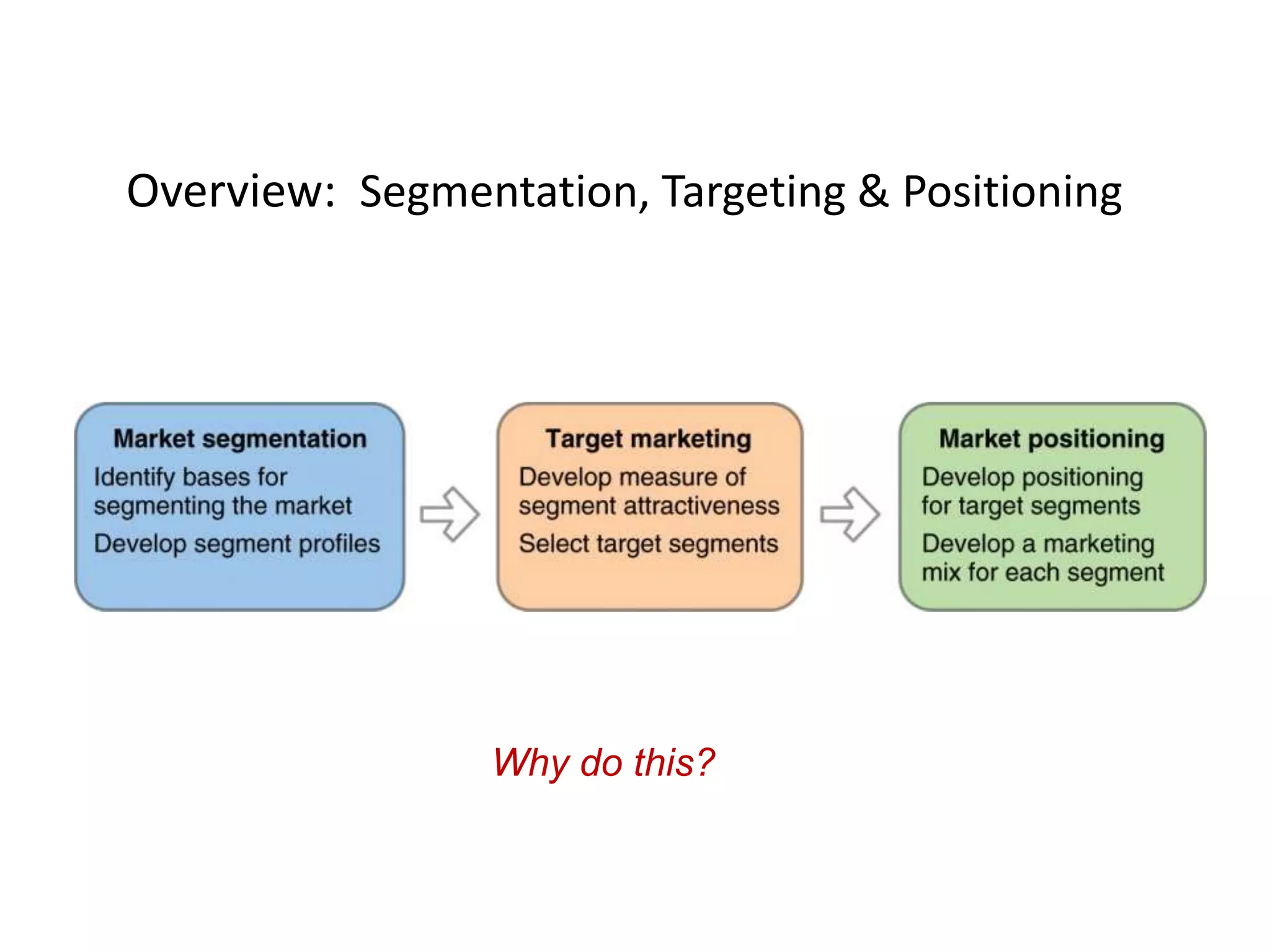
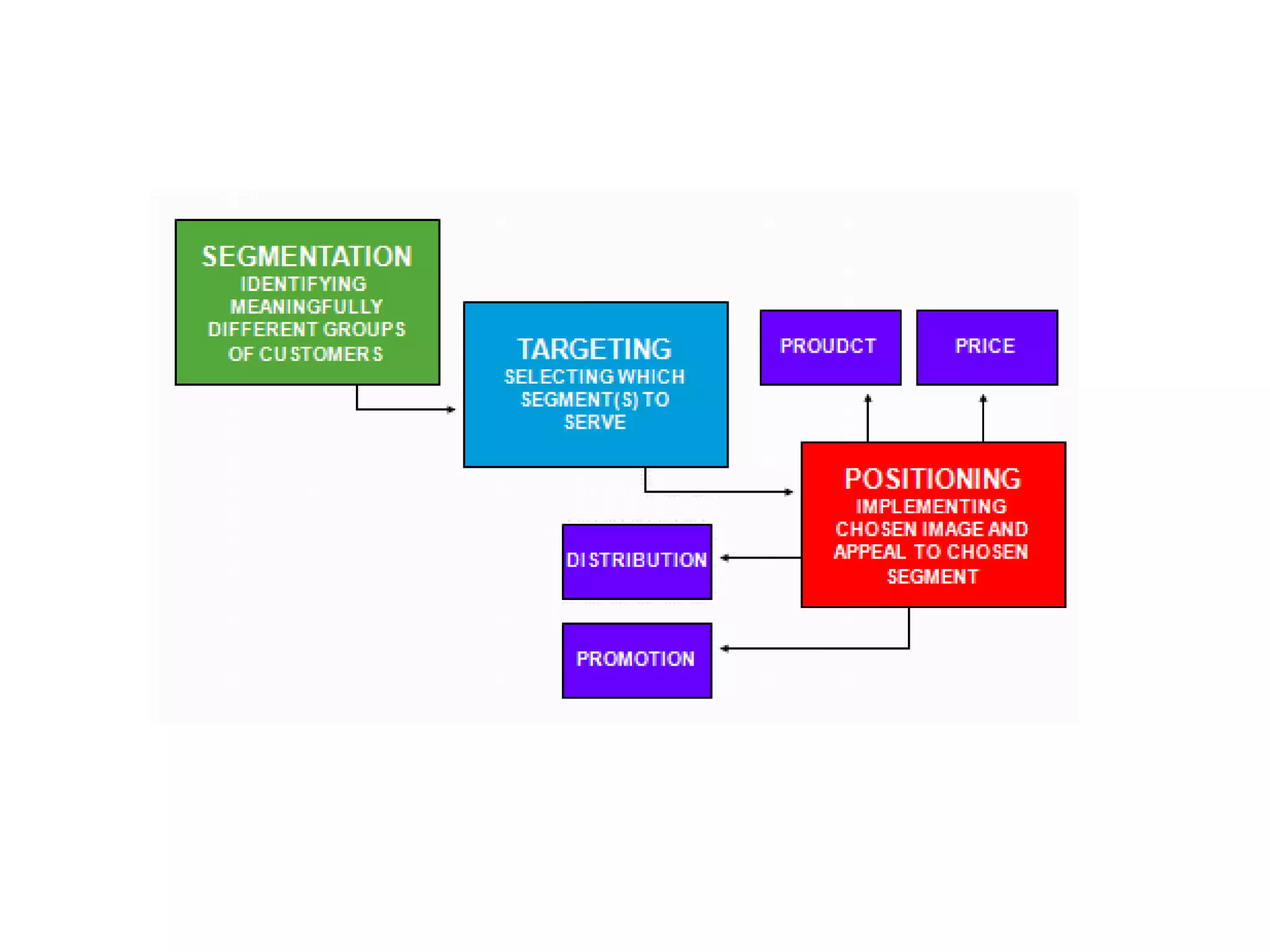
Overview: Segmentation, Targeting & Positioning


                 Why do this?
• Segmentation:
  involves finding out what kinds of consumers
  with different needs exist.
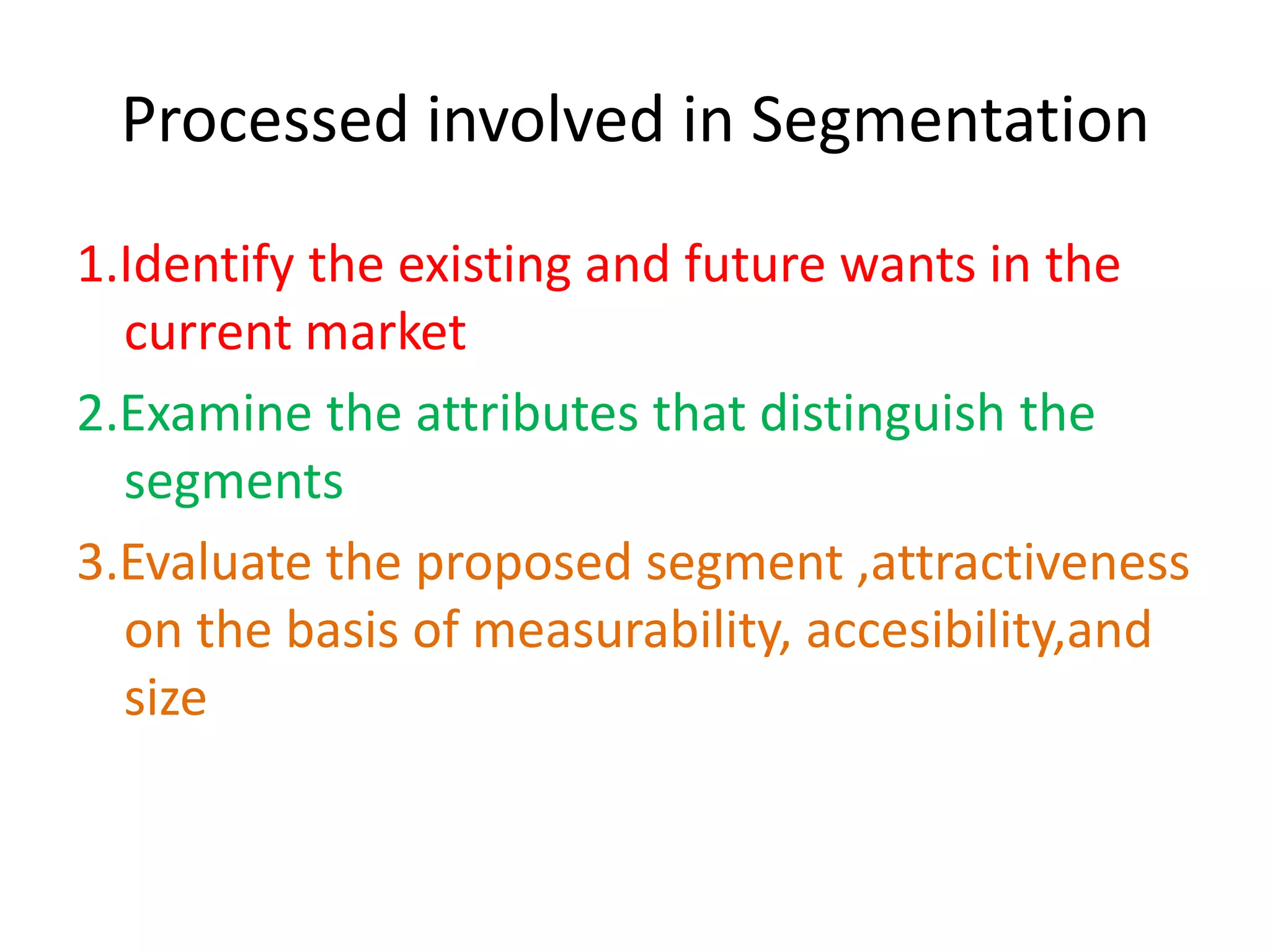
Processed involved in Segmentation
1.Identify the existing and future wants in the
  current market
2.Examine the attributes that distinguish the
  segments
3.Evaluate the proposed segment ,attractiveness
  on the basis of measurability, accesibility,and
  size
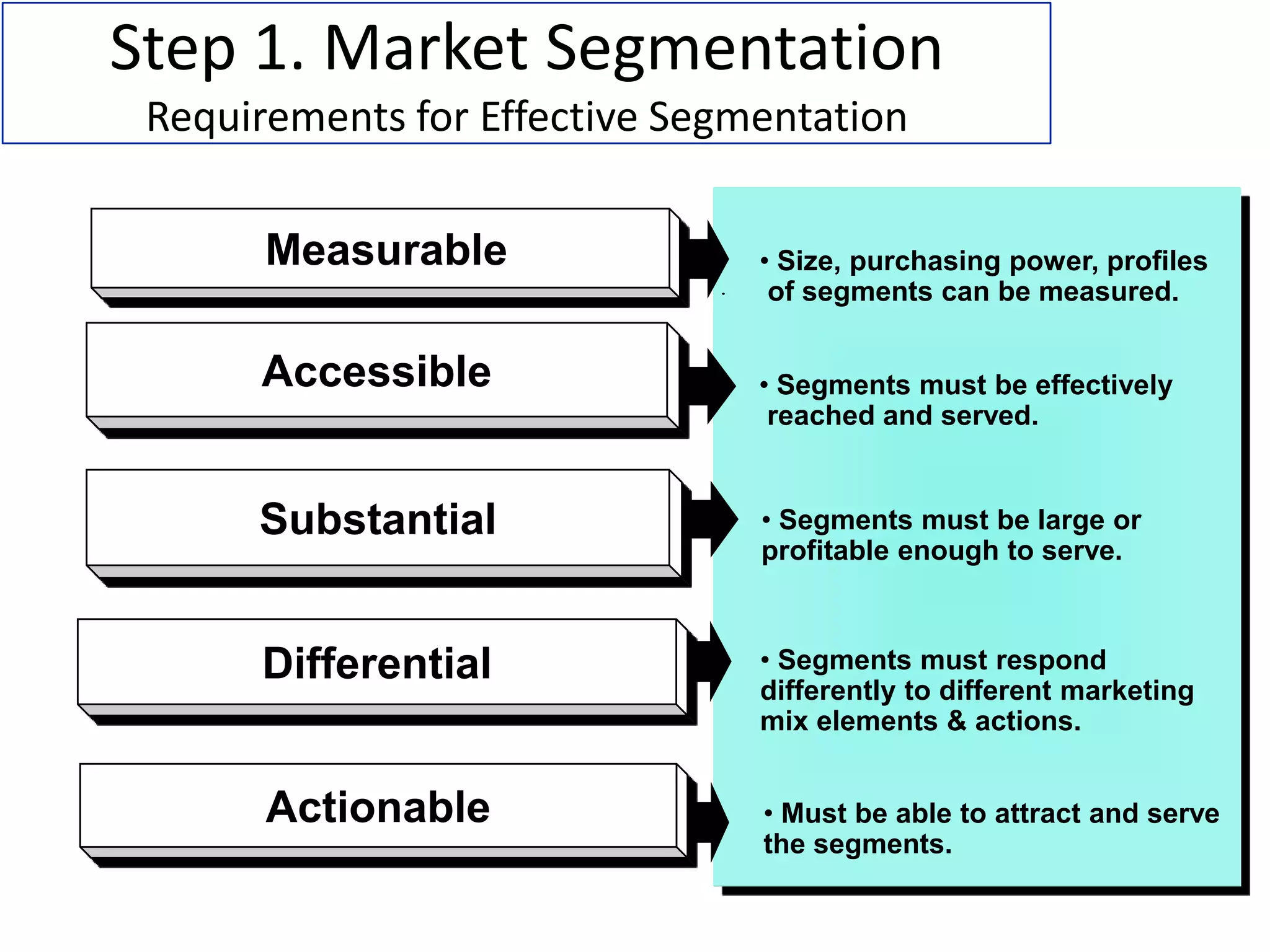
Step 1. Market Segmentation
 Requirements for Effective Segmentation

       Measurable               • Size, purchasing power, profiles
                                 of segments can be measured.


      Accessible                • Segments must be effectively
                                 reached and served.


      Substantial               • Segments must be large or
                                profitable enough to serve.


      Differential              • Segments must respond
                                differently to different marketing
                                mix elements & actions.


       Actionable               • Must be able to attract and serve
                                the segments.
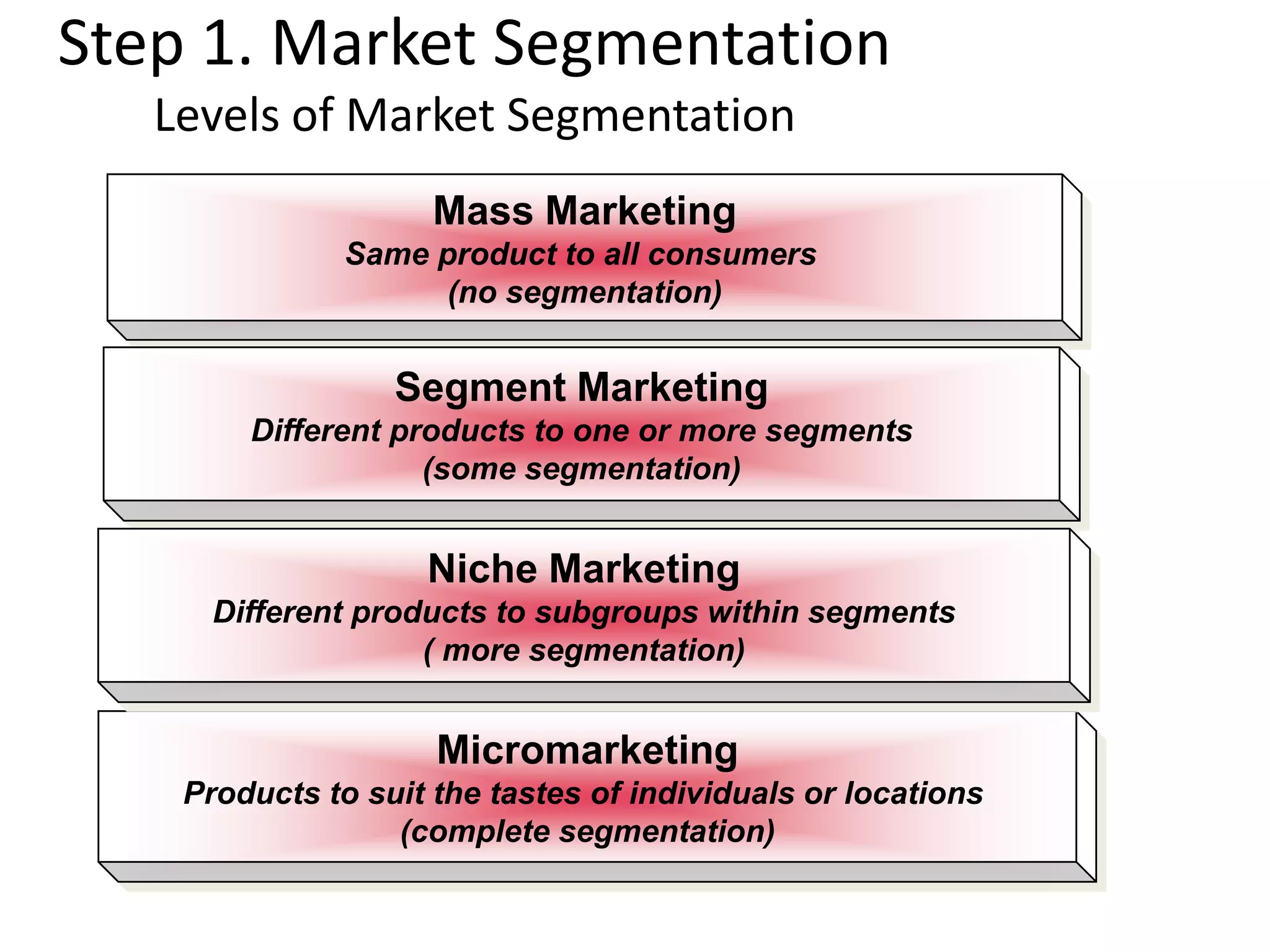
Step 1. Market Segmentation
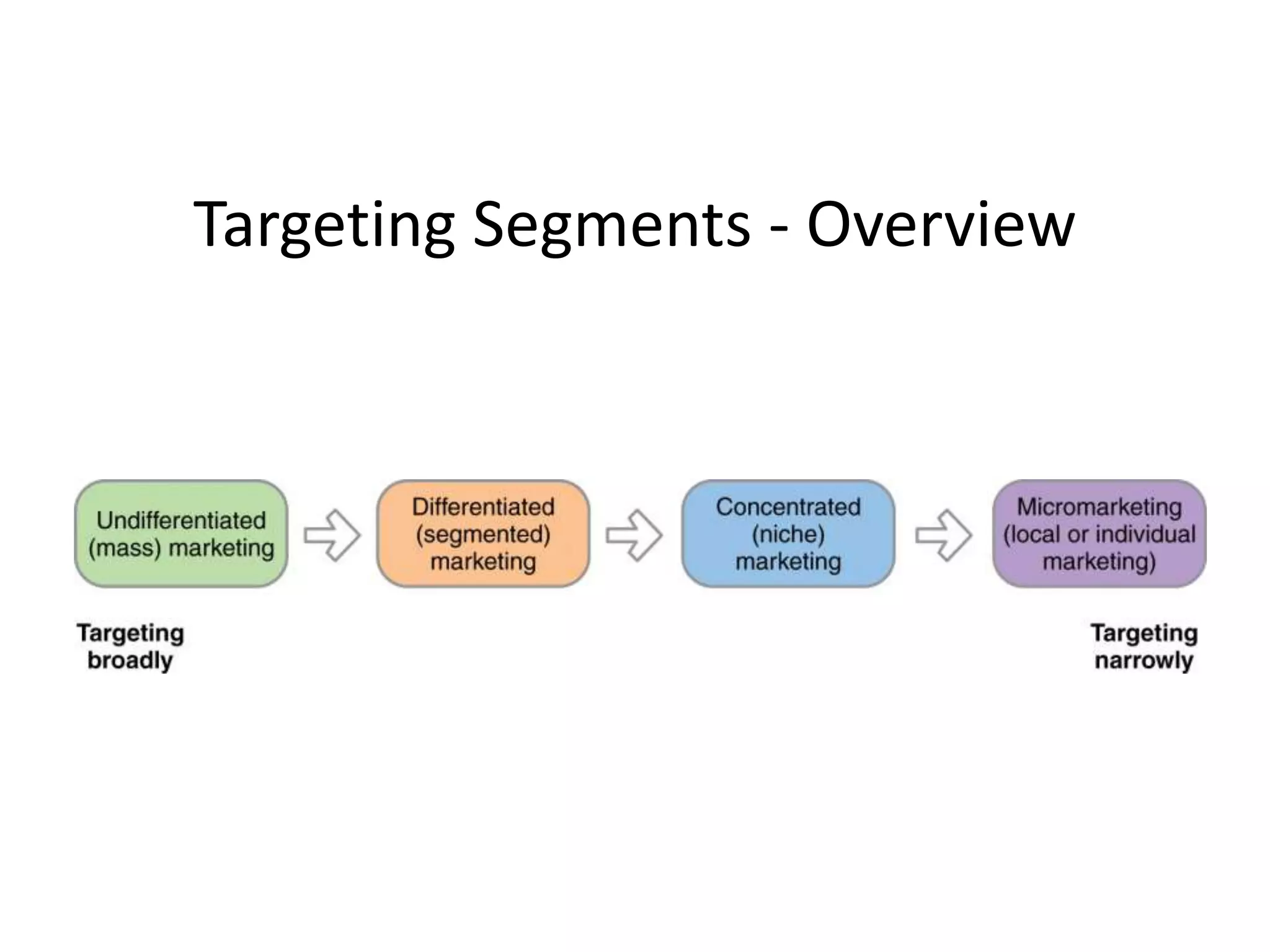
   Levels of Market Segmentation
                     Mass Marketing
               Same product to all consumers
                     (no segmentation)


                  Segment Marketing
        Different products to one or more segments
                    (some segmentation)


                    Niche Marketing
      Different products to subgroups within segments
                    ( more segmentation)


                     Micromarketing
    Products to suit the tastes of individuals or locations
                  (complete segmentation)
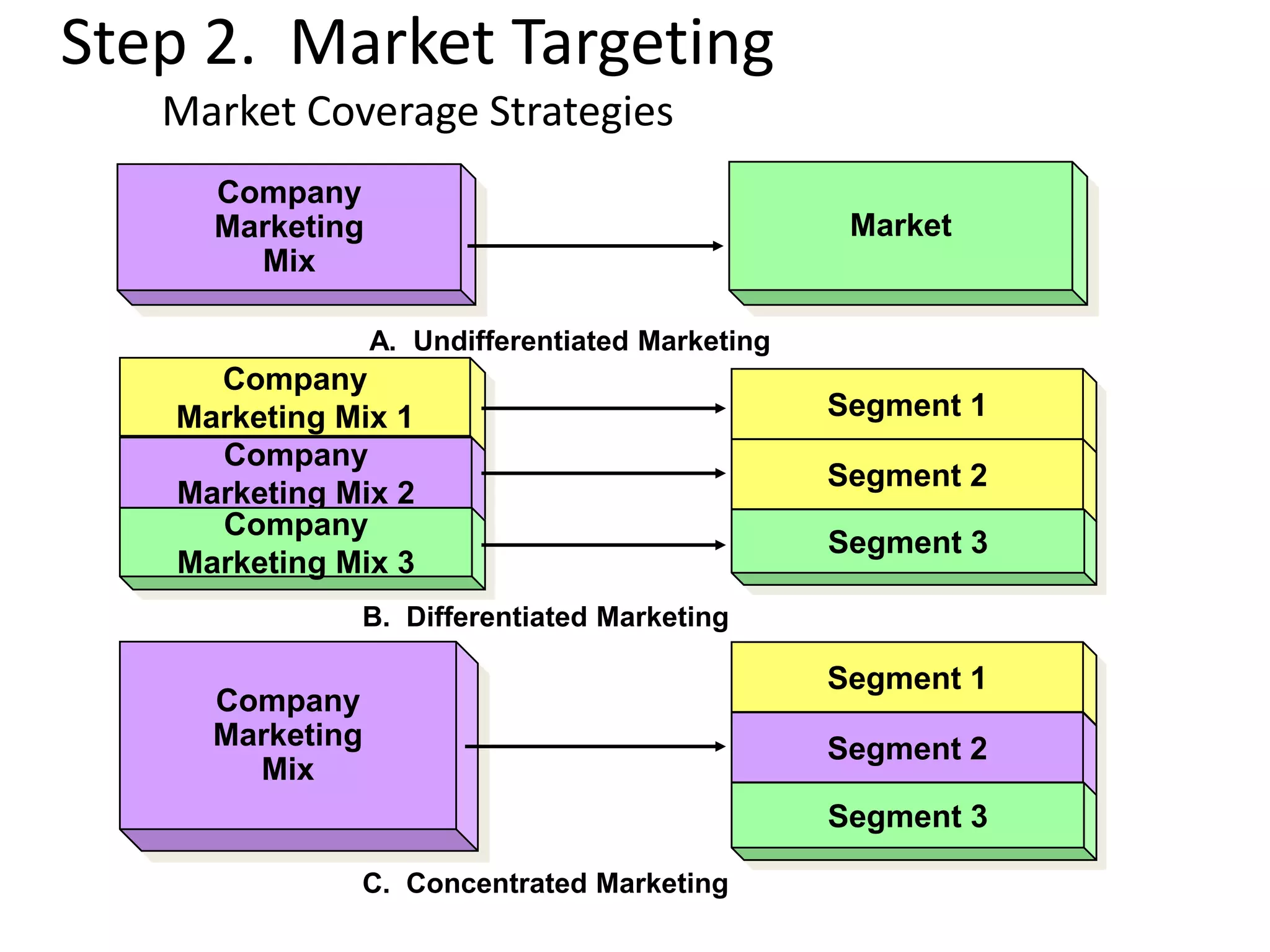
Step 2. Market Targeting
   Market Coverage Strategies
     Company
     Marketing                                    Market
       Mix

                 A. Undifferentiated Marketing
     Company
   Marketing Mix 1                               Segment 1
     Company
                                                 Segment 2
   Marketing Mix 2
     Company
                                                 Segment 3
   Marketing Mix 3
              B. Differentiated Marketing

                                                 Segment 1
     Company
     Marketing                                   Segment 2
       Mix
                                                 Segment 3

              C. Concentrated Marketing
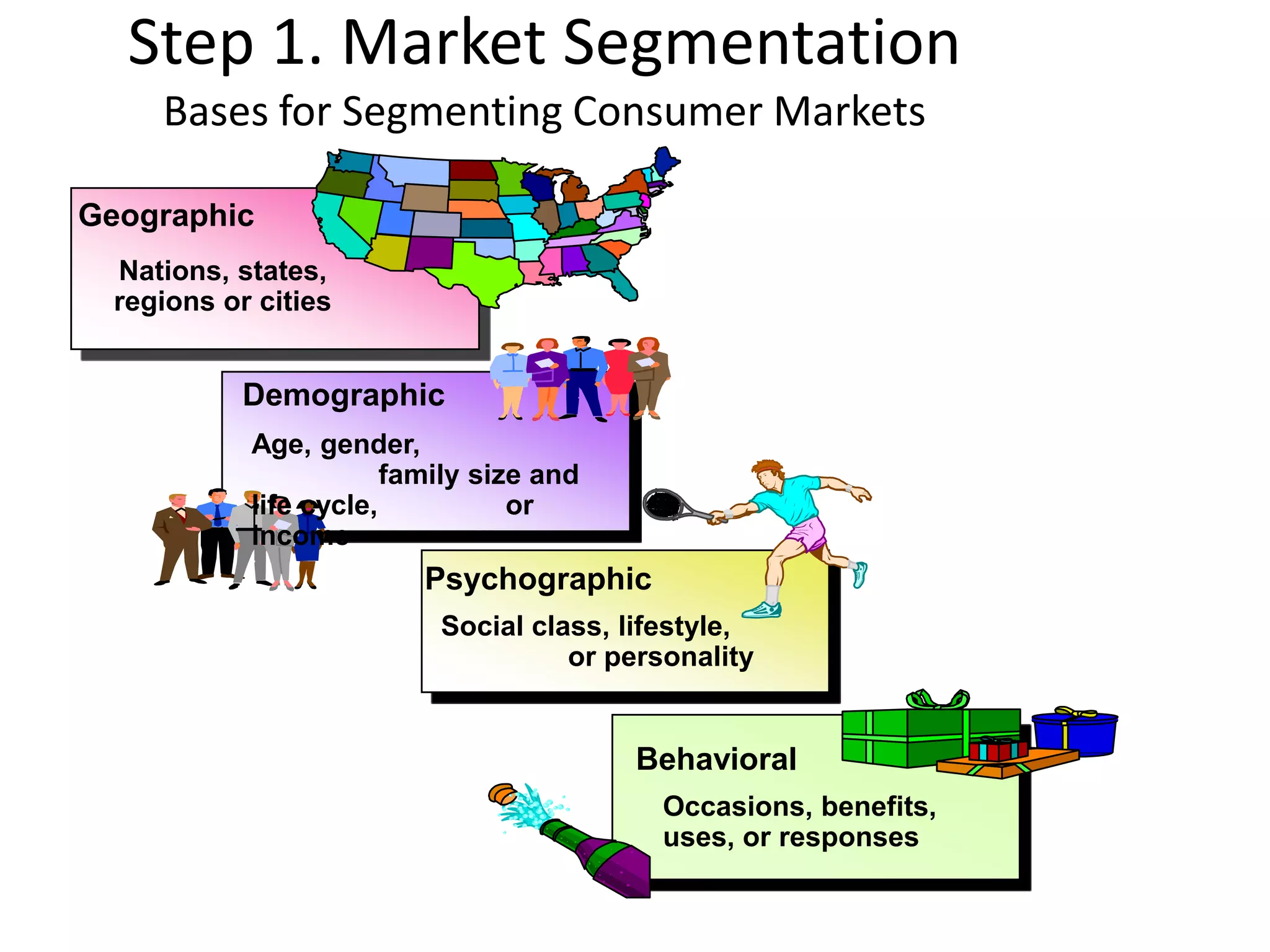
Step 1. Market Segmentation
     Bases for Segmenting Consumer Markets

Geographic
  Nations, states,
  regions or cities


            Demographic
            Age, gender,
                        family size and
            life cycle,           or
            income
                          Psychographic
                           Social class, lifestyle,
                                     or personality


                                          Behavioral
                                            Occasions, benefits,
                                            uses, or responses
Market Segmentation - Principles
• Segmentation Variables
   – Geographic
   – Demographic
   – Psychographic
   – Behavioral
   – Other (anything!)
• No single best way to segment a market.
• Often best to combine variables and identify smaller, better-
  defined target groups.
Geographic Segmentation
• Divide markets into different geographic units.

• Examples:
  – World Region or Country: North America, Western
    Europe, European Union, Pacific Rim, Mexico, etc.
  – Country Region: Pacific, Mountain, East Coast, etc.
  – City or Metro Size: New York, San Francisco
  – Population Density: rural, suburban, urban
  – Climate: northern, southern, tropical, semi-tropical
Demographic Segmentation
• Use Differences in:
  – age, gender, family size, family life
    cycle, income, occupation, education, race, and
    religion

  – Most frequently used segmentation variable
     • Ease of measurement and high availability.


  – Usually the worst variable to use.
Psychographic Segmentation


      Psychographic segmentation
          divides a market into
       different groups based on
        social class, lifestyle, or
       personality characteristics.

   People in the same demographic classification
often have very different lifestyles and personalities.
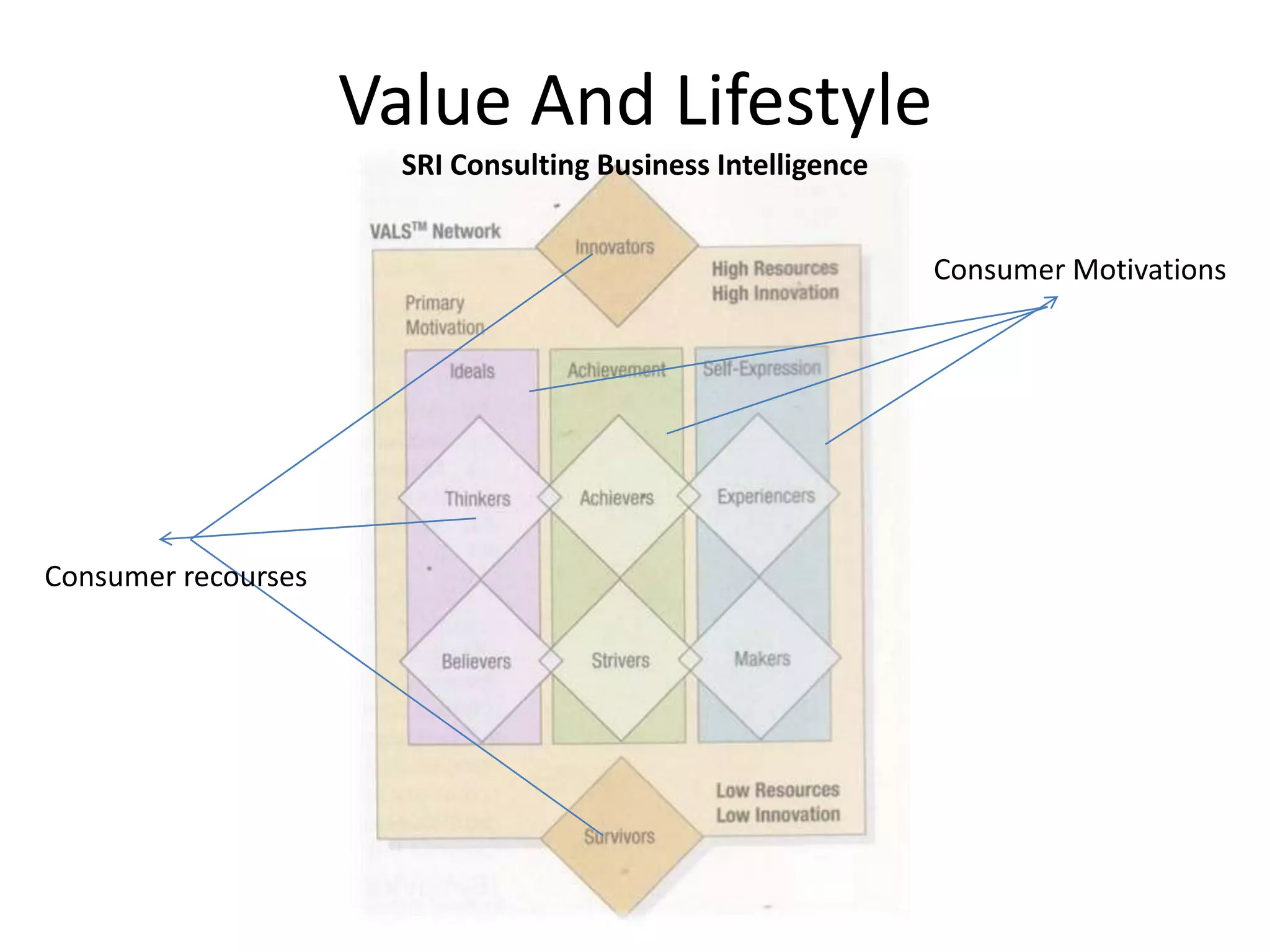
Value And Lifestyle
                       SRI Consulting Business Intelligence


                                                              Consumer Motivations


Consumer recourses
• http://www.strategicbusinessinsights.com
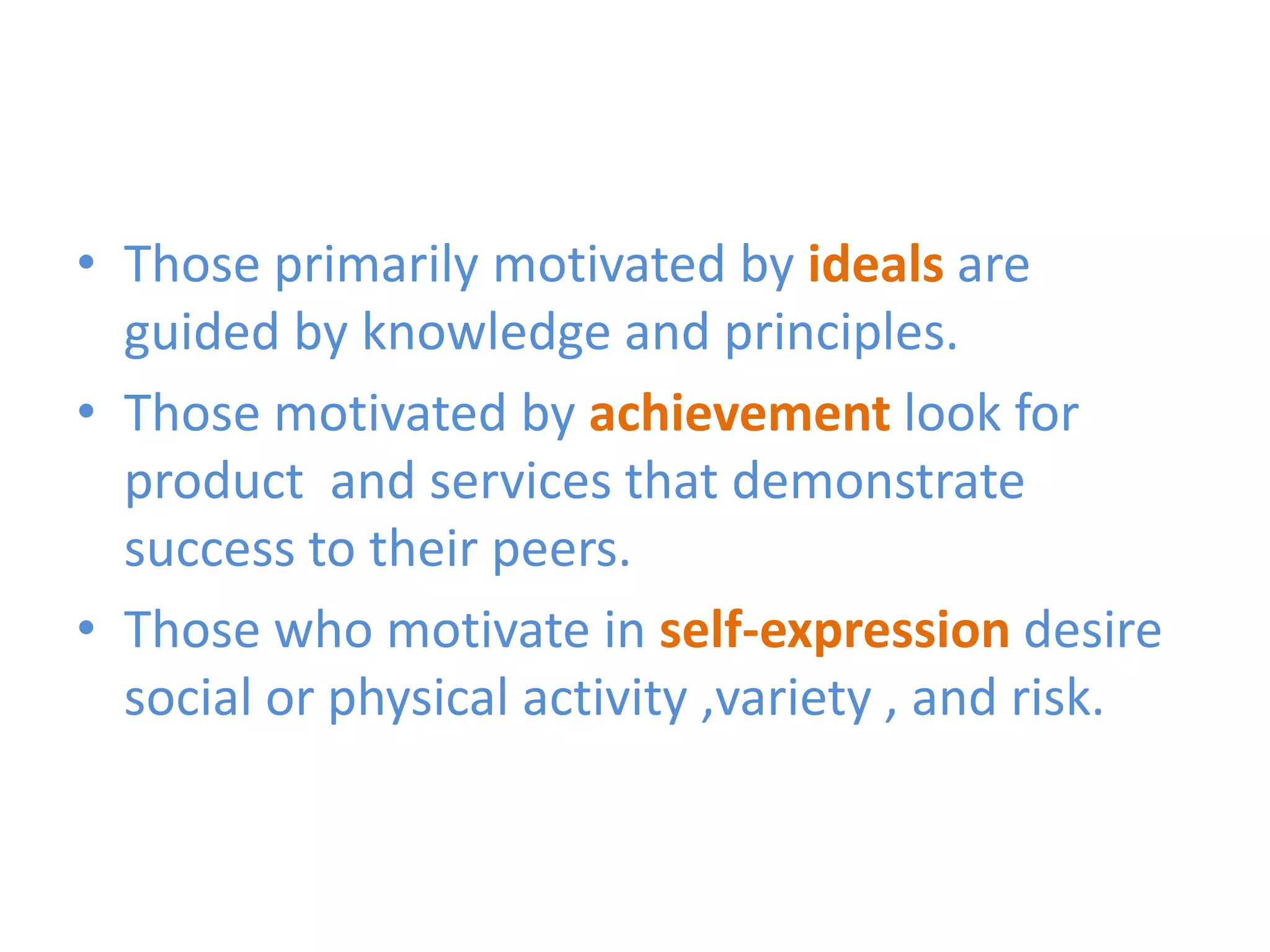
• Those primarily motivated by ideals are
  guided by knowledge and principles.
• Those motivated by achievement look for
  product and services that demonstrate
  success to their peers.
• Those who motivate in self-expression desire
  social or physical activity ,variety , and risk.
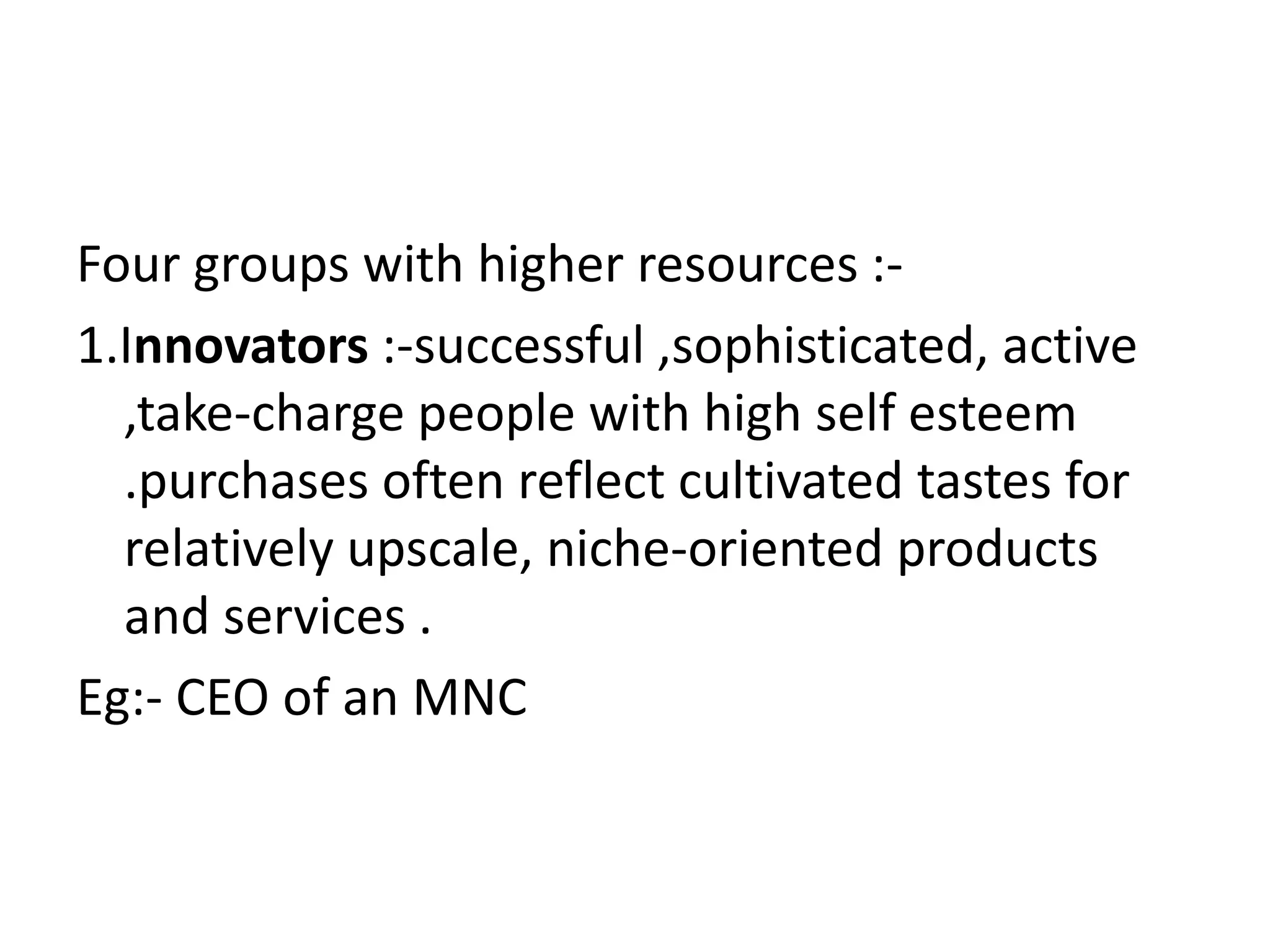
Four groups with higher resources :-
1.Innovators :-successful ,sophisticated, active
  ,take-charge people with high self esteem
  .purchases often reflect cultivated tastes for
  relatively upscale, niche-oriented products
  and services .
Eg:- CEO of an MNC
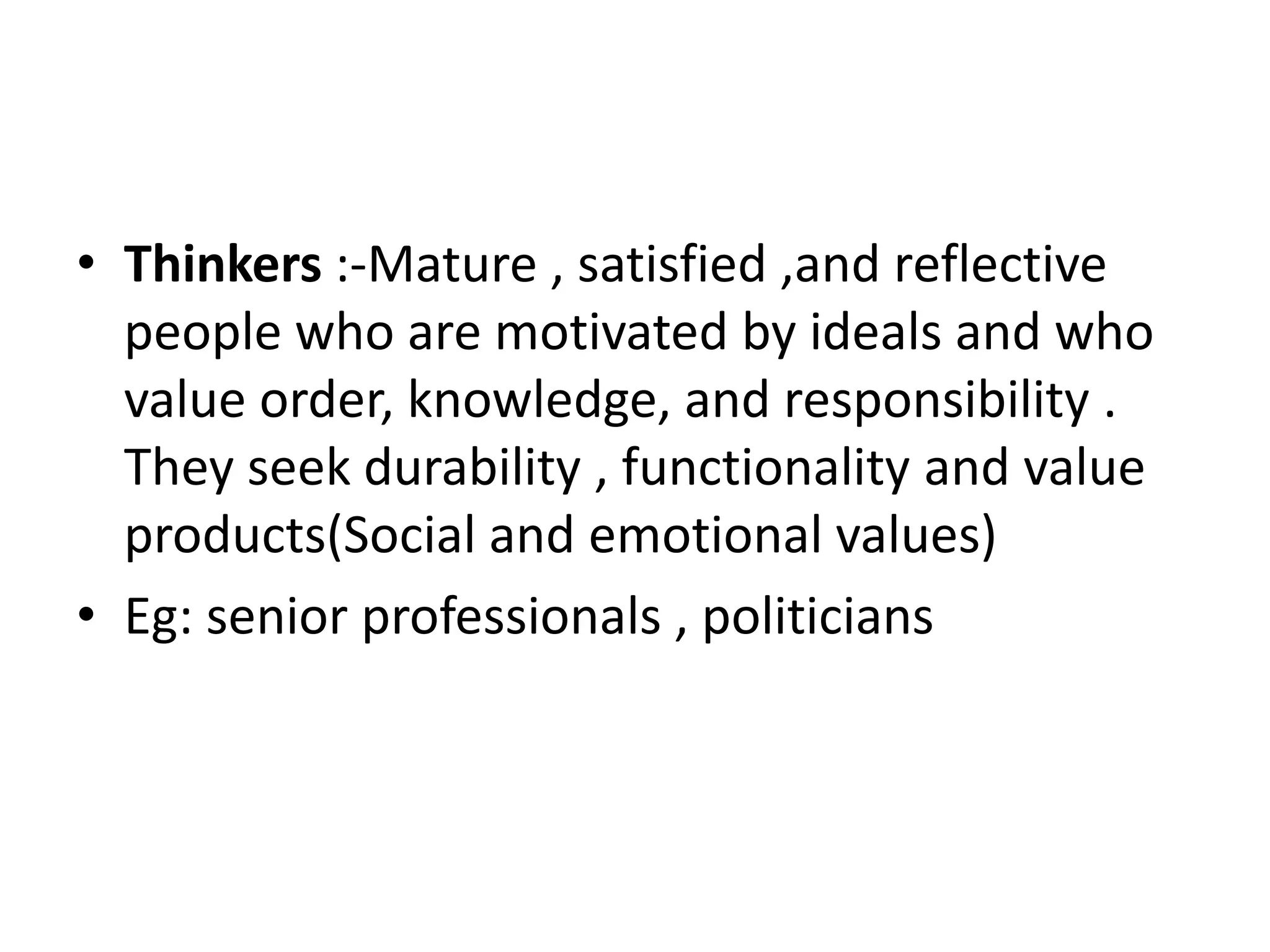
• Thinkers :-Mature , satisfied ,and reflective
  people who are motivated by ideals and who
  value order, knowledge, and responsibility .
  They seek durability , functionality and value
  products(Social and emotional values)
• Eg: senior professionals , politicians
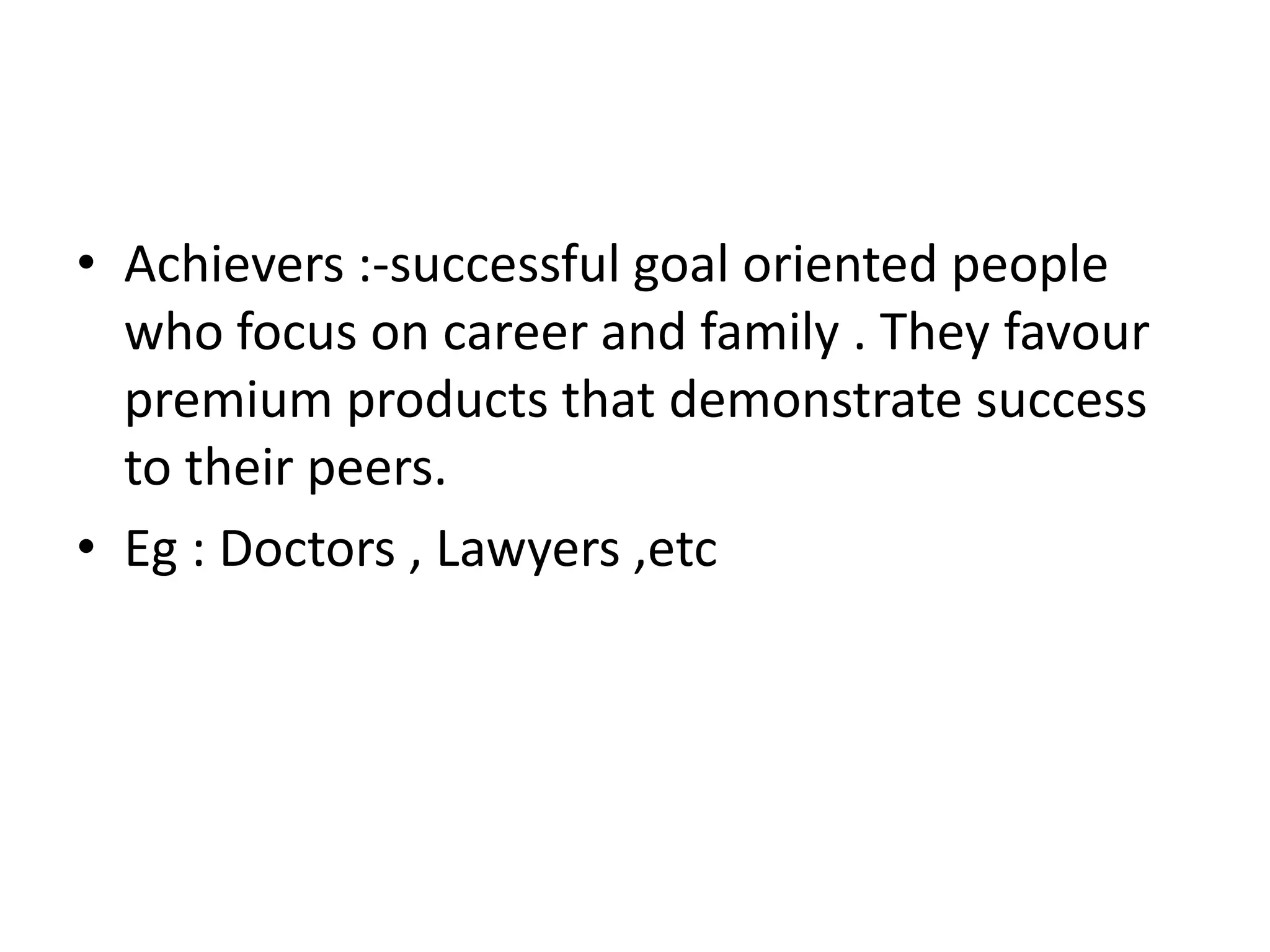
• Achievers :-successful goal oriented people
  who focus on career and family . They favour
  premium products that demonstrate success
  to their peers.
• Eg : Doctors , Lawyers ,etc
• Experiencers :- Young enthusiastic , impulsive
  people who seek variety and excitement. They
  spend a comparatively high proportion of
  income on fashion , entertainment , and
  socializing
• Eg:- young IT prof
The four group with lower recourse are:-
• 1.Believer :-conservative , conventional
  ,traditional people with concrete beliefs .They
  prefer familiar products and are loyal to
  established brand .
• Eg:-Middle income group
2.Strivers :- Trendy and fun loving people who
  are resource constrained . They favor stylish
  products that emulate the purchases of those
  with greater material wealth .
Eg :- Low income
3.Makers :- Practical , down to earth , self
  sufficient people who like to work with their
  hands . They seek products with a practical or
  functional purpose .
Eg:-trade union leaders , human activists
4.Survivors :- Elderly , passive people who are
  concerned about change. They are loyal to
  their favorite brands.
Eg:- retired employees, senior citizens,
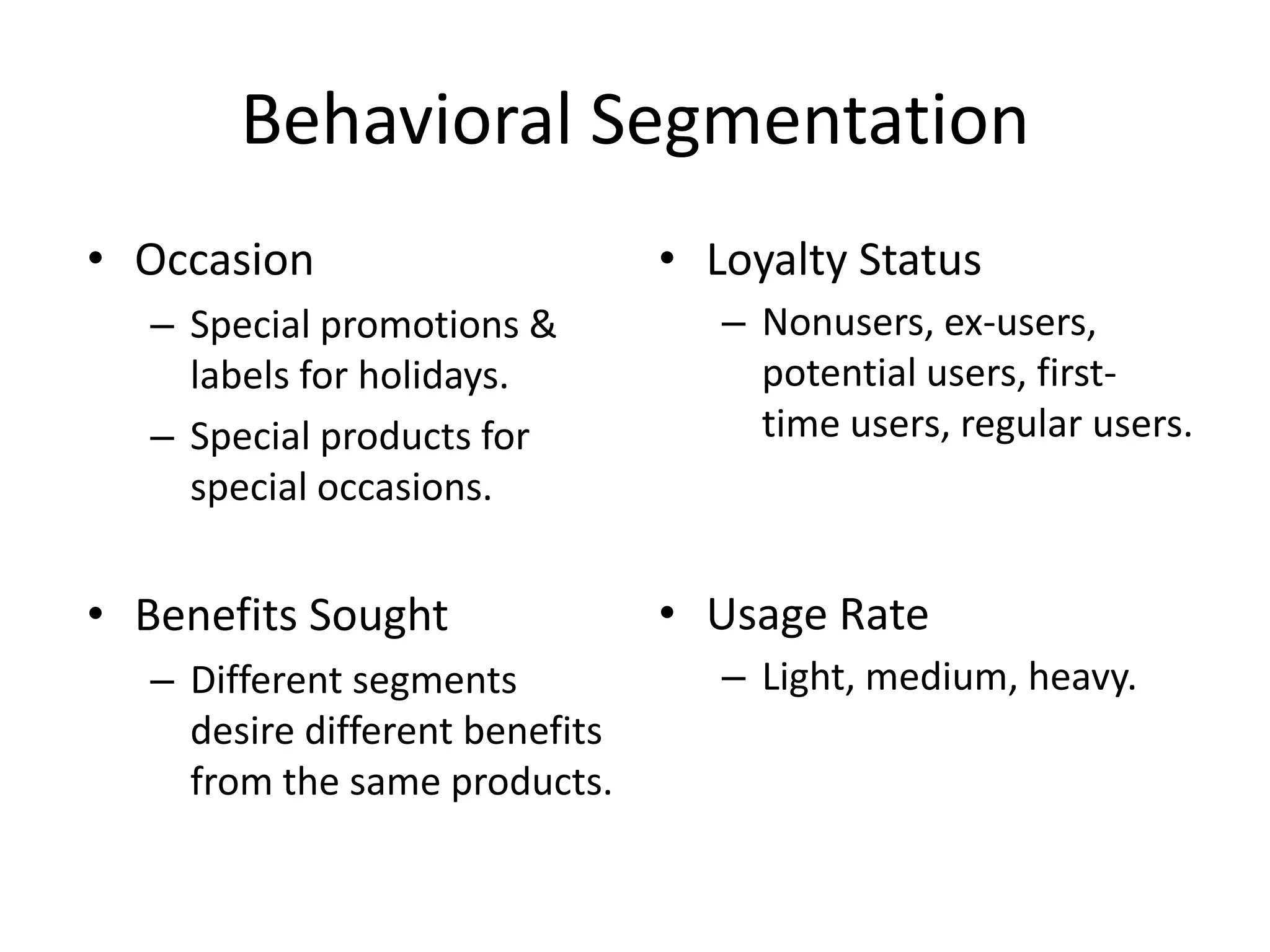
Behavioral Segmentation
• Occasion                      • Loyalty Status
  – Special promotions &           – Nonusers, ex-users,
    labels for holidays.             potential users, first-
  – Special products for             time users, regular users.
    special occasions.


• Benefits Sought               • Usage Rate
  – Different segments             – Light, medium, heavy.
    desire different benefits
    from the same products.
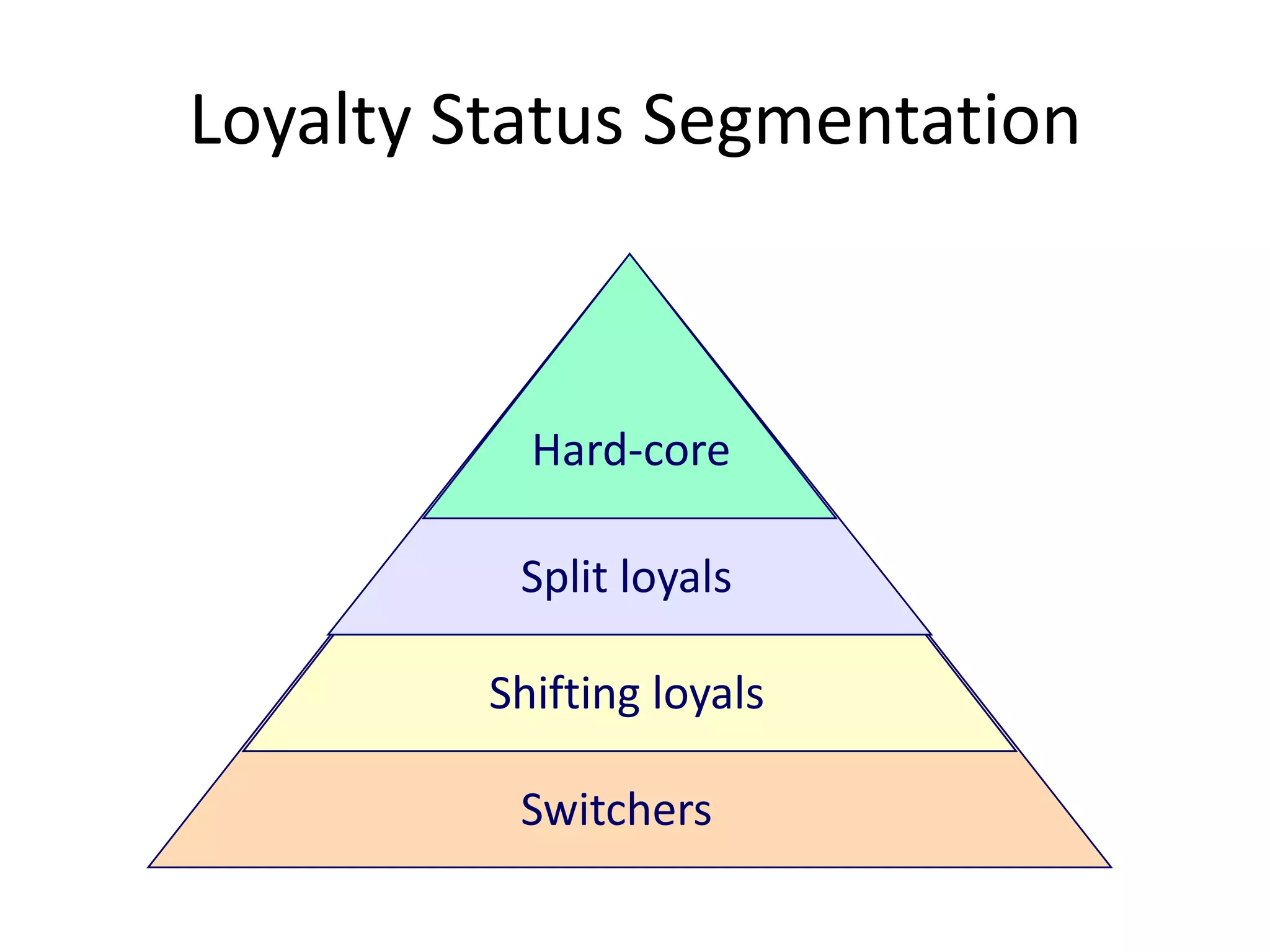
Loyalty Status Segmentation


           Hard-core

          Split loyals

         Shifting loyals

          Switchers
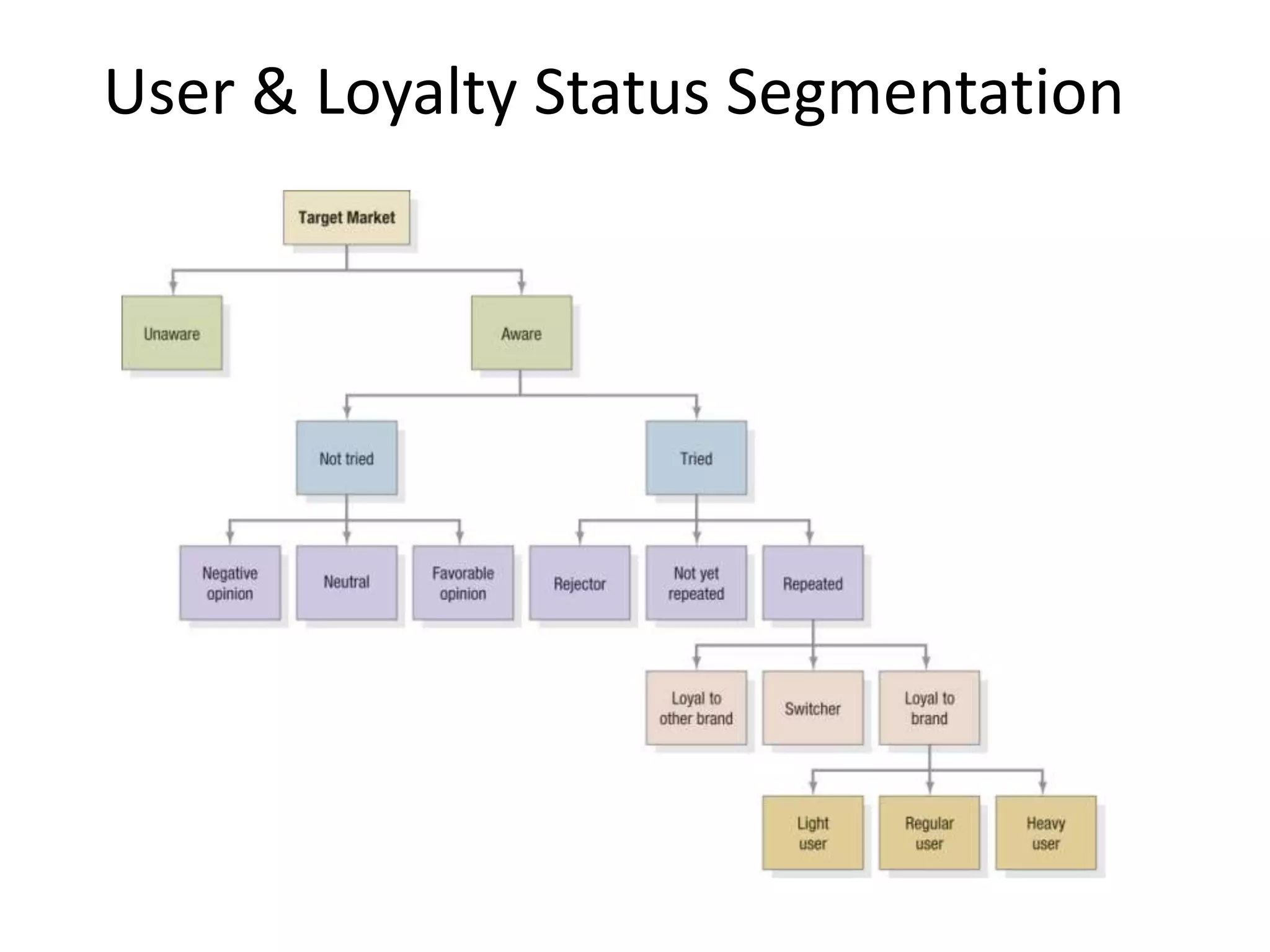
User & Loyalty Status Segmentation
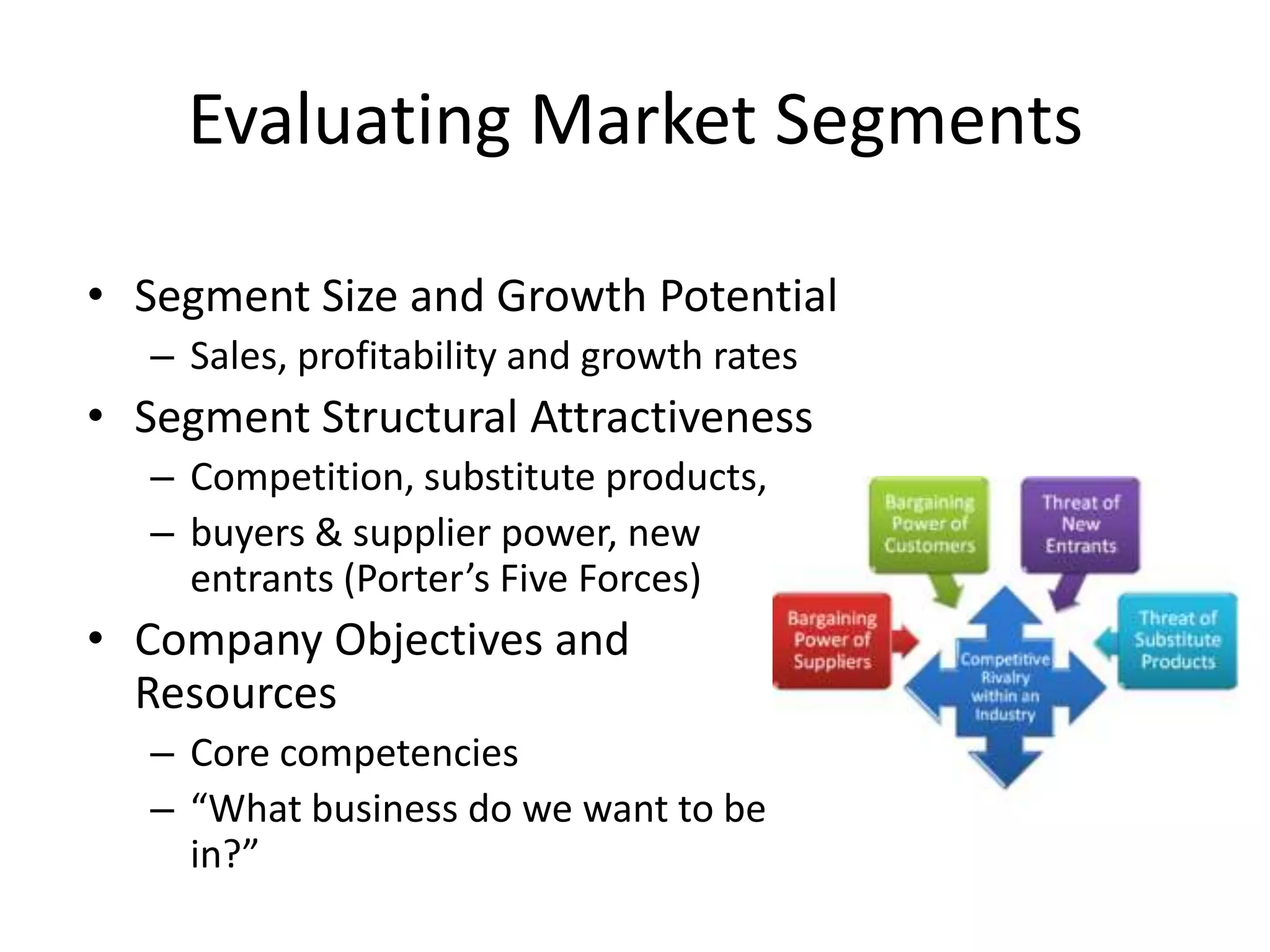
Evaluating Market Segments

• Segment Size and Growth Potential
   – Sales, profitability and growth rates
• Segment Structural Attractiveness
   – Competition, substitute products,
   – buyers & supplier power, new
     entrants (Porter’s Five Forces)
• Company Objectives and
  Resources
   – Core competencies
   – “What business do we want to be
     in?”
Targeting Segments - Overview
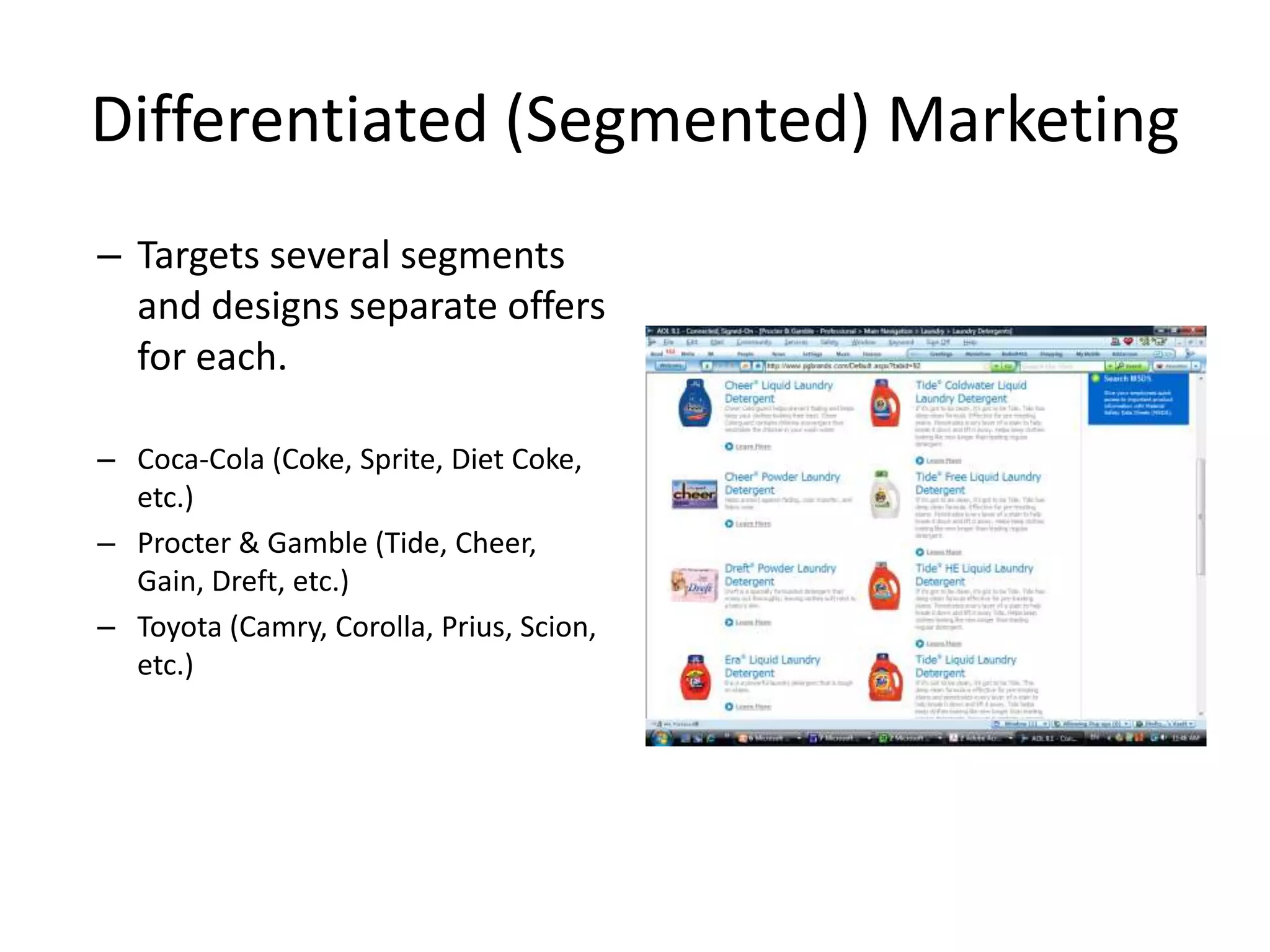
Differentiated (Segmented) Marketing
– Targets several segments
  and designs separate offers
  for each.

– Coca-Cola (Coke, Sprite, Diet Coke,
  etc.)
– Procter & Gamble (Tide, Cheer,
  Gain, Dreft, etc.)
– Toyota (Camry, Corolla, Prius, Scion,
  etc.)
Micromarketing
• Tailoring products and marketing programs to suit
  the tastes of specific individuals and/or locations.
Activity -2 c
Identify the bases by which companies have
  segmented their markets for these products
  (taking help from the television ads and other
  advertisements) : Nakshatra diamonds
  , Cinthol soaps , Domex toilet cleaner and
  parker pen .
TARGETING
• Targeting is defined as a group of people or
  organisations for which an organisation
  designs , impements and maintains the
  marketing mix .
Selecting target market
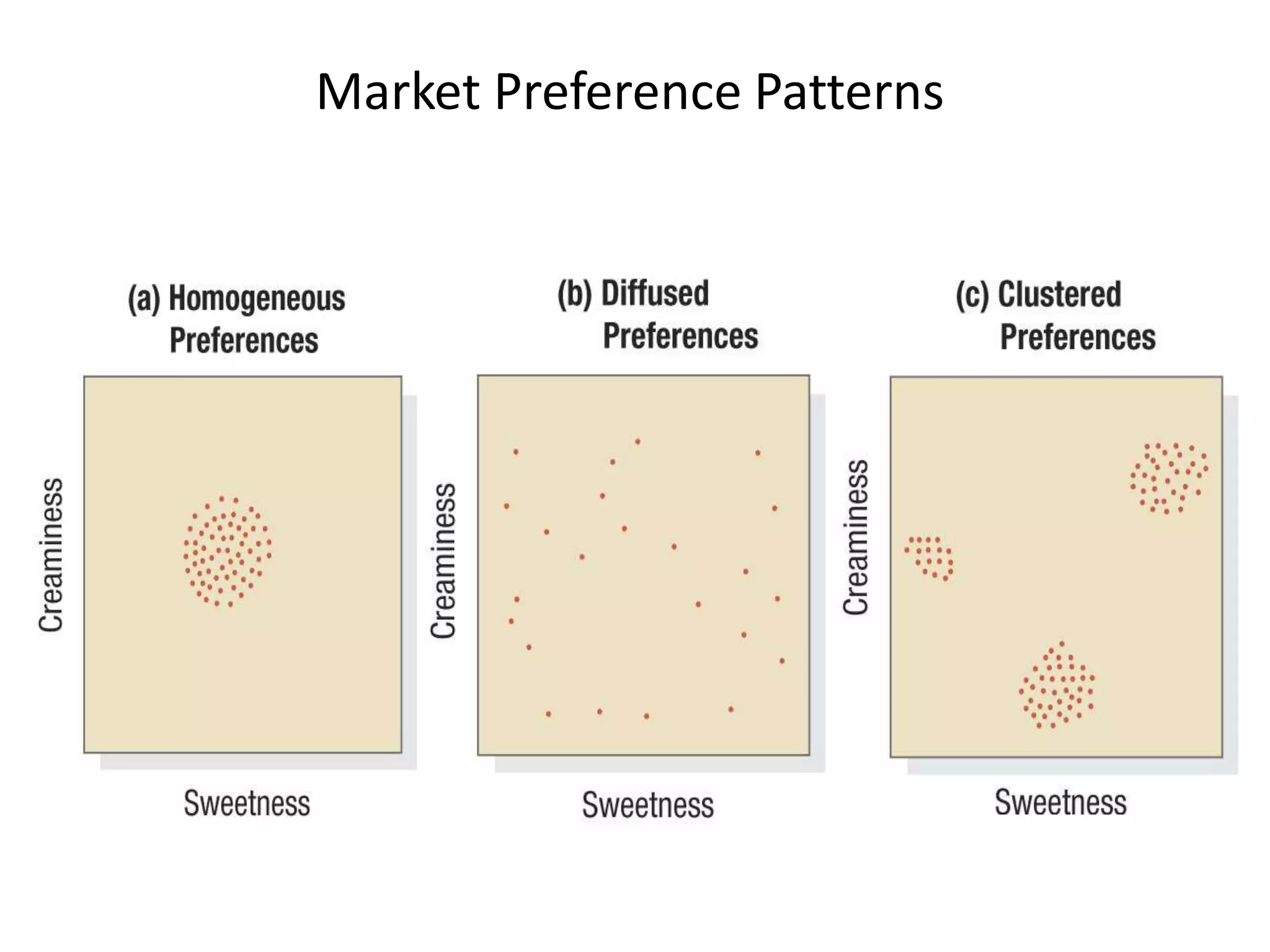
• Homogenious preference :- soft drinks
  market(Co-co cola )
• Diffused preferences :- automobile
  market,HUL having different brands for soaps .
• Clustered preferences :- occupation having
  impact on the types cloths worn.
Market Preference Patterns
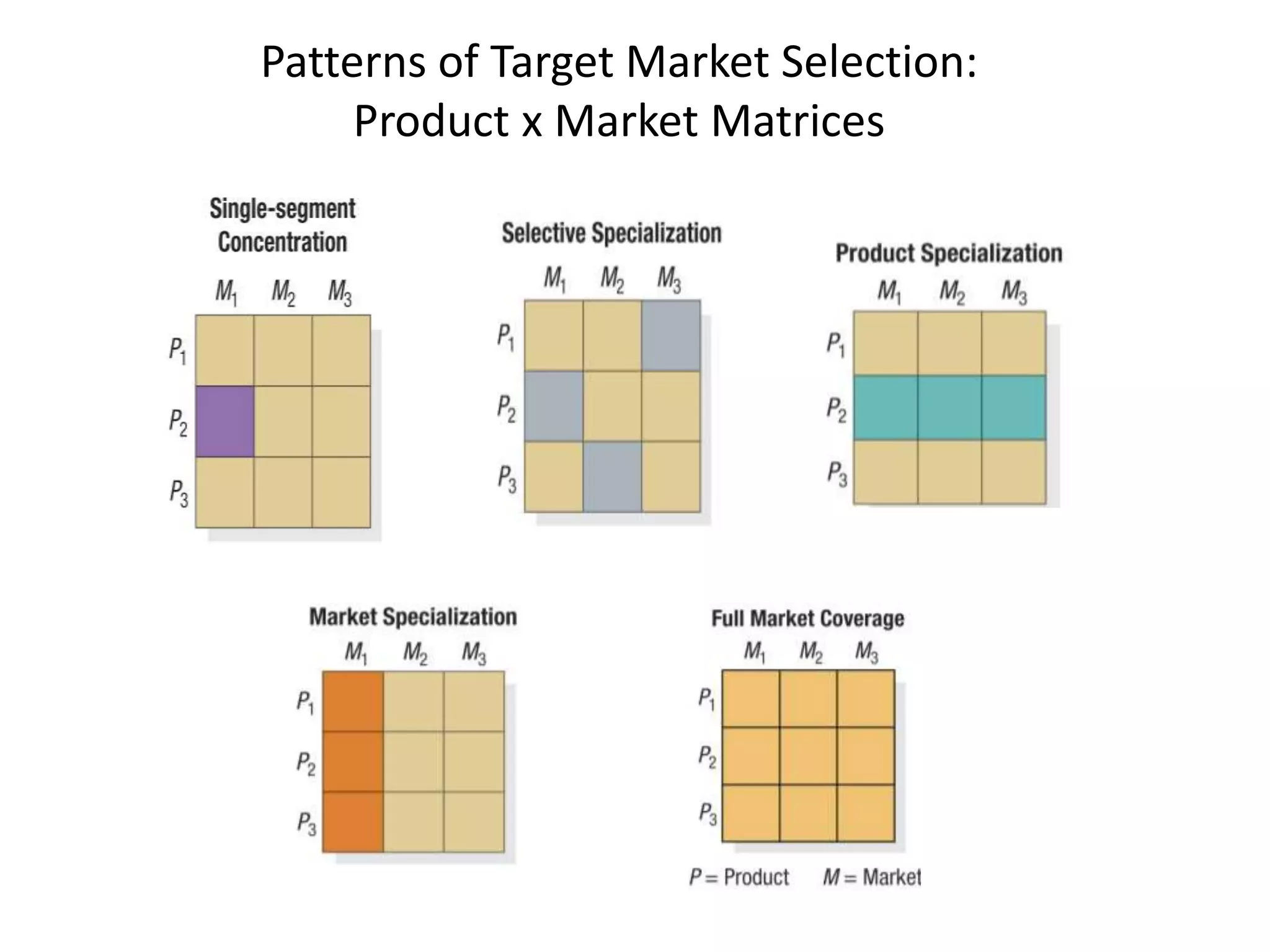
Patterns of Target Market Selection:
     Product x Market Matrices
Positioning


Placing a product occupies in consumers’ minds
          relative to competing products.
Positioning Example


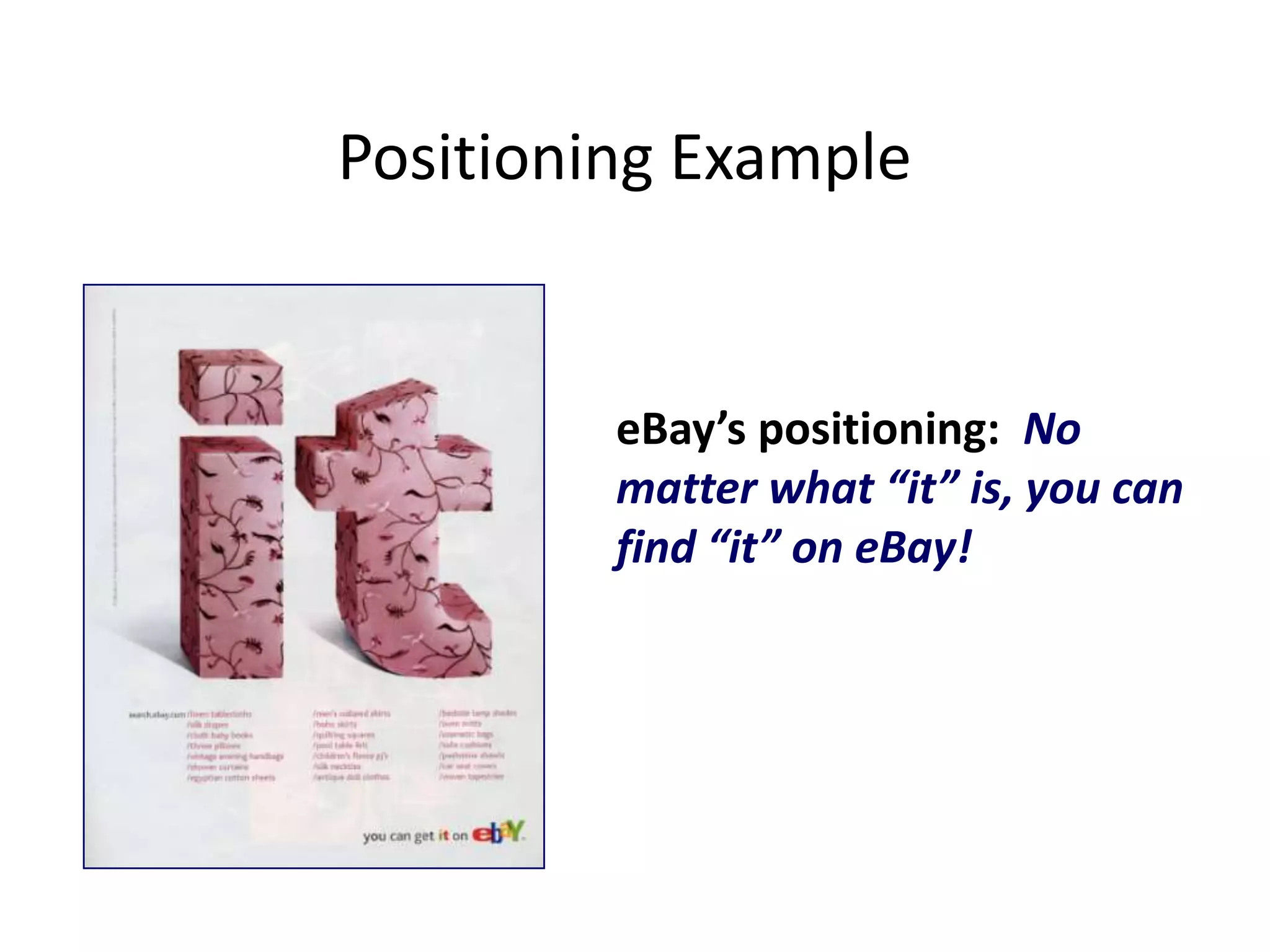
         eBay’s positioning: No
         matter what “it” is, you can
         find “it” on eBay!
Remember this important point.


  Positioning is all
        about
   'perception'.
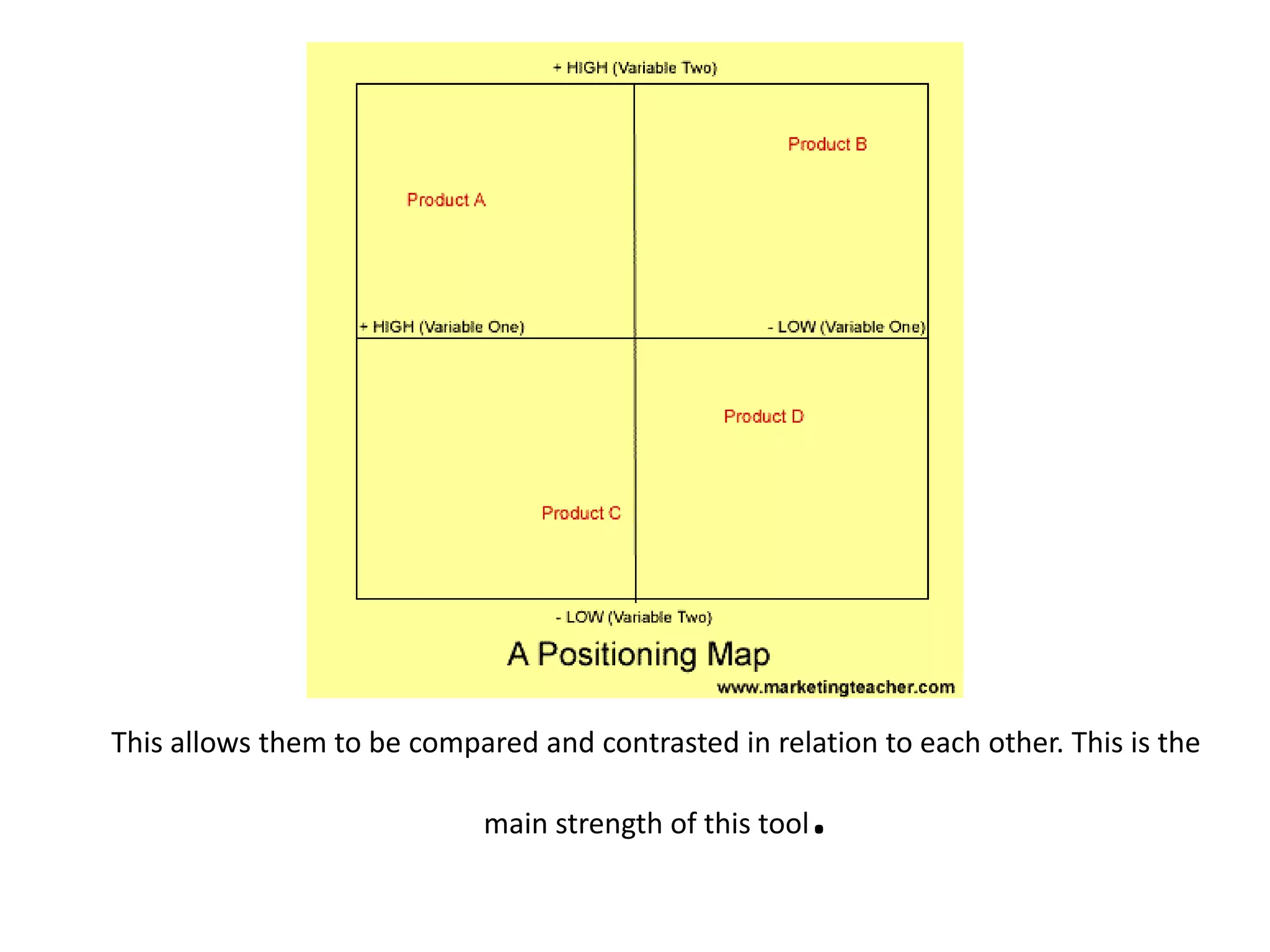
This allows them to be compared and contrasted in relation to each other. This is the

                                                      .
                             main strength of this tool
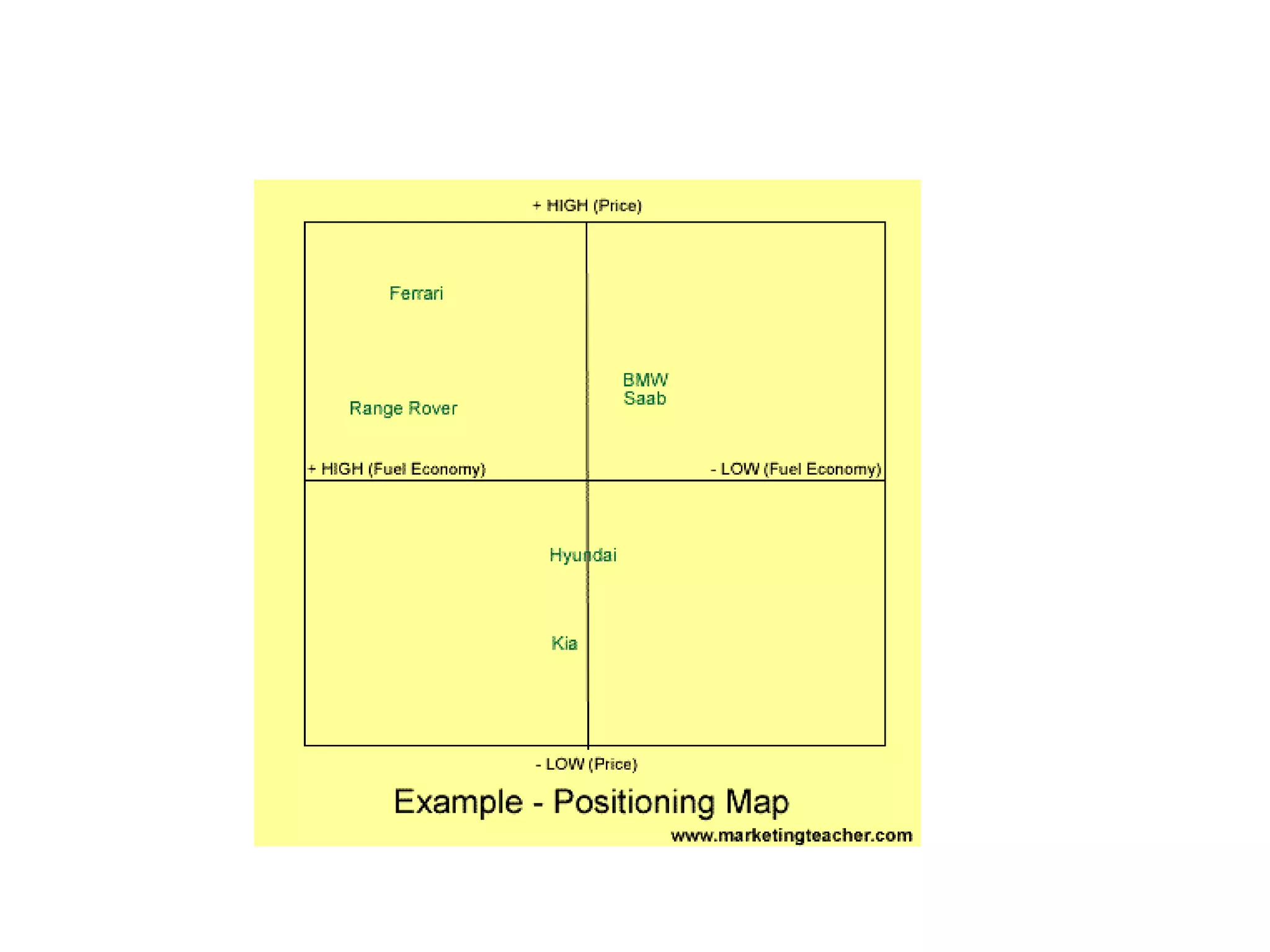
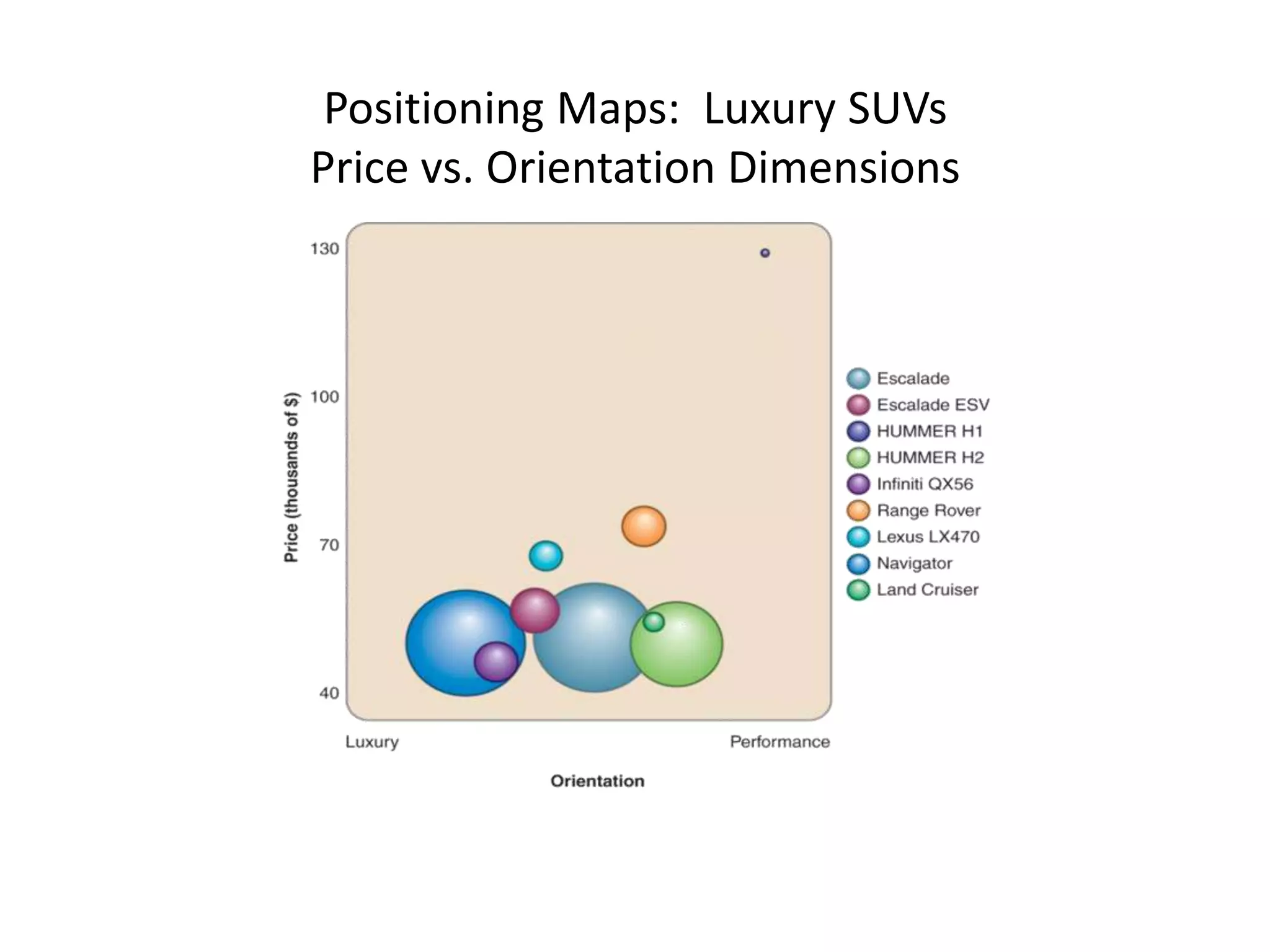
Working of position map
• The marketer would draw out the map and
  decide upon a label for each axis.
• They could be price (variable one) and quality
  (variable two), or Comfort (variable one) and
  price (variable two).
• The individual products are then mapped out
  next to each other Any gaps could be regarded
  as possible areas for new products.
Positioning Maps: Luxury SUVs
Price vs. Orientation Dimensions
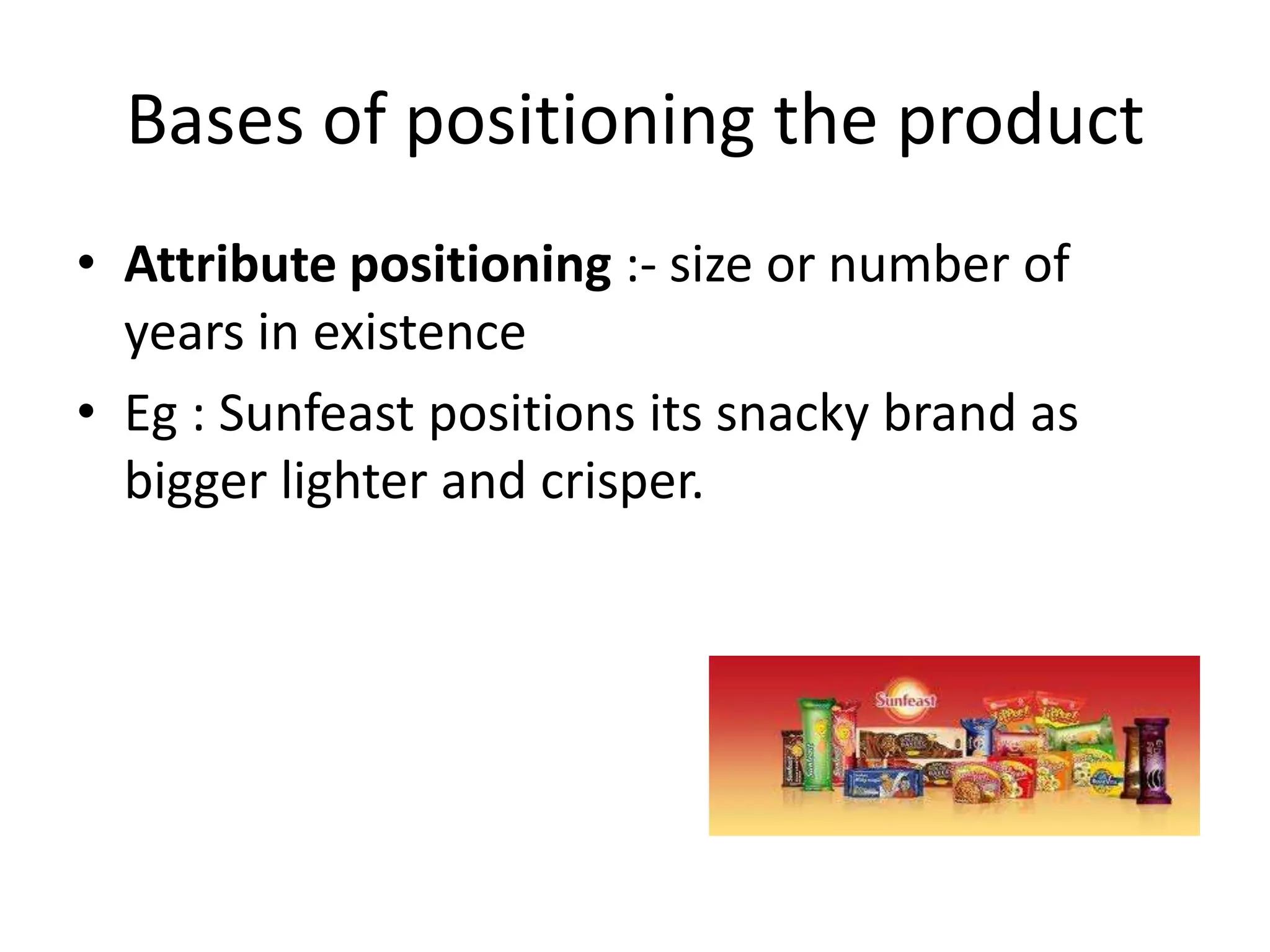
Bases of positioning the product
• Attribute positioning :- size or number of
  years in existence
• Eg : Sunfeast positions its snacky brand as
  bigger lighter and crisper.
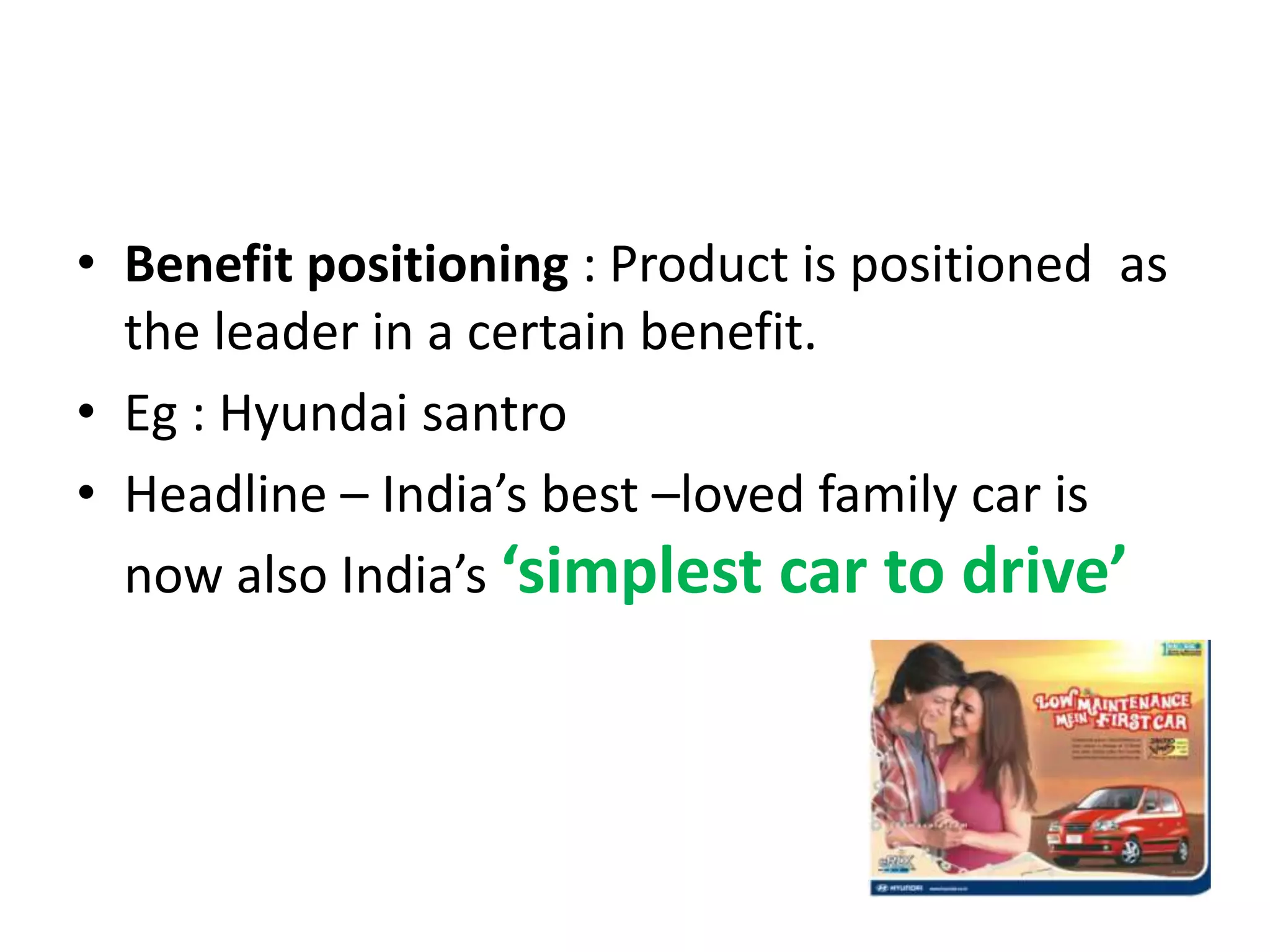
• Benefit positioning : Product is positioned as
  the leader in a certain benefit.
• Eg : Hyundai santro
• Headline – India’s best –loved family car is
  now also India’s ‘simplest car to drive’
• Use or Application positioning
• Positioning the product as best for use and
  application .
• Eg: Kenstar positioned its product as
  UNEXPECTEDLY COLD
• User positioning:- for some user group
• Eg :- Parle-G for kids
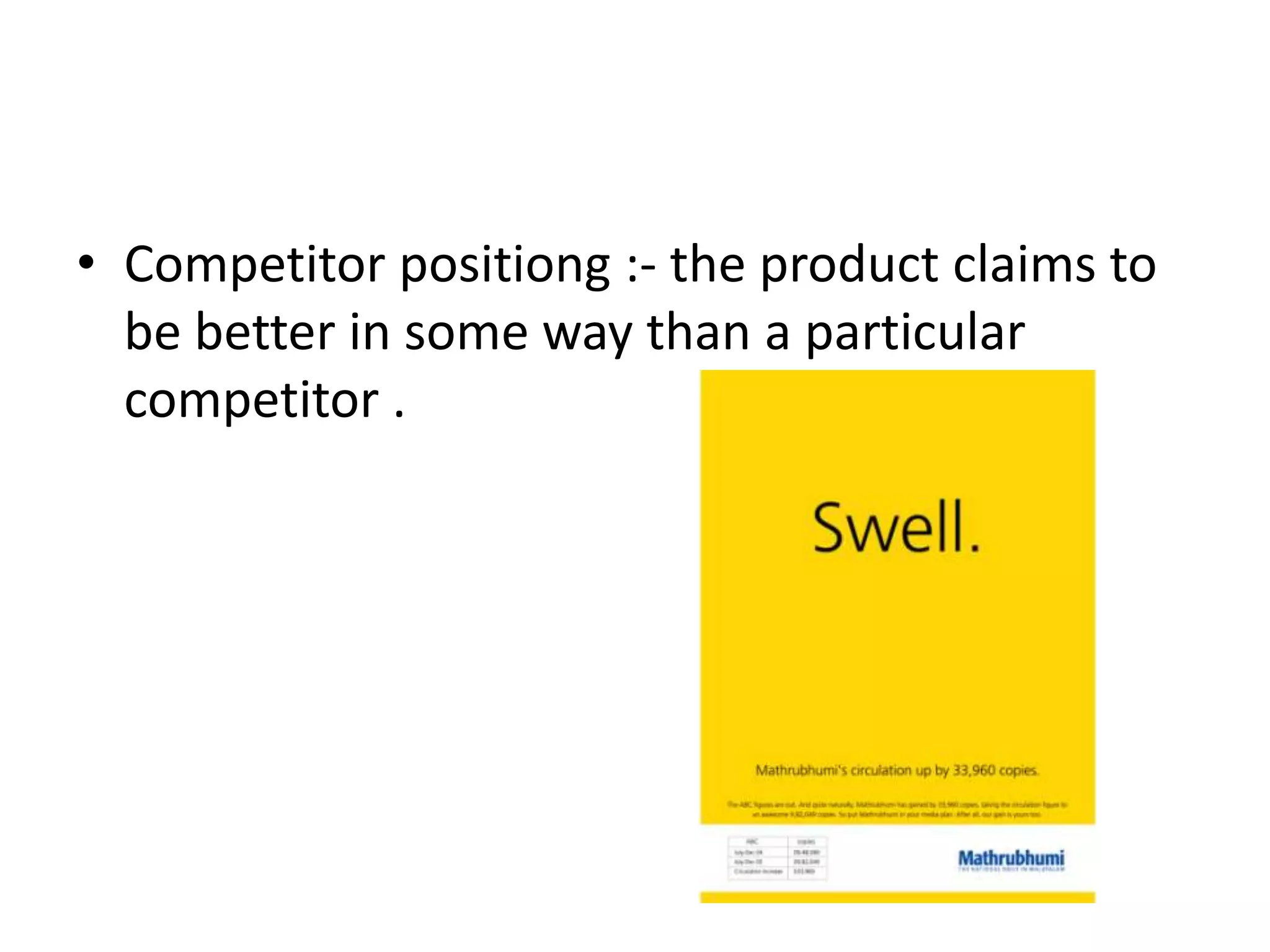
• Competitor positiong :- the product claims to
  be better in some way than a particular
  competitor .
• Quality and price positioning :-
The product is positioned as offering the best
  value .
Eg : Big Bazar
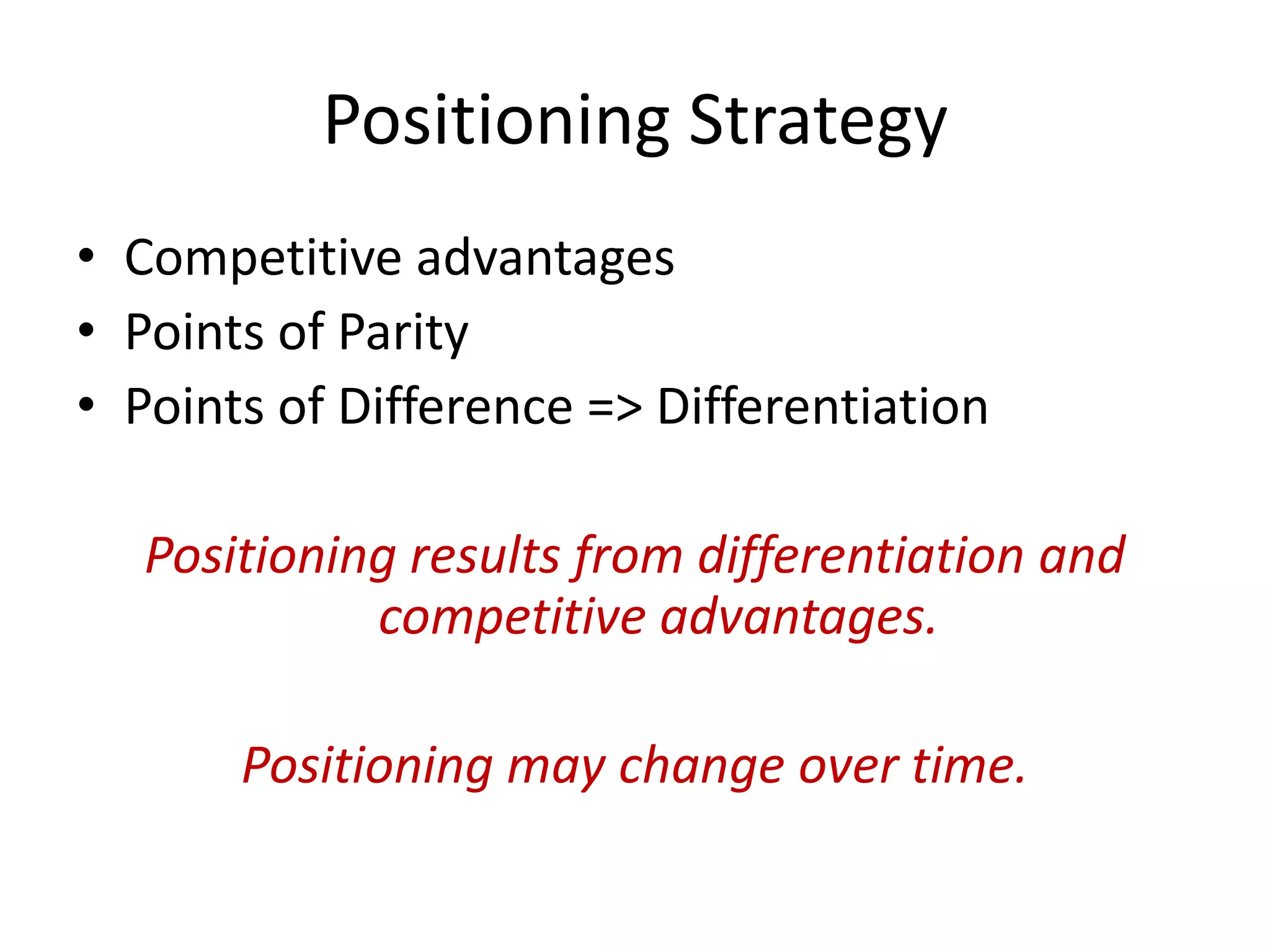
Positioning Strategy
• Competitive advantages
• Points of Parity
• Points of Difference => Differentiation

   Positioning results from differentiation and
             competitive advantages.

       Positioning may change over time.
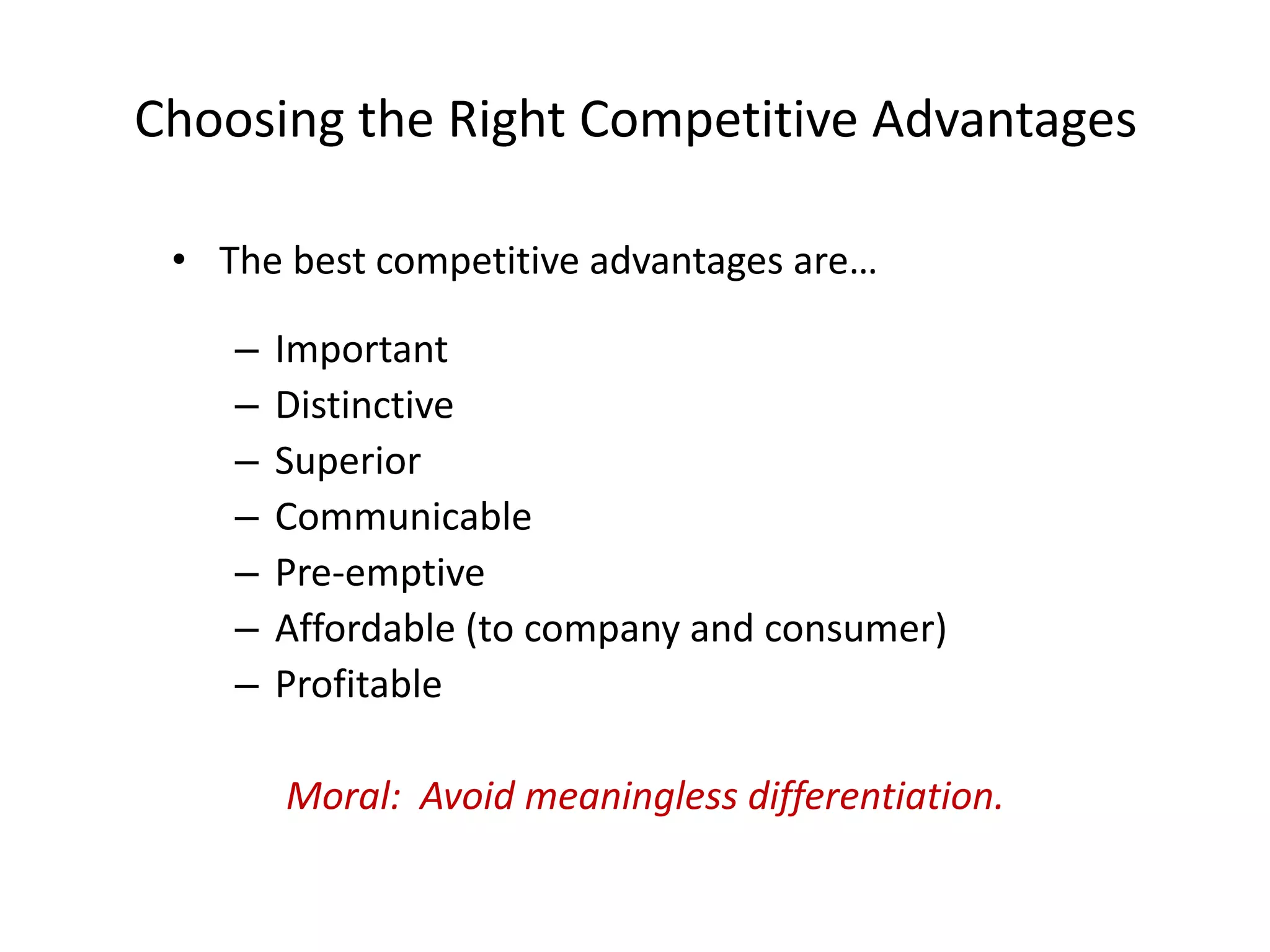
Choosing the Right Competitive Advantages

 • The best competitive advantages are…

    –   Important
    –   Distinctive
    –   Superior
    –   Communicable
    –   Pre-emptive
    –   Affordable (to company and consumer)
    –   Profitable

        Moral: Avoid meaningless differentiation.
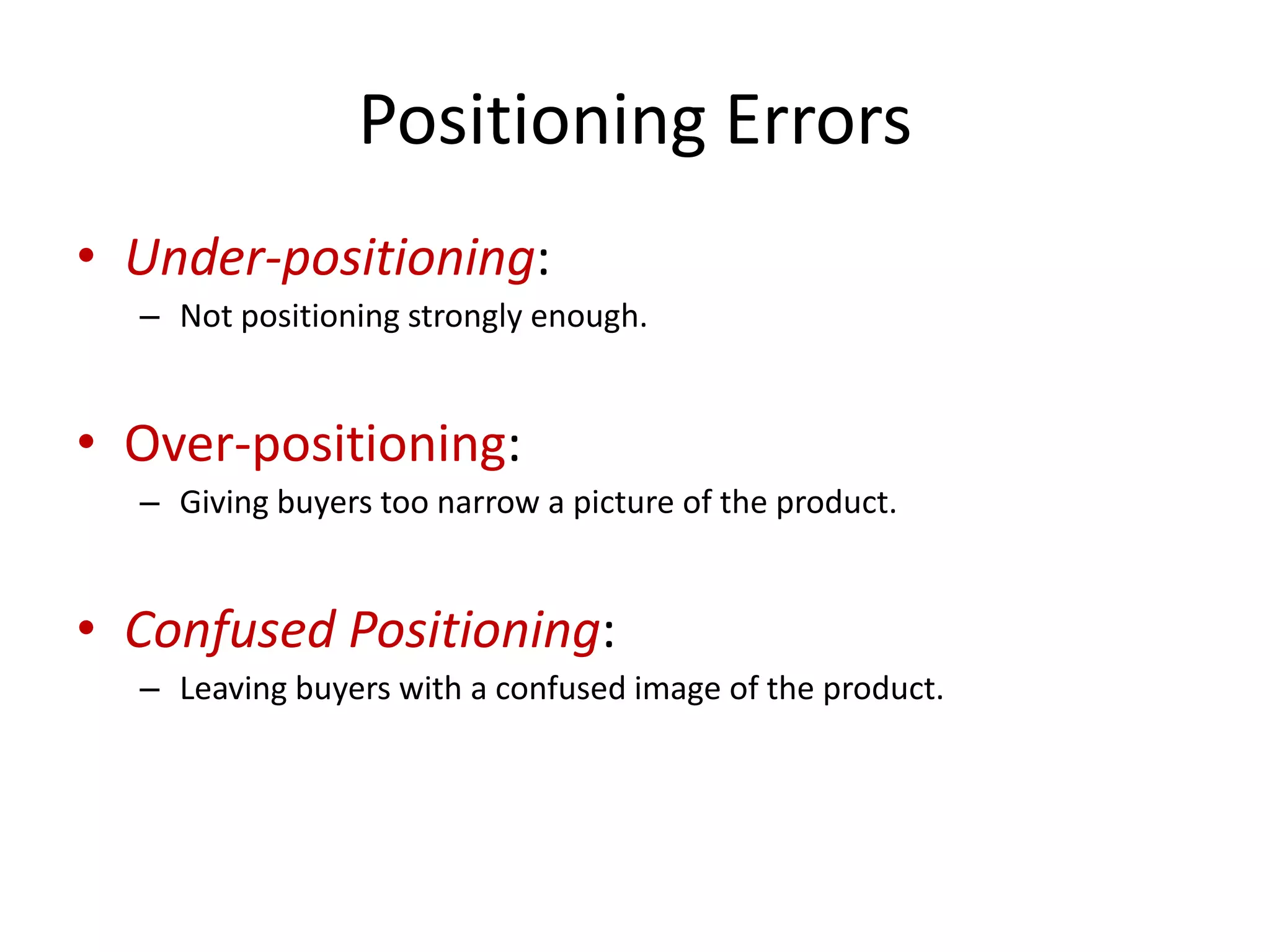
Positioning Errors
• Under-positioning:
  – Not positioning strongly enough.


• Over-positioning:
  – Giving buyers too narrow a picture of the product.


• Confused Positioning:
  – Leaving buyers with a confused image of the product.
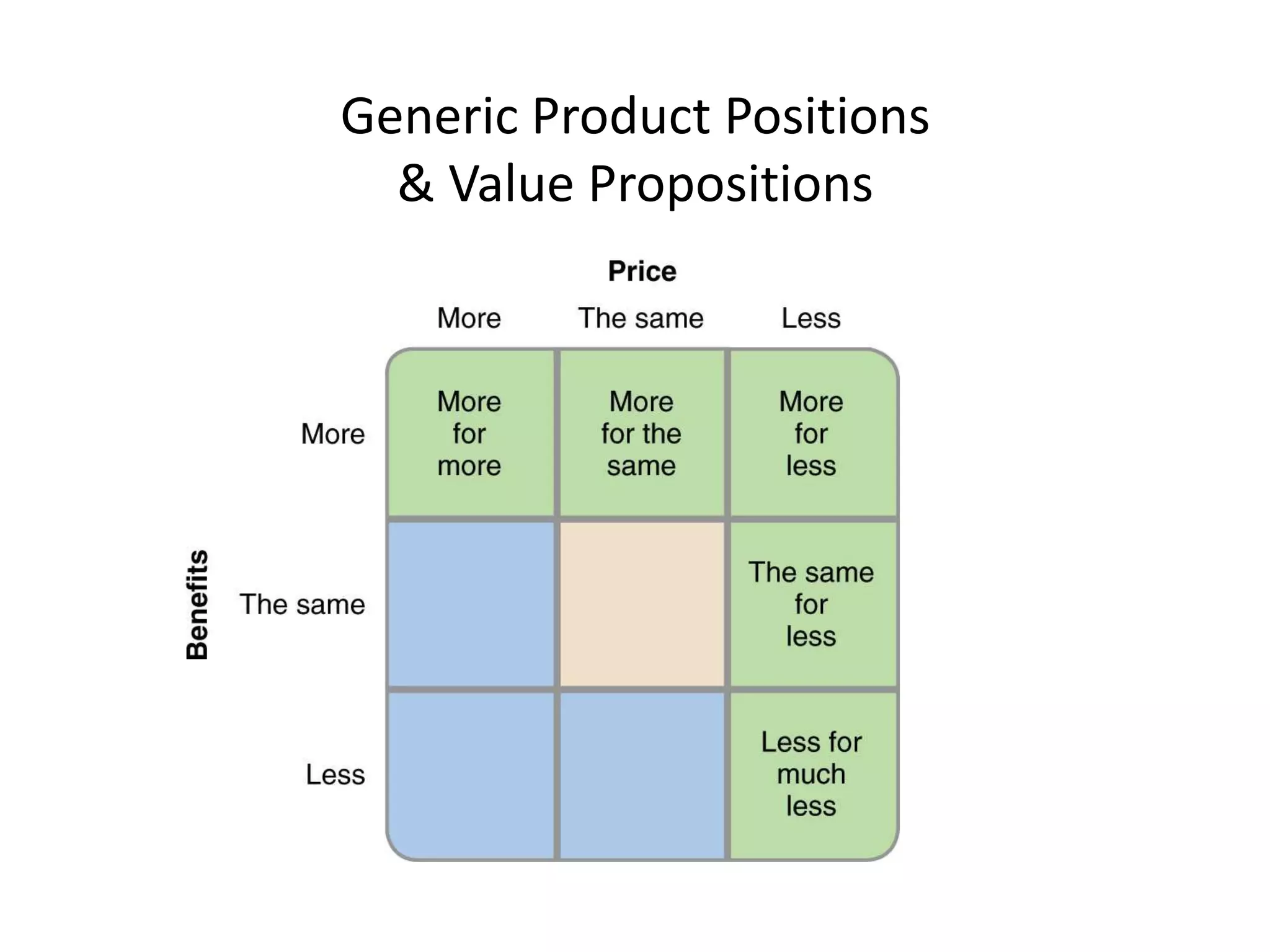
Generic Product Positions
  & Value Propositions
In-class Activity
• Describe how each of the following
  brands, companies, or products is positioned:
In-class Activity, Part 2
• Choose one of the companies/brands and…
  – Identify relevant direct competitors
  – Choose the two dimensions that are most
    important to consumers
  – Develop a perceptual positioning map
  – Are there any opportunities in this category?
In-class Activity, Part 3
• Choose a company and invent a segmentation scheme for
  that company’s customers using the variables we discussed in
  class.

STP

  • 1.
  • 2.
    In this chapterwe will go through :- 1. What are the different levels of market segmentation? 2. How can a company divide a market into segments ? 3. How should a company choose the most attractive target markets ? 4. What are the requirements for effective segmentation ?
  • 3.
    Overview: Segmentation, Targeting& Positioning Why do this?
  • 5.
    • Segmentation: involves finding out what kinds of consumers with different needs exist.
  • 6.
    Processed involved inSegmentation 1.Identify the existing and future wants in the current market 2.Examine the attributes that distinguish the segments 3.Evaluate the proposed segment ,attractiveness on the basis of measurability, accesibility,and size
  • 7.
    Step 1. MarketSegmentation Requirements for Effective Segmentation Measurable • Size, purchasing power, profiles of segments can be measured. Accessible • Segments must be effectively reached and served. Substantial • Segments must be large or profitable enough to serve. Differential • Segments must respond differently to different marketing mix elements & actions. Actionable • Must be able to attract and serve the segments.
  • 8.
    Step 1. MarketSegmentation Levels of Market Segmentation Mass Marketing Same product to all consumers (no segmentation) Segment Marketing Different products to one or more segments (some segmentation) Niche Marketing Different products to subgroups within segments ( more segmentation) Micromarketing Products to suit the tastes of individuals or locations (complete segmentation)
  • 9.
    Step 2. MarketTargeting Market Coverage Strategies Company Marketing Market Mix A. Undifferentiated Marketing Company Marketing Mix 1 Segment 1 Company Segment 2 Marketing Mix 2 Company Segment 3 Marketing Mix 3 B. Differentiated Marketing Segment 1 Company Marketing Segment 2 Mix Segment 3 C. Concentrated Marketing
  • 10.
    Step 1. MarketSegmentation Bases for Segmenting Consumer Markets Geographic Nations, states, regions or cities Demographic Age, gender, family size and life cycle, or income Psychographic Social class, lifestyle, or personality Behavioral Occasions, benefits, uses, or responses
  • 11.
    Market Segmentation -Principles • Segmentation Variables – Geographic – Demographic – Psychographic – Behavioral – Other (anything!) • No single best way to segment a market. • Often best to combine variables and identify smaller, better- defined target groups.
  • 12.
    Geographic Segmentation • Dividemarkets into different geographic units. • Examples: – World Region or Country: North America, Western Europe, European Union, Pacific Rim, Mexico, etc. – Country Region: Pacific, Mountain, East Coast, etc. – City or Metro Size: New York, San Francisco – Population Density: rural, suburban, urban – Climate: northern, southern, tropical, semi-tropical
  • 13.
    Demographic Segmentation • UseDifferences in: – age, gender, family size, family life cycle, income, occupation, education, race, and religion – Most frequently used segmentation variable • Ease of measurement and high availability. – Usually the worst variable to use.
  • 14.
    Psychographic Segmentation Psychographic segmentation divides a market into different groups based on social class, lifestyle, or personality characteristics. People in the same demographic classification often have very different lifestyles and personalities.
  • 15.
    Value And Lifestyle SRI Consulting Business Intelligence Consumer Motivations Consumer recourses
  • 16.
  • 17.
    • Those primarilymotivated by ideals are guided by knowledge and principles. • Those motivated by achievement look for product and services that demonstrate success to their peers. • Those who motivate in self-expression desire social or physical activity ,variety , and risk.
  • 18.
    Four groups withhigher resources :- 1.Innovators :-successful ,sophisticated, active ,take-charge people with high self esteem .purchases often reflect cultivated tastes for relatively upscale, niche-oriented products and services . Eg:- CEO of an MNC
  • 19.
    • Thinkers :-Mature, satisfied ,and reflective people who are motivated by ideals and who value order, knowledge, and responsibility . They seek durability , functionality and value products(Social and emotional values) • Eg: senior professionals , politicians
  • 20.
    • Achievers :-successfulgoal oriented people who focus on career and family . They favour premium products that demonstrate success to their peers. • Eg : Doctors , Lawyers ,etc
  • 21.
    • Experiencers :-Young enthusiastic , impulsive people who seek variety and excitement. They spend a comparatively high proportion of income on fashion , entertainment , and socializing • Eg:- young IT prof
  • 22.
    The four groupwith lower recourse are:- • 1.Believer :-conservative , conventional ,traditional people with concrete beliefs .They prefer familiar products and are loyal to established brand . • Eg:-Middle income group
  • 23.
    2.Strivers :- Trendyand fun loving people who are resource constrained . They favor stylish products that emulate the purchases of those with greater material wealth . Eg :- Low income
  • 24.
    3.Makers :- Practical, down to earth , self sufficient people who like to work with their hands . They seek products with a practical or functional purpose . Eg:-trade union leaders , human activists
  • 25.
    4.Survivors :- Elderly, passive people who are concerned about change. They are loyal to their favorite brands. Eg:- retired employees, senior citizens,
  • 26.
    Behavioral Segmentation • Occasion • Loyalty Status – Special promotions & – Nonusers, ex-users, labels for holidays. potential users, first- – Special products for time users, regular users. special occasions. • Benefits Sought • Usage Rate – Different segments – Light, medium, heavy. desire different benefits from the same products.
  • 27.
    Loyalty Status Segmentation Hard-core Split loyals Shifting loyals Switchers
  • 28.
    User & LoyaltyStatus Segmentation
  • 29.
    Evaluating Market Segments •Segment Size and Growth Potential – Sales, profitability and growth rates • Segment Structural Attractiveness – Competition, substitute products, – buyers & supplier power, new entrants (Porter’s Five Forces) • Company Objectives and Resources – Core competencies – “What business do we want to be in?”
  • 30.
  • 31.
    Differentiated (Segmented) Marketing –Targets several segments and designs separate offers for each. – Coca-Cola (Coke, Sprite, Diet Coke, etc.) – Procter & Gamble (Tide, Cheer, Gain, Dreft, etc.) – Toyota (Camry, Corolla, Prius, Scion, etc.)
  • 32.
    Micromarketing • Tailoring productsand marketing programs to suit the tastes of specific individuals and/or locations.
  • 33.
    Activity -2 c Identifythe bases by which companies have segmented their markets for these products (taking help from the television ads and other advertisements) : Nakshatra diamonds , Cinthol soaps , Domex toilet cleaner and parker pen .
  • 34.
    TARGETING • Targeting isdefined as a group of people or organisations for which an organisation designs , impements and maintains the marketing mix .
  • 35.
    Selecting target market •Homogenious preference :- soft drinks market(Co-co cola ) • Diffused preferences :- automobile market,HUL having different brands for soaps . • Clustered preferences :- occupation having impact on the types cloths worn.
  • 36.
  • 37.
    Patterns of TargetMarket Selection: Product x Market Matrices
  • 38.
    Positioning Placing a productoccupies in consumers’ minds relative to competing products.
  • 39.
    Positioning Example eBay’s positioning: No matter what “it” is, you can find “it” on eBay!
  • 40.
    Remember this importantpoint. Positioning is all about 'perception'.
  • 41.
    This allows themto be compared and contrasted in relation to each other. This is the . main strength of this tool
  • 42.
    Working of positionmap • The marketer would draw out the map and decide upon a label for each axis. • They could be price (variable one) and quality (variable two), or Comfort (variable one) and price (variable two). • The individual products are then mapped out next to each other Any gaps could be regarded as possible areas for new products.
  • 44.
    Positioning Maps: LuxurySUVs Price vs. Orientation Dimensions
  • 45.
    Bases of positioningthe product • Attribute positioning :- size or number of years in existence • Eg : Sunfeast positions its snacky brand as bigger lighter and crisper.
  • 46.
    • Benefit positioning: Product is positioned as the leader in a certain benefit. • Eg : Hyundai santro • Headline – India’s best –loved family car is now also India’s ‘simplest car to drive’
  • 47.
    • Use orApplication positioning • Positioning the product as best for use and application . • Eg: Kenstar positioned its product as UNEXPECTEDLY COLD
  • 48.
    • User positioning:-for some user group • Eg :- Parle-G for kids
  • 49.
    • Competitor positiong:- the product claims to be better in some way than a particular competitor .
  • 50.
    • Quality andprice positioning :- The product is positioned as offering the best value . Eg : Big Bazar
  • 51.
    Positioning Strategy • Competitiveadvantages • Points of Parity • Points of Difference => Differentiation Positioning results from differentiation and competitive advantages. Positioning may change over time.
  • 52.
    Choosing the RightCompetitive Advantages • The best competitive advantages are… – Important – Distinctive – Superior – Communicable – Pre-emptive – Affordable (to company and consumer) – Profitable Moral: Avoid meaningless differentiation.
  • 53.
    Positioning Errors • Under-positioning: – Not positioning strongly enough. • Over-positioning: – Giving buyers too narrow a picture of the product. • Confused Positioning: – Leaving buyers with a confused image of the product.
  • 54.
    Generic Product Positions & Value Propositions
  • 55.
    In-class Activity • Describehow each of the following brands, companies, or products is positioned:
  • 56.
    In-class Activity, Part2 • Choose one of the companies/brands and… – Identify relevant direct competitors – Choose the two dimensions that are most important to consumers – Develop a perceptual positioning map – Are there any opportunities in this category?
  • 57.
    In-class Activity, Part3 • Choose a company and invent a segmentation scheme for that company’s customers using the variables we discussed in class.