Introduction to
Consumer Behavior
MRS. PUSPANJALI BHANDARI
Introduction:
Consumers are unique in themselves; they have needs
and wants which are varied and diverse from one
another; and they have different consumption patterns
and consumption behaviour. The marketer helps satisfy
these needs and wants through product and service
offerings. For a firm to survive, compete and grow, it is
essential that the marketer identifies these needs and
wants, and provides product offerings more effectively
and efficiently than other competitors.
For a firm to succeed, understanding and
acknowledging each different needs and behaviours of
consumer is crucial fact to be accepted.
 Consumer Behaviour may be defined as “the interplay
of forces that takes place during a consumption
process, within a consumers’ self and his
environment.
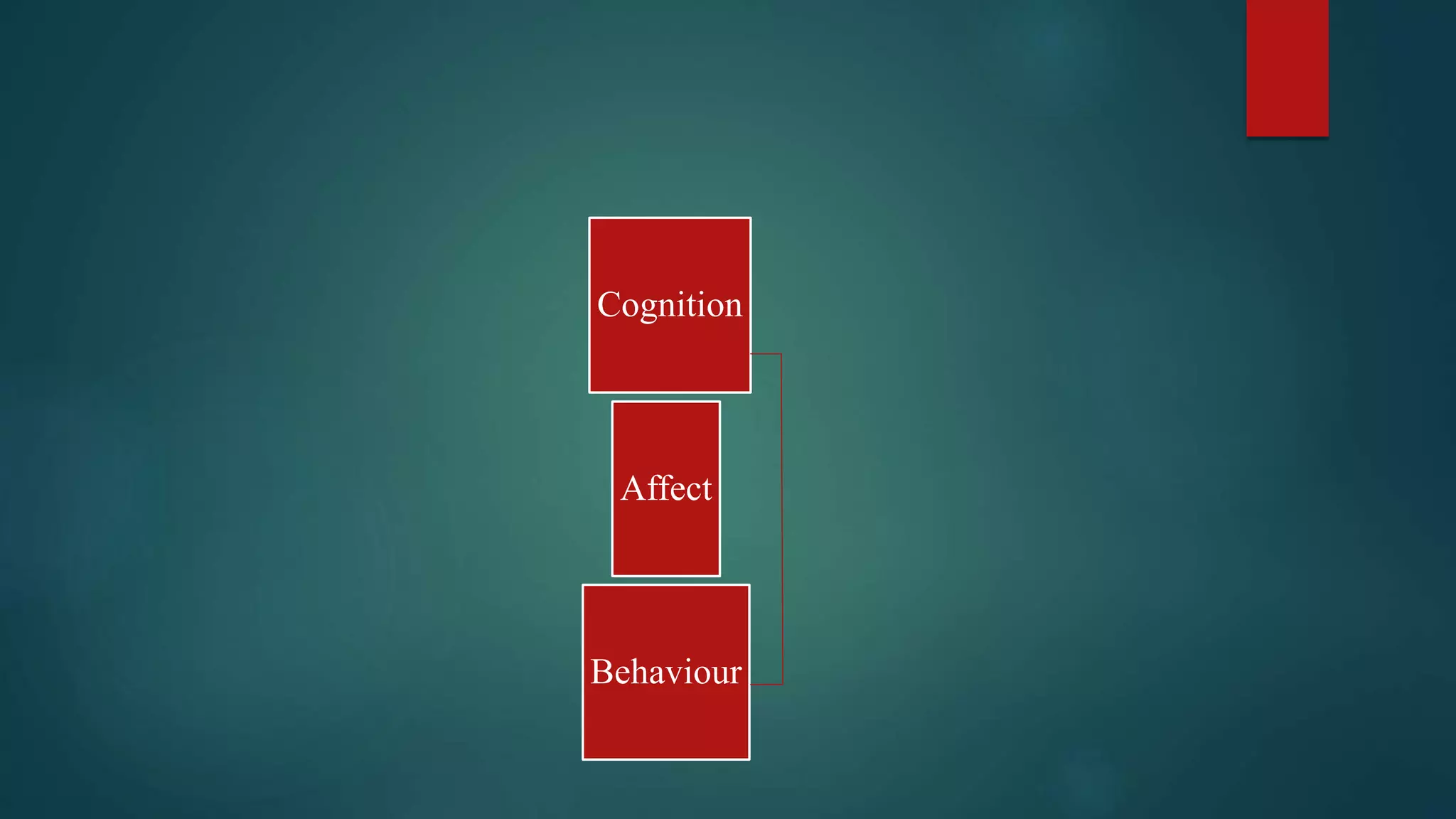
 This interaction takes place between three elements
viz. knowledge, affect and behaviour.
 it continues through pre-purchase activity to the post
purchase experience; - it includes the stages of
evaluating, acquiring, using and disposing of goods
and services”.
 The “consumer” includes both personal consumers
and business/industrial/organizational consumer.
Cognition
Affect
Behaviour
 Cognition: It includes the mental processes
involved in processing of information, thinking and
interpretation of stimuli (people, objects, things,
places and events).
 Affect: It includes the favorable or unfavorable
feelings and corresponding emotions towards a
stimuli (eg. towards a product or service offering or
a brand).
 Behaviour: This is the “visible” part. In our case,
this could be the purchase activity: to buy or not a
buy.
Definitions
“The behavior that consumers display in
searching for, purchasing, using, evalauting and
disposing of products and services that they expect
will satisfy their needs.”
- Schiffman and Kanuk
“The decision process and physical activity
engaged in when evaluating, acquiring, using
or disposing of goods and services.
-Loudon and Bitta
“The dynamic interaction of effect and cognition,
behavior and the environment by which human
beings conduct the exchange aspects of their lives”
-American Marketing Association
“ The study of consumers as they exchange
something of value for a product or service that
satisfies their needs”
- Wells and Prensky
Buying Roles:
1. Initiator: The initiator is the person who
identifies that there exists a need or want
2. Influencer: the influencer is the one who
influences the purchase decision
3. Decider: the decider is the one who decides
whether to buy, what to buy, when to buy, from
where to buy, and how to buy;
4. Buyer: the buyer is the one who makes the actual
purchase.
5. User: the user is the person who use the product
or service.
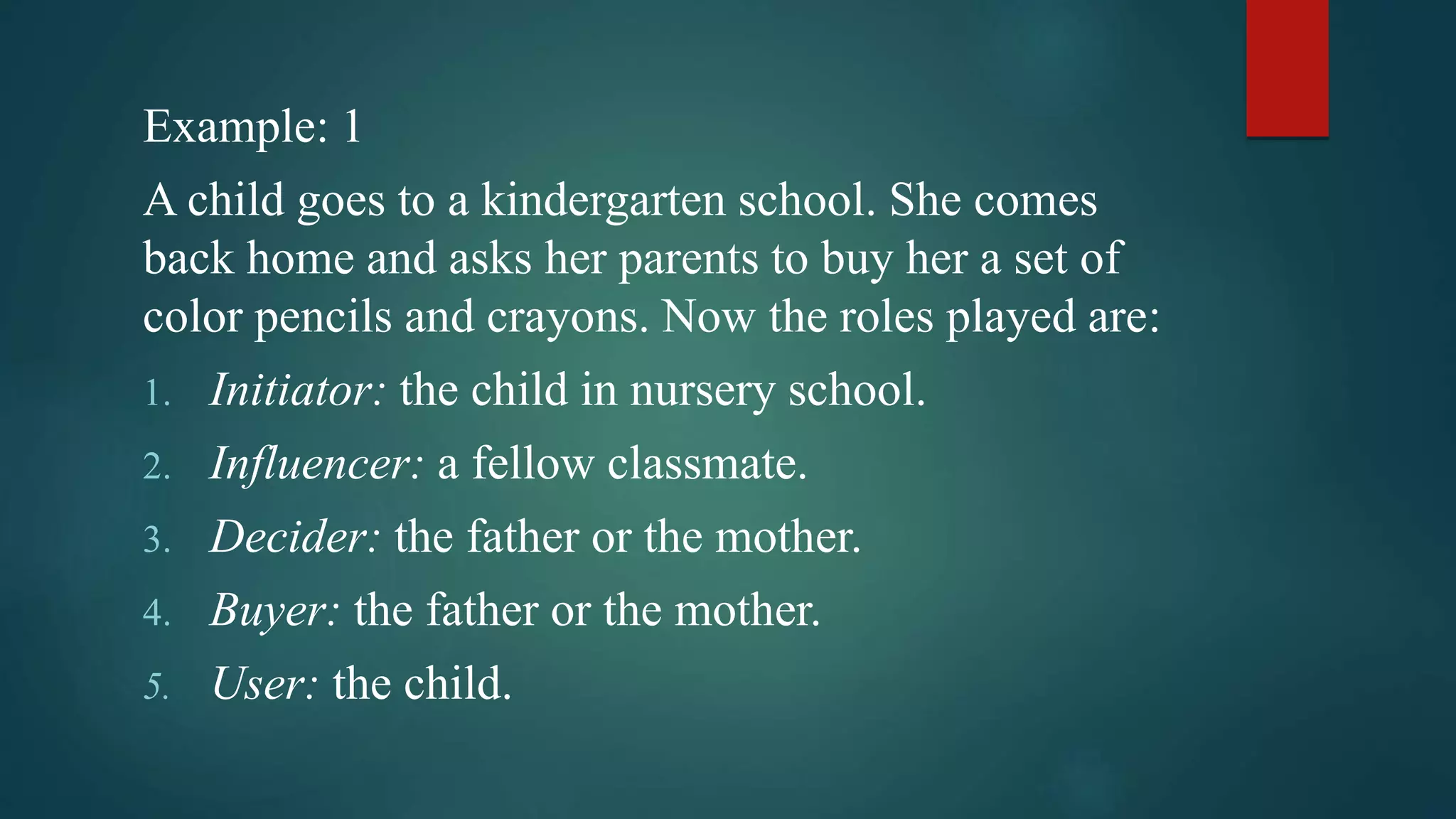
Example: 1
A child goes to a kindergarten school. She comes
back home and asks her parents to buy her a set of
color pencils and crayons. Now the roles played are:
1. Initiator: the child in nursery school.
2. Influencer: a fellow classmate.
3. Decider: the father or the mother.
4. Buyer: the father or the mother.
5. User: the child.
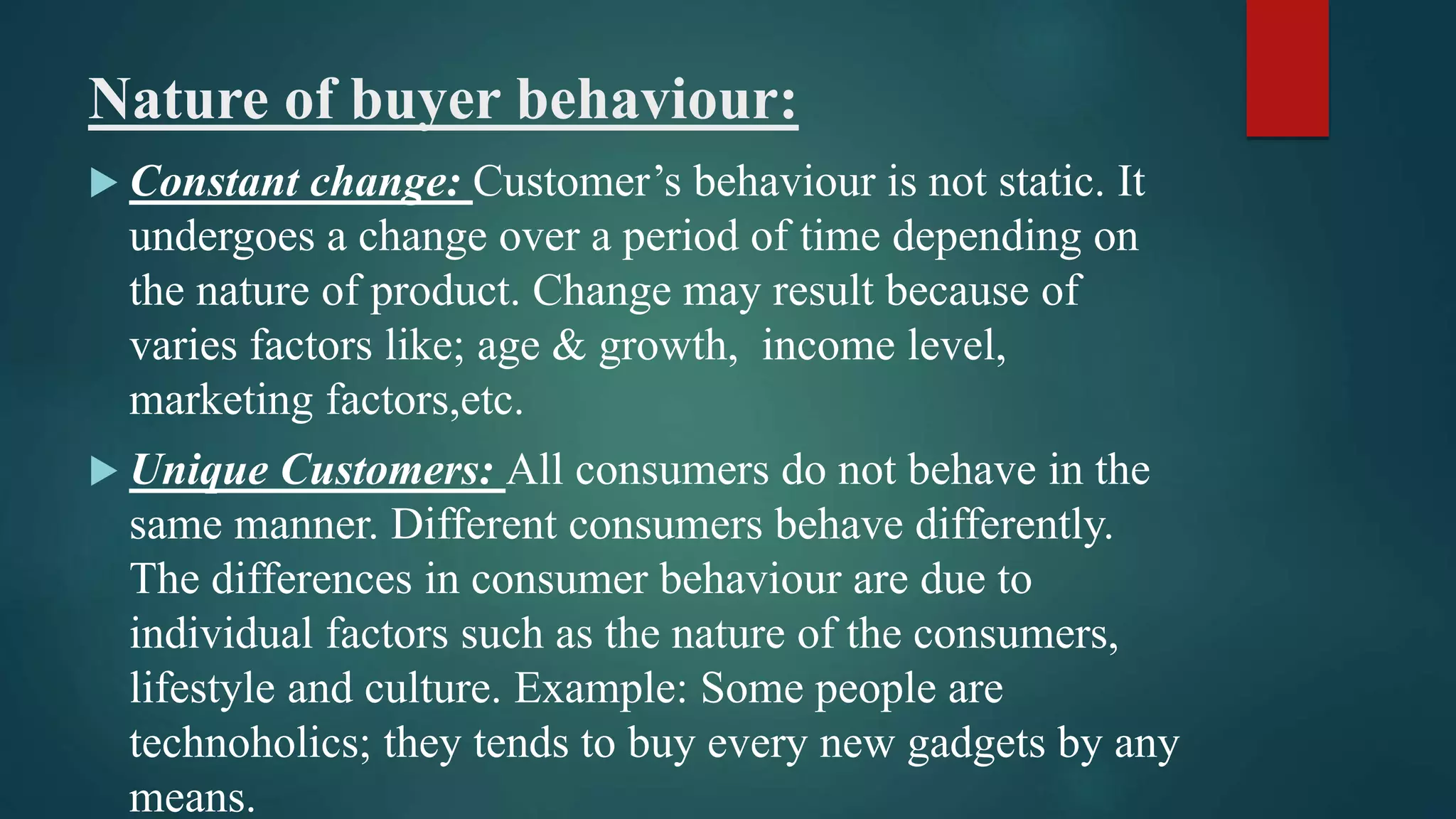
Nature of buyer behaviour:
 Constant change: Customer’s behaviour is not static. It
undergoes a change over a period of time depending on
the nature of product. Change may result because of
varies factors like; age & growth, income level,
marketing factors,etc.
 Unique Customers: All consumers do not behave in the
same manner. Different consumers behave differently.
The differences in consumer behaviour are due to
individual factors such as the nature of the consumers,
lifestyle and culture. Example: Some people are
technoholics; they tends to buy every new gadgets by any
means.
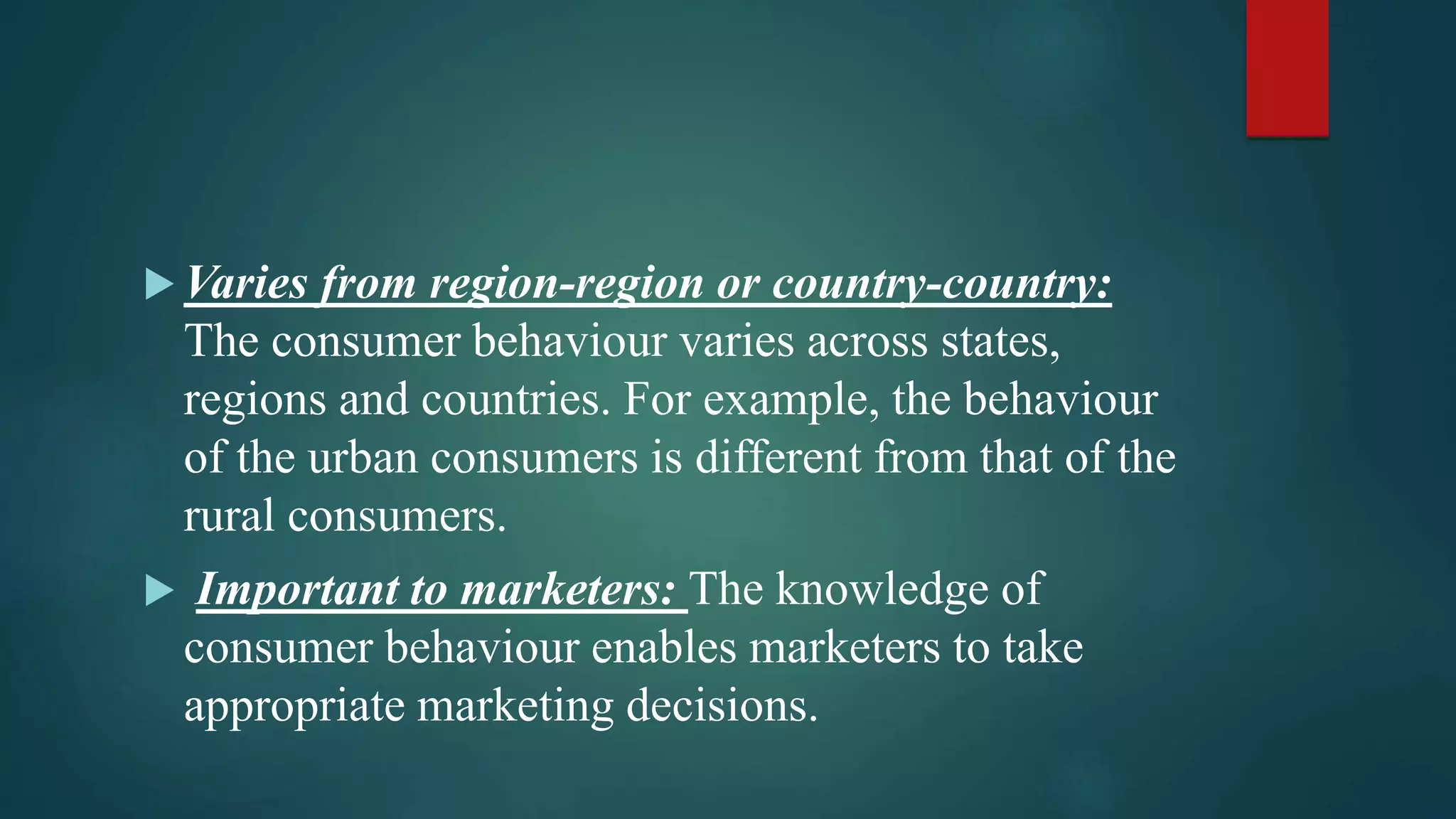
 Varies from region-region or country-country:
The consumer behaviour varies across states,
regions and countries. For example, the behaviour
of the urban consumers is different from that of the
rural consumers.
 Important to marketers: The knowledge of
consumer behaviour enables marketers to take
appropriate marketing decisions.
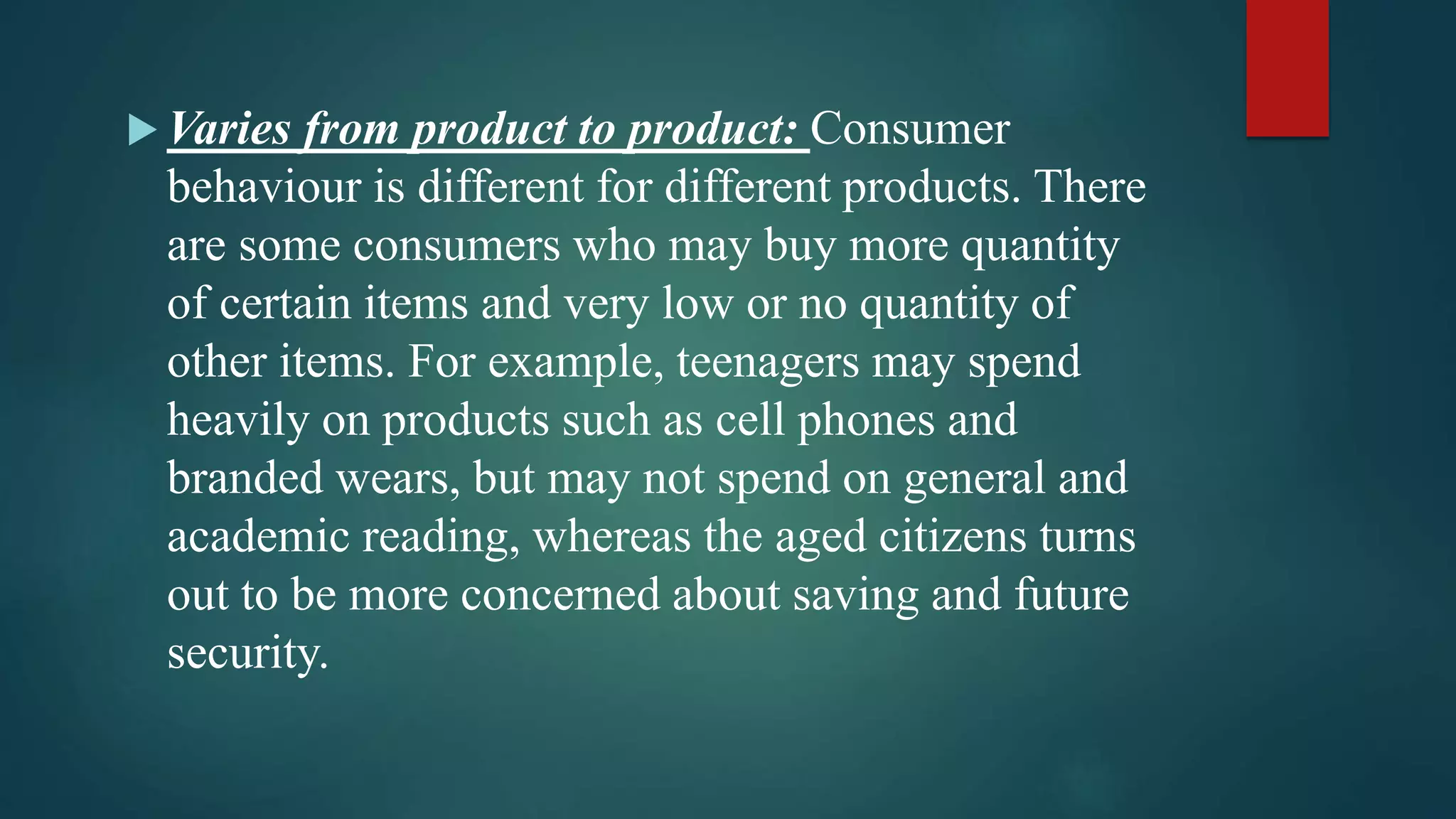
 Varies from product to product: Consumer
behaviour is different for different products. There
are some consumers who may buy more quantity
of certain items and very low or no quantity of
other items. For example, teenagers may spend
heavily on products such as cell phones and
branded wears, but may not spend on general and
academic reading, whereas the aged citizens turns
out to be more concerned about saving and future
security.
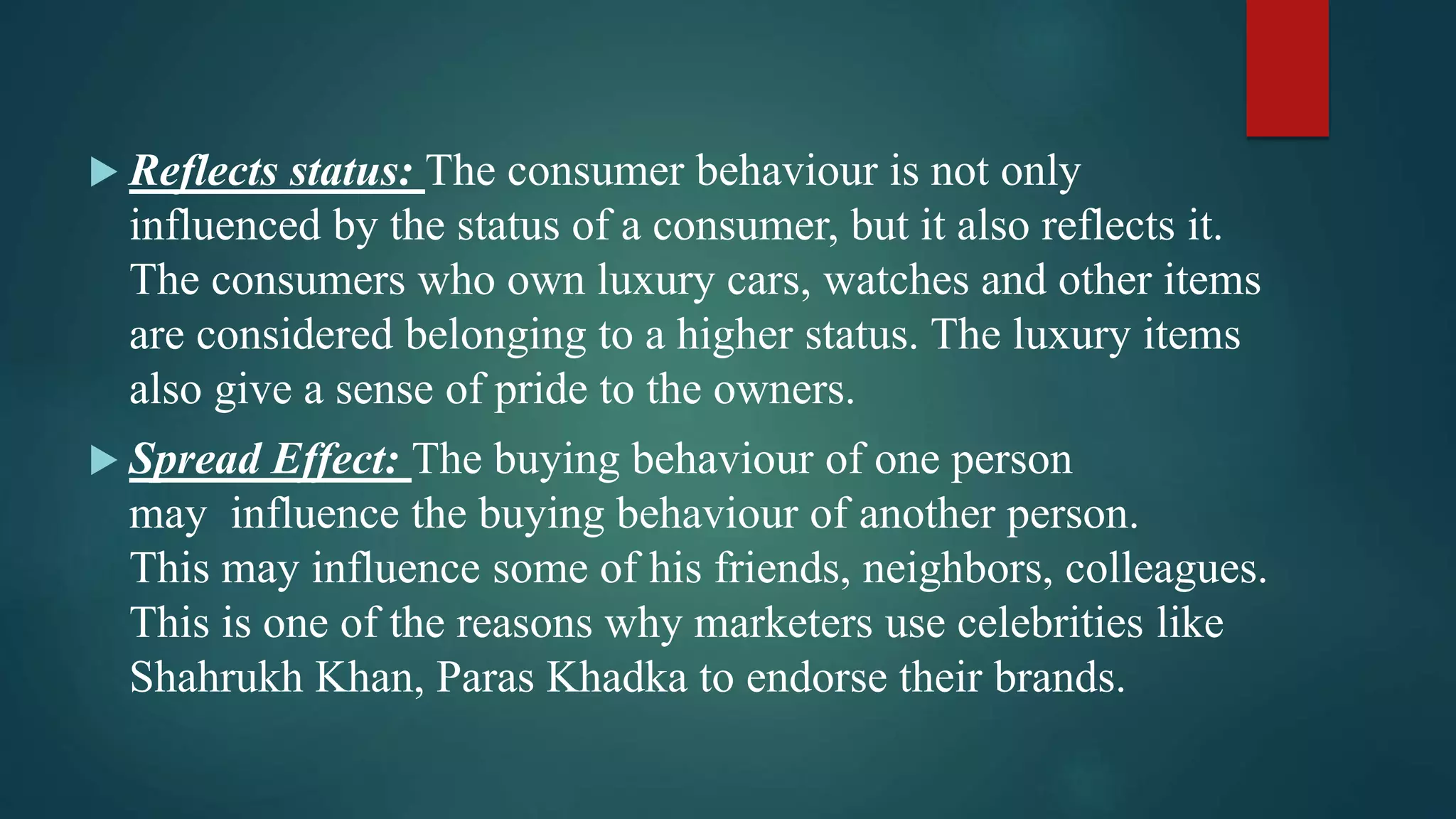
 Reflects status: The consumer behaviour is not only
influenced by the status of a consumer, but it also reflects it.
The consumers who own luxury cars, watches and other items
are considered belonging to a higher status. The luxury items
also give a sense of pride to the owners.
 Spread Effect: The buying behaviour of one person
may influence the buying behaviour of another person.
This may influence some of his friends, neighbors, colleagues.
This is one of the reasons why marketers use celebrities like
Shahrukh Khan, Paras Khadka to endorse their brands.
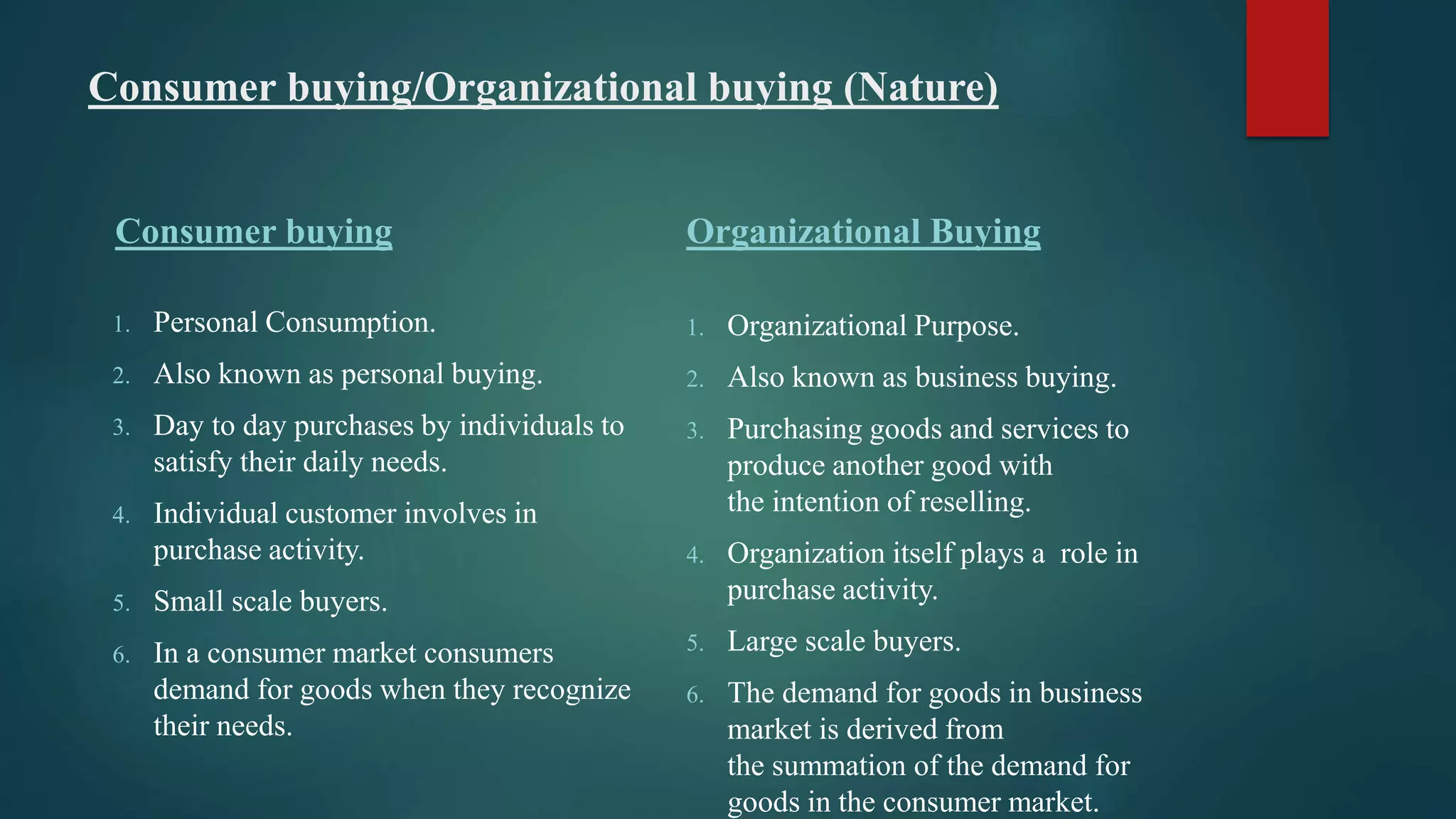
Consumer buying/Organizational buying (Nature)
Consumer buying
1. Personal Consumption.
2. Also known as personal buying.
3. Day to day purchases by individuals to
satisfy their daily needs.
4. Individual customer involves in
purchase activity.
5. Small scale buyers.
6. In a consumer market consumers
demand for goods when they recognize
their needs.
Organizational Buying
1. Organizational Purpose.
2. Also known as business buying.
3. Purchasing goods and services to
produce another good with
the intention of reselling.
4. Organization itself plays a role in
purchase activity.
5. Large scale buyers.
6. The demand for goods in business
market is derived from
the summation of the demand for
goods in the consumer market.
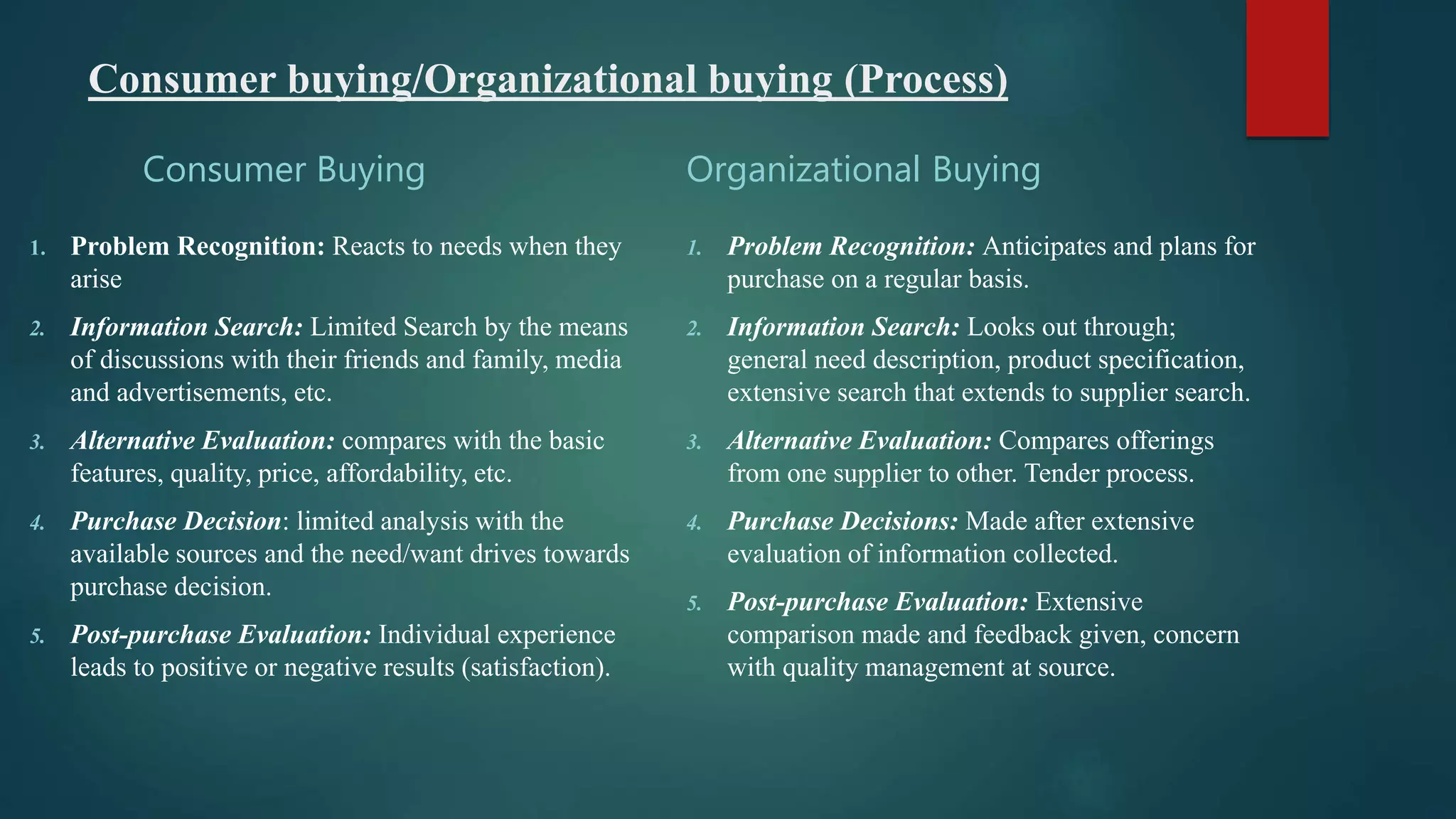
Consumer buying/Organizational buying (Process)
Consumer Buying
1. Problem Recognition: Reacts to needs when they
arise
2. Information Search: Limited Search by the means
of discussions with their friends and family, media
and advertisements, etc.
3. Alternative Evaluation: compares with the basic
features, quality, price, affordability, etc.
4. Purchase Decision: limited analysis with the
available sources and the need/want drives towards
purchase decision.
5. Post-purchase Evaluation: Individual experience
leads to positive or negative results (satisfaction).
Organizational Buying
1. Problem Recognition: Anticipates and plans for
purchase on a regular basis.
2. Information Search: Looks out through;
general need description, product specification,
extensive search that extends to supplier search.
3. Alternative Evaluation: Compares offerings
from one supplier to other. Tender process.
4. Purchase Decisions: Made after extensive
evaluation of information collected.
5. Post-purchase Evaluation: Extensive
comparison made and feedback given, concern
with quality management at source.
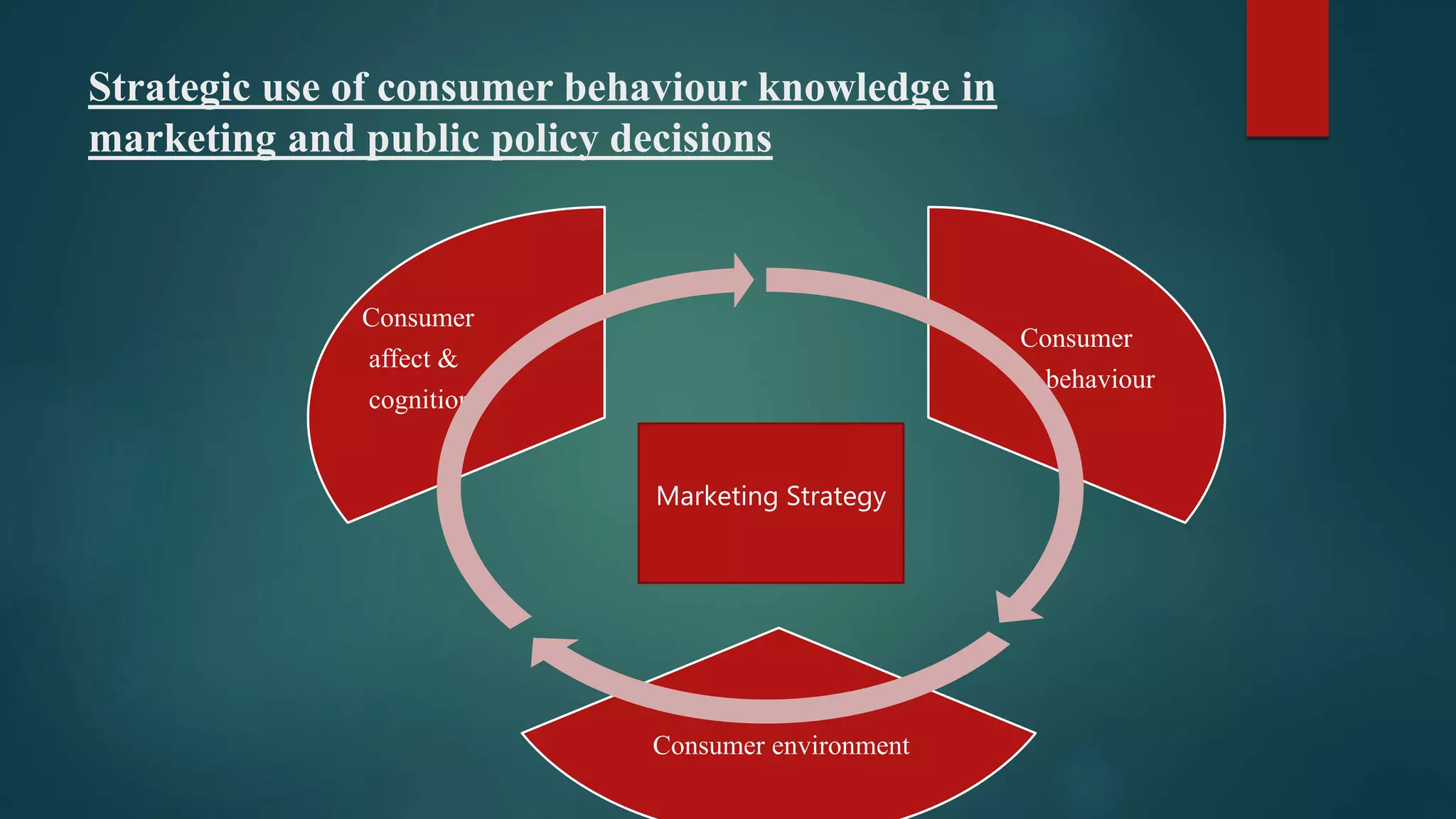
Strategic use of consumer behaviour knowledge in
marketing and public policy decisions
Consumer
behaviour
Consumer environment
Consumer
affect &
cognition
Marketing Strategy
 Explicit or implicit beliefs
 Decisions based on explicit beliefs tends to be more beneficial than
that of decisions solely based on implicit beliefs.
 Knowledge of consumer behaviour can be important competitive
advantage and can greatly reduce the odds of bad decisions and
market failures.
Regulatory Policy:
 Various regulatory bodies exists to develop, interpret and/or implement
policies designed to protect and aid consumer.
 Effective regulation of many marketing practices requires an extensive
knowledge of consumer behaviour.
 Example: Sausage,Noodles, Pustakari, ketchup,etc.
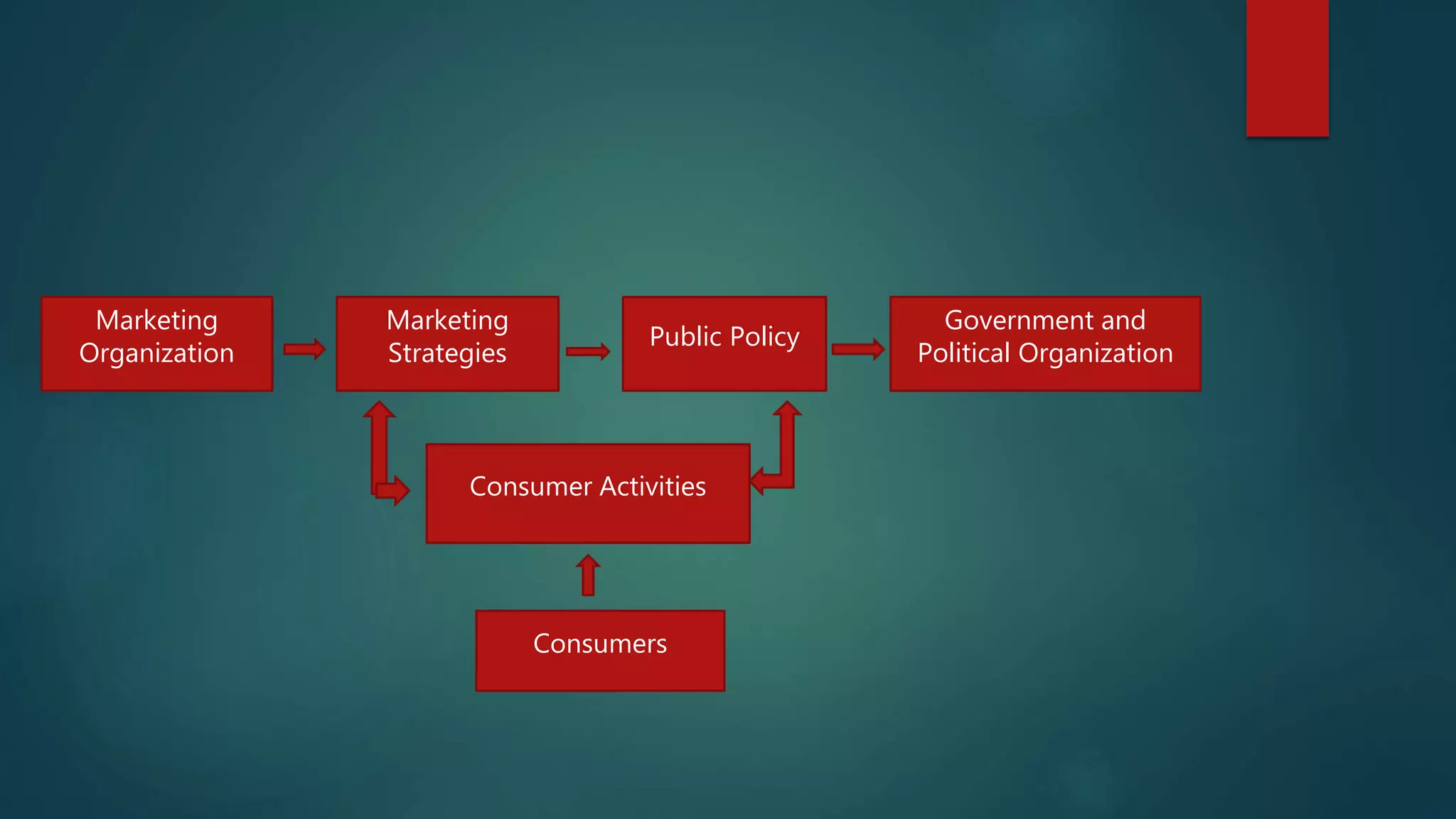
Marketing
Organization
Marketing
Strategies
Public Policy
Government and
Political Organization
Consumer Activities
Consumers
Consumer Behaviour & Marketing:
 Analysing Market Oppourtunity
 Identifying the target market.
 Market-mix Decisions
 Use in social and non-profit marketing ( AIDS, Family
Planning, women safety and empowerment, safe driving,
environmental concern, etc. )
Public Policy Decisions & Consumer
Behaviour
 The set of policies (laws, plans, actions, behaviours) of a government; plans and
methods of action that govern that society; a system of laws, courses of action,
and priorities directing a government action.
 Public policy, as government action, is generally known as the principled guide
to action taken by the administrative or executive branches of the state with
regard to a class of issues in a manner consistent with law and institutional
customs.
 Shaping public policy is a complex and multifaceted process that involves the
interplay of numerous individuals and interest groups competing and
collaborating to influence policymakers to act in a particular way.

Nepal’s Consumer Protection Act from 1998 clearly states that any
activity that intends to deceive consumers is strictly punishable by law.
Provisions of the Act protect consumers from irregularities such as the
quality, quantity and prices of consumer goods or services; ensuring
that no one lowers or removes the attributes or usefulness of consumer
goods or services; preventing circumstances in which monopolies and
unfair trading practices may lead to an increase in prices, as well as
false and misleading propaganda about the use and usefulness of
consumer goods or services. The Act includes provisions on selling,
supplying, importing, exporting and storing safe and quality consumer
goods or services, and protecting the rights and interests of consumers
through the establishment of an agency for redress.
It consists of various government and political organizations.
These include government agencies in monitoring and
regulating exchanges between marketing organizations and
consumers. This is accomplished through the development of
public policies that affect marketing organizations and
consumers. Political organizations include consumer activists
such as Students Against Drunk Driving and various industry
and trade organizations. These groups exert pressure on
marketing organizations and consumers to behave in certain
ways. The third group interested in consumer behaviour
includes both consumers and organizational
buyers who exchange resources for various goods and
services.
Consumerism:
Consumerism can be defined as an organized-efforts by
individuals, groups, and governments to help protect
consumers from policies and practices that infringe
consumer rights to fair business practices. In simple
words, it is the promotion and protection of the
consumer's interests.
Pros & Cons of consumerism:
Pros
 Low cost of living
 More jobs
 Better for business
Cons
 Low Quality Products
 Unethical Practice
Consumer Movement Background
“Consumer movement consists of the organized
efforts of individual citizens and private, not-for-
profit organizations to enhance the rights and
collective welfare of consumers”
“Primary goal of the movement is to advance
efficiency and equity in the marketplace”
 The consumer movement consists of a broad and
loosely coordinated set of individuals and private,
not-for-profit organizations that consciously seek to
advance the welfare of consumers.
 Policies aimed at regulating products, services,
methods and standards of manufacture, selling,
advertising in the interests of the buyer.
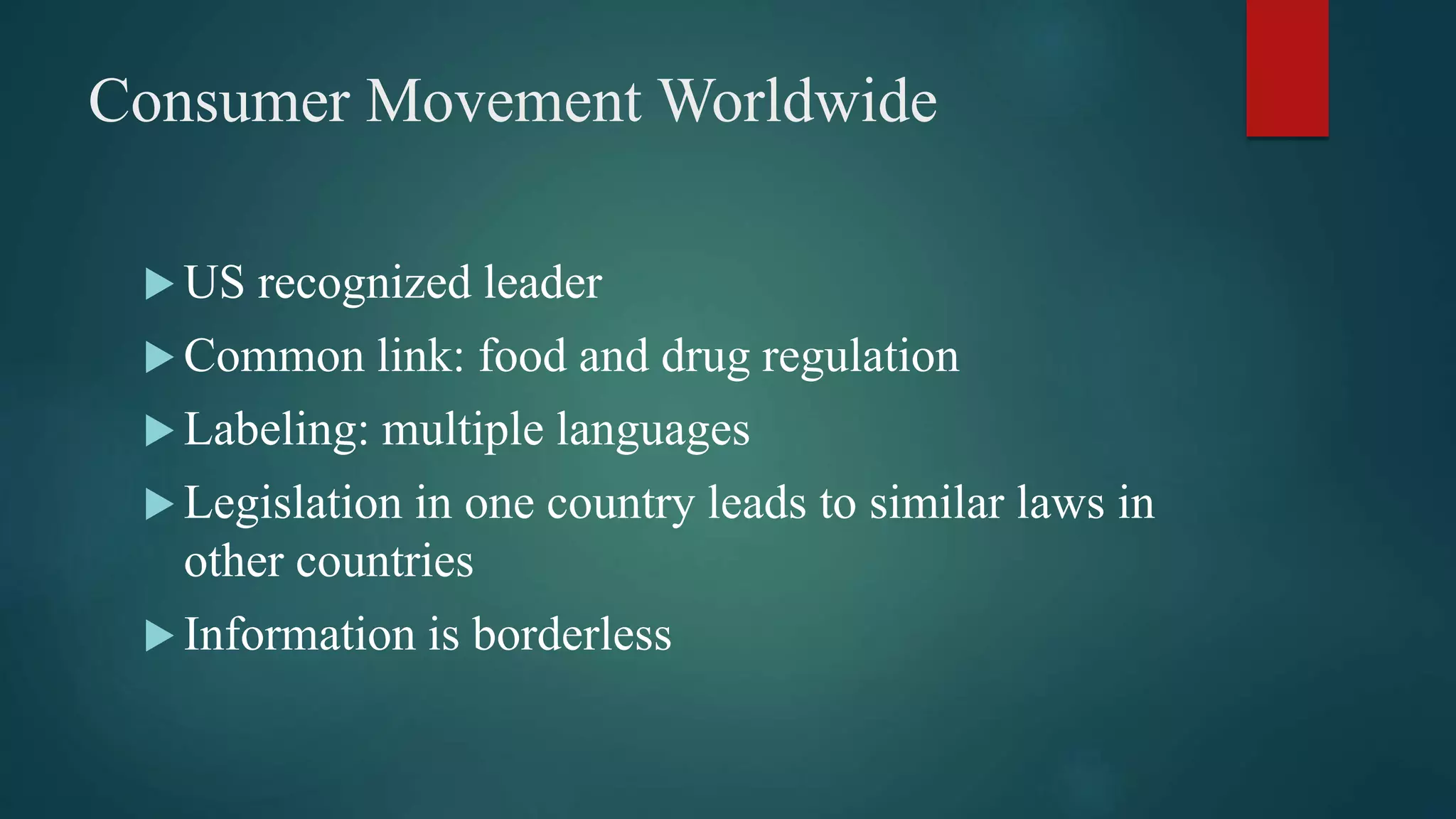
Consumer Movement Worldwide
 US recognized leader
 Common link: food and drug regulation
 Labeling: multiple languages
 Legislation in one country leads to similar laws in
other countries
 Information is borderless
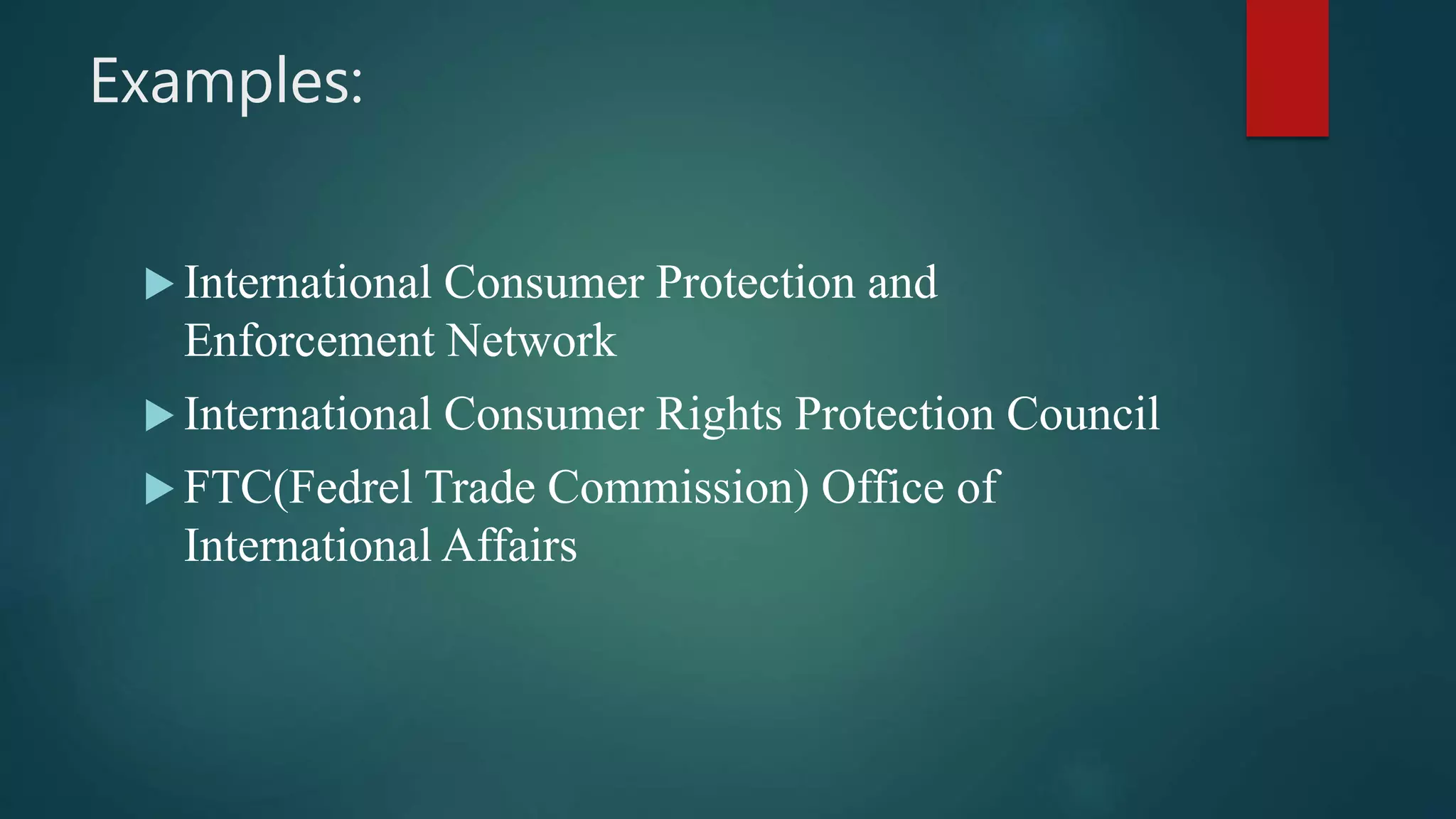
Examples:
 International Consumer Protection and
Enforcement Network
 International Consumer Rights Protection Council
 FTC(Fedrel Trade Commission) Office of
International Affairs
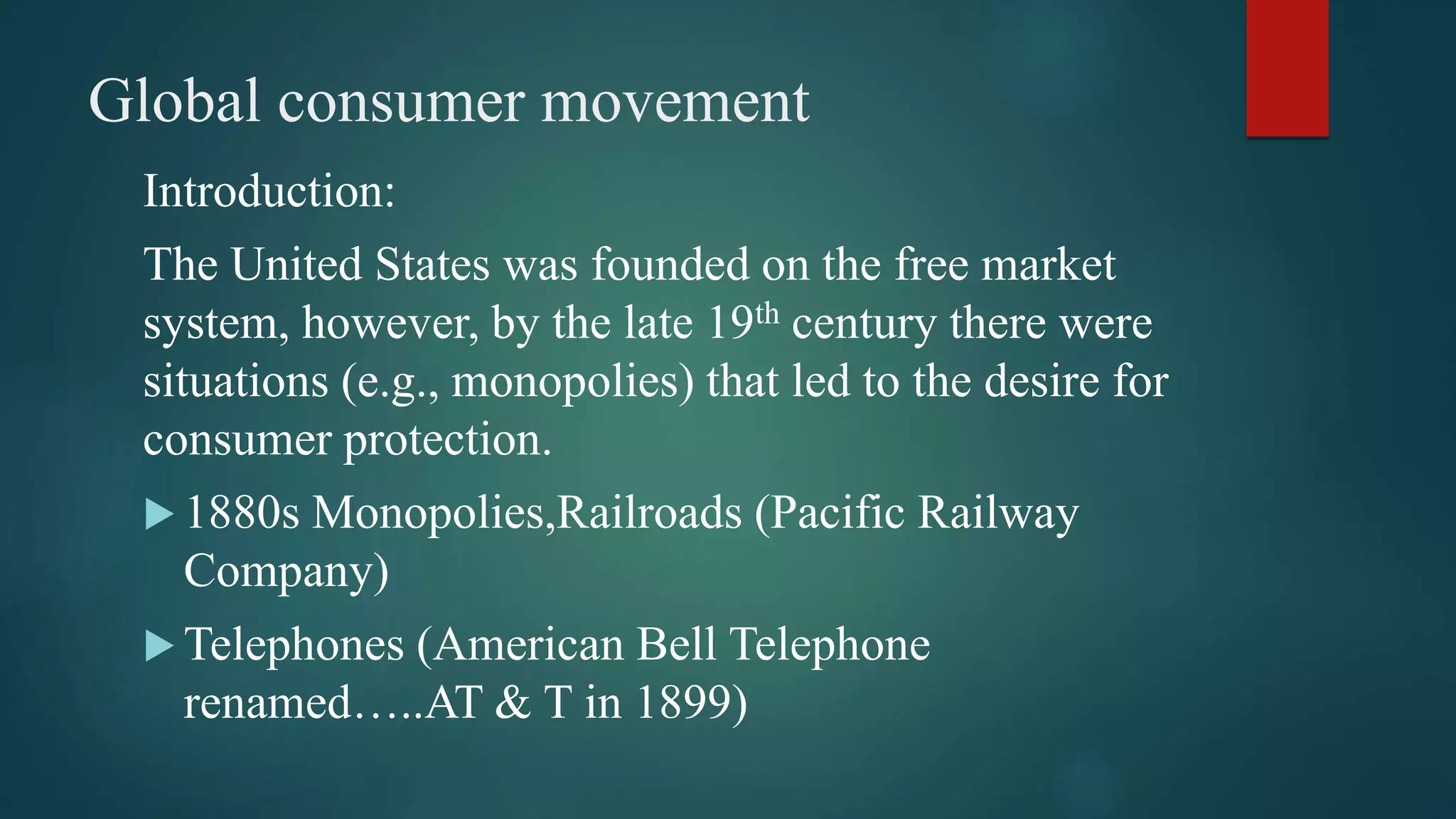
Global consumer movement
Introduction:
The United States was founded on the free market
system, however, by the late 19th century there were
situations (e.g., monopolies) that led to the desire for
consumer protection.
 1880s Monopolies,Railroads (Pacific Railway
Company)
 Telephones (American Bell Telephone
renamed…..AT & T in 1899)
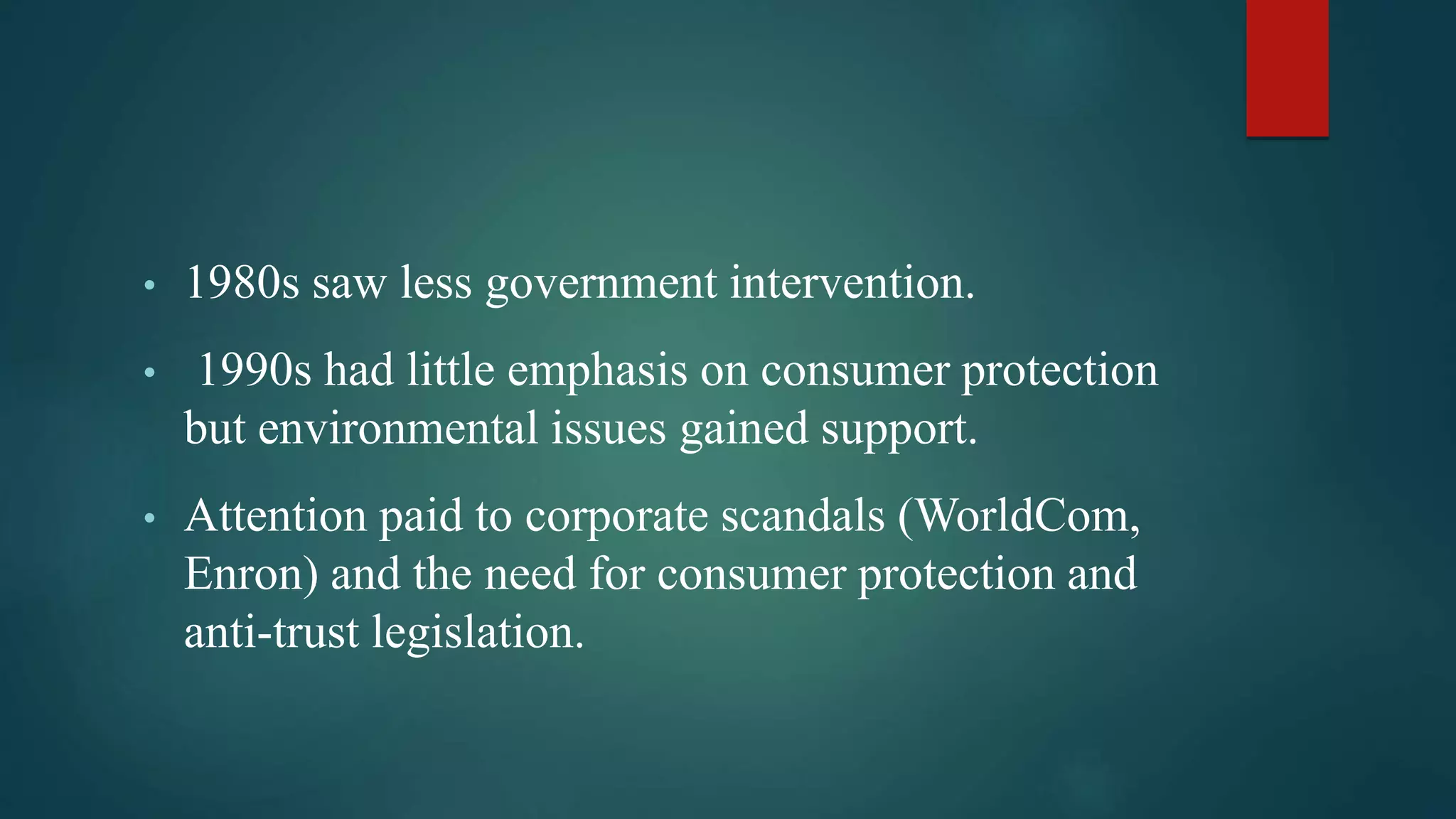
• 1980s saw less government intervention.
• 1990s had little emphasis on consumer protection
but environmental issues gained support.
• Attention paid to corporate scandals (WorldCom,
Enron) and the need for consumer protection and
anti-trust legislation.
Credit CARD Act of 2009
It is comprehensive credit card reform legislation that
aims “ to establish fair and transparent practices
relating to the extension of credit under an open end
consumer credit plan, and for other purposes.”
Patient Protection and Affordable
Care Act (PPACA) of 2010
 The PPACA reforms certain aspects of the private
health insurance industry and public health
insurance programs, including increasing insurance
coverage of pre-existing conditions and expanding
access to insurance to over 30 million Americans
being challenged in state courts as to the
constitutionality of the Act.
Consumer Financial Protection Bureau
(CFPB) July 21, 2011
 Elizabeth Warren was chosen by President Barack
Obama last year to set up the new Consumer
Financial Protection Bureau.

Introduction to consumer behavior

  • 1.
  • 2.
    Introduction: Consumers are uniquein themselves; they have needs and wants which are varied and diverse from one another; and they have different consumption patterns and consumption behaviour. The marketer helps satisfy these needs and wants through product and service offerings. For a firm to survive, compete and grow, it is essential that the marketer identifies these needs and wants, and provides product offerings more effectively and efficiently than other competitors. For a firm to succeed, understanding and acknowledging each different needs and behaviours of consumer is crucial fact to be accepted.
  • 3.
     Consumer Behaviourmay be defined as “the interplay of forces that takes place during a consumption process, within a consumers’ self and his environment.  This interaction takes place between three elements viz. knowledge, affect and behaviour.  it continues through pre-purchase activity to the post purchase experience; - it includes the stages of evaluating, acquiring, using and disposing of goods and services”.  The “consumer” includes both personal consumers and business/industrial/organizational consumer.
  • 4.
  • 5.
     Cognition: Itincludes the mental processes involved in processing of information, thinking and interpretation of stimuli (people, objects, things, places and events).  Affect: It includes the favorable or unfavorable feelings and corresponding emotions towards a stimuli (eg. towards a product or service offering or a brand).  Behaviour: This is the “visible” part. In our case, this could be the purchase activity: to buy or not a buy.
  • 6.
    Definitions “The behavior thatconsumers display in searching for, purchasing, using, evalauting and disposing of products and services that they expect will satisfy their needs.” - Schiffman and Kanuk “The decision process and physical activity engaged in when evaluating, acquiring, using or disposing of goods and services. -Loudon and Bitta
  • 7.
    “The dynamic interactionof effect and cognition, behavior and the environment by which human beings conduct the exchange aspects of their lives” -American Marketing Association “ The study of consumers as they exchange something of value for a product or service that satisfies their needs” - Wells and Prensky
  • 8.
    Buying Roles: 1. Initiator:The initiator is the person who identifies that there exists a need or want 2. Influencer: the influencer is the one who influences the purchase decision 3. Decider: the decider is the one who decides whether to buy, what to buy, when to buy, from where to buy, and how to buy; 4. Buyer: the buyer is the one who makes the actual purchase. 5. User: the user is the person who use the product or service.
  • 9.
    Example: 1 A childgoes to a kindergarten school. She comes back home and asks her parents to buy her a set of color pencils and crayons. Now the roles played are: 1. Initiator: the child in nursery school. 2. Influencer: a fellow classmate. 3. Decider: the father or the mother. 4. Buyer: the father or the mother. 5. User: the child.
  • 10.
    Nature of buyerbehaviour:  Constant change: Customer’s behaviour is not static. It undergoes a change over a period of time depending on the nature of product. Change may result because of varies factors like; age & growth, income level, marketing factors,etc.  Unique Customers: All consumers do not behave in the same manner. Different consumers behave differently. The differences in consumer behaviour are due to individual factors such as the nature of the consumers, lifestyle and culture. Example: Some people are technoholics; they tends to buy every new gadgets by any means.
  • 11.
     Varies fromregion-region or country-country: The consumer behaviour varies across states, regions and countries. For example, the behaviour of the urban consumers is different from that of the rural consumers.  Important to marketers: The knowledge of consumer behaviour enables marketers to take appropriate marketing decisions.
  • 12.
     Varies fromproduct to product: Consumer behaviour is different for different products. There are some consumers who may buy more quantity of certain items and very low or no quantity of other items. For example, teenagers may spend heavily on products such as cell phones and branded wears, but may not spend on general and academic reading, whereas the aged citizens turns out to be more concerned about saving and future security.
  • 13.
     Reflects status:The consumer behaviour is not only influenced by the status of a consumer, but it also reflects it. The consumers who own luxury cars, watches and other items are considered belonging to a higher status. The luxury items also give a sense of pride to the owners.  Spread Effect: The buying behaviour of one person may influence the buying behaviour of another person. This may influence some of his friends, neighbors, colleagues. This is one of the reasons why marketers use celebrities like Shahrukh Khan, Paras Khadka to endorse their brands.
  • 15.
    Consumer buying/Organizational buying(Nature) Consumer buying 1. Personal Consumption. 2. Also known as personal buying. 3. Day to day purchases by individuals to satisfy their daily needs. 4. Individual customer involves in purchase activity. 5. Small scale buyers. 6. In a consumer market consumers demand for goods when they recognize their needs. Organizational Buying 1. Organizational Purpose. 2. Also known as business buying. 3. Purchasing goods and services to produce another good with the intention of reselling. 4. Organization itself plays a role in purchase activity. 5. Large scale buyers. 6. The demand for goods in business market is derived from the summation of the demand for goods in the consumer market.
  • 16.
    Consumer buying/Organizational buying(Process) Consumer Buying 1. Problem Recognition: Reacts to needs when they arise 2. Information Search: Limited Search by the means of discussions with their friends and family, media and advertisements, etc. 3. Alternative Evaluation: compares with the basic features, quality, price, affordability, etc. 4. Purchase Decision: limited analysis with the available sources and the need/want drives towards purchase decision. 5. Post-purchase Evaluation: Individual experience leads to positive or negative results (satisfaction). Organizational Buying 1. Problem Recognition: Anticipates and plans for purchase on a regular basis. 2. Information Search: Looks out through; general need description, product specification, extensive search that extends to supplier search. 3. Alternative Evaluation: Compares offerings from one supplier to other. Tender process. 4. Purchase Decisions: Made after extensive evaluation of information collected. 5. Post-purchase Evaluation: Extensive comparison made and feedback given, concern with quality management at source.
  • 17.
    Strategic use ofconsumer behaviour knowledge in marketing and public policy decisions Consumer behaviour Consumer environment Consumer affect & cognition Marketing Strategy
  • 18.
     Explicit orimplicit beliefs  Decisions based on explicit beliefs tends to be more beneficial than that of decisions solely based on implicit beliefs.  Knowledge of consumer behaviour can be important competitive advantage and can greatly reduce the odds of bad decisions and market failures.
  • 19.
    Regulatory Policy:  Variousregulatory bodies exists to develop, interpret and/or implement policies designed to protect and aid consumer.  Effective regulation of many marketing practices requires an extensive knowledge of consumer behaviour.  Example: Sausage,Noodles, Pustakari, ketchup,etc.
  • 20.
  • 21.
    Consumer Behaviour &Marketing:  Analysing Market Oppourtunity  Identifying the target market.  Market-mix Decisions  Use in social and non-profit marketing ( AIDS, Family Planning, women safety and empowerment, safe driving, environmental concern, etc. )
  • 22.
    Public Policy Decisions& Consumer Behaviour  The set of policies (laws, plans, actions, behaviours) of a government; plans and methods of action that govern that society; a system of laws, courses of action, and priorities directing a government action.  Public policy, as government action, is generally known as the principled guide to action taken by the administrative or executive branches of the state with regard to a class of issues in a manner consistent with law and institutional customs.  Shaping public policy is a complex and multifaceted process that involves the interplay of numerous individuals and interest groups competing and collaborating to influence policymakers to act in a particular way. 
  • 23.
    Nepal’s Consumer ProtectionAct from 1998 clearly states that any activity that intends to deceive consumers is strictly punishable by law. Provisions of the Act protect consumers from irregularities such as the quality, quantity and prices of consumer goods or services; ensuring that no one lowers or removes the attributes or usefulness of consumer goods or services; preventing circumstances in which monopolies and unfair trading practices may lead to an increase in prices, as well as false and misleading propaganda about the use and usefulness of consumer goods or services. The Act includes provisions on selling, supplying, importing, exporting and storing safe and quality consumer goods or services, and protecting the rights and interests of consumers through the establishment of an agency for redress.
  • 24.
    It consists ofvarious government and political organizations. These include government agencies in monitoring and regulating exchanges between marketing organizations and consumers. This is accomplished through the development of public policies that affect marketing organizations and consumers. Political organizations include consumer activists such as Students Against Drunk Driving and various industry and trade organizations. These groups exert pressure on marketing organizations and consumers to behave in certain ways. The third group interested in consumer behaviour includes both consumers and organizational buyers who exchange resources for various goods and services.
  • 25.
    Consumerism: Consumerism can bedefined as an organized-efforts by individuals, groups, and governments to help protect consumers from policies and practices that infringe consumer rights to fair business practices. In simple words, it is the promotion and protection of the consumer's interests.
  • 26.
    Pros & Consof consumerism: Pros  Low cost of living  More jobs  Better for business Cons  Low Quality Products  Unethical Practice
  • 27.
    Consumer Movement Background “Consumermovement consists of the organized efforts of individual citizens and private, not-for- profit organizations to enhance the rights and collective welfare of consumers” “Primary goal of the movement is to advance efficiency and equity in the marketplace”
  • 28.
     The consumermovement consists of a broad and loosely coordinated set of individuals and private, not-for-profit organizations that consciously seek to advance the welfare of consumers.  Policies aimed at regulating products, services, methods and standards of manufacture, selling, advertising in the interests of the buyer.
  • 29.
    Consumer Movement Worldwide US recognized leader  Common link: food and drug regulation  Labeling: multiple languages  Legislation in one country leads to similar laws in other countries  Information is borderless
  • 30.
    Examples:  International ConsumerProtection and Enforcement Network  International Consumer Rights Protection Council  FTC(Fedrel Trade Commission) Office of International Affairs
  • 31.
    Global consumer movement Introduction: TheUnited States was founded on the free market system, however, by the late 19th century there were situations (e.g., monopolies) that led to the desire for consumer protection.  1880s Monopolies,Railroads (Pacific Railway Company)  Telephones (American Bell Telephone renamed…..AT & T in 1899)
  • 32.
    • 1980s sawless government intervention. • 1990s had little emphasis on consumer protection but environmental issues gained support. • Attention paid to corporate scandals (WorldCom, Enron) and the need for consumer protection and anti-trust legislation.
  • 33.
    Credit CARD Actof 2009 It is comprehensive credit card reform legislation that aims “ to establish fair and transparent practices relating to the extension of credit under an open end consumer credit plan, and for other purposes.”
  • 34.
    Patient Protection andAffordable Care Act (PPACA) of 2010  The PPACA reforms certain aspects of the private health insurance industry and public health insurance programs, including increasing insurance coverage of pre-existing conditions and expanding access to insurance to over 30 million Americans being challenged in state courts as to the constitutionality of the Act.
  • 35.
    Consumer Financial ProtectionBureau (CFPB) July 21, 2011  Elizabeth Warren was chosen by President Barack Obama last year to set up the new Consumer Financial Protection Bureau.