Customer-Driven
Marketing Strategy
Turan SULEYMANOV
MSc in Business Administration
Linkoping University
Prepared to accompany the lecture at
Azerbaijan University
Chapter 7
• Customer-Driven Marketing
Strategy: Creating Value for Target
Customers
Outline
•Customer-Driven Marketing Strategy
•Market Segmentation
•Market Targeting
•Differentiation and Positioning
Market Segmentation
• Dividing a market into smaller segments with
distinct needs, characteristics, or behavior
that might require separate marketing
strategies or mixes.
• Four important segmentation topics:
segmenting consumer markets, segmenting
business markets, segmenting international
markets, and the requirements for effective
segmentation.
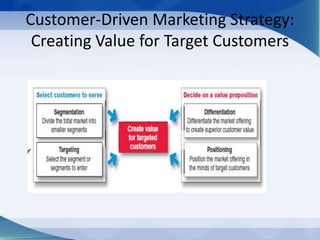
Customer-Driven Marketing Strategy:
Creating Value for Target Customers
Segmentation
• Geographic segmentation- Dividing a market
into different geographical units, such as
nations, states, regions, counties, cities, or
even neighborhoods.
• Demographic segmentation-Dividing the
market into segments based on variables such
as age, gender, family size, family life cycle,
income, occupation, education, religion, race,
generation, and nationality.
Segmentation
• Age and life-cycle segmentation Dividing a market
into different age and life-cycle groups.
• Gender segmentation- Dividing a market into
different segments based on gender.
• Income segmentation- Dividing a market into
different income segments.
• Psychographic segmentation- Dividing a market into
different segments based on social class, lifestyle, or
personality characteristics.
Segmentation
• Behavioral segmentation- Dividing a market into
segments based on consumer knowledge, attitudes,
uses, or responses to a product.
• Occasion segmentation- Dividing the market into
segments according to occasions when buyers get
the idea to buy, actually make their purchase, or use
the purchased item.
• Benefit segmentation- Dividing the market into
segments according to the different benefits that
consumers seek from the product.
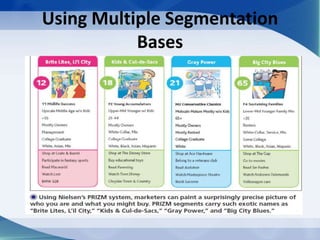
Using Multiple Segmentation
Bases
Segmenting Business Markets
• Business buyers can be segmented geographically,
demographically (industry, company size), or by
benefits sought, user status, usage rate, and loyalty
status. Yet, business marketers also use some
additional variables, such as customer operatin
characteristics, purchasing approaches, situational
factors, and personal characteristics.
• It is believed that buying behavior and
benefits provide the best basis for segmenting
business markets.
Segmenting International Markets
• Economic factors , Political and legal factors
• Intermarket segmentation (cross-market
segmentation) - Forming segments of
consumers who have similar needs and buying
behavior even though they are located in
different countries.
Segmenting International Markets
Requirements for Effective
Segmentation
• To be useful, market segments must be:
• - measurable
• - accessible
• - Substantial
• - Differentiable
• - Actionable
Market Targeting
• Market segmentation reveals the firm’s market
segment opportunities. The firm now has to evaluate
the various segments and decide how many and
which segments it can serve best.
• In evaluating different market segments, a firm must
look at three factors: segment size and growth,
segment structural attractiveness, and company
objectives and resources.
Selecting Target Market Segments
• After evaluating different segments, the
company must decide which and how many
segments it will target.
• Target market- A set of buyers sharing
common needs or characteristics that the
company decides to serve.
Selecting Target Market Segments
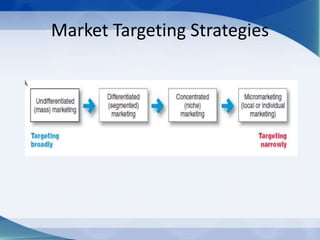
• Market targeting can be carried out at several
different levels. Companies can target very
broadly (undifferentiated marketing), very
narrowly (micromarketing), or somewhere in
between (differentiated or concentrated
marketing).
Market Targeting Strategies
• Undifferentiated (mass) marketing - A
market-coverage strategy in which a firm
decides to ignore market segment differences
and go after the whole market with one offer.
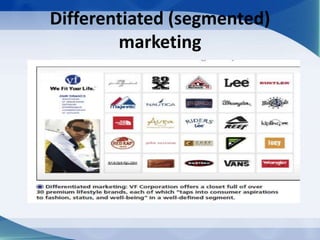
• Differentiated (segmented) marketing -A
market-coverage strategy in which a firm
decides to target several market segments and
designs separate offers for each.
Differentiated (segmented)
marketing
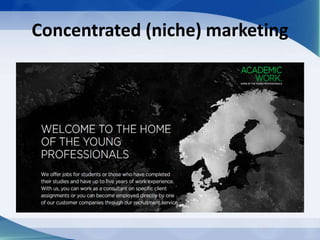
Concentrated (niche) marketing
• Concentrated (niche) marketing - A market-
coverage strategy in which a firm goes after a
large share of one or a few segments or
niches.
Concentrated (niche) marketing
Micromarketing
• Micromarketing - Tailoring products and
marketing programs to the needs and wants
of specific individuals and local customer
segments; It includes local marketing and
individual marketing.
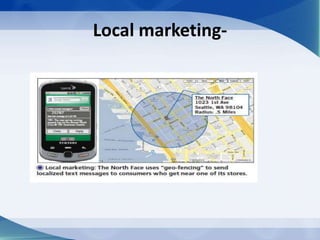
• Local marketing- Tailoring brands and
promotions to the needs and wants of local
customer segments—cities, neighborhoods,
and even specific stores.
Local marketing-
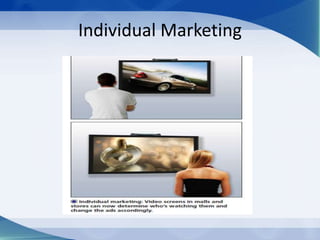
Individual marketing
• Tailoring products and marketing programs to
the needs and preferences of individual
customers—also called one-toone marketing,
customized marketing, and markets-of-one
marketing.
Individual Marketing
Choosing a Targeting Strategy
• Companies need to consider many factors
when choosing a market-targeting strategy:
company’s resources, The product’s life-cycle
stage, competitors’ marketing strategies and
etc.
Differentiation and Positioning
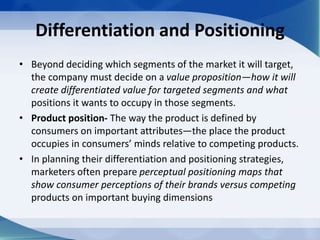
• Beyond deciding which segments of the market it will target,
the company must decide on a value proposition—how it will
create differentiated value for targeted segments and what
positions it wants to occupy in those segments.
• Product position- The way the product is defined by
consumers on important attributes—the place the product
occupies in consumers’ minds relative to competing products.
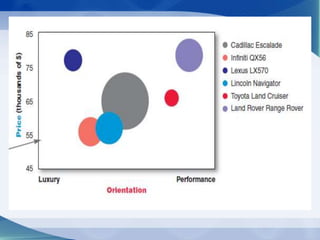
• In planning their differentiation and positioning strategies,
marketers often prepare perceptual positioning maps that
show consumer perceptions of their brands versus competing
products on important buying dimensions
Differentiation and Positioning
Strategy
• The differentiation and positioning task
consists of three steps: identifying a set of
differentiating competitive advantages on
which to build a position, choosing the right
competitive advantages, and selecting an
overall positioning strategy. The company
must then effectively communicate and
deliver the chosen position to the market
Identifying Possible Value Differences
and Competitive Advantages
• Competitive advantage- An advantage over
competitors gained by offering greater
customer value, either by having lower prices
or providing more benefits that justify higher
prices.
• Companies can differentiate along the lines of
product, services, channels, people, or image.
Choosing the Right Competitive
Advantages
• Many marketers think that companies should
aggressively promote only one benefit to the
target market.
• Unique Selling Proposition
• Buyers tend to remember number one better,
especially in this overcommunicated society.
Thus, Walmart promotes its unbeatable low
prices, and Burger King promotes personal
choice—“have it your way.”
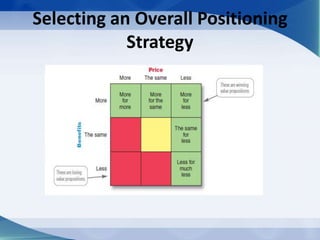
Selecting an Overall Positioning
Strategy
Developing a Positioning
Statement
• Positioning statement - A statement that
summarizes company or brand positioning. It
takes this form: To (target segment and need)
our (brand) is (concept) that (point of
difference).
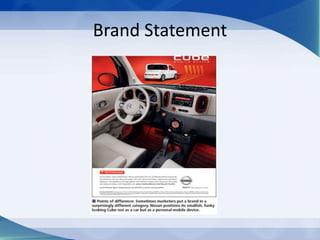
Brand Statement
Thank you for your attention!

Customer Driven Marketing Strategy12.ppt

  • 1.
    Customer-Driven Marketing Strategy Turan SULEYMANOV MScin Business Administration Linkoping University Prepared to accompany the lecture at Azerbaijan University
  • 2.
    Chapter 7 • Customer-DrivenMarketing Strategy: Creating Value for Target Customers
  • 3.
    Outline •Customer-Driven Marketing Strategy •MarketSegmentation •Market Targeting •Differentiation and Positioning
  • 4.
    Market Segmentation • Dividinga market into smaller segments with distinct needs, characteristics, or behavior that might require separate marketing strategies or mixes. • Four important segmentation topics: segmenting consumer markets, segmenting business markets, segmenting international markets, and the requirements for effective segmentation.
  • 5.
  • 6.
    Segmentation • Geographic segmentation-Dividing a market into different geographical units, such as nations, states, regions, counties, cities, or even neighborhoods. • Demographic segmentation-Dividing the market into segments based on variables such as age, gender, family size, family life cycle, income, occupation, education, religion, race, generation, and nationality.
  • 7.
    Segmentation • Age andlife-cycle segmentation Dividing a market into different age and life-cycle groups. • Gender segmentation- Dividing a market into different segments based on gender. • Income segmentation- Dividing a market into different income segments. • Psychographic segmentation- Dividing a market into different segments based on social class, lifestyle, or personality characteristics.
  • 8.
    Segmentation • Behavioral segmentation-Dividing a market into segments based on consumer knowledge, attitudes, uses, or responses to a product. • Occasion segmentation- Dividing the market into segments according to occasions when buyers get the idea to buy, actually make their purchase, or use the purchased item. • Benefit segmentation- Dividing the market into segments according to the different benefits that consumers seek from the product.
  • 9.
  • 10.
    Segmenting Business Markets •Business buyers can be segmented geographically, demographically (industry, company size), or by benefits sought, user status, usage rate, and loyalty status. Yet, business marketers also use some additional variables, such as customer operatin characteristics, purchasing approaches, situational factors, and personal characteristics. • It is believed that buying behavior and benefits provide the best basis for segmenting business markets.
  • 11.
    Segmenting International Markets •Economic factors , Political and legal factors • Intermarket segmentation (cross-market segmentation) - Forming segments of consumers who have similar needs and buying behavior even though they are located in different countries.
  • 12.
  • 13.
    Requirements for Effective Segmentation •To be useful, market segments must be: • - measurable • - accessible • - Substantial • - Differentiable • - Actionable
  • 14.
    Market Targeting • Marketsegmentation reveals the firm’s market segment opportunities. The firm now has to evaluate the various segments and decide how many and which segments it can serve best. • In evaluating different market segments, a firm must look at three factors: segment size and growth, segment structural attractiveness, and company objectives and resources.
  • 15.
    Selecting Target MarketSegments • After evaluating different segments, the company must decide which and how many segments it will target. • Target market- A set of buyers sharing common needs or characteristics that the company decides to serve.
  • 16.
    Selecting Target MarketSegments • Market targeting can be carried out at several different levels. Companies can target very broadly (undifferentiated marketing), very narrowly (micromarketing), or somewhere in between (differentiated or concentrated marketing).
  • 17.
  • 18.
    Market Targeting Strategies •Undifferentiated (mass) marketing - A market-coverage strategy in which a firm decides to ignore market segment differences and go after the whole market with one offer. • Differentiated (segmented) marketing -A market-coverage strategy in which a firm decides to target several market segments and designs separate offers for each.
  • 19.
  • 20.
    Concentrated (niche) marketing •Concentrated (niche) marketing - A market- coverage strategy in which a firm goes after a large share of one or a few segments or niches.
  • 21.
  • 22.
    Micromarketing • Micromarketing -Tailoring products and marketing programs to the needs and wants of specific individuals and local customer segments; It includes local marketing and individual marketing. • Local marketing- Tailoring brands and promotions to the needs and wants of local customer segments—cities, neighborhoods, and even specific stores.
  • 23.
  • 24.
    Individual marketing • Tailoringproducts and marketing programs to the needs and preferences of individual customers—also called one-toone marketing, customized marketing, and markets-of-one marketing.
  • 25.
  • 26.
    Choosing a TargetingStrategy • Companies need to consider many factors when choosing a market-targeting strategy: company’s resources, The product’s life-cycle stage, competitors’ marketing strategies and etc.
  • 27.
    Differentiation and Positioning •Beyond deciding which segments of the market it will target, the company must decide on a value proposition—how it will create differentiated value for targeted segments and what positions it wants to occupy in those segments. • Product position- The way the product is defined by consumers on important attributes—the place the product occupies in consumers’ minds relative to competing products. • In planning their differentiation and positioning strategies, marketers often prepare perceptual positioning maps that show consumer perceptions of their brands versus competing products on important buying dimensions
  • 29.
    Differentiation and Positioning Strategy •The differentiation and positioning task consists of three steps: identifying a set of differentiating competitive advantages on which to build a position, choosing the right competitive advantages, and selecting an overall positioning strategy. The company must then effectively communicate and deliver the chosen position to the market
  • 30.
    Identifying Possible ValueDifferences and Competitive Advantages • Competitive advantage- An advantage over competitors gained by offering greater customer value, either by having lower prices or providing more benefits that justify higher prices. • Companies can differentiate along the lines of product, services, channels, people, or image.
  • 31.
    Choosing the RightCompetitive Advantages • Many marketers think that companies should aggressively promote only one benefit to the target market. • Unique Selling Proposition • Buyers tend to remember number one better, especially in this overcommunicated society. Thus, Walmart promotes its unbeatable low prices, and Burger King promotes personal choice—“have it your way.”
  • 32.
    Selecting an OverallPositioning Strategy
  • 33.
    Developing a Positioning Statement •Positioning statement - A statement that summarizes company or brand positioning. It takes this form: To (target segment and need) our (brand) is (concept) that (point of difference).
  • 34.
  • 35.
    Thank you foryour attention!