This section includes:
 Introduction
 Guniting
 Shortcreting
 Repair for cracks
 Shoring and underpinning
 Repairs to overcome low member
strength
Introduction:
The success of repair activity depends on the
identification of the root cause of the deterioration of
the concrete structures.
If this cause is properly identified, satisfactory
repairs can be done for the improvement of strength
and durability, thus extending the life of the structure,
is not difficult to achieve.
General procedure in the repair of
distressed concrete structure:
Support the structural members properly as required.
Remove all cracked, spalled and loose concrete.
Clean the exposed concrete surfaces and steel reinforcement.
Provide additional reinforcing bars, if the loss in
reinforcement is more than 10%
Apply shortcreting/polymer concrete for patch repair work
and grouting for porous/honeycombed concrete.
Apply protective coatings over the exposed/repaired surface.
Guniting
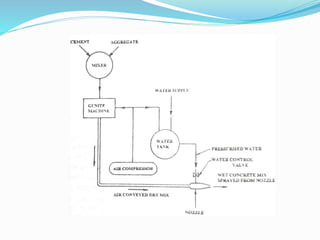
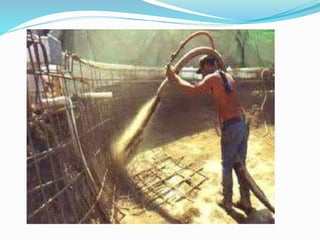
Guniting is mechanically applied material consisting of
cement, aggregates and water.
The cement and sand are batched and mixed in the usual way
and conveyed through a hose pipe with the help of compressed air.
A separate pipe line brings water under pressure and the water
and cement aggregate mix are passed through and intimately mixed in
a special manifold and then projected at high velocity to the surface
being repaired.
In good quality work, a density around 2100kg/m3
is achieved. For effective guniting, the nozzle should
be kept at 60cm to 150cm from the work normal to the
surface.
Before guniting is applied, the old concrete surface
is prepared properly, all the cracks treated and the new
reinforcement fixed in position.
Cracks wider than about 0.5 mm should be cut out
and filled with hand-applied mortar or with gunite.
Shortcreting
Shortcrete is defined as “ mortar or concrete pneumatically projected at
high speed onto a surface”.
Types of shorcrete:
i) Dry mix
ii) Wet mix
Dry mix:
Dry cement, sand and coarse aggregate are premixed with only
sufficient water to reduce dusting.
ii) Wet mix:
The cement, sand and coarse aggregate are mixed with water and
the resulting concrete is then pumped to the nozzle where compressed air propels
the wet mixture onto the surface.
Applications :
Shortcrete has been used to repair :
canal and spillway linings and walls
the faces of dams, tunnel linings
highway bridges and tunnels
deteriorating natural rock walls and
earthen slopes
to thicken and strengthen existing concrete surfaces
Repair for cracks:
i) Stitching
ii) Routing and sealing
iii) Resin injection
iv) Dry packing
v) Polymer impregnation
vi) Vacuum impregnation
vii) Autogenous healing
viii) Flexible sealing
ix) Drilling and plugging
x) Bandaging
STITCHING
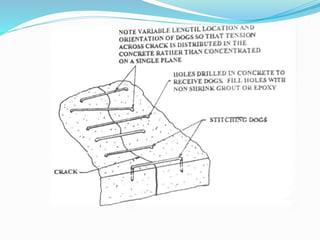
 In this technique, the crack is bridged with U-shaped metal
units called stitching dogs before being repaired with a rigid resin
material.
 A non- shrink grout or an epoxy resin based adhesive should
be used to anchor the legs of the dogs.
 Stitching is suitable when tensile strength must be
re established across major cracks.
 Stitching dogs should be of variable length and orientation.
BENEFITS OF CRACKED STITCHING
 Quick, simple, effective and permanent.
 The grout combination provides an excellent bond within the
substrate.
 Masonry remains flexible enough to accommodate natural
building movement.
 Non-disruptive structural stabilization with no additional
stress
ROUTING AND SEALING
 This is the simplest and most common method of crack
repair.
 It can be executed with relatively unskilled labor and can
be used to seal both fine pattern cracks and larger isolated
cracks.
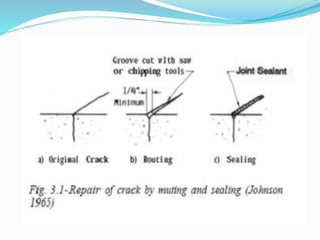
 This involves enlarging the crack along its exposed face
and sealing it with crack fillers.
 Care should be taken to ensure that the entire crack is
routed and sealed.
RESIN INJECTION
 Epoxy resins are usually selected for crack injection
because of their high mechanical strength and resistance to
most chemical environments encountered by concrete.
 Epoxies are rigid and not suitable for active cracks.
 This method is used to restore structural soundness of
members where cracks are dormant or can be prevented
from further movements.
INTRODUCTION
Definition
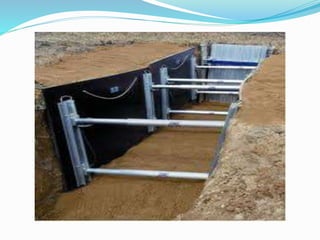
 It is the method of providing temporary support (shores) to an
unsafe structure.
Types of Shoring
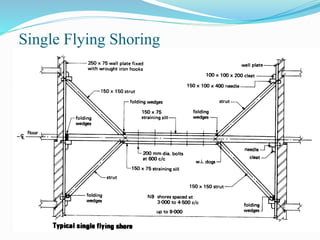
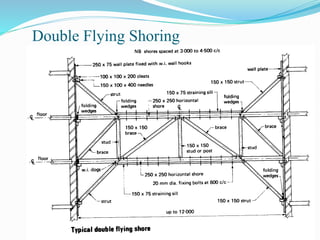
 Horizontal shoring or flying shoring
 Vertical shoring or dead shoring
 Inclined Shoring or flying shoring
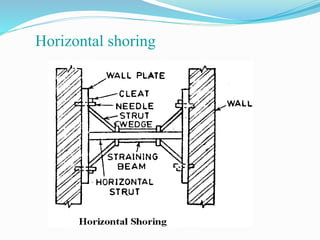
Horizontal shoring
 It consists of
 Horizontal beam or strut
 Wall plates
 Cleats
 Straining beams
 Used to support two adjacent buildings.
Horizontal shoring
Single Flying Shoring
Double Flying Shoring
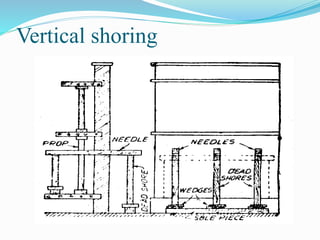
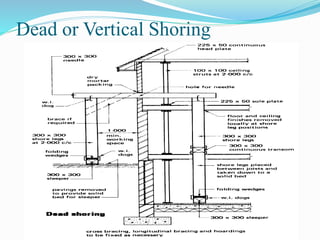
Vertical shoring
 It consists of
 Dead shores
 Sole plates
 Needles
 Props
 Used for rebuilding of walls.
Vertical shoring
Dead or Vertical Shoring
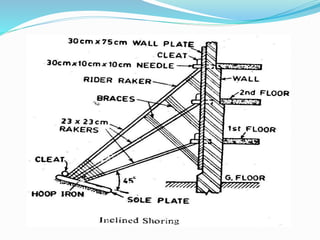
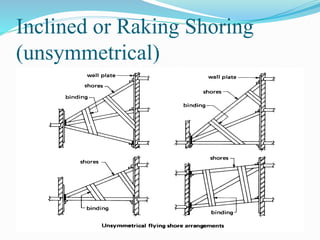
Inclined Shoring
 It consists of
 Rackers
 Needles
 Cleats
 Braces
 Sole plate
 Used to strengthen a wall.
Inclined or Raking Shoring
(unsymmetrical)
DEFINITION
• Underpinning is the process of strengthening and
stabilizing the foundation of an existing building or
other structure
• Foundation underpinning is a means of transferring
loads to deeper soils or bedrock.
PURPOSE OF UNDERPINNING
• To obtain additional foundation capacity
• To modify the existing foundation system
• To create new foundations through which the existing load may
be wholly or partially transferred into deeper soil
• To arrest the excessive settlement
• To improve the future performance of the existing foundations
WHEN UNDERPINING IS REQUIRED?
Underpinning is required when:
• Construction of a new project with deeper foundation
adjacent to an existing building.
• Change in the use of structure
• The properties of the soil supporting the foundation may have
changed or was mischaracterized during planning.
• To support a structure which is sinking or tilting due to
ground subsidence or instability of the super structure
METHODS USED FOR UNDERPINNING
• Pit Underpinning
 Push Piers System
• Helical Pier System
• Pile Underpinning
• Other Methods
• Chemical Grouting
• Microfine Grouting
 Micropiles
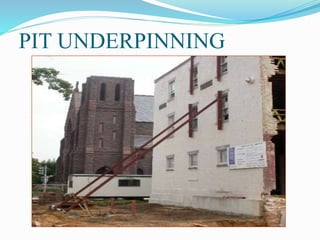
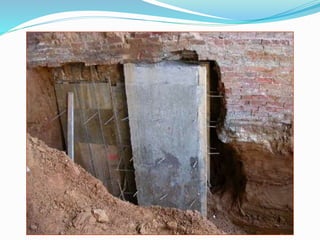
PIT UNDERPINNING
42
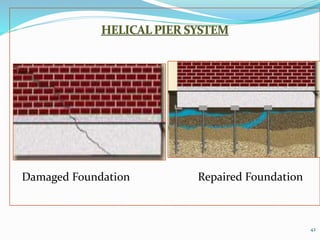
Damaged Foundation Repaired Foundation
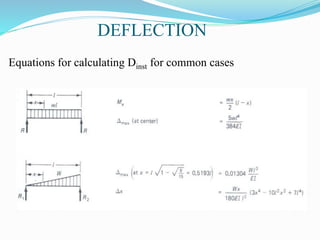
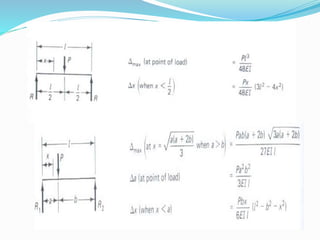
DEFLECTION
Equations for calculating Dinst for common cases
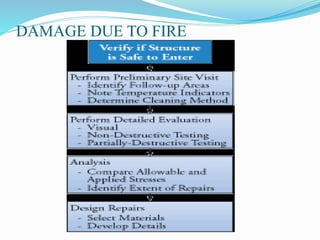
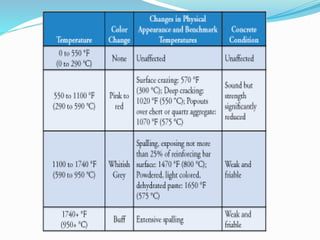
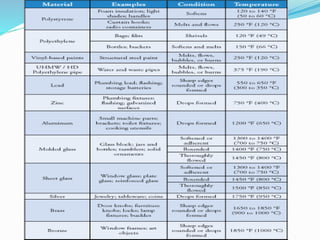
DAMAGE DUE TO FIRE
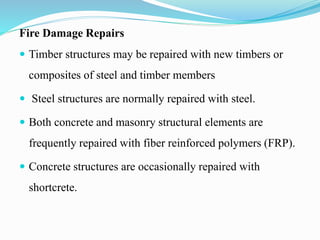
Fire Damage Repairs
 Timber structures may be repaired with new timbers or
composites of steel and timber members
 Steel structures are normally repaired with steel.
 Both concrete and masonry structural elements are
frequently repaired with fiber reinforced polymers (FRP).
 Concrete structures are occasionally repaired with
shortcrete.
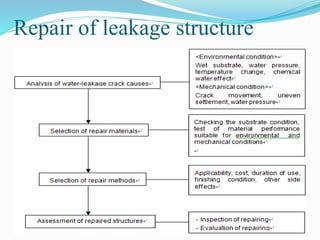
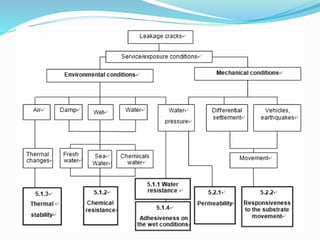
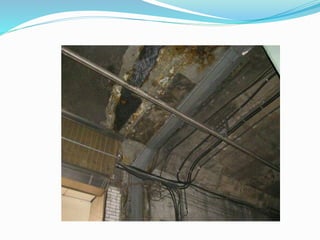
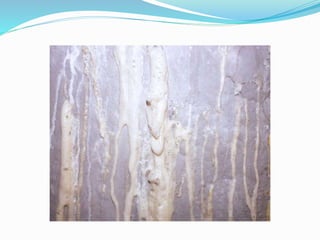
Repair of leakage structure
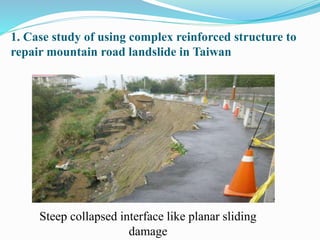
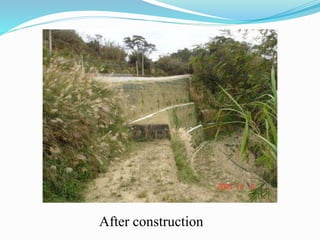
1. Case study of using complex reinforced structure to
repair mountain road landslide in Taiwan
Steep collapsed interface like planar sliding
damage
After construction
Grouting, guniting, jacketing

Grouting, guniting, jacketing

  • 2.
    This section includes: Introduction  Guniting  Shortcreting  Repair for cracks  Shoring and underpinning  Repairs to overcome low member strength
  • 3.
    Introduction: The success ofrepair activity depends on the identification of the root cause of the deterioration of the concrete structures. If this cause is properly identified, satisfactory repairs can be done for the improvement of strength and durability, thus extending the life of the structure, is not difficult to achieve.
  • 4.
    General procedure inthe repair of distressed concrete structure: Support the structural members properly as required. Remove all cracked, spalled and loose concrete. Clean the exposed concrete surfaces and steel reinforcement. Provide additional reinforcing bars, if the loss in reinforcement is more than 10% Apply shortcreting/polymer concrete for patch repair work and grouting for porous/honeycombed concrete. Apply protective coatings over the exposed/repaired surface.
  • 6.
    Guniting Guniting is mechanicallyapplied material consisting of cement, aggregates and water. The cement and sand are batched and mixed in the usual way and conveyed through a hose pipe with the help of compressed air. A separate pipe line brings water under pressure and the water and cement aggregate mix are passed through and intimately mixed in a special manifold and then projected at high velocity to the surface being repaired.
  • 7.
    In good qualitywork, a density around 2100kg/m3 is achieved. For effective guniting, the nozzle should be kept at 60cm to 150cm from the work normal to the surface. Before guniting is applied, the old concrete surface is prepared properly, all the cracks treated and the new reinforcement fixed in position. Cracks wider than about 0.5 mm should be cut out and filled with hand-applied mortar or with gunite.
  • 10.
    Shortcreting Shortcrete is definedas “ mortar or concrete pneumatically projected at high speed onto a surface”. Types of shorcrete: i) Dry mix ii) Wet mix Dry mix: Dry cement, sand and coarse aggregate are premixed with only sufficient water to reduce dusting. ii) Wet mix: The cement, sand and coarse aggregate are mixed with water and the resulting concrete is then pumped to the nozzle where compressed air propels the wet mixture onto the surface.
  • 11.
    Applications : Shortcrete hasbeen used to repair : canal and spillway linings and walls the faces of dams, tunnel linings highway bridges and tunnels deteriorating natural rock walls and earthen slopes to thicken and strengthen existing concrete surfaces
  • 13.
    Repair for cracks: i)Stitching ii) Routing and sealing iii) Resin injection iv) Dry packing v) Polymer impregnation vi) Vacuum impregnation vii) Autogenous healing viii) Flexible sealing ix) Drilling and plugging x) Bandaging
  • 15.
    STITCHING  In thistechnique, the crack is bridged with U-shaped metal units called stitching dogs before being repaired with a rigid resin material.  A non- shrink grout or an epoxy resin based adhesive should be used to anchor the legs of the dogs.  Stitching is suitable when tensile strength must be re established across major cracks.  Stitching dogs should be of variable length and orientation.
  • 17.
    BENEFITS OF CRACKEDSTITCHING  Quick, simple, effective and permanent.  The grout combination provides an excellent bond within the substrate.  Masonry remains flexible enough to accommodate natural building movement.  Non-disruptive structural stabilization with no additional stress
  • 18.
    ROUTING AND SEALING This is the simplest and most common method of crack repair.  It can be executed with relatively unskilled labor and can be used to seal both fine pattern cracks and larger isolated cracks.  This involves enlarging the crack along its exposed face and sealing it with crack fillers.  Care should be taken to ensure that the entire crack is routed and sealed.
  • 20.
    RESIN INJECTION  Epoxyresins are usually selected for crack injection because of their high mechanical strength and resistance to most chemical environments encountered by concrete.  Epoxies are rigid and not suitable for active cracks.  This method is used to restore structural soundness of members where cracks are dormant or can be prevented from further movements.
  • 23.
    INTRODUCTION Definition  It isthe method of providing temporary support (shores) to an unsafe structure. Types of Shoring  Horizontal shoring or flying shoring  Vertical shoring or dead shoring  Inclined Shoring or flying shoring
  • 24.
    Horizontal shoring  Itconsists of  Horizontal beam or strut  Wall plates  Cleats  Straining beams  Used to support two adjacent buildings.
  • 25.
  • 26.
  • 27.
  • 28.
    Vertical shoring  Itconsists of  Dead shores  Sole plates  Needles  Props  Used for rebuilding of walls.
  • 29.
  • 30.
  • 31.
    Inclined Shoring  Itconsists of  Rackers  Needles  Cleats  Braces  Sole plate  Used to strengthen a wall.
  • 33.
    Inclined or RakingShoring (unsymmetrical)
  • 36.
    DEFINITION • Underpinning isthe process of strengthening and stabilizing the foundation of an existing building or other structure • Foundation underpinning is a means of transferring loads to deeper soils or bedrock.
  • 37.
    PURPOSE OF UNDERPINNING •To obtain additional foundation capacity • To modify the existing foundation system • To create new foundations through which the existing load may be wholly or partially transferred into deeper soil • To arrest the excessive settlement • To improve the future performance of the existing foundations
  • 38.
    WHEN UNDERPINING ISREQUIRED? Underpinning is required when: • Construction of a new project with deeper foundation adjacent to an existing building. • Change in the use of structure • The properties of the soil supporting the foundation may have changed or was mischaracterized during planning. • To support a structure which is sinking or tilting due to ground subsidence or instability of the super structure
  • 39.
    METHODS USED FORUNDERPINNING • Pit Underpinning  Push Piers System • Helical Pier System • Pile Underpinning • Other Methods • Chemical Grouting • Microfine Grouting  Micropiles
  • 40.
  • 42.
  • 44.
  • 46.
  • 49.
    Fire Damage Repairs Timber structures may be repaired with new timbers or composites of steel and timber members  Steel structures are normally repaired with steel.  Both concrete and masonry structural elements are frequently repaired with fiber reinforced polymers (FRP).  Concrete structures are occasionally repaired with shortcrete.
  • 50.
  • 55.
    1. Case studyof using complex reinforced structure to repair mountain road landslide in Taiwan Steep collapsed interface like planar sliding damage
  • 56.