Unit –III
Phase Diagrams and Iron-Carbon Diagram
INTRODUCTION
•One of the important objectives of engineering metallurgy
is to determine the properties of material.
•The properties of material is
a
function of the
microstructure which is further dependent on the
overall composition and variables such
as
temp., pressure and composition.
•Equilibrium diagram or phase diagram
is
a
graphical
representation of various phases present in the
material system at various temp. and compositions.
Solid Solutions
In solid state the alloy may be present in one or more of
the following forms
1. Solid Solution
2. An intermediate phase.
3. Mechanical mixture of metals.
4. Mechanical mixture of Solid solutions
5. Mechanical Mixture of Chemical compound of Metals
• Alloys are more widely used than pure metals
• Properties of alloys are better than pure metals.
• A solid solution is formed when two metals are completely
soluble in liquid state and also completely soluble in solid state.
• In other words, when homogeneous mixtures of two or more
kinds of atoms (of metals) occur in the solid state, they are
known as solid solutions.
Solvent and Solute
• The more abundant atomic form is referred as solvent
• The less abundant atomic form is referred as solute.
Types of Solid Solutions
1. Substitutional Solid Types
2. Interstitial Solid Solutions
Substitutional Solid Types
If the atoms of the solvent or parent metal are replaced in the
crystal lattice by atoms of the solute metal then the solid solution is
known as substitutional solid solution.
□ For example, copper atoms may substitute for nickel
atoms without disturbing the
F.C.C. structure of nickel
□In the substitutional solid solutions, the substitution can be either
disordered or
ordered.
□Figure 1.1 shows disordered substitutional solid solution. Here
the solute atoms
have substituted disorderly for the solvent atoms on their lattice
site.
□Fig.1.1 shows an ordered substitutional solid solution. Here the
solute atoms have
substituted in an orderly manner for the solvent atoms on
USEFUL
TERMINOLOGY
•A pure substance, under equilibrium conditions,
as either of a phase namely vapor,
may exist
or solid,
ldi
qepuei
dndingupon the conditions of temperature and
pressure.
•A phase can be defined as a homogeneous portion of a
system that has uniform physical and chemical characteristics
i.e. it is a physically distinct from other phases, chemically
homogeneous and mechanically separable portion of a
system.
•Other words, a phase is a structurally homogeneous portion
of matter.
It is a region that differs in it’s microstructure and
composition from another region.
Forthe same composition, different crystal
structures represent different phases.
A solid solution has atoms mixed at atomic level thus it
represents a single phase.
A single-phase system is termed as homogeneous, and systems
composed of two or more phases are termed as mixtures or
heterogeneous. Most of the alloy systems and composites are
heterogeneous
•1. System
A system is a portion of interacting or interdependent
component parts forming a complex whole is called
system
This refers to any portion of objective space within
specified boundaries subject to specified
variables.
An alloy
more
system is a
combination elements
forming
of
alloys
considered within a specified
two
or
which
are
temp. , pressure and
concentration.range of
Systems are classified according to number of system it
constitutes
Types of systems:-
1. Binary system: 2 components
2. Ternary system: 3 components
3. Quaternary System: 4 components
2. Phase :
Phase is defined as homogeneous , physically distict portion
of the system.
Each portion is physically and chemically homogeneous
composition throughout and regardless of sample taken in
any portion.
•But each phase have same composition but different
properties.
•In an equilibrium diagram, liquid is one phase and solid
• Many phases exists in some alloys.
• Example: A liquid may exist with solid solution or two solid
solutions of different combinations may exists.
• Many phases exists in same alloy
• Grey Cast Iron for example is made up of following phases in
order to decreasing amount
• 1. Solid solution phase of iron containing some
carbon , silicon, phosphorus
• 2. A soft metalloid , graphite (carbon)
• 3. A hard brittle compound, Fe3
C (Cementite).
• 4. A compound of the impurity Sulphur (MnS)
• 5. A compound of impurity , Phosphorus (Fe3P)
• 6. A very small amount of non metallic compound.
3. Variable :
•A particular phase exists under various conditions
of temp., pressure and concentrations.
•These parameter are known as the variables of the
phase.
•These variables specify the combination of phases
present in system
•Component –
These
are the substances, chemical
eltehmeerntsor chemical compounds whose presence
is necessary and sufficient to make a system.
•Pure metal is a one-component system whereas an alloy
of two metal is a two-component system.
•Fe – 1 component
•Cu- Ni (Copper Nickel alloy)– 2 components
•Elements Cu and Ni
•In Ice water steam system, the component is H O
4. Alloy :
•It is a mixture of two or
more elements having metallic
properties.
•Inthe mixture, metal is in the
large
proportion
•and the others can be metals or non-
metals.
The element in the largest amount is called as
base metal(Parent metal) or solvent
•and the other elements are called as alloying elements
or
solute.
•The components of alloy are usually completely soluble in
liquid state
•Phase equilibrium –
•it refers to the set of conditions where more thanone
phase may exist.
•
It can be reflected by constancy with time in
the phase characteristics of a system.
•In most metallurgical and materials systems, phase
equilibrium involves just solid phases.
PHASE DIAGRAM OF WATER
HUME-ROTHERY’S RULES FOR SOLID
SOLUTION
•Solid solution is an alloy of two or more elements wherein
the atomic crystal structure of the alloying element (solute)
is same as that of the base metal matrix (solvent).
•The solubility limit of the solute in the solvent is govern by
certain factors.
•These governing factors are known as Hume- Rothery’s rules
for solid solubility.
1. Atomic size or Relative Size Factor:
- Greater the difference between the atom size of two metals
involved , smaller is the solubility.
-If atomic size of solute and solvent differ more than 15% ,then
solid solubility is extremely smaller.
-If atomic size differ exceeds less than 15% solid solubility
is more.
2. Chemical-affinity Factor :-
• The ions of all metals are electropositive but some are more
electro positive than others.
• Greater the difference in electro positivity , greater will be the
chemical affinity of one atom for another atom so that they
will tend to form compound than solid solution.
• The greater the chemical affinity more restricted is their
solid solubility
• Greater affinity greater the tendency of formation of
compound.
• If Electropositive are similar then they will probably for solid
solution
• Compound contains two or more elements that are chemically
3.Relative Valence (Valency) Factor :-
• Valency is the number of atoms of a particular element that is
combined with one atom of another element to form a
molecule.
• Valency is also known as molecular weight.
• Valency is a measure of the combining power of an atom.
• The valency of an element is determined by the number
of electrons in its outermost shell.
• The valency of an element can be increased either by gaining
or losing electron.
• A metal of Higher valency can dissolve a small amount of lower
valency metal.
• While the lower valency metal can have good solubility
for higher valency metal.
4.Crystal Structure Factor-
• Metals having same crystal structure will have greater solubility.
Since atoms tend to assume relatively fixed positions.
• This gives rise to the formation of crystals in solid state.
• Difference in crystal structure limits the solid solubility.
GIBB’S PHASE RULE
•Dr.Gibbs studied the relationship between the number of phases
and the effect of variables such as pressure, temperature and
composition.
•The Gibb’s phase rule states that under equilibrium condition, the
following condition must be satisfied
P + F = C + 2
P = Number of phase in system
F = Degree of Freedom i.e Number of variables that can be changed
independently without affecting the number of phase.
C = Number of Components (i.e. element)
2 = It represents any two variable amongst three
In general, all equilibrium diagrams are studied
caot nstant pressure, hence rule is modified to.
P + F = C + 1
•The phase rule helps determine maximum
phase pnruemsebnetr in oafn alloy system under equilibrium
conditions at any point in phase diagram.
COOLING CURVE FOR PURE METAL
• used to determine phase transition temperature
record T of material vs time, as it cools from its molten state
through solidification and finally to RT (at a constant pressure!!!)
B1
Latent heat
NUCLEATION
•Nucleation is the beginning of a phase transformation.
• Nucleation is the process by which atoms or molecules come together to
form a new phase or structure. This process is crucial in the formation of
crystals, as well as in the formation of bubbles in a liquid or gas.
•It is marked by the appearance in the molten metal of tiny
regions called nuclei of new phase which grow to solid
crystals until the transformation is complete.
1.Homogeneous or self Nucleation.
2.Heterogeneous Nucleation.
Homogeneous or self Nucleation. Heterogeneous Nucleation.
Interiors of a uniform substance
Slower process
It occurs with much more
difficulties.
Nuclei are formed from atoms of
solidifying metals.
Lower temperature.
It requires supercoiling to form first
nuclei.
Start at the nucleation sites on the
surface contacting liquid or vapor.
Faster process
Occurs easily.
At impurity atoms or container surface
acts as a nucleating agent.
Higher temperature.
It requires little or no supercoiling.
COOLING CURVE FOR PURE METAL
Region AB,
P + F = C + 1
1 + F = 1 +
1
F=1(T without
changing liquid phase)
Region BC,
P + F = C + 1
2 + F = 1 +
1 F=0
(No variable)
Region CD,
P + F = C + 1
1 + F = 1 +
1
F=1 (T without
changing a solid
COOLING CURVE FOR BINARY SOLID
SOLUTION
Region AB,
P + F = C + 1
1 + F = 2 + 1
F=2 (T and C without
changing liquid phase)
Region BC,
P + F = C + 1
2 + F = 2 +
1 F=1
(T without changing
liquid-solid phase)
Region CD,
P + F = C + 1
1 + F = 2 +
1
F = 2
(T and C without
COOLING CURVE FOR BINARY
EUTECTIC ALLOY
Region AB,
P + F = C +
1 1 + F = 2
+ 1
F=2 (Bi-
varient)
Region BC,
P + F = C +
1 3 + F = 2
+ 1
F=0 ( Non
Binary Eutectic is homogeneous mixture of two solids which
forms at constant temperature during cooling and melts at
constant temperature during heating.
• Binary eutectic transformation reaction can be as follows
Constant Temperature
• L S1 + S2
• Where
• S1- one solid
• S2- another solid
• The temperature at which this transformation reaction is
obtained is called eutectic temperature
COOLING CURVE FOR OFF-EUTECTIC
BINARY ALLOY
Region AB,
P + F = C + 1
1 + F = 2 + 1
F= 2 ( T &
C without
changing
Liquid
Phase)
Region BC,
P + F = 2 + 1
2+ F = 2 + 1
F= 1
( Univarient
)
Region CD
P + F = C+ 1
3 + F = 2 +
Region CD
P + F = C +
1 2 + F = 2
+ 1
F=1
( Univarient)
PLOTTING OF EQUILIBRIUM
OR PHASE DIAGRAM
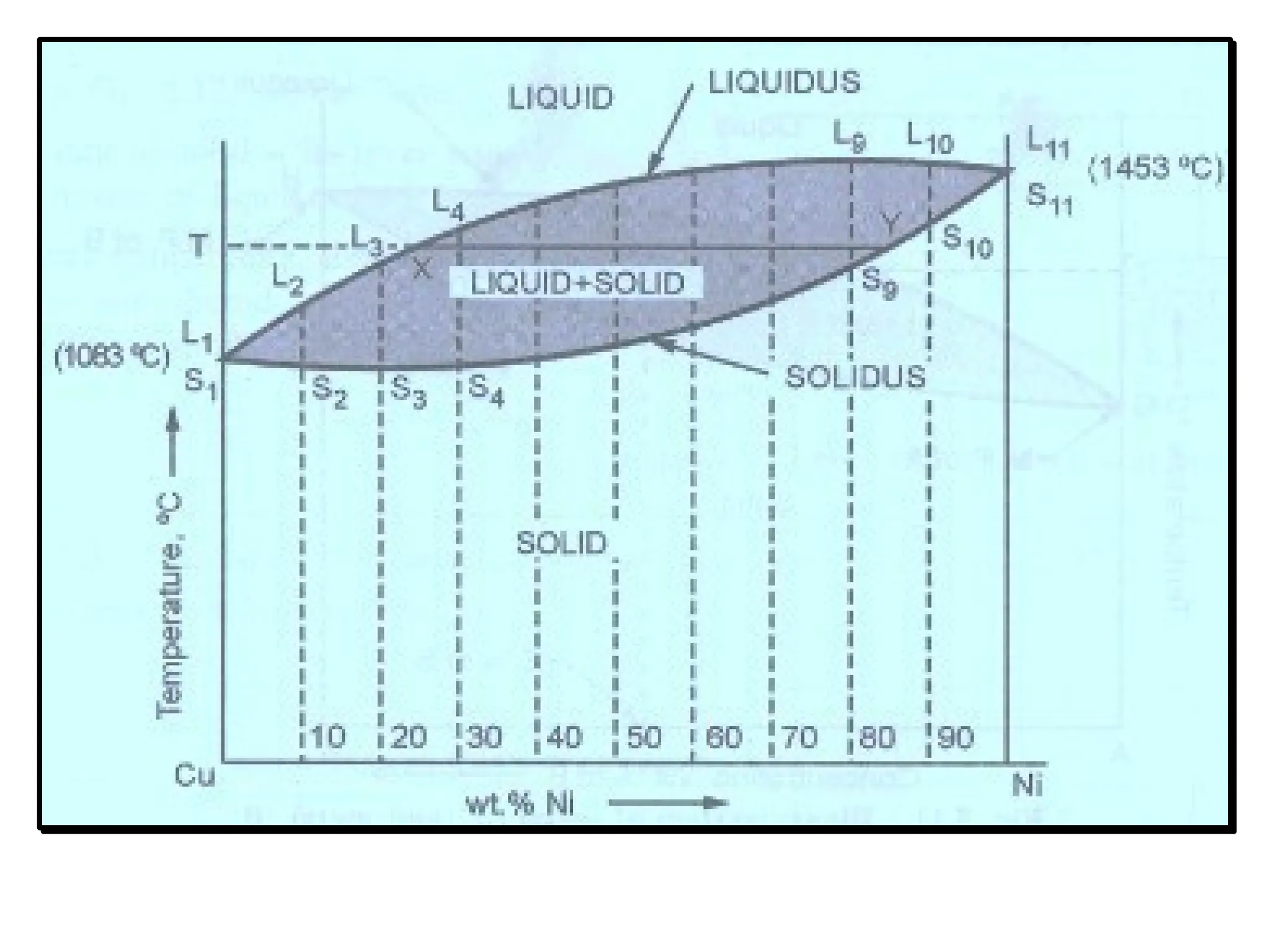
Sample 1 2 3 4 5 6 7 8 9 10 11
% Cu 100 90 80 70 60 50 40 30 20 10 0
% Ni 0 10 20 30 40 50 60 70 80 90 100
LEVER RULE
•It is the method used to find out the exact amount of a
particular phase existing in a binary system for a given alloy
at any temperature under consideration.
•Let us consider an alloy A and B.
•Z be the composition of alloy under consideration and T be
the temperature at which phase content is to be found.
•According to lever rule,
•% of liquid =Intercept distance between Z% B alloy
under consideration and the solidus line/Distance
between solidus and liquidus line
So, % of
liquid
Similarl
y,
•% of
Solid
= L(FD) *100
L(CD)
= Intercept distance between Z% B alloy
under consideration and the liquidus line/Distance
between solidus and liquidus line
So, % of Solid = L(CF) X 100
L(CD)
NOW, Amount of solid
= Amount
of liquid
L(CF) / L (CD)
=
L (FD)/ L (CD)
L(CF)
L(FD)
Therefor,
amount of solid x L(FD) = amount of liquid x
L(CF)
It means, the line CD acts as a lever
arm and the point F acts as a
fulcrum point as shown in fig,
hence it is called as lever rule OR
lever arm principle.
•Tie line – connects the phases in equilibrium with
each other - essentially an isotherm
THE LEVER RULE
How much of each phase?
Think of it as a lever (teeter-
totter)
ML
Mα
M ⋅ S =
α
M
20
T
B
1200
1300
T(°C)
L
(liquid)
α
(solid
)
L
+
α
L
α
liquidu
s
+
so
lidus
B
tie
line
30 40
CL Co Cα
wt%
Ni
50
R S R S
⋅
L
R
=Must
balanc
e
INTRODUCTION TO IRON
CARBON DIAGRAM
0.08 to 2 % carbon in Iron – Steel
Iron- Ductile, Less strength & Hardness
Increase the strength- by adding alloying
elements
Carbon alloying element in Iron(Steel)
Plain carbon steel
1. Low carbon steel
2.Medium carbon steel
3.High carbon steel
ALLOTROPY OF IRON
In actual practice it is very difficult to trace the cooling of iron from
1600°C to ambient temperature because particular cooling rate is
not known.
Particular curve can be traced from temperature, time and
transformation (TTT) curve.
However allotropic changes observed during cooling of pure iron are
depicted in Fig.
Molten-Fe (Liquid state of iron)
Delta-Fe (Body centered)
austenite
structure
TRANSFORMATION DURING HEATING AND COOLING OF STEEL
Principal phases of steel and
their
Characteristics
Phase
Crystal
structure
BCC
Characteristics
Ferrite Soft, ductile, magnetic
Austenite FCC
Soft, moderate
strength, non-
magnetic
Cementite
Compound of Iron
& Carbon Fe3
C
Hard &brittle
01/03/19 PROF.MAYUR S MODI 81
1. Austenite
Austenite is a solid solution of free carbon (ferrite) and iron in
gamma iron.
On heating the steel, after upper critical temperature, the
formation of structure completes into austenite which is
ductile and non-magnetic.
It is formed when steel contains carbon up to 1.8% at 1130°C.
On cooling below 727°C, it starts transforming into pearlite
and ferrite.
Structures in Fe-C-diagram
Ferrite
Ferrite contains very little or no carbon in iron.
It is the name given to pure iron crystals which are soft and ductile.
The slow cooling of low carbon steel below the critical
temperature produces ferrite structure.
Ferrite does not harden when cooled rapidly.
Should be cold worked to be hardened
Cementite
Cementite is a chemical compound of carbon with iron and is known
as iron carbide (Fe3
C).
Cast iron having 6.67% carbon is possessing complete structure
of cementite.
It is extremely hard.
It is magnetic below 200°C.
Pearlite
Pearlite is a eutectoid alloy of ferrite and cementite.
As the carbon content increases beyond 0.2% in the temperature at
which the ferrite is first rejected from austenite drop until, at or
above 0.8% carbon, no free ferrite is rejected from the austenite.
This steel is called eutectoid steel, and it is the pearlite structure in
composition.
01/03/1
9
PROF.MAYUR S MODI 88
SYMBO TEMP.⁰ SIGNIFICANC
A0 (curie 210
temp.)
Above temp. Cementite losses its magnetism
A1 (LCT)727 Above temp. perlite gets transformed in
austenite
A2 (curie 768
temp.)
Above temp. Ferrite losses its magnetism
A3
(critical
hypo-
eutectoid
steeeel)
727-910 Above temp. Free ferrite gets dissolved to 100
% ferrite.
ACM(critic
al hyper-
eutectoid
steeeel)
727-1147 Above temp. Free cementite gets dissolved to 100 %
austenite.
A4 (UCT) 1400-
1492
Above temp. Austenite gets transformed into δ
– ferrite.
Peritectic reaction
0.55 % C
0.55 % C
1493⁰C
1400⁰C
1539⁰C
The Austenite to ferrite / cementite
transformation in relation to
Fe-C diagram
Peritectic Reaction
Peritectic Reaction
Eutectoid Reaction
Eutectic Reactions
Eutectic Reaction
Eutectic Reaction
Unit-III  Phase diagram & Iron Carbon Diagram.pptx

Unit-III Phase diagram & Iron Carbon Diagram.pptx

  • 1.
    Unit –III Phase Diagramsand Iron-Carbon Diagram
  • 2.
    INTRODUCTION •One of theimportant objectives of engineering metallurgy is to determine the properties of material. •The properties of material is a function of the microstructure which is further dependent on the overall composition and variables such as temp., pressure and composition. •Equilibrium diagram or phase diagram is a graphical representation of various phases present in the material system at various temp. and compositions.
  • 3.
    Solid Solutions In solidstate the alloy may be present in one or more of the following forms 1. Solid Solution 2. An intermediate phase. 3. Mechanical mixture of metals. 4. Mechanical mixture of Solid solutions 5. Mechanical Mixture of Chemical compound of Metals • Alloys are more widely used than pure metals • Properties of alloys are better than pure metals.
  • 4.
    • A solidsolution is formed when two metals are completely soluble in liquid state and also completely soluble in solid state. • In other words, when homogeneous mixtures of two or more kinds of atoms (of metals) occur in the solid state, they are known as solid solutions. Solvent and Solute • The more abundant atomic form is referred as solvent • The less abundant atomic form is referred as solute.
  • 5.
    Types of SolidSolutions 1. Substitutional Solid Types 2. Interstitial Solid Solutions
  • 6.
    Substitutional Solid Types Ifthe atoms of the solvent or parent metal are replaced in the crystal lattice by atoms of the solute metal then the solid solution is known as substitutional solid solution. □ For example, copper atoms may substitute for nickel atoms without disturbing the F.C.C. structure of nickel □In the substitutional solid solutions, the substitution can be either disordered or ordered. □Figure 1.1 shows disordered substitutional solid solution. Here the solute atoms have substituted disorderly for the solvent atoms on their lattice site. □Fig.1.1 shows an ordered substitutional solid solution. Here the solute atoms have substituted in an orderly manner for the solvent atoms on
  • 7.
  • 8.
    •A pure substance,under equilibrium conditions, as either of a phase namely vapor, may exist or solid, ldi qepuei dndingupon the conditions of temperature and pressure. •A phase can be defined as a homogeneous portion of a system that has uniform physical and chemical characteristics i.e. it is a physically distinct from other phases, chemically homogeneous and mechanically separable portion of a system. •Other words, a phase is a structurally homogeneous portion of matter.
  • 9.
    It is aregion that differs in it’s microstructure and composition from another region. Forthe same composition, different crystal structures represent different phases. A solid solution has atoms mixed at atomic level thus it represents a single phase. A single-phase system is termed as homogeneous, and systems composed of two or more phases are termed as mixtures or heterogeneous. Most of the alloy systems and composites are heterogeneous
  • 10.
    •1. System A systemis a portion of interacting or interdependent component parts forming a complex whole is called system This refers to any portion of objective space within specified boundaries subject to specified variables. An alloy more system is a combination elements forming of alloys considered within a specified two or which are temp. , pressure and concentration.range of
  • 11.
    Systems are classifiedaccording to number of system it constitutes Types of systems:- 1. Binary system: 2 components 2. Ternary system: 3 components 3. Quaternary System: 4 components
  • 12.
    2. Phase : Phaseis defined as homogeneous , physically distict portion of the system. Each portion is physically and chemically homogeneous composition throughout and regardless of sample taken in any portion. •But each phase have same composition but different properties. •In an equilibrium diagram, liquid is one phase and solid
  • 13.
    • Many phasesexists in some alloys. • Example: A liquid may exist with solid solution or two solid solutions of different combinations may exists. • Many phases exists in same alloy • Grey Cast Iron for example is made up of following phases in order to decreasing amount • 1. Solid solution phase of iron containing some carbon , silicon, phosphorus • 2. A soft metalloid , graphite (carbon) • 3. A hard brittle compound, Fe3 C (Cementite). • 4. A compound of the impurity Sulphur (MnS) • 5. A compound of impurity , Phosphorus (Fe3P) • 6. A very small amount of non metallic compound.
  • 14.
    3. Variable : •Aparticular phase exists under various conditions of temp., pressure and concentrations. •These parameter are known as the variables of the phase. •These variables specify the combination of phases present in system
  • 15.
    •Component – These are thesubstances, chemical eltehmeerntsor chemical compounds whose presence is necessary and sufficient to make a system. •Pure metal is a one-component system whereas an alloy of two metal is a two-component system. •Fe – 1 component •Cu- Ni (Copper Nickel alloy)– 2 components •Elements Cu and Ni •In Ice water steam system, the component is H O
  • 16.
    4. Alloy : •Itis a mixture of two or more elements having metallic properties. •Inthe mixture, metal is in the large proportion •and the others can be metals or non- metals. The element in the largest amount is called as base metal(Parent metal) or solvent •and the other elements are called as alloying elements or solute. •The components of alloy are usually completely soluble in liquid state
  • 17.
    •Phase equilibrium – •itrefers to the set of conditions where more thanone phase may exist. • It can be reflected by constancy with time in the phase characteristics of a system. •In most metallurgical and materials systems, phase equilibrium involves just solid phases.
  • 18.
  • 19.
    HUME-ROTHERY’S RULES FORSOLID SOLUTION •Solid solution is an alloy of two or more elements wherein the atomic crystal structure of the alloying element (solute) is same as that of the base metal matrix (solvent). •The solubility limit of the solute in the solvent is govern by certain factors. •These governing factors are known as Hume- Rothery’s rules for solid solubility.
  • 20.
    1. Atomic sizeor Relative Size Factor: - Greater the difference between the atom size of two metals involved , smaller is the solubility. -If atomic size of solute and solvent differ more than 15% ,then solid solubility is extremely smaller. -If atomic size differ exceeds less than 15% solid solubility is more.
  • 21.
    2. Chemical-affinity Factor:- • The ions of all metals are electropositive but some are more electro positive than others. • Greater the difference in electro positivity , greater will be the chemical affinity of one atom for another atom so that they will tend to form compound than solid solution. • The greater the chemical affinity more restricted is their solid solubility • Greater affinity greater the tendency of formation of compound. • If Electropositive are similar then they will probably for solid solution • Compound contains two or more elements that are chemically
  • 22.
    3.Relative Valence (Valency)Factor :- • Valency is the number of atoms of a particular element that is combined with one atom of another element to form a molecule. • Valency is also known as molecular weight. • Valency is a measure of the combining power of an atom. • The valency of an element is determined by the number of electrons in its outermost shell. • The valency of an element can be increased either by gaining or losing electron. • A metal of Higher valency can dissolve a small amount of lower valency metal. • While the lower valency metal can have good solubility for higher valency metal.
  • 23.
    4.Crystal Structure Factor- •Metals having same crystal structure will have greater solubility. Since atoms tend to assume relatively fixed positions. • This gives rise to the formation of crystals in solid state. • Difference in crystal structure limits the solid solubility.
  • 24.
    GIBB’S PHASE RULE •Dr.Gibbsstudied the relationship between the number of phases and the effect of variables such as pressure, temperature and composition. •The Gibb’s phase rule states that under equilibrium condition, the following condition must be satisfied P + F = C + 2 P = Number of phase in system F = Degree of Freedom i.e Number of variables that can be changed independently without affecting the number of phase. C = Number of Components (i.e. element) 2 = It represents any two variable amongst three
  • 25.
    In general, allequilibrium diagrams are studied caot nstant pressure, hence rule is modified to. P + F = C + 1 •The phase rule helps determine maximum phase pnruemsebnetr in oafn alloy system under equilibrium conditions at any point in phase diagram.
  • 26.
    COOLING CURVE FORPURE METAL • used to determine phase transition temperature record T of material vs time, as it cools from its molten state through solidification and finally to RT (at a constant pressure!!!) B1 Latent heat
  • 27.
    NUCLEATION •Nucleation is thebeginning of a phase transformation. • Nucleation is the process by which atoms or molecules come together to form a new phase or structure. This process is crucial in the formation of crystals, as well as in the formation of bubbles in a liquid or gas. •It is marked by the appearance in the molten metal of tiny regions called nuclei of new phase which grow to solid crystals until the transformation is complete. 1.Homogeneous or self Nucleation. 2.Heterogeneous Nucleation.
  • 28.
    Homogeneous or selfNucleation. Heterogeneous Nucleation. Interiors of a uniform substance Slower process It occurs with much more difficulties. Nuclei are formed from atoms of solidifying metals. Lower temperature. It requires supercoiling to form first nuclei. Start at the nucleation sites on the surface contacting liquid or vapor. Faster process Occurs easily. At impurity atoms or container surface acts as a nucleating agent. Higher temperature. It requires little or no supercoiling.
  • 29.
    COOLING CURVE FORPURE METAL Region AB, P + F = C + 1 1 + F = 1 + 1 F=1(T without changing liquid phase) Region BC, P + F = C + 1 2 + F = 1 + 1 F=0 (No variable) Region CD, P + F = C + 1 1 + F = 1 + 1 F=1 (T without changing a solid
  • 30.
    COOLING CURVE FORBINARY SOLID SOLUTION Region AB, P + F = C + 1 1 + F = 2 + 1 F=2 (T and C without changing liquid phase) Region BC, P + F = C + 1 2 + F = 2 + 1 F=1 (T without changing liquid-solid phase) Region CD, P + F = C + 1 1 + F = 2 + 1 F = 2 (T and C without
  • 31.
    COOLING CURVE FORBINARY EUTECTIC ALLOY
  • 32.
    Region AB, P +F = C + 1 1 + F = 2 + 1 F=2 (Bi- varient) Region BC, P + F = C + 1 3 + F = 2 + 1 F=0 ( Non
  • 33.
    Binary Eutectic ishomogeneous mixture of two solids which forms at constant temperature during cooling and melts at constant temperature during heating. • Binary eutectic transformation reaction can be as follows Constant Temperature • L S1 + S2 • Where • S1- one solid • S2- another solid • The temperature at which this transformation reaction is obtained is called eutectic temperature
  • 34.
    COOLING CURVE FOROFF-EUTECTIC BINARY ALLOY
  • 35.
    Region AB, P +F = C + 1 1 + F = 2 + 1 F= 2 ( T & C without changing Liquid Phase) Region BC, P + F = 2 + 1 2+ F = 2 + 1 F= 1 ( Univarient ) Region CD P + F = C+ 1 3 + F = 2 +
  • 36.
    Region CD P +F = C + 1 2 + F = 2 + 1 F=1 ( Univarient)
  • 37.
    PLOTTING OF EQUILIBRIUM ORPHASE DIAGRAM Sample 1 2 3 4 5 6 7 8 9 10 11 % Cu 100 90 80 70 60 50 40 30 20 10 0 % Ni 0 10 20 30 40 50 60 70 80 90 100
  • 40.
    LEVER RULE •It isthe method used to find out the exact amount of a particular phase existing in a binary system for a given alloy at any temperature under consideration. •Let us consider an alloy A and B. •Z be the composition of alloy under consideration and T be the temperature at which phase content is to be found.
  • 42.
    •According to leverrule, •% of liquid =Intercept distance between Z% B alloy under consideration and the solidus line/Distance between solidus and liquidus line So, % of liquid Similarl y, •% of Solid = L(FD) *100 L(CD) = Intercept distance between Z% B alloy under consideration and the liquidus line/Distance between solidus and liquidus line So, % of Solid = L(CF) X 100 L(CD)
  • 43.
    NOW, Amount ofsolid = Amount of liquid L(CF) / L (CD) = L (FD)/ L (CD) L(CF) L(FD) Therefor, amount of solid x L(FD) = amount of liquid x L(CF) It means, the line CD acts as a lever arm and the point F acts as a fulcrum point as shown in fig, hence it is called as lever rule OR lever arm principle.
  • 44.
    •Tie line –connects the phases in equilibrium with each other - essentially an isotherm THE LEVER RULE How much of each phase? Think of it as a lever (teeter- totter) ML Mα M ⋅ S = α M 20 T B 1200 1300 T(°C) L (liquid) α (solid ) L + α L α liquidu s + so lidus B tie line 30 40 CL Co Cα wt% Ni 50 R S R S ⋅ L R =Must balanc e
  • 45.
  • 46.
    0.08 to 2% carbon in Iron – Steel Iron- Ductile, Less strength & Hardness Increase the strength- by adding alloying elements Carbon alloying element in Iron(Steel) Plain carbon steel 1. Low carbon steel 2.Medium carbon steel 3.High carbon steel
  • 47.
    ALLOTROPY OF IRON Inactual practice it is very difficult to trace the cooling of iron from 1600°C to ambient temperature because particular cooling rate is not known. Particular curve can be traced from temperature, time and transformation (TTT) curve. However allotropic changes observed during cooling of pure iron are depicted in Fig.
  • 48.
    Molten-Fe (Liquid stateof iron) Delta-Fe (Body centered) austenite structure
  • 49.
    TRANSFORMATION DURING HEATINGAND COOLING OF STEEL
  • 50.
    Principal phases ofsteel and their Characteristics Phase Crystal structure BCC Characteristics Ferrite Soft, ductile, magnetic Austenite FCC Soft, moderate strength, non- magnetic Cementite Compound of Iron & Carbon Fe3 C Hard &brittle
  • 51.
  • 52.
    1. Austenite Austenite isa solid solution of free carbon (ferrite) and iron in gamma iron. On heating the steel, after upper critical temperature, the formation of structure completes into austenite which is ductile and non-magnetic. It is formed when steel contains carbon up to 1.8% at 1130°C. On cooling below 727°C, it starts transforming into pearlite and ferrite. Structures in Fe-C-diagram
  • 53.
    Ferrite Ferrite contains verylittle or no carbon in iron. It is the name given to pure iron crystals which are soft and ductile. The slow cooling of low carbon steel below the critical temperature produces ferrite structure. Ferrite does not harden when cooled rapidly. Should be cold worked to be hardened
  • 54.
    Cementite Cementite is achemical compound of carbon with iron and is known as iron carbide (Fe3 C). Cast iron having 6.67% carbon is possessing complete structure of cementite. It is extremely hard. It is magnetic below 200°C.
  • 55.
    Pearlite Pearlite is aeutectoid alloy of ferrite and cementite. As the carbon content increases beyond 0.2% in the temperature at which the ferrite is first rejected from austenite drop until, at or above 0.8% carbon, no free ferrite is rejected from the austenite. This steel is called eutectoid steel, and it is the pearlite structure in composition.
  • 56.
    01/03/1 9 PROF.MAYUR S MODI88 SYMBO TEMP.⁰ SIGNIFICANC A0 (curie 210 temp.) Above temp. Cementite losses its magnetism A1 (LCT)727 Above temp. perlite gets transformed in austenite A2 (curie 768 temp.) Above temp. Ferrite losses its magnetism A3 (critical hypo- eutectoid steeeel) 727-910 Above temp. Free ferrite gets dissolved to 100 % ferrite. ACM(critic al hyper- eutectoid steeeel) 727-1147 Above temp. Free cementite gets dissolved to 100 % austenite. A4 (UCT) 1400- 1492 Above temp. Austenite gets transformed into δ – ferrite.
  • 57.
    Peritectic reaction 0.55 %C 0.55 % C 1493⁰C 1400⁰C 1539⁰C
  • 59.
    The Austenite toferrite / cementite transformation in relation to Fe-C diagram
  • 60.
  • 61.
  • 62.
  • 63.
  • 64.
  • 65.