BENCHMARKINGBENCHMARKING
OUTLINE
Benchmarking Meaning
Benchmarking Definition
Benchmarking features & concept.
Why Benchmarking?
Benchmarking advantages & Disadvantages
Benchmarking Process
Benchmarking Types
WHAT IS BENCHMARKING?
At its simplest, benchmarking means:
"Improving ourselves by learning
from others."
WHAT IS BENCHMARKING?
 Benchmarking is the process of improving performance
by continuously identifying, understanding, and adapting
outstanding practices found inside and outside the
organization.
Company S
Company P Company R
Company T
Company U
Client
CompanyA
CompanyB
CompanyC
Co.D
Cement Industry
Mining Industry
WHAT IS BENCHMARKING?
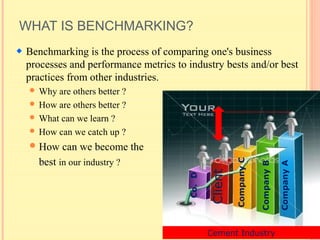
Benchmarking is the process of comparing one's business
processes and performance metrics to industry bests and/or best
practices from other industries.
 Why are others better ?
 How are others better ?
 What can we learn ?
 How can we catch up ?
How can we become the
best in our industry ?
Client
CompanyA
CompanyB
CompanyC
Co.D
Cement Industry
OUTLINE
Benchmarking Meaning
Benchmarking Definition
Benchmarking features & concept.
Why Benchmarking?
Benchmarking advantages & Disadvantages
Benchmarking Process
Benchmarking Types
American Productivity and Quality Center-1988
OUTLINE
Benchmarking Meaning
Benchmarking Definition
Benchmarking features & concept.
Why Benchmarking?
Benchmarking advantages & Disadvantages
Benchmarking Process
Benchmarking Types
BENCHMARKING FEATURES
Benchmarking has three main features:
BENCHMARK
 A benchmark is an organization recognized for its
exemplary operational performance.
 There are many benchmarks in the world including:
Processes
Design
Training
Service
Rapid product development
COMMONLY BENCHMARKED
PERFORMANCE MEASURES
CONTINUOUS AND BREAKTHROUGH
IMPROVEMENT
Time
Improvement
Continuous
Improvement
Breakthrough
Improvement
Continuous
Improvement
Highly
Competitive
Situation
Benchmarking
Accelerates
Innovation
and Change
OUTLINE
Benchmarking Meaning
Benchmarking Definition
Benchmarking features & concept.
Why Benchmarking?
Benchmarking advantages & Disadvantages
Benchmarking Process
Benchmarking Types
WHY BENCHMARKING?
Traditional performance improvement trends seem not to
be sufficient for the highly competitive markets. In other
words external environment and market conditions
change rapidly
Customers’ expectations are highly liquid and are driven
by standards set by best performer. Any product or
service just below these standards may not catch the eyes
of customer.
Prevents the “Re-inventing the wheel”.
WHY BENCHMARKING?
 Benchmarking gives us the chance of gaining:
 Better Awareness of Ourselves (Us)
What we are doing
How we are doing it
How well we are doing it
 Better Awareness of the Best (Them)
What they are doing
How they are doing it
How well they are doing it
WHY BENCHMARK
• Benchmarking is a more efficient way to make
improvements. Managers can eliminate trials and errors.
• Benchmarking speeds up organization’s ability to make
improvements. Today, time is of the essence.
• Benchmarking has the ability to bring your performance up
as a whole significantly.
• Learn from others’ experiences
• Set realistic but ambitious targets
OUTLINE
Benchmarking Meaning
Benchmarking Definition
Benchmarking features & concept.
Why Benchmarking?
Benchmarking advantages & Disadvantages
Benchmarking Process
Benchmarking Types
THREE MAJOR ADVANTAGES OF
BENCHMARKING
Product and Process Improvement:
By implementing benchmarking activity, organizations can
improve their operation process
Time & Cost Reduction:
Bench marking is time and cost efficient because it involves
imitation and adaptation rather than pure invention.
Competitive Strategy
By implementing benchmarking activity, organizations can
improve their operation process.
DISADVANTAGES
 What is best for someone else may not suit you
 Poorly defined benchmarks may lead to wasted effort
and meaningless results.
 Incorrect comparisons
 Reluctance to share information
19
OUTLINE
Benchmarking Meaning
Benchmarking Definition
Benchmarking features & concept.
Why Benchmarking?
Benchmarking advantages & Disadvantages
Benchmarking Process
Benchmarking Types
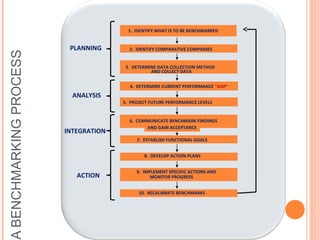
ABENCHMARKINGPROCESS
5. PROJECT FUTURE PERFORMANCE LEVELS
10. RECALIBRATE BENCHMARKS
9. IMPLEMENT SPECIFIC ACTIONS AND
MONITOR PROGRESS
8. DEVELOP ACTION PLANS
7. ESTABLISH FUNCTIONAL GOALS
6. COMMUNICATE BENCHMARK FINDINGS
AND GAIN ACCEPTANCE
4. DETERMINE CURRENT PERFORMANCE "GAP"
3. DETERMINE DATA COLLECTION METHOD
AND COLLECT DATA
2. IDENTIFY COMPARATIVE COMPANIES
1. IDENTIFY WHAT IS TO BE BENCHMARKED
PLANNING
ANALYSIS
INTEGRATION
ACTION
OUTLINE
Benchmarking Meaning
Benchmarking Definition
Benchmarking features & concept.
Why Benchmarking?
Benchmarking advantages & Disadvantages
Benchmarking Process
Benchmarking Types
TYPES OF BENCHMARKING
 On the basis of “What” is being compared with other
organizations and “Who” is being compared with our
organization, we can classify benchmarking.
“What” is being
compared with
other
organizations
vs.
Who” is being
compared with
our organization
TYPES OF BENCHMARKING
 On the basis of “What” is being compared with other
organizations we have four main types. These four major
types of benchmarking are evolutionary beginning with
product, performance, process and strategic
benchmarking.
Product
Performance
Process
Strategic
TYPES OF BENCHMARKING
 On the basis of “Who” is being compared with our
organization, we have these categories:
Internal vs. External
Generic
International
Best in Class
Best of the Best
Thank You

Bench marking