Organic Chemistry : National Examination Board, Nepal
Alkane
Alkene
Alkyne
Dr. Damodar Koirala
Amarsingh Model Secondary
School
Pokhara, Nepal
Dr. Damodar Koirala koirala2059@gmail.com
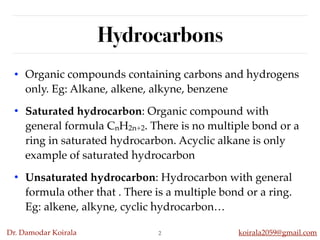
Hydrocarbons
• Organic compounds containing carbons and hydrogens
only. Eg: Alkane, alkene, alkyne, benzene
• Saturated hydrocarbon: Organic compound with
general formula CnH2n+2. There is no multiple bond or a
ring in saturated hydrocarbon. Acyclic alkane is only
example of saturated hydrocarbon
• Unsaturated hydrocarbon: Hydrocarbon with general
formula other that . There is a multiple bond or a ring.
Eg: alkene, alkyne, cyclic hydrocarbon…
2
Dr. Damodar Koirala koirala2059@gmail.com
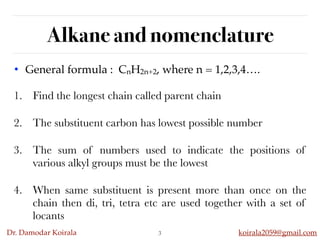
Alkane and nomenclature
• General formula : CnH2n+2, where n = 1,2,3,4….
3
1. Find the longest chain called parent chain
2. The substituent carbon has lowest possible number
3. The sum of numbers used to indicate the positions of
various alkyl groups must be the lowest
4. When same substituent is present more than once on the
chain then di, tri, tetra etc are used together with a set of
locants
Dr. Damodar Koirala koirala2059@gmail.com
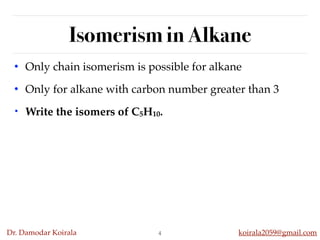
Isomerism in Alkane
• Only chain isomerism is possible for alkane
• Only for alkane with carbon number greater than 3
• Write the isomers of C5H10.
4
Dr. Damodar Koirala koirala2059@gmail.com
Structure of Alkane
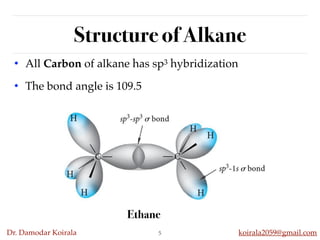
• All Carbon of alkane has sp3 hybridization
• The bond angle is 109.5
5
Ethane
Dr. Damodar Koirala koirala2059@gmail.com
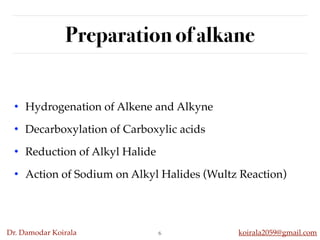
Preparation of alkane
• Hydrogenation of Alkene and Alkyne
• Decarboxylation of Carboxylic acids
• Reduction of Alkyl Halide
• Action of Sodium on Alkyl Halides (Wultz Reaction)
6
Dr. Damodar Koirala koirala2059@gmail.com
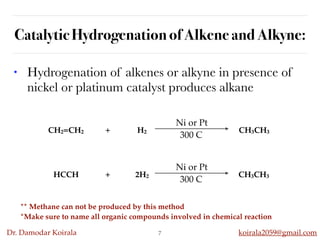
Catalytic Hydrogenation of Alkene and Alkyne:
• Hydrogenation of alkenes or alkyne in presence of
nickel or platinum catalyst produces alkane
7
** Methane can not be produced by this method
*Make sure to name all organic compounds involved in chemical reaction
CH2=CH2 + H2 CH3CH3
Ni or Pt
300 C
HCCH + 2H2 CH3CH3
Ni or Pt
300 C
Dr. Damodar Koirala koirala2059@gmail.com
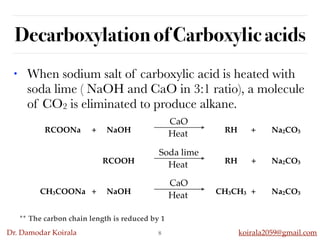
Decarboxylation of Carboxylic acids
• When sodium salt of carboxylic acid is heated with
soda lime ( NaOH and CaO in 3:1 ratio), a molecule
of CO2 is eliminated to produce alkane.
8
** The carbon chain length is reduced by 1
RCOONa + NaOH RH + Na2CO3
CaO
Heat
RCOOH RH + Na2CO3
Soda lime
Heat
CH3COONa + NaOH CH3CH3 + Na2CO3
CaO
Heat
Dr. Damodar Koirala koirala2059@gmail.com
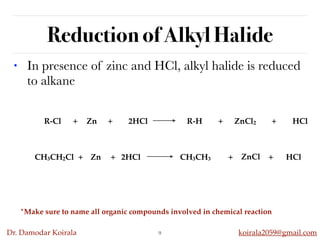
Reduction of Alkyl Halide
• In presence of zinc and HCl, alkyl halide is reduced
to alkane
9
R-Cl + Zn + 2HCl R-H + ZnCl2 + HCl
CH3CH2Cl + Zn + 2HCl CH3CH3 + ZnCl
2
+ HCl
*Make sure to name all organic compounds involved in chemical reaction
Dr. Damodar Koirala koirala2059@gmail.com
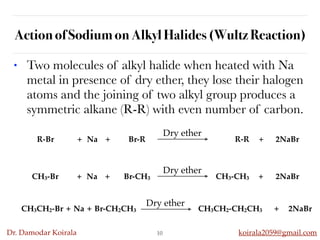
Action of Sodium on Alkyl Halides (Wultz Reaction)
• Two molecules of alkyl halide when heated with Na
metal in presence of dry ether, they lose their halogen
atoms and the joining of two alkyl group produces a
symmetric alkane (R-R) with even number of carbon.
10
CH3-Br + Na + Br-CH3 CH3-CH3 + 2NaBr
Dry ether
R-Br + Na + Br-R R-R + 2NaBr
Dry ether
CH3CH2-Br + Na + Br-CH2CH3 CH3CH2-CH2CH3 + 2NaBr
Dry ether
Dr. Damodar Koirala koirala2059@gmail.com
Alkane: Chemical reaction
• The alkanes the least chemically reactive class of
organic compounds because alkanes do not contain
any function group and  contain strong carbon-
carbon single bonds and strong carbon-hydrogen
bonds.
11
Dr. Damodar Koirala koirala2059@gmail.com
Alkane: Chemical reaction
• Substitution reaction
• Halogenation
• Nitration: Substitution of -NO2 group for H)
• Sulphonation (Substitution of -SO3H for H)
• Oxidation of ethane
12
Dr. Damodar Koirala koirala2059@gmail.com
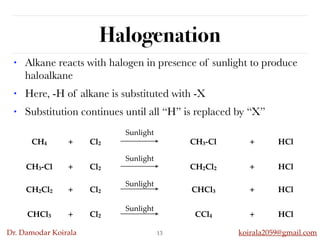
Halogenation
13
• Alkane reacts with halogen in presence of sunlight to produce
haloalkane
• Here, -H of alkane is substituted with -X
• Substitution continues until all “H” is replaced by “X”
CH4 + Cl2 CH3-Cl + HCl
CH3-Cl + Cl2 CH2Cl2 + HCl
CH2Cl2 + Cl2 CHCl3 + HCl
CHCl3 + Cl2 CCl4 + HCl
Sunlight
Sunlight
Sunlight
Sunlight
Dr. Damodar Koirala koirala2059@gmail.com
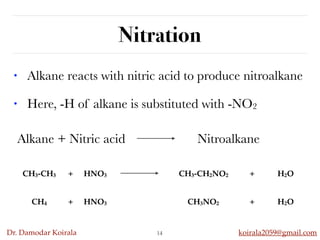
Nitration
14
• Alkane reacts with nitric acid to produce nitroalkane
• Here, -H of alkane is substituted with -NO2
Alkane + Nitric acid Nitroalkane
CH3-CH3 + HNO3 CH3-CH2NO2 + H2O
CH4 + HNO3 CH3NO2 + H2O
Dr. Damodar Koirala koirala2059@gmail.com
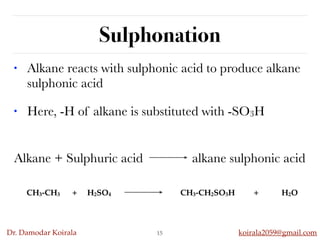
Alkane + Sulphuric acid alkane sulphonic acid
Sulphonation
15
• Alkane reacts with sulphonic acid to produce alkane
sulphonic acid
• Here, -H of alkane is substituted with -SO3H
CH3-CH3 + H2SO4 CH3-CH2SO3H + H2O
Dr. Damodar Koirala koirala2059@gmail.com
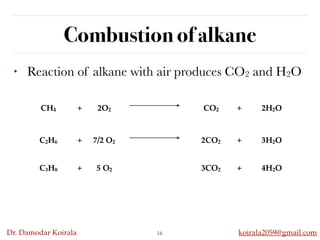
Combustion of alkane
• Reaction of alkane with air produces CO2 and H2O
16
CH4 + 2O2 CO2 + 2H2O
C2H6 + 7/2 O2 2CO2 + 3H2O
C3H8 + 5 O2 3CO2 + 4H2O
Dr. Damodar Koirala koirala2059@gmail.com
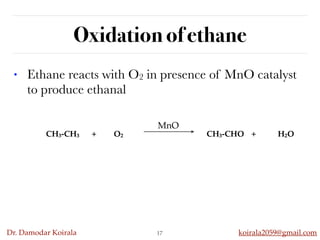
Oxidation of ethane
• Ethane reacts with O2 in presence of MnO catalyst
to produce ethanal
17
CH3-CH3 + O2 CH3-CHO + H2O
MnO
Dr. Damodar Koirala koirala2059@gmail.com
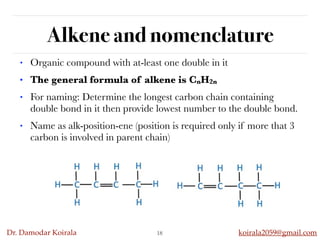
Alkene and nomenclature
18
• Organic compound with at-least one double in it
• The general formula of alkene is CnH2n
• For naming: Determine the longest carbon chain containing
double bond in it then provide lowest number to the double bond.
• Name as alk-position-ene (position is required only if more that 3
carbon is involved in parent chain)
Dr. Damodar Koirala koirala2059@gmail.com
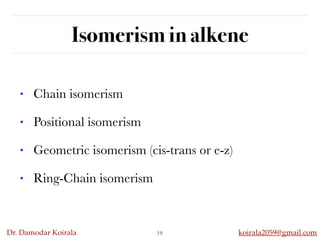
Isomerism in alkene
19
• Chain isomerism
• Positional isomerism
• Geometric isomerism (cis-trans or e-z)
• Ring-Chain isomerism
Dr. Damodar Koirala koirala2059@gmail.com
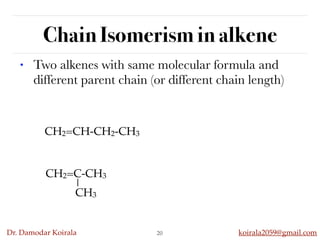
Chain Isomerism in alkene
20
• Two alkenes with same molecular formula and
different parent chain (or different chain length)
CH2=CH-CH2-CH3
CH2=C-CH3
CH3
Dr. Damodar Koirala koirala2059@gmail.com
Positional Isomerism in alkene
21
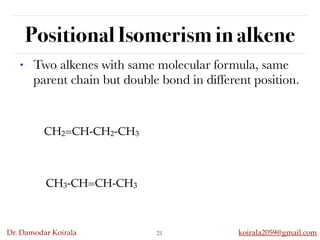
• Two alkenes with same molecular formula, same
parent chain but double bond in different position.
CH2=CH-CH2-CH3
CH3-CH=CH-CH3
Dr. Damodar Koirala koirala2059@gmail.com
Cis-trans Isomerism in alkene
22
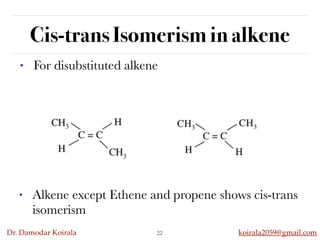
• For disubstituted alkene
• Alkene except Ethene and propene shows cis-trans
isomerism
Dr. Damodar Koirala koirala2059@gmail.com
Symmetric and asymmetric alkene
23
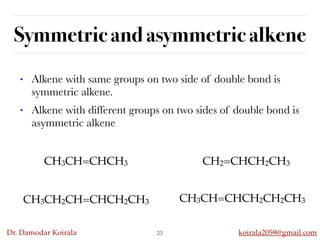
• Alkene with same groups on two side of double bond is
symmetric alkene.
• Alkene with different groups on two sides of double bond is
asymmetric alkene
CH3CH=CHCH3 CH2=CHCH2CH3
CH3CH2CH=CHCH2CH3 CH3CH=CHCH2CH2CH3
Dr. Damodar Koirala koirala2059@gmail.com
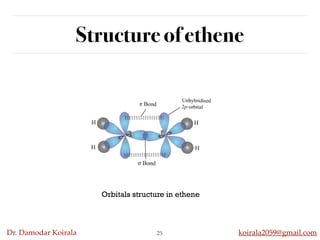
Structure of alkene
24
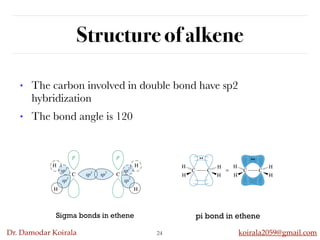
• The carbon involved in double bond have sp2
hybridization
• The bond angle is 120
pi bond in ethene
Sigma bonds in ethene
Dr. Damodar Koirala koirala2059@gmail.com
Structure of ethene
25
Orbitals structure in ethene
Dr. Damodar Koirala koirala2059@gmail.com
Preparation of alkene
26
• Dehydrohalogenation of haloalkane
• Dehydration of alcohol
• Catalytic hydrogenation of alkyne
Dr. Damodar Koirala koirala2059@gmail.com
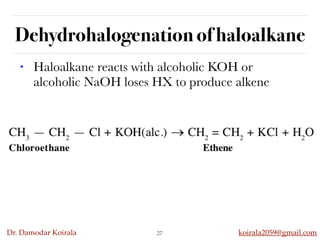
Dehydrohalogenation of haloalkane
27
• Haloalkane reacts with alcoholic KOH or
alcoholic NaOH loses HX to produce alkene
Dr. Damodar Koirala koirala2059@gmail.com
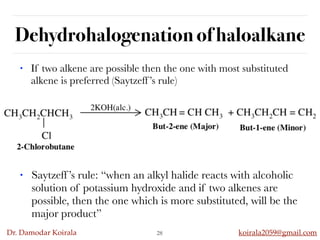
Dehydrohalogenation of haloalkane
28
• If two alkene are possible then the one with most substituted
alkene is preferred (Saytzeff’s rule)
• Saytzeff’s rule: “when an alkyl halide reacts with alcoholic
solution of potassium hydroxide and if two alkenes are
possible, then the one which is more substituted, will be the
major product”
Dr. Damodar Koirala koirala2059@gmail.com
Dehydration of alcohol
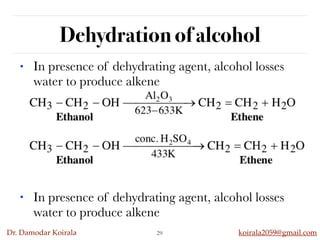
29
• In presence of dehydrating agent, alcohol losses
water to produce alkene
• In presence of dehydrating agent, alcohol losses
water to produce alkene
Dr. Damodar Koirala koirala2059@gmail.com
Catalytic hydrogenation of alkyne
30
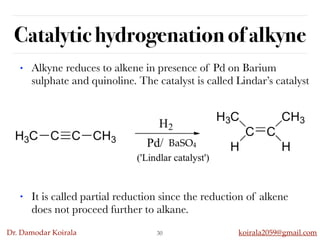
• Alkyne reduces to alkene in presence of Pd on Barium
sulphate and quinoline. The catalyst is called Lindar’s catalyst
BaSO4
• It is called partial reduction since the reduction of alkene
does not proceed further to alkane.
Dr. Damodar Koirala koirala2059@gmail.com
Alkene: Chemical reaction
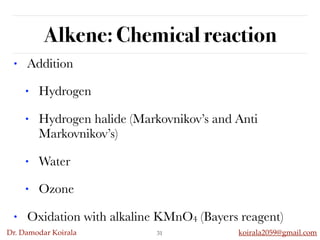
• Addition
• Hydrogen
• Hydrogen halide (Markovnikov’s and Anti
Markovnikov’s)
• Water
• Ozone
• Oxidation with alkaline KMnO4 (Bayers reagent)
31
Dr. Damodar Koirala koirala2059@gmail.com
Hydrogenation
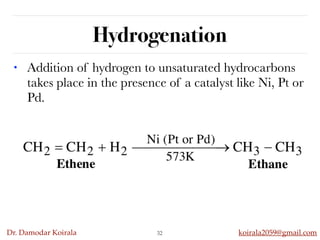
• Addition of hydrogen to unsaturated hydrocarbons
takes place in the presence of a catalyst like Ni, Pt or
Pd.
32
Dr. Damodar Koirala koirala2059@gmail.com
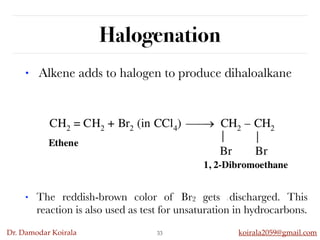
Halogenation
• The reddish-brown color of Br2 gets 2 discharged. This
reaction is also used as test for unsaturation in hydrocarbons.
33
• Alkene adds to halogen to produce dihaloalkane
Dr. Damodar Koirala koirala2059@gmail.com
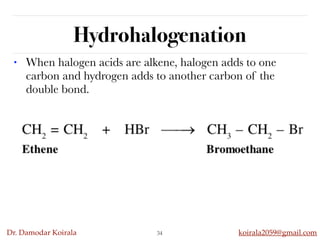
Hydrohalogenation
• When halogen acids are alkene, halogen adds to one
carbon and hydrogen adds to another carbon of the
double bond.
34
Dr. Damodar Koirala koirala2059@gmail.com
Hydrohalogenation
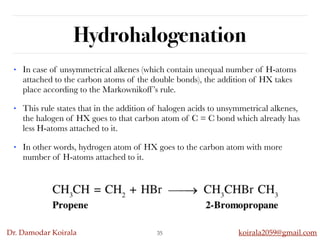
• In case of unsymmetrical alkenes (which contain unequal number of H-atoms
attached to the carbon atoms of the double bonds), the addition of HX takes
place according to the Markownikoff’s rule.
• This rule states that in the addition of halogen acids to unsymmetrical alkenes,
the halogen of HX goes to that carbon atom of C = C bond which already has
less H-atoms attached to it.
• In other words, hydrogen atom of HX goes to the carbon atom with more
number of H-atoms attached to it.
35
Dr. Damodar Koirala koirala2059@gmail.com
Hydrohalogenation
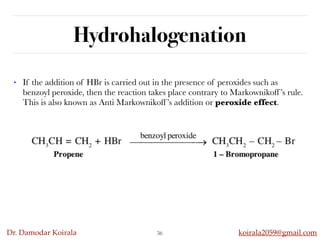
• If the addition of HBr is carried out in the presence of peroxides such as
benzoyl peroxide, then the reaction takes place contrary to Markownikoff’s rule.
This is also known as Anti Markownikoff’s addition or peroxide effect.
36
Dr. Damodar Koirala koirala2059@gmail.com
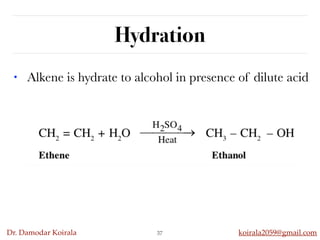
Hydration
• Alkene is hydrate to alcohol in presence of dilute acid
37
Dr. Damodar Koirala koirala2059@gmail.com
Ozonolysis
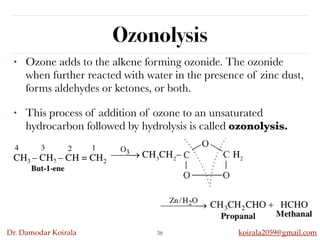
• Ozone adds to the alkene forming ozonide. The ozonide
when further reacted with water in the presence of zinc dust,
forms aldehydes or ketones, or both.
• This process of addition of ozone to an unsaturated
hydrocarbon followed by hydrolysis is called ozonolysis.
38
Dr. Damodar Koirala koirala2059@gmail.com
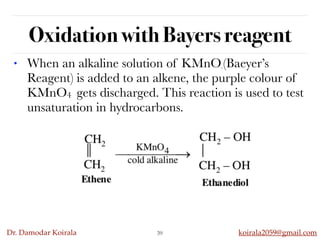
Oxidation with Bayers reagent
• When an alkaline solution of KMnO4
(Baeyer’s
Reagent) is added to an alkene, the purple colour of
KMnO4 gets discharged. This reaction is used to test
unsaturation in hydrocarbons.
39
Dr. Damodar Koirala koirala2059@gmail.com
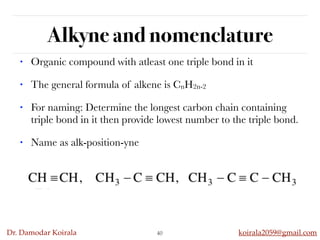
Alkyne and nomenclature
40
• Organic compound with atleast one triple bond in it
• The general formula of alkene is CnH2n-2
• For naming: Determine the longest carbon chain containing
triple bond in it then provide lowest number to the triple bond.
• Name as alk-position-yne
Dr. Damodar Koirala koirala2059@gmail.com
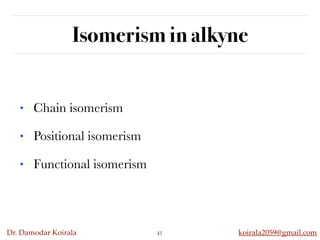
Isomerism in alkyne
41
• Chain isomerism
• Positional isomerism
• Functional isomerism
Dr. Damodar Koirala koirala2059@gmail.com
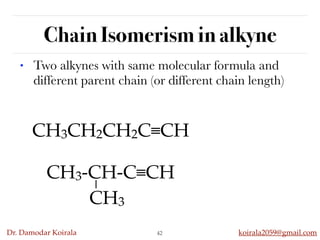
Chain Isomerism in alkyne
42
• Two alkynes with same molecular formula and
different parent chain (or different chain length)
CH3CH2CH2C≡CH
CH3-CH-C≡CH
CH3
Dr. Damodar Koirala koirala2059@gmail.com
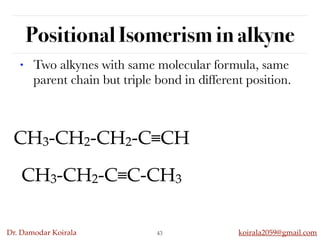
Positional Isomerism in alkyne
43
• Two alkynes with same molecular formula, same
parent chain but triple bond in different position.
CH3-CH2-CH2-C≡CH
CH3-CH2-C≡C-CH3
Dr. Damodar Koirala koirala2059@gmail.com
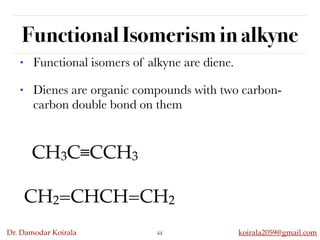
Functional Isomerism in alkyne
44
• Functional isomers of alkyne are diene.
• Dienes are organic compounds with two carbon-
carbon double bond on them
CH3C≡CCH3
CH2=CHCH=CH2
Dr. Damodar Koirala koirala2059@gmail.com
Structure of alkyne
45
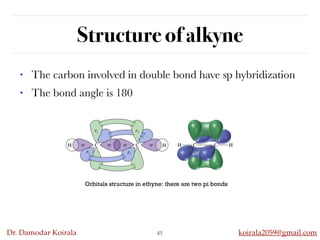
• The carbon involved in double bond have sp hybridization
• The bond angle is 180
Orbitals structure in ethyne: there are two pi bonds
Dr. Damodar Koirala koirala2059@gmail.com
Preparation of alkyne
46
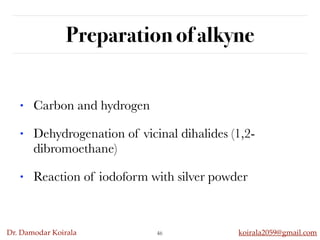
• Carbon and hydrogen
• Dehydrogenation of vicinal dihalides (1,2-
dibromoethane)
• Reaction of iodoform with silver powder
Dr. Damodar Koirala koirala2059@gmail.com
Dehydrogenation of vicinal dihalides
47
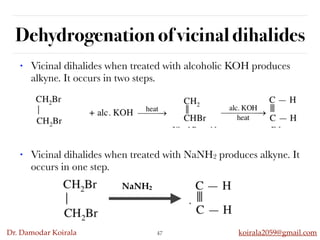
• Vicinal dihalides when treated with alcoholic KOH produces
alkyne. It occurs in two steps.
• Vicinal dihalides when treated with NaNH2 produces alkyne. It
occurs in one step.
NaNH2
Dr. Damodar Koirala koirala2059@gmail.com
Reaction of iodoform with silver powder
48
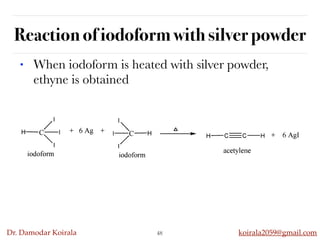
• When iodoform is heated with silver powder,
ethyne is obtained
Dr. Damodar Koirala koirala2059@gmail.com
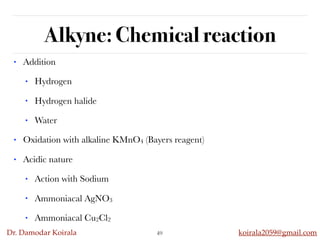
Alkyne: Chemical reaction
• Addition
• Hydrogen
• Hydrogen halide
• Water
• Oxidation with alkaline KMnO4 (Bayers reagent)
• Acidic nature
• Action with Sodium
• Ammoniacal AgNO3
• Ammoniacal Cu2Cl2
49
Dr. Damodar Koirala koirala2059@gmail.com
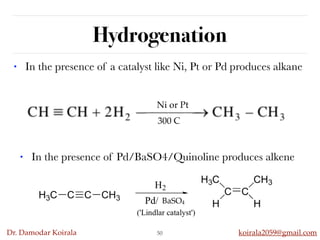
Hydrogenation
• In the presence of a catalyst like Ni, Pt or Pd produces alkane
50
• In the presence of Pd/BaSO4/Quinoline produces alkene
Ni or Pt
300 C
BaSO4
Dr. Damodar Koirala koirala2059@gmail.com
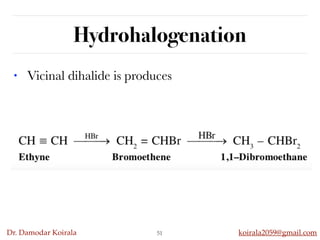
Hydrohalogenation
• Vicinal dihalide is produces
51
Dr. Damodar Koirala koirala2059@gmail.com
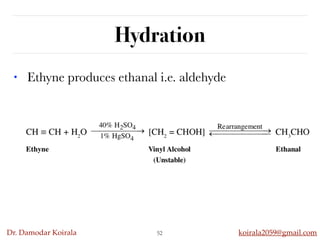
Hydration
• Ethyne produces ethanal i.e. aldehyde
52
Dr. Damodar Koirala koirala2059@gmail.com
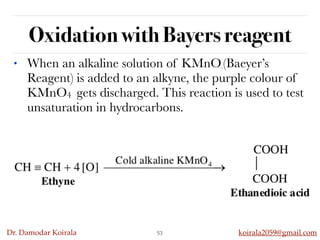
Oxidation with Bayers reagent
• When an alkaline solution of KMnO4
(Baeyer’s
Reagent) is added to an alkyne, the purple colour of
KMnO4 gets discharged. This reaction is used to test
unsaturation in hydrocarbons.
53
Dr. Damodar Koirala koirala2059@gmail.com
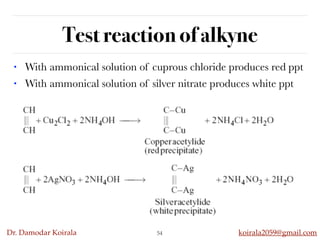
Test reaction of alkyne
• With ammonical solution of cuprous chloride produces red ppt
• With ammonical solution of silver nitrate produces white ppt
54
Dr. Damodar Koirala koirala2059@gmail.com
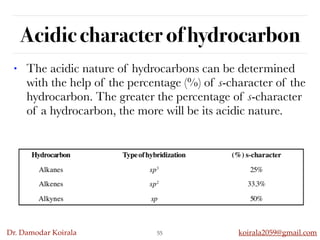
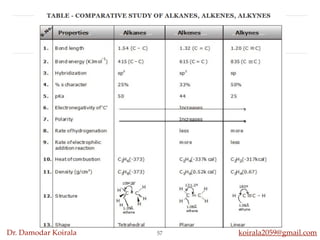
Acidic character of hydrocarbon
• The acidic nature of hydrocarbons can be determined
with the help of the percentage (%) of s-character of the
hydrocarbon. The greater the percentage of s-character
of a hydrocarbon, the more will be its acidic nature.
55
Dr. Damodar Koirala koirala2059@gmail.com
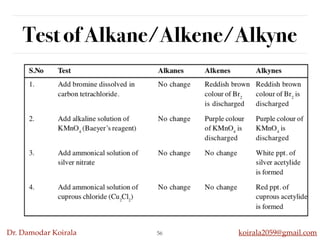
Test of Alkane/Alkene/Alkyne
56
Dr. Damodar Koirala koirala2059@gmail.com
57
Dr. Damodar Koirala koirala2059@gmail.com
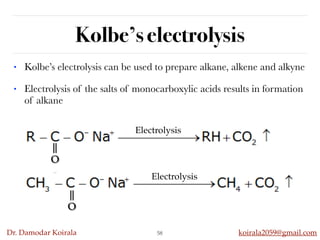
Kolbe’s electrolysis
• Kolbe’s electrolysis can be used to prepare alkane, alkene and alkyne
• Electrolysis of the salts of monocarboxylic acids results in formation
of alkane
58
O
O
Electrolysis
Electrolysis
Dr. Damodar Koirala koirala2059@gmail.com
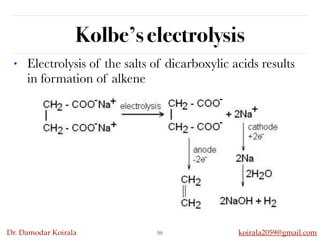
Kolbe’s electrolysis
• Electrolysis of the salts of dicarboxylic acids results
in formation of alkene
59
Dr. Damodar Koirala koirala2059@gmail.com
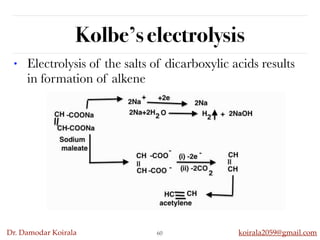
Kolbe’s electrolysis
• Electrolysis of the salts of dicarboxylic acids results
in formation of alkene
60

Hydrocarbon

  • 1.
    Organic Chemistry :National Examination Board, Nepal Alkane Alkene Alkyne Dr. Damodar Koirala Amarsingh Model Secondary School Pokhara, Nepal
  • 2.
    Dr. Damodar Koiralakoirala2059@gmail.com Hydrocarbons • Organic compounds containing carbons and hydrogens only. Eg: Alkane, alkene, alkyne, benzene • Saturated hydrocarbon: Organic compound with general formula CnH2n+2. There is no multiple bond or a ring in saturated hydrocarbon. Acyclic alkane is only example of saturated hydrocarbon • Unsaturated hydrocarbon: Hydrocarbon with general formula other that . There is a multiple bond or a ring. Eg: alkene, alkyne, cyclic hydrocarbon… 2
  • 3.
    Dr. Damodar Koiralakoirala2059@gmail.com Alkane and nomenclature • General formula : CnH2n+2, where n = 1,2,3,4…. 3 1. Find the longest chain called parent chain 2. The substituent carbon has lowest possible number 3. The sum of numbers used to indicate the positions of various alkyl groups must be the lowest 4. When same substituent is present more than once on the chain then di, tri, tetra etc are used together with a set of locants
  • 4.
    Dr. Damodar Koiralakoirala2059@gmail.com Isomerism in Alkane • Only chain isomerism is possible for alkane • Only for alkane with carbon number greater than 3 • Write the isomers of C5H10. 4
  • 5.
    Dr. Damodar Koiralakoirala2059@gmail.com Structure of Alkane • All Carbon of alkane has sp3 hybridization • The bond angle is 109.5 5 Ethane
  • 6.
    Dr. Damodar Koiralakoirala2059@gmail.com Preparation of alkane • Hydrogenation of Alkene and Alkyne • Decarboxylation of Carboxylic acids • Reduction of Alkyl Halide • Action of Sodium on Alkyl Halides (Wultz Reaction) 6
  • 7.
    Dr. Damodar Koiralakoirala2059@gmail.com Catalytic Hydrogenation of Alkene and Alkyne: • Hydrogenation of alkenes or alkyne in presence of nickel or platinum catalyst produces alkane 7 ** Methane can not be produced by this method *Make sure to name all organic compounds involved in chemical reaction CH2=CH2 + H2 CH3CH3 Ni or Pt 300 C HCCH + 2H2 CH3CH3 Ni or Pt 300 C
  • 8.
    Dr. Damodar Koiralakoirala2059@gmail.com Decarboxylation of Carboxylic acids • When sodium salt of carboxylic acid is heated with soda lime ( NaOH and CaO in 3:1 ratio), a molecule of CO2 is eliminated to produce alkane. 8 ** The carbon chain length is reduced by 1 RCOONa + NaOH RH + Na2CO3 CaO Heat RCOOH RH + Na2CO3 Soda lime Heat CH3COONa + NaOH CH3CH3 + Na2CO3 CaO Heat
  • 9.
    Dr. Damodar Koiralakoirala2059@gmail.com Reduction of Alkyl Halide • In presence of zinc and HCl, alkyl halide is reduced to alkane 9 R-Cl + Zn + 2HCl R-H + ZnCl2 + HCl CH3CH2Cl + Zn + 2HCl CH3CH3 + ZnCl 2 + HCl *Make sure to name all organic compounds involved in chemical reaction
  • 10.
    Dr. Damodar Koiralakoirala2059@gmail.com Action of Sodium on Alkyl Halides (Wultz Reaction) • Two molecules of alkyl halide when heated with Na metal in presence of dry ether, they lose their halogen atoms and the joining of two alkyl group produces a symmetric alkane (R-R) with even number of carbon. 10 CH3-Br + Na + Br-CH3 CH3-CH3 + 2NaBr Dry ether R-Br + Na + Br-R R-R + 2NaBr Dry ether CH3CH2-Br + Na + Br-CH2CH3 CH3CH2-CH2CH3 + 2NaBr Dry ether
  • 11.
    Dr. Damodar Koiralakoirala2059@gmail.com Alkane: Chemical reaction • The alkanes the least chemically reactive class of organic compounds because alkanes do not contain any function group and  contain strong carbon- carbon single bonds and strong carbon-hydrogen bonds. 11
  • 12.
    Dr. Damodar Koiralakoirala2059@gmail.com Alkane: Chemical reaction • Substitution reaction • Halogenation • Nitration: Substitution of -NO2 group for H) • Sulphonation (Substitution of -SO3H for H) • Oxidation of ethane 12
  • 13.
    Dr. Damodar Koiralakoirala2059@gmail.com Halogenation 13 • Alkane reacts with halogen in presence of sunlight to produce haloalkane • Here, -H of alkane is substituted with -X • Substitution continues until all “H” is replaced by “X” CH4 + Cl2 CH3-Cl + HCl CH3-Cl + Cl2 CH2Cl2 + HCl CH2Cl2 + Cl2 CHCl3 + HCl CHCl3 + Cl2 CCl4 + HCl Sunlight Sunlight Sunlight Sunlight
  • 14.
    Dr. Damodar Koiralakoirala2059@gmail.com Nitration 14 • Alkane reacts with nitric acid to produce nitroalkane • Here, -H of alkane is substituted with -NO2 Alkane + Nitric acid Nitroalkane CH3-CH3 + HNO3 CH3-CH2NO2 + H2O CH4 + HNO3 CH3NO2 + H2O
  • 15.
    Dr. Damodar Koiralakoirala2059@gmail.com Alkane + Sulphuric acid alkane sulphonic acid Sulphonation 15 • Alkane reacts with sulphonic acid to produce alkane sulphonic acid • Here, -H of alkane is substituted with -SO3H CH3-CH3 + H2SO4 CH3-CH2SO3H + H2O
  • 16.
    Dr. Damodar Koiralakoirala2059@gmail.com Combustion of alkane • Reaction of alkane with air produces CO2 and H2O 16 CH4 + 2O2 CO2 + 2H2O C2H6 + 7/2 O2 2CO2 + 3H2O C3H8 + 5 O2 3CO2 + 4H2O
  • 17.
    Dr. Damodar Koiralakoirala2059@gmail.com Oxidation of ethane • Ethane reacts with O2 in presence of MnO catalyst to produce ethanal 17 CH3-CH3 + O2 CH3-CHO + H2O MnO
  • 18.
    Dr. Damodar Koiralakoirala2059@gmail.com Alkene and nomenclature 18 • Organic compound with at-least one double in it • The general formula of alkene is CnH2n • For naming: Determine the longest carbon chain containing double bond in it then provide lowest number to the double bond. • Name as alk-position-ene (position is required only if more that 3 carbon is involved in parent chain)
  • 19.
    Dr. Damodar Koiralakoirala2059@gmail.com Isomerism in alkene 19 • Chain isomerism • Positional isomerism • Geometric isomerism (cis-trans or e-z) • Ring-Chain isomerism
  • 20.
    Dr. Damodar Koiralakoirala2059@gmail.com Chain Isomerism in alkene 20 • Two alkenes with same molecular formula and different parent chain (or different chain length) CH2=CH-CH2-CH3 CH2=C-CH3 CH3
  • 21.
    Dr. Damodar Koiralakoirala2059@gmail.com Positional Isomerism in alkene 21 • Two alkenes with same molecular formula, same parent chain but double bond in different position. CH2=CH-CH2-CH3 CH3-CH=CH-CH3
  • 22.
    Dr. Damodar Koiralakoirala2059@gmail.com Cis-trans Isomerism in alkene 22 • For disubstituted alkene • Alkene except Ethene and propene shows cis-trans isomerism
  • 23.
    Dr. Damodar Koiralakoirala2059@gmail.com Symmetric and asymmetric alkene 23 • Alkene with same groups on two side of double bond is symmetric alkene. • Alkene with different groups on two sides of double bond is asymmetric alkene CH3CH=CHCH3 CH2=CHCH2CH3 CH3CH2CH=CHCH2CH3 CH3CH=CHCH2CH2CH3
  • 24.
    Dr. Damodar Koiralakoirala2059@gmail.com Structure of alkene 24 • The carbon involved in double bond have sp2 hybridization • The bond angle is 120 pi bond in ethene Sigma bonds in ethene
  • 25.
    Dr. Damodar Koiralakoirala2059@gmail.com Structure of ethene 25 Orbitals structure in ethene
  • 26.
    Dr. Damodar Koiralakoirala2059@gmail.com Preparation of alkene 26 • Dehydrohalogenation of haloalkane • Dehydration of alcohol • Catalytic hydrogenation of alkyne
  • 27.
    Dr. Damodar Koiralakoirala2059@gmail.com Dehydrohalogenation of haloalkane 27 • Haloalkane reacts with alcoholic KOH or alcoholic NaOH loses HX to produce alkene
  • 28.
    Dr. Damodar Koiralakoirala2059@gmail.com Dehydrohalogenation of haloalkane 28 • If two alkene are possible then the one with most substituted alkene is preferred (Saytzeff’s rule) • Saytzeff’s rule: “when an alkyl halide reacts with alcoholic solution of potassium hydroxide and if two alkenes are possible, then the one which is more substituted, will be the major product”
  • 29.
    Dr. Damodar Koiralakoirala2059@gmail.com Dehydration of alcohol 29 • In presence of dehydrating agent, alcohol losses water to produce alkene • In presence of dehydrating agent, alcohol losses water to produce alkene
  • 30.
    Dr. Damodar Koiralakoirala2059@gmail.com Catalytic hydrogenation of alkyne 30 • Alkyne reduces to alkene in presence of Pd on Barium sulphate and quinoline. The catalyst is called Lindar’s catalyst BaSO4 • It is called partial reduction since the reduction of alkene does not proceed further to alkane.
  • 31.
    Dr. Damodar Koiralakoirala2059@gmail.com Alkene: Chemical reaction • Addition • Hydrogen • Hydrogen halide (Markovnikov’s and Anti Markovnikov’s) • Water • Ozone • Oxidation with alkaline KMnO4 (Bayers reagent) 31
  • 32.
    Dr. Damodar Koiralakoirala2059@gmail.com Hydrogenation • Addition of hydrogen to unsaturated hydrocarbons takes place in the presence of a catalyst like Ni, Pt or Pd. 32
  • 33.
    Dr. Damodar Koiralakoirala2059@gmail.com Halogenation • The reddish-brown color of Br2 gets 2 discharged. This reaction is also used as test for unsaturation in hydrocarbons. 33 • Alkene adds to halogen to produce dihaloalkane
  • 34.
    Dr. Damodar Koiralakoirala2059@gmail.com Hydrohalogenation • When halogen acids are alkene, halogen adds to one carbon and hydrogen adds to another carbon of the double bond. 34
  • 35.
    Dr. Damodar Koiralakoirala2059@gmail.com Hydrohalogenation • In case of unsymmetrical alkenes (which contain unequal number of H-atoms attached to the carbon atoms of the double bonds), the addition of HX takes place according to the Markownikoff’s rule. • This rule states that in the addition of halogen acids to unsymmetrical alkenes, the halogen of HX goes to that carbon atom of C = C bond which already has less H-atoms attached to it. • In other words, hydrogen atom of HX goes to the carbon atom with more number of H-atoms attached to it. 35
  • 36.
    Dr. Damodar Koiralakoirala2059@gmail.com Hydrohalogenation • If the addition of HBr is carried out in the presence of peroxides such as benzoyl peroxide, then the reaction takes place contrary to Markownikoff’s rule. This is also known as Anti Markownikoff’s addition or peroxide effect. 36
  • 37.
    Dr. Damodar Koiralakoirala2059@gmail.com Hydration • Alkene is hydrate to alcohol in presence of dilute acid 37
  • 38.
    Dr. Damodar Koiralakoirala2059@gmail.com Ozonolysis • Ozone adds to the alkene forming ozonide. The ozonide when further reacted with water in the presence of zinc dust, forms aldehydes or ketones, or both. • This process of addition of ozone to an unsaturated hydrocarbon followed by hydrolysis is called ozonolysis. 38
  • 39.
    Dr. Damodar Koiralakoirala2059@gmail.com Oxidation with Bayers reagent • When an alkaline solution of KMnO4 (Baeyer’s Reagent) is added to an alkene, the purple colour of KMnO4 gets discharged. This reaction is used to test unsaturation in hydrocarbons. 39
  • 40.
    Dr. Damodar Koiralakoirala2059@gmail.com Alkyne and nomenclature 40 • Organic compound with atleast one triple bond in it • The general formula of alkene is CnH2n-2 • For naming: Determine the longest carbon chain containing triple bond in it then provide lowest number to the triple bond. • Name as alk-position-yne
  • 41.
    Dr. Damodar Koiralakoirala2059@gmail.com Isomerism in alkyne 41 • Chain isomerism • Positional isomerism • Functional isomerism
  • 42.
    Dr. Damodar Koiralakoirala2059@gmail.com Chain Isomerism in alkyne 42 • Two alkynes with same molecular formula and different parent chain (or different chain length) CH3CH2CH2C≡CH CH3-CH-C≡CH CH3
  • 43.
    Dr. Damodar Koiralakoirala2059@gmail.com Positional Isomerism in alkyne 43 • Two alkynes with same molecular formula, same parent chain but triple bond in different position. CH3-CH2-CH2-C≡CH CH3-CH2-C≡C-CH3
  • 44.
    Dr. Damodar Koiralakoirala2059@gmail.com Functional Isomerism in alkyne 44 • Functional isomers of alkyne are diene. • Dienes are organic compounds with two carbon- carbon double bond on them CH3C≡CCH3 CH2=CHCH=CH2
  • 45.
    Dr. Damodar Koiralakoirala2059@gmail.com Structure of alkyne 45 • The carbon involved in double bond have sp hybridization • The bond angle is 180 Orbitals structure in ethyne: there are two pi bonds
  • 46.
    Dr. Damodar Koiralakoirala2059@gmail.com Preparation of alkyne 46 • Carbon and hydrogen • Dehydrogenation of vicinal dihalides (1,2- dibromoethane) • Reaction of iodoform with silver powder
  • 47.
    Dr. Damodar Koiralakoirala2059@gmail.com Dehydrogenation of vicinal dihalides 47 • Vicinal dihalides when treated with alcoholic KOH produces alkyne. It occurs in two steps. • Vicinal dihalides when treated with NaNH2 produces alkyne. It occurs in one step. NaNH2
  • 48.
    Dr. Damodar Koiralakoirala2059@gmail.com Reaction of iodoform with silver powder 48 • When iodoform is heated with silver powder, ethyne is obtained
  • 49.
    Dr. Damodar Koiralakoirala2059@gmail.com Alkyne: Chemical reaction • Addition • Hydrogen • Hydrogen halide • Water • Oxidation with alkaline KMnO4 (Bayers reagent) • Acidic nature • Action with Sodium • Ammoniacal AgNO3 • Ammoniacal Cu2Cl2 49
  • 50.
    Dr. Damodar Koiralakoirala2059@gmail.com Hydrogenation • In the presence of a catalyst like Ni, Pt or Pd produces alkane 50 • In the presence of Pd/BaSO4/Quinoline produces alkene Ni or Pt 300 C BaSO4
  • 51.
    Dr. Damodar Koiralakoirala2059@gmail.com Hydrohalogenation • Vicinal dihalide is produces 51
  • 52.
    Dr. Damodar Koiralakoirala2059@gmail.com Hydration • Ethyne produces ethanal i.e. aldehyde 52
  • 53.
    Dr. Damodar Koiralakoirala2059@gmail.com Oxidation with Bayers reagent • When an alkaline solution of KMnO4 (Baeyer’s Reagent) is added to an alkyne, the purple colour of KMnO4 gets discharged. This reaction is used to test unsaturation in hydrocarbons. 53
  • 54.
    Dr. Damodar Koiralakoirala2059@gmail.com Test reaction of alkyne • With ammonical solution of cuprous chloride produces red ppt • With ammonical solution of silver nitrate produces white ppt 54
  • 55.
    Dr. Damodar Koiralakoirala2059@gmail.com Acidic character of hydrocarbon • The acidic nature of hydrocarbons can be determined with the help of the percentage (%) of s-character of the hydrocarbon. The greater the percentage of s-character of a hydrocarbon, the more will be its acidic nature. 55
  • 56.
    Dr. Damodar Koiralakoirala2059@gmail.com Test of Alkane/Alkene/Alkyne 56
  • 57.
    Dr. Damodar Koiralakoirala2059@gmail.com 57
  • 58.
    Dr. Damodar Koiralakoirala2059@gmail.com Kolbe’s electrolysis • Kolbe’s electrolysis can be used to prepare alkane, alkene and alkyne • Electrolysis of the salts of monocarboxylic acids results in formation of alkane 58 O O Electrolysis Electrolysis
  • 59.
    Dr. Damodar Koiralakoirala2059@gmail.com Kolbe’s electrolysis • Electrolysis of the salts of dicarboxylic acids results in formation of alkene 59
  • 60.
    Dr. Damodar Koiralakoirala2059@gmail.com Kolbe’s electrolysis • Electrolysis of the salts of dicarboxylic acids results in formation of alkene 60