THE HISTORY OF CELLS Roel R. Maraya Discovering CELLS
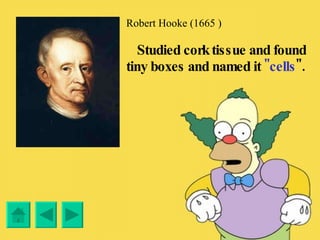
Robert Hooke (1665 )      Studied cork tissue and found tiny boxes and named it  "cells ".
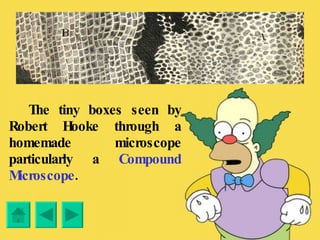
      The tiny boxes seen by Robert Hooke through a homemade microscope particularly a  Compound Microscope .
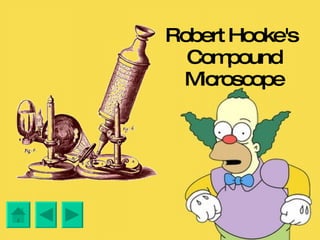
Robert Hooke's  Compound Microscope
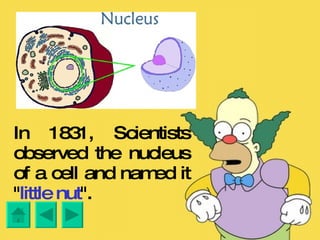
In 1831, Scientists observed the nucleus of a cell and named it " little nut ".
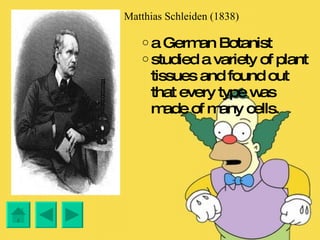
Matthias Schleiden (1838) a German Botanist studied a variety of plant tissues and found out that every type was made of many cells.
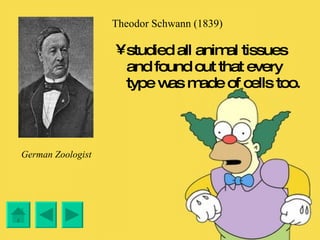
Theodor Schwann (1839) studied all animal tissues and found out that every type was made of cells too. German Zoologist
CELL THEORY      This states that cells are building blocks of life and that cells come from other cells. 
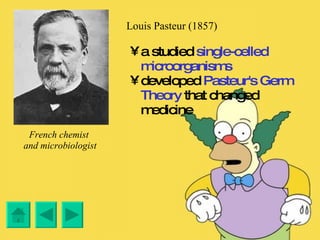
Louis Pasteur (1857) a studied  single-celled microorganisms developed  Pasteur's Germ Theory  that changed medicine French chemist  and microbiologist
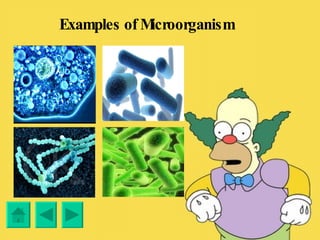
Examples of Microorganism
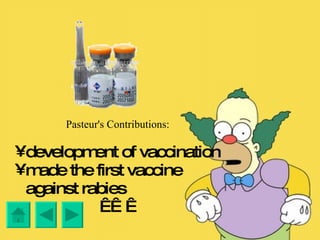
Pasteur's Contributions: development of vaccination made the first vaccine against rabies     
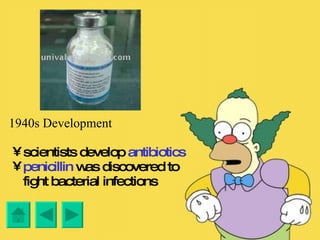
1940s Development scientists develop  antibiotics penicillin  was discovered to fight bacterial infections
People in Science
Gary Sayler a Beaman Distinguished Professor of Microbiology. studies how  microbes  (another name for  microorganisms ) live and how they interact with other living things.
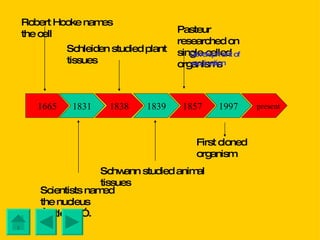
1857 1839 1838 1665 1831 Robert Hooke names the cell Scientists named the nucleus “little nut”. Schleiden studied plant tissues Schwann studied animal tissues Pasteur researched on single-celled organisms 1997 Development of vaccination First cloned organism present
That's all for now. Thank You!
 

Discovering the Cells

  • 1.
    THE HISTORY OFCELLS Roel R. Maraya Discovering CELLS
  • 2.
    Robert Hooke (1665)      Studied cork tissue and found tiny boxes and named it "cells ".
  • 3.
        The tiny boxes seen by Robert Hooke through a homemade microscope particularly a Compound Microscope .
  • 4.
    Robert Hooke's Compound Microscope
  • 5.
    In 1831, Scientistsobserved the nucleus of a cell and named it " little nut ".
  • 6.
    Matthias Schleiden (1838)a German Botanist studied a variety of plant tissues and found out that every type was made of many cells.
  • 7.
    Theodor Schwann (1839)studied all animal tissues and found out that every type was made of cells too. German Zoologist
  • 8.
    CELL THEORY     This states that cells are building blocks of life and that cells come from other cells. 
  • 9.
    Louis Pasteur (1857)a studied single-celled microorganisms developed Pasteur's Germ Theory that changed medicine French chemist and microbiologist
  • 10.
  • 11.
    Pasteur's Contributions: developmentof vaccination made the first vaccine against rabies     
  • 12.
    1940s Development scientistsdevelop antibiotics penicillin was discovered to fight bacterial infections
  • 13.
  • 14.
    Gary Sayler aBeaman Distinguished Professor of Microbiology. studies how microbes (another name for microorganisms ) live and how they interact with other living things.
  • 15.
    1857 1839 18381665 1831 Robert Hooke names the cell Scientists named the nucleus “little nut”. Schleiden studied plant tissues Schwann studied animal tissues Pasteur researched on single-celled organisms 1997 Development of vaccination First cloned organism present
  • 16.
    That's all fornow. Thank You!
  • 17.