All About Cells
TEKS 7.12F recognize that
according to the cell theory all
organisms are composed of cells &
cells carry on similar functions
such as extracting energy from
food to sustain life
TEKS 7.3D relate the impact of
research on scientific thought and
society, including the history of
science and contributions of
scientists as related to the
content
What do all of
the following
objects have in
common?
They are all
living things so
they are all
made of cells…
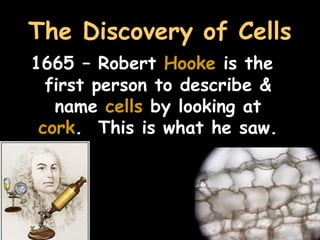
The Discovery of Cells
1665 – Robert Hooke is the
first person to describe &
name cells by looking at
cork. This is what he saw.
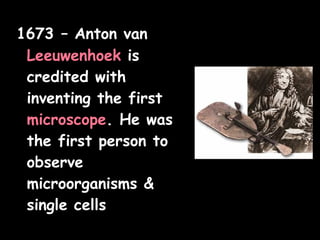
1673 – Anton van
Leeuwenhoek is
credited with
inventing the first
microscope. He was
the first person to
observe
microorganisms &
single cells
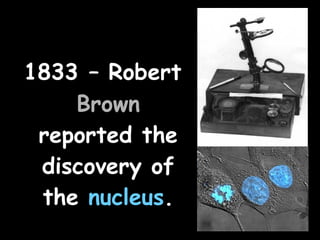
1833 – Robert
Brown
reported the
discovery of
the nucleus.
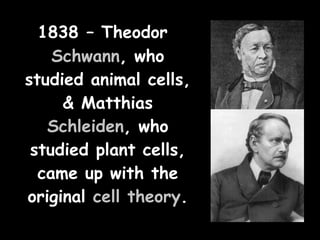
1838 – Theodor
Schwann, who
studied animal cells,
& Matthias
Schleiden, who
studied plant cells,
came up with the
original cell theory.
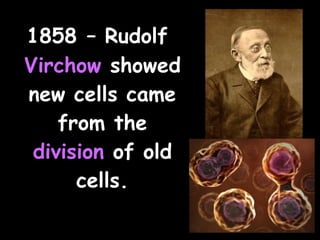
1858 – Rudolf
Virchow showed
new cells came
from the
division of old
cells.
• All living things are made up
of cells.
• The cell is the basic unit
of structure & function
in all living things.
• All cells come from other
living cells by division.
• Cells contain genetic
information (DNA)
that is passed from
one cell to another.
• All energy flow
(metabolism) of life
occurs within cells.
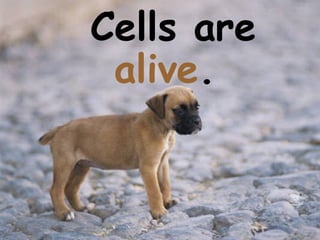
Cells are
alive.
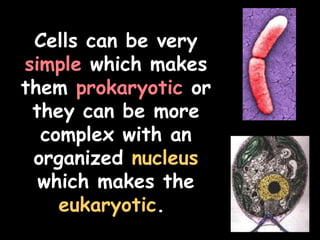
Cells can be very
simple which makes
them prokaryotic or
they can be more
complex with an
organized nucleus
which makes the
eukaryotic.
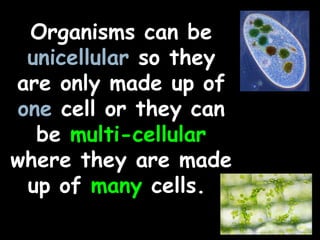
Organisms can be
unicellular so they
are only made up of
one cell or they can
be multi-cellular
where they are made
up of many cells.
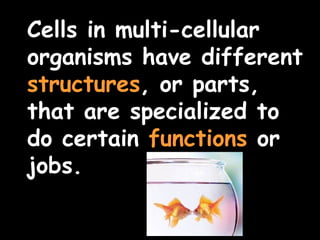
Cells in multi-cellular
organisms have different
structures, or parts,
that are specialized to
do certain functions or
jobs.
All cells work
together to help
the organism
function as a
whole.
The characteristics &
needs of an organism
are in reality the
characteristics & needs
of the cells that make
up the organism.
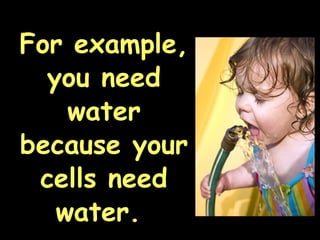
For example,
you need
water
because your
cells need
water.
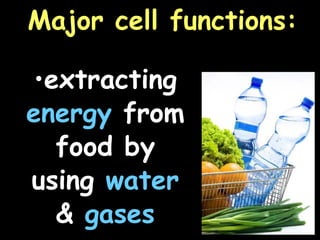
Major cell functions:
•extracting
energy from
food by
using water
& gases
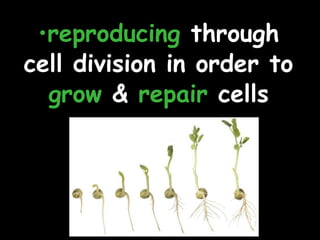
•reproducing through
cell division in order to
grow & repair cells
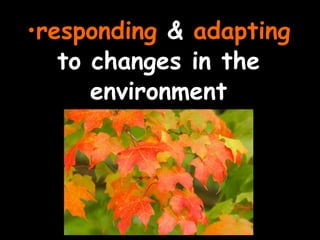
•responding & adapting
to changes in the
environment
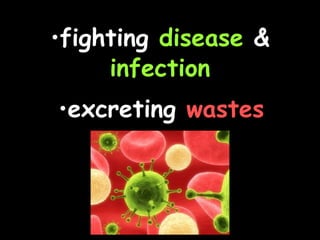
•fighting disease &
infection
•excreting wastes

All about cells