Chapter 3
  Cell Processes
Section 3: Energy for Life
III. Energy for Life
A. What is Metabolism?
  1. Metabolism is the total of all chemical
     reactions that happen inside an
     organism.
    a. Example 1: Rate at which your body burns
       food.
    b. Rate your lungs convert oxygen for cellular
       use.
III. Energy for Life
  2. Enzymes: chemicals that help the body
     go through metabolism.
    a. Enzymes cause a change but the enzyme
       itself is not changed.
       1. Example: Can opener and a can of spaghettio’s
    b. Enzymes can cause things to come apart OR
       cause things to join together.
    c. There is a specific enzyme for EVERY chemical
       reaction that the body undergoes
III. Energy for Life
B. Producers and Consumers
  1. All organisms are either producers or
     consumers.
  2. Producers make their own food.
    a. Plants, green bacteria, green protists.
    b. Producers us a process called photosynthesis.
  3. Consumers cannot make their own food.
    a. Animals, non-green bacteria, non-green
       Protists, Fungi
    b. Consumers eat producers or other
       consumers.
III. Energy for Life
C. Photosynthesis
  1. Process of producers taking in sunlight and
     carbon dioxide to make food.
  2. Use a green pigment called chloryophyll.


  3. Even though producers make their own food;
     they must then be able to break it down to be
     used for energy.
III. Energy for Life
D. Producing Carbohydrates
  1. Producers that use photosynthesis are
     usually green because they contain
     chlorophyll.
  2. Photosynthesis produces glucose (which
     is a carbohydrate), using raw material
     from the air and soil.
  3. The captured light energy used in
     photosynthesis also helps hold the sugar
     molecules together.
III. Energy for Life
E. Storing Carbohydrates
  1. Plants make more sugar during
     photosynthesis than they need to survive.
    a. Excess sugar is changed and stored as
       starches or used to make other
       carbohydrates that are used as food for
       growth, maintenance, and reproduction.
  2. No matter what you eat, photosynthesis
     was involved directly or indirectly in its
     production. (we often eat the excess
     sugar stored by plants!!!)
III. Energy for Life
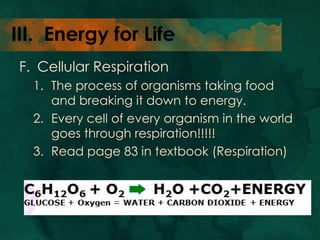
F. Cellular Respiration
  1. The process of organisms taking food
     and breaking it down to energy.
  2. Every cell of every organism in the world
     goes through respiration!!!!!
  3. Read page 83 in textbook (Respiration)
III. Energy for Life
G. Breaking Down Carbohydrates
  1. Food molecule most easily broken down
     by cells are carbohydrates.
  2. Respiration of carbs begins in the
     cytoplasm.
    a. Carbs are broken down into glucose
    b. Glucose then broken down into simpler
       molecules.
    c. As this happens energy is released.
III. Energy for Life
  3. The two simpler molecules are broken
     down in the mitochondria of
     plants, animals, fungi, and many other
     organisms.
  4. This process uses oxygen, releases MUCH
     MORE energy, and produces carbon
     dioxide and water as wastes.
  5. Right now….millions of your cells are
     breaking down glucose, releasing
     energy, and producing Carbon Dioxide
     and Water!!!!!
III. Energy for Life
H. Fermentation
  1. Sometimes cells don’t have the oxygen
     they need to go through respiration; cells
     will undergo respiration without enough
     oxygen; this is called FERMENTATION.
  2. Like respiration, fermentation begins in
     the cytoplasm….but the simple
     molecules do not move into the
     mitochondria.
  3. Fermentation produces lactic acid or
     alcohol, and carbon dioxide as wastes.
III. Energy for Life
H. Fermentation
 4. When cells make energy without enough
    O2, they make an acid called Lactic Acid.
   a. When this builds up in the muscles you cramp!!
 5. When yeasts are in heat they go through
    fermentation and make bread rise.
   a. In this process they give off CO2, this is why all
      baked goods have little air pockets in them.
 6. Fermentation produces LESS ENERGY then
    respiration!!!!
III. Energy for Life
H. Fermentation
III. Energy for Life
H. Fermentation
III. Energy for Life
I.   How are Photosynthesis and Respiration Related?
     1. What is produced in photosynthesis is
        used in respiration and vice versa!!!
     2. Respiration and Photosynthesis are
        directly liked together….they need each
        other to continue the process!!!!

Chapter 3 section 3 notes

  • 1.
    Chapter 3 Cell Processes Section 3: Energy for Life
  • 2.
    III. Energy forLife A. What is Metabolism? 1. Metabolism is the total of all chemical reactions that happen inside an organism. a. Example 1: Rate at which your body burns food. b. Rate your lungs convert oxygen for cellular use.
  • 3.
    III. Energy forLife 2. Enzymes: chemicals that help the body go through metabolism. a. Enzymes cause a change but the enzyme itself is not changed. 1. Example: Can opener and a can of spaghettio’s b. Enzymes can cause things to come apart OR cause things to join together. c. There is a specific enzyme for EVERY chemical reaction that the body undergoes
  • 4.
    III. Energy forLife B. Producers and Consumers 1. All organisms are either producers or consumers. 2. Producers make their own food. a. Plants, green bacteria, green protists. b. Producers us a process called photosynthesis. 3. Consumers cannot make their own food. a. Animals, non-green bacteria, non-green Protists, Fungi b. Consumers eat producers or other consumers.
  • 5.
    III. Energy forLife C. Photosynthesis 1. Process of producers taking in sunlight and carbon dioxide to make food. 2. Use a green pigment called chloryophyll. 3. Even though producers make their own food; they must then be able to break it down to be used for energy.
  • 6.
    III. Energy forLife D. Producing Carbohydrates 1. Producers that use photosynthesis are usually green because they contain chlorophyll. 2. Photosynthesis produces glucose (which is a carbohydrate), using raw material from the air and soil. 3. The captured light energy used in photosynthesis also helps hold the sugar molecules together.
  • 7.
    III. Energy forLife E. Storing Carbohydrates 1. Plants make more sugar during photosynthesis than they need to survive. a. Excess sugar is changed and stored as starches or used to make other carbohydrates that are used as food for growth, maintenance, and reproduction. 2. No matter what you eat, photosynthesis was involved directly or indirectly in its production. (we often eat the excess sugar stored by plants!!!)
  • 8.
    III. Energy forLife F. Cellular Respiration 1. The process of organisms taking food and breaking it down to energy. 2. Every cell of every organism in the world goes through respiration!!!!! 3. Read page 83 in textbook (Respiration)
  • 9.
    III. Energy forLife G. Breaking Down Carbohydrates 1. Food molecule most easily broken down by cells are carbohydrates. 2. Respiration of carbs begins in the cytoplasm. a. Carbs are broken down into glucose b. Glucose then broken down into simpler molecules. c. As this happens energy is released.
  • 10.
    III. Energy forLife 3. The two simpler molecules are broken down in the mitochondria of plants, animals, fungi, and many other organisms. 4. This process uses oxygen, releases MUCH MORE energy, and produces carbon dioxide and water as wastes. 5. Right now….millions of your cells are breaking down glucose, releasing energy, and producing Carbon Dioxide and Water!!!!!
  • 12.
    III. Energy forLife H. Fermentation 1. Sometimes cells don’t have the oxygen they need to go through respiration; cells will undergo respiration without enough oxygen; this is called FERMENTATION. 2. Like respiration, fermentation begins in the cytoplasm….but the simple molecules do not move into the mitochondria. 3. Fermentation produces lactic acid or alcohol, and carbon dioxide as wastes.
  • 13.
    III. Energy forLife H. Fermentation 4. When cells make energy without enough O2, they make an acid called Lactic Acid. a. When this builds up in the muscles you cramp!! 5. When yeasts are in heat they go through fermentation and make bread rise. a. In this process they give off CO2, this is why all baked goods have little air pockets in them. 6. Fermentation produces LESS ENERGY then respiration!!!!
  • 14.
    III. Energy forLife H. Fermentation
  • 15.
    III. Energy forLife H. Fermentation
  • 16.
    III. Energy forLife I. How are Photosynthesis and Respiration Related? 1. What is produced in photosynthesis is used in respiration and vice versa!!! 2. Respiration and Photosynthesis are directly liked together….they need each other to continue the process!!!!